RESEARCH
Maternal genetic contribution
to pre-pregnancy obesity, gestational weight
gain, and gestational diabetes mellitus
Selvihan Beysel
1,2,6*, Nilnur Eyerci
3, Mustafa Ulubay
4, Mustafa Caliskan
1, Muhammed Kizilgul
1,
Merve Hafızoğlu
5and Erman Cakal
1Abstract
Introduction: Pre-pregnancy obesity, gestational diabetes mellitus (GDM), and gestational weight gain (GWG) are
associated with each other. This is the first study to investigate whether genetic variants were associated with having GDM, and whether genetic variants-related GDM were associated with adiposity including pre-pregnancy obesity and excessive GWG in Turkish women.
Patients and methods: Women with GDM (n = 160) and without GDM (n = 145) were included in case-controlled
study. Genotyping of the HNF1A gene (p.I27L rs1169288, p.98V rs1800574, p.S487N rs2464196), the VDR gene (p.BsmI rs1544410, p.ApaI rs7975232, p.TaqI rs731236, p.FokI rs2228570), and FTO gene (rs9939609) SNPs were performed by using RT-PCR.
Results: The FTO AA genotype was associated with an increased risk of having GDM (AA vs. AT + TT, 24.4% vs. 12.4%,
OR = 2.27, 95% CI [1.23–4.19], p = 0.007). The HNF1A p.I27L GT/TT genotype was associated with increased GDM risk (GT + TT vs. GG-wild, 79.4% vs. 65.5%, OR = 2.02, 95% CI 1.21–3.38], p = 0.007). However, all VDR gene SNPs and the
HNF1A p.A98V, p.S487N were not associated with having GDM (p > 0.05). The FTO AA genotype was associated with an
increased risk for pre-pregnancy overweight/obesity (OR = 1.43, 95% CI [1.25–3.4], p = 0.035), but not associated with excessive GWG after adjusting for pre-pregnancy weight (p > 0.05). Pre-pregnancy weight, weight at delivery, and GWG did not differ in both VDR and HNF1A gene carriers (p > 0.05). HOMA-IR and HbA1c were increased in both p.I27L TT and FTO AA genotype carriers (p < 0.05).
Conclusion: The adiposity-related gene FTO is associated with GDM by the effect of FTO on pre-pregnancy obesity.
The diabetes-related p.I27L gene is associated with GDM by increasing insulin resistance.
Keywords: Gestational weight gain, Polymorphisms, Gestational diabetes, Pre-pregnancy obesity
© The Author(s) 2019. This article is distributed under the terms of the Creative Commons Attribution 4.0 International License (http://creat iveco mmons .org/licen ses/by/4.0/), which permits unrestricted use, distribution, and reproduction in any medium, provided you give appropriate credit to the original author(s) and the source, provide a link to the Creative Commons license, and indicate if changes were made. The Creative Commons Public Domain Dedication waiver (http://creat iveco mmons .org/ publi cdoma in/zero/1.0/) applies to the data made available in this article, unless otherwise stated.
Introduction
Maternal obesity and gestational diabetes mellitus (GDM) is a growing public health problem worldwide [1]. The Institute of Medicine (IOM) developed guide-lines for gestational weight gain (GWG) during preg-nancy; however, no specific recommendations could be made for GDM and multiethnic differences [2, 3]. Both
pre-pregnancy obesity and excessive GWG are related to increased risk of maternal obesity and GDM [3]. Becoming pregnant or gaining too much weight dur-ing pregnancy are the risk factors for adverse perinatal complications and increased risk for future metabolic disease in overweight/obese women, both for the moth-ers and their offspring [1, 4]. Pre-pregnancy obesity and excessive GWG may have additive negative impact on maternal and neonatal outcomes in women with GDM [5, 6]. Pre-pregnancy obesity, gestational diabetes, and excessive GWG are associated with multiple factors such as the environment, behavior, and genetics; however,
Open Access
*Correspondence: [email protected]; [email protected] 6 Department of Endocrinology and Metabolism, Afyonkarahisar Saglik Bilimleri University, Afyon, Turkey
understanding these associations is complex [1, 3]. Dia-betes-related or maternal and/or fetal adiposity-related genetic variants have been associated with GDM, pre-pregnancy weight, and GWG during pre-pregnancy [7–9]. Kawai et al. reported that common type 2 diabetes risk variants were associated with increased risk of GDM [8]. Genetic variants were associated with GDM and progression to pre-diabetes and type 2 diabetes mel-litus in women with prior GDM [9]. Evidence has been presented for a genetic predisposition to GDM risk and also a change in GWG during pregnancy [7, 10–13], and gene–environment interactions could explain the varia-tion in GWG and GDM.
The fat mass and obesity-associated gene (FTO) rs9939609 single nucleotide polymorphism (SNP) was associated with increased risk of obesity and type 2 dia-betes, as well as GDM [10]. The FTO SNPs have been reported to be associated with pre-pregnancy obesity [8] and excessive GWG [11]. The FTO variants related to type 2 diabetes are mediated by the effect of the FTO gene on body mass index (BMI); however, the exact mechanisms of this relation have not been identified [10, 11]. Vitamin D shows its cellular activity by binding to vitamin D receptors (VDR). VDR, as a transcription fac-tor, has a role in the regulation of insulin secretion from pancreatic beta cells [14]. VDR has effect on prolifera-tion, differentiaprolifera-tion, and activation of immune cells and cytokine production, and subsequently type 2 diabetes occurs [15, 16]. Hepatocyte nuclear factor 1A (HNF1A), as a transcription factor, has a role in the function of pan-creas beta cells [17]. Endocrine and exocrine pancreatic cells express HNF1A in the developmental stage. HNF1A is necessary for the glucose response to insulin secretion and glucose metabolism [18]. Women with HNF1A muta-tion are diagnosed as having monogenic form of diabetes type 3 (MODY3), and these women usually present with GDM, and diabetes persisting after delivery [17–19].
This is the first study to investigate the effect of HNF1A gene, VDR gene, and FTO gene variants on having GDM, pre-pregnancy obesity, and excessive GWG in Turkey. We aimed to examine whether these genetic variants would associate with having GDM, and then, whether the genetic variants that associated with GDM would associate with adiposity including pre-pregnancy obe-sity and excessive GWG. The VDR gene (encoding as SNPs p.BsmI, p.ApaI, p.TaqI, and p.FokI), and, HNF1A gene (encoding as SNPs p.I27L, p.A98V, and p.S487N) were chosen because these genetic variants have been reported to be associated with type 2 diabetes, as well as GDM risk [12, 14–20]. We also investigated the obesity-related FTO gene rs9939609 SNP because it is associ-ated with both GDM and gestational body weight during pregnancy [10, 13, 20]. Genetic variants are implicated in
the pathogenesis of GDM. Evidence suggests the genetic alterations in genes responsible for metabolic changes during pregnancy predispose to GDM [7]. We also hypothesized that these diabetes and adiposity-related genetic variants would likely be associated with GDM risk and gestational body weight during pregnancy.
Patients and methods
Study population
Pregnant women referred to tertiary hospital, Obstetrics and Gynecology Clinic, Ankara, from 2015 to 2016, were included in this case-control study. Women with GDM (n = 160) and age- and gestational age-matched women without GDM as controls (n = 145) were included in the study. Gestational age was assessed from the date of the last menstrual period and clinical assessment. A 2-h, 75-g oral glucose tolerance test at 24 to 28 weeks gesta-tion age was performed for all pregnant women, irrespec-tive of family history of DM or any other risk factors for GDM. Glucose concentrations after fasting, and 1 and 2 h after glucose administration < 92 mg/dl, < 180 mg/ dl, and < 153 mg/dl, respectively, were considered nor-mal. When the pregnant women’s glucose concentra-tion was higher than any of these values, the women were diagnosed as having GDM [12]. Women whose GDM was diagnosed according to these criteria, aged 22–38 years, and whose pregnancy age was 24–48 weeks were included in the study. Women with GDM who had pre-existing type 2 diabetes, GDM observed in prior pregnancy, GDM with chronic disease such as hyperten-sion, thyroid disorders, cardiac, hepatic or renal dysfunc-tion were excluded. Women aged 22–38 years and with pregnancy age 24–28 weeks, with no GDM, type 2 diabe-tes, hypertension, thyroid disorders, cardiac, hepatic or renal dysfunction were accepted as controls and included in the study. Treatment of diet with or without insulin therapy was recorded. Weight, height, and systolic (SBP) and diastolic blood pressure (DBP) were measured in all participants. Body mass index (BMI, kg/m2) was calcu-lated as weight (kg)/height2 (m2). Women were catego-rized as underweight (BMI < 18.5 kg/m2), normal weight (BMI = 18.5–24.9 kg/m2), overweight (BMI = 25–29.9 kg/ m2), and obese (BMI ≥ 30 kg/m2). Maternal weight before pregnancy, pre-pregnancy weight, was obtained through a questionnaire. Maternal weight was measured at deliv-ery. Gestational weight gain (GWG) was calculated as the difference between the maternal weight at delivery and pre-pregnancy weight. The recommended GWG was calculated based on IOM guidelines related with pre-pregnancy BMI: underweight, a gain of 12.5–18 kg; nor-mal weight, a gain of 11.5–16 kg; overweight, a gain of 7–11.5 kg; and obese, a gain of 5–9 kg. After this, GWG was divided into three categories: low, if the weight was
below the recommendation; adequate, if the weight gain was within the recommendation; and high, if the weight gain was above the recommendation [21]. Serum glucose, insulin, and glycated hemoglobin (HbA1c) concentrations were measured at 24–28 weeks of pregnancy. Insulin resistance was calculated using the homeostasis model assessment-insulin resistance (HOMA-IR): [fasting plasma insulin (µIU/ml) × fasting plasma glucose (mg/ dl)]/405 [12]. This study was approval by Diskapi Yildirim Beyazit Teaching and Training Research Hospital Ethics Board (Number. 24.04.2015-13/25). Written informed consent was obtained from each participant.
Genotyping
Genetic analyses for the VDR gene SNPs p.FokI (rs2228570), p.BsmI (rs1544410), p.ApaI (rs7975232), and p.TaqI (rs731236) and the HNF1A gene SNPs p.S487N (rs2464196, p.Ser486Asn), p.A98V (rs1800574, p.Ala98Val), p.I27L (rs1169288, p.Ile27Leu) and the FTO gene rs939609 SNPs were performed using real-time polymerase chain reac-tion (RT-PCR) amplificareac-tion. Genomic DNA was isolated from collected peripheral blood samples of the subjects using DNA Isolation Kit (Roche Diagnostics, Indianapo-lis, IN, USA). Genotyping of each SNP in the VDR gene, HNF1A gene, and FTO gene was independently conducted using a pre-validated fluorescence-based allele-specific PCR assay, KASPar (KBiosciences, Hoddesdon, UK) and performed on a Rotor-Gene Q real-time cycler (Qiagen, Hilden, Germany) according to the manufacturer’s instruc-tion. Allele discrimination was made using Rotor-Gene Q software v.2.3.1 (Qiagen, Hilden, Germany). The genotype calling was performed blind without information on the clinical phenotypes.
Statistical analysis
Statistical analysis was performed using the SPSS 18.0 (SPSS, Inc) software. Variables are presented as mean ± standard deviation (SD) or median (min–max), percentages (%), odds ratios (OR), 95% confidence inter-vals (CI). Normality was tested using the Kolmogorov– Smirnov and Shapiro–Wilk W test. SNPs are expressed as allelic frequency (q) or prevalence of genotypes (%). Categorical variables were analyzed using the Chi-square test or Fisher’s exact test, where appropriate. Student’s t-test was used for normally distributed continuous vari-ables or log-transformed varivari-ables between two groups. The Hardy–Weinberg equilibrium (HWE) at individual loci was assessed using the Chi-square test. Multiple logistic regression analysis and the Chi-square test or Fisher’s exact test was tested using models and ORs were calculated: dominant (major allele homozygotes vs. het-erozygotes + minor allele homozygotes), recessive (major allele homozygotes + heterozygotes vs. minor allele
homozygotes) and codominant (major allele homozy-gotes vs. heterozygote and minor allele homozyhomozy-gotes vs. major allele homozygotes). Pair-wise linkage disequilib-rium (LD) and correlation coefficients (r2) were analyzed using the HAPLOVIEW program. We made a variable reflecting all possible combinations of genotypes for each SNP. Power analysis was performed using web-based software http://osse.bii.a-star.edu.sg/calcu latio n2.php. The power of study was 65%. Statistical significance was defined as p < 0.05.
Results
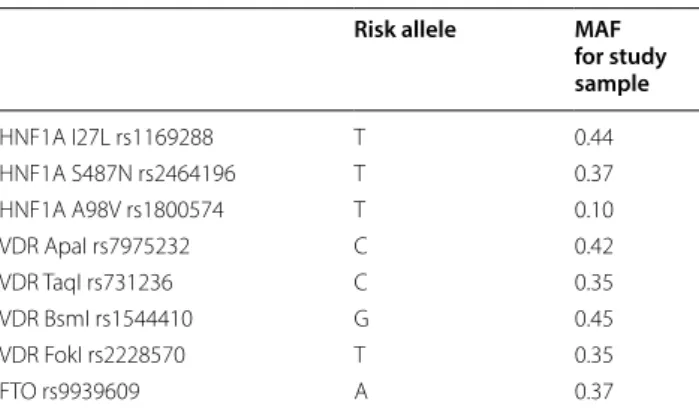
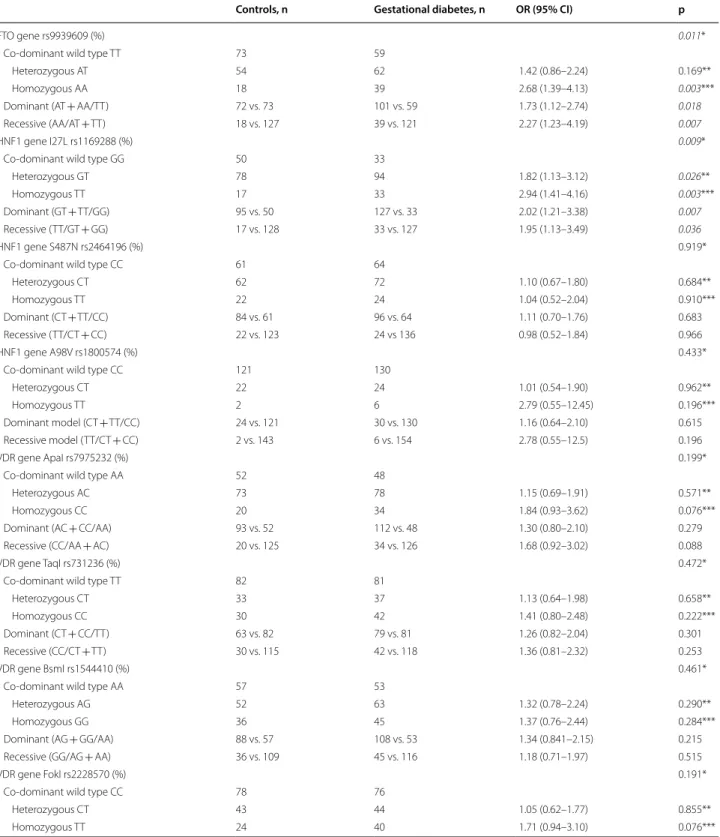
The mean age, gestational age, and height were similar between the women with GDM and controls (p > 0.05). Pre-pregnancy overweight/obesity were increased in women with GDM compared with controls (p < 0.05). Weight at delivery and excessive GWG were increased in women with GDM compared with the controls (p < 0.05). Serum glucose, insulin, HOMA-IR, and HbA1c were increased in women with GDM compared with the con-trols (p < 0.05, each). The clinical features of the sub-jects are shown in Table 1. Minor allele frequency of the HNF1A, VDR, and FTO genes is shown in Table 2. These frequencies were in HWE except p.A98V. Hap-loview analysis showed that the HNF1A, VDR, and FTO genes were not in LD. The risk alleles of the HNF1A gene (p.S487N, and p.A98V) and, VDR gene (p.ApaI, p.TaqI, p.BsmI and p.FokI) were similar between women with GDM and the controls (p > 0.05, each). Genotype analysis is shown in Table 3.
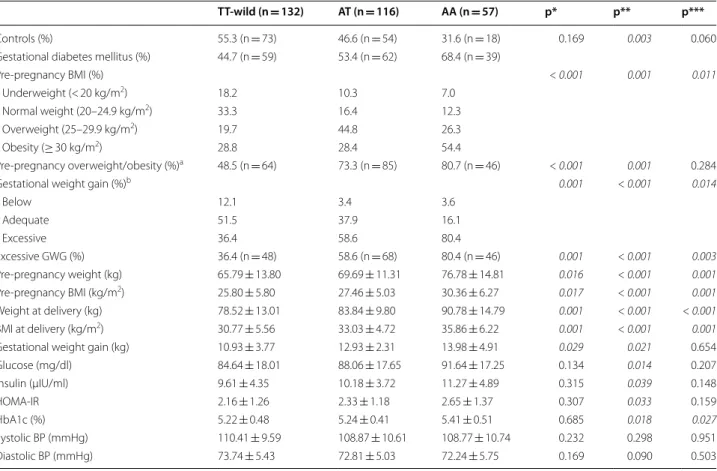
The FTO gene rs9939609 distribution was TT-wild, heterozygote AT, and homozygote AA at 50.3%, 37.2%, and 12.4% in the controls, and 36.9%, 38.8%, and 24.4% in women with GDM (p = 0.011). The FTO gene AA genotype was associated with an increased risk of GDM more than the TT/AT genotype in co-dominant, domi-nant, and recessive models (dominant: AT + AA vs. TT-wild, 63.1% vs. 49.7%, OR = 1.73, 95% CI [1.12– 2.74], p = 0.018, and recessive: AA vs. AT + TT, 24.4 vs. 12.4%, OR = 2.27, 95% CI [1.23–4.19], p = 0.007) (Table 3). The FTO AA/AT genotype had a greater association with pre-pregnancy overweight/obesity than TT-wild genotype (p < 0.05) (Table 4). Pre-preg-nancy weight (p < 0.05) and weight at delivery (p < 0.05) progressively increased from the AA genotype to the TT genotype. GWG was increased in AT/AA geno-type compared with the TT genogeno-type (p < 0.05). Serum glucose, insulin, HOMA-IR, and HbA1c were higher in the AA genotype compared with the TT genotype (p < 0.05). The FTO AA genotype was associated with a greater risk of pre-pregnancy overweight/obesity compared with AT/TT genotypes (OR = 1.43, 95% CI [1.25–3.4], p = 0.035). The FTO AA genotype was
associated with excessive GWG risk compared with the TT and AT genotype (OR = 1.73, 95% CI [1.62–3.15], p = 0.034); however, this association was lost after
adjusting for pre-pregnancy weight (OR = 1.1, 95% CI [0.94–2.38], p > 0.05).
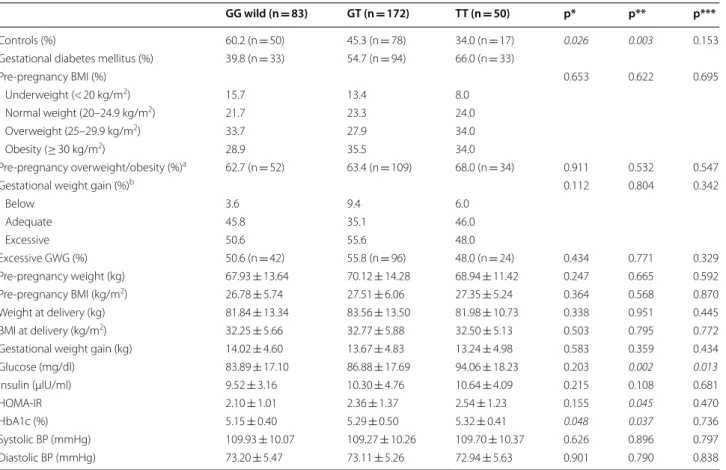
The HNF1A gene p.I27L distribution of GG-wild, GT, and TT was 34.5%, 53.8%, and 11.7% in the con-trols, and 20.6%, 58.8%, and 20.6% in women with GDM (p = 0.009). The HNF1A gene p.I27L TT/GT genotype was associated with a greater risk of GDM in comparison with the GG genotype in co-dominant, dominant, and recessive models (dominant: GT + TT vs. GG-wild, 79.4 vs. 65.5%, OR = 2.02, 95% CI [1.21– 3.38], p = 0.007 and recessive: TT vs. GT + GG, 20.6 vs. 11.7%, OR = 1.95, 95% CI [1.13–3.49], p = 0.036) (Table 3). Pre-pregnancy weight, weight at delivery, and GWG were similar between p.I27L genotypes (p > 0.05) (Table 5). Glucose, HOMA-IR, and HbA1c were increased in the p.I27L TT genotype compared with the GG-wild type (p < 0.05). Pre-pregnancy weight, weight at delivery, and GWG did not differ between the VDR and HNF1A gene carriers (p > 0.05).
Table 1 Characteristics of subjects
Italics represents significant p-values
PPO pre-pregnancy overweight/obesity, GDM gestational diabetes mellitus, GWG gestational weight gain, BMI body mass index, BP blood pressure, HOMA-IR homeostasis model assessment-insulin resistance, HbA1c hemoglobin A1c
a Prepregnancy overweight/obesity is defined as the percentage of subjects with having BMI ≥ 25 kg/m2
b Recommended gestational weight gain was calculated based on Institute of Medicine (IOM) recommendations according to pre-pregnancy BMI
Controls (n = 145) Gestational diabetes mellitus
(n = 160) p
Age (year) 28.25 ± 5.15 29.35 ± 5.36 0.075
Gestational age (weeks) 26.27 ± 1.48 25.99 ± 1.65 0.137
Height (cm) 160.40 ± 5.71 159.21 ± 5.95 0.076 Pre-pregnancy weight (kg) 61.74 ± 11.98 76.21 ± 11.27 0.001 Pre-pregnancy BMI (kg/m2) 24.06 ± 4.82 30.21 ± 5.10 0.001 Pre-pregnancy BMI (%) 0.001 Underweight (< 20 kg/m2) 23.4 3.8 Normal weight (20–24.9 kg/m2) 38.6 8.8 Overweight (25–29.9 kg/m2) 26.2 34.4 Obesity (≥ 30 kg/m2) 11.7 53.1 Pre-pregnancy overweight/obesity (%)a 37.9 87.5 0.001 Weight at delivery (kg) 77.60 ± 12.59 87.58 ± 11.54 0.001 BMI at delivery (kg/m2) 30.24 ± 5.18 34.71 ± 5.30 0.001
Gestational weight gain (kg) 16.05 ± 5.43 11.56 ± 2.72 0.001
Gestational weight gain (%)b 0.011
Excessive 44.1 61.2 Adequate 46.9 33.1 Below 9.0 5.6 Glucose (mg/dl) 72.39 ± 7.12 101.67 ± 11.99 0.001 İnsulin (µIU/ml) 8.07 ± 2.02 11.93 ± 4.78 0.001 HOMA-IR 1.42 ± 0.39 3.06 ± 1.26 0.001 HbA1c (%) 5.01 ± 0.32 5.51 ± 0.43 0.001 Systolic BP (mmHg) 108.06 ± 8.74 110.84 ± 11.23 0.052 Diastolic BP (mmHg) 72.70 ± 5.62 73.48 ± 5.11 0.207
Table 2 Minor allele frequency of polymorphisms
MAF minor allele frequency
Risk allele MAF
for study sample HNF1A I27L rs1169288 T 0.44 HNF1A S487N rs2464196 T 0.37 HNF1A A98V rs1800574 T 0.10 VDR ApaI rs7975232 C 0.42 VDR TaqI rs731236 C 0.35 VDR BsmI rs1544410 G 0.45 VDR FokI rs2228570 T 0.35 FTO rs9939609 A 0.37
Table 3 Genotype analysis of HNF1A gene, VDR gene and FTO gene polymorphisms
Controls, n Gestational diabetes, n OR (95% CI) p
FTO gene rs9939609 (%) 0.011*
Co-dominant wild type TT 73 59
Heterozygous AT 54 62 1.42 (0.86–2.24) 0.169**
Homozygous AA 18 39 2.68 (1.39–4.13) 0.003***
Dominant (AT + AA/TT) 72 vs. 73 101 vs. 59 1.73 (1.12–2.74) 0.018
Recessive (AA/AT + TT) 18 vs. 127 39 vs. 121 2.27 (1.23–4.19) 0.007
HNF1 gene I27L rs1169288 (%) 0.009*
Co-dominant wild type GG 50 33
Heterozygous GT 78 94 1.82 (1.13–3.12) 0.026**
Homozygous TT 17 33 2.94 (1.41–4.16) 0.003***
Dominant (GT + TT/GG) 95 vs. 50 127 vs. 33 2.02 (1.21–3.38) 0.007
Recessive (TT/GT + GG) 17 vs. 128 33 vs. 127 1.95 (1.13–3.49) 0.036
HNF1 gene S487N rs2464196 (%) 0.919*
Co-dominant wild type CC 61 64
Heterozygous CT 62 72 1.10 (0.67–1.80) 0.684**
Homozygous TT 22 24 1.04 (0.52–2.04) 0.910***
Dominant (CT + TT/CC) 84 vs. 61 96 vs. 64 1.11 (0.70–1.76) 0.683
Recessive (TT/CT + CC) 22 vs. 123 24 vs 136 0.98 (0.52–1.84) 0.966
HNF1 gene A98V rs1800574 (%) 0.433*
Co-dominant wild type CC 121 130
Heterozygous CT 22 24 1.01 (0.54–1.90) 0.962**
Homozygous TT 2 6 2.79 (0.55–12.45) 0.196***
Dominant model (CT + TT/CC) 24 vs. 121 30 vs. 130 1.16 (0.64–2.10) 0.615
Recessive model (TT/CT + CC) 2 vs. 143 6 vs. 154 2.78 (0.55–12.5) 0.196
VDR gene ApaI rs7975232 (%) 0.199*
Co-dominant wild type AA 52 48
Heterozygous AC 73 78 1.15 (0.69–1.91) 0.571**
Homozygous CC 20 34 1.84 (0.93–3.62) 0.076***
Dominant (AC + CC/AA) 93 vs. 52 112 vs. 48 1.30 (0.80–2.10) 0.279
Recessive (CC/AA + AC) 20 vs. 125 34 vs. 126 1.68 (0.92–3.02) 0.088
VDR gene TaqI rs731236 (%) 0.472*
Co-dominant wild type TT 82 81
Heterozygous CT 33 37 1.13 (0.64–1.98) 0.658**
Homozygous CC 30 42 1.41 (0.80–2.48) 0.222***
Dominant (CT + CC/TT) 63 vs. 82 79 vs. 81 1.26 (0.82–2.04) 0.301
Recessive (CC/CT + TT) 30 vs. 115 42 vs. 118 1.36 (0.81–2.32) 0.253
VDR gene BsmI rs1544410 (%) 0.461*
Co-dominant wild type AA 57 53
Heterozygous AG 52 63 1.32 (0.78–2.24) 0.290**
Homozygous GG 36 45 1.37 (0.76–2.44) 0.284***
Dominant (AG + GG/AA) 88 vs. 57 108 vs. 53 1.34 (0.841–2.15) 0.215
Recessive (GG/AG + AA) 36 vs. 109 45 vs. 116 1.18 (0.71–1.97) 0.515
VDR gene FokI rs2228570 (%) 0.191*
Co-dominant wild type CC 78 76
Heterozygous CT 43 44 1.05 (0.62–1.77) 0.855**
Discussion
Both the FTO AA genotype and HNF1A p.I27L GT/ TT genotype were associated with an increased risk of having GDM in Turkish women. However, the VDR gene (p.ApaI, p.TaqI, p.FokI, p.BsmI) and HNF1A gene
(p.A98V, p.S487N) were not associated with having GDM. Insulin resistance and impaired glucose metabo-lism was observed in both p.I27L TT and FTO AA geno-type carriers. The FTO AA genogeno-type was associated with an increased risk for pre-pregnancy overweight/obesity, Categorical variables were analyzed with Chi-square test or Fisher’s exact test, where appropriate. Multiple logistic regression analysis and Fisher’s exact test were tested using models: dominant (major allele homozygotes vs heterozygotes + minor allele homozygotes), recessive (major allele homozygotes + heterozygotes vs minor allele homozygotes) and codominant (major allele homozygotes vs heterozygote and minor allele homozygotes vs major allele homozygotes)
Italics represents significant p-values *p Wild vs homozygous vs heterozygous **p heterozygous vs wild
***p homozygous vs wild type
Table 3 (continued)
Table 4 Clinics of pregnants according to the FTO gene rs9939609 SNP
Italics represents significant p-values
PPO pre-pregnancy overweight/obesity, GDM gestational diabetes mellitus, GWG gestational weight gain, BMI body mass index, BP blood pressure, HOMA-IR homeostasis model assessment-insulin resistance, HbA1c hemoglobin A1c
*p TT wild type vs heterozygote AT **p TT wild type vs homozygote AA ***p heterozygote AT vs homozygote AA
a Prepregnancy overweight/obesity is defined as the percentage of subjects with having BMI ≥ 25 kg/m2
b Recommended gestational weight gain was calculated based on Institute of Medicine (IOM) recommendations according to pre-pregnancy BMI
TT-wild (n = 132) AT (n = 116) AA (n = 57) p* p** p***
Controls (%) 55.3 (n = 73) 46.6 (n = 54) 31.6 (n = 18) 0.169 0.003 0.060 Gestational diabetes mellitus (%) 44.7 (n = 59) 53.4 (n = 62) 68.4 (n = 39)
Pre-pregnancy BMI (%) < 0.001 0.001 0.011 Underweight (< 20 kg/m2) 18.2 10.3 7.0 Normal weight (20–24.9 kg/m2) 33.3 16.4 12.3 Overweight (25–29.9 kg/m2) 19.7 44.8 26.3 Obesity (≥ 30 kg/m2) 28.8 28.4 54.4 Pre-pregnancy overweight/obesity (%)a 48.5 (n = 64) 73.3 (n = 85) 80.7 (n = 46) < 0.001 0.001 0.284
Gestational weight gain (%)b 0.001 < 0.001 0.014
Below 12.1 3.4 3.6 Adequate 51.5 37.9 16.1 Excessive 36.4 58.6 80.4 Excessive GWG (%) 36.4 (n = 48) 58.6 (n = 68) 80.4 (n = 46) 0.001 < 0.001 0.003 Pre-pregnancy weight (kg) 65.79 ± 13.80 69.69 ± 11.31 76.78 ± 14.81 0.016 < 0.001 0.001 Pre-pregnancy BMI (kg/m2) 25.80 ± 5.80 27.46 ± 5.03 30.36 ± 6.27 0.017 < 0.001 0.001 Weight at delivery (kg) 78.52 ± 13.01 83.84 ± 9.80 90.78 ± 14.79 0.001 < 0.001 < 0.001 BMI at delivery (kg/m2) 30.77 ± 5.56 33.03 ± 4.72 35.86 ± 6.22 0.001 < 0.001 0.001
Gestational weight gain (kg) 10.93 ± 3.77 12.93 ± 2.31 13.98 ± 4.91 0.029 0.021 0.654 Glucose (mg/dl) 84.64 ± 18.01 88.06 ± 17.65 91.64 ± 17.25 0.134 0.014 0.207 İnsulin (µIU/ml) 9.61 ± 4.35 10.18 ± 3.72 11.27 ± 4.89 0.315 0.039 0.148 HOMA-IR 2.16 ± 1.26 2.33 ± 1.18 2.65 ± 1.37 0.307 0.033 0.159 HbA1c (%) 5.22 ± 0.48 5.24 ± 0.41 5.41 ± 0.51 0.685 0.018 0.027 Systolic BP (mmHg) 110.41 ± 9.59 108.87 ± 10.61 108.77 ± 10.74 0.232 0.298 0.951 Diastolic BP (mmHg) 73.74 ± 5.43 72.81 ± 5.03 72.24 ± 5.75 0.169 0.090 0.503
Controls, n Gestational diabetes, n OR (95% CI) p
Dominant (CT + TT/CC) 67 vs. 78 84 vs. 76 1.28 (0.82–2.01) 0.272
but not associated with excessive GWG after adjusting for pre-pregnancy weight. The association of the adi-posity-related gene FTO with GDM might be mediated by the effect of FTO on pre-pregnancy obesity. The dia-betes-related p.I27L gene was associated with GDM by increasing insulin resistance.
Our results demonstrated that the VDR gene p.ApaI, p.TaqI, p.BsmI, and p.FokI genotypes were not associ-ated with having GDM in Turkish women. The VDR gene and HNF1A gene SNPs were not associated with pre-pregnancy weight, weight at delivery, and GWG during pregnancy. The associations of the VDR gene and HNF1A gene with pre-pregnancy weight, weight at delivery, and GWG have not been investigated in previous studies. El-Beshbishy et al. reported that p.BsmI and p.FokI were not associated with GDM in Saudi women [22]. Incompatible to our results, p.FokI
[23], p.ApaI, and p.TaqI [22] were associated with an increased risk of GDM in Iranian women [24]. We found that the HNF1A gene p.A98V and p.S487N were not associated with GDM in Turkish women. Zurawek et al. reported that p.I27L, p.A98V, and p.S487N were not associated with GDM in Polish women [25]. No relationship was reported between p.A98V and GDM in Danish women [12]; however, insulin secretion was decreased in p.A98V carriers without GDM [26], which is compensated by increasing insulin sensitivity [27]. Our data show that the HNF1A gene p.I27L GT/ GG genotype was associated with an increased risk of GDM (OR = 2.02, 95% CI [1.21–3.38], p = 0.007). Pre-pregnancy weight, weight at delivery, and GWG were not associated with p.I27L genotypes. Insulin resist-ance and impaired glucose metabolism was observed in p.I27L TT carriers. We suggest that the diabetes-related
Table 5 Clinics of pregnant women according to the HNF1A gene p.I27L
Italics represents significant p-values
PPO pre-pregnancy overweight/obesity, GDM gestational diabetes mellitus, GWG gestational weight gain, BMI body mass index, BP blood pressure, HOMA-IR homeostasis model assessment-insulin resistance, HbA1c hemoglobin A1c
*p wild GG vs heterozygote GT **p wild GG vs homozygote TT ***p heterozygote GT vs homozygote TT
a Prepregnancy overweight/obesity is defined as the percentage of subjects with having BMI ≥ 25 kg/m2
b Recommended GWG was calculated based on Institute of Medicine (IOM) recommendations according to pre-pregnancy BMI
GG wild (n = 83) GT (n = 172) TT (n = 50) p* p** p***
Controls (%) 60.2 (n = 50) 45.3 (n = 78) 34.0 (n = 17) 0.026 0.003 0.153 Gestational diabetes mellitus (%) 39.8 (n = 33) 54.7 (n = 94) 66.0 (n = 33)
Pre-pregnancy BMI (%) 0.653 0.622 0.695 Underweight (< 20 kg/m2) 15.7 13.4 8.0 Normal weight (20–24.9 kg/m2) 21.7 23.3 24.0 Overweight (25–29.9 kg/m2) 33.7 27.9 34.0 Obesity (≥ 30 kg/m2) 28.9 35.5 34.0 Pre-pregnancy overweight/obesity (%)a 62.7 (n = 52) 63.4 (n = 109) 68.0 (n = 34) 0.911 0.532 0.547
Gestational weight gain (%)b 0.112 0.804 0.342
Below 3.6 9.4 6.0 Adequate 45.8 35.1 46.0 Excessive 50.6 55.6 48.0 Excessive GWG (%) 50.6 (n = 42) 55.8 (n = 96) 48.0 (n = 24) 0.434 0.771 0.329 Pre-pregnancy weight (kg) 67.93 ± 13.64 70.12 ± 14.28 68.94 ± 11.42 0.247 0.665 0.592 Pre-pregnancy BMI (kg/m2) 26.78 ± 5.74 27.51 ± 6.06 27.35 ± 5.24 0.364 0.568 0.870 Weight at delivery (kg) 81.84 ± 13.34 83.56 ± 13.50 81.98 ± 10.73 0.338 0.951 0.445 BMI at delivery (kg/m2) 32.25 ± 5.66 32.77 ± 5.88 32.50 ± 5.13 0.503 0.795 0.772
Gestational weight gain (kg) 14.02 ± 4.60 13.67 ± 4.83 13.24 ± 4.98 0.583 0.359 0.434 Glucose (mg/dl) 83.89 ± 17.10 86.88 ± 17.69 94.06 ± 18.23 0.203 0.002 0.013 İnsulin (µIU/ml) 9.52 ± 3.16 10.30 ± 4.76 10.64 ± 4.09 0.215 0.108 0.681 HOMA-IR 2.10 ± 1.01 2.36 ± 1.37 2.54 ± 1.23 0.155 0.045 0.470 HbA1c (%) 5.15 ± 0.40 5.29 ± 0.50 5.32 ± 0.41 0.048 0.037 0.736 Systolic BP (mmHg) 109.93 ± 10.07 109.27 ± 10.26 109.70 ± 10.37 0.626 0.896 0.797 Diastolic BP (mmHg) 73.20 ± 5.47 73.11 ± 5.26 72.94 ± 5.63 0.901 0.790 0.838
p.I27L gene was associated with the increased risk of GDM by impairing glucose metabolism and increas-ing insulin resistance. Similarly, p.I27L was associated with an increased GDM risk in Scandinavian women by the effect of p.I27L on pancreas beta cell function [28] and insulin resistance [29]. Decreased beta cell func-tion/transcriptional activity, decreased glucose-stim-ulated insulin secretion, increased insulin resistance, and increased type2 diabetes risk have been found in p.I27L + p.S487N carriers (if also including p.A98V) [27, 30, 31]. HNF1A controls beta cell function by regu-lating target genes such as glucose transporter 2, liver pyruvate kinase, collectrin, hepatocyte growth fac-tor activafac-tor, and HNF4A. Decreased HNF1A activity causes decreased beta cell mass and expression of these target genes, which lead to impaired insulin secretion [17, 18]. Beta-cell dysfunction is more prone to devel-oping impaired glucose tolerance during pregnancy [28].
The FTO gene AA genotype was associated with an increased risk of having GDM (OR = 2.27, 95% CI [1.23– 4.19], p = 0.007). The FTO AA genotype had a greater risk for pre-pregnancy overweight/obesity (OR = 1.43, 95% CI [1.25–3.4], p = 0.035). The FTO AA genotype was not associated with GWG after adjusting for pre-preg-nancy weight (OR = 1.1, 95% CI [0.94–2.38], p > 0.05). Insulin resistance and impaired glucose metabolism were observed in FTO AA genotype carriers. We suggest that the adiposity-related gene FTO was associated with increased risk of GDM by increasing pre-pregnancy obe-sity. Similarly, previous studies have shown that the FTO rs9939609 AA genotype was associated with higher pre-pregnancy weight [10, 13, 32]. Lawlor et al. reported that maternal fat or fetal fat adiposity-related variants were not associated with excessive GWG, but the FTO gene was associated with pre-pregnancy overweight [33]. The FTO gene has a role in the regulation of adiposity-related phenotypes through the effect of FTO on weight gain during younger ages [34] and continues throughout life [10]. FTO is expressed in the hypothalamic region, which regulates appetite [35], and this would contribute to energy intake and body fat mass [36]. Our data demon-strated that FTO gene AA genotype carriers were heavier before pregnancy, but AA carriers did not have signifi-cant weight gain during pregnancy. Chiou et al. reported that the FTO gene was associated with pre-pregnancy obesity and a tendency to gain less weight throughout pregnancy [5]. Consistent with our data, the FTO gene was not associated with greater GWG after adjusting for pre-pregnancy BMI in Caucasian and African-Amer-ican populations [37]. The FTO gene was not associ-ated with GWG according to the period of pregnancy in British [33] and Brazilian women [10]. Moreover, GWG
comprises other factors such as the fetus, amniotic fluid, and placenta [10]. Pregnant women have biologic, behav-ioral, and hormonal changes throughout pregnancy [11]. Pre-pregnancy body weight shows maternal nutritional changes before conception, whereas GWG represents fetal-maternal physiologic conditions associated with genetic and nutrition factors [1]. This could modify the genetic contributions of the maternal FTO, HNF1A, and VDR gene variants on pre-gestational weight and GWG, as well as GDM [13, 33]; however it is not fully known which of these conditions is more associated with these disorders.
There are some limitations in our study that should be considered. We did not report the GWG according to gestational weeks. The small sample size resulted in a lower power for investigating a significant effect of any of the HNF1A, VDR, and FTO gene SNPs on weight changes during pregnancy. Also, we did not control our data for confounding variables such as nutrition, edu-cation, smoking and parity.
Conclusion
Both the FTO AA genotype and HNF1A p.I27L GT/ TT genotype were associated with increased GDM risk in Turkish pregnant women. However, the VDR gene p.ApaI, p.TaqI, p.FokI, p.BsmI and the HNF1A gene p.A98V, p.S487N genotypes were not associated with having GDM. The diabetes-related p.I27L gene was asso-ciated with GDM by increasing insulin resistance. The diabetes-related HNF1A p.I27L gene was associated with insulin resistance, which might contribute to developing GDM. The FTO AA genotype was associated with pre-pregnancy overweight/obesity, but did not contribute to significant weight gain during pregnancy. The adipos-ity-related gene FTO was associated with GDM by the effect of FTO on pre-pregnancy obesity. The FTO gene was associated with pre-pregnancy obesity, which might contribute to developing GDM. Genetic factors involved in GDM, pre-pregnancy weight, and GWG should be identified for the prevention of adverse complications of GDM and obesity during pregnancy. Further studies with multiethnic and larger populations are needed to find genetic variants related to GDM, pre-pregnancy obesity, and GWG during pregnancy.
Abbreviations
GDM: gestational diabetes mellitus; GWG : gestational weight gain; BMI: body mass index; SNPs: single nucleotide polymorphisms; IOM: Institute of Medicine; HNF1A: hepatocyte nuclear factor 1α; FTO: the fat mass and obesity associated gene; VDR: vitamin D receptor; HOMA-IR: homeostasis model assessment-insulin resistance; HbA1c: hemoglobin A1c.
Acknowledgements
Not applicable.
Authors’ contributions
SB, contributions to conception and design, or acquisition of data, or analysis and interpretation of data, involved in drafting the manuscript, NE and MU, contributions to conception and design, or acquisition of data, or analysis and interpretation of data; MK, MC and MH contribute to acquisition of data, or analysis and interpretation of data; EC, revising it critically for important intel-lectual content; and have given final approval of the version to be published. All authors read and approved the final manuscript.
Funding
No funding sources for research.
Availability of data and materials
All data are freely available for scientific purpose.
Ethics approval and consent to participate
This study was approved by Diskapi Yildirim Beyazit Teaching and Research Hospital Ethics Board (Number.24.04.2015-13/25). Written informed consent was obtained from all subjects.
Consent to publish
Not applicable.
Competing interests
The authors declare that they have no competing interests.
Author details
1 Department of Endocrinology and Metabolism, Ankara Diskapi Yildirim Beyazit Teaching and Training Research Hospital, Ankara, Turkey. 2 Depart-ment of Medical Biology, Baskent University, Ankara, Turkey. 3 Department of Genetic Research, Ankara Diskapi Yildirim Beyazit Teaching and Training Research Hospital, Ankara, Turkey. 4 Department of Obstetrics and Gynecology, Gulhane School of Medicine, Ankara, Turkey. 5 Department of İnternal Medi-cine, Afyonkarahisar Saglik Bilimleri University, Afyon, Turkey. 6 Department of Endocrinology and Metabolism, Afyonkarahisar Saglik Bilimleri University, Afyon, Turkey.
Received: 30 December 2018 Accepted: 8 May 2019
References
1. Bianchi C, de Gennaro G, Romano M, Aragona M, Battini L, Del Prato S, Bertolotto A. Pre-pregnancy obesity, gestational diabetes or gestational weight gain: which is the strongest predictor of pregnancy outcomes? Diabetes Res Clin Pract. 2018;144:286–93.
2. Viecceli C, Remonti LR, Hirakata VN, Mastella LS, Gnielka V, Oppermann MLR, Silveiro SP, Reichelt AJ. Weight gain adequacy and preg-nancy outcomes in gestational diabetes: a meta-analysis. Obes Rev. 2017;18:567–80.
3. Li C, Liu Y, Zhang W. Joint and independent associations of gestational weight gain and pre-pregnancy body mass index with outcomes of pregnancy in Chinese women: a retrospective cohort study. PLoS ONE. 2015;10:e0136850.
4. Blackwell SC, Landon MB, Mele L, Reddy UM, Casey BM, Wapner RJ, Varner MW, Rouse DJ, Thorp JM, Sciscione A, Eunice Kennedy Shriver National Institute of Child Health and Human Development (NICHD) Maternal-Fetal Medicine Units (MFMU) Network, et al. Relationship between exces-sive gestational weight gain and neonatal adiposity in women with mild gestational diabetes mellitus. Obstet Gynecol. 2016;128:1325–32. 5. Chiou Y-L, Hung C-H, Liao H-Y. The impact of prepregnancy body mass index and gestational weight gain on perinatal outcomes for women with gestational diabetes mellitus. Worldviews Evid Based Nurs. 2018;15:313–22.
6. Egan AM, Dennedy MC, Al-Ramli W, Heerey A, Avalos G, Dunne F. ATLAN-TIC-DIP: excessive gestational weight gain and pregnancy outcomes
in women with gestational or pregestational diabetes mellitus. J Clin Endocrinol Metab. 2014;99:212–9.
7. Dias S, Pheiffer C, Abrahams Y, Rheeder P, Adam S. Molecular biomarkers for gestational diabetes mellitus. Sci: Int J Mol; 2018. p. 19.
8. Kawai VK, Levinson RT, Adefurin A, Kurnik D, Collier SP, Conway D, Stein CM. A genetic risk score that includes common type 2 diabetes risk variants is associated with gestational diabetes. Clin Endocrinol. 2017;87:149–55.
9. Cormier H, Vigneault J, Garneau V, Tchernof A, Vohl M-C, Weisnagel SJ, Robitaille J. An explained variance-based genetic risk score associated with gestational diabetes antecedent and with progression to pre-diabetes and type 2 pre-diabetes: a cohort study. BJOG Int J Obstet Gynaecol. 2015;122:411–9.
10. Martins MC, Trujillo J, Farias DR, Struchiner CJ, Kac G. Association of the FTO (rs9939609) and MC4R (rs17782313) gene polymorphisms with maternal body weight during pregnancy. Nutrition. 2016;32:1223–30. 11. Warrington NM, Richmond R, Fenstra B, Myhre R, Gaillard R,
Pater-noster L, Wang CA, Beaumont RN, Das S, Murcia M, et al. Maternal and fetal genetic contribution to gestational weight gain. Int J Obes. 2018;2005(42):775–84.
12. Lauenborg J, Damm P, Ek J, Glümer C, Jørgensen T, Borch-Johnsen K, Vestergaard H, Hornnes P, Pedersen O, Hansen T. Studies of the Ala/Val98 polymorphism of the hepatocyte nuclear factor-1alpha gene and the relationship to beta-cell function during an OGTT in glucose-tolerant women with and without previous gestational diabetes mellitus. Diabet Med J Br Diabet Assoc. 2004;21:1310–5.
13. Gaillard R, Durmuş B, Hofman A, Mackenbach JP, Steegers EAP, Jaddoe VWV. Risk factors and outcomes of maternal obesity and excessive weight gain during pregnancy. Obesity. 2013;21:1046–55.
14. Bid HK, Konwar R, Aggarwal CG, Gautam S, Saxena M, Nayak VL, Banerjee M. Vitamin D receptor (FokI, BsmI and TaqI) gene polymorphisms and type 2 diabetes mellitus: a North Indian study. Indian J Med Sci. 2009;63:187–94.
15. Zhang J, Li W, Liu J, Wu W, Ouyang H, Zhang Q, Wang Y, Liu L, Yang R, Liu X, et al. Polymorphisms in the vitamin D receptor gene and type 1 diabetes mellitus risk: an update by meta-analysis. Mol Cell Endocrinol. 2012;355:135–42.
16. Xia Z, Hu Y, Zhang H, Han Z, Bai J, Fu S, Deng X, He Y. Association of vitamin D receptor Fok I and Bsm I polymorphisms with dyslipidemias in elderly male patients with type 2 diabetes. Nan Fang Yi Ke Da Xue Xue Bao. 2014;34:1562–8.
17. Balamurugan K, Bjørkhaug L, Mahajan S, Kanthimathi S, Njølstad PR, Srinivasan N, Mohan V, Radha V. Structure–function studies of HNF1A (MODY3) gene mutations in South Indian patients with monogenic diabetes. Clin Genet. 2016;90:186–495.
18. Yamagata K. Roles of HNF1α and HNF4α in pancreatic β-cells: les-sons from a monogenic form of diabetes (MODY). Vitam Horm. 2014;95:407–23.
19. Kwak SH, Kim S-H, Cho YM, Go MJ, Cho YS, Choi SH, Moon MK, Jung HS, Shin HD, Kang HM, et al. A genome-wide association study of gestational diabetes mellitus in Korean women. Diabetes. 2012;61:531–41. 20. Klemetti M, Hiltunen LM, Heino S, Heinonen S, Kajantie E, Laivuori H. An
obesity-related FTO variant and the risk of preeclampsia in a Finnish study population. J Pregnancy. 2011;2011:251470.
21. Institute of Medicine (US), National Research Council (US) Committee to Reex-amine IOM Pregnancy Weight Guidelines. Weight gain during pregnancy: reexamining the guidelines. Washington, DC: National Academies Press; 2009. 22. El-Beshbishy HA, Tawfeek MA, Taha IM, FadulElahi T, Shaheen AY, Bardi
FA, Sultan II. Association of vitamin D receptor gene BsmI (A>G) and FokI (C>T) polymorphism in gestational diabetes among Saudi Women. Pak J Med Sci. 2015;31:1328–33.
23. Aslani S, Hossein-Nezhad A, Mirzaei K, Maghbooli Z, Afshar AN, Karimi F. VDR FokI polymorphism and its potential role in the pathogenesis of gestational diabetes mellitus and its complications. Gynecol Endocrinol. 2011;27:1055–60.
24. Rahmannezhad G, Mashayekhi FJ, Goodarzi MT, Rezvanfar MR, Sadeghi A. Association between vitamin D receptor ApaI and TaqI gene polymor-phisms and gestational diabetes mellitus in an Iranian pregnant women population. Gene. 2016;581:43–7.
•fast, convenient online submission
•
thorough peer review by experienced researchers in your field
• rapid publication on acceptance
• support for research data, including large and complex data types
•
gold Open Access which fosters wider collaboration and increased citations maximum visibility for your research: over 100M website views per year
•
At BMC, research is always in progress. Learn more biomedcentral.com/submissions
Ready to submit your research? Choose BMC and benefit from:
25. Zurawek M, Wender-Ozegowska E, Januszkiewicz-Lewandowska D, Zawiejska A, Nowak J. GCK and HNF1alpha mutations and polymor-phisms in Polish women with gestational diabetes. Diabetes Res Clin Pract. 2007;76:157–8.
26. Urhammer SA, Fridberg M, Hansen T, Rasmussen SK, Møller AM, Clausen JO, Pedersen O. A prevalent amino acid polymorphism at codon 98 in the hepatocyte nuclear factor-1alpha gene is associated with reduced serum C-peptide and insulin responses to an oral glucose challenge. Diabetes. 1997;46:912–6.
27. Bergman BC, Howard D, Schauer IE, Maahs DM, Snell-Bergeon JK, Eckel RH, Perreault L, Rewers M. Features of hepatic and skeletal muscle insulin resistance unique to type 1 diabetes. J Clin Endocrinol Metab. 2012;97:1663–72.
28. Shaat N, Karlsson E, Lernmark A, Ivarsson S, Lynch K, Parikh H, Almgren P, Berntorp K, Groop L. Common variants in MODY genes increase the risk of gestational diabetes mellitus. Diabetologia. 2006;49:1545–51. 29. Chiu KC, Chuang L-M, Chu A, Yoon C, Wang M. Comparison of the
impact of the I27L polymorphism of the hepatocyte nuclear factor-1alpha on estimated and measured beta cell indices. Eur J Endocrinol. 2003;148:641–7.
30. Awa WL, Thon A, Raile K, Grulich-Henn J, Meissner T, Schober E, Holl RW, DPV-Wiss Study Group. Genetic and clinical characteristics of patients with HNF1A gene variations from the German-Austrian DPV database. Eur J Endocrinol. 2011;164:513–20.
31. Winckler W, Burtt NP, Holmkvist J, Cervin C, de Bakker PIW, Sun M, Almgren P, Tuomi T, Gaudet D, Hudson TJ, et al. Association of common variation in the HNF1alpha gene region with risk of type 2 diabetes. Diabetes. 2005;54:2336–42.
32. Andraweera PH, Dekker GA, Leemaqz S, McCowan L, Roberts CT, SCOPE consortium. The obesity associated FTO gene variant and the risk of adverse pregnancy outcomes: evidence from the SCOPE study. Obesity. 2016;24:2600–7.
33. Lawlor DA, Fraser A, Macdonald-Wallis C, Nelson SM, Palmer TM, Davey Smith G, Tilling K. Maternal and offspring adiposity-related genetic variants and gestational weight gain. Am J Clin Nutr. 2011;94:149–55.
34. Hardy R, Wills AK, Wong A, Elks CE, Wareham NJ, Loos RJF, Kuh D, Ong KK. Life course variations in the associations between FTO and MC4R gene variants and body size. Hum Mol Genet. 2010;19:545–52.
35. Gerken T, Girard CA, Tung Y-CL, Webby CJ, Saudek V, Hewitson KS, Yeo GSH, McDonough MA, Cunliffe S, McNeill LA, et al. The obesity-associated FTO gene encodes a 2-oxoglutarate-dependent nucleic acid demethyl-ase. Science. 2007;318:1469–72.
36. Meyre D, Proulx K, Kawagoe-Takaki H, Vatin V, Gutiérrez-Aguilar R, Lyon D, Ma M, Choquet H, Horber F, Van Hul W, et al. Prevalence of loss-of-function FTO mutations in lean and obese individuals. Diabetes. 2010;59:311–8.
37. Stuebe AM, Lyon H, Herring AH, Ghosh J, Wise A, North KE, Siega-Riz AM. Obesity and diabetes genetic variants associated with gestational weight gain. Am J Obstet Gynecol. 2010;203:283.e1–e17.
Publisher’s Note
Springer Nature remains neutral with regard to jurisdictional claims in pub-lished maps and institutional affiliations.