ANALYZING TURKEY'S INTERACTIONS WITH
GREECE AND SYRIA IN THE POST-COLD WAR ERA
The Institute of Economics and Social Sciences
of
Bilkent University
by
Re~at
Bayer
-·-····-·-···-···-···-In Partial Fulfillment of the Requirements for the Degree of
MASTER OF INTERNATIONAL RELATIONS
m
THE DEPARTMENT OF INTERNATIONAL RELATIONS
BiLKENT UNIVERSITY
ANKARA
July 1999
·"
{ '.... J . i I
j) \)
1-~·-I certify that 1-~·-I have read this thesis and have found that it is fully adequate, in scope and in quality, as a thesis for the degree of Master of Science in International Relations.
._,..---Asst. Prof. Serdar Gilner Supervisor
I certify that I have read this thesis and have found that it is fully adequate, in scope and in quality, as a thesis for the degree of Master of Science in International Relations.
I certify that I have read this thesis and have found that it is fully adequate, in scope and in quality, as a thesis for the degree of Master of Science in International Relations.
~~~0
Asst. Prof. Gillgiln Tuna
Examining Committee Member
Approval of the Institute of Economics and Social Sciences
ABSTRACT
ANALYZING TURKEY'S INTERACTIONS WITH GREECE AND SYRIA IN THE POST-COLD WAR ERA
Bayer, Re~t
M.S., Department oflntemational Relations Supervisor: Asst. Prof. Serdar Giiner
July 1999
The aim of this study is to analyze foreign policy patterns of Turkey within the context of Turkish-Greek and Turkish-Syrian relations. The interactions between Turkey and its neighbors are analyzed for the period between 1990 and 1998 on a scale ranging from cooperation to hostility. Content analysis and, more particularly, events data are applied. The issues analyzed are those pertaining to the Aegean Sea, Cyprus, security and water. The premise, which argues that Turkey has adopted a dynamic foreign policy in the 1990s, was investigated and the results generally support it. Turkey is found to be the most active country in the study whose average behavior was usually more assertive than the rest. The use of content analysis
enabled the systematic study of Turkish foreign policy. The theoretical,
methodological and practical implications are further discussed in this study.
OZET
TDRKiYE'NiNSOGUKSAVA~SONRASIDONEMDE
YUNANiST AN VE SURiYE iLE ETKiLE~iMiNiN ANALizi
Bayer, Re~at
Yuksek Lisans, Uluslararas1 ili~kiler Bolumu Tez Yoneticisi: Yrd. Do9. Dr. Serdar Guner
Temmuz 1999
Bu 9ah~mamn amac1 Turk d1~ politikasmm egilimlerini Yunan ve
Turk-Suriye ili~kileri 9er9evesinde incelemektir. Turkiye ile kom~ulan arasmdaki
etkile~im 1990 ila 1998 donemini kapsayacak ~ekilde i~birliginden husumete kadar yayllan bir yelpaze iyinde analiz edilmi~tir. i9erik 9ozumlemesi ve daha ozlu olarak,
olay verileri kullamlm1~tir. Ege, Kibns, giivenlik ve suya ili~kin konular
incelenmi~tir. l 990'h y1llarda Tiirkiye'nin daha dinamik bir d1~ politika benimsedigi tezi ara~tmlm1~ ve vanlan sonu9lar genelde bu tezi desteklemi~tir. Bu 9ah~mada ele alman iilkeler arasmda Tiirkiye, en aktif ve digerlerinden daha belirleyici bir davram~a sahip ulke olarak saptanm1~tlr. i9erik 9oziimlemesinin kullamlmas1, Turk d1:;; politikasmm sistematik tarzda belirlenmi:;; goriiniimunii 91kartmaya yard1mc1
olmu~tur. Teorik, metodolojik ve pratik yans1malar 9ah~mada daha aynntth ~ekilde tart1~1lmaktadir.
ACKNOWLEDGMENTS
This work was made possible by the support rendered to me by many people who are too numerous to list here. My gratitude is extended to all of them.
Dr. Serdar Giiner was of crucial importance during the conduct of this study. Conversations with him opened new gateways for me and I consider myself fortunate for having worked with him.
The original catalyst behind this work was Dr. Nimet Beriker-Atiyas. This piece is indebted to some of her ideas and I am particularly grateful for her support.
Dr. Scott Pegg and Dr. Giilgiin Tuna kindly reviewed this work and provided insightful criticisms. I am much obliged to Dr. Daniel Druckman for having brought the coding system that he and Moorad Mooradian developed to my attention.
Tijen Demirel deserves special thanks for being there for me as a friend, coder, tennis partner and even a guru at my moments of desperation.
And lastly my parents, Tomur and Y e~im Bayer, deserve much of the praise for this
work. This work is the result of all the effort that they put into their son over twenty-odd years. I dedicate this thesis to my father on his fiftieth birthday.
TABLE OF CONTENTS
ABSTRACT·---iii
OZET. _________________________________________________________________________________ ···-···---···-··--·iv
ACKNOWLEDGMENTS. __________________________ ·-···---···--···---···---·---·v
LIST OF TABLES ··-·---·---···-····-·-·---···-···----·-····---·--···-····---vu LIST OF FIGURES _________________________________________________________________________________________________________ _viii ABBREVIATIONS ______________________________________ ... ---···-···---·ix
I. INTRODUCTION __________________________________________________________________________________________________ 1 A Foreign Policy Pattems _______________________________________________________________________________ 3 B. Issues of Aegean Sea, Cyprus, Security and Water __________________________________ 8 C. Findings·---···-·-···---··· 10
D. Method: Content Analysis ... ---···----· 10
E. 10utline _______________________________________________________________________________________ ... 13
II. LITERATURE REVIEW _____________________________________________________________________ ... 15
III. RESEARCH DESIGN_ ___________________________________________________ ... 36
A Data: Reuters News Agency···---···-·---···-···-····36
B. Unit of Analysis. _______________________ ... 3 7 C. Pilot Test···---··---···---···-·-··---·--·--···-·38
D. Coding System _________________________ ·--···---···-···--····---···---·39
E. Coding Process ---···---···---···-····41
F. Limitations and Delimitations _________________________________________________________________ 43 G. Reliability __________________________________________________________________________________________________ 45 IV. FINDINGS ____ ·---·-··---···-·-····--···---····-·---··47 A. Aegean Sea·--··---·---···---···---···---·47 B. Cyprus __________ ···---·-···--·-··--·---····---·51 C. Holbrooke's mediation in 1996 ···---···---55 D. Security ________________________________ ... __________________________ 57
E. Effects of Turkish-Israeli Cooperation on Turkish-Syrian Relations _____ 60
F. Water _________________________________________________________________________________________________________ 62 V. INTERPRETATIONS __________________________________________________________________________________________ 66
A Summary and Comparison of the Findings, _____________________________________________ 66 B. 1Inplications _______________________________________________________________________________________________ 69 VI. CONCLUSION _____________________________________________________________________________________________________ 83 SELECTED BIBLIOGRAPHY ______________________________________________________________________________________ 86
LIST OF TABLES
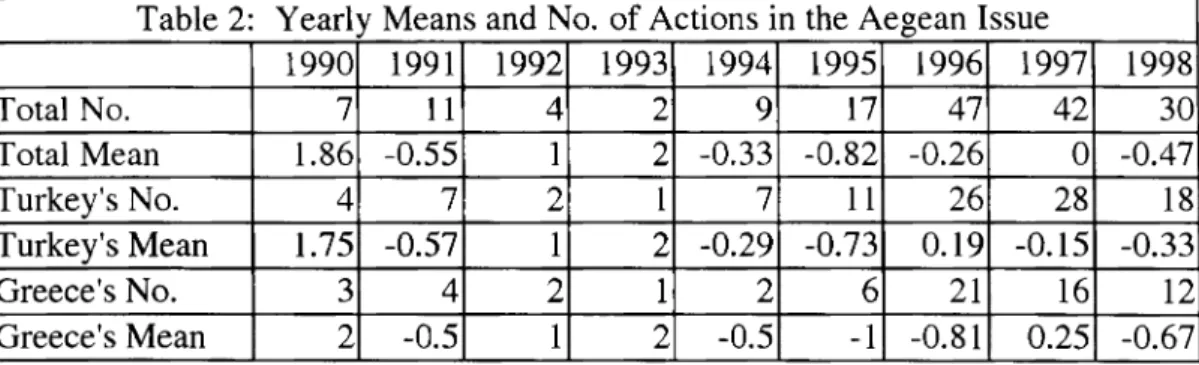
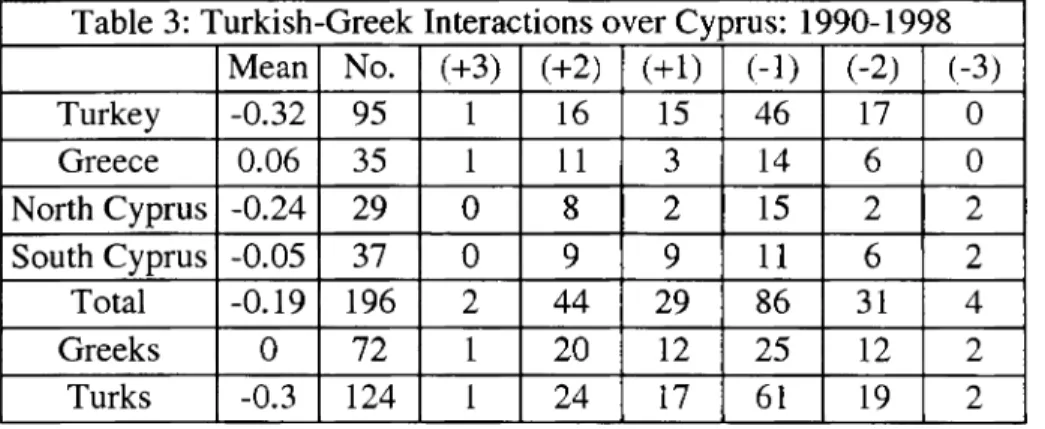
Table 1: Turkish-Greek Interactions over Aegean Sea: 1990-1998 _____________________________ 48 Table 2: Yearly Means and No. of Actions in the Aegean Issue ___________________________________ 49 Table 3: Turkish-Greek Interactions over Cyprus: 1990-1998 ______________________________________ 52 Table 4: Yearly Means and No. of Actions in the Cyprus Issue ____________________________________ 53 Table 5: Turkish-Syrian Interactions over Security: 1990-1998. __________________________________ 58 Table 6: Yearly Means and No. of Actions in the Security Issue _________________________________ 59 Table 7: Turkish-Syrian Interactions over Water: 1990-1998 _______________________________________ 64 Table 8: Yearly Means and No. of Actions in the Water Issue _____________________________________ 65
LIST OF FIGURES
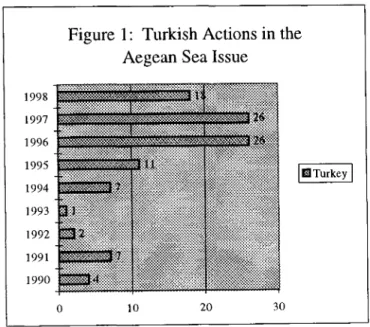
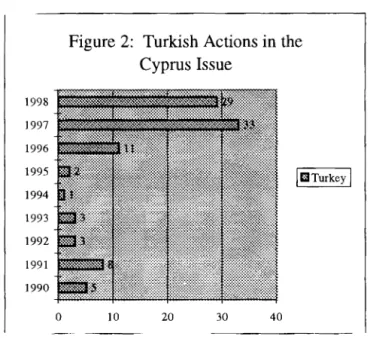
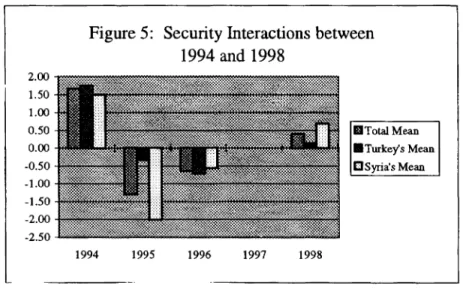
Figure 1: Turkish Actions in the Aegean Sea Issue ________________________________________________________ 47 Figure 2: Turkish Actions in the Cyprus Issue ________________________________________________________________ 51 Figure 3: The Effects of Holbrooke's Cyprus Mediation _______________________________________________ 56 Figure 4: Turkish Actions in the Security Issue ______________________________________________________________ 57 Figure 5: Security Interactions between 1994 and 1998 _______________________________________________ 62 Figure 6: Turkish Actions in the Water Issue ________________________________________________________________ 63
ABBREVIATIONS
ASALA_ _________________________________________ Armenian Secret Army for the Liberation of Armenia BCOW ___________________________________ ··---·---···-Behavioral Correlates of War BP A.---··---··---Bargaining Process Analysis COPD AB ---Conflict and Peace Data Bank CREON _____________________________________ Comparative Research on the Events of Nations project DON ---Dimensionality of Nations project EC _____ ·---···---···---·European Co1n1nunity EU. ___ .. ___ . _________________ .. _____________ .. __ ... ____________ ... ____________ ... ____ ... _---·. _____ European Union GAP_. ____ . ________________________ .. _ ... _______ . ___________________________ .. __________ Sou th eastern Anatolian Project GEDS ··-···---·---····---·---···---Global Event Data System KEDS ---·-·-···---·---Kansas Event Data System MIC ________ --···-····- ___ ... _________ -···--- ______________________ .. Managing Interstate Conflict NA TO _________________________________________________________________________
.N
orth Atlantic Treaty Organization NP A _________ . _____ . ___ ---···-···· ______ ---··· ______ ----· ___ ._---·---··· ____ Negotiation Process Analysis PKK __ ···---····---···---···---Kurdistan Workers Party SAFED ____ ··--·---···---···---···---South African Foreign Events Data TRNC ______________________________________________________________________ .Turkish Republic of N orthem Cyprus UN ____ . _____________________________________________________________________________________________________ ... __ United Nations UNFICYP _________________________________________________________________________ United Nations Force in Cyprus WEIS ______________________________________________________________________________ .World Events Interaction SurveyCHAPTER I
INTRODUCTION
An era of uncertainty has clouded the international arena following the alteration of the international environment as a result of post-1989 events. The breaking up of the Soviet Union and the diminishing of Russian power signaled the end of the Cold War. Just like many other actors, Turkey experienced an element of change in its international environment. This situation was, however, not unique to Turkey. Countries throughout the world were experiencing the same situation.
However, whereas many members of the US-led alliance against the USSR felt more secure with the end of the Cold War, Turkey did not (Mtiftti, 1998: 33 ). Within the North Atlantic Treaty Organization (NA TO), Turkey is one of the two countries that did not experience peace dividends.1 Former Undersecretary of the
Ministry of Foreign Affairs ~tikrti Elekdag's article, "2 Y2 War Strategy" ( 1996)
clearly shows that Turkey was still expecting aggression: Fighting on two fronts consecutively and matching an internal enemy had to be anticipated. The threat from the north no longer existed (for the time being) but Turkey was fearing for the worst from others. The two explicitly mentioned countries are Greece and Syria.
Turkey's interactions with Greece and Syria constitute an interesting subject-matter. Amongst Turkey's neighbors, these countries are arguably the two that Turkey has the most strained relations with. In fact, it is known that Turkish strategy
makers believe that these two countries are deeply hostile as seen in Elekdag's article (see also Mtiftti, 1998: 34-36). The "Sevres syndrome" (a belief that the world is trying to break up Turkey) lies at the foundation of this perception (Kinzer, l 998b: 6).
In this study, Turkey's interactions with Greece and Syria in the post-Cold War era will be analyzed through the use of content analysis in order to grasp Turkey's foreign policy patterns on a number of issues of importance for Turkey. These issues are the Aegean Sea and Cyprus with Greece and security and water with Syria. This study measures cooperation and conflict in bilateral relations between Turkey and Syria and Turkey and Greece. The cooperativeness and hostility of the actors, and, particularly, Turkey will be one of the focal points of attention. The impact of external events on foreign policy patterns undergo scrutiny. It will be maintained that one external event had little effect (Richard Holbrooke's mediation) while another external event had an effect (Turkish-Israeli rapprochement). Turkish foreign policy will be examined primarily for the activism in its external relations during the 1990s, it has demonstrated in the issue as well as for its general approach to the issue (i.e., one espousing cooperation or hostility).
The use of content analysis, and events data m particular, enables a systematic approach to foreign policy. It is imperative that formal approaches be conducted so as to arrive at a fuller understanding of Turkey's external relations. During this process, the issues also experience the same methodical application. A coding process encompassing cooperative and hostile actions was used on Reuters news wires dispatched between January 1990 and December 1998. Events were coded on a scale ranging from significant peaceful moves ( + 3) to overt hostile moves (-3).
A. Foreign Policy Patterns
Studies on Turkish foreign policy have usually underlined similar factors: caution and support for international order and peace. The Turkish Ministry of Foreign Affairs says that Turkey's foreign policy is based on Mustafa Kemal Atattirk's principle of 'Peace at Home and Peace in the World' (l 998a: 3 ). According to Oral Sander, Turkish foreign policy has been influenced by Atattirk's goals of creation of a nation-state based on a nineteenth-century European model, Turkey's occupation of a commendable position in the international arena while practicing the principle of 'Peace at Home and Peace in the World', and promotion of Turks to the level of 'contemporary civilization' (1993: 34). Sharing a border with the former Soviet Union and the volatile nature of the Middle East impelling Turkey to look towards the West are suggested as some of the factors that shaped Turkish foreign policy (Sander, 1993 ). However, Turkey started to become more self reliant during the 1980s as a result of differences of opinion with the West and improvement of its own capabilities (Sander, 1993: 43). In a study from the turn of the decade, Philip Robins says that Turkey's policy towards the Middle East is largely based on
non-interference (1991: 65-67). The fundamental problem with the creation of
Republican Turkish foreign policy, according to Selim Deringil, was "readjustment to secondary power status from an Imperial past" (1992: 1 ). This factor coupled with the Turkish identity crisis has made it virtually impossible for the establishment of a Turkish foreign policy. This situation propelled Turkey to support the status quo ante as well being anti-revisionist.
In a detailed study, Malik Mtiftti (1998) assesses the current security environment and the various factors which have shaped Turkish policy orientation. He maintains that while Greeks and Syrians are 'enemies,' ('natural allies' against Turkey according to Elekdag, 1996) Russians and Iranians are 'rivals.' He points out
that Turkish foreign policy is witnessing a debate between those supporting caution and those advocating boldness (or 'daring') with the civilian and military bureaucracies falling behind the first category (Milfti.i, 1998: 48 ).
Many works maintain that Turkey is becoming increasingly active m its foreign policy in the 1990s. Stephen Kinzer writes, "But despite . . . domestic uncertainty [lack of a stable government since the 1995 elections], Turkish foreign policy has become tougher and more forceful than ever" (l 999a: 5). According to Kemal Kiri~i, Turkey met the challenge of the post-Cold War by becoming more
active and assertive (1994: 407). Former French Ambassador to Turkey, Eric
Rouleau uses the qualification "remarkable dynamism" to describe Turkish diplomacy in the post-Cold War era (1993: 113). Morton I. Abramowitz, a former US ambassador to Turkey, wrote that President Turgut Ozal's death (on April 17, 1993) would alter Turkey's political process and that Turkish citizens realize that a certain amount of international clout surrounds them (1993: 164). Yet, there have been voices which have been against Turkey taking a more active role in its region. For example, Ersin Kalayc10glu believes that the citizens of Turkey have nothing to gain at the moment from Turkish involvement in regional affairs (1994: 414). ~ule
Kut says that Turkey has become much more active in the international arena (including interventionist, multidirectional) but is still cautious and following a realist policy (1998: 58). ~adi Ergilven9 indicates that Turks realized that 'Turkey looked bigger from outside than it did to them from inside. Freed from the constraints of the Cold War era, Turkey seemed to have a better chance of playing bigger and different roles" (1998: 38). Alan Makovsky, in an article entitled, "The New Activism in Turkish Foreign Policy," points towards the post-Gulf War era during which Turkey broke from its shell and became more dynamic ( 1999: 92-113 ). Ziya Oni~ maintains that Turkey is moving from "passive neutrality" to becoming an
important regional actor (1995: 50). Taking such declarations into account, we find it instructive to pose the following questions: Is this really the case? Is it possible to say that Turkey has become more active and assertive since the beginning of this decade?
The end of the Cold War is by and large taken as a turning point m international affairs as many have noted (Fukuyama, 1989; Mearsheimer, 1990; and Huntington, 1993 ). This manner of thinking is also in line with the notion that middle-range powers and regional great powers will find themselves as being more influential in the post-Cold War era (as opposed to the previous era during which their roles were relatively constrained and subordinate).2 Research on middle powers indicate that they will find it easier to maneuver in a time of uncertainty and when the relations between middle and great powers are not intense (Mtiftiiler and Yliksel, 1997: 184-196).3 It is maintained in this research that Turkey became increasingly more active and assertive in the era of uncertainty marking the international arena since the end of the Cold War. Activity in foreign policy is evaluated in this study through the number of initiations and actions taken on an issue by an actor.
It is tentatively proposed that Turkey has become increasingly more active throughout the 1990s. Based on this assumption, Turkey should have undertaken more actions in the late 1990s, e.g., 1998, than in the early 1990s, e.g., 1990. Although this research could have been conducted by reviewing the number of new international organizations that Turkey has spearheaded in the 1990s such as the Black Sea Economic Cooperation and the Developing Eight, the viability (let alone
Middle-range powers are countries committed to the maintenance of international order and security. Regional great powers must. at least, be part of a region and a key player in regional affairs.
For more on middle powers and regional powers. see Cooper. 1997: Neumann. 1992: Lake and Morgan. 1998: and Ayoob. 1989-1990.
utility) of these formations is still suspect and relevant data for a systematic approach is limited.
On the issues studied, the overall pattern of interactions for the 1990s will be determined. This will be done so as to understand Turkey's general approach to the issues and to obtain a picture of its negotiation style. It will also be possible to understand how Turkey's actions differ with those of the other sides. The questions that will be answered here are, "what has Turkey's approach been in the 1990s and how does it compare with those of the other actors (primarily Greece and Syria) as well as the other issues studied?" The positions of the actors will be approached from the point of how much cooperation and hostility they demonstrated. 4
There have also been external inputs into these interactions. Certain external events could have influenced the happenings and changed the course of events. One interesting type of external intervention is mediation. There have been numerous mediation efforts on Turkish-Greek relations, especially over the Cyprus issue. The
United Nations (UN) has been conducting them for decades. However, as this
research is on Turkey in the 1990s, it was more appropriate to examine a newer, purely 1990s mediation effort. This and other reasons led to the selection of US
Assistant Secretary of State Richard Holbrooke's mission. This mission is a
confirmation of the important place this topic occupies for the United States as indicated by researchers (Mirbagheri, 1998). Secondly, Holbrooke said at the outset of his mission to Cyprus in March 1995 that he was aspiring for a repeat of the "historic breakthrough that (French) General (Charles) de Gaulle and (German Chancellor) Konrad Adenauer effected between France and Germany in the late 50s
• Following Robert Keohane, international cooperation is defined as occmTing "when actors adjust their behavior to the actual or anticipated preferences of others, through a process of policy coordination" ( 1984: 51) while hostility is taken as implying "goal-seeking behavior that strives to reduce the gains available to others or to impede their want-satisfaction" (Milner, 1992: 468).
and early 60s . . . an historic change in the map of Europe" and Washington was hopeful that the "big push" towards peace on the island would occur (Giacomo, 1995). An attempt will be made here to see whether he achieved this goal. It is believed that Holbrooke's ongoing missions have had little positive impact. Bearing in mind that he "declared 1996 as being 'the year of Cyprus"', this year is going to be investigated ("Cyprus," 1996).
Bilateral relations are also affected by the relationships between one of the actors and a third actor. Syria maintains that their relations with Turkey have been negatively influenced by Israel's increasing amount of cooperation with Turkey. States in the region look upon this pact uneasily despite Turkish and Israeli official attempts to portray this pact as not being directed against others. The Syrian assertion, thus, merits attention. Although this relationship has been steadily building up throughout the 1990s, it has gained much momentum after the signing of a military accord between Turkey and Syria in 1996. The Syrians were especially rattled when Israeli Prime Minister Benjamin Netanyahu announced the "main axis of a regional security arrangement" shortly before Turkish Prime Minister Mesut Y1lmaz's visit to Israel in 1997 (Hamza, 1998). Despite denials to the contrary, it is believed that the increasing ties with Israel altered Turkey's stance towards Syria. Thus, there should be a change in the Turkish position before 1996 and that after.
These questions have not been significantly dealt with but are important as they will say much about Turkish foreign policy in general. However, it is evident that as there are few countries in this research, there will only be a partial understanding. Yet, the importance of these countries for Turkey should not be underestimated. The issues that are being examined are certainly significant for Turkey and in answering these questions it will be possible to see Turkish foreign policy patterns.
B. Issues of Aegean Sea, Cyprus, Security and Water
There are a number of issues that separate these countries. In the Turkish-Greek case, the Cyprus conflict and claims over the Aegean Sea are the two main issues. In the Turkish-Syrian case, the primary problems can be cited as being over security and water. The term 'security' covers terrorism, arms smuggling, and drug trafficking. Evidence of Syrian support rendered to the Kurdistan Workers Party (PKK) is directly covered under this term. As this paper is on Turkish foreign policy, Syrian security anxiety arising from Israel is not covered here. The water issue concerns the amount of water that Turkey and Syria are bargaining over. Iraq is also a partner to these negotiations as it also uses the Euphrates River but it was not included in this study. This is because the repercussions of the Gulf War following its operation in Kuwait have meant that it was quite muted about this topic.
The Aegean Sea is taken from a holistic perspective m this research to include all sub-issues in the Aegean Sea between the two countries. While Greece believes that the only real problem between Turkey and Greece is the continental shelf and everything else is Turkish aggression, such an examination would have meant that there would be little to analyze.5
In this study, the issue of Cyprus includes all relevant moves of the Cypriot governments, Greece, and Turkey. Most of the moves deal with security matters and the relationship between the communities. In the issues of Cyprus and Aegean Sea, matters concerning the European Union (EU) were only included if they were relevant to the issue. For example, Turkish North Cyprus's refusal to join the
Greece says that the only issue is the continental shelf. Other Aegean disputes "consist exclusively of arbitrary claims against Greek sovereignty put forth by Turkey in defiance of international law and agreements" and "Turkey has 'discovered' problems" for the goal of continental shelf. Greece gives the continental shelf such a status because of the rulings of the International Court of Justice. See Hellenic Ministry of Foreign Affairs, 1998.
accession talks with the EU was included for the message that it sent the Greek side and not from a Turkish-EU perspective.
At certain times, other issues have occupied the center stage, e.g., minority treatment in Greece and Greece's stance in the EU towards Turkey. Importantly, these countries also enjoy good understandings on certain issues, e.g., the Turkish-Syrian stance on discussions over Iraqi dismemberment and the Turkish-Greek joint intervention to Albania in April 1997.
Yet, these have been sporadic and not the key elements in determining the relations between the countries. The data available from Reuters confirms the importance of the chosen issues: A simple word count conducted for relations between Turkey and Greece from 1990 onwards shows that the word 'Cyprus' appeared more than 1,500 times and the word 'Aegean' appeared more than 750 times. In the case of relations with Syria, while Syrian claims on the Turkish province of Hatay (Sandjak of Alexandretta) are important, it is hard to pinpoint direct examples of it whereas security and water matters are easier.
Although this research investigates Turkey's relations with Syria and Greece, other actors also had to be included in the study of certain issues, such as the Greek and Turkish Cypriots and Lebanon. Both Cypriot communities have many agreements (political, military, and economical) with the 'motherlands.' There is much synchronization between the sides, as seen in the military cooperation agreement signed between the Greek parties in 1993 and the Turkish security guarantee given to the Turkish Republic of Northern Cyprus (TRNC) in 1997. In the case of Lebanon, it should be remembered that the Bekaa Valley (which used to be a training ground for various terrorist groups) is officially part of Lebanon but Syria has much say in its administration (Harik, 1997). Although it is true that adding these actors does change somewhat the scope of the study, not including them would
have resulted in a partial understanding of the matter. This is because these issues could not have been studied without the inclusion of these actors.
C. Findings
The results indicate that Turkey was the more assertive and active country in the issues studied for the nine years under examination. Turkey was the relatively
more cooperative actor only in the Aegean Sea issue. The premise of Turkey
becoming more active over the 1990s is supported but with the qualification that it is not an ever-increasing (as attested through the fluctuations) or ubiquitous (as seen in the water issue) dynamism. A significant change in pattern is observed after 1995 with Turkey becoming both more assertive and active in the period between 1995 and 1998. The findings present Holbrooke's mediation in the Cyprus problem as ineffective but rather give support to the view that mediation efforts by themselves are not enough to alter the course of events. Also, the increasing Turkish-Israeli cooperation influenced Turkey's relations with Syria negatively. The use of content analysis (and events data) helped in obtaining an image of Turkish foreign policy that is systematically derived.
D. Method: Content Analysis
Content analysis is a scientific method for going beyond the data and arriving at the crux of the message. It has been described as a technique of measurement, description, and inference. Krippendorff describes it as a "research technique for making replicable and valid inferences from data to their context" (1980: 2 l ). Similarly, Holsti said that it is "any technique for making inferences by objectively and systematically identifying specified characteristics of messages" (1968: 14). Shapiro and Markoff define it as "any methodical measurement applied to text (or
other symbolic material) for social science purpose" (1997: 14). "A research methodology that utilizes a set of procedures to make valid inferences from text" is Weber's definition (1985: 9). The text can be any medium of communication. After breaking the various definitions of content analysis into their components, Shapiro and Markoff come up with the following plausible definition for content analysis, "any systematic reduction of a flow of text (or other symbols) to a standard set of statistically manipulable symbols representing the presence, the intensity or the frequency of some characteristics relevant to social science" (1997: 14).
In a nutshell, content analysis simplifies the process of collecting and analyzing the content of text (Neuman, 1997: 272): "A central idea in content analysis is that many words of the text are classified into much fewer content categories" (Weber, 1985: 12). Such a technique is obviously useful in international affairs where large volumes of data are created daily. In international affairs, content analysis is used in foreign policy analysis where it appears in the fonn of events data.
Events data is a process of content analysis which involves three steps: identifying the news sources, developing a coding system or using an existing one, and training coders (Schrodt, 1995: 148-149). This process captures individual foreign policy behaviors of actors into categories through the examination of public documents and assigns codes to the reported interaction. They "are a formal method of measuring the phenomena that contribute to foreign policy perceptions" (Schrodt, 1995: 146). The aim of events data is to see if a pattern emerges and one subject that has often been inspected is the amount of international cooperation and conflict (Hastedt and Knickrehm, 1991: 57).
Measuring international conflicts in a scientific fashion has a recent history. Lewis Fry Richardson is accepted as the founder of scientific research on conflict
and research; other important early contributors were Quincy Wright and Pitirim A. Sorokin (Cioffi-Revilla, 1990: 2-3). Charles McClelland is given credit for having woven the traditional method of diplomatic history with the quantitative analysis of the behavioral school in the 1960s as events data (Schrodt, 1995: 151). "Riding the behavioral wave that swept the post-war generation of social sciences, the event-data movement has sought to advance the theory and practice of international politics" (Duffy, 1994: 147).
Merritt says that there are two dimensions in the current attention to events: the approach and the unit of analysis (1994: 5-6). For the unit of analysis, the question involves what actors to use: state-actors or others. The approaches are also two-fold: A generic-behavior approach takes into consideration all events while an event specific approach starts from the outcome and works backwards. Schrodt expresses similar views when he says that there are two approaches: actor-oriented data sets and episode-oriented sets (1995: 152).
The major events data projects are Rudolph J. Rummel's Dimensionality of Nations (DON) project, Charles A. McClelland's World Event Interaction Survey (WEIS); Edward E. Azar's Conflict and Peace Data Bank (COPDAB), Charles F. Hermann's Comparative Research on the Events of Nations (CREON) project, Ernst B. Haas et al. 's Managing Interstate Conflict (MIC), and Russell J. Leng's Behavioral Correlates of War (BCOW).
WEIS, COPDAB and CREON are actor-oriented data sets. BCOW is a major episode-oriented data set. However, these are not the only data sets available. There are various smaller data sets available (Schrodt, 1995: 152-56 ). The South African Foreign Events Data (SAFED) of Koos van Wyk and Sarah Radloff is one
such example.6 While most of the major projects have been around since the Cold War, there are also newer projects, e.g., the Global Event Data System (GEDS) and Kansas Event Data System (KEDS), which rely on computers for coding.
An event has been defined in similar fashion by the different projects. The least common denominator being an issue, action, and actors (sender and targets) (Merritt, 1994: 22). In a similar fashion, we define event as an action from one actor (sender) to others (target/targets) on a specified issue that is deemed to be newsworthy. We code each event by four variables: time (i.e., date), sender (i.e., initiator), target (i.e., recipient), and event classification on a six-score scale ranging from extremely cooperative moves to overt hostile moves.
Events data has been extensively used in the study of foreign policy analysis (see Schrodt, 1995: 156-160). It has been utilized for the study of superpower interactions (Goldstein and Freeman, 1990), influence strategies in interstate conflicts (Leng, 1993; Leng, 1998), crisis early warning capabilities (Schrodt and Gerner, 1997), and environmental change and conflict (Savaiano and Schrodt, 1997). This piece studying Turkey's interactions with Greece and Syria through events data adds to the ever-growing list of topics studied by events data and demonstrates that events data is useful for the analysis of Turkish foreign policy.
E. Outline
The next chapter pinpoints important work pertaining to our study. We will investigate the state of Turkish-Greek and Turkish-Syrian literature with an emphasis on recent works relevant to the issues under investigation. We also discuss works utilizing (or not) content analysis in Turkish foreign policy. An attempt will be
For demonstration of the data-set as well as its utility in the study of South African foreign policy see van Wyk and Radloff. 1993.
made to show that systematic studies are lacking.
The third chapter presents the research design. It includes information about the data used, unit of analysis, pilot test, coding system, coding process, reliability, and the types of measurement.
The fourth chapter offers the findings. In a nutshell, the questions inspect Turkish foreign policy activity in the 1990s and its approaches to the issues (Aegean Sea, Cyprus, Security and Water). Two other problems that will be investigated are
case-specific topics: The effects of Holbrooke's mediation in 1996 on Cyprus
problem and the effects of increased Israeli relations since 1996 on Turkish-Syrian relations. The value of content analysis for the study of Turkish foreign policy will be determined. A general overview of relations in the 1990s between the actors will be presented as seen from the data.
In the fifth chapter, a summary and comparison of the findings along with the implications of this study will be offered.
CHAPTER II
LITERATURE REVIEW
From the point of Turkish foreign policy literature, the issues with Greece have been studied more than other issues. Turkish-Greek relations have received more attention than Turkish-Syrian relations. The importance of Aegean Sea and Cyprus is clearly shown in a publication of the Ministry of National Defense: White
Paper Defense 1998 deals with both issues under a separate chapter ( 1998 ). However, no mention of Syria occurs while matters of internal security, international terrorism, and PKK are discussed.
Of the view that Greece occupies more attention than it deserves in Turkish foreign policy is Bilge (1996) who bases this situation on Greece's constant attempts to hurt Turkey. He maintains the differences are due to the fact that the Greeks base their foreign policy on the 'Great Idea' or Megali Idea (which can be defined as the establishment of a Greek empire or the resurrection of the Byzantium empire) while the Turks base it on the dictum associated to Atatlirk, 'Peace at Home and Peace in the World' which is openly espoused by different Turkish ministries including the Ministry of Foreign Affairs and Ministry of Defense. Another author who believes that Greek policies on Cyprus are of an aggressive nature while those of the Turks are of a peaceful nature is Gtirkan (retired General) ( 1994: 140). This view is clearly articulated in his article ( 1994) on how the decision to use force in Cyprus was reached by Turkish decision-makers and the military application of the decision.
Yet, Greek authors also point to the aggressiveness of Turkish policies as seen in Platias's work, "Greece's Strategic Doctrine: In Search of Autonomy and Deterrence" (1991). Veremis says that Greeks support the territorial status quo in the Aegean Sea while the Turks are challenging it (1998: 10). Along the same line, Prodromou (1998) depicts Turkey as the main cause for the failure of reintegration talks in Cyprus. Not to be outdone, Greek hostility is mentioned by Ergtivenr; who also points out the relevance of the adage, "If you want peace, you should be prepared for war" which sums up the important role played by the military in guarding Turkey's vital interests (1998: 40, 37). Ergtivenr; also says that it is Turkey's geography which gives Turkey its special significance (1998: 41-42). Adding the finishing touch to this debate on aggressiveness, Ayman's application of cognitive theory in the Aegean dispute demonstrates that the actors only take account of the other's hostile actions (1998: 301-319). She says that Turkey's Aegean policy is based on two factors: deterrence and negotiations. The first is reinforced through its declarations of casus belli and the second is seen in its demands for a package deal.
In the beginning of the 1990s, it was expected that as in the previous decade, the shared continental shelf of the two countries would be the main point of discussion in the relations between Turkey and Greece. Bo1Ukba~1 in "The Turco-Greek Disputes: Issues, Policies and Prospects" goes so far as to suggest that the territorial sea dispute was playing second fiddle to the continental shelf dispute ( 1992: 38 ). Following a review of the problems, he concludes that the disputants view the content of the disputes and the means to solve them differently (Boltikba~1,
1992: 49). Hickok (1998), in a detailed review, shows that the Kardak crisis demonstrated in 1996 that an islet in the Aegean Sea could strain Turkish-Greek relations to the utmost. He says that it was not American intervention but Turkish
military projection that decided the flow of events (Hickok, 1998: 134). The Turkish side fears that changes will result in the Aegean Sea becoming a Greek lake and this fear receives much impetus from the increased armament of the Greek islands which the Turkish side believes is against the Lausanne Agreement and many other treaties signed by the two parties.
A number of authors have suggested that external threats bring the two countries together and without a hostile overlooming presence, an improvement will not occur (Clogg, 1991; and Birand, 1991 ). Veremis also points towards external measures, such as the constraints caused by the Cold War and external threats, and adds domestic priorities, such as economic reform, that could lead toward detente (1998: 17). Couloumbis and Klarevas use a level of analysis approach in order to come up with proposals and find that reduction in tensions is possible (1997).
Dealing with the detente between the Soviets and Americans, Evangelista (1991) pointed out that the atmosphere would not contribute positively to the
relations between Turks and Greeks. However, he does say that international
dialogue that pushes for common-security thinking instead of the current zero-sum thinking would be more useful (Evangelista, 1991: 152).
A year before the declaration of independence of TRNC, Rauf Denkta~
correctly emphasized the importance of Cyprus in Turkish-Greek relations by uttering, "Cyprus continues to be the fulcrum on which the Turkey-Cyprus-Greece triangle is delicately balanced" (1982: 108). Since the 1950s, Deringil says that the issue of Cyprus is the most problematic one (1992: 5). This is a view also put forward by Stearns (l992) and Lesser (1993). As the situation was bad enough in 1964 to warrant the placement of United Nations Force in Cyprus (UNFICYP) and the Turkish side portrays the era between 1963 and 197 4 as a period of captivity (Ministry of Foreign Affairs, 1998b: 6), these views are warranted. However, Henze
is of the opinion that as all the actors favor the current structure, Cyprus has become a politically marginal issue (1993: 12). Veremis qualifies that view by saying that the Turks are happy with the situation prevalent in Cyprus but the Greek Cypriots want unity (1998: 10).
An important publication is Tozun Bahcheli's Greek-Turkish Relations Since 1955. He says that the most important issues, in respective order, are Cyprus and the Aegean Sea. He sums up the history of the relationship as being one of "grievance and mistrust" (Bahcheli, 1990: 189). On the issue of Cyprus, he points out that the Cypriots are not as subordinate to the mainlanders as believed. In the Aegean Sea dispute, he says that it is the conflicting national interests which lie at the core.
While intercommunal gatherings between the Cypriots regularly took place in the aftermath of Turkey's 1974 intervention in Cyprus, following an attempted coup d'etat by Greece against Greek Cypriot leader Archbishop Makarios (because the Junta ruling in Greece perceived him as being anti-Junta and socialist), problems over ties to the mainlands, the three freedoms (of movement, settlement, and ownership of property) and government types for Cyprus resulted in dead-locks. The Turks worrying about marginalization (which were augmented by Greek demands for full implementation of the three freedoms, loose relations to the mainlands, and a central, strong government) wanted close ties with the mainlands and a weak, central government as well as partial implementation of three freedoms at most. The need for security is not properly addressed.
Among others, Sir David Hannay and Richard Holbrooke attempted to mediate between the sides but usually to no avail. The Greek Cypriot government's decision in the mid-l 990s to buy S-300 surface-to-air missiles from Russia resulted in Turkish threats to destroy them. The atmosphere somewhat calmed down when the Greek Cypriots decided not to place them on Cyprus.
The amount of articles on the peace initiatives between Turks and Greeks, especially on the Cyprus conflict, are numerous. Boltikba~1 looks at the Cyprus initiatives in two articles. In an article covering UN Secretary General Boutros-Ghali's 1992 initiative, besides pointing out that Boutros-Ghali was too optimistic, he says that differences of opinion between the two communities on what constitutes an acceptable solution resulted in failure of the talks (Boltikba~1, 1995: 461, 479). Insecurity and mistrust constituting the key elements. In a more extensive article,
Boltikba~1 (1998) covers the UN involvement in the period between 1954 and 1996 and says that mutual suspicion lies at the heart of the matter. He says that while the UN has generally maintained tranquillity on the island, it has not been able to cajole the parties to a peaceful settlement and the issue is not any "riper" than before
(Boltikba~1, 1998: 429-430).
Couloumbis and Klarevas look upon Cyprus as being the most prickly issue between Turks and Greeks but say that the problem is '"ripe'" (1997: 53) meaning that the parties want to reach a settlement. This is in contrast to Sir Hannay, UK Special Representative for Cyprus, who has said, "The sad truth is that in Cyprus today there is a lack of trust and confidence in the good faith of the other side which undermines the best intentioned efforts to reach agreement" (1997: 35 ). Prodromou (1998) maintains that Turkey must be engaged more decisively by the EU and the US if the impasse in Cyprus is to be overcome. Keashly and Fisher ( 1990) develop a contingency approach to third party intervention in regional conflicts and illustrate the conceptual analysis through Cyprus. They point to the shortcomings of the various efforts and point specifically to lack of coordination and inappropriate timing (Keashly and Fisher, 1990: 452-453). Evriviades and Bourantonis also indicate the deficiencies of the peace methods utilized in Cyprus (1994). Onal (1997), in a policy paper, indicates that while most of the peace efforts have concentrated on the
issue of Cyprus, the Aegean Sea issue cannot be ignored and that it has actually caused more crises. He says that the sides should address each other's security w01Ties and calls for more NATO involvement (Unal, 1997).
A study, using cointegration and causality tests, examines Greek-Turkish arms procurement and concludes that an arms race between the NA TO members exists (Kollias and Makrydakis, 1997: 355-379). The volatility of the relations has resulted in a number of works calling upon NATO to become a catalyst in the resolution. Greece and Turkey have been for almost half a century within the same camp and alliance. While alliances also function to sort out differences within the members, this was not the case for the Turks and Greeks. Participation in one of the most important collective defense organizations in history has not done enough to smooth out differences. Stearns (1992) in a policy-oriented research suggests that a non-aggression pact guaranteed by NA TO could be the answer. He reaches this view because of the emphasis put on territorial security in the official propaganda of the two countries and goes on to suggest that the United States should do more to curb the arms race (Stearns, 1992: 103, 151 ). In a similar research, Brown ( 1991) also says that the North Atlantic Alliance could play a major role in the solution. Brown points out that NA TO was not designed for solving problems between members but that the incident of March 1987, when Greeks and Turks came closest to confrontation since 197 4, was an indication of the omnipresence of friction between the two allies (1991: 16, 127, 162). Pisiotis in "L'OT AN et la persistance du conflit greco-turc" besides uttering the familiar claim that the parties will only unite against a common aggressor, also makes an interesting remark that stipulates that as the Turks want to be European and the Aegean Sea is European, Turks want the Aegean Sea (1993-1994: 914, 908). Haass (1988) and McDonald (1988) under the same volume describe Turkey and Greece's importance in the Alliance as well as
the disputes of the countries but suggest that NATO should be cautious. Unlike most authors, Krebs (1999) believes that NA TO has also contributed to the tensions between the sides by eliminating the immediate Soviet threat, providing arms, and altering the balance of power between the parties and allowing them to concentrate on regional interests. However, Krebs also concedes that the fact that war never broke out is also due to NATO (1999: 369).
Laipson (1991), reviewing the policies of US administrations on Greek-Turkish relations in the post-1974 era, says that there is no consensus within the US and predicts that if the countries are seen as insignificant, their supporters will face a harder time in influencing and engaging US institutions. Carley ( 1997) somewhat overestimates the importance of Cyprus for US foreign policy by maintaining that the US was always interested in it. In Cyprus and International Peacemaking,
Mirbagheri says that the United States has shifted "out of its sluggish bottom gear" and the appointment of Richard Holbrooke to Cyprus was a strong indication of their search for a end to the Cyprus problem (1998: 153). He also says that talks over Cyprus's accession to the EU have resulted in more peacemaking efforts but he points out the importance of Turkey on the island as being the main outside power (Mirbagheri, 1998: 152, 161). While the EU and NATO are mentioned as third-parties for Cyprus, only the UN is a possibility according to Carley (1997: 19).
There are also a number of authors who examine the role of the European
Community/European Union (EC/EU) in the Cyprus conflict. Pushing for
international dialogue under the auspices of the EC/EU is Meinardus ( 1991) who wants a more active and constructive role. However, Stephanou and Tsardanides say that the EC/EU cannot mediate because one of the disputants is a member (1991). In their work on the EC factor, they maintain that the domestic political situation in Turkey following the coup d'etat is to blame for Turkish-EC relations and not
Greece (Stephanou and Tsardanides, 1991: 211) but also assert that the Greek role could become more decisive when other barriers are solved. Inspecting the ethnic conflict between the parties on Cyprus, Joseph points to the polarizing effect of ethnopolitics in Cyprus and is of the view that the accession of Cyprus to the EU is an excellent opportunity (1997: 129, 137). Kramer (1997) looks at the precarious position of the European Union in the events leading up to the Greek Cypriot government's accession talks and mentions the positions of the main actors involved in the Cyprus problem. However, his call for EU accession negotiations not to be concluded before a solution is found to the Cyprus problem has been largely ignored (Kramer, 1997: 30). Following an examination of whether EU expansion into Cyprus would be good for the island, F1rak (1998) concludes negatively. She also says that Turkey has had no real policy on Cyprus and that the relations between the Turks is closer than the relations between the Greeks which poses questions on the sovereignty of TRNC (F1rat, 1998: 279-81). Following the Luxembourg summit (of December 1997), Jenkins says that the EU cannot imagine that Turkey views them as impartial and that Turkey became more defensive and less conciliatory, especially towards Greece, following international setbacks (1998: 13).
Following a year (1996) marked by confrontation Bahcheli and Rizopoulous ( 1996-1997) examine possible options. They say that any consent will necessitate the approval of the majority of the two communities. According to them, the Turkish Cypriots are willing to give up territory for a deal with the EU and as the majority of Greek Cypriots recognize that they have to share the island, a positive outcome could follow for the island (Bahcheli and Rizopoulous, 1996-1997: 29-39).
Domestic factors have also played an important role in the relations as the findings in this work also maintain. Turkish Prime Minister Ozal maintained that greater cooperation was prevented through the bureaucracy in both countries
(Birand, 1991: 34). A work examining the domestic influences is Pridham's "Linkage Politics Theory and the Greek-Turkish Rapprochement" (1991) in which the author approaches the post-1987 relationship through linkage politics theory. He concludes that domestic pressures (particularly on Greek Prime Minister Papandreou) hindered greater cooperation (Pridham, 1991: 86 ). Keri dis (1998 ), in a study on Greek domestic politics, tries to show how they affect relations between Turkey and Greece. He clearly shows that domestic politics influences relations when he says that though Prime Minister Simitis wants accommodation, he is constrained by personal factors and party politics (Keridis, 1998: 17 ). Keri dis believes that Greece has been unable to create and implement policies but since 1995 he says that Greek foreign policy has become more flexible and 'mature' which is contradicted by recent Greek actions in support of Abdullah bcalan ('Avenger') and the PKK (1998: 23-24). Showing the precarious nature of Turkish politics and the national consensus on Turkish foreign policy, Kramer (after his examination of Greece's position in broader Turkish foreign policy) maintains that Turkish
governments would need considerable tradeoffs for concess10ns
O
991).Coufoudakis, following his comparison of the foreign policies of Greece's two major parties, asserts that there is continuity in Greek foreign policy and says that in the foreseeable future, the cycle of 'confrontation-negotiation-confrontation' will
continue (1991: 54). This element of continuity has been also expressed in
discussions of Turkish foreign policy on matters concerning Greece, as can be see in Former Greek Ambassador to Ankara, Nezeretis's declarations ( 1999: A8 ).
At a Conference on Aegean issues in Turkey, the participants concluded that any settlement had to include the political elements surrounding the Aegean Sea as well as its uniqueness and gave a position of secondary importance to the evolving,
Conference, Aquarone came right to the point when she said, "The Challenge is now to move beyond legal correctness: to overcome stereotypes and define a new relationship which would incorporate the two countries' wider concerns and provide then with space to move into" (1995: 56). Elsewhere, Keridis (1998) also says that while international law is important, actors should be prepared to go beyond it.
This is not to say that there are no other disputes between the Greeks and Turks. For the Turks, the Turkish minority of Western Thrace constitutes another topic as can be seen in Oran's publication (1996).
From this literature review on Turkish-Greek relations, some conclusions can be made: Greece and Turkey both see the other as threatening and aggressive. Domestic politics in both countries affect the relations between the countries. More international attention was paid to Cyprus than to the Aegean Sea. Mediation efforts between the sides have been inconclusive. The EU is no longer a serious contender for the role of mediation. The UN will continue to be the major player in Cyprus; NATO has to assume a greater role in matters concerning Greece and Turkey. The absence of an external threat resulted in the sides becoming more antagonistic towards each other. The Cypriot communities are not the lackeys of the mainland countries. The relations between the sides can be characterized as one of hostility with the occasional positive or negative factor thrown in. Most of these conclusions emerge from publications of similar nature: policy, opinion papers. Content analysis is lacking and while systematic studies exist, they are few. The general lack of systematic approaches, such as content analysis, can also be seen in the literature on Turkish-Syrian relations.
An overview of Turkish-Syrian relations indicates that there have been few studies solely on this subject. Rather, this relationship was mainly covered within the context of Turkey's relationships with the Middle Eastern countries or as part of a
study on a subject such as water in the Middle East. As the examples given below show water and security matters are generally tied. Almost no work fails to mention them both. Another discussion matter, Hatay, has received less attention because Syrian capabilities limit any possibility of change. Syria has not reconciled itself to the loss of Hatay which chose to become part of Turkey in 1939 following a plebiscite. Syria refuses to accept this situation and portrays it as a Syrian province.
Dalacoura's article, "Turkey and the Middle East in the 1980s," examines the internal and external factors that have influenced Turkish-Middle Eastern relations (1990). She concludes that while Turkey became more involved in the region, its interest in the region did not greatly increase. Altum~1k (1998) says a key factor for greater Turkish involvement in the Middle East has been the redefinition of the national security problem which has resulted in the end of the division between internal and external politics: The external threat comes from the south and the internal threats of Islamic fundamentalism and the PKK receive support from the Middle East or the south (1998: 350). The increasing military involvement in Turkish foreign policy has been pointed out by Ulman ( 1998 ). For him this is because the military sees foreign policy as too important to be left to the politicians.
In the Turkish-Syrian showdown in October 1998, the military was the key player. In one of the few studies devoted to relations among Israel, Syria and Turkey, Gresh (1998) points out that it is not regional cooperation but realpolitik that is the order of the day in the Middle East. He describes the relations between the non-Arabs as one of military axis and Damascus's attempts to counter this movement as unsuccessful (Gresh, 1998: 202-203). Waxman, in a policy paper, is correct in pointing out that Turkey and Israel share many reasons why they should be close but his usage of the term, 'balance of power' is misplaced as these countries do not need each other to deter Syria (1999: 25-32 ).
Muslih maintains that Syria perceives Turkey as the lackey of the West and the United States in particular (1996: 113-130). This view, he believes, can be improved as a consequence of the amelioration of relations among Syria, Israel, and the United States. This contradicts the Turkish opinion that such a situation would lead Syria to become more hostile. Olson's article, "Turkey-Syria Relations Since the Gulf War: Kurds and Water" is one of the few works entirely on the relations between the two neighbors (1997). Following a comprehensive review of relations since the Gulf War, he points to 1996 as the year when relations hit a new low and this was despite the presence of (the pro-Arab) Welfare government in Ankara. Yet, he says that Turkey needs Syrian (and Iranian) cooperation to combat PKK terrorism (Olson, 1997: 189). Bayaz1t (1998), a retired General, points to the external forces behind the Kurdish question and says this is done so as to subdue Turkey. In the same volume, Kiri~\:i accepts the reality of the Kurdish question, and says that besides making Turkey appear aggressive, it also influences Turkish foreign policy (1998: 73, 77).
Robins ( 1991) mentions that Turkish decision-makers look upon Syria as being the most problematic of its neighbors. However, he points out that while Syria is using illegal groups against Turkey to gain leverage on the water issue, Turkey is still unaffected by Syrian (and Iraqi) concerns about its water policies (Robins, 1991:
51, 95). On many occasions, charges of sponsoring terrorism have been leveled at Syria. Turkey has been accusing Syria of giving support to illegal groups within Turkey for decades. This is withstanding the fact that agreements exist between them calling for the extradition of criminals. Direct Syrian support to terror was witnessed in 1982 when the Armenian Secret Army for the Liberation of Armenia (ASALA) members arriving from Syria caused havoc and bloodshed at Ankara's Esenboga Airport. However, it was only in 1983 that Turkish officials publicly
denounced Syria. The reason was Syrian permission to terrorists to establish bases in Syria and parts of Lebanon under Syrian control (Boltikba~1, 1993: 17).
The PKK occupies a central role in Turkey's relations with Syria. The PKK is unique among the Kurdish groups in the Middle East in that it was Pan-Kurdish, was based on ideology (and not tribalism) from its inception, and demanded complete independence for much of its existence (Fuller, 1993a: 115-116 ). Abdullah bcalan headed the organization from the beginning (usually from his residence in Damascus). He has acknowledged Syrian support many times. In fact, the Syrians openly told Prime Minister Ozal during his visit in 1987 (which resulted in a Mutual Security Accord7 being signed) that bcalan was a political refugee.
Many authors point out that the PKK card is used for the Euphrates problem.
Boli.ikba~1 (1993) points towards this view following his examination of the relations between Syria and Turkey. However, he also adds Hatay and the anti-Turkishness of the Syrian regime as two other issues that have to be addressed and summarizes Syrian policy as one based on supporting terrorism, revising borders, and believing that time is on their side (Boli.ikba~1, 1993: 32, 17). Fuller (l 993b) in "Turkey's New Eastern Orientation" takes the view that the Syrians are using the Kurds as an instrument and that if Syrian negative images towards Turkey changes, a future amelioration in the relations could take place. Fuller also illuminates the intricate differences between the Turks and Arabs and how history, culture and social factors have meant that the two peoples have followed different lines ( l 993b: 49-51 ).
One article of particular interest to emerge from a book which examines the effects of the Kurdish question on Turkey is Olson's "The Kurdish Question and Turkey's Foreign Policy Toward Syria, Iran, Russia and Iraq since the Gulf War" in
In one protocol, Syria promises to cut its support to terrorist organizations operating against Turkey. In the other protocol, Turkey pledges a minimum of 500 cubic meters per second of water from the Euphrates River.
which he maintains that Turkey concluded a series of security agreements with its neighbors when it faced the possibility of an independent Kurdish state in Northern Iraq from 1993 onwards (1996: 86). On the section on Turkish-Syrian relations, besides offering the recent history of the relations, he explores the Turkish decision not to take moves which would have shown its displeasure with Syrian assistance to PKK in 1995 and 1996. His two-fold answer (not attacking an Arab state which was improving its relations with Israel and the possibilities of failure) does not tell the whole story as it ignores the fact that Turkish foreign policy has generally shied away from entanglements in the Middle East (Olson, 1996: 92-93 ).
Of the opinion that the Kurdish issue is the most important national challenge facing Turkey is Rouleau (1993: 122). Taking a larger perspective, Fuller says it is "central for the Middle East in the new world order" (1993a: 121). Following an examination of the status of the Kurds, which he maintains is the best in Turkey but still not satisfactory, Fuller (1993a) says that the options (including repression and federation) will all have dramatic consequences for the Middle East. In a study on the future choices for Turkey, Tunander (1995) reviews what the breakup of the Soviet Union meant for Turkey, and says that Turkey can choose to become a 'national fortress' or an 'Euro-Asian Centre.' Comparing the Czechoslovak breakup with Turkey, he says that Turkey has much more reason than even the Czechs to "amputate" South-East Anatolia (Tunander, 1995: 422-423 ). His assertion that Turkey would thus be ridding itself of its difficulties with the Syrians and Iraqis is
far-fetched. Moreover, Pegg (1999) indicates that what happened between the
Czechs and the Slovaks should be taken not as the rule but as the exception and that as the example of Greek Cypriots doing their utmost to stop the Turkish Cypriots from becoming recognized internationally shows, the decisions are not based on economics (1999: 145-146).