509
ABSTRACT
Introduction: There is no previous study examining muscle damage responses from training load changes in individuals trained exclusively with repeated sprint exercise. Objectives: The purpose of this study was to examine the effect of training load changes on physical performance and exercise-induced muscle damage in male college athletes who were trained using a 30m repeated sprint protocol. Methods: Twelve participants completed the 6-week training period (three sessions/week), which consisted of progressively increasing intensity training in the first 5 weeks. On the first day of the training period, all sprints were performed at 70–80% of maximum effort. In the first session of the 5th week (Maximal intensity training; MIT), all sprints (10×30m sprints) were performed at maximal speed. The sets
(10 sprints at maximal speed in each set) were repeated until exhaustion (Exhaustive training; ET) in the first training session of the 6th week, followed by two sessions of the normal training. Isometric strength, 30m sprint performance,
flexibility, serum creatine kinase (CK) and cortisol were measured periodically during the examination period. Results: Isometric strength, 30m sprint performance, and flexibility were significantly decreased following the ET, and did not recover during the following 9-day period, which consisted of two training sessions and 6 days of recovery. Cortisol was significantly elevated immediately after the ET but was not changed after training on first day and during MIT. CK was significantly elevated after training every week, but the increase at 24 hours after ET was significantly higher than after the first day and MIT. Conclusions: Dramatically increasing the volume of maximal intensity repeated sprint exercise results in greater relative muscle damage even in trained individuals, which will significantly limit their performance. Further training sessions, even at normal intensity and volume with insufficient time for muscle recovery, may prolong the duration of fatigue. Level of evidence II; Diagnostic Studies - Investigating a diagnostic test.
Keywords: Creatine kinase; Cortisol; Flexibility; Muscle strength; Sprint interval training; Muscle Fatigue.
RESUMO
Introdução: Não existe nenhum estudo anterior que tenha analisado as respostas às lesões musculares decor-rentes das alterações da carga de treinamento em indivíduos treinados exclusivamente com exercícios repetitivos de corrida. Objetivos: A proposta deste estudo foi examinar o efeito das alterações da carga de treinamento sobre o desempenho físico e as lesões musculares induzidas pelo exercício em atletas universitários do sexo masculino que foram treinados usando um protocolo de sprint (treinamento de alta intensidade) de 30 metros repetido. Métodos: Doze participantes concluíram o período de treinamento de 6 semanas (três sessões/semana), que consistiu em aumentar progressivamente o treinamento de intensidade nas primeiras 5 semanas. No primeiro dia do período de treinamento, todos os sprints foram realizados com 70% a 80% do esforço máximo. Na primeira sessão da 5ª semana (treinamento de intensidade máxima, TIM), todos os sprints (10 × 30 m) foram realizados na velocidade máxima. As séries (10 sprints na velocidade máxima em cada série) foram repetidas até a exaustão (treinamento exaustivo, TE) na primeira sessão de treinamento da 6ª semana, seguidas de duas sessões de treinamento normal. A força isométrica, o desempenho no sprint de 30 metros, a flexibilidade, a creatina quinase sérica (CK) e o cortisol foram medidos periodicamente durante o período de treinamento. Resultados: A força isométrica, o desempenho no sprint de 30 metros e a flexibilidade diminuíram significativamente depois do TE e não foram recuperados durante o período de 9 dias seguintes, que consistiu em duas sessões de treinamento e 6 dias de recuperação. O cortisol teve elevação significativa imediatamente após o TE, mas não teve alteração depois do treinamento no primeiro dia e durante o TIM. A CK teve aumento significativo depois do treinamento em cada semana, mas o aumento 24 horas depois de TE foi expressivamente maior do que depois do primeiro dia e do TIM. Conclusões: O aumento drástico da intensidade máxima do exercício de sprint repetido resulta em maior dano muscular relativo, mesmo em indivíduos treinados, o que limitará substancialmente seu desempenho. Outras sessões de treina-mento, mesmo em intensidade e volume normais, com tempo insuficiente para recuperação muscular, podem prolongar a duração da fadiga. Nível de evidência II; Estudos Diagnósticos – Investigação de exame diagnóstico. Descritores: Creatina Quinase; Cortisol; Flexibilidade; Força Muscular; Treinamento Intervalado de Arranque; Fadiga Muscular.
RESUMEN
Introducción: No existe ningún estudio anterior que haya analizado las respuestas a las lesiones musculares provenien-tes de las alteraciones de la carga de entrenamiento en individuos entrenados exclusivamente con ejercicios repetitivos
EFFECTS OF TRAINING LOAD CHANGES ON PHYSICAL
PERFORMANCE AND EXERCISE-INDUCED MUSCLE DAMAGE
EFEITOS DAS MUDANÇAS DE CARGA DE TREINAMENTO SOBRE O DESEMPENHO FÍSICO E DANO
MUSCULAR INDUZIDO POR EXERCÍCIO
EFECTOS DE LOS CAMBIOS DE CARGA DE ENTRENAMIENTO SOBRE EL DESEMPEÑO FÍSICO Y DAÑO
MUSCULAR INDUCIDO POR EJERCICIO
Selcen Korkmaz Eryılmaz1
(Physical Education Professional)
Zübeyde Aslankeser2
(Physical Education Professional)
Çiğdem Özdemir3 (Physiologist) Kerem Özgünen3 (Physiologist) Sadi Kurdak3 (Physiologist)
1. Çukurova University, School of Physical Education and Sports, Balcalı, Adana, Turkey.
2. Selçuk University, Faculty of Sport Science, Konya, Turkey.
3. Çukurova University, Faculty of Medicine, Department of Physiology, Division of Sports Physiology, Balcalı, Adana, Turkey. Correspondence:
Selcen Korkmaz Eryılmaz. Çukurova University, School of Physical Education and Sports, Balcalı, Sarıçam, Adana, Turkey.1380. [email protected]
Original article
Artigo originAl Artículo originAl
510
de carrera. Objetivos: La propuesta de este estudio fue examinar el efecto de las alteraciones de la carga de entrenamiento sobre el desempeño físico y las lesiones musculares inducidas por el ejercicio en atletas universitarios del sexo masculino que fueron entrenados usando un protocolo de sprint (entrenamiento de alta intensidad) de 30 metros repetido. Métodos: Doce participantes concluyeron el período de entrenamiento de seis semanas (tres sesiones/semana), que consistió en aumentar progresivamente el entrenamiento de intensidad en las primeras cinco semanas. En el primer día del período de entrenamiento, todos los sprints fueron realizados con 70% a 80% del esfuerzo máximo. En la primera sesión de la 5ª semana (entrenamiento de intensidad máxima, EIM), todos los sprints (10 × 30 m) fueron realizados en la velocidad máxima. Las series (10 sprints en la velocidad máxima en cada serie) fueron repetidas hasta la extenuación (entrenamiento exhaustivo, EE) en la primera sesión de entrenamiento de la 6ª semana, seguidas de dos sesiones de entrenamiento normal. La fuerza isométrica, el desempeño en el sprint de 30 metros, la flexibilidad, la creatina quinasa sérica (CK) y el cortisol fueron medidos periódicamente durante el período de entrenamiento. Resultados: La fuerza isométrica, el desempeño en el sprint de 30 metros y la flexibilidad dismi-nuyeron significativamente después del EE y no fueron recuperados durante el período de 9 días siguientes, que consistió en dos sesiones de entrenamiento y seis días de recuperación. El cortisol tuvo elevación significativa inmediatamente después del EE, pero no tuvo alteración después del entrenamiento en el primer día y durante el EIM. La CK tuvo aumento significativo después del entrenamiento en cada semana, pero el aumento 24 horas después de EE fue expresivamente mayor que después del primer día y del EIM. Conclusiones: El aumento drástico de la intensidad máxima del ejercicio de sprint repetido resulta en mayor daño muscular relativo, aún en individuos entrenados, lo que limitará sustancialmente su desempeño. Otras sesiones de entrenamiento, aún en intensidad y volumen normales, con tiempo insuficiente para recuperación muscular, pueden prolongar la duración de la fatiga. Nivel de evidencia II; Estudios Diagnósticos – Investigación de examen diagnóstico. Descriptores: Creatina Quinasa; Cortisol; Flexibilidad; Fuerza Muscular; Entrenamiento por Intervalos de Sprint; Fatiga Muscular.
Article received on 12/17/2017 accepted on 08/11/2019 DOI: http://dx.doi.org/10.1590/1517-869220192506189248
INTRODUCTION
Multiple-sprint sports such as basketball, rugby and soccer require brief periods of high intensity and low intensity repeated running through either daily practice or matches.1 It has been documented that in
sprint-ing, eccentric muscle contractions during the landing phase results in muscle damage.2-4 It is widely accepted that the repeated microtraumas
that occur throughout a season during both training and competition may have provided some degree of sensitization of the muscles.5 Efflux
of the intramuscular enzyme creatine kinase (CK) into the blood6 and
prolonged decrements in muscle function as evidenced by reductions in isometric strength,7,8,9 range of motion,9 and rapid dynamic muscle
functions10-12 are discussed in the literature as some of the symptoms
for muscle damage. If these symptoms persist, athletic performance is likely to be affected. The magnitude of muscle damage is determined by training load together with individual’s recovery ability.13-15
The ability to perform repeated sprints with minimal recovery be-tween sprint bouts is considered an important fitness component in multiple-sprint sports.1 It has been documented that a 30m repeated
sprinting protocol results in muscle damage.4,16 However, there is no
previous study examining the muscle damage responses from training load changes in individuals trained by only repeated sprint exercise protocol, during the training period. The purpose of this study was to examine the effect of training load changes on physical performance and exercise-induced muscle damage in college athletes who were trained by repeated sprint training.
METHODS
ParticipantsTwelve healthy male subjects (mean ± SD; age 24 ± 3.5 years, height 178.5 ± 5.8cm, weight 72.8 ± 8.6 kg) volunteered to participate in the pres-ent study. All the subjects were university-level athletes from various team sport backgrounds competing (at least 4 years) and training at least three times a week. The study was explained to all participants in detail, and writ-ten informed consent forms were acquired. Measurements were performed
following the approval of the Cukurova University Medical Faculty Ethics Committee and carried out in accordance with the Declaration of Helsinki (200711). During the study, the subjects were not allowed to perform any physical activity that would impact the results of the study.
Training and testing procedures
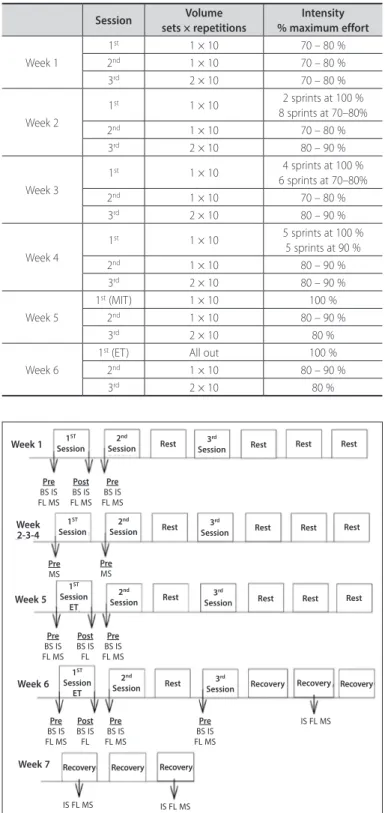
The subjects were trained 3-day a week for 6-week. All training ses-sions were performed on Mondays, Tuesdays, and Thursdays. During training, the subjects were asked to perform consecutive 30m sprints. One set was composed of 10 repetitions and the subjects performed one set in the 1st and 2nd sessions of each week and two sets in the
3rd session of each week. In the first 5-week, the subjects were adapted to
the intensity (based on a percentage of the individual maximum effort) of the training which increased gradually in the first training session of the each week. (Table 1; Figure 2)
Maximal intensity training session (MIT): In the 1st session of the 5th
week, all sprints were performed at the maximal speed.
Exhaustive training session (ET): In the 1st training session of the 6th
week, the subjects were asked to perform a maximum number of sets to the point of exhaustion. The exercise was terminated when the subject reached volitional fatigue. All sprint sets were performed at the maximal speed. ET was followed by regular training sessions as in the adaptive training period. Subjects were asked to train their weekly routine in the 2nd and 3rd sessions of the 6th week. At the end of final training session,
6 days of recovery were given without any training.
Subjects’ 30m sprint performance was measured before and 24-hour after training in the first session of each week throughout the training period. Isometric strength and flexibility were measured before, imme-diately after, and 24-hour after the first day of the training program, MIT and ET. In addition, all performance measurements (after a standardized 15-minute warm-up) were made 72-hour after ET and the 2nd, 4th and 6th
days of recovery. Blood samples were taken before, immediately after and 24-hour after the first day, MIT and ET, and 72-hour after ET. (Figure 1) To minimize the time effect, all training and measurements were performed at the same time of day for each subject.
511 Training protocol
All training sessions were performed on a 60m indoor track at Cu-kurova University Sports Physiology Laboratory. Before the training ses-sions, the subjects completed a standardized 15 min warm-up period, involving light jogging, a series of dynamic sprint drills, stretching, and several acceleration runs. Subjects were tested prior to the 1st and 2nd
training sessions of each week and the final training session, therefore completing their regular warm-up prior to testing. The training consisted of 30m repeated sprints interspersed with 30-second of active jogging recovery. Each set was interspersed with 5 min of passive recovery. Dur-ing the active recovery period between sprints, the subjects decelerated
within the 10m distance after passing the finish line and jogged back to the starting line. Sprint times were measured with infrared light sensors connected to a timing device (New test Oy, Oulu, Finland). The recovery time was controlled by hand-held stopwatch.
Maximal isometric strength
Maximal isometric knee extension strength from the dominant leg was measured with an isokinetic dynamometer (Cybex, Norm 6000). The dynamometer was set up according to manufacturer’s instructions; the joint angle was set at 60º of extension and gravity compensation was employed to allow for inter subject variations in moment acting upon limb weight. All participants completed two tests with 5-second duration and were separated with 60-second recovery period. Standardized verbal instructions and encouragements were provided throughout the protocol. The best peak isometric strength value was used in the data analysis.
Sit and reach test (SRT)
A standard sit-and-reach box was used to measure the subjects’ flexibility.17 SRT is typically used to evaluate flexibility of the low back
and hamstring muscles. Subjects were seated on the floor with their bare feet touching the box. The subjects then slowly reached forward towards their toes while keeping their legs straight and their hands together pushing the sliding ruler that was centered on the top of the box to obtain the SRT scores. The test was performed three times and the best score was recorded.
30m sprint test
The subjects stood 30 cm behind the start line to avoid premature triggering of the timing system and completed three maximal sprints which were separated by 60-second of recovery. The fastest 30m sprint time was recorded for data analysis.
Blood analysis
Blood samples (10 ml) were collected from the antecubital vein for serum CK and cortisol measurements. Whole blood was allowed to clot at room temperature. Subsequently, blood was centrifuged at 3500 rpm for 5-minute and was separated into serum. Serum CK and cortisol levels were determined immediately. CK was measured with colorimetric assay procedure and cortisol was measured with electrochemiluminescen-ce immunoassay (Elecsys Modular Analytics E170; Roche Diagnostics, Mannheim, Germany). All blood sampling processes were performed at the same time of the day.
Statistical analyses
Changes in isometric strength, flexibility, 30m sprint time and cortisol over time were analyzed using a repeated measures analysis of varian-ce (ANOVA). Bonferroni correction was used as a post hoc test when main effects were found to be significant. CK data were not normally distributed, determined by the Kolmogrov–Smirnov and Shapiro–Wilk normality tests. Therefore, Friedman’s nonparametric test was used to determine whether significant changes occurred with time for the CK data, and changes were located with Wilcoxon’s matched-pair signed-rank test. Other parameters in the study were normally distributed. Statistical significance was accepted at p<0.05. The values were reported as mean ± standard deviation (S.D.). The SPSS version 16 was used for all analyses (16, SPSS Inc. Chicago, IL).
RESULTS
In the ET, one subjects performed 17 sprints, four subjects performed 20 sprints, one subjects performed 24 sprints, one subjects performed 26 sprints, one subjects performed 30 sprints, one subjects performed Figure 1. Study design. BS= Blood sampling, IS= Isometric strength, FL= Flexibility,
MS= Maximal sprint.
Table 1. Weekly program for the 6 weeks of repeated sprint training.
Session sets × repetitionsVolume % maximum effortIntensity Week 1 1st 1 × 10 70 – 80 % 2nd 1 × 10 70 – 80 % 3rd 2 × 10 70 – 80 % Week 2 1st 1 × 10 2 sprints at 100 % 8 sprints at 70–80% 2nd 1 × 10 70 – 80 % 3rd 2 × 10 80 – 90 % Week 3 1st 1 × 10 4 sprints at 100 % 6 sprints at 70–80% 2nd 1 × 10 70 – 80 % 3rd 2 × 10 80 – 90 % Week 4 1st 1 × 10 5 sprints at 100 % 5 sprints at 90 % 2nd 1 × 10 80 – 90 % 3rd 2 × 10 80 – 90 % Week 5 1st (MIT) 1 × 10 100 % 2nd 1 × 10 80 – 90 % 3rd 2 × 10 80 % Week 6
1st (ET) All out 100 %
2nd 1 × 10 80 – 90 % 3rd 2 × 10 80 % 1ST Session Pre BS IS FL MS Week 1 Week 5 Week 6 Week 7 Week 2-3-4 Pre BS IS FL MS Pre BS IS FL MS Pre BS IS FL MS IS FL MS IS FL MS IS FL MS Pre MS PreMS Pre BS IS FL MS Post BS IS FL MS Post BS IS FL Post BS IS FL 1ST Session 1ST Session ET 1ST Session ET 2nd Session 2nd Session 2nd Session 2nd Session 3rd Session 3rd Session 3rd Session 3rd Session Rest Rest Rest Rest Rest Rest Rest
Recovery Recovery Recovery
Recovery Recovery Recovery
Rest Rest Rest Rest Rest Rest Pre BS IS FL MS Pre BS IS FL MS
512
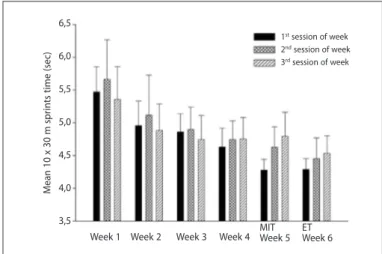
35 sprints, one subjects performed 40 sprints, one subjects performed 46 sprints and one subjects performed 50 sprints. There was no significant difference in mean sprint time (10 repetitions) between MIT (4.28 ± 0.1 sec) and the first set of ET (4.27 ± 0.1 sec) (p>0.05. (Figure 2)
30m sprint times measured before the first training session of each week were 4.28 ± 0.2, 4.21 ± 0.1, 4.17 ± 0.1, 4.09 ± 0.1, 4.11 ± 0.1 and 4.07 ± 0.1 sec, respectively for the 1st, 2nd, 3rd, 4th, 5th and 6th weeks. 30m
sprint performance was improved significantly at the 3rd, 4th, 5th and 6th
weeks compared to initial (p<0.01). (Figure 3)
30m sprint times measured 24-hour after training in the 1st (4.28 ±
0.2 sec), 2nd (4.27 ± 0.2 sec), 3rd (4.2 ± 0.2 sec), 4th (4.11 ± 0.1 sec) and 5th
(4.11 ± 0.2 sec) weeks, was not significantly different from the pre--training value (p>0.05). However, a significant reduction in the sprint performance was observed at 24 (4.18 ± 0.2 sec, P < 0.05) and 72-hour (4.24 ± 0.2 sec, P<0.001) after ET. Sprint performance during 6-day recovery period was still significantly lower than the pre-ET value (4.29 ± 0.3, 4.2 ± 0.2 and 4.17± 0.1 sec for the 2th, 4th and 6th days of
recovery, respectively, P<0.05, Figura 3).
The pre-training isometric strength at the ET was significantly higher than the first day and MIT (p<0.05). (Table 2) Immediately after and 24-hour after MIT, the isometric strength was unchanged compared to the pre-training value (p>0.05). A significant immediate decrease in the isometric strength was found at the first day (P<0.05) and ET (P<0.01).
24-hour after the first day, isometric strength returned to the pre-trai-ning value (p>0.05). Significant decrement in the isometric strength was observed at 24 and 72-hour after ET (P<0.05). The subjects had not been able to recover completely during the 6-day recovery period and all the values were significantly lower than the pre-ET value (P<0.05).
Pre-training flexibility was not significantly different among the first day, MIT and ET (p>0.05). (Table 2) The subjects’ flexibility in both the first day and MIT did not change immediately after training, but decreased significantly 24-hour after training compared to pre-training value (P<0.05). A significant decrement in the flexibility was observed immediately after, 24-hour, and 72-hour after ET (P<0.05). The subjects’ flexibility remained significantly lower during the recovery period when compared to the pre-ET value (P<0.05).
Pre-training serum CK and cortisol levels were not significantly different among the first day, MIT and ET (p>0.05). (Table 3) CK increased significantly immediately after training (P<0.01) and 24-hour after training (P<0.01) when compared to pre-training values. 24-hour after the ET, the increase was significantly higher when compared to the first day and MIT (P<0.01). CK was still significantly higher 72-hour after training compared to the pre-training values of the ET (P<0.01). Cortisol only elevated significantly immediately after the ET (p<0.001) when compared to pre-training values. Table 2. Changes in the isometric strength and flexibility of subjects during the study period.
Measure Isometric Strength (N) Flexibility (cm) First day Week 1 Pre-training 250 ± 35.2# 28.3 ± 4.4 Post-training 231 ± 27.5* 28.4 ± 4.7 24 hr after 234.3 ± 36.1 26.5 ± 5* MIT Week 5 Pre-training 267.8 ± 45.1# 28.2 ± 4.6 Post-training 258.8 ± 39.3 27.7 ± 4.2 24 hr after 275.6 ± 39.3 26.4 ± 4.7* ET Week 6 Pre-training 284.4 ± 52.5 28.1 ± 4.2 Post-training 243.9 ± 32.4* 26.3 ± 4.1* 24 hr after 259.7 ± 40.4* 25.3 ± 5.5* 72 hr after 267.1 ± 45.6* 25.5 ± 5.5* Recovery 2th day 260.7 ± 42.1# 24.8 ± 5# 4th day 266.2 ± 47.3# 25.8± 5.1# 6th day 262.2 ± 49.9# 26.5 ± 4.9#
Values are means ± SD;* Significantly different from pre-training values of the each week (P< 0.05). & Significantly different from pre-training values of the first week (P< 0.05). # Significantly different from pre-training values of the 6th week (P< 0.05).
Table 3. Changes in the serum creatine kinase and cortisol levels following the first day, MIT and ET.
First day
Week 1 Week 5MIT Week 6ET
Creatine Kinase (U/L)
Pre-training 196 ± 103.3 176.2 ± 70.3 153.7 ± 29.5
Post-training 248.8 ± 121.6* 223.8 ± 86.1* 223.6 ± 47*
24 hr after 406 ± 304.1*,& 377.7 ± 245.9*,& 647.7 ± 366*
72 hr after 380.7 ± 247* Cortisol (µg/dl) Pre-training 13.5 ± 3.3 13.2 ± 4 13.5 ± 4.2 Post-training 14 ± 6 15.2 ± 4.6 25.9 ± 3.9* 24 hr after 13.5 ± 5.6 12.9 ± 3 12.5 ± 2.7 72 hr after 15.1 ± 3.9
Values are means ± SD; * Significantly different from pre-training value of each training session (P < 0.05); & significantly different from 24 hours after ET (p < 0.05).
Figure 2. Weekly training intensity (mean 10 × 30 m sprint time ± SD) for the three training sessions of each week (Average running speed was not different for the MIT and ET – note; mean value of the first set of data is given in the figure for the ET and the 3rd session of each week).
Week 1 Week 2 Week 3 Week 4
M ean 10 x 30 m spr in ts time (sec) 6,5 6,0 5,5 5,0 4,5 4,0 3,5 MIT Week 5 ETWeek 6 1st session of week 2nd session of week 3rd session of week
Figure 3. Changes in 30m sprint performance before and after the first training session of each week (mean ± SD).
#Significantly different from pre-training value of the 1th week; & significantly different from pre-training value the 2th and 3th weeks; * Significantly different from the pre-training value of the ET (p < 0.05).
Week 1 Week 2 Week 3 Week 4
30m maximal spr in t time (sec) 4,6 4,4 4,2 4,0 3,8 MIT Week 5 # #,& #,& #,& * ET Week 6
Pre- 1st training session of week
1 day after 3 days after
2nd, 4th, 6th days of recovery respectively
* *
* *
513
DISCUSSION
The main finding of this study is that during the training period, a single session of exhaustive exercise may cause long-term performance reduction even in regularly trained individuals. These data suggest that regular performance evaluation together with CK and cortisol may be useful for monitoring training stress and tolerance to training.
In this study, the training program was based on the progressive overloading principle18,19 and training intensity was increased
progres-sively through the 5-week period. Sprint performance improvement may be accepted as evidence of our training program’s efficiency. Through the 5-week period, subjects had been able to recover within 24 hours following the first training session of each week. On the other hand, exercise to the point of exhaustion as performed in the 6th week of
the study was improper stress for the subjects and caused a significant decrement in 30m sprint performance, muscle strength and flexibility. Moreover, subjects had not been able to recover in the following 9-day period which consisted of two training sessions and 6-day of recovery. As noted earlier,15,19,20 following strenuous training, a performance
re-duction may be attributed to muscle damage. Long term decrement in athletic performance together with an increase in CK have been reported during and/or after the intensified training period.19,20,21 Only a one-day
exhaustive training session as performed in our study resulted in a long term reduction of performance. The time needed to recover performance after ET was greater than the previous weeks’ training sessions. Despite low intensity and volume training performed in the following two train-ing sessions, the imbalance between traintrain-ing and recovery may have prolonged the duration of fatigue. Such performance reduction can also be seen following an “all out” competition.
It has been documented that repeated sprinting with rapid decelera-tion may have the potential to induce muscle damage.4,16 The increases
in CK following repeated sprint exercise provide evidence of skeletal muscle fiber damage.4,16 Isometric strength is thought to be the most
accurate and reliable indirect marker of muscle damage8 and is known
to remain depressed for several days after exercise.7,9 Isometric strength
of the knee extensors has been shown to decrease 24 and 48-hour after repeated sprint exercise.4 It has also been shown that sprinting
perfor-mance10,22 and flexibility23,24 reduction is associated with muscle
dam-age. In this study, sprint performance, isometric strength, and flexibility
were reduced following the ET. All of these findings together with the increased post-training CK may indicate the presence of muscle tissue damage caused by repeated sprinting.
It is known that increasing the number of eccentric contractions produces greater muscle damage.13,14 The time needed for muscle
re-covery depends on the severity of the muscle damage.13,14 In this study,
although training increased serum CK following both the first day and MIT, it did not negatively affect performance during successive days. A higher increase in CK was observed when the sets were repeated until exhaustion in the ET. In addition, ET had a long term negative effect on muscle performance. The training volume was possibly greater than subjects were accustomed to, thereby causing greater severity muscle damage by ET despite relatively well-trained subjects.
An exercise is particular form of metabolic and physical stress which is shown to be a potent activator of the hypothalamo-pituitary-adrenal axis (HPA), increasing cortisol levels.25,26 Training intensity and
dura-tion are one of the determinants of the HPA response to exercise.26,27
The exercise-induced increase in the blood cortisol is essential for normal metabolic response and adaptation to exercise.28 On the other hand, it
has been considered that resting cortisol generally reflect a long-term training stress.28,29 Significantly elevated cortisol levels following the ET
indicate that this type of physical activity was enough to cause a stressful situation for the body. Insignificant post-training cortisol changes in the first day of the training program may be explained by the low intensity of the training. Whereas in MIT, due to the possible adrenal adaptation of the subjects,30 cortisol may not have changed significantly even when
exercise intensity was increased compared to the beginning.
CONCLUSION
Relatively greater muscle damage and hence more severe symptoms can be observed even in regularly trained individuals when the volume of maximal intensity repeated sprint exercise is increased dramatically during the training period. If adequate recovery is not allowed during subsequent training sessions even at normal intensity and volume, it may prolong the duration of fatigue.
All authors declare no potential conflict of interest related to this article
REFERENCES
1. Spencer M, Bishop D, Dawson DB, Goodman C. Physiological and metabolic responses of repeated sprint activities: specific to field based team sports. Sports Med. 2005;35(12):1025-44.
2. Thompson D, Nicholas CW, Williams C. Muscular soreness following prolonged intermittent high-intensity shuttle running. J Sports Sciences. 1999;17(5):387-95.
3. Fridén J, Seger J, Ekblom B. Sublethal muscle fibre injuries after high-tension anaerobic exercise. Eur J Appl Physiol. 1988;57(3):360-8.
4. Howatson G, Milak A. Exercise-induced muscle damage following a bout of sport specific repeated sprints. J Strength Cond Res. 2009;23(8):2419-24.
5. Hoffman JR, Kang J, Ratamess NA, Faigenbaum AD. Biochemical and hormonal responses during an intercollegiate football season. Med Sci Sports Exerc. 2005;37(7):1237-41.
6. Brancaccio P, Maffulli N, Limongelli FM. Creatine kinase monitoring in sport medicine. Br Med Bull. 2007;81-82:209-30.
7. Clarkson PM, Nosaka K, Braun B. Muscle function after exercise-induced muscle damage and rapid adaptation. Med Sci Sports Exerc. 1992;24(5):512-20.
8. Warren GL, Lowe DA, Armstrong RB. Measurement tools used in the study of eccentric contraction induced injury. Sports Med. 1999;27(1):43-59.
9. Cleak MJ, Eston RG. Muscle soreness, swelling, stiffness and strength loss after intense eccentric exercise. Br J Sports Med. 1992;26(4):267-72.
10. Twist C, Eston RG. The effects of exercise-induced muscle damage on maximal intensity intermittent exercise performance. Eur J Appl Physiol. 2005;94(5-6):652-8.
11. Byrne C, Twist C, Eston RG. Neuromuscular function following exercise-induced muscle damage: theoretical and applied implications. Sports Med. 2004;34(1):49-69.
12. Byrne C, Eston RG. The effect of exercise induced muscle damage on isometric and dynamic knee extensor strength and vertical jump performance. J Sport Sci. 2002;20(5):417-25.
13. Nosaka K, Newton M. Difference in the magnitude of muscle damage between maximal and submaximal eccentric loading. J Strength Cond Res. 2002;16(2):202-8.
14. Clarkson PM, Tremblay I. Exercise-induced muscle damage, repair and adaptation in humans. J Appl Physiol. 1988;65(1):1-6.
15. Simith LL. Cytokine hypothesis of overtraining: A physiological adaptation to excessive stress? Med Sci Sports Exerc. 2000;32(2):317-31.
16. Keane KM, Salicki R, Goodall S, Thomas K, Howatson G. Muscle damage response in female collegiate athletes after repeated sprint activity. J Strength Cond Res. 2015;29(10):2802-7.
AUTHORS’ CONTRIBUTIONS: Each author made significant individual contributions to this manuscript. SKE (0000-0002-3680-3580)* and ZA (0000-0003-1850-7048)*: were respon-sible for data collection, data analysis and interpretation, and the writing of the draft; ÇÖ (0000-0003-3360-8541)*: assisted in data analysis and interpretation; KÖ (0000-0002-6840-6299)* and SK (0000-0002-0797-046X)*: designed the study and supervised the data collection, analysis, and the writing of the manuscript. All authors read and approved the final manuscript. *ORCID (Open Researcher and Contributor ID).
514
17. Hopkins DR, Hoeger WWK. A comparison of the sit-and-reach test and the modified sit-and-reach test in the measurement of flexibility for males. J Appl Sport Sci Res. 1992;6(1):7-11.
18. Fry AC, Kraemer WJ. Resistance exercise overtraining and overreaching. Neuroendocrine responses. Sports Med. 1997;23(2):106-29.
19. Coutts AJ, Reaburn P, Piva TJ. Murphy A. Changes in selected biochemical, muscular strength, power, and endurance measures during deliberate overreaching and tapering in rugby league players. Int J Sports Med. 2007;28(2):116-24.
20. Coutts AJ, Reaburn P, Rowsell GJ. Monitoring for overreaching in rugby league players. Eur J Appl Physiol. 2007;99(3):313-24.
21. Halson SL, Lancaster G, Jeukendrup AE, Gleeson M. Immunological responses to overreaching in cyclists. Med Sci Sports Exerc. 2003;35(5):854-61.
22. Highton J, Twist C, Eston RG. The effects of exercise-induced muscle damage on agility and sprint running performance. J Exerc Sci Fit. 2009;7(1):24-30.
23. Worrell TW, Perrin DH, Cansneder B, Cieck I. Comparison of isokinetic strength and flexibility measures between hamstring injured and noninjured athletes. J Orthop Sports Phys Ther. 1991;13(3):118-25.
24. Askling C, Saartok T, Thorstensson A. Type of acute hamstring strain affects flexibility, strength, and time to return to pre-injury level. Br J Sports Med. 2006;40(1):40-1.
25. Buono MJ, Yeager JE, Hodgon JA. Plasma adrenocorticotropin and cortisol responses to brief high-intensity exercise in humans. J Appl Physiol. 1986;61(4):1337-9.
26. Luger A, Deuster PA, Kyle SB, Gallucci WT, Montgomery LC, Gold PW, et al. Acute hypothalamic-pituitary adrenal responses to the stress of treadmill exercise. Physiologic adaptations to physical training. N Engl J Med. 1987;316(21):1309-15.
27. Kuoppasalmi K, Naveri H, Harkonen M, Adlercreutz H. Plasma cortisol, androstenedione, testosterone and luteinizing hormone in running exercise of different intensities. Scand J Clin Lab Invest. 1980;40(5):403-9. 28. Kraemer WJ, Ratamess NA. Hormonal Responses and Adaptations to Resistance Exercise and Training.
Sports Med. 2005;35(4):339-61.
29. Purge P, Jürimäe T, Jürimäe J. Hormonal and psychological adaptation in elite male rowers during prolonged training. J Sports Sciences. 2006;24(10):1075-82.
30. Silva TS, Longui CA, Faria CDC, Rocha MN, Melo MR, Faria TG, et al. Impact of prolonged physical training on the pituitary glucocorticoid sensitivity determined by very low dose intravenous dexamethasone suppression test. Horm Metab Res. 2008;40:718-21.