An Evaluation of Faculty Use of the Digital Library at Ankara
University, Turkey
Doğan Atilgan Associate Professor (PhD) Ankara University Library DirectorDepartment of Information and Record Management
Ozlem (Gokkurt) Bayram Research Assistant (PhD) Ankara University
Department of Information and Record Management
An Evaluation of the Use of the Digital Libraries at Ankara University, Turkey
Abstract
New consortial buying models have dramatically increased the availability of online resources, particularly journal articles, in the universities and technical institutes of developing countries. The degree of acceptance and pattern of use of such materials is of great interest to library collection development. Ankara University surveyed faculty members regarding their awareness and use of these electronic materials.
Introduction
As a result of the information revolution, industrialized societies are gradually becoming information societies. Schram (1996) and Mchombu (1998) discuss information as an essential resource for economic and social development in the Third World. Developing countries such as Turkey are adopting technological changes in order to transform the libraries.1 However, there are challenges to change. It is not enough to produce a library web site. Important parameters such as functional literacy, national bibliographic control and information policy all need to be considered. Although more than 80% of the population is literate, functional literacy has not been evenly achieved by the different social groups in Turkey.2 Capar concludes that this is because library patrons are not provided enough education on the use of library publications, information centers and services.
Digital technologies require new values, attitudes and patterns of behavior to access information. A digital library is not successful unless the system is used effectively. Therefore, there is a great deal of interest in measuring the extent to which users are utilizing such resources and services. This article focuses on the importance of application of evaluation tools, especially with regard to digital resources.
Libraries are increasingly involved in collaborative endeavors of both preservation and retrieval of collections in order to minimize costs and prevent duplicative effort. There are a number of digital initiatives addressing reformatting and access issues for digital collections in the USA, UK, Canada, Australia and Europe.3
Over the past few years, there has been an increasing investment in information technology in many countries. In the USA, the expense of information technology is more than 50% of general expenses. In the last decade, the USA has spent more than three trillion dollars on information technology in the recent decade.4
In recent years many Turkish university libraries have joined digital library consortiums; however, their efforts are focused on providing a digitized collection rather than maintaining a user-centered system for that collection. Therefore, this study aims to provide data from the faculty perspective to identify the most frequently used online resources acquired in the 2002–2003 academic year for a typical Turkish academic library. The survey summarizes conclusions from a recent survey of Ankara University faculty and highlights some conclusions about how faculty members use electronic collections, including a ranking of databases by their importance to faculty users.
Evaluating Digital Libraries: Literature Review
In Turkey, the lack of user studies is surprising considering the increasing interest in, and number of, digital library projects. Studies from other countries, however; have examined the use of online resources in the academic environment and provide a useful context for considering the Turkish situation. The key issues in digital library assessment, including consortial collection assessment, are defining library users and
their needs, evaluating functionality of online resources, and identifying system requirements.
Bancroft (et al.) reported a user survey examining the library services, including electronic journals, at the Washington State University.5 This survey requested faculty members and graduate students to rank the electronic resources as essential for their work. Faculty reported that the library OPAC was the most important source for their work (37.5%). However, over 70% of faculty expressed “No opinion /never used” concerning online full text journals. As proved to be the case for our study, the results of the WSU survey were also useful in subsequent decision-making involving journal cancellation.
A survey of the use of the electronic journals at the University of Patras in Greece looked at the frequency of use according to the demographic profile of library patron’s including faculty members. Age, gender and academic position were considered. E-journal service appears to be used by all ages, although the majority of use was reported by those under 35 as a result of the high proportion of students who completed the questionnaire. Proportionally, more males used the service on a daily, weekly or monthly basis than females. This survey also investigated reasons for using electronic resources 6.
CIBER (Coordinamento Interuniversitario Basi dati e Editoria in Rete), Central-Southern Italian Library Consortium survey showed both an increasing use of electronic journals and an ongoing need for promotional activities to academic communities for awareness of online resources 7. A similar survey undertaken by the Utah State University Libraries asked respondents whether they were aware of the libraries’ electronic databases. More than two-thirds of the respondents were aware of some of the electronic resources. Respondents who were aware of and made use of databases were
asked to rate the importance of each database to their own work. 8 The majority of faculty respondents (77.8%) gave a high priority rating to Elsevierelectronic journals.
Tenner and Yang analyzed the relationship between electronic journal use and the age and status of faculty members and found that assistant professors were most likely to have used electronic journals (44.7%), followed by full professors (34.5), and associate professors (34.2%) 9.
The research question addressed in our study is to what extent do Turkish faculty reveal similar attitudes and report similar use patterns to other faculty world-wide and what does this mean for publicizing library digital resources.
Case Study
Method of the study
Ankara University Libraries have been concerned about the use of e-databases and the degree to which such subscriptions can be useful. Usefulness is one of the crucial measures of how appropriate the information resources or services are for a defined user group. Therefore, the key objectives of the study were two: to examine the level of awareness by academic staff of digital library resources along with their use rate and to evaluate the preferences of faculty for specific electronic databases. A number of factors and their interrelationships were considered in the survey issues such as academic rank and discipline in connection with use frequency and preferences in order to determine how these factors affect one another.
The level of subscription use and/or sample issues as a case study was undertaken by means of a questionnaire in 2002. The questionnaire was then distributed to 3800 academics the total number of faculty positions at Ankara University. Some 2100 (55%)
of the forms were returned. Excluded from the evaluation were 104 of these returned forms made invalid because of mistakes in filling out the questionnaire, leaving a total of 1996 (53%) useable responses.
Results and analysis
The 1996 forms were analyzed with the number and percentage of each pattern being recorded and tabulated. Faculty members were distributed in 15 Faculties, 9 colleges and two Research Centers within Ankara University. Some of those who, work in Research Centers, Institutes and Colleges, were evaluated under their Faculty/Unit. The results are presented in Appendix A. A review of these data for our respondents shows that they constitute a representative sample of academics in Ankara University.
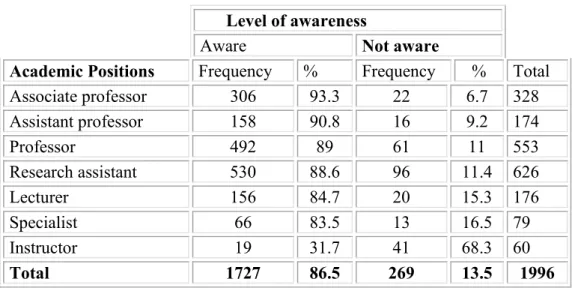
A large majority (86.5%) of respondents indicated that they knew digital library resources existed in Ankara University. When looking at the distribution of the level of awareness by faculty members according to faculty rank, associate professors placed first with a ranking of 93.3%. Assistant professors placed second (90.8%), professors placed third (%89.0) and research assistants placed fourth (88.6%) in the ranking. Lecturers (84.7%), specialists (83.5%) and instructors (31.7%) are last in level of awareness. (Table 1: Level of awareness of digital library). The associate professors and assistant professors are expected to make original research in their fields. They are also required to publish their researches in order to promote to higher positions whereas instructors are not required to do so. Thus, both the associate professors and assistant professors expressed the highest use among the other faculty members.
A quarter (24.8%) of the respondents who reported knowing that digital library resources existed indicated that they had “no information at all” about the contents of the
electronic databases. Almost half (45.9 %) knew something of these databases, and 29.4% replied that they knew many of the electronic databases (Table 2: Level of knowledge of databases).
Of the 1727 respondents indicating that they had knowledge about the contents of electronic databases, 20.5% reported that they did not use these resources while, 52.0% of respondents reported occasionally use, and 27.5% reported using these databases frequently (Table 3: Use of databases). The results showed that there is a relationship between table two, “level of knowledge of databases” and table three, “use of databases”. Only 20% of the respondents who have knowledge of databases do not use them at all. The respondents who have knowledge of databases constitute the large majority of database usage. This result supports the idea that the use of electronic databases is influenced by the level of knowledge of them. Having knowledge of databases is seen as a major advantage, while lack of knowledge as a major disadvantage. This indicates that the librarians should give more importance to the training of the database usage.
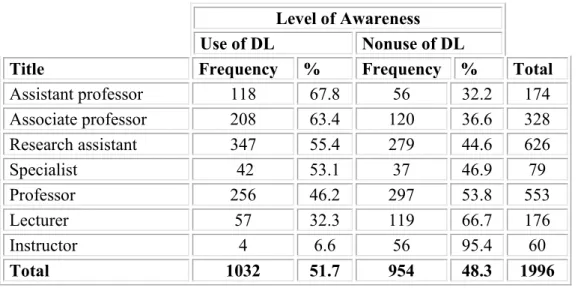
When use of the electronic databases is analyzed, in respect of faculty rank and level of awareness, assistant professors, who ranked second as concerns level of awareness of the digital library (DL), placed first for use (67.8%). Associate professors, who were first with regard to level of awareness, were in second place for use (63.4%). Research assistants, were fourth in level of awareness, and were in third use of databases (55.4%). While specialists were sixth in level of awareness, they placed fourth in use (53.1%). Professors, third in awareness, were only fifth in use (46.2%). Lecturers who placed fifth in level of awareness, placed sixth in use with 32.3%. The least use of the digital library was made by the instructor (6.6%) (Table 4: Use of digital Library).
Among the 1727 respondents, declared that they were aware of the digital library, 1032 of them had used the digital library and rest did not.
Another evaluation was undertaken to determine the preferences in use of the databases by all respondents who had declared that they use it frequently and occasionally (1032) in table three. The results showed that ISI-Web of Science was most preferred with 37.7%; second was EBSCO Host with 21% and third was ScienceDirect with 18.7%. As second choice in importance, ISI-Web of Science was selected by 15.5%,
EBSCO Host by 12.4%, ScienceDirect by 12.3%, and OCLC by 8.8% of the respondents
(Table 5: use of databases). The large majority (995) of 1032 respondents selected the first preference, and the 37 of them did not make any preference. Because more than this number did not select second or third choice the preference for those choices remained low.
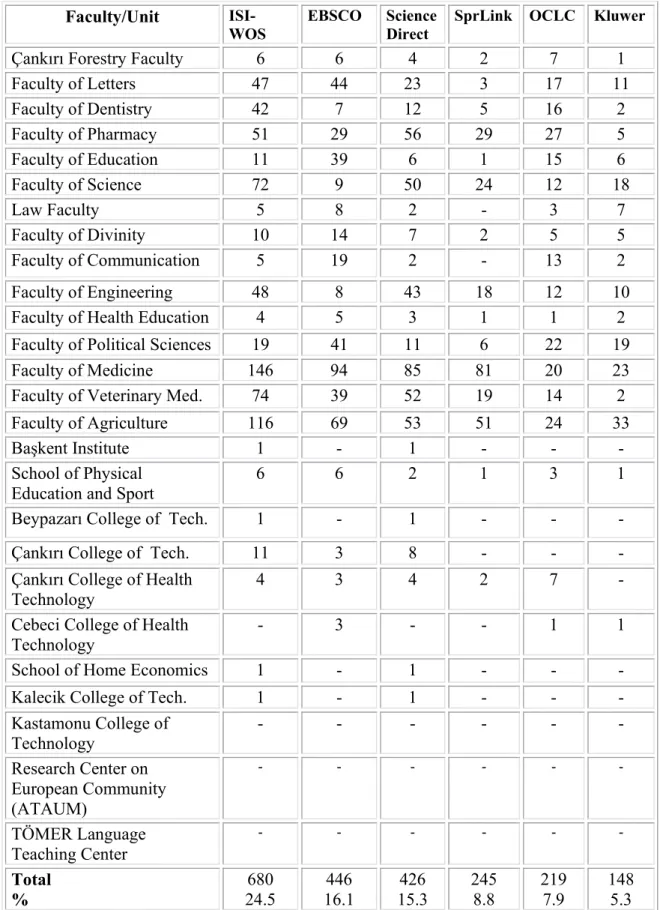
When looking at the use of the database by the faculty (Table 7), the most used were again ISI – Web of Science (24.5%), EBSCO Host (16.1%), Science Direct(15.3%), SPRINGER LINK(8.8%), OCLC (7.9%), Kluwer (5.3%). This table also indicates that the most frequent users of all databases were from the Faculty of Medicine, Agriculture, and Science and Technology (Table 6: Use of databases). It is reasonable to assume that they make more research to follow the current information as scientific data changes more rapidly in medicine, natural science and technology than the other fields. There might be the second reason that as these faculty members has produced more publication in English they use databases more than the faculty members from Faculties of Social Sciences.
After determining the usage of the electronic databases, the second step was to find out for what purposes they were used. 11.9% of the respondents use databases for
education-teaching purposes, 86.7% prefer these resources for research (bibliographic search & information retrieval) purposes, and 1.4% of them use electronic databases to have some knowledge about these resources (Table 7 : Purposes of database use). It is seen that the major reason for database use is the purpose of information retrieval.
The 266 respondents that do not use databases in table three responded the reasons for not using the database. When the reasons for not using the digital library were identified 38% of the faculty members indicated that they had no knowledge about how to use it. 36.1% stated that they met their information need from other sources. The rest of them had either “no knowledge” about digital information technology (8.6%) or “no interest” in these databases (8.6%). 1.1% of the faculty members called these databases “not very useful” (Table 8: Reasons for not using digital library). As table fifth, here in table 7 and table 8, a large majority of respondents did not make second and third choice.
The total number of answers to the question about the best way to teach patrons about the electronic databases was 1867. The respondents asked to select only one preference on how the database usage training should be provided, however; the 1867 of 1996 respondents answered that question and 129 (6.5%) did not. 24.0% of the respondents think that the best way would be provide instructional material including database information; 5.6% think training classes should be organized on a regular basis; and 19.4% think both instructional material and classes should be provided. 10.1 % of respondents suggested consulting information services, and 40.8 % suggested help links under the library homepage on the Internet (Table 9: User preferences for training). This indicates that most of the respondents preferred the training to be given via Internet, and
the rest of them preferred it to be given by traditional training methods. It is seen that Ankara University members are adapted to information technology.
Conclusion
The consciousness of the importance of information technology in scientific research and development in Ankara University places great emphasis on the use of digital resources by researchers. This study was undertaken in order to see how well the electronic resources of the Ankara University Libraries are being used and to have an idea of how to improve this use.
Library-use questionnaires from several academic institutions were reviewed. The surveys included data related to the characteristics of end-users such as age, status and gender, as well as their use of electronic databases and/or journals. We used similar indicators in order to compare Turkish faculty attitudes and use patterns to this larger, population realizing that Turkish academic libraries may need to improve their services to academic communities to increase awareness and provide training.
The results of the study inform the ongoing development of the Digital Library system in Ankara Universities. As a research tool, this survey was expected to provide information that would help in two directions: First, in decisions on how many of these e-databases the library should subscribe to. Second, in analyzing the level of awareness among the faculty members along with the frequency of their use of the digital library.
According to the results, the majority of the faculty members of 26 Faculty/units of Ankara University know about the existence of the digital library. Many of the faculty members, although not all of them, use electronic databases. The study also shows that more effort is needed to encourage the use of databases. It might be useful to explore why professors and research assistants place after associate and assistant professors in the use
of electronic databases, although they place first in level of awareness of the digital library.
Ankara University, which started providing electronic database services in 1999 with a Web of Science subscription, joined the Anatolian University Libraries Consortium (ANKOS) in 2000. At present, 35 databases, including those on trial, have been made available. The most preferred databases have been Web of Science, Science Direct and
Ebsco, but the benefits of these databases can be fully realized only if they are widely and
heavily used.
To examine whether there might be a relationship between the use of databases in Ankara University Libraries and information production by faculty members a search has been made through the citation indexes in Web of Science. It has been concluded that there has been a notable increase in works published by Ankara University faculty since 2000. 430 articles were published in 2000 and this number rose to 583 in 2001. Considering that there were nearly 400 fewer in 2001, this result become more significant. It seems possible that there is a positive impact of newly subscribed databases on this increase in publishing. The extent to which the use of databases can influence productivity in Ankara University might be a topic for further study.
Appendix A : Academic ranks and locations of respondents
Faculty/Unit Prof. Assoc.
Prof. Ass. Prof
Lecturer Research Assistant
Specialist Instructor Total
Çankırı Forestry Faculty 3 7 2 12
Faculty of Letters 36 33 29 74 22 2 1 197 Faculty of Dentistry 46 20 3 28 6 1 104 Faculty of Pharmacy 5 7 13 23 3 1 52 Faculty of Education 22 14 12 26 2 9 85 Faculty of Science 24 17 17 53 11 3 125 Law Faculty 5 6 4 10 1 26 Faculty of Divinity 16 12 6 16 9 59 Faculty of Communication 8 4 5 14 6 4 41 Faculty of Engineering 22 10 13 29 1 75
Faculty of Health Education 1 6 6 2 4 1 1 21
Faculty of Political Sciences 19 6 12 39 3 79
Faculty of Medicine 188 97 22 135 19 43 504
Faculty of Veterinary Med. 61 36 5 53 1 156
Faculty of Agriculture 87 51 16 102 2 258
Başkent Institute 1 1 2 3 7
School of Phys. Educ. & Sport
1 2 3 2 6 14
Beypazarı College of Tech. 6 3 9
Çankırı College of Tech. 2 34 3 6 45
Çankırı College of Health Tech.
2 3 5
Cebeci College of Health Tech
1 1 1 10 3 16
School of Home Economics 7 5 3 11 26
Kalecik College of Technology
1 6 2 9
Kastamonu College of Tech. 1 19 1 21
Research Center on European Community (ATAUM)
2 2
TÖMER Language Teaching Center
2 46 48
Level of awareness
Aware Not aware
Academic Positions Frequency % Frequency % Total Associate professor 306 93.3 22 6.7 328 Assistant professor 158 90.8 16 9.2 174 Professor 492 89 61 11 553 Research assistant 530 88.6 96 11.4 626 Lecturer 156 84.7 20 15.3 176 Specialist 66 83.5 13 16.5 79 Instructor 19 31.7 41 68.3 60 Total 1727 86.5 269 13.5 1996
Table 1. Level of awareness of digital library
Frequency % No information at all 429 24.8 Information about some 791 45.9 Information about many 507 29.3
Total 1727 100
Table 2. Level of knowledge of databases
Frequency %
Occasionally 675 52.0
Often 357 27.5
Not at all 266 20.5
Total 1298 100
Level of Awareness Use of DL Nonuse of DL
Title Frequency % Frequency % Total
Assistant professor 118 67.8 56 32.2 174 Associate professor 208 63.4 120 36.6 328 Research assistant 347 55.4 279 44.6 626 Specialist 42 53.1 37 46.9 79 Professor 256 46.2 297 53.8 553 Lecturer 57 32.3 119 66.7 176 Instructor 4 6.6 56 95.4 60 Total 1032 51.7 954 48.3 1996
Table 4. Use of digital library
#1 Preference #2 Preference #3 Preference Databases Frequency % Frequency % Frequency %
ISI-Web of Science 389 37.7 160 15.5 88 8.5 EBSCO Host 217 21.0 128 12.4 69 6.7 Science Direct 193 18.7 127 12.3 88 8.5 SPRINGER LINK 65 6.3 76 7.4 67 6.5 OCLC 43 4.2 91 8.8 36 3.5 Kluwer 30 2.9 42 4.1 34 3.3 MathSciNet 23 2.2 15 1.5 10 1.0 Engineering Village 12 1.2 15 1.5 11 1.1 OVID 12 1.2 11 1.1 10 1.0 Micromedex 6 0.6 18 1.7 11 1.1 IOP 4 0.4 14 1.4 10 1.0 Compendex 1 0.1 1 0.1 1 0.1 Total 995 95.9 698 67.8 435 42.3
Table 6. Use of databases by Faculty/unit name Faculty/Unit
ISI-WOS EBSCO Science Direct SprLink OCLC Kluwer
Çankırı Forestry Faculty 6 6 4 2 7 1
Faculty of Letters 47 44 23 3 17 11 Faculty of Dentistry 42 7 12 5 16 2 Faculty of Pharmacy 51 29 56 29 27 5 Faculty of Education 11 39 6 1 15 6 Faculty of Science 72 9 50 24 12 18 Law Faculty 5 8 2 - 3 7 Faculty of Divinity 10 14 7 2 5 5 Faculty of Communication 5 19 2 - 13 2 Faculty of Engineering 48 8 43 18 12 10
Faculty of Health Education 4 5 3 1 1 2
Faculty of Political Sciences 19 41 11 6 22 19
Faculty of Medicine 146 94 85 81 20 23
Faculty of Veterinary Med. 74 39 52 19 14 2
Faculty of Agriculture 116 69 53 51 24 33
Başkent Institute 1 - 1 - - -
School of Physical Education and Sport
6 6 2 1 3 1
Beypazarı College of Tech. 1 - 1 - - -
Çankırı College of Tech. 11 3 8 - - -
Çankırı College of Health Technology
4 3 4 2 7 -
Cebeci College of Health Technology
- 3 - - 1 1
School of Home Economics 1 - 1 - - -
Kalecik College of Tech. 1 - 1 - - -
Kastamonu College of Technology - - - Research Center on European Community (ATAUM) - - - TÖMER Language Teaching Center - - - Total % 680 24.5 446 16.1 426 15.3 245 8.8 219 7.9 148 5.3
#1 Priority #2 Priority #3 Priority Frequency % Frequency % Frequency %
Education-Teaching 123 11.9 720 69.8 35 3.4
Information Retrieval 895 86.7 120 11.6 3 0.3
Info about Databases 14 1.4 38 3.7 474 45.9
Total 1032 100 878 84.1 512 49.6
Table 7. Purposes of database use
#1 Priority #2 Priority #3 Priority
Frequency % Frequency % Frequency % Don’t know how to
use
101 38 29 10.9 6 2.3
Met info- need by other resources 96 36.1 31 11.7 8 3.0 Have no knowledge about digital technology 43 16.2 20 7.5 8 3.0 Not interested 23 8.6 9 3.4 10 3.8
Found not useful 3 1.1 1 0.4 3 1.1
Total 266 100 90 53.9 35 13.2
Table 8. Reasons for not using digital library
Frequency % Instructional material including databases information 449 22.5
Training classes 104 5.2
Both instructional material and training classes 363 18.2
Consulting librarians 189 9.5
Help links under the Library homepage on the Internet 762 38.1
Total 1867 93.5
Appendix B: Questionnaire on the Use of Electronic Databases and Electronic Journals through the Web
The Ankara University E-Library Survey has been designed to provide information regarding faculty members’ use of electronic databases. It is very important for us to have your feedback to help us improve our services for the future. Please fill out this survey, and return it to the Library and Documentation Management Department in three days.
1. Please provide the following data: a) Academic rank
b) Institution
c) Department /academic unit
2. Are you aware that Ankara University has a digital library? Yes
No
(If “No” please go to Q. 8)
3. Are you aware of the subject content of electronic journals that the University Library subscribes to?
I am not aware
I’m aware of some of them I’m aware of many of them (If “not aware” please go to Q. 8)
4. Do you use electronic databases that the University Library provides in the Library Web pages?
Yes, often
Yes, occasionally No
5. Please put “1”, “2”, “3” etc. in a box according to your frequency of use of the
following databases? (For example, if you use three databases, indicate by using 1 for the highest frequency, down to 3 for lowest. )
ISI – Web of Science ScienceDirect EBSCO Host Silver Platter MathSciNet ProQuest
IOPP ProQuest Digital Dissertations OCLC
History and Life from ABC SPRINGER LINK Ovid
Association of Computing Machinery Micromedex Healthcare Series
Compendex Kluwer Engineering Village Up To Date
6. Please rank in order of importance according to your reasons for using databases, (Indicate by using 1 for your first choice, 2 for your second choice and 3 for your third choice.)
Education and teaching activities (Lecture preperation)
Information retrieval (Research and access to full text) To be informed about electronic databases
7. Please rank your choices according to your reasons for not using databases, (Indicate by using 1 for most important down to 5 for least important)
I don’t know how to use electronic databases I have no knowledge on digital technology I don’t have any interest
I don’t find useful
8. What would be the best way to teach patrons about the electronic databases and their usage?
Providing instructional material including database information Organizing training classes
Providing both instructional material and training classes Consulting librarians
Help links under the Library homepage on the Internet
References and Notes
1. K.J Mchombu. “Impact of Information on Rural Development: Background,
Methodology and Progress.” (1998): http://www.idrc.ca/books/focus/783/mchombu.html
(March 25 2003) ; W. Schram. Mass Media and National Development, Stanford CA, Stanford University(1996),
2. Bengu Capar. “Functional literacy and information retrieval in Turkey” 61st
IFLA General Conference – Conference Proceedings, August 20-25 1995.
Booklet 7, 68- 72. Istanbul. (1995): http://www.ifla.org/IV/ifla61/61-capb.htm. (April 12, 2003).
3. Please see the D-Lib Magazine articles http://www.dlib.org/projects.html#joint for more information.
4. VIII. Beş yıllık kalkınma planı Bilişim teknolojileri ve politikaları Özel ihtisas
komisyonu raporu. Ankara: DPT(2001): http://ekutup.dpt.gov.tr/bilisim/oik576.pdf (April 12, 2003).
5. Audrey Bancroft, F.Vicki, F.Croft, Robert Speth, and Dretha M. Philips . “A Forward looking library use survey: WSU Libraries in the 21st Century. ” The Journal of American
Librarianship 24 (1998): 216–224.
6. Maria Monopoli, David Nicholas, Panagotis Georgiou and Marina Korfiati “A User-oriented Evaluation of Digital Libraries: Case Studies The Electronic Journals Services of the Library and Information Service of the University of Patras, Greece”, Aslib
Proceedings 54 (2002): 103–117.
7. Paola Garciulo. “Electronic journals and users: The CIBER experience in Italy”
Serials: the journal for the serials community (3) (2003) : 293-298.
8. J. Sandra Weingart and Janet A. Anderson “When Questions are Answers: Using a Survey to Achieve Faculty Awareness of the Library’s Electronic Resources”, College &
Research Libraries 61, March 2 (2000): 127 – 134
9. Elka Tenner and Zheng Ye (Lan) Yang. “End-User Acceptance of Electronic Journals: A Case Study from a Major Academic Research Library”. Technical Services Quarterly 2 (1999) :1-11.