ContentslistsavailableatScienceDirect
Journal
of
Analytical
and
Applied
Pyrolysis
j o u r n a l ho me p a g e : w w w . e l s e v i e r . c o m / l o c a t e / j a a p
Preparation
and
characterization
of
polystyrene-b-poly(2-vinylpyridine)
coordinated
to
metal
or
metal
ion
nanoparticles
Tugba
Orhan
Lekesiz
a,
Kadir
Kaleli
a,
Tamer
Uyar
b,
Ceyhan
Kayran
a,
Jale
Hacaloglu
a,∗aMiddleEastTechnicalUniversity,ChemistryDepartment,TR-06800Ankara,Turkey
bBilkentUniv,UNAMInstMatSci&Nanotechnol,TR-06800Ankara,Turkey
a
r
t
i
c
l
e
i
n
f
o
Articlehistory:
Received15March2013
Accepted1January2014
Availableonline9January2014
Keywords:
Metalormetalionnanoparticles,
Polystyrene-block-poly(2-vinylpyridine)
Thermaldegradation
Pyrolysismassspectrometry
a
b
s
t
r
a
c
t
Inthisstudy,Co,CrorAu3+functionalpolystyrene-block-poly(2-vinylpyridine),PS-b-P2VPcomplexes werepreparedandcharacterized.Coordinationofmetalatomoriontonitrogenatomofpyridinerings wasconfirmedbyFTIRanalyses.ThestrengthandefficiencyofcoordinationofP2VPblockstoCo,Cror Au3+mainlydependsonchargeandstabilityofthecomplexformedthatismainlyrelatedtotheenergy ofdorbitals.Theresultsrevealthatthethermalstabilityofthepolymercompositeformedincreaseswith theincreaseinstrengthofthecoordination.Changesinthermaldecompositionmechanismandproduct distributionwererecorded.DegradationofP2VPunitscoordinatedtoCr,CoorAu3+wasstartedbylossof pyridineunitsleavinganunsaturatedand/orcrosslinkedpolymerbackbonethatdegradedatrelatively hightemperatures.
©2014ElsevierB.V.Allrightsreserved.
1. Introduction
Nanostructureshavereceivedgreatattentionrecentlydueto theirspecial optical,electronic, magneticand chemical proper-ties[1–5].Themostpopularapproachinvolvesthesynthesisof nanoparticlesinsituwithintheblockcopolymertemplatebyusing preformedmicellesofblockcopolymerscontainingmetal precur-sors[6–11].Asaconsequenceofthestrongaffinityoftheamines tovariousionsandpolargroups,thepolymerscontaininga pyri-dinemoiety canmakestrongbondswithvariousmetalionsor nanoparticlesandhaveattractedincreasingattention.
Inrecentstudies,poly(vinylpyridine)(PVP)waswidelyusedto synthesizenanoparticlesbyitselfaswellasincombinationwith otherpolymers.Blockcopolymerswiththeabilitytoformstable micellesinsolutionandatinterfacesareexcellentcandidatesfor thepreparationofvariousmetalnanoparticleswithanarrowsize distributionandlong-termstability[12–17].
Forexample,Moelleretal.[15,16]haspreparedgold nanopar-ticles with the use of polystyrene-block-poly-2-vinylpyridine (PS-b-P2VP)copolymerforthefirsttime.Themetalsaltsformed complexes with the pendant pyridine rings, concentrating the metalionsinthepoly-2-vinylpyridinedomains.Lohmuelleretal.
∗ Correspondingauthor.Tel.:+903122105148;fax:+903122103200.
E-mailaddress:[email protected](J.Hacaloglu).
[17]fabricatedvariousmetalnanoparticles(Au,Pt,andPd)packed inquasi-hexagonalorderingusingPS-b-P2VPmicelles.Thesizeof nanoparticleswascontrolledbytheimmersiontimeintoasolution containingmetalprecursors.
Coordinationofmetal/metalionimprovesthethermalstability ofthehostpolymer[18–22].Zanderetal.[22],studiedthethermal characterizationofpoly(4-vinylpyridine) crosslinkedwithmetal saltsandsuggestedthatTgenhancementwashighlydependent uponthetypeandloadingofthemetalsalt.Wuetal.[21] investi-gatedTgvalueofpoly(4-vinylpyridine)copolymeranditscomplex withtransitionmetalionanddeterminedthatTgincreaseswith increasingthemetalionscontent.Theresultrevealsthatupon coor-dinationofthepyridineringstothemetalionstheintermolecular interactionsareenhanced.
However,theknowledgeofthermalcharacteristicsand degra-dationmechanismsofthesecompositesthatareveryimportant for investigationof applicationareasis stilllimited.Among the severalthermalanalysismethods,directpyrolysismass spectrom-etry(DP-MS)istheonlyonethatgivesinformationonnotonly thermalstabilitybutalsoonprimaryandunstablethermal degra-dationproductsthatareveryimportantforinvestigationofthermal degradationmechanism[23].
Inthepresentstudy,thermalcharacterizationof polystyrene-block-poly(2vinylpyridine),PS-b-P2VP,coordinatedtoCo,Crand Au3+nanoparticleswereinvestigatedviaDP-MStechniqueto elu-cidatetheeffectofmetalcoordination onthermalstability and degradationmechanism.
0165-2370/$–seefrontmatter©2014ElsevierB.V.Allrightsreserved.
2. Experimental
2.1. Materialsandsynthesis
PS-b-P2VP was purchased from Polymer Source Inc. (PS: Mn=25,000,P2VP:Mn=15,000,PDI=1.04).Co2(CO)8andCr(CO)6 werepurchasedfromAldrichChemicalCompanyandHAuCl4·3H2O was purchased from Acros Organics and used without further purification. Toluene, purchased from Aldrich, was purified by refluxingovermetallicsodiumundernitrogenfortwoorthreedays. Metal functional PMMA-b-P2VP polymers were prepared accordingtotheliteraturemethods[24].Asasummary,the poly-merwasdissolvedintoluenebystirringovernighttoformmicelles. Afterthedissolutionofthepolymer,themetalormetalion com-plexes,keepingthenumberofmolesofmetalormetalionequalto thatof2VPrepeatingunits,wereaddedtothissolutionandrefluxed for8h.Afterevaporationofthesolventundervacuum,theresultant productwasanalyzedbyTEM,FTIRandDP-MStechniques.Among theseveralmetalsandmetalionstestednanoparticlescouldonly beobtainedforCo,CrandAu3+.
2.2. Instrumentation
FTIRanalysesofthesampleswereperformedbyBrukerVertex 70Spectrophotometer.
TEMimagingofthenanoparticleswascarriedoutwitha Tec-naiG2F30instrumentat200kV(UNAM –BILKENTUniversity). Thenanoparticlesweredispersedonthecarbon-coatedcoppergrid fromtheirdilutedsuspensionintoluene.
Thermogravimetryanalyses(TGAandDTA)wereconductedon PerkinElmerPyris1TGAequipment,heatingat10◦Cmin−1under nitrogenatmospherefromambienttemperatureto600◦C.
Directpyrolysismassspectrometry,DP-MS,analyseswere per-formedbyatriplequadrupleWatersMicromassQuattroMicroGC MassSpectrometerwithamassrangeof10–1500Dacoupledtoa directinsertionprobe.Duringthepyrolysis,thetemperaturewas increasedto50◦Catarateof5◦Cmin−1,then,wasraisedto650◦C witharateof10◦Cmin−1andkeptat650◦Cfor5additional min-utes.0.01mgsampleswerepyrolyzedintheflaredquartzsample vialswhilerecording70eVEImassspectraatamass scanrate of1scans−1.Theanalyseswererepeatedseveraltimestoensure reproducibility.Eachtime,almostexactlythesametrendswere detected.
3. Resultsanddiscussion
TheTEM imagesof the metal-functional polymers, Cr-PS-b-P2VP,Co-PS-b-P2VP,Au-PS-b-P2VP,showninFig.1,pointedout welldispersedmetalormetalionnanoparticlesinthePS-b-P2VP matrix.ThesizeofCrandConanoparticleswerecomparable,while
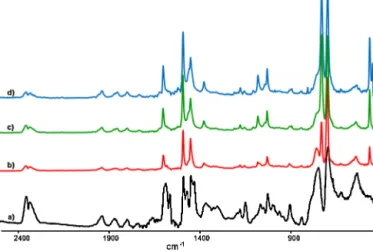
Fig.2. FTIRspectraof(a)PS-b-P2VP,(b)Co,(c)Crand(d)Au3+functionalPS-b-P2VP.
Au(III)nanoparticleswereaboutmorethan2-foldssmaller. Fur-thermore, the images indicated that coordination to Au3+ was significantlymoreefficient.Ontheother,theextentofcoordination toCrseemedtobenotveryproductive.
Asthenanoparticleformationstartsbythecoordinationofthe electron-rich segmentof thecopolymer,2-vinylpyridine,tothe metalatomorionbytheexclusion oftheligands,thepyridine stretchingandbendingmodesofpyridineringareaffected.
For Coand CrfunctionalPS-b-P2VP, thedisplacementof CO ligandsbypyridineswasconfirmedbythedisappearanceofthe peaksassociated withcarbonylgroupsofCo2(CO)8 (2023,2041, 2071cm−1)andCr(CO)6 (ataround2000cm−1)completely.The relative intensitiesof theabsorptionpeaks dueto thepyridine strecthing and bendingmodes in the range of 1590–600cm−1, especiallytheonesataround1590cm−11472and1431cm−1were decreasedsignificantlyinallthesecomplexes.Characteristic unco-ordinatedpyridineringvibrationataround1590cm−1shiftedto 1604cm−1forCoandAu3+functionalcopolymersandto1602cm−1 Crcoordinatedrings.Anewabsorptionpeakappearedataround 464cm−1detectedforallthecompositeswasassociatedwith N-metalstretchingmode(Fig.2).Consideringtherelativeintensities ofthepeaksassociatedwithN-metalstretchingnormalizedwith respecttothepeaksduetophenylringvibrationsitcanbe con-cludedthatextentofcoordinationwascomparableforCoandAu3+ whereasnotveryfruitfulforCrinaccordancewithTEMresults.
Pyrolysisofthemetaland/ormetalionfunctionalcopolymers yieldedalmostidenticalthermaldegradationproducts.Yet, inspec-tionof pyrolysismass spectraand singleion evolution profiles pointedoutdrasticchangesintherelativeintensitiesofP2VPbased products,especially thoseassociatedwithprotonatedoligomers of vinylpyridine, upon coordination to metal or metal ion.
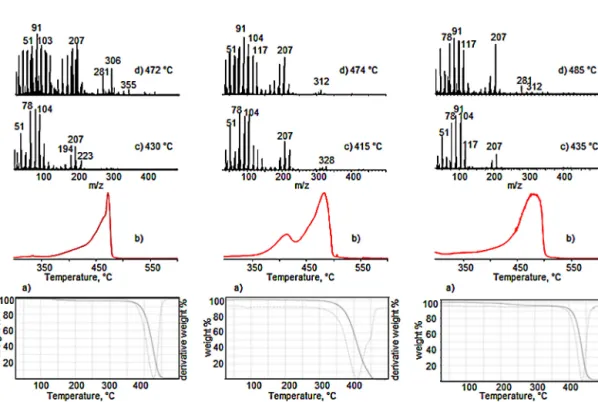
Fig.3.(a)TGA,(b)TICcurvesand(c)themassspectraatpeakmaximarecordedduringthedirectpyrolysisof(a)PS-b-P2VP,(b)Co,(c)Crand(d)Au3+functionalPS-b-P2VP.
Furthermore,newpeaksappearedinthepyrolysismassspectra atelevatedtemperatures.
Thermaldecomposition mechanisms of polystyrene, PS, and poly(2-vinylpyridine), P2VP, have been studied extensively [25–27].PSdegradesinasinglestepbyadepolymerizationreaction toyieldmainly,themonomer,styrene[25,26].P2VPdecomposes byacomplexdegradationmechanismproducingalsoprotonated oligomersinadditiontomonomerandlowmassoligomers[27]. PreviousDP-MSstudiesrevealedthatduringthepyrolysisof PS-b-P2VPcopolymer,eachcomponentdecomposesindependentlyvia thedecompositionpathwaysidentifiedforthecorrespondingpure homopolymersasexpectedforablockcopolymer[28,29].
InFig.3theTGAcurves,totalioncurrent(TIC)curves,the varia-tionoftotalionyieldasafunctionoftemperature,andthepyrolysis massspectrarecordedatpeakmaximaforofCo,CrandAu3+ func-tionalPS-b-P2VParepresented.Ingeneral,thetrendsintheTGA curveswereinaccordancewiththoseinTICcurves.InFig.4, sin-gleionevolutionprofilesofC7H7 (91),Stmonomer(104),[St2– H](207)andStdimer(208)thatwerediagnostictoPSblockand C5H5N(79),2VPmonomer(105),2VPdimer(210)and2VP proto-nateddimer(211)thatwerecharacteristicforP2VPblockrecorded duringthepyrolysisofCo,CrandAu3+functionalPS-b-P2VPare shown.
DuringthepyrolysisofthePS-b-P2VP,VPoligomersand pro-tonatedoligomersreachedtomaximumyieldataround415and 426◦C respectively, whereas, PS based products maximized at around437◦C.Theevolutionprofilesofthethermaldegradation productsdetectedduringthepyrolysisofPS-b-P2VPareincluded inFig.3forcomparison.
Ingeneral,uponcoordinationtoCo,CrorAu3+,theevolution profilesofP2VPbasedproductsshowedoverlappingpeaks indi-catingpresenceofP2VPchainswithnoticeablydifferentthermal stabilities.Thelowtemperaturepeakswithamaximumat417,405 and395◦CintheevolutionprofilesofP2VPbasedproductsforCo, CrorAu3+functionalcopolymersrespectively,canbeattributedto degradationofunreacted2VPsegments(Fig.4b–d).Ontheother hand,thecorrespondinghightemperaturepeaksat472,474and
485◦Ccanbeassociatedwithdecompositionofvinylpyridineunits coordinatedtometalsormetalion.Thelossofpyridineandvinyl pyridinewasnoticeablysuppressedinthelowtemperatureregion. Anoppositetrendwasdetectedfortheoligomersandprotonated oligomers.Theyweremainlyeliminatedatinitialstagesof pyrol-ysis.Inaddition,therelative yieldsof theseproductsdecreased significantly.Itmaybethoughtthatuponcoordinationtometal ormetaliontheextentof2VPsegmentsoftwoormorerepeating unitsinvolvinguncoordinatedpyridineringswasquitelow. Actu-ally,thedecreaseintherelativeintensitieswasmorepronounced fortheprotonatedoligomers.Thus,itmayfurtherbethoughtthat uponcoordinationofpyridinenitrogentoCo,CrorAu3+,the prob-abilityofgenerationofprotonatedoligomersbyH-transfertoN atomdecreasedsignificantly[29].
Thebroadpeakspresentinthesingleionpyrogramsofthermal degradationproductsof PSshiftedtohightemperatureregions. MaximumyieldsforPSbasedproductsweredetectedat472,474 and485◦CforCo,CrorAu3+functionalcopolymersrespectively. Shoulders in the temperatureregions where PSdecomposition occursforthevirgincopolymerweredetected.
Productpeakswhichwereeither totallyabsentoronlyvery weakinthepyrolysismassspectraofthecopolymer,atm/zvalues 267,281,306,325,355,429,461,613,etc.werenoticeablyintense, exceptforCrfunctionalsample.Thesingleionevolutionprofiles ofproductswithm/zvalues281and355attributedtoC23H29and C29H31arealsoincludedinFig.4.Theevolutionprofilesofthese productsshowedidenticaltrends,asharppeakwithamaximum at472and499◦CforCoandAu3+functionalP-b-P2VPrespectively. IncaseofCrfunctionalcopolymertheyieldsoftheseproductswere quitelow.Inadditiontheywereeliminatedinabroadtemperature region.
Itmaybethoughtthatduetothestronginteractionbetween metalatoms/ionsandthenitrogenatomonthepyridinerings,the massofthepyridineringsincreasesaffectingthethermal degra-dationofP2VP block.Thehightemperaturepeaksorshoulders presentintheevolutionprofilesofP2VPbasedproductssupported this proposal. A degradation mechanism involving loss of side
Fig.4.Singleionevolutionprofilesofselectedthermaldegradationproductsrecordedduringthedirectpyrolysisof(a)PS-b-P2VP,(b)Co,(c)Crand(d)Au3+functional
PS-b-P2VP.
chainsinthefirststepcanbesuggestedtobepreferential com-paredtothedepolymerizationmechanism(Scheme1).Uponloss ofpyridinerings,intermolecularcouplingreactionsmaytakeplace yieldingeitherconjugateddoublebondsorcrosslinkedstructures thatdecomposeatrelativelyhightemperatures.
Thedetectionofnewproductsatelevatedtemperaturethatcan readilybeassociatedwithhydrocarbonunitsinvolvingHdeficiency wasinaccordancewiththeexpectations.Asaconsequence,the sharphightemperaturepeakspresentintheevolutionprofilesof characteristicthermaldecompositionproductsofP2VPandPSmay thenbeattributedwithcontributionofproductsduetothe degra-dationoftheseunsaturatedchainsorcrosslinkedstructureswith thesamem/zvalues.
Thetrendsintheevolutionprofilesofdiagnosticthermal degra-dationproductsofP2VP,PSandthenewunsaturatedunitsforthe
Scheme1. Thermaldecompositionofmetal-functionalP2VPchains.
compositesinvolvingCoorAu3+coordinationwasquitesimilar. Theonlydifferencewastheincreaseinthermalstabilityinthe pres-enceofAu3+thatmaybeassociatedwiththehighermolarmassof Au.Furthermore,thenoticeabledecreaseintherelativeintensities ofthermaldegradationproductsofunreactedP2VPnotedforthis samplecanberelatedtoastrongerinteractionbetweentheNof pyridineringsduetothehighpositivechargeofAu3+ion.
FortheCrcoordinatedcomposite,therelativeyieldsof ther-maldegradationproductsofunreactedP2VParehigherwhereas thoseofunsaturatedhydrocarbonunitsareremarkablylowerthan thecorrespondingonesforCoandAu3+analogues,inaccordance withtheTEMresults.Furthermore,threeoverlappingpeakswere presentintheevolutionprofilesofunsaturatedhydrocarbonunits, insteadofthesharppeakrecordedforCoandAu3+coordinated PS-b-P2VP. The smallest effectivenuclear charge of Cr maybe regardedasoneofthepossiblesourcesfortheweakestinteraction withpyridine.Inaddition,oneshouldalsoconsiderthe degener-acyoftheenergylevelsofCo,CrandAu3+usedforcoordination. Thesquare planarAu3+ complexand Cocomplexasa resultof tetragonaldistortion,havesimilartypeofdorbitalsplitting. Hav-ingnon-degeneratedorbitals,theenergyofthecomplexesformed decreased.Itmaybethoughtthat,asaconsequence,thepossibility of-backbondingbetweenpyridineandCoandAu3+increases, yieldingastrongercoordination.Ontheother,suchadistortion thatstabilizesthecomplexformedisnotexpectedforCrcomplex. Furthermore,bothlowandhighspinconfigurations,affectingthe strengthofcoordinationmayalsobeconsideredforthiscomplex, asforad6metalcomplexspincrossoverinitiatedbyachangein pressureortemperaturesometimesoccurs.
4. Conclusion
Inthepresentstudy,ithasbeendeterminedthatthestrength and efficiencyofcoordination ofP2VP blocks toCo, CrorAu3+ mainlydependsonchargeandstabilityofthecomplexformedthat ismainlyrelatedtotheenergyofdorbitals.Theresultsrevealthat
thethermalstabilityofthepolymercompositeformedincreases withtheincreaseinstrengthofcoordination.
Acknowledgment
Thisworkis partiallysupportedbyTUBITAK ResearchFunds TBAG-106T092andTBAG-106T656.
References
[1]N.L. Pocard, D.C. Alsmeyer, R.L. McCreery, T.X. Neenan, M.R. Callstrom, Nanoscaleplatinum(0)clustersinglassy-carbon–synthesis,characterization, anduncommoncatalyticactivity,J.Am.Chem.Soc.114(1992)769–771.
[2]W.L.Barnes,A.Dereux,T.W.Ebbesen,Surfaceplasmonsubwavelengthoptics, Nature424(2003)824–830.
[3]T.K.Sau,A.L.Rogach,F.Jackel,T.A.Klar,J.Feldmann,Propertiesand applica-tionsofcolloidalnonsphericalnoblemetalnanoparticles,Adv.Mater.22(2010) 1805–1825.
[4]P.K. Jain,X.H. Huang, I.H. El-Sayed, M.A.El-Sayed, Noblemetals onthe nanoscale:opticalandphotothermalpropertiesandsomeapplicationsin imag-ing,sensing,biology,andmedicine,Acc.Chem.Res.41(2008)1578–1586.
[5]D.L.Lesliepelecky,R.D.Rieke,Magneticpropertiesofnanostructuredmaterials, Chem.Mater.8(1996)1770–1783.
[6]M.R.Bockstaller,R.A.Mickiewicz,E.L.Thomas,Blockcopolymer nanocom-posites:perspectivesfortailoredfunctionalmaterials,Adv.Mater.17(2005) 1331–1349.
[7]S.B.Darling,Directingtheself-assemblyofblockcopolymers,Prog.Polym.Sci. 32(2007)1152–1204.
[8]J.K.Kim,S.Y.Yang,Y.Lee,Y.Kim,Functionalnanomaterialsbasedonblock copolymerself-assembly,Prog.Polym.Sci.35(2010)1325–1349.
[9]S.I.Yoo,J.H.Kwon,B.H.Sohn,Singlelayersofdiblockcopolymermicellesfor thefabricationofarraysofnanoparticles,J.Mater.Chem.17(2007)2675–2969.
[10]H.Cho,H.Park,T.P.Russell,S.Park,Preciseplacementsofmetalnanoparticles fromreversibleblockcopolymernanostructures,J.Mater.Chem.20(2010) 5047–5051.
[11]S.Papp,L.Korosi,B.Gool,T.Dederichs,P.Mela,M.Moller,I.Dekany, Forma-tionofgoldnanoparticlesindiblockcopolymermicelleswithvariousreducing agents,J.Therm.Anal.Calorim.101(2010)865–872.
[12]J.P.Spatz,S.Mossmer,C.Hartmann,M.Mooller,T.Herzog,M.Krieger,H.G. Boyen,P.Ziemann,Ordereddepositionofinorganicclustersfrommicellarblock copolymerfilms,Langmuir16(2000)407–415.
[13]R.Suntivich,I.Choi,M.K.Gupta,C.Tsitsilianis,V.Tsukruk,Gold nanoparti-clesgrownonstar-shapedblockcopolymermonolayers,Langmuir27(2011) 10730–10738.
[14]J.-H.Kim,S.H.Bae,S.Chae,B.-H.Sohn,Inversionofdiblockcopolymermicelles byselectivesolventsforconversionofgoldnanopatterns,ThinSolidFilms520 (2012)2022–2025.
[15]R.Glass,M.Moeller,J.P.Spatz,Blockcopolymermicellenanolithography, Nano-technology14(2003)1153–1160.
[16]M.Moeller,J.P.Spatz,Mineralizationofnanoparticlesinblockcopolymer micelles,Curr.Opin.ColloidsInterfaceSci.2(1997)177–187.
[17]T.Lohmueller,E.Bock,J.P.Spatz,Synthesisofquasi-hexagonalorderedarrays ofmetallicnanoparticleswithtuneableparticlesize,Adv.Mater.20(2008) 2297–2302.
[18]J.H. Cho, J.K. Hong, K. Char, F. Caruso, Nanoporous block copolymer micelle/micellemultilayerfilmswithdualopticalproperties,J.Am.Chem.Soc. 128(2006)9935–9942.
[19]K.S.Khairou,M.A.Diab,Stabilityanddegradationofpoly(4-vinylpyridine)and copolymersof4-vinylpyridinewithmethyl-methacrylate,Polym.Degrad.Stab. 44(1994)17–20.
[20]A.M.Lyons,E.M.Pearce, A.M. Mujsce,Thermal-decomposition of poly(2-vinylpyridine)–effectofcomplexationwithcopperchloride,J.Polym.Sci.A: Polym.Chem.28(1990)245–259.
[21]K.H.Wu,Y.R.Wang,W.H.Hwu,FTIRandTGAstudiesof poly(4-vinylpyridine-co-divinylbenzene)–Cu(II)complex,Polym.Degrad.Stab.79(2003)195–200.
[22]N.E.Zander,J.A.Orlicki,A.M.Rawlett,WeaponsandMaterialsResearch
Direc-torate,ARL.
[23]J.Hacaloglu,Directinsertionprobemassspectrometryofpolymers,Adv.Polym. Sci.248(2012)69–103.
[24]V.V. Baranauskas, M.A. Zalich, M. Saunders, T.G. St Pierre, J.S. Riffle, Poly(styrene-b-4-vinylphenoxyphthalonitrile)–cobaltcomplexesandtheir conversiontooxidativelystablecobaltnanoparticles,Chem.Mater.17(2005) 5246–5254.
[25]I.C.McNeil,M.Zulfiqar,T.Kousar,Adetailedinvestigationoftheproductsofthe thermal-degradationofpolystyrene,Polym.Degrad.Stab.28(1990)131–151 (andreferencescitedtherein).
[26]Y.Nur,S.Yurteri,I.Cianga,Y.Yagci,J.Hacaloglu,Pyrolysisofpolyphenylenes withPCLor/andPStsidechains,J.Anal.Appl.Pyrol.80(2007)453–459.
[27]A.Elmaci,J.Hacaloglu,Thermaldegradationofpoly(vinylpyridine)s,Polym. Degrad.Stab.94(2009)738–743.
[28]T.Orhan,J.Hacaloglu,Thermaldegradationofpoly(2-vinylpyridine) copoly-mers,Polym.Degrad.Stab.98(2013)356–360.
[29]A.Elmaci,J.Hacaloglu,C.Kayran,G.Sakellariou, N.Hadjichristidis, Ther-maldecompositionofpolystyrene-b-poly(2-vinylpyridine)coordinatedtoco nanoparticles,Polym.Degrad.Stab.94(2009)2023–2027.