Correlations in a one-dimensional Bose gas
E. Demirel and B. TanatarDepartment of Physics, Bilkent University, Bilkent, 06533 Ankara, Turkey ~Received 11 June 1998!
We study the correlation effects in a one-dimensional Bose gas with repulsive delta-function interaction. The correlation effects are described by a local-field correction which takes into account the short-range correla-tions. We find that the ground state energy is in good agreement with the exact result up to intermediate coupling strengths, showing an improvement over the Bogoliubov and other related approximations. The velocity of sound, the static structure factor, and pair-correlation function are also calculated within the present approximation.@S0163-1829~99!00314-8#
I. INTRODUCTION
The one-dimensional~1D! electron gas models are attract-ing a lot of interest because of theoretical and technological implications, since the motion of electrons confined to move freely only in one spatial dimension gives rise to a variety of novel phenomena, such as the non-Fermi liquid characteristics.1 The system of bosons are of equal impor-tance because of the role played by statistics and the revela-tion of macroscopic effects like Bose-Einstein condensarevela-tion and superfluidity.2 The interplay between the statistics and interaction effects, the enhanced quantum fluctuations in low-dimensional systems, and the prospects of experimental realization provide ample motivation to study quantum many-body systems in 1D.
A system of bosons in one-dimension interacting via a short-range, delta-function potential has been a useful model to study the nature of ground state properties of quantum systems and assessing the role played by statistics in com-parison to the corresponding system of 1D fermions.3,4The close analogy between the fermions and bosons in 1D has been established.4 An exact analysis of the ground-state properties, in particular the ground-state energy as a function of the coupling strength, of a 1D interacting Bose gas was provided by Lieb and Liniger.5,6Yang and Yang7 extended this Bethe ansatz approach to study the thermodynamics at finite temperature. Correlation effects in a 1D Bose gas within the self-consistent field approximation was first at-tempted by Hipoˆlito and Lobo8and recently by Gold.9 The many-body effects beyond the mean-field theory was de-scribed by the local-field correction calculated within the Singwi et al.10~STLS! scheme. The local-field corrected Bo-goliubov approximation11 shows a definite improvement for the ground state energy. Recently, Kerman and Tommasini12 introduced a Gaussian time-dependent variational principle for bosonic systems and applied their method to the problem of 1D bosons interacting through a repulsive contact poten-tial. Charged bosons in 1D have also attracted some interest.13 Correlation effects in a quasi-one-dimensional charged Bose condensate is also studied within the STLS scheme.14There has been a renewed interest in low density15 Bose gases because of the recent experimental progress in achieving Bose-Einstein condensation in atomic vapors un-der external potentials.16It is expected that by adjusting the
confining potential in these atomic systems, two and possibly one-dimensional boson condensates may be produced.
In this work we revisit the problem of 1D bosons inter-acting via a delta-function potential within the local-field correction approach. We describe the correlation effects in the interacting Bose gas in terms of a local-field factor intro-duced by Vashishta and Singwi17 ~VS! in an approximate way. We find that the exact ground-state energy5within this perturbation theory approach can be faithfully reproduced up to large values of the coupling constant. This is an improve-ment over the Bogoliubov approximation11 and the STLS scheme10which show agreement with the exact ground state energy for small values of the coupling strength. Although based on certain approximations, the perturbation theory ap-proaches have the advantage of obtaining the ground-state properties, and in particular the correlation functions in the weak and intermediate coupling regimes. These may also find their use in other applications. The self-consistent ap-proximation scheme of Singwi et al.10makes use of the one-particle distribution function in deriving the density response of the many-body system to an external perturbation. Since the equation of motion of the one-particle distribution func-tion depends on the two-particle distribufunc-tion funcfunc-tion, and so on, the hierarchy of equations is truncated by making an assumption for the two-particle distribution function. The ap-proach developed by Vashista and Singwi17 is also based on a similar idea but introduces a slightly different assumption at the truncation level. More explicitly, the instantaneous pair-correlation function is approximated as the equilibrium pair-correlation function and a term involving its derivative with respect to the density which amounts to a first order correction in the density fluctuation dn. The VS approach has recently been applied to a degenerate plasma of charged bosons.18
An important limitation of the present approach which is shared by the Bogoliubov and STLS approximations is that the system is assumed to be in the Bose-Einstein condensed state. Since it is established19that the homogeneous one- and two-dimensional systems cannot have long-range order ~hence no condensate! the above assumption violates the cor-rect behavior of interacting systems in 1D. As we show in the sequel, the ground-state energy and some correlation functions are nevertheless determined quite reliably. The method is not appropriate to account for the long-range
cor-PRB 59
relations responsible for the behavior of the momentum dis-tribution, whereas the other correlation functions such as the static structure factor and pair-correlation function are ex-pected to be less severely influenced by this assumption.
The rest of this paper is organized as follows. In the next section we present the model of 1D bosons and the theoret-ical framework with which to discuss the correlation effects. In Sec. III we calculate the ground state energy of the system and compare with the exact result and other related ap-proaches. Sections IV and V discuss the collective excita-tions and the compressibility sum-rule, respectively. The cor-relation functions within the present model are calculated in Sec. VI. We conclude in Sec. VII with a brief discussion of our results.
II. MODEL AND THEORY
We consider a system of bosons in 1D interacting via a contact potential V(r1,r2)5V0d(r12r2), where V0 is the interaction strength. In terms of the boson mass m and the density of the particles n, we use the dimensionless param-eter g5mV0/n to characterize the strength of the coupling ~we take \51). After Hipoˆlito and Lobo8
and Gold9 we further assume that the 1D bosons are in the condensate and the generalized Bogoliubov model is applicable. The local-field concept has been demonstrated by Gold9 to be quite useful in understanding the weak coupling regime of 1D bosons. The ground state properties were calculated to be in good agreement with the exact results of Lieb and Liniger5,6 as g→0.
In this work we choose a different local-field factor in the description of the ground state correlation effects for 1D bosons. We use the approach introduced by Vashishta and Singwi17~VS! which was originally constructed to satisfy the compressibility sum-rule. As discussed in Sec. I, in the modified theory of Vashishta and Singwi17 the equilibrium pair correlation function g(r) which enters the ansatz for the two-particle distribution function is amended by a correction term involving the density derivative of g(r). For a one-dimensional system of bosons interacting via a constant po-tential~in the wave vector space! the local-field factor in the Vashishta-Singwi approximation now reads
GVS~g!5
S
11an ] ]nD
1 npE
0 ` dq@12S~q!#, ~1!where a is an adjustable parameter. Note that the local-field factor G is still independent of the wave vector variable as in the STLS approximation. As in the case of the STLS scheme, the above equation for G has to be solved self-consistently along with the static structure factor S(q) given in the generalized Bogoliubov approximation by9
S~q!5
F
114n 2q2 g„12G~g!…
G
21/2
. ~2!
Substituting Eq. ~2! into Eq. ~1!, we obtain the following differential equation for GVS(g)
dGVS dg 5 p ag3/2GVS~12GVS! 1/21~122/a! g ~12GVS!, ~3! which is first order, but highly nonlinear. Rather than at-tempting to solve Eq. ~3! numerically, we adopt a simpler approximation given by
GVS~g!5
S
12ag ]]g
D
GSTLS~g!, ~4!which is the lowest-order expression in the iterative solution of Eqs.~1! and ~2!, starting from the STLS solution. As we shall see later, the lowest-order approximation is capable of improving the STLS approach to the ground-state energy remarkably, keeping the discussion at the same level of transparency given by Gold.9 The closed form expressions for GSTLS ~Refs. 8 and 9! and GVS~within our approximate scheme! are easily obtained to be
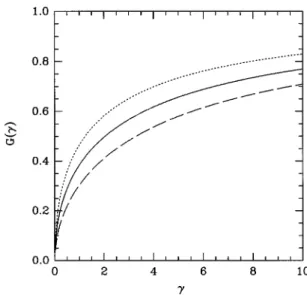
GSTLS~g!52g p2@~11p 2/g!1/221#, ~5a! and GVS~g!5 2 p2~12a!g@~11p 2/g!1/221#1a~11p2/g!21/2, ~5b! respectively. In Fig. 1 we display the local field correction GVS(g) for a51/2 and a51, and GSTLS(g) as a function of the coupling strengthg. The weak coupling limit of GVS(g) is GVS(g→0)'(2/p)g1/2(12a/2) which reduces to the re-sult given by Gold,9GSTLS(g→0)'(2/p)g1/2, as a→0. In the Vashishta-Singwi theory17the parameter a is determined by adjusting the compressibility calculated using the ground-state energy and that obtained from the long-wavelength limit of the dielectric function. In this work we take a51/2 which gives the best agreement with the exact ground state energy. We discuss the compressibility sum rule in the sub-sequent sections.
FIG. 1. The local-field factor GVS(g) at a51/2 ~solid line! and
a51 ~dashed line!, and GSTLS(g) ~dotted line! ~Ref. 9! as a func-tion ofg.
III. GROUND STATE ENERGY
The interaction energy ~per particle! of a many particle system is written as Eint(g)5(1/2)(qVq@Ndq501S(q)21#,
in which the Hartree contribution is also included. Within the mean-field theory this reduces to Eint(g)5(n2/2m)@1 22g1/2
„12G(g)…1/2/p#. The ground state energy per par-ticle is calculated by a coupling constant integration E0 5*0gdlEint(l)/l. We express E0 in terms of the dimension-less quantity given by
e~g!5
E
0 g dlF
122 pl1/2„12GVS~l!…1/2G
, ~6! where E05(n2/2m)e(g).In the exact treatment ofe(g), an expansion for smallg was not provided because of the inadequacy of the perturba-tion theory and nonanalytic properties of e(g) as g→0. Gold9 has shown that the local-field correction becomes a useful quantity in the analysis of 1D bosons and has given a weak coupling expansion
eSTLS~g→0!5g2 4 3p g 3/21 1 p2g 22 2 5p3g 5/21 1 14p5g 7/2 1•••. ~7!
As may be seen in Fig. 2, the STLS approximation compares well with the exact result of Lieb and Liniger5 only for g &2. Our Vashishta-Singwi approach yields the following weak coupling expansion~for a51/2)
eVS~g→0!5g2 4 3p g 3/21 3 4p2g 22 7 40p3g 5/22 5 192p4g 3 2358411p5g7/21•••. ~8! Figure 2 shows that the VS approach adopted here gives a better agreement than the STLS result to the exact
ground-state energy e(g). More interestingly, the comparison of weak coupling expansions of eSTLS(g) andeVS(g) demon-strates that terms of ordergn where n>3 are missing in the
eSTLS(g) expansion. Some other ground state quantities of interest are the chemical potential
m5]E0/]N5~n2/2m!~3e2gde/dg!,
the average potential energy per particle
^
V&
5(n2/2m)gde/dg, and the average kinetic energy^
T&
5E0 2^
V&
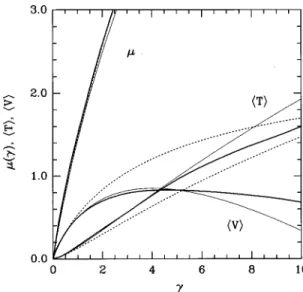
5(n2/2m)(e2gde/dg). Using the numerically calcu-latedeVS(g) we compare these quantities with the results of the exact solution to the 1D boson problem in Fig. 3. We first note that the STLS approximation results ~dotted lines! start deviating from the exact calculation of^
T&
and^
V&
for g '2. The VS calculation represents^
T&
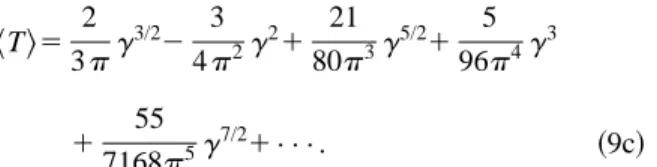
reasonably well, but the potential energy term starts to deviate from the exact result for g*6. However a cancelation effect renders the total energy in quantitative agreement with the exact result up tog'10 ~see Fig. 2!. In the available range ofg both the STLS and VS approximations agree well with the exact re-sult for the chemical potentialm(g). The weak coupling lim-its of the chemical potential and the average potential and kinetic energies per particle ~in units of n2/2m) in the VS approximation are given bym52g2p g2 3/21 3 4p2g 22 7 80p3g 5/21 11 7168p5g 7/21•••, ~9a!
^
V&
5g22 p g3/21 3 2p2g 22 7 16p3g 5/22 5 64p4g 3 2102411p5g 7/21•••, ~9b!FIG. 2. The ground-state energy per particle e(g), in units of
n2/2m, as a function of the coupling strengthg. The dotted and dot-dashed lines are for the STLS approximation~Ref. 9! and the exact result of Ref. 5, respectively. The solid and dashed lines rep-resent the VS approximation for a51/2 and a51, respectively.
FIG. 3. The chemical potential, average kinetic and potential energies as functions of g. The thick solid lines denote the exact results of Ref. 5. The thin solid lines and dotted lines are for the VS and STLS approximations~Ref. 9!, respectively.
^
T&
5 2 3p g 3/22 3 4p2g 21 21 80p3g 5/21 5 96p4g 3 1716855p5g7/21•••. ~9c! When we perform a similar calculation using the ground-state energy within the STLS approximation,8,9we obtainm52g2p g2 3/21 1 p2g 22 1 5p3g 5/22 1 28p5g 7/21•••, ~10a!
^
V&
5g22 p g3/21 2 p2g22 1 p3g5/21 1 4p5g 7/21•••, ~10b!^
T&
5 2 3p g 3/22 1 p2g 21 3 5p3g 5/22 5 28p5g 7/21•••, ~10c! which again shows that certain terms are missing in the ex-pansion of^
V&
and^
T&
compared to the VS approximation.IV. COLLECTIVE EXCITATIONS
The collective mode excitation spectrum in our model is readily obtained from the RPA-like density-density response function. The dispersion relation for the collective mode is given by9 vq5
S
n2 2mD
q n@~q/n! 214g„12G~g!…#1/2, ~11!which represents a gapless excitation ~may be identified as the Goldstone mode!. Taking G(g)50 or its weak coupling limit G(g)'2g1/2/p yields the collective mode dispersion in the RPA and the Bogoliubov approximation, respectively. In the exact solution6 of the interacting 1D boson gas two types of elementary excitations were found, the first of which ~‘‘particle’’ excitations! corresponds to the Bogoliubov spec-trum. The second type ~‘‘hole’’ excitations! of the elemen-tary excitation which exists only for uqu,pn, is not ac-counted for within the Bogoliubov approximation or the present model with a local-field correction. Part of the reason for this is that the Bogoliubov model assumes that all the particles are in the condensate whereas in the treatment of Lieb and Liniger5,6no such assumption is made. In the recent work of Kerman and Tommasini12the self-interactions of the particles out of the condensate are taken into account. Al-though the Gaussian variational method provides only an upper bound for the ground state energy and does not repro-duce the exact energy so well forg*5, it captures success-fully the basic structure of the elementary excitations.
V. SOUND VELOCITY
The VS theory was originally devised17to fulfill the com-pressibility sum rule in interacting electron systems. It was demonstrated that the compressibility calculated from the long-wavelength limit of the response function coincides with that calculated from the ground-state energy through the
thermodynamic relation. Since the compressibility is also re-lated to the velocity of sound by 1/k5mnvs2, we can use the sound velocity in the present context to check the compress-ibility sum rule. The sound velocity may be calculated from the excitation spectrumvs5limq→0]vq/]q which yields the
resultvs52n@4g„12G(g)…#1/2. On the other hand, the
ther-modynamic relation vs 25(g2/m)]2E 0/]g2, gives vs52
F
g2 1 2] 2e ]g2 22g ]e ]g13eG
1/2 . ~12!In Fig. 4 we show the velocity of sound calculated in the VS and STLS approximations using the above mentioned two different ways. The ground-state energy based calculation of
vswithin the STLS and VS approximations are quite close to
the exact result for g&10. The excitation energy spectrum based calculation of vs remains below the thermodynamic
results. In the VS approach the compressibility sum rule is violated less than in the STLS approach, but it is still not very satisfactory. The Bogoliubov spectrum yields a sound velocity above the energy based results. It is not surprising that the compressibility sum rule is not satisfied either in the STLS or the VS approximations, since both of these schemes assume that all the particles are in the condensate. In other words, the local-field based theories take only the ‘‘particle’’ contribution to the excitation spectrum and neglect the ‘‘hole’’ excitations.
VI. STATIC STRUCTURE FACTOR AND PAIR-CORRELATION FUNCTION
The static structure factor as defined in Eq. ~2! gives a measure of the correlation effects. For a noninteracting sys-tem it is unity and in the random-phase approximation~RPA!
FIG. 4. The velocity of soundvsas a function ofg. The lower
~dashed! and upper ~solid! curves are calculated from the excitation
spectrum and thermodynamic definition, respectively. The thick and thin lines are for the VS and STLS approximations~Ref. 9!, respec-tively. The exact result from Ref. 6 is depicted by the dot-dashed line. vs calculated using the Bogoliubov excitation spectrum is given by the dotted line.
we take G(g)50. The Bogoliubov approximation is recov-ered when the leading order term in the local-field factor is retained, viz. G(g)52g1/2/p. Figure 5 shows the static structure factor S(q) for g52 in the RPA, Bogoliubov, STLS and the present VS approximations. In the RPA the interaction effects are over-stressed. The Bogoliubov ap-proximation is closest to the noninteracting result, but forg 52 it may already be not so good. The inclusion of the local-field correction G(g) tends to decrease S(q) from the Bogoliubov result, since in the latter correlation effects are not fully taken into account. The probability of finding two bosons at a distance r is described by the pair-correlation function g(r) which is the Fourier transform of S(q). Per-forming the one-dimensional Fourier integral analytically20 we obtain the pair-correlation function within the present model as
gVS~r!5gVS~0!1g1/2~12GVS!1/2@I1„2rng1/2~12GVS!1/2… 2L1„2rng1/2~12GVS!1/2
…#, ~13!
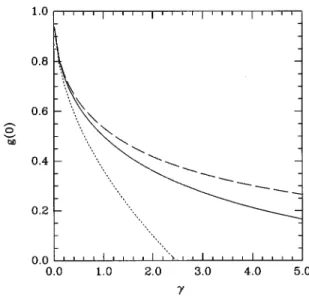
where I1(x) is the modified Bessel function ~of the first kind!, L1(x) is the modified Struve function,20 and gVS(0) 512(2/p)g1/2(12GVS)1/2 is the pair-correlation function at zero separation. Note that a similar expression for the pair-correlation function within the STLS was also given by Gold.9 Figure 6 compares gVS(0) with gSTLS(0) as a func-tion ofg. It was noted9that in the STLS approximation g(0) remains positive for all g, unlike the Coulomb systems which yield unphysically negative g(0) at some intermediate coupling strength. In the case of Vashishta-Singwi approxi-mation, we find that g(0) eventually becomes negative for
g*15. Since the theories involving the local-field factor are perturbational in character, thus limiting their applicability for small and intermediate range ofg, our result for gVS(0) should be useful in practical applications. The weak coupling limit of gVS(0) is given by lim g→0 gVS~0!.122 pg1/21 2 p2g~12a/2!1•••, ~14! which reduces to the STLS result9gSTLS(0).122g1/2/p, as a→0. The effect of the STLS and VS local-field corrections on the pair-correlation function is further illustrated in Fig. 7 where g(r) is plotted for g51 andg55, and we also spe-cialize to the a51/2 case. The differences occur largely at small separations. The asymptotic forms of g(r) are obtained as gVS~r→0!5gVS~0!1rng@12GVS~g!# 28r 2n2 3p g 3/2@12GVS~g!#3/21••• ~15! and
FIG. 5. The static structure factor S(q) at g52 for various approximations. The solid and dot-dashed lines indicate SVS(q) and
SSTLS(q)~Ref. 9!, respectively. The dotted and dashed lines are for the RPA and Bogoliubov approximations, respectively.
FIG. 6. The pair-correlation function at zero separation g(0) as a function ofg. The solid, dashed, and dotted lines indicate gVS(0),
gSTLS(0) ~Ref. 9!, and g(0) in the Bogoliubov approximation, re-spectively.
FIG. 7. The pair-correlation function g(r) atg51 and g55 as a function of r. The solid and dotted lines indicate gVS(r) and
gVS~r→`!512 2
pr2n2g
21/2@12GVS~g!#21/2
22p3r4n4g23/2@12GVS~g!#23/21•••. ~16! A comparison with the corresponding expansions in the STLS approximation9 shows that both methods have the same r dependences.
VII. DISCUSSION
In this work we have employed the formalism of Vash-ishta and Singwi17 to study the ground state properties of a system of 1D boson condensates. The VS approach is largely based on the STLS theory. The local-field factor which suc-cessfully describes the correlation effects in electron liquids is found also to be useful in the present analysis. In compari-son to the STLS approach, the VS local-field description extends the validity range of approximate theories tog&10, since for this region the ground-state energy is faithfully re-produced. The strong coupling regime, viz.g→` is not de-scribed well by the STLS and VS approaches, thus we have omitted any discussion on this regime. In the dielectric for-mulation of the interacting quantum systems the sum-rule constraints21 on the frequency and wave vector dependent dielectric function «(q,v) is often found useful. We point out that the frequency and wave vector independent local-field corrections satisfy the first and third moment sum-rules simultaneously. This follows from the fact that the local-field factor is independent of wave vector variable q. However, it is conceivable to imagine the correlation effects giving rise to an effective q-dependent interaction given by V0@1 2G(q;g)#, even though the bare interaction V0 is a con-stant. This may be achieved within the so-called SSTL ap-proach of Singwi et al.22 in which the bare Coulomb inter-action is renormalized by the static screening function «(q) which is incorporated into the self-consistent scheme. The consequences of the SSTL approach with wave vector de-pendent local-field correction in the context of 1D bosons appears to be an interesting problem for future explorations. The major shortcoming of the present model ~as well as the Bogoliubov and STLS approaches! is that the 1D bosons are assumed to be in the condensate. It is known that the 1D Bose system at zero temperature cannot have long range or-der and the Bose condensation in this system is absent.19,23In fact, our effort to calculate the depletion of the condensate as
a result of particle interactions was fruitless. The inequality nq>n0/4S(q)21/2, for the momentum distribution which must be obeyed for Bose systems satisfying the f-sum rule,23 yields negative values for q/n*2. However, it is interesting to observe that the assumption of full condensation yields ground state energy and other properties in reasonable agree-ment with the exact results. Combining our results and re-calling the earlier results of Gold9and those of Kerman and Tommasini12we conclude that the condensate assumption is not very severe for the ground state energy, but the interac-tion with out of condensate particles is essential for the de-scription of elementary excitations. Because of the recent interest in Bose-Einstein condensed gases in low-dimensional systems, we believe our results should be useful in understanding the interaction effects on the condensed systems. One possible way to improve upon the condensate assumption is to consider a two fluid model, and take the momentum distribution of the out of the condensate particles explicitly into account. Further work is necessary to explore these ideas.
Both the STLS and VS approximations are based on the perturbation theory, thus they are not expected to yield reli-able results in the strong coupling limit,g→`. In particular, GVS(g) behaves as;12p2(11a)/4g for large g. A pos-sible improvement may be achieved if one considers the lad-der diagrams~multiple scattering! which take the short-range correlations into account in an improved way. Such an ap-proach was shown to work quite well for 1D fermions inter-acting with ad function.24
In summary, we have considered the correlation effects in a system of 1D bosons interaction with a short-range poten-tial. We have introduced a local-field factor based on the Vashishta-Singwi approach to describe the correlation ef-fects. The ground state energy calculated within this approxi-mation is in good agreement with the exacts results for g &10, thus showing an improvement compared to the Bogo-liubov and STLS approximations. The sound velocity and correlation functions in the present model are also calculated.
ACKNOWLEDGMENTS
This work was partially supported by the Scientific and Technical Research Council of Turkey ~TUBITAK! under Grant No. TBAG-1662. We thank Dr. C. Bulutay for fruitful discussions, and Professor M. Gu¨rses and Dr. U. Mug˘an for valuable comments.
1The Many-body Problem, edited by D. C. Mattis~World Scien-tific, Singapore, 1993!.
2P. Nozie`res and D. Pines, The Theory of Quantum Liquids
Vol-ume II: Superfluid Bose Liquids ~Addison-Wesley, Redwood
City, CA, 1990!.
3C. N. Yang, Phys. Rev. Lett. 19, 1312~1967!. 4M. Girardeau, J. Math. Phys. 1, 516~1960!. 5
E. H. Lieb and W. Liniger, Phys. Rev. 130, 1605~1963!. 6E. H. Lieb, Phys. Rev. 130, 1616~1963!.
7C. N. Yang and C. P. Yang, J. Math. Phys. 10, 1115~1969!.
8O. Hipoˆlito and R. Lobo, Phys. Rev. B 17, 1433~1978!. 9A. Gold, Z. Phys. B 91, 397~1993!.
10K. S. Singwi, M. P. Tosi, R. H. Land, and A. Sjo¨lander, Phys. Rev. 176, 589~1968!.
11N. N. Bogoliubov, J. Phys.~Moscow! 11, 23 ~1947!.
12A. K. Kerman and P. Tommasini, Phys. Rev. B 56, 14 733
~1997!.
13
T. Blum, D. S. Koltun, and Y. Shapir, Phys. Rev. Lett. 66, 2417
~1991!.
14A. Gold and L. Calmels, Phys. Rev. B 57, 12 119~1998!.
15E. H. Lieb and J. Yngvason, Phys. Rev. Lett. 80, 2504~1998!. 16M. H. Anderson, J. R. Ensher, M. R. Matthews, C. E. Wieman,
and E. A. Cornell, Science 269, 198~1995!; K. B. Davis, M.-O. Mewes, M. R. Andrews, N. J. van Druten, D. S. Durfee, D. M. Kurn, and W. Ketterle, Phys. Rev. Lett. 75, 3969~1995!; M.-O. Mewes, M. R. Andrews, N. J. van Druten, D. M. Kurn, D. S. Durfee, and W. Ketterle, ibid. 77, 416~1996!.
17P. Vashishta and K. S. Singwi, Phys. Rev. B 6, 875~1972!. 18S. Conti, M. L. Chiofalo, and M. P. Tosi, J. Phys.: Condens.
Matter 6, 8795~1994!.
19P. C. Hohenberg, Phys. Rev. 158, 383~1967!; N. D. Mermin,
ibid. 176, 250~1968!.
20I. S. Gradshteyn and I. M. Rhyzik, Table of Integrals, Series and
Products~Academic Press, New York, 1980!.
21N. Iwamoto, Phys. Rev. A 30, 3289~1984!.
22K. S. Singwi, A. Sjo¨lander, M. P. Tosi, and R. H. Land, Phys. Rev. B 1, 1044~1970!.
23L. Pitaevskii and S. Stringari, J. Low Temp. Phys. 85, 377~1991!. 24S. Nagano and K. S. Singwi, Phys. Rev. B 27, 6732~1983!.