KADIR HAS UNIVERSITY
GRADUATE SCHOOL OF SOCIAL SCIENCES
"NEW" MEDIA TOOLS IN THE "NEW" MUSEUMS THE STUDY CASE OF ISTANBUL MODERN
GRADUATE THESIS
AYÇA BAYRAK
Ayç a B ayr ak M .A. T he sis 2014 S tudent’ s F ull Na me P h. D. ( or M .S . or M .A. ) T he sis 20 11
"NEW" MEDIA TOOLS IN THE "NEW" MUSEUMS THE STUDY CASE OF ISTANBUL MODERN
AYÇA BAYRAK
Submitted to the Graduate School of Social Sciences in partial fulfillment of the requirements for the degree of
Master of Arts in NEW MEDIA
KADIR HAS UNIVERSITY May, 2014
ABSTRACT
"NEW" MEDIA TOOLS IN THE "NEW" MUSEUMS THE STUDY CASE OF ISTANBUL MODERN
Ayça Bayrak
Master of Arts in New Media
Advisor: Asst. Prof. Eylem Yanardağoğlu - Kadir Has University May, 2014
Technology and the individual have a reciprocal and transformative relation and the area, which is affected by this relation, is more sophisticated than the idea that technology is shaping the society. To understand the sophistication of the relation between technology and the society; historical, cultural, economic and sociologic dimensions should be considered rather than “techno-deterministic” descriptions for the topic. In order to express the developments in the area of media; the concept “new media”, of which its definition and its specifications are still debated for its aspects such as interactivity and empowering the democracy, should be considered in a critical way. The museums are an important part of the cultural life; and the restructuring of the museums in parallel to technological developments should be evaluated in the axis of “New Museology” with the above critical perspective.
In this research, it is aimed to understand the effects and the contributions of the “New Media” tools to the user experience in “New Museums”, where the main focal point is shifted from the exhibited objects to the visitors. For this, the case study of the Istanbul Museum of Modern Art was examined; a survey about the awareness and the use of “New Media” tools among the visitors of the museum was done. The “New Media” tools in Istanbul Museum of Modern Art have been reevaluated in the axis of “New Museology” according to the visitor surveys.
Keywords: New media, new museology, Istanbul Modern, visitor experience, techno-determinism APPENDIX B AP PE ND IX C
Teşekkür Notu
Maddi ve manevi desteğini hiç bir zaman eksik etmeyen aileme, zor zamanlarımda yanımda olan Gökhan Uluğ’a, eğitime verdiği destek için Kadir Has Üniversitesi’ne, değerli fikirlerini paylaştığı için Yard. Doçent Dr. Eylem Yanardağoğlu’na, araştırmalarımı mümkün kılan İstanbul Modern çalışanlarına, ‘Yeni Müzecilik’ kavramı ile tanışmamı sağlayan Suay Aksoy’a ve Kitapyurdu ailesine en içten teşekkürlerimi sunarım. AP PE ND IX C AP PE ND IX
Table of Contents
ÖZET ... 3 ABSTRACT ... 4 Teşekkür Notu ... 5 Table of Contents ... 6 List of Tables ... 7 List of Figures ... 8 1. Introduction ... 92. ‘‘New’’ Media That Is Actually Not New ...15
3. Methodology ...28
4. Melting Pot: “New” Media and “New” Museology ...33
5. The Case Study: Istanbul Modern ...42
5.1. About Istanbul Modern Museum ...42
5.2. An overview of Istanbul Modern Museum’s Media Engagement ...42
5.3. Evaluation of Results ...47
5.3.1. Process of Research ...47
5.3.2. Results of Visitor Survey ...50
6. Conclusion and Discussion...59
6.1. New museum approach to research ...60
References ...65
List of Tables
List of Figures
Figure 1 ...17 Figure 2 ...52 Figure 3 ...53 Figure 4 ...54 Figure 5 ...55 Figure 6 ...571. Introduction
It is nearly impossible to find a place on earth, where human being has been lived but no technology has been developed or used. Since the beginning of human history, the technology has been employed by humankind. However, living in the computer and internet-driven “Information Age”, we don't necessarily think of fire, wheel or spears as technologies.
As highlighted in much quoted Marshal McLuhan’s book “Understanding Media” the relationship between human and technology is described as following “We become what we behold that we shape our tools and thereafter our tools shape us.” (Lapham, 1964:xi). For the sake of not falling into the trap of techno deterministic explanations, this relationship should not be established in one direction as it has been done in the sentence. In fact, for developing more comprehensive and realistic understanding about the everyday life practices and society, the human factor is needed to include in these equation. Maybe it is more accurate to put a triple dot at the end of this sentence rather than a full stop. The unending version of the quote reveals not only transformative relationship but also the reciprocal nature of interaction between technology and human. Actually, not only the technology changes the individual’s life but also user practices, needs, demands and expectations have an effect on the development of technological devices.
Developments in technology affected various layers of life; healthcare, education, transportation, production systems, construction sector, business management etc. It is for sure the invention of Internet technology has accelerated the developments in other technologies; so the relations between science, technology,
media and society became more complicated than before. In the 21st century, the term “new” media started to be used in order to catch up with these new technologies in the media field. It will be not wrong to say that the high availability of “new” media tools and the excessive use of them have changed the habits and the behaviors of individuals on their daily life. Thus, it resulted in new practices as it reshaped the existing practices with the new ones. Besides celebrating the possibilities created by new media, the discursive creation of “new” media should be kept in mind always. The question of “What is new media?” is a much-debated question and is not an easy one to answer. There are several definitions of the term and critics about its “newness”. In the third chapter named “New Media that is actually not New?” the discussions and critics about “New” Media phenomenon will be covered. Moreover, the myths about “new” media will be reviewed and interactivity myth is the main issue.
Besides other transformative changes in cultural, economical and political spheres of life, museums as cultural institutions are affected by the transformation of the term “media”, too. In the fourth chapter named “Melting Pot: “New” Media in “New” Museums”, for figuring out the roots of “modern” museum a historical perspective will be adapted. Adapting historical perspective on the issue will reveal significant cultural and social factors that have a role in the making of “modern” museum. The chapter is reviewing the weight of the "new" media tools in the development of museums due to the fact that new museum phenomenon. In recent years, the human factor has been the focal point of the definitions of both the "new media" and the "new museum" by emphasizing the visitor orientation and the human interaction. Accordingly it is important to highlight that "new media art" or installations with new media elements are not put into the focus of this study. To be
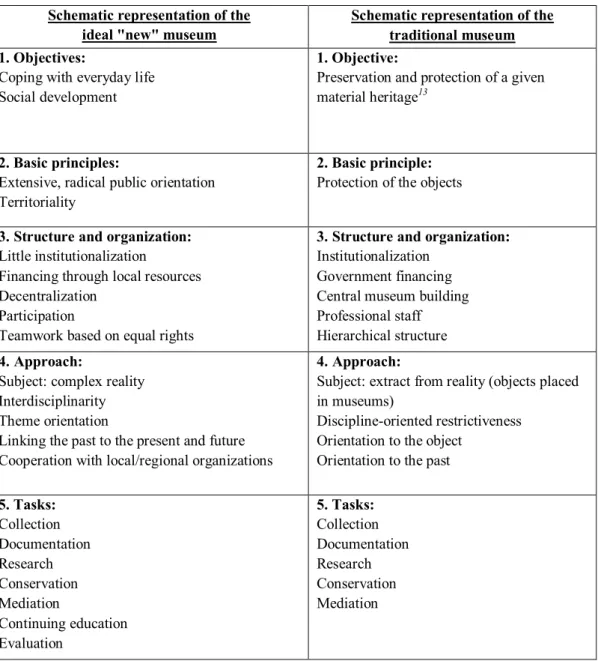
more specific and clear, the discussion will be limited to the “new” media tools which are embedded in art museums in order to fulfill objectives, basic principles, structure and organization, approach and tasks of new museology in the form of software or hardware. These tools can be exemplified with QR codes, touch screens (kiosks), mobile applications and tablet computers that give information about museum and artworks before, during and after visits. I will employ the Schematic Representations of Traditional and New Museums by Andrea Hauenschild which is stated in the “Claims and Reality of New Museology: Case Studies in Canada, the United States and Mexico” (1998). Since 1998 many other discussions have been held about new museology, however Hauenschild’s is the first doctoral dissertation to analyze the effectiveness of new models for museums and the scheme is functional as it compares the qualifications of traditional and new museums point by point. (Claims and Reality of New Museology: Case Studies in Canada, The United States and Mexico, 2004) This schema provides a practical framework because it gives a list of objectives, basic principles, structure and organization, approach and tasks that point out the basic differences between traditional and new museums. In addition to this scheme, the chapter introduces different perspectives on museology and covers fundamental discussions about ‘new’ museology.
Second Chapter “Methodology” elaborates the model and context of the research. This chapter includes a visitor survey that is designed for the research and conducted in the museum with random participants. While collecting data, based survey was preferred deliberately. The reason behind the preference of paper-based survey was worked through the chapter in details. The survey questions were written for collecting data about visitor’s museum experiences, new media skills, visitor’s awareness of ’new’ media tools in the museum and some certain type of
demographical data. Measuring two correlations was main aim of the survey:
1. correlation between age and technical skills,
2. correlation between visitor experience quality and new media tool usage. Due to the limited field-research time provided by the museum administration and the low number of representatives from each age group of participants, the data did not yield meaningful inferences to understand the above-mentioned correlations. These limitations and the reasons behind them will be discussed in details in the next chapter called Methodology. However, the survey results enabled the researcher to understand the relationships between age, technical skills, visitor experience and new media tool usage at a certain level as evaluated in Chapter 5.
In real life practice there is a multidimensional relationship between visitors, museum and “new” media. Constituting some distinct cause and effect relationships among those variables will not illustrate the most accurate picture of the situation in reality. At this point, the Istanbul Modern example in the case study chapter will enhance the discussion of research by giving space to visitor motives, preferences and experience. Istanbul Modern Museum was preferred as a case study, because it is “Turkey’s first private museum to organize modern and contemporary art exhibitions.” (Istanbul Modern, 2014) and utilizes “new” media tools such as QR codes, kiosk, mobile application, iPads for the public use. On the website of the museum, The Chair of the Board Oya Eczacıbaşı declares “When Istanbul Modern opened, we promised to offer our audiences an opportunity to witness, learn about, enjoy, appreciate and to continually become updated with the evolution of contemporary art.” (Istanbul Modern, 2014) The sentence of Oya Eczacıbaşı is a significant indicator of Istanbul Modern’s management strategy. In her statement the
term “New Museology” was not mentioned explicitly. However, the claim of İstanbul Modern promising the audience an opportunity to learn, appreciate and enjoy the contemporary art museum experience on a continual basis rather than just protecting and exhibiting objects give hints about the New Museology approach in Istanbul Modern Museum’s management plan. Besides being first private modern art museum and employing new media tools, it is worth to study Istanbul Modern Museum as a case study because of its new museology approach. Chapter of “ A Case Study: Istanbul Modern Museum” includes the short history of the museum, its media engagement, evaluation of research process, critical observations of the researcher and the evaluation of information gathered during visitor surveys in Istanbul Modern Museum.
In general terms, “new museology” is about a shift from object-oriented museology to visitor-oriented museums. For achieving this goal “new” museums started to utilize “new” media tools in museum’s physical and virtual environments. However, the idea of accomplishing new museology objectives by just embedding “new” media tools in museum’s environment is an optimistic view. Employing “new” media tools for oriented museology is just the foremost step of visitor-orientation. The effective use of those “new” media tools is another significant point, which must be taken into the account as a second step. Just celebrating some certain possibilities provided by “new” media (such as increased interactivity, time and space independency, democratizing the culture etc.) can reduce visibility of the concerns about their effectiveness and negative effects. Therefore, in this research, the awareness of “new” media tools in the museum and the effects of them on visitor experience are questioned. Throughout the study, the researcher tried developing answers to the two interrelated questions: “Are ‘new’ media tools becoming new
objects of new museums rather than helping them with their aim of visitor orientation and are ‘new’ museums at the risk of having “fetish of technology” (Harvey, 2003) rather than being visitor oriented?”
The last chapter called “Conclusion and Discussion” presents the findings based on the field observations of the researcher and visitor surveys conducted at the museum environment. Additionally, the chapter includes several suggestions for accomplishing the aims of ‘new’ museology i.e. ‘real’ shift in orientation (from object to visitor), democratizing culture and being socially inclusive. The researcher hopes that the study will enable the reader for developing a critical view on the given hierarchy of relationships not only between the museum and visitors but also between the institutions and society.
When analyzing the so-called “visitor-oriented new museums”, one should always keep in mind the “hegemonic” relations and the determinative power of museum administration to define the term “visitor.” Otherwise, the ‘new’ media tools in the museums will just indicate their “new” object orientation as another kind of object orientation rather than indicating the visitor-orientated museology as discussed in Chapter 5. In order to accomplish the real visitor orientation, museum administrations should stop envisaging the visitors and should start being acquainted with them by listening to their voices. In addition to that, the museums should encourage scientific researches about museum and visitor studies to develop its strategies for meet the visitor’s need. Moreover, while employing new technologies the museums should consider the fact that a part of the visitors in particular may have some form of accessibility problems, which affects their use of the technology.
2. ‘‘New’’ Media That Is Actually Not New
In last 20 years, most of the people around the globe witnessed astounding changes in the structure of technologies, in the nature of communication technologies, in the society and in the daily practices. As common sense knowledge, some of the technological developments were named as ‘world changing’ technology. Stream machine, printing press telephone, automobile, plane, computer, Internet are just some examples of ‘world changing’ technology as generally mentioned in the mainstream media. It is said that, so-called “world changing technologies” resulted in a “new historical era” and a ‘new’ kind of society. For instance, in his influential Information Age trilogy, techno evolutionary theorists Manuel Castells proposes that the successive stage of technological developments and the centrality of information technologies resulted in a ‘new era’ called ‘Information Age’ and then he concludes at the end of second millennium this particular age created a ‘new’ kind of society. That is ‘Network Society’ in the ‘Information Age.’ Shortly, Castells explains the reasons of the ’Information Age” and its effects of on reshaping society as “Technological revolution, centered around information technologies, began to reshape at accelerated pace, the material basis of society.” (2010:1)
Following such highly encapsulated techno-deterministic accounts -which evaluate the technological developments as the ‘prime movers’ of the changes- draw a strict cause and effect relationship between the economy and society while underestimating other explanatory factors. In this techno-deterministic relationship, it is illustrated that the society has a tendency to follow a linear progression driven by developments in technology. Daniel Chandler explains techno-determinism as “in its
most extreme form, the entire form of society is seen as being determined by technology: new technologies transform society at every level, including institutions, social interaction and individuals. At the least a wide range of social and cultural phenomena are seen as shaped by technology. 'Human factors' and social arrangements are seen as secondary.” (1999) However, the changes in ‘real life’ practices are neither purely in a linear progression nor just technology-driven. Beside technology many other significant aspects are involved in making of the society and the world. Also these some other factors have power to shape and reshape the scope, meaning, and intended purpose of technologies. Saying that is not claiming the technology does not play any role in the changes of society at all but it is saying technology is not the primary explanatory factor. Beside technological factors, it is needed to pay attention to the relationship and interrelations between the economic, political, cultural, social, psychological and educational contexts, too.
It can be said that since 1990s in accordance with developments in communication technology, economic and socio-cultural circumstances, the speed of technological progress increased. Thus, on the just some of parts of the world, the penetration of technology into daily life raised to a considerable level. (See Figure-1, which illustrates world Internet penetration rates in the second quarter of 2012). Saying that the developments in communication technology have certain effects on other technological developments will not be misleading; because in a general sense, the communication channels are directly affected by technological developments in communication technologies. August E. Grant describes the communication technologies as following “Communication technologies are the nervous system of contemporary society transmitting and distributing sensory and control information and interconnecting a myriad of interdependent units.” (2010: 1) Thus, developing
communication technologies enabled alternative ways for transferring information. On the one hand, generalizations, reductionism and emphasizing on causality alert the danger of developing a deterministic account. On the other hand, it seems without referring some generalizations and causality chain it is nearly impossible to explain thoughts. Sometimes, the explanatory power of statements comes into existence only in these causality chains. Chandler explains this paradox as following “Any exploration of communications technology has to recognize the difficulty of isolating 'causes' and 'effects', or even in distinguishing causes from effects.” (Chandler 1999)
Figure 1
After introducing the concept of techno-determinism briefly and giving a description of communication technologies, some perspectives on the science and technology will bring the discussion further. In the 21st century; technology and
science are embedded within themselves; so that sometimes individuals can mention them interchangeably. An example will help to make the situation clearer. The lexical definition of science is followed by an example phrase that is “the world of science and technology”. (Oxford Online Dictionary 2014) This example phrase indicates connectedness between science and technology. In order to understand this tight relationship between science and technology, it is needed to define them more elaborately. Sergio Sismondo refers science as”... a formal activity that creates and accumulates knowledge by directly confronting the natural world.” He also questions the relationship between science and technology “Where is technology in all of this? Technology has tended to occupy a secondary role, for a simple reason: it is often thought, in both popular and academic accounts, that technology is the relatively straightforward application of science.’ (2010:1). Some philosophers such as Edmund Husserl and Martin Heidegger assume technology as a well-defined monolithic phenomenon. (Chandler, 1999) The social constructivists Trevor J. Pinch and Wiebe E. Bijker point out the need of reviewing the technology-science dichotomy “One theme that has been pursued by philosophers is the attempt to separate technology from science on analytical grounds. In doing so, philosophers tend to posit over idealized distinctions, such as that science is about the discovery of truth whereas technology is about the application of truth.” (1993:19) This dichotomy of science and technology can be seen as a result of a certain kind of reductionist tendency. “As the social critic Lewis Mumford has noted, one reductionist tendency is the identification of technology with tools and machines.” (Chandler 1999) Chandler himself uses the term “reification” for explaining this reductionism of technology to the material basis (tools, machines etc.) and he describes it, as “Associated with technological determinism is reification. To reify is
to 'thingy': to treat an abstraction as a material thing. Chandler explains one of the results of technological reification as “(...) 'to substitute a part for the whole' (in Pursell 1994, p. 26), because technology includes the whole of our material culture, not only tools and machines.” (Chandler, 1999)
Reitification of technology is assuming technology as a material phenomenon only by explaining technology through the physical existence of some tools and machines. This assumption positions technology at the ‘outside’ of society rather than being an inextricable part of society. Giving technology a ‘supra-social’ position rather than seeing it as a product of society results in undermining socially shaped nature of the technology. Chandler refers this situation as “Technological Autonomy” and explains the term as following “Closely associated with reification is another feature of technological determinism whereby technology is presented as autonomous (or sometimes 'semi-autonomous'): it is seen as a largely external - 'outside' of society, 'supra-social' or 'exogenous' (as opposed to 'endogenous’). Rather than as a product of society and an integral part of it, technology is presented as an independent, self-controlling, self-determining, self-generating, self-propelling, self-perpetuating and self-expanding force.” (Chandler, 1999)
Like technology and science, communication and media are interpenetrated in daily language, too. Even one cannot describe media without mentioning communication or vice versa. For example, when the media studies mentioned, it generally refers to communication media such as print media and press, photography, advertising, cinema, broadcasting (radio and television), publishing and so on. Thus, before coming to the emergence of the “new” media phenomenon, it is a necessity to look at previous developments in the communication technologies.
The latest developments in the communication technologies were presented as the “final communications revolution” and named as “Information Technologies (IT) Revolution”. In this view, “IT Revolution” has been preceded by other “revolutions”. According to Chandler, ‘printing revolution’ and ‘electronics revolution’ are presented as forming stages of IT Revolution. That’s to say, the emergence of information technologies has been considered as the final stage of this so called ‘electronics revolution’. (Chandler, 1999)
To come back to what was said in the previous paragraphs; the stress on technologies generally creates the possibility of developing techno deterministic accounts as Leo Marx and Merritt Roe Smith state “Taken together, these before-and-after narratives give credence to the idea of "technology" as an independent entity, a virtually autonomous agent of change.” (1994: xi) In order to avoid such a techno deterministic account, August E. Grant’s perspective is instructive as explained “In discussing each technology, we will address these technologies from a systematic perspective, looking at a range of factors beyond hardware.” (2010:1) Consequently, in the following paragraphs, two different perspectives on the effects of technology will be held. First, the accounts that handle hardware (technology) as a prime mover of changes in the society will be mentioned, and then the critics of these techno deterministic accounts will be provided for the further the discussion.
In the second half of 15th century, Gutenberg invented the printing press technology. Printing press has been seen as revolutionary technology because it introduced the possibility of eliminating some disadvantages of the handwriting such as long production time, high production costs and non-standard alphabetical images. Moreover, decrease in the production time could result in increasing production volume, which means greater availability and access. In her book called “The
Printing Revolution in Early Modern Europe”, first edition published in 1983, Elizabeth L. Eisenstein refers invention of printing press like “An Unacknowledged Revolution.” and explains agency of printing press technology in the making of Early Modern European society and culture. According to her, printing press enabled the knowledge being accessible to the common people and for her it was a revolutionary moment. (Eisenstein, 1983)
Fourteen years later than 1983, S.D. Noam Cook reviewed “Gutenberg Revolution” by drawing attention to limited availability of Gutenberg Bible and low literacy rates in the Early Modern Europe. Cook claims, “The printing revolution is often evoked as a model for understanding the social importance of new technologies.” (2006:18) This much, he points the need of reviewing techno-determinist perspective of “Gutenberg Revolution.” and renamed it “Gutenberg Myth”. Cook’s review reveals the ability to read and write is related with class and gender. The knowledge did not become accessible in a revolutionary way because in 1650 the level of illiteracy in Europe in general stood at about 80 percent. (Cook, 2006)
In the nineteenth century, the invention of the electronic media was treated like a wonder as it has been done to the other technologies at the very beginning of their inventions (Briggs and Burke, 2005). Besides, in popular accounts these technologies commonsensically labeled as ‘world changing’ technologies. In his book called “Understanding Media”, McLuhan claims that electronic media had affected perception of typographic man (1964). With his famous quote “The medium is the message.” he offered that rather than the content of the media, the form of the media matters. So he claimed that after the invention of electronic media the typographic man, who was born in 15th century, evolved a man who can also decode
images which on the screens. At the second half of twentieth century, media discussions were fueled with new discussions and the need to review these technologies was revealed. (Briggs and Burke, 2005)
For developing a better understanding of New Media debates, one need to be aware that the first of all the electronic media can be in analog or digital forms. Traditionally, new media has been grouped under the digital forms. In the book “New Media: A Critical Introduction”, Martin Lister et al. draw the difference line between analogue and digital in the context of media. According to writers of the book:
‘Analogue’ refers to the way that the input data (reflected light from a textured surface, the live sound of someone singing, the inscribed marks of some one's handwriting) and the coded media product (the grooves on a vinyl disc or the distribution of magnetic particles on a tape) stand in an analogous relation to one another. (2009: 16)
Whereas they describe digital in the context of media as:
In a digital media process all input data are converted into numbers. In terms of communication and representational media this ‘data’ usually takes the form of qualities such as light or sound or represented space which have already been coded into a ‘cultural form’ (actually ‘analogues’), such as written text, graphs and diagrams, photographs, recorded moving images, etc. These are then processed and stored as numbers and can be output in that form from online sources, digital disks, or memory drives to be decoded and received as screen displays, dispatched again through telecommunications networks, or output as ‘hard copy’. (2009: 16)
If the press technology directly affects the scenery of communication by letting mass consumption of printed mediums, electrical communication is another milestone that increased the speed of communication, which accelerated the pace of technological developments directly. To be clearer, invention of digital communication itself has been fostered by the application of those technologies and so it resulted in self-perpetuating developments. For instance, Internet can bee seen as one of the most far-reaching technologies, which advanced the communication; and as a result accelerated the developments in media technologies.
Technological progress not only transforms the nature of media; it also affects the scope of the media usage. Therefore, the need for redefining the media more elaborately aroused. In order to catch up with the new technologies applied in the media field the term “new media” is started to use. “What is new media?” is a much-debated question and not an easy one to answer. Still there are several perspectives and continuous discussions about the content, meaning and newness of the term. “The answer to this basic question depends very much on who is consulted. As noted by Rob Kling (1994), the literature on computerization is divided by utopians, anti-utopians, and more empirically anchored writers”. In the following paragraphs some of the critical discussions will be mentioned in details. (Marien, 2006: 44)
“The Language of New Media” written by Lev Manovich puts a question mark on generally accepted characteristics of New Media by asking following questions: “What is new media? We may begin answering this question by listing the categories, which are commonly discussed under this topic: Internet, Web sites, computer multimedia, computer games, CD-ROMs and DVD, virtual reality. Is this all new media is? ” (2002:43)
Then he concludes the possible reason of the revolutionary and broader impact of New Media as affecting all types of communication and media different than the previous inventions in the communication technologies:
Indeed, the introduction of printing press affected only one stage of cultural communication -- the distribution of media. In the case of photography, its introduction affected only one type of cultural communication -- still images. In contrast, computer media revolution affects all stages of communication, including acquisition, manipulating, storage and distribution; it also affects all types of media -- text, still images, moving images, sound, and spatial constructions. (2002:44)
Then he lists six key differences between old and new media as: Numerical Representation, Modularity, Automation, Variability, Transcoding and under the subheading called “What New Media is Not”, he discusses other six features which are generally mentioned as distinguishing features between new and old media. Yet according to him, they do not contribute to newness of media. He refers digitality and interactivity of ‘new’ media as myths. (Manovich, 2002) Rather than discussing ‘digitality’ myth of the New Media, the research is more focused on the interactivity discourse. One of the aims of the research is to survey the globally celebrated interactive nature of new media and its relationship with users of museum visitors / audience / consumer. Accordingly, the need to include the human factor into the discussion appears. Approaches which reject extreme technological determinism (broadly involving 'social context' models) tend to be characterized more by terms such as 'human agency', 'social constraints', 'social opportunities', 'socio-cultural contexts', 'control', 'purposes', 'access', 'power' and so on. (Chandler, 1999)
Manovich summarizes the popular perspective on interactivity of New Media as following:
New media is interactive. In contrast to traditional media where the order of presentation was fixed, the user can now interact with a media object. In the process of interaction the user can choose which elements to display or which paths to follow, thus generating a unique work. Thus the user becomes the co-author of the work. (2001: 71)
Then Manovich argues:
Used in relation to computer-based media, the concept of interactivity is a tautology. Modern human-computer interface (HCI) is by its very definition interactive. In contrast to earlier interfaces such as batch processing, modern HCI allows the user to control the computer in real-time by manipulating information displayed on the screen. Once an object is represented in a computer, it automatically becomes interactive. (2001: 71)
Similar to Manovich’s argument in their book called “Critical Introduction: New Media” Martin Lister, Jon Dovey, Seth Giddings, Iain Grant and Kieran Kelly put a critical eye on the definition of new media by asking two significant questions: “First, ‘What are media anyway?’ When you place the prefix ‘new’ in front of something it is a good idea to know what you are talking about and ‘media’ has long been a slippery term. ... Second, what, at face value and before we even begin to interrogate them, do we include as ‘new media’? ” (2009: 9)
Rather than making linear clear cuts like end of old media and the beginning of new media era, like Manovich they survey technical shifts in the nature of production, access, manipulation and storage processes.
They claim that ‘new’ media is not a neutral definition because the media as ‘new’ results in connotation of some messages. For them, preference of describing some media as ‘new’ media is problematic because of the following three reasons:
First, new media are thought of as epochal; whether as cause or effect, they are part of larger, even global, historical change. Second, there is a powerful utopian and positive ideological charge to the concept ‘new’. Third, it is a useful and inclusive ‘portmanteau’ term which unifying term ‘new media’ actually refers to a wide range of changes in media production, distribution and use. (Lister et. al, 2009: 10)
Similar to Manovich they also questioned the newness of interactivity, which is like synonym of new media because it is one of the most mentioned characteristics of new media that distinguish ‘new’ media from the old one. As well as they introduce cultural, ideological, social and economical factors while analyzing “newness” of new media interactivity:
At the ideological level, interactivity has been one of the key ‘value added’ characteristics of new media. Where ‘old’ media offered passive consumption new media offer interactivity. Generally, the term stands for a more powerful sense of user engagement with media texts, a more independent relation to sources of knowledge, individualised media use, and greater user choice. Such ideas about the value of ‘interactivity’ have clearly drawn upon the popular discourse of neo-liberalism (see 3.7), which treats the user as, above all, a consumer. Neo-liberal societies aim to commodify all kinds of experience and offer more and more finely tuned degrees of choice to the consumer. (Lister et al. 2009: 21)
To sum up; in order to avoid techno deterministic (or occasionally 'media determinism') accounts, it is needed to beware of risks of generalizing too widely and of the limitations of following the linear, progressive and technology driven perspectives of media history. While discussing about “new” media, the discursive construction of the term “New Media” and its accordance with neoliberalism should always be kept in mind (Marstine et al., 2006). Leaving aside specific socio-cultural and historical contexts result in asocial and ahistorical explanations that handle changes in society through a fixed sequence of different technological developments. However, also the socio-cultural and historical contexts are determinant in the use, scope and meaning of technology because “The same technology can have very different "effects" in different situations” (MacKenzie & Wajcman 1985: 6 cited in Chandler, 1999). Shortly, it is important to consider the multidimensional nature of changes in the society and historicize these changes in order to develop more accurate explanations.
3. Methodology
As pointed in the introduction part, the aim of field research is to discover the relationship between the deployment of new technologies in the museum and successfully implementation of necessary aspects of being a “new” museum. In this field research, 42 people were surveyed in order to examine experiences, expectations and demands of museum visitors from their visits to the museum. An online survey would be an easier method to collect and store information and also it would be possible to reach more people than a paper-based survey conducted at the location of the museum experience. However, the critical point of this research is the examination of the museum visitors including those who did not possess strong technology skills. An online survey would certainly eliminate a significant part of the target population. Therefore, a paper-based survey among museum visitors during their visits was conducted because it would elicit the most significant results.
In this research, secondary sources, which are beneficial for following the past and contemporary discussions about the research, were employed to construct theoretical framework for the research. Beside the theoretical literature review, a case study was conducted for analyzing the point, which is discussed throughout the paper. Judith Bell writes about the advantages of case study as following “the case study approach can be particularly appropriate for individual researchers because it provides an opportunity for one aspect of a problem to be studied in some depth.’ (2010: 8) Beside strong points of case study, Bell refers some critics about limitations of this approach, too. These limitations are the value of studying a single
event and drawback of making generalizations based just on a single event. Bassey answered such criticisms about case study by pointing out the importance of ‘relatability’ of a study case approach rather than ‘generalizability’ of it. (Bell, 2010:9) Bell draws attention to the fact that if case studies ‘are carried out systematically and critically, if they are aimed at the improvement of education, if they are relatable, and if by publication of the findings they extend the boundaries of existing knowledge, then they are valid forms of educational research.’ (Bassey 1981, cited in Bell 2010:10). The aim of this research is not making generalizations about new museology in Istanbul or Turkey. Similarly preference of analyzing just Istanbul Modern, which is Istanbul’s first contemporary museum in terms of “new” museology and “new” media policy, does not decrease the Istanbul Modern Case Study’s “relatability”.
While working on the case of Istanbul Modern, a quantitative research method will provide some more extra data for discussing following questions in depth: “Are “new” media tools becoming new objects of “new” museums rather than helping them with the real aim of visitor orientation and are ‘new” museums at the risk of being “technology fetishist” rather than being visitor oriented? (Harvey, 2003) “Because of that reason, a visitor survey was conducted in order to understand visitor’s experiences with the new media tools not only in the museum environment but also in their daily life practices. Survey questions were designed for revealing the correlation between age, education and new media adaptation because surveys “... strengths are in collecting demographic and socio-economic data, and in describing people’s general perceptions and attitudes.” (Guthrie, 2010: p.77) The gender of participants was not asked on purpose. It is not ignoring the gender role’s effects on technology usage performance but avoiding from reproducing male/female
dichotomy in the research.
Survey is a useful research method for gathering demographic information about people. In the given time, as much as possible quantitative and qualitative data was collected. First of all, this quantitative data was analyzed with SPSS software. Unfortunately, this analysis did not reveal any reliable and meaningful results for concluding accurate statements about the participant visitors because of two reasons. First, the limited permission for gathering data resulted in low response rates. Second, the age of survey participants were not equally distributed which disallowed the results to be comparable among determined age groups. Due to the limited timeframe allowed for the survey study, the homogeneity between the age groups in the sample was lacking. There is significant difference between the number of responders who born between 1990-86 (n=25) and other age groups (i.e. born in 1980s (n=4), 1970s (n=5) 1960s (n=3), 1950s (n=2), 1940s (n=3). Gerard Guthrie advises against false representativeness of small sample groups: “A sample of one, two or three cannot be fully representative of a larger group. It is not possible to generalize the outcomes reliably from such small samples to the population as a whole.” (2010: 67) Hereby, it was needed to analyze the collected quantitative data manually to reach qualitative inferences, instead of employing statistical quantitative methods.
The biggest part of the survey questions consists of closed-response questions, which include checklist responses, categorical responses (yes/ no), ranked responses and likert scales. One funnel question is included in order to understand the motivation of participants who choose the no option in the question numbered 4.3.1 (Guthrie 2010:137) In addition to closed-response questions, two open ended questions were addressed in order to give some space for visitors’ own words
because as Creswell states ''meanings are constructed by human beings as they engage with the world they are interpreting. Qualitative researchers tend to use open-ended questions so that participants can express their views'' (2003:9). These two questions enabled an explanation about participants’ “new” media usage purposes and effects of “new” media tools on their museum experience. Moreover, questions numbered 1.4, 1.5, 1.6, and 1.7 were included for measuring the effects of personal curiosity and personal ability of technological tool use. These questions would provide at least some basic opinion about each participant’s disposition to technology.
According to researcher’s field observations, it seems that the variety (teachers, children, students etc.) and intensity of visitors is clearly high on Thursdays. Conducting the visitor surveys mostly on the public day of museum (Thursdays) could eliminate the entrance fee’s negative effect on the variety of visitors, at a certain level. In addition to this economical reason, on public day the museum is open till 20.00 whereas on other days (Museum is closed on Monday) museum is open till 18.00. Beside weekends, this extra two hours will contribute to reach blue and white-collar workers. At first, the participant number was not fixed in order to reach maximum people during research. However, the museum administration permitted to conduct visitor survey in two weeks, just for 3 weekdays and in total for 8 hours within work hours of museum’s administrative staff (09:00- 18:00). Then, the research schedule was regulated according to this limitations and at least reaching to 50 visitors was planned. In accordance with the peak hours information given by museum Management Director, surveys were scheduled as following 19th February Wednesday between 15.00-17.00 (target: at least 10 participants), 20th February Thursday between 14.00- 17.00 (target: at least 20
participants) and 27th February Thursday: 15.00- 18.00 (target: at least 20 participants).
Visitor questionnaires were conducted mostly in the entrance lounge and cinema lounge for not disturbing visitor’s communication with artworks during their walk in the exhibition halls. The participants were chosen according two factors. First one was the age of participant. The age balance between participants was tried to keep in balance as possible so to question different age groups in equal numbers is aimed. Nonetheless, during the time period in which the survey was conducted, the percentage of young visitors was seemingly higher than the older ones. Different than age, observations on the visitors’ involvement with “new” media tools like iPads in the museum or their own smart phones were employed.
Istanbul Modern is conducting two different visitor surveys: One is in Turkish; the other is in English for foreigners. In order to get access to museum’s own survey results and some detailed information (such as about visitor numbers, QR codes in museums etc.) a meeting with the management director of Istanbul Modern Museum was scheduled. During the meeting, scope of the research was explained and the management director gave some general information about the administrative issues. Her insider knowledge was beneficial for revising survey questions. Moreover, she helped me with getting the permission from administrative body of museum. While conducting survey Marketing Officer accompanied me, so a chance to ask some questions about the digital communication strategy of museum, aroused. Later, she provides some very basic information museum’s digital media accounts via e-mail.
4. Melting Pot: “New” Media and “New” Museology
In the introduction chapter of the book “New Museology”, the editor Peter Vergo relates the roots of the modern museum to the Alexandria library by stating: “The origin of the museum is often traced back to the Ptolemaic mouseion at Alexandria, which was (whatever else it may have been) first and foremost a study collection with library attached, a repository of knowledge, a place of scholars and philosophers and historians.” (1989: 1)
Since the foundation of Ptolemaic mouseion at Alexandria up to the date, several definitions of museum have been developed because throughout the centuries in order to prevent its own extinction, the museum has been undergone through numerous transformations. Transformations in the museum have been paralleled with economical, cultural, social circumstances and the new possibilities created by advent of new technologies. Briefly, it can be said that the museum is an institution, which is best understood as a dynamic and always in ongoing process of transformation. For instance, this dynamic process of transformation can be traced in the definition of museum. In 1969, museums defined as ‘any permanent institutions which conserves and displays, for purposes of study, education and enjoyment, collections of objects of cultural or scientific significance.’ by International Council of Museums (ICOM). In 2001 they updated the definition of museum as “a non-profit making, permanent institution in the service of society and of its development, and open to the public, which acquires, conserves, researches, communicates and exhibits, for purposes of study, education and enjoyment, material evidence of people and their environment.” Even this change in museum’s definition shows how the
functions of museum were broadened.
After the Second World War, some new intellectual flows emerged. Although there were numerous variations within them, it is possible to divide these flows in two broad categories. The scientists in the one group insisted on studying social science on the model of natural sciences. The other group pointed out the significance of interpreting human subjectivity and the contextual meaning. (Bonnell and Hunt 1999:1) It seems, supporters of second group have been more influential than the first group in shaping of contemporary social science scenery. Visibly, they became diversified in various study fields through their special focus on some subject matters like media, culture, literature, performance, museums, women, gender etc.
In 1869, Philip Leopold Martin mentioned the term Museology for the first time. In his book “Praxis der Naturgeschichte”, he named the second chapter as “Dermoplastik und Museologie” (1869). For the first time, the book “Die Museologies als Fachwissenschaft” (Museology as a Professional Science) by J. G. Th. von Graesse referred museology as a scientific field to study. (1883) The beginning of the 20th century was the time for publishing journals about practices in the museum studies, foundation of museum associations, and participating conferences. In the second half of the 20th century, the focus of these journals and conferences shifted a bit from the practice of museum to the ‘theory of museum’ in parallel to contemporary context. Postmodernism and “cultural turn” prepared the circumstances for developing more critical view on the many layers of life, as well as on museum as a cultural institution:
for postmodernism; the traditional museum being seen as another repressive, disciplinary institution controlling visitor behavior and both physical and intellectual access to art, history and other cultures, while providing grand narratives from a position of uncontested authority. (Araeen et al., 2002; Crimp in Foster, 1985; Duncan, 1995; Foucault in Rabinow, 1984; Hall, 1997). Others, such as the sociologist Pierre Bourdieu, have examined the motives for visiting art galleries, for example the middle class hoping to acquire cultural capital. (Reeve and Woolard, 2006: 7)
If this theoretical questioning in the museum studies prepared the circumstances for new museology, the artists who started to challenge the ‘elitist’ tendency of museum, matured these circumstances for a new kind of more inclusive museum. “New ideas about culture and society and new policy initiatives challenge museums to rethink their purposes, to account for their performance and to redesign their pedagogies.”(Marstine 2006: 17) Generally, these new methods of museology and the study of the changes in museums are referred to as new museum theory, new museology and critical museum theory. On the theoretical basis, traditional museum and new museum have certain differences in their approaches, focuses, and functions. It seems, the main and most obvious difference between them was the shift from object orientation to visitor orientation. The visitor orientation, which affects the quality of visitor experience in museums, has been started to matter for museum administrations. (Hooper-Greenhill, 1988: 215) Max Ross states in the article named ‘Interpreting the new museology’:
Political and economic pressures have forced its professionals to shift their attention from their collections towards visitors. Whereas in the past the museum tended to be exclusive and elitist, signs of a progressive opening-up and greater
accessibility have appeared. A climate of increasing reflexivity within the profession is identified as a ‘new museology’. (Ross, 2004:84)
Visiting a museum can be seen as a communication through variety of media. It can be said that artwork itself is a media, which connotes several different meanings and messages to visitors. Beside artwork itself, associated information next to it is another communication channel. The advent of new technologies created the opportunity for developing new ways for these second types of communication experiences. Caroline Dunmore points the significance of the engagement with newly emerged tools for organizations, as “Any organization that has an audience with which it wants to communicate cannot afford to ignore these extraordinarily powerful tools.” (2006:95) “New” Museums should benefit this communication opportunities emerged by the development of “powerful tools” carefully because as discussed in the previous chapter, first, the electronic media and then the digital electronic media (new media tools can be grouped under this heading) changed how information is produced and distribute. Also since mid-1980’s these new media tools have been started to use in museums. There is a strong belief that these tools can help to achieve new museum’s promise to democratize knowledge. (2003:375)
A shift from object orientation to visitor orientation is the most obvious but not the last goal of new museology. At this point, Andrea Hauenschild’s schematic representations of the ideal ‘‘new’’ and the traditional museums is beneficial to see difference between two approaches point by point. (See TABLE 1). This shift in the orientation revealed the need for being more interactive, more inclusive and more democratic as a cultural institution. Developments in technology enabled alternative interactive ways of displaying in the museums and increasingly museums are appealed to some popular media tools for achieving new museology goals.
Schematic representation of the ideal "new" museum
Schematic representation of the traditional museum 1. Objectives:
Coping with everyday life Social development
1. Objective:
Preservation and protection of a given material heritage13
2. Basic principles:
Extensive, radical public orientation Territoriality
2. Basic principle: Protection of the objects 3. Structure and organization:
Little institutionalization
Financing through local resources Decentralization
Participation
Teamwork based on equal rights
3. Structure and organization: Institutionalization
Government financing Central museum building Professional staff Hierarchical structure 4. Approach:
Subject: complex reality Interdisciplinarity Theme orientation
Linking the past to the present and future Cooperation with local/regional organizations
4. Approach:
Subject: extract from reality (objects placed in museums)
Discipline-oriented restrictiveness Orientation to the object
Orientation to the past 5. Tasks: Collection Documentation Research Conservation Mediation Continuing education Evaluation 5. Tasks: Collection Documentation Research Conservation Mediation
TABLE 1 – Comparison of Traditional and “New” Museum
In the mainstream view, media like multi media guides touch screens, application, QR codes etc. are mentioned as the new media and their cooperation in new museums celebrated as a new alternative for being interactive. Commonly, audio guide is not referred as ‘new’ media tools. However, according to Manovich’s interactivity definition, also audio guides can be named as new media tools. Manovich states “Once an object is represented in a computer, it automatically
becomes interactive.”(2001: 71). Different than Manovich’s definition, when the “new” media elements in the museum mentioned, generally it does not include audio guides. The choice of excluding audio guide from the interactive ‘‘new’’ media tools in the museum can be explained by certain type of ideology fueled with economic neo-liberalism and ‘‘a powerful utopian and positive ideological charge to the concept ‘new’.” (Lister et al. 2009: 10)
For a moment, museums should stop and rather than employing more ‘‘new’’ media elements, they should measure both positive and negative effects of the ‘‘new’’ media tools. According to evaluation of measurements, administrative body should develop different kind of communication strategy in order to fulfill the aims of ‘new’ museology. Otherwise, ‘‘new’’ museum are at the risk of being ‘’technology fetishist’’ rather than being interactive and visitor oriented.
Different than interactivity, it is said that new media tools can increase the democracy in museums. Democracy in museums can be understood as democratizing culture and “Democratizing culture refers to public accessibility of culture, through price, location and education; there should be no barriers to prevent individuals participating in culture”, as the UN Declaration of Human Rights states. Cultural democracy describes the desire for every culture to be respected equally, without hierarchy. (Reeve and Woollard, 2006:7-8)
The shift to the visitor orientation and the aim of democratizing knowledge revealed the need for investigating ‘accessibility’ issue so it has become another important debate in New Museology. Caroline Lang discusses the developments in the accessibility terminology starting from the late 1990’s. In Code of Ethics, the International Council of Museums illustrates public access in terms of physical
sources like opening hours and physical access to collections and staff. (2006) In her article Lang reviews the Department of Culture, Media and Sport’s report on intellectual, cultural, attitudinal/social, financial, physical and sensory barriers to access and she adds another significant barrier: “Technological; for example IT, websites and other new media not being available to everyone or in suitable formats.” (2006: 32)
The technological barrier in front of the access to culture brings out a significant question: “Whose culture?” And before answering this question another big question should be answered “What is culture?” Raymond Williams is one of academicians who questioned the well-accepted elitist ‘high culture.’ It is not false to say that, focusing on high culture results in the marginalization of some practices or some groups. And he introduced the idea: “Culture is ordinary” as a first fact. (1958: 4) Then he explains “Every human has its own shape, its own purposes, its own meanings. Every human society expresses these in institutions, and in arts and learning.” After Williams, many discussions about culture have been held among social scientists. Stuart Hall describes the culture in a broader sense by saying culture is about ‘shared meanings’ and it enables seeing the culture as a process rather than being fixed ‘Thing’. (1997) Than, it is impossible to mention different types of cultures like television culture, consumption culture, Internet culture etc. together with ‘high culture’. What is culture is such a big question and the aim of this paper is not discussing culture theories one by one. So returning back to technological barriers and whose culture question, in the so-called ‘Network Society’, first the “internet culture” should be defined. In his popular trilogy, Manuel Castells defines ‘internet culture’ as following. “The culture of the Internet is a culture made up of a technocratic belief in the progress of humans through technology, enacted by
communities of hackers thriving on free and open technological creativity, embedded in virtual networks aimed at reinventing society, and materialized by money driven entrepreneurs into the workings of the new economy”(Castells, 1996:61). While celebrating the presence of ‘‘new’’ media tools in the ‘‘new museum’’, one should always keep in mind beside ‘internet culture’ the relationship between technology and social inclusion. The “Digital divide” phenomenon is a good start for discovering the relationship between technology and social inclusion. In her book, Pippa Norris handles the digital divide as a multidimensional phenomenon and describes it with its global, social and democratic dimension. First, the global divide refers to, as its name suggests, the Internet access discrepancies globally. Second, social divide focuses on income inequalities (poor and rich) within a country (a nation). Last, the democratic
divide concerns the differences between individuals who do and do not integrated
new media tool usage in everyday life. (Norris, 2001)
It can be said that global divide is more visible than the other two divisions of digital divide. In the 21st century, the world is such an unequal place where on some of its part some people still do not have any access to computers. On the other hand, some part of it, broadband Internet is declared as legal right. (e.g. Finland)
Downscaling this view from a global approach to more specific social context; it seems, Turkey as an analysis unit of social divide, will not reveal sharp differences. This is mainly due to the successive mobile phone campaigns of telecommunication companies and the opportunity of paying with credit card (dividing the high prices in smaller installments) opportunity. However, in the first months of 2014, Banking Regulation and Supervision Agency (BDDK) made some regulations about credit card installments and one of these regulations involve the forbidding installments during telecommunication purchases. It can be predicted that
the social divide will be greater in Turkey than before in the following years, if sellers and buyer did not flout the rule.
Handling the museum as a smaller scale of analysis will reflect the democratic divide better. Generally, new media tools in museums raise the hopes for developing a more democratic relationship between the museum and its visitor; thus, creating more democratic visitor experience in museums. However, the question of “who is visitor?” should also be included in the equation in order to create more accurate and realistic understanding of democracy in the museums because the museum experience is not a fixed thing as Eilean Hooper Greenhill explains
“…museum experience is made up of many different aspects that operate in relation to each other.” (Hooper-Greenhill, 1988:223) Asking the question ‘who is visitor?’ opens the way for discussing the power of defining visitors and designing the aspects, which created the visitor experience through these accepted definitions. It seems, how much the museums desire to be socially inclusive thanks to media tools, there is another group which will become marginalized by not having the needed hardware or needed technological ability. Just celebrating new media tools is dangerous because of underestimating reflections of the social inequalities created by
5. The Case Study: Istanbul Modern
5.1. About Istanbul Modern Museum
Istanbul Modern Museum, shortly Istanbul Modern, established in 2004 as Turkey’s first private museum to exhibit modern and contemporary artworks. Its building was transformed from the 8,000 square meters dry cargo warehouse into a museum building. In 1987, the warehouse was used as a space for art for the first time. It was the home to the 1st International Contemporary Art Exhibition, known today as the International Istanbul Biennial. Two-storey museum has facilities like library, cinema saloon, shop and restaurant. The permanent exhibition named “Past and Future” is situated on the first floor. This exhibition documents the history of contemporary art in Turkey through 180 varied artworks by 136 artists. On the ground floor, there is a space for temporary exhibitions consisting of international and national artists’ artworks. Since 2004, more than 70 exhibitions were held there. (Istanbul Modern, 2014)
5.2. An overview of Istanbul Modern Museum’s Media Engagement
Firstly, the digital communication accounts of museum will be listed for structuring a basis for the analysis of museum’s media engagement. After giving an overview of website and social media accounts, personal experiences of the researcher during the research process will be explained. Finally, the results of visitor survey will be analyzed in order to understand visitor interaction with media tools in the museum. In this research, media tools in the Istanbul Modern refer to both media as software or hardware. Website, social media accounts and application can be grouped under software whereas Istanbul Modern kiosks, iPads, Desktops, audio guide can be listed as hardware.