A Gift from Jean-Jacques Rousseau to George Simon Harcourt:
Etchings and Proofs of the Illustrations to His Works
Ann-Marie Thornton
Eighteenth-Century Fiction, Volume 14, Numbers 3-4, April-July 2002, pp. 441-463 (Article)
Published by University of Toronto Press
DOI:
For additional information about this article
Access provided by Bilkent Universitesi (30 Jan 2019 16:08 GMT) https://doi.org/10.1353/ecf.2002.0030
A Gift from Jean-Jacques Rousseau
to George Simon Harcourt:
Etchings and Proofs of the
Illustrations to His Works
Ann-Marie ThorntonThis article offers a history and description of a portfolio contain-ing engravcontain-ings which once constituted Jean-Jacques Rousseau's personal collection of illustrations to his works and which he offered
to George Simon Harcourt, Viscount Nuneham (1736-1809) during
his stay in England, from 11 January 1766 to 21 May 1767. The
port-folio was inventoried and exhibited for the first time by the present
author on 28 October 1995 at the Voltaire Foundation, Oxford, with
the kind permission of its owner, the Honourable Mrs Gascoigne, née Harcourt.1 This study will trace the circumstances under which the engravings came into the possession of the Harcourt family, ac-count for their particular arrangement in the portfolio, and offer a description of each plate. It will also seek to determine how and when Rousseau originally acquired the illustrations, and which en-gravings he valued most highly. Rousseau's ownership of a given proof is of particular interest in the light of comments made in his correspondence, a rereading of which will indicate the extent to which this hitherto unknown collection of engravings offers
pre-1 The exhibition, entitled "A Portfolio of Rousseau Engravings in Oxfordshire, Accompan-ied by Illustrations to Early Editions oí Julie in Oxford Libraries," is recorded in Etudes Jean-Jacques Rousseau 8 (1996), p. 319; The Collected Writings of Rousseau, vol. 6, Julie, or The New Hêloïse, ed. and trans. Philip Stewart and Jean Vaché (Hanover, NH: University Press of New England, 1997), p. xxxi.
cious new insights into the publishing history of the illustrations to
Rousseau's works.
In a postscript to a letter of 14 February 1767, Rousseau offered his
portfolio containing the illustrations to his works to Harcourt with the words: "Il doit y avoir parmi mes estampes un petit portefeuille contenant de bonnes épreuves de celles de tous mes écrits. Oserai-je me flatter que vous ne dédaignerez pas ce foible cadeau, et de pla-cer ce portefeuille parmi les vôtres?"2 The gift was intended to thank Harcourt for overseeing the sale of Rousseau's collection of prints
from 10 February 1767 (Leigh 5724). Rousseau clearly preferred to
offer the illustrations to his works to an admirer rather than to have
them sold along with his other engravings. From Rousseau's collec-tion, Harcourt also acquired a substantial collection of rare works by Jean-Claude Richard de St Non, and a smaller but equally rare col-lection of prints engraved and offered to Rousseau by Claude-Henri
Watelet in December 1765.3
In 1910, Louis-Jean Courtois expressed the hope that "peut-être quelque châtelain anglais pourrait-il renseigner les rousseauistes sur le sort des livres et des estampes du maître."4 The location of the
en-gravings offered to Harcourt has indeed remained obscure. In 1760,
Harcourt's father, the first Earl Harcourt (1714-1777), moved the Harcourt family seat from Stanton Harcourt Manor to Nuneham
Park, situated to the south of Oxford. Harcourt inherited the estate
and the title Earl Harcourt in September 1777. His portfolios may
have been housed in the library, which was transferred to the North Wing from 1781 as part of an extensive villa conversion. In 1880, Ed-ward William Harcourt republished Rousseau's letters to Harcourt and affirmed that "the drawings, prints and etchings alluded to in the letters are still to be found in portfolios at Nuneham."5 However, neitherJacques Voisine nor Ralph A. Leigh, who catalogued George
2 Correspondance complète de Jean-Jacques Rousseau, ed. R.A. Leigh, 52 vols (Oxford: Voltaire Foundation, 1965-98), letter 5728. References are to this edition by letter number. 3 George Simon Harcourt to Rousseau: 9, 10, or 11 March 1767 (Leigh 5770);January 1768
(Leigh 6215).
4 Louis-Jean Courtois, Le Séjour de J-J. Rousseau en Angleterre (1766—1767): lettres et documents inédits, 2 parts (Geneva: Jullien, 1910), p. 81.
5 Harcourt Papers, ed. Edward William Harcourt (Oxford: James Parker, 1876-1905), 11:4. The letters reproduced on pp. 4-17 of the Harcourt Papers correspond to Leigh 5641,5709,
Simon Harcourt's souvenirs of Rousseau, inventoried the portfo-lios. Voisine was prevented from seeing the Rousseau memorabilia in 1953 owing to restrictions still in place following the war, Nune-ham Park having been requisitioned by the RAF.6 When Leigh ex-amined the souvenirs in 1959, they had been moved to Stanton Har-court Manor prior to the sale of Nuneham Park to the University of
Oxford.7 In 1978, Leigh borrowed Thomas Gogain's copy of
Ram-say's portrait of Rousseau, and Rousseau's pocket book and copy of Tasso, for an exhibition in Cambridge University Library to accom-pany the Cambridge Bicentennial Colloquium "Rousseau after 200
Years."
In June 1995, the present author visited Stanton Harcourt Manor
in search of the mounted bust of Rousseau which George Simon
Harcourt had placed in his flower garden and which, it transpired, had been auctioned by Sotheby's in 1993. Of the remaining souven-irs, the author saw only the glass case in which Rousseau's pocket book and edition of Tasso were displayed: beneath them lay a single portfolio containing the illustrations to Rousseau's works. The port-folio, which measures 37.3 by 22.7 cm, must have lain in the glass case for some time, since the two books have prevented patches of the front cover from fading.8 In January 1894, at Nuneham Park, Emilie Julia Vernon Harcourt (d. 1913) copied all but two of the let-ters published by her elder brother in 1880.9 Her manuscript copies
are transcribed in black ink onto three bifoliate leaves of violet
pa-per speckled with white, each measuring 33.2 by 42 cm. The letters, which pertain to Rousseau's gift of engravings, are stored inside the back cover of the portfolio, and the postscript to Rousseau's letter
6 See Jacques Voisine, J.-J. Rousseau en Angleterre à l'époque romantique: les écrits autobiographiques et la légende (Paris: Didier, 1956), pp. 36-39. Voisine bases his inventory upon Rousseau, Les Inédits recueillis en Angleterre par Léon Genonceaux (London: Léon Genonceaux, 1892), and, for Rousseau's pocket book, the Oxford Directory (1939).
7 Leigh describes the souvenirs in notes to letters from Brooke Boothby to Earl Harcourt, December 1777 (Leigh 7145); and George Simon Harcourt to Frances Poole, 1766 (Leigh
5182).
8 The portfolio is of thick card covered with paper marbled in russet, beige, and blue. It is bound with string and four bottle-green ribbons are attached to each cover. The front
cover is stained.
9 Emilie Julia Vernon Harcourt omitted to transcribe the letters corresponding to Leigh 5808, 5821. In her signed and dated manuscript, she states that the letters were copied from "Confessions de Rousseau Vol 9. Pub. 1790." Earl Harcourt sent copies of Rousseau's letters to Pierre-Alexandre DuPeyrou towards 1780. They were published in the Geneva
of 14 February 1767 (Leigh 5728) has been underlined. Emilie Ju-lia Vernon Harcourt also inscribed the title "Portefeuille ofPrints given by J. J. Rousseau to Nuneham" on a label measuring 13.4 by 6.8 cm, which she glued to the front cover.10
The portfolio differs from George Simon Harcourt's other Rous-seau souvenirs in that the illustrations which it contains were a per-sonal gift from the philosopher, one which Rousseau clearly prized.
In a letter of 1 June 1764, Jakob Heinrich Meister, the future
ed-itor of the Correspondance littéraire, informed his father that Rousseau "nous montra les tailles douces qui se trouvent dans ses ouvrages" and that "il les a recueillies avec beaucoup de soin" (Leigh 3311).
Rousseau took such care of the illustrations that when he received
a damaged proof of "Thétis, Liv. L," the frontispiece to Emile, he asked his publishers to notify him if they intended to send him fur-ther proofs, "etje vous enverrai mon portefeuille pour les mettre."11 It is unlikely, however, that the collection which Rousseau showed to Meister was identical in form or arrangement to that uncovered at Stanton Harcourt Manor. Rousseau's collection of prints arrived at the London booksellers T Becket and PA. De Hondt on 18 July 1766, having been forwarded from Neuchâtel by his friend Pierre-Alexandre DuPeyrou. On 23 August, Rousseau received a number of empty portfolios. He immediately suspected that the prints had been stolen, but by September they had been recovered. Rousseau allowed them to remain with Becket until Davenport arrived in
Lon-don and stored them in his rooms at Piccadilly.12 On 28
Febru-ary 1767, Davenport delivered to Harcourt's lodgings in Cavendish Square "all the prints I have yet found" (Leigh 5755). The prints were gathered loosely into a number of portfolios, and on the same day Harcourt complained to Rousseau that "les estampes sont dans
un desordre affreux, les bonnes et les mauvaises impressions sont
mêlées ensemble," though fortunately none of the prints had been
damaged (Leigh 5756) . Harcourt suspected that the Watelet prints,
which were missing, had been lost or stolen by customs officers, but they were eventually located in two further portfolios, which
Daven-port delivered on 7 March (Leigh 5770).
10Handwritten inscriptions are given in italics.
11Rousseau to Nicolas-Bonaventure Duchesne and Pierre Guy, 7 March 1762 (Leigh 1704). 12On the transfer of Rousseau's books and engravings to England, see Courtois, pp. 73-81.
Harcourt did not refer to Rousseau's gift in any of his subsequent letters: he probably needed time to sift through the jumbled en-gravings, locating and then arranging the illustrations to Rousseau's works in one of his own portfolios. Evidence from the portfolio
found at Stanton Harcourt Manor seems to confirm this: Harcourt's
inscription on the inside cover reads, "The Prints in this Portefeuille were given to me by Jean-Jacques Rousseau." When he wrote to thank
Rousseau for the Watelet prints in January 1768, Harcourt, who had
apparently not yet finished arranging the illustrations to Rousseau's works, expressed his intention of keeping all of the engravings offered to him by Rousseau in a single portfolio: "je vous laisse a juger Monr si celui de mes portefeuilles qui contiendra les estampes queje tiens de vous sera celui dont je ferai le moins de cas" (Leigh 6215). This may account for the unfortunate trimming of several proofs and the removal of one print from the end of the collection.13 Ultimately there may have been two further portfolios containing the remaining prints and bearing the same inscription, for there is a "III." in the top left-hand corner of the inside cover of the port-folio. Edward William Harcourt's reference to the "portfolios" at Nuneham Park would appear to support this suggestion.
Previous descriptions of the portfolio have been based solely on the evidence of the correspondence. Following Rousseau's intim-ation that his portfolio contained "de bonnes épreuves" of the
il-lustrations to his works, Courtois affirmed that Harcourt came into
possession of the "estampes originales des œuvres de Rousseau."14 Voisine similarly claimed that Rousseau's gift comprised "une collec-tion des illustracollec-tions des livres du philosophe."15 Harcourt's second inscription on the inside cover—" Collection ofproofs of all the Engrav-ings for the Works ofJean Jacques Rousseau with the EtchEngrav-ings of most of the same."—offers a more accurate description. The portfolio actu-ally contains a mixture of proofs, states, and etchings, ordered not chronologically but according to their degree of completion. A
por-trait of Rousseau engraved in spring 1763 by Claude-Antoine Littret
de Montigny from Maurice Quentin de La Tour's pastel of 1753 has
13The prints in the portfolio have been glued down, probably by Harcourt, since his ex-libris is also glued to the inside cover. This has led to foxing on some plates and is curious, since Harcourt was an experienced collector.
14Courtois, p. 80.
been placed first, perhaps as a tribute to the philosopher.16 The plate measures 130 by 83 mm and has been trimmed, even though there are no other prints on this recto. Nicolas-Bonaventure Duchesne originally intended the portrait as a frontispiece to his edition of Rousseau's works.17 Pierre Guy sent Rousseau a late state of this
en-graving on 12 July 1763 and agreed to sell the portrait separately
in accordance with Rousseau's wishes (Leigh 2812). Subsequently, Rousseau and Guy both noticed that Littret had added two accents to Rousseau's motto—"VITAM IMPENDERÉ VERO."—on two proofs, including that in Rousseau's possession.18 On 6 August, Guy forwar-ded thirty-six prints of the portrait, "bonnes Epreuves, autant qu'il a Eté possible" (Leigh 2858) . The portrait in Harcourt's portfolio is probably an early proof rather than a late state, since there are no accents on Rousseau's devise (figure 1).
Thereafter, the fundamental organizing principle of the portfolio is that proofs appear to have been placed before states and etch-ings, in accordance with the second inscription on the inside cover. There is a lettered proof of Jakob van der Schley's frontispiece to Jean Néaulme's Amsterdam edition of Emile.™ The plate—entitled
"TRAITÉ D'ÉDUCATION. / Consacré au Terns."—measures 147 by
94 mm and has been trimmed, even though there are no other prints on this verso. Rousseau did not wish the frontispiece to ap-pear, but on 20 May 1762 Néaulme apologized for its inclusion, af-firming that the plate was being printed and that "j'auroit esté bien mortifiez d'avoir fait cette dépence Inutillement" (Leigh 1783). The
single plate which Néaulme forwarded to Rousseau after 21 October
may be that displayed in Harcourt's portfolio.20 On receipt of the plate, Rousseau commended the engraving but mocked the gram-matical infelicity of the title: "ceux qui savent que j'ai un peu étudié ma langue verront bien que ce titre traité d'éducation n'est pas de
16Claude-Antoine Littret de Montignv was renowned for his portrait etchings (Leigh 2514,
n.i).
17Œuvres de M. Rousseau de Genève, 9 vols, 8E, 12E (Paris: Duchesne, 1764-69). 18Guy to Rousseau, 6 August 1763 (Leigh 2858).
19This edition is designated as 2 by Jo-Ann E. McEachern, Bibliography of the Writings ofJean-Jacques Rousseau to 1800, vol 2, Emile, ou de l'éducation (Oxford: Voltaire Foundation, 1989), p. 89. Hereafter, the McEachern reference will be inserted in the text. The frontispiece is described on p. 91.
Figure 1. Portrait of Rousseau. Engraved by Claude-Antoine Littret de Montigny
moi."21 In the prelims, Néaulme stated that the frontispiece had been
included "à l'insu de l'auteur."
The frontispiece is followed by five lettered proofs of Charles-Joseph-Dominique Eisen's illustrations to Duchesne's first Paris edi-tion of Emile (McEachern Ia). The plates are carefully placed in sequence, with an untitled variant of ["Thétis, Liv. I."] followed by lettered proofs of "Chiron, Liv. IL," "Hermès, Liv. III.," and "Orphée, Liv. TV." on one recto, and "Circe, Liv. V." at the top of the next
verso.22 The trimmed proofs measure 120 by 69 mm, 120 by 75 mm,
121 by 72 mm, 122 by 80 mm, and 120 by 75 mm respectively. By
29 April 1762, Rousseau possessed several states of "Thétis, Liv. I."
and two prints of another unspecified engraving (probably "Circe, Liv. V" of which he had received a proof on 1 April) but only one plate of "Hermès, Liv. III." and "Chiron, Liv. II."23 Moreover, the proof of "Chiron, Liv. II." which he had received from Duchesne in early March, had been folded.24 He thus requested further proofs, and on 12 May acknowledged receipt of "trois bonnes épreuves des figures."25 These were probably proofs of the first three plates, and must have included the first, because Rousseau complained that the title "Thétis, Liv. L." had been erased, "et qu'il convenait d'autant mieux d'y laisser, que chacune des autres a aussi le sien"
(Leigh 1769). The title was subsequently restored, but some
cop-ies of McEachern Ia contain an untitled variant plate, as does the portfolio at Stanton Harcourt Manor.26 It is thus probable that the lettered proof of ["Thétis, Liv. I."] in Harcourt's collection is that forwarded to Rousseau on 12 May (figure 2). The same maybe true
of the plates "Hermès, Liv. III." and "Chiron, Liv. II." given that the
lettered proof of the latter in the portfolio has not been folded. Beneath "Circe, Liv. V" there is a lettered proof of a framed en-graving bearing the inscription "Ah, berger volage! / Faut-il t'aimer
21Leigh 2297, cited in McEachern, Bibliography, 2:61nl93.
22These five plates are described in McEachern, Bibliography, 2:76. 23Rousseau to Duchesne, 29 April 1762 (Leigh 1759).
24Rousseau to Duchesne, 12 March 1762 (Leigh 1709).
25Rousseau to Duchesne, 29 April and 12 May 1762 (Leigh 1759, 1769).
26For a description of the plate and its variant, see McEachern, Bibliography, 2:76. See also Leigh 1769, n.b. There are no proofs of the variant plate in McEachern Ib, the first Paris duodecimo published by Duchesne (McEachern, Bibliography, 2:85).
Figure 2. ["Thétis, Liv. /."]. Engraved byJoseph de Longueil (1730-1792). From the
malgré moi!" from scene 6 of Rousseau's opera Le Devin du village, which was first performed in 1752. The engraving, which was de-signed by Hubert-François Bourguignon, dit Gravelot, and engraved
by Noël Le Mire in 1763, depicts Colin scorning a fine ribbon from
his Parisian mistress in favour of Colette's more humble adornment.
The trimmed plate measures 118 by 75 mm and may have been
one of two illustrations being sketched for the projected Œuvres
when Guy wrote to Rousseau on 23 April 1763 (Leigh 2640). The
next recto page of the portfolio contains two further proofs inten-ded for this edition, beginning with the framed frontispiece to the
1764 Duchesne edition ??Julie.'11 The allegorical frontispiece, which
bears no inscription, was designed by the accomplished draughts-man Charles-Nicolas Cochin and engraved by Joseph de Longueil
in 1763. Rousseau had promised Duchesne a sujet for this plate by 7
November 1761.28 He requested a proof from Duchesne on 5 April
1763, and on 23 April Guy forwarded an etching.29 By 15 October, the perfectionist Rousseau had received a proof, which he somewhat uncharacteristically described as "parfaitement belle."30 He reques-ted Duchesne to convey his thanks to Cochin in person, and even reserved a rare note of praise for the quality of the engraving, which
he found to be "très bonne et convenable au dessein" (Leigh 2971).
This may be the lettered proof in the portfolio, which measures 120 by 76 mm and has been trimmed. Beneath this frontispiece, there is a trimmed proof of the allegorical frontispiece to the Œuvres. The framed engraving, which was designed by Gravelot and engraved by de Longueil, is an adaptation of the original frontispiece engraved by Jean-Charles Bacquoy for the first edition of the Discours sur les
sciences et les arts published by Noël-Jacques Pissot in January 1751,
though unlike the Bacquoy engraving it bears no inscription.31 It may
27The plate is described in McEachern, Bibliography of the Writings ofJean-Jacques Rousseau to
1800, vol. 1, Julie, ou la Nouvelle Hêloïse (Oxford: Voltaire Foundation, 1993), p. 295. The edition is designated by McEachern as 17. Hereafter, the McEachern reference will be
inserted in the text.
28Rousseau to Rey, 7 November 1761 (Leigh 1534 and t?. a, where the sujet is given in full). 29Leigh 2597, 2640.
30Rousseau to Duchesne, 15 October 1763 (Leigh 2971).
31This plate, though signed only by the engraver, may have been designed byJean-Baptiste-Marie-Pierre. See Rousseau to Elizabeth-Sophie-Françoise Lalive de Bellegarde, comtesse d'Houdetot, 26 December 1757 (Leigh 595 and n.c).
be the second of the illustrations to which Guy referred on 23 April (Leigh 2640).
Harcourt positioned these three engravings before a set of Grave-lot's illustrations to Julie, which Duchesne had published three years
earlier, on 9 March 1761, as a separate Recueil d'estampes pour "La
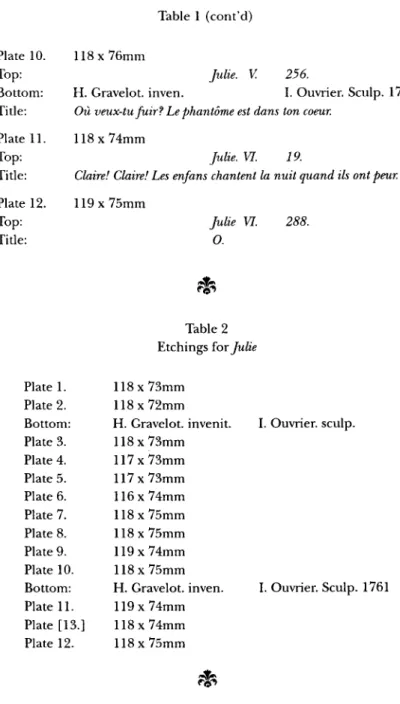
Nouvelle Hêloïse. '52 The main ordering principle of the portfolio thus appears to remain that of placing finished proofs before states and etchings, for close examination of the twelve plates to Julie reveals that eleven are not finished proofs, but states. Each state is centred on a separate recto or verso and none has been trimmed. Harcourt clearly prized these states and made them the centrepiece of his portfolio. The states are listed in table 1. Plates 3 and 8 bear the sig-natures of their designers and engravers, have engraved titles, and have the part and page number of the novel engraved above the illus-trations. However, on plate 3, there is a centred "Julie." inscribed by hand above the illustration, before the engraved "3.e" which appears on the finished plate.33 On plate 8, the centred, handwritten "Julie." takes the place of the engraved "8" of the finished engraving. Plate 3 is thus strictly a lettered proof, whereas plate 8 is a late state. Plates
2, 7, and 10, bear the signatures of their designer and engravers, but
the inscriptions above and below the engravings are handwritten. A glance at the etchings listed in table 2 reveals thatJean Ouvrier had signed plates 2 and 10 when the plates were etched. All other states in the series are unlettered: there are no engraved signatures be-low the engravings and the inscriptions are neatly handwritten in bistre onto scored lines. There is even a handwritten inscription to the untitled plate 12, which represents the heroineJulie lying on her deathbed, in the form of a dramatic "0." The handwriting is that of Rousseau, and the presence of Rousseau's handwriting on the plates may in part explain why they have not been trimmed. These states may have been among the collection of prints shown to Meister on 1 June 1764, when Rousseau professed to prefer plate 5 (Leigh 3311). A single vignette occupies the next verso of the portfolio, perhaps
in order to mark a clear distinction between the series of states and
the etchings which follow. The vignette represents Liberty holding the scales ofjustice. It was designed by B. Bolomey and engraved by
32The Recueilli, designated as Rl and described in McEachern, Bibliography, 1:161-64. 33Handwritten inscriptions are given in italics.
C. Boily for the first edition of Du contrat social published by Marc-Michel Rey in April 1762. Rey sent Rousseau a proof on 22 March 1762, which may well be that contained in the portfolio, since the publisher began to print the vignette on the title-page the following day (Leigh 1717). It is the only vignette in the collection.
Rousseau's etchings are placed together in the portfolio, begin-ning with a single etching for Emile—that of the plate entitled "Orphée, Liv. LV."—beneath which there is an etching of Gravelot's adaptation of Bacquoy's frontispiece to the Discours sur les sciences et
les arts. These etchings measure 123 by 79 mm and 120 by 85 mm
re-spectively. A complete set of etchings for the plates to Julie follows. All of the etchings have been trimmed with the exception of plate 12. This plate, which has been placed on a single verso opposite the last engraving in the portfolio, is preceded by an etching of a new
episode from Julie, which replaced plate 12 in the 1764 Duchesne
edition.34 The etching for the plate entitled "L'Amour maternel." represents Julie saving her youngest son Marcellin from drowning, ultimately at the cost of her own life. It is given as plate 13 in table 2. It was designed by Gravelot and engraved by de Longueil, who had not contributed to the original Recueil d'estampes pour "La Nouvelle
Hêloïse. "
The last print in the portfolio does not follow its general ordering pattern, because it is a late state rather than an etching. Since a print
was removed from the end of the collection, Harcourt was perhaps
uncertain how to fill the remaining twenty-two pages of the portfo-lio. The plate, which is trimmed and measures 136 by 85 mm, is the allegorical frontispiece to the Discours sur l'inégalité.35 It bears the in-scription "Il retourne chez ses Egaux. / Voyez la Note 13. p."36 To the finished engraving, the page number has been added.
Rousseau's ownership of a particular proof is of considerable in-terest in the light of comments made in his correspondence. The lettered proof of ["Thétis, Liv. I."] , which Rousseau had criticized for
being the only untitled plate, is a case in point: curiously, Rousseau 34McEachern, 17. This plate is described in McEachern, Bibliography, 1:296.
35The plate, which was designed by Eisen and engraved by Dominique Sornique, is de-scribed in Jean-Jaques Rousseau, Œ,uvres complètes, vol. 3, Du Contrat social. Ecrits politiques, ed. Bernard Gagnebin and Marcel Raymond (Paris: Gallimard, 1964), p. 1862.
36The note includes a passage from the Histoire générale des voyages, vol. 5 (Paris: Didot, 1748), which the frontispiece represents. See Rousseau, Œuvres complètes, 3:220—21, and 3:221n3.
not only retained this proof but, when he showed his collection to Meister, professed to prefer "Thétis, Liv. I." to the other four illus-trations to Emile.37 Rousseau appears to have reconciled himself to the plate following repeated examination of his collection of illustra-tions, perhaps because the untitled engraving actually came closest to his preferred intention for the plates. The existence of the vari-ant plate lacking the title "Thétis, Liv. I." has hitherto remained unaccounted for, but a possible explanation may be found in the correspondence between Rousseau and Duchesne.38 Rousseau ori-ginally intended to have each engraving inscribed with its sujet, but on 12 February 1762 he warned Duchesne that he had changed his mind: "je dois vous prévenir que quoique j'eusse d'abord pensé à y mettre des inscriptions j'ai changé d'avis, et qu'il n'en faut point" (Leigh 1674). When Rousseau received a lettered proof for "Thétis, Liv. I." he reiterated his change of heart in a letter to Duchesne and Guy of 7 March—"Je ne crois pas qu'il faille d'inscription au bas des estampes"—and offered byway of explanation that "on ne doit point expliquer ce qui est clair." He proposed as an alternative that "on pourrait seulement y coter la page et le volume où chaque estampe se rapporte" (Leigh 1704) . By 12 March, Rousseau was adamant that the inscription must be either modified or removed, which, if prac-ticable, was his preferred option: "Je serois donc d'avis d'effacer tout a fait l'inscription, si cela se peut sans beaucoup de peine." At this point, the entire explanation had been engraved beneath the illus-tration, forming "deux espèces de petits vers rimes, très ridicules"
(Leigh 1709). Rousseau requested Duchesne to make the final
de-cision but asked for consistency and, for the first plate, proposed the
more prosaic title, "Thetis plonge Son fils / dans Ie Stix. v. pag. 37."
Rousseau was actually reluctant to allow Duchesne the last word: on 2 April, he forwarded a "definitive" list of the exact inscription for each plate (Leigh 1728). The title was to comprise only the name of
each figure followed by the page reference, thus "THETIS, p. 37."
Above each engraving, Rousseau wished to have the correspond-ing book number, in order to ensure that the binder positioned the plates at the beginning of the correct book or volume rather than within the text. Two days later, it became apparent that Duchesne had decided to print the "Explications des figures" in the prelims,
37Leigh 1769,3311.
obviating the need to include the rhymed inscriptions. Consistent with his view that "il n'y a rien de si plat que d'expliquer deux fois la même chose," Rousseau forwarded a prose version of the "Explic-ations des figures" and added: "si vous n'avez pas encore fait graver
le mot au-dessous de chaque estampe, ne le faites pas."39 If the titles
were already engraved, Rousseau held that the "Explications des
fig-ures" should not appear. Rousseau also complained on 29 April that
the page reference appeared at the top of each illustration rather
than following the title (Leigh 1759). He feared, with justice, that
this would cause some plates to be positioned within the body of the
text rather than as frontispieces.40 In view of these prevarications, it is
scarcely surprising that of the three proofs which Rousseau received
on 12 May, the first should be untitled. Since the "Explications des
figures" were now to be printed, Duchesne may have decided to con-ciliate Rousseau by removing the title from each plate, beginning with the first. Rousseau's injunction to restore the title paved the way for a compromise by which both the explanations, and a one-word inscription followed by the book number for each engraving, were printed. It was perhaps for financial reasons that the variant plate appeared in some copies of Emile.
Rousseau's ownership of two states to Julie, plates 5 and 8 (table
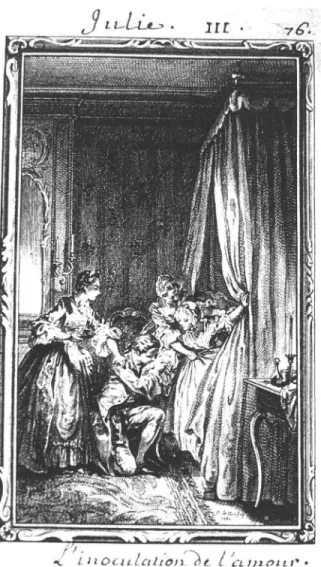
1), and one etching, plate 13 (table 2), are also of interest when con-sidered alongside the correspondence. Rousseau refused to alter the inscription "L'inoculation de l'amour." to plate 5 even though its meaning might be misconstrued.41 Rousseau argued that he was not responsible for vulgar interpretations by others, and recalled that he had used the same words in the novel, "où je ne puis ni ne veux la
changer."42 He suggested that the engraving correspond to page 76
rather than page 75 of the text, which would then prepare the reader for the inscription (Leigh 1286). On the state found in Harcourt's collection, the page number " 76." has been handwritten above the il-lustration (figure 3). This indicates that the states to Julie must have
39Rousseau to Duchesne, 4 April 1762 (Leigh 1729).
40The illustrations are positioned opposite the relevant pages of text rather than at the begin-ning of each volume or book in some copies of McEachern Ia (McEachern, Bibliography,
2:76).
41See Rousseau to Coindet, 11 February 1761 (Leigh 1280). 42Rousseau to Coindet, 13 February 1761 (Leigh 1286).
Figure 3. "L'inoculation de l'amour." Engraved by Noël Le Mire (1724-1801). From
the library at the Manor House, Stanton Harcourt.been inscribed later than 13 February 1761, when Rousseau instruc-ted François Coindet to alter the cross-reference (Leigh 1286). The handwritten inscriptions could not have been intended as a guide to the engraver, because Rousseau had forwarded his renvois desplanches to Coindet earlier in February (Leigh 1270). His request to Coindet
rather constituted a correction to the renvois.
In his conversation with Meister on 1 January 1764, Rousseau was most critical of plate 8 (figure 4). Julie, he complained, looked like a "Grisette de Paris" rather than the daughter of a Swiss noble-man (Leigh 3311). This negative judgment contrasts markedly with
Rousseau's original assessment of the plate. On 25 January 1761,
Coindet had sent Rousseau a late state of plate 8 and commended Pierre-Philippe Choffard's profile ofJulie's face: "Vous trouverez, je crois, le profil du visage de Julie assez joli dans les Monumens des Anciennes Amours,je vous assure que ce n'a pas été chose aisée a ob-tenir" (Leigh 1231). In his express reply of the same day, Rousseau complained that "je ne suis content d'aucun visage," but added: "ce-lui de Julie est bien dans les monumens" (Leigh 1232). The fact that plate 8 was among a personal collection of engravings which Rousseau examined frequently enabled him to review its merits over time, so that three years later he confessed to Meister that whenever he looked at this plate he became enraged (Leigh 3311).
In 1761, plate 12 distressed Rousseau to the point where he
considered suppressing it. In his letter to Coindet of 19 January
1761, he outlined a number of possible improvements (Leigh 1223).
However, he remained highly displeased with the finished engraving and determined that it should be replaced in subsequent editions
of the novel. On 7 November 1761, he informed Rey that he was
already projecting a new "sujet à la place de la dernière qui ne vaut rien" (Leigh 1534). The new sujet was for "L'Amour maternel, "(plate 13). Rousseau may not have seen Gravelot's original drawing, but
Guy sent him an untitled etching of the plate on 23 April 1763
(Leigh 2640) . This is almost certainly the etching found in the port-folio (figure 5) . Rousseau was equally scathing in his judgment of this engraving: on 15 October, he complained to Duchesne that Ju-lie looked as though she were about to begin a rigadoon, for her foot was poised in mid-air as she prepared to jump into Lac Léman to save her son. Rousseau maintained that "Elle doit avoir Ie corps baissé en avant, les bras étendus, les pieds encore sur le terrein; c'est des mains et non pas des pieds qu'elle doit aller chercher l'enfant."
Figure 4. "Les monumens des anciennes amours." Engraved by Pierre Philippe
Figure 5. ["L'Amour maternel."] Etched byJoseph de Longueil. From the library at
He not only threatened to withdraw this plate if it were not modi-fied, as he had threatened to suppress plate 12, but also claimed to prefer the original deathbed scene: "J'opine à changer cette figure ou à supprimer tout à fait l'estampe; la première n'est que maussade, et celle-ci est ridicule" (Leigh 2971).
"L'Amour maternel." had caused the publishers considerable anxiety: on 31 October, Guy informed Rousseau that "cette miser-able estampe dont vous n'êtes pas content, m'a donné bien des soins, on l'a retouchée à plus de dix fois, et encore elle n'est pas bien à beaucoup près, cependantje n'y ai rien Epargné pour la de-pense." (Leigh 2999). Although Leigh commented that the plate in his copy of the Duchesne edition had been corrected, with the heroine's dress duly extended to conceal the offending foot, there are actually few copies of the revised plate.43 Leigh located several proofs of the uncorrected plate in Geneva and Versailles which had
been annotated by Rousseau towards 1770 with the words: "Cette
froide et ridicule estampe avec ce pied de Julie en l'air, comme pour danser, a été ajouté à mon insu je ne sais par qui ni pour-quoi, et n'est point dans les premières éditions."44 Rousseau here merely repeated his original judgment, but wrongly claimed both that the plate had been absent from early editions, and, as Leigh re-marked, that he knew neither why nor by whom the plate had been printed, since the correspondence reveals that he had discussed the plate with Duchesne and Guy from the moment of its inception.45 The presence of an etching of this plate in Rousseau's collection provides further visual evidence that Rousseau had direct and early knowledge of the plate, which makes his annotation all the more as-tonishing. However, the uncorrected plate was printed, perhaps for
financial reasons, without Rousseau's consent, and it remained
un-clear who had been responsible for including the unauthorized plate in some copies of the novel.
Rousseau made a surprising remark in his correspondence con-cerning the frontispiece to the Discours sur l'inégalité. In a letter to
43The corrected plate is reproduced in Bernard Gagnebin, Album Rousseau (Paris: Gallimard, 1976), p. 117. The Leigh edition containing the revised plate is located in Cambridge University Library (shelfmark: Leigh, d.3.292) and corresponds to McEachern 19. It is the only edition of the Leigh collection to contain the corrected plate. McEachern does not inventory this revised plate.
44Published in Leigh 1534, n.a. 45See Leigh 1534, n.a.
Elizabeth-Sophie-Françoise Lalive de Bellegarde, comtesse d'Hou-detot of 26 December 1757, Rousseau commended the frontispiece but wrongly recalled that Cochin had designed it (Leigh 595) . This is a surprising error given that the Discours sur l'inégalité had been pub-lished only two years earlier and that Rousseau owned a late state of the engraving, which was actually designed by Eisen. It is possible that Rousseau perused his collection of illustrations more frequently once he had amassed more of them. Cochin may have been up-permost in Rousseau's mind in December 1757, because Rey had recently failed to engage him to design the engravings to Julie.46
The above examples demonstrate that Harcourt's portfolio offers visual evidence which, when examined alongside the explanations to the plates and Rousseau's works and correspondence, reveals new facets of the publishing history of the illustrations to Rousseau's works, a subject which calls for a comprehensive study. The most significant aspect of the portfolio is that it contains the original etch-ings and states of the illustrations to Julie. These etchetch-ings and states constitute a vital and hitherto missing link in the publishing his-tory of the Recueil d'estampes pour "La Nouvelle Hêloïse. " Eighteen of Gravelot's original studies for the plates are housed in the Depart-ment of Printing and Graphic Arts at the Houghton Library, Har-vard University.47 The finished Gravelot drawings are bound in the handwritten copy ofJulie transcribed by Rousseau for the Maréchale de Luxembourg and housed in the library of the Assemblée Na-tionale, Paris. Rousseau's etchings and states have now been loc-ated in the portfolio at Stanton Harcourt Manor, and the finished engravings are published either separately or bound into early edi-tions of the novel. A detailed study of these sources, in conjunction with Rousseau's texts and correspondence, offers fresh insight into the nature and extent of Rousseau's personal involvement with the illustrations to his novel. The visual evidence provided by the
etch-ings and states reveals how many of Rousseau's proposed corrections
were effectuated on the proofs, and whether Rousseau was examin-ing sketches, finished drawexamin-ings, etchexamin-ings, or states when he made his various comments and suggestions. It is also possible to explain why
46See Rousseau to the comtesse d'Houdetot, 5 December 1757 (Leigh 587).
47See Philip Hofer, "Gravelot's Illustrations for La Nouvelle Hêloïse," Harvard Library Bulletin
Rousseau deemed his proposed corrections necessary. The results of this inquiry will be presented in a separate article.48
The portfolio highlights the value Rousseau attached to friend-ship in his life and works. Friendfriend-ship constitutes a central theme of the illustrations to Julie, and personal friends offered Rousseau many of the prints in his collection. Rousseau's gift to Harcourt was a token of his affection and respect for a disciple who shared his love of engraving.49 The two men met only at the beginning of Rousseau's stay in England: they almost certainly did not meet again, either at Nuneham Courtenay before Rousseau's hasty departure, or sub-sequently in Paris. Rousseau's final contact with Nuneham, through the intermediary of Brooke Boothby, instead took the form of a fur-ther token of friendship, an engraved portrait of Nuneham. On 10
August 1777, Boothby informed Nuneham that "our divine
philo-sopher received the portrait with the utmost seeming pleasure, and mentioned in the strongest terms his regard for the original" (Leigh
7131). Rousseau's stay in England is often viewed negatively in terms
of his quarrel with David Hume, the press campaign against him, and the confused emotional state in which he fled the country. The port-folio of engravings found at Stanton Harcourt Manor has uncovered elements of a far more positive and creative legacy of Rousseau's stay in England.50
48Ann-Marie Thornton, "Rousseau graveur: une collection d'eaux-fortes et d'états pour la Julie," Annales de la SociétéJean-Jacques Rousseau, forthcoming.
49George Simon Harcourt, Viscount Nuneham was an accomplished engraver: from 1763-64, he designed and etched four views in folio of the Ruins at Stanton Harcourt in the County of Oxford.
50I am grateful to Nicholas Cronk and Philip Stewart for their perceptive comments at an earlier stage of this work.
Table 1 States for Julie
Plate 1. Top: Title: Plate 2. Top: Bottom: Title: Plate 3. Top: Bottom: Title: Plate 4. Top: Title: Plate 5. Top: Title: Plate 6. Top: Title: Plate 7. Top: Bottom: Title: Plate 8. Top: Bottom: Title: Plate 9. Top: Title: 118 x73mm
Le premier baiser de l'amour.
118 x73mm H. Gravelot. invenit. L'héroïsme de la valeur. Julie. I.87 Julie. I 343. I. Ouvrier, sculp. 118 x73mm II Part.eJulie. 3.e H. Gravelot. inven.
Ah! jeune homme, à ton bienfaiteur!
118 x73mm
Julie II. La honte et les remords vengent l'amour outragé.
118 x73mm L'inoculation de l'amour. 117x74mm La force paternelle. 118x74mm H. Gravelot. inv.
La confiance des belles ames.
Page 343. L. !empereur scu 294. Julie. III.76. Julie III.117. Julie. TV.59. PP. Choffard Sculp. 1761. 118 x74mm IV Part.eJulie. H. Gravelot. del.
Les monumens des anciennes amours
Page 323. PP Choffard Sculp. 1761.
118 x74mm
La matinée à l'angloise.
Table 1 (cont'd) Plate 10. Top: Bottom: Title: Piateli. Top: Title: Plate 12. Top: Title: 118 ? 76mm Julie. V. 256.
H. Gravelot. inven.I. Ouvrier. Sculp. 1761 Où veux-tufuir? Le phantôme est dans ton coeur.
118 x74mm
Julie. VI. 19.
Claire! Claire! Les enfans chantent la nuit quand ils ont peur.
119 ? 75mm
Julie VI. 288. O.
F
Table 2
Etchings for Julie
Platel.118 x73mm Plate 2.118 x72mm
Bottom:H. Gravelot. invenit.
Plate 3.118 x73mm Plate 4.117 x73mm Plate 5.117 x73mm Plate 6.116 x74mm Plate 7.118 x75mm Plate 8.118 x75mm Plate 9.119 x74mm PlatelO.118 x75mm
Bottom:H. Gravelot. inven.
Piateli.119 x74mm Plate [13.]118 x74mm Plate 12.118 x75mm

![Figure 2. ["Thétis, Liv. /."]. Engraved byJoseph de Longueil (1730-1792). From the](https://thumb-eu.123doks.com/thumbv2/9libnet/5766648.116821/10.648.163.484.202.741/figure-thétis-liv-engraved-byjoseph-longueil-from-the.webp)

![Figure 5. ["L'Amour maternel."] Etched byJoseph de Longueil. From the library at the Manor House, Stanton Harcourt.](https://thumb-eu.123doks.com/thumbv2/9libnet/5766648.116821/19.648.176.476.211.706/figure-maternel-etched-byjoseph-longueil-library-stanton-harcourt.webp)