OFDM with Transmit and Receive Antenna
Selection Based on Subcarrier Groups
P. Remlein
*, T. Cogalan
**and T. Gucluoglu
*** * Poznan University of Technology, Poznan, Poland** Kadir Has University, Istanbul, Turkey *** Yildiz Technical University, Istanbul, Turkey
[email protected], [email protected], [email protected]
Abstract— In this paper, the performance of coded OFDM transmission over multiple antennas is explored when joint transmit and receive antenna selection is employed. The channel is assumed as Rayleigh frequency selective fading channel and only receiver is assumed to have perfect channel state information (CSI). The performance of MIMO OFDM system using pragmatic coding techniques such as convolutional coding (CC) and space-time block coding (STBC) with antenna selection based on subcarrier groups and other types such as all-tone, per-tone and hybrid techniques are obtained via computer simulations. The results suggests that joint antenna selection particularly based on subcarrier groups can be a desirable option in Worldwide Interoperability for Microwave Access (WiMAX) and Long Term Evolution (LTE) standards.
I. INTRODUCTION
New generation wireless communication systems can utilize coded transmission over multiple antennas at the transmitter and receiver so that increased diversity and coding gains reduce the effects of fading. The multiple antenna systems are called multi-input multi-output (MIMO) systems and it increased the system diversity. For example simple block codes or convolutional codes or sophisticated turbo coding are widely used in multiple antenna systems [3, 22]. Convolutional codes (CC) are very popular in practice and they can also achieve satisfactory performance even on very bad channels if proper generators and large constraint lengths are used for encoding. Achieving full spatial diversity with full rate STBC is introduced by Alamouti [2]. STBC is preferred because of its simple structure and satisfactory performance while not degrading rate whereas other codes can. In recent years, there has been increasing interest in applying MIMO systems with orthogonal frequency division multiplexing (OFDM) transmission [12, 13]. Integrating OFDM with MIMO is considered as a strong contender for the next generation wireless systems, for example 802.11ac [23].
OFDM transmission can convert frequency selective channels into parallel flat fading sub-channels by transmitting symbols over narrowband subcarriers. Therefore a common problem of having inter-symbol interference (ISI) is eliminated even at very high speed transmissions. Thus it is preferred in high speed wireless networks such as 802.11n, WiMAX and LTE [8, 9, 10]. Coded OFDM transmission over multiple antennas can
This work was partially supported by the Polish Ministry of Science and Higher Education under research grant 5545/B/T02/2010/39
achieve multipath and spatial diversity to lower error rates [12, 13].
MIMO systems increase data rate but it also increase the system complexity. Antenna selection technique [4, 5,6] is a solution of hardware and software complexity problem of MIMO systems. By using antenna selection technique, some of the available antennas are used. Accordingly, the complexity, cost and power consumption of the transmission system are reduced, and system performance is largely maintained [7, 11, 14, 15]. Antenna selection technique can be based on maximum signal to noise ratio (SNR), maximum capacity or maximum error probability. In the literature different types of transmissions with several selection schemes are studied [16-22].
In this paper, we consider pragmatic channel codes with OFDM transmission using joint transmit and receive antenna selection. We claim that full diversity gain can be achieved with joint antenna selection if full rank codes are employed. After a brief theoretically expected performance discussion, the computer simulations results for convolutional coding (CC) or space-time block coding (STBC) with four different antenna selection types: all-tone, per-all-tone, group-based and hybrid techniques are presented. The maximum SNR criterion is used for selecting antennas where the best antennas are selected based on the received average SNR values. We assume that only the receiver has perfect channel state information (CSI) and channel is modeled as quasi-static Rayleigh fading channel.
This paper is composed of 4 sections. In Section II the proposed system with antenna selection is described. The simulation results are shown in Section III and finally in section IV, conclusions are stated.
II. SYSTEM DESCRIPTION
The coded multiple antenna OFDM system block diagram is shown in Figure 1. The channel encoder modifies the input bits (e.g. CC, STBC, etc.) and the output of this encoder is sent to the OFDM transmitter. At the transmitter, we have M available transmit antennas and OFDM modulated codeword is transmitted from the selected Ms transmit antennas. The receiver has N receive
antennas and Ns of them are selected and used in active
transmission. Receiver is assumed to know CSI perfectly and antenna selection is based on this CSI to obtain largest received power. The received signal pass through the 8th IEEE, IET International Symposium on Communication Systems, Networks and Digital Signal Processing
OFDM receiver and at the decoder, a suitable algorithm depending on the encoder is employed.
The OFDM transmitter includes serial to parallel (S/P) converter, IFFT, adding cyclic prefix, parallel to serial (P/S) converter and digital to analog (D/A) converter. A/D converter, S/P converter, removal of cyclic prefix, FFT and P/S converter are included in OFDM receiver. At this system model, the conventional OFDM transmitter and receiver most of the modules are suppressed as our main focus is the error rate performance. The received signals can be written as,
where
Y k
n[ ]
is received signal from antenna n (n=1,2,…Ns) at subcarrier k (k=1,2,..K).S k
m[ ]
istransmitted signal from antenna m.
W k
n[ ]
is Gaussian noise sample andH
n m,[ ]
k
is fading channel coefficientin frequency domain and they are both modeled as zero mean complex Gaussian with variance 1. We assume identical power transmission from all antennas and
ρ
is the total transmitted power and hence denotes the average received SNR. Channel coefficients at each subcarrier can be written as( )
2 1 , , 0[ ]
L[ ]
jKlk2
n m n m lH
k
−h
l e
− π ==
∑
where
h
n m,[ ]
l
is zero-mean Gaussian distributed channel coefficient in time domain, L is the number of channel taps where l=0,1,..L. We note that K is the number of subcarriers which is also equal to FFT size. The complete channel matrix containing all fading coefficients for every pair of transmit and receive antennas can be expressed as( )
1,1 1, ,1 ,[ ]
[ ]
3
[ ]
[ ]
[ ]
N M M NH k
k
k
k
H
k
H
H
⎡
⎤
⎢
⎥
= ⎢
⎥
⎢
⎥
⎣
⎦
H
"
#
%
#
"
In antenna selection for MIMO-OFDM system, all channel coefficients in the frequency domain for all possible combinations are considered and finally the maximum Frobenius norm (i.e. maximum received power) is used as the selection criterion of transmit and receive antennas. In “all-tone” selection, a subset of transmitter and receiver antennas selected for all subcarriers. If
antennas are selected for each subcarrier, this technique is called “per-tone” selection where the receiver uses CSI for each subcarrier so complexity of the system is increasing and it may become impractical. The combination of all-tone and per-all-tone selections is called hybrid selection and it decreases per-tone selection complexity. In “hybrid” selection technique, some antennas are selected by all-tone technique and “per-all-tone” selection is used among the selected antennas, thus complexity of system is less than per-tone selection. In the antenna selection based on groups of subcarrier (i.e. group selection), the antennas are selected based on the received power for a group of subcarriers. For example, if the group size is 64 and total number of subcarriers is 256, then subcarriers are divided into 4 groups and each group has 64 subcarriers. In per-tone selection, the antenna selection is performed for all subcarriers but in group selection, the selection computation is reduced by the size of the group.
Similar to [1], pairwise error probability (PEP) upper bound for the MIMO OFDM system [12] for a specific channel matrix H (containing all channel coefficients for all n, m, k values) can be written as
( )
( )
2 ,ˆ ˆ ( | ) exp 4 8 d P M ρ ⎛ ⎞ ⎜ ⎟ → ≤ ⎜− ⎟ ⎝ ⎠ S S S S HIn the above expression S and ˆS represents the transmitted codeword and the decoded codeword matrices, respectively. As in [5], PEP can be written as
( )
2 ˆ ( | ) exp 5 8 P M ρ ⎛ ⎞ → ≤ ⎜− ⎟ ⎝ ⎠ S S H HBwhere B represents the codeword difference matrix, and the rank of it determines the diversity and eigenvalues of square of it determine the coding gain. The major difference is the application of channel coding in frequency domain instead of coding in time. Based on the above expression, the PEP derivation in [5] can be applied to MIMO OFDM system by following the similar lines of the lengthy PDF derivation and averaging over the distribution of the selected channel coefficients. Therefore, based on studies presented in [5] and [12], we can claim that full diversity order NML can be obtained if a strong full rank space time coding is used in an OFDM system. The achievable diversity order of NML is also shown in [21] where PEP for STC over frequency selective fading channel is derived even with the assumption of imperfect channel estimation. We note that
, 1
[ ]
s[ ] [ ]
[ ]
(1)
M n n m m n mY k
H
k S k
W k
==
∑
+
if rank-deficient codes are used then only some portion of the diversity can be achieved. Although theoretical expectation of STC-OFDM with antenna selection is promising, computer simulations are needed to gain some idea about the performance of practical coding schemes such as STBC and CC.
III. SIMULATION RESULTS
In this section, the performances of the STBC-OFDM and CC-OFDM systems with antenna selection using different sizes of subcarrier groups are provided. In the simulations, BPSK signaling and 256 subcarriers are used in transmission over quasi-static Rayleigh frequency-selective fading channel with L=2 multipath taps.
The performances of antenna selection types on STBC-OFDM system are shown in Figure 2. From M=4 transmit and N=4 receive antennas, Ms=2 transmit and
Ns=1 receive antennas are selected with different sizes of
groups. The STBC-OFDM system is simulated with no selection, all-tone, hybrid, subcarrier groups and per-tone selection techniques. When the group size is increased, BER also increases while achieved diversity order decreases. At BER 10-4, when subcarrier group size is 1
(i.e. per-tone selection) performance is 0.5 dB better than group selection with 32 subcarriers. Furthermore, the performance of group selection with 32 subcarriers is 6 dB better than the all-tone selection.
0 1 2 3 4 5 6 7 8 9 10 10-5 10-4 10-3 10-2 10-1
Signal to Noise Ratio (SNR)
B it E rror R at e (B E R )
STBC-OFDM with Antenna Selection
no selection all-tone hybrid Group = 64 Group = 32 per-tone
Figure 2. STBC-OFDM with Joint Transmit and Receive Antenna Selection
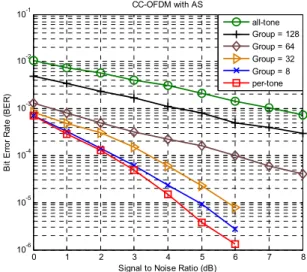
Figure 3 shows the performance of group selection with different sizes when CC-OFDM is used. Binary inputs are encoded by a nonsystematic convolutional encoder which uses code generator [23 35], in octal notation. The system has M=2 transmit and N=2 receive antennas. Different lengths of groups are selected for actively used Ms=1
transmit and Ns=1 receive antennas. Decreasing the
group size from 256 (i.e. all-tone selection) to 64 improves the BER approximately 7 dB. As observed, the achievable diversity also depend on group size. When subcarrier group size is 1, the highest diversity can be obtained. Furthermore group sizes 32 and 8 have high
diversity orders. On the other hand, changing the group size from 8 to 1 has slight improvement. We note that group selection technique can allow system designers to select the group size according to the desired performance and computational complexity.
0 1 2 3 4 5 6 7 8 10-6 10-5 10-4 10-3 10-2 10-1
Signal to Noise Ratio (dB)
B it E rro r R at e (B E R ) CC-OFDM with AS all-tone Group = 128 Group = 64 Group = 32 Group = 8 per-tone
Figure 3. CC-OFDM with Joint Transmit and Receive Antenna Selection
IV. CONCLUSION
In this paper, the antenna selection methods for pragmatic coded MIMO OFDM transmission are investigated. The discussion about the theoretical performance of space time coded OFDM with transmit and receive antenna selection is provided and specifically, the performance of subcarrier group based joint antenna selection technique for convolutional coded OFDM and space time block coded OFDM systems are presented. It is observed that the performance depends on the number of subcarriers in each group. When the size of the group is decreased, the performance approaches to per-tone selection and if it is increased, performance is close to all-tone selection which can be a highly useful trade-off in system design. The results suggests that joint antenna selection particularly based on subcarrier groups can be a desirable option in wireless systems e.g. WiMAX and LTE.
REFERENCES
[1] V. Tarokh, N. Seshadri, and A. R. Calderbank, A, “Space time codes for high data rate wireless communication: performance criterion and code construction,” IEEE Transactions Information Theory, vol. 44, pp: 745–764, Mar. 1998.
[2] S. M. Alamouti, “A Simple Transmit Diversity Technique for Wireless Communications”, IEEE Journals on Sel. Areas in Com., vol. 16, no. 8, October 1998.
[3] Y. Hong, J. Yuan, Z. Chen, B. Vucetic, “Space time turbo trellis codes for two, three, and four transmit antennas”, IEEE Transactions on Vehicular Technology,vol. 53, no. 2, pp. 318 – 328, 2004.
[4] S. Sanayei, A. Nosratinia, “Antenna selection in MIMO systems”, IEEE Communication Magazine,, vol. 42, no. 10, pp. 68-73, October 2004.
[5] T. Gucluoglu, T. Duman, “Performance analysis of transmit and receive antenna selection over flat fading channels” IEEE Transactions on Wireless Communications, vol. 7, no. 8, pp. 3056-3065, August 2008.
[6] T. Gucluoglu, E. Panayirci, “Performance of transmit and receive antenna selection in the presence of channel estimation errors”, IEEE Communications letters, vol. 12, no. 5, May 2008.
[7] M. Collados and A. Gorokhov, "Antenna selection for MIMO-OFDM WLAN systems", in Proc. PIMRC, 2004, pp.1802-1806. [8] IEEE, “IEEE 802.11n Wireless Local Area Networks” from
http://grouper.ieee.org/groups/802/11/
[9] IEEE, 2004. “IEEE Standard for Local and Metropolitan Area Networks; part 16: Air Interface for Fixed Broadband Wireless Access Systems,” IEEE, Tech. Rep. 802.16-2004 part 16, Oct. [10] 3GPP, 2008. “Technical Specification Group Radio Access
Network; Evolved Universal Terrestrial Radio Access (E-UTRA),” 3GPP, Tech. Rep. 36.213 V8.2.0, Mar.
[11] Z. Tang, H. Suzuki and I. B. Collings, “Performance of antenna selection for MIMO-OFDM systems based on measured indoor correlated frequency selective channels,” Proc. ATNAC, Dec. 2006.
[12] Lu, B.; Wang, X.; “Space time code design in OFDM systems”, Global Telecommunications Conference, vol. 2, pp. 1000-10004, Year: 2000.
[13] Z. Liu, Y. Xin, G. Giannakis, “Space-time-frequency coded OFDM over frequency-selection fading channels”, IEEE Transactions on Signal Processing, vol. 50, no.10, October 2002. [14] I. Bahceci, T. Duman, Y. Altunbasak, “Performance of MIMO
antenna selection for space-time coded OFDM systems”, Proceedings of IEEE Wireless Communications and Networking Conference (WCNC), pp. 987-992, Atlanta, GA, March 2004. [15] A. Narasimhamurthy, C. Tepedelenlioglu, “Antenna selection for
MIMO OFDM systems with channel estimation error”, IEEE Transactions on Vehicular Technology, vol. 58, pp: 2269-2278, 2009.
[16] J. Coon, M. Sandell, “Analysis of per-tone transmit antenna selection in OFDM systems with Alamouti coding”, 7’th International Symposium on Wireless Communication systems, pp:164-168, 2010.
[17] M. Sandell, J. Coon, “Per-subcarrier antenna selection with power constraints in OFDM Systems”, IEEE Transactions on Wireless Communications, vol. 8, no 2, February 2009.
[18] H. Zhang, R. Nabar, “Transmit antenna selection in MIMO OFDM systems: bulk versus per-tone selection”, IEEE International Conference on Communications, pp: 4371-4375, 2008.
[19] J. Coon, M. Sandell, “Combined bulk and per-tone transmit antenna selection in OFDM systems”, IEEE Communication Letters, vol. 15, no. 5 May 2010.
[20] S. Cinar, T. Gucluoglu, M. E. Celebi, “Space-time coded OFDM system with transmit and receive antenna selection”, pp.1-6, Future Networks and Mobile Summit (FUNEMS), 2010.
[21] T. Gucluoglu, E. Panayirci, “Performance of transmit antenna selection over frequency selective fading channels in the presence of channel estimation errors", European Signal Processing Conference (EUSIPCO), Lausanne, August 2008.
[22] P. Remlein, T. Gucluoglu, “Space Time Turbo Coded OFDM with Joint Transmit and Receive Antenna Selection”, Advances in Electronics and Telecommunications, vol. 2, no. 4, pp. 63-67, December 2011.
[23] IEEE 802.11 TGac, “802.11ac - Technical Specification Draft 0.1", January 20, 2011.