INTERNATIONAL DIMENSION OF DEMOCRATIZATION:
THE IMPACT OF EU CREDIBILITY ON DEMOCRATIC CONSOLIDATION OF TURKEY A Master’s Thesis by RÜYA LÜLECĐ Department of International Relations Bilkent University Ankara September 2008
INTERNATIONAL DIMENSION OF DEMOCRATIZATION:
THE IMPACT OF EU CREDIBILITY ON DEMOCRATIC CONSOLIDATION OF TURKEY
The Institute of Economics and Social Sciences of
Bilkent University
by
RÜYA LÜLECĐ
In Partial Fulfillment of the Requirements for the Degree of MASTER OF ARTS in THE DEPARTMENT OF INTERNATIONAL RELATIONS BILKENT UNIVERSITY ANKARA September 2008
I certify that I have read this thesis and have found that it is fully adequate, in scope and in quality, as a thesis for the degree of Master of Arts in International Relations.
………... Asst. Prof. Dr. Ali Tekin Supervisor
I certify that I have read this thesis and have found that it is fully adequate, in scope and in quality, as a thesis for the degree of Master of Arts in International Relations.
………... Asst. Prof. Dr. Paul Williams Examining Committee Member
I certify that I have read this thesis and have found that it is fully adequate, in scope and in quality, as a thesis for the degree of Master of Arts in International Relations.
……… Asst. Prof. Dr. Aylin Güney Examining Committee Member
Approval of the Institute of Economics and Social Sciences
……… Prof. Dr. Erdal Erel
ABSTRACT
INTERNATIONAL DIMENSION OF DEMOCRATIZATION: THE IMPACT OF EU CREDIBILITY ON DEMOCRATIC CONSOLIDATION OF TURKEY
Lüleci, Rüya
M.A., Department of International Relations Supervisor: Asst. Prof. Dr. Ali Tekin
September 2008
The European Union (EU) has been a decisive actor in Turkey’s long journey of democratization, and this is due to substantial impact of the EU democratic conditionality on Turkish reform process. However, whether this effect will be persistent or not, is depended on the existence of a credible EU approach towards Turkey. Slow down in Turkey’s democratic consolidation in the post- 2004 period due to increasingly sided and discriminatory approaches of the EU as regards to Turkey’s accession process is an indicator of this fact. In this respect, analyzing three different period (pre- 1999, 1999-2004 and post- 2004) of EU-Turkey relations, the thesis investigates how the variance in the credibility of the EU conditionality affects the variance in the speed and quality of democratic consolidation in Turkey.
Keywords: Credibility, Turkey and the European Union, democratic consolidation, conditionality.
ÖZET
DEMOKRATĐKLEŞMENĐN ULUSLARARASI BOYUTU: AVRUPA BĐRLĐĞĐ’NĐN GÜVENĐLĐRLĐĞĐNĐN TÜRKĐYE’DE DEMOKRASĐNĐN
PEKĐŞMESĐNE ETKĐSĐ Lüleci, Rüya
Yüksek Lisans, Uluslararası Đlişkiler Bölümü Tez Yöneticisi: Yrd. Doç. Dr. Ali Tekin
Eylül 2008
Avrupa Birliği (AB), Türkiye’nin uzun yıllar süren demokratikleşme yolculuğunda belirleyici bir aktör olmuştur ve bu durum AB demokratik şartlılığının Türk reform süreci üzerindeki önemli etkisine bağlıdır. Fakat bu etkinin sürekli olabilmesi Türkiye’ye karşı güvenilir bir AB yaklaşımının varlığına bağlıdır. Özellikle 2004 sonrası dönemde AB’nin Türkiye’nin üyelik sürecine ilişkin giderek artan taraflı ve ayrımcı politikalar izlemesi sonucu Türkiye’deki demokratik pekişmenin yavaşlaması bu durumun bir göstergesidir. Bu tezde, AB- Türkiye ilişkilerinin 3 farklı dönemi (1999 öncesi, 1999- 2004 ve 2004 sonrası) süresince, AB demokratik şartlılığının güvenilirliğindeki değişimin Türkiye’deki demokratik pekişmenin hız ve kalitesindeki değişime nasıl etki ettiğini incelenmektedir.
Anahtar Kelimeler: Güvenilirlik, Avrupa Birliği ve Türkiye, demokratik pekişme, şartlılık.
ACKNOWLEDGMENTS
I would like to thank to Asst. Prof. Dr. Ali Tekin, Asst. Prof. Dr. Paul Williams and Asst. Prof. Dr. Aylin Güney for their valuable assistance and support. I also would like to express my thanks to my family for always being by my side with their constant support and encouragement.
TABLE OF CONTENTS
ABSTRACT ………. iii
ÖZET ……….iv
ACKNOWLEDGEMENTS………....v
TABLE OF CONTENTS ………...vi
LIST OF TABLES………..x
CHAPTER I: INTRODUCTION ………...1
CHAPTER II: RESEARCH DESIGN………...9
2.1. Variables………...9
2. 2. Case Selection, Why Turkey?...12
2.3. Methodology………...13
2. 4. Definitions of the Basic Concepts………..13
2.4.1. Democracy………... 14
2.4.2. Democratization and Democratic Consolidation………..16
2.4.3. Conditionality (of the EU)………17
2.4.4. Credibility (of the EU)………..18
2.4.5. Absorption Capacity……….19
2.5. The Intended Contributions of the Thesis to the Field………20
3.1. Rationalist Accounts- External Incentives Model
and Its Reformulation………..23
3.2. Constructivist Accounts- Social Learning Model and Its Reformulation………..27
3.3. Juxtaposition of Rationalist and Constructivist Models………..31
CHAPTER IV: THE EU AS AN ACTOR IN INTERNATIONAL DIMENSION OF DEMOCRATIZATION………...33
4.1. International Dimension of Democratization………..33
4.2. The European Union and Its Role in Democracy Promotion………...35
4.2.1. Legal Base of the EU’s Role………35
4.2.2. The Reasons for the EU’s Promotion of Democracy………...37
4.2.3. The Evolution of EU Democratic Conditionality…………...38
CHAPTER V: AN ANALYSIS OF TURKEY- EU RELATIONS: DEMOCRATIC CONSOLIDATION IN PRE- 1999 PERIOD…………...42
5.1. Developments in Turkey- EU Relations in Pre- 1999 Period…...43
5.2. The EU’s Approach and Credibility………45
5.3. Impact on Governmental Domain, Rationalist Accounts………46
5.4. Impact on Societal Domain, Constructivist Accounts………...48
5.5. An overall assessment………..50
5.5.1.1998 Progress Report………...51
5.5.2. Surveys and Public Opinion………..52
CHAPTER VI: AN ANALYSIS OF TURKEY- EU RELATIONS: DEMOCRATIC CONSOLIDATION IN 1999- 2004 PERIOD…………....55
6.1. Developments in Turkey- EU Relations in 1999- 2004 Period….…...56
6.3. Impact on Governmental Domain, Rationalist Accounts………...58
6.4. Impact on Societal Domain, Constructivist Accounts………68
6.5. An overall assessment……….71 6.5.1. Progress Reports………..72 6.5.1.1. 1999 Progress Report………....72 6.5.1.2. 2000 Progress Report………73 6.5.1.3. 2001 Progress Report………....74 6.5.1.4. 2002 Progress Report………....75 6.5.1.5. 2003 Progress Report………....77 6.5.1.6. 2004 Progress Report………....77
6.5.2. Surveys and Public Opinion……….80
CHAPTER VII: AN ANALYSIS OF TURKEY- EU RELATIONS: DEMOCRATIC CONSOLIDATION IN POST- 2004 PERIOD……….….82
7.1. Developments in Turkey- EU Relations in Post- 2004 Period……...83
7.2. The EU’s Approach and Credibility……….84
7.2.1. The Reasons for the Decrease in the EU’s Credibility……….86
7.2.1.1. Negative-Discriminatory Statements on Turkish Membership………...86
7.2.1.2. Special Standards and Rules (Double Standards) for Turkey, as demonstrated by certain documents and concepts………....90
7.2.1.2.1. EU Strategy Paper………...92
7.2.1.2.2. Brussel Summit Decisions………..94
7.2.1.2.3. Progress Reports……….95 7.2.1.2.4. Negotiation Framework,
New Concepts for Turkey………..96
7.2.1.2.5. Communication from the Commission to the European Parliament and the Council, Enlargement Strategy and Main Challenges 2006-2007………..106
7.2.1.3. Cyprus Problem………...…108
7.2.1.4. Public Opinion in the EU…………..………...110
7.3. Impact on Governmental Domain, Rationalist Accounts………...…114
7.4. Impact on Societal Domain, Constructivist Accounts………..……..119
7.5. An overall assessment………..………...125
7.5.1. Progress Reports……….………...…...126
7.5.1.1. 2005 Progress Report………....…………...127
7.5.1.2. 2006 Progress Report……… ………..128
7.5.1.3. 2007 Progress Report……….…………..130
7.5.2. Freedom House Reports……….……….131
7.5.3. Surveys and Public Opinion……….………...134
7.5.3.1. Eurobarometers (Standard)………….………….…135
7.5.3.2. Transatlantic Trends…………..………...137
7.5.3.3. A&G Research Company………..…………..139
7.5.3.4. Pew Global Attitudes Project………...…....140
CHAPTER VIII: CONCLUSION………...…..143
LIST OF TABLES
Table 1: Review of Democratization Reforms in the 1999-2004 Period…………..68
Table 2: Review of European societies’ attitudes to Turkey’s accession to the EU………....111
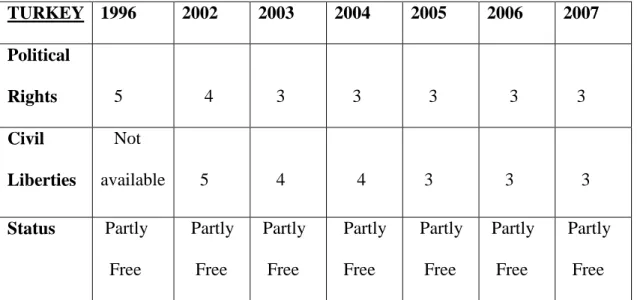
Table 3: Freedom House Ratings for Turkish Democracy………..…….132
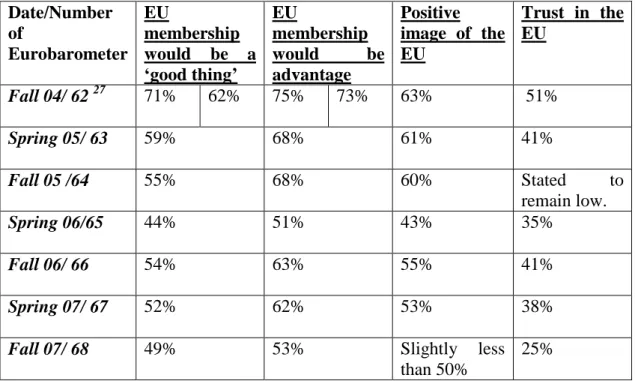
Table 4: Review of Eurobarometer Results………..…………136
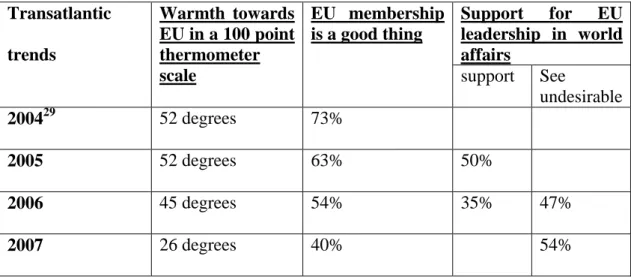
Table 5: Review of Transatlantic Trends Results………..……...138
Table 6: Review of Findings of A&G Research Company………..…………139
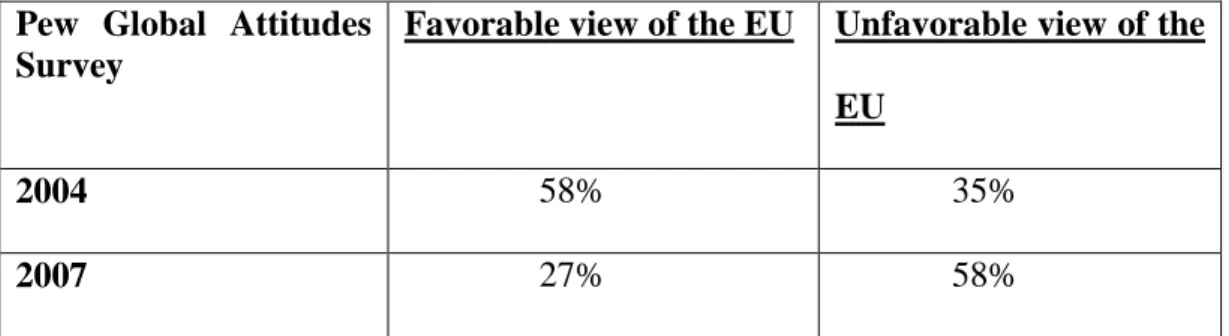
Table 7: Review of “Rising Environmental Concern in 47-Nation Survey, Global unease with major world powers, 47-Nation Pew Global Attitudes Survey”………..……...141
CHAPTER I
INTRODUCTION
Although international dimension of democratization still remains understudied and poorly understood by the scholars (Schrader, 2003: 21), there is a growing concern for international factors within the democratization literature. The new literature on democratization has underlined the role played by the European Union (EU)1 democratic conditionality in facilitating democratic change in candidate countries. Closer examination of Turkish case is crucial in that respect. Though the Turkish democracy remained very much unconsolidated between 1946 when the country begun multi- party politics and the 2000s, it has recently taken significant steps towards consolidation of democracy stimulated by the EU accession process.
The thesis assumes that the EU conditionality has been the main factor in the process of democratic consolidation in Turkey, and investigates how the variance in the credibility of the EU conditionality shapes the variance in the speed and quality of democratic consolidation in Turkey. In other words, this thesis will be an attempt to “unpack the discourse on conditionality” (Tocci, 2007: 9). The central hypothesis
1 In this thesis, I will use “the EU” to refer to the overall process of European integration since the
is that the more credible the EU conditionality towards Turkey, the more likely
Turkey’s ability to make its democracy consolidated becomes in this process.
However, this is not to argue that EU credibility is enough for the emergence of fully consolidated democracy in Turkey. Domestic factors, such as social acceptability and satisfaction with respect to democratic reforms and public’s internalization of these democratic rules, norms and values are crucial for the emergence and continuation of consolidated democracy in Turkey. Therefore, the thesis will investigate the impact of EU credibility on Turkey’s democratic consolidation throughout different time periods, without ignoring the significance of domestic considerations in this long process of democratic consolidation in Turkey.
The thesis will benefit both from rationalist and constructivist theories in order to explain the impact of the EU approach on different domains in Turkey. It will both look at the formal rule adoption at the governmental domain and the behavioral rule adoption at the societal domain that is crucial for the effective implementation of democratic reforms undertaken by governments.
In order to substantiate this argument, I will analyze three different periods of Turkey- EU relations ( pre- 1999, 1999-2004 and post- 2004), with special emphasis on the post 2004 phase in which EU’s discriminatory and sided approach towards Turkey has increased. Hence, the post- 2004 period is especially important for analyzing the possible impact of the change in the EU’s credibility on Turkey’s democratic consolidation and for commenting on the future of Turkey-EU relations.
The official relations between Turkey and the EU go back to 1959 when Turkey applied for associate membership. The process gained more strength with 1963 Ankara Agreement, which is the association agreement signed between the European Economic Community (EEC) and Turkey. Since then the relations with the
EU has had an important place in Turkey’s foreign policy despite all ups and downs. Thus, it becomes crucial to answer how Turkey’s ties with Western democracies (the EU in our case) have affected and continue to affect democratization in Turkey, with its ups and downs over more than 50 years (Kubicek, 2008: 22). In the period up to 1999 Helsinki Summit when Turkey was not given the credible incentive of membership, the impact of the EU on Turkey’s democratic consolidation remained negligible.
1999 Helsinki Summit constitutes an important turning point in that long journey since Turkey was granted official candidate status. So, in the period after 1999 Helsinki Summit, this credible incentive by the EU intensified the reform attempts of the subsequent governments in Turkey in terms of transforming its democracy so as to comply with the so-called Copenhagen political criteria.2
Ironically however, in the post 2004 period, there has been a decrease on the level of credibility provided by the EU despite the beginning of official accession negotiations. Due to imposition of double standards on Turkey with emphasis on the ‘open- endedness’ of the process with Turkey, and on ‘absorption capacity’ of the Union to absorb new members3, credibility of the EU started to decline. Certain documents by the EU further emphasized such double standards. These have been complemented by negative demarches of the French and German political leaderships about Turkey’s inclusion in the Union, the EU’s stance in the Cyprus problem and negative public opinion in the EU as regards to Turkish membership.
2 Copenhagen political criteria refer to stability of institutions guaranteeing democracy, the rule of
law, human rights and respect for and protection of minorities. There are two more Copenhagen criteria that requires the existence of a functioning market economy as well as the capacity to cope with competitive pressure and market forces within the Union (economic criteria); and the ability to take on the obligations of membership including adherence to the aims of political, economic and monetary union.
Within this general framework, I will argue that with considerable decrease in the level of EU’s credibility in the post 2004 period, there has been a decrease in the speed and quality of democratic consolidation in Turkey. This is similar to what happened in pre-Helsinki period, when Turkey was not given the official candidacy status as a credible incentive. Thus, by specifying under which conditions the EU democratic conditionality is more effective, this thesis will attempt to make a future analysis of Turkey- EU relations within the context of democratization, situating it with the larger framework of Turkish accession to the EU.
Touching upon the newly emphasized concepts like ‘absorption capacity’, and other differences in the EU’s approach towards Turkey, this thesis will also try to demonstrate the paradox in the EU’s recent policy of enlargement and democratization. While the EU increases its standards and makes its conditionality tougher to contribute more effectively to the process of democratization in candidate countries, it decreases its own credibility by emphasizing the open endedness of the process and the capacity of the Union to absorb new members.
Pridham (2007: 455) also mentions about the changing character of EU’s conditionality and argues that conditionality policy of the EU during 2004-2007 can be characterized as having extended scope and intensity, but also as raising new doubts about its credibility over the candidate countries. This is exactly what happens in EU- Turkey relations in post- 2004 period. In this period, the EU did not only intensify its demands on Turkey during the process of accession, but also decreased its credibility that resulted in non- compliance at both governmental and societal domains.
On the bases of this general picture, this thesis is organized as follows. The second chapter will cover the research design of the thesis and explain the variables,
case selection and methodology in order to provide the necessary framework for such an analysis. This chapter is crucial in order to clarify how the central hypothesis of this thesis is formulated; to what extent it is justifiable in methodological terms and to what extent it can be analyzed by the chosen case. In the chapter, I will also make definitions of the main concepts to provide conceptual clarity and explain the intended contributions of the thesis to the field.
The third chapter is crucial and aims to provide the theoretical background on which the main argument of the thesis is established. Rationalist and constructivist theories are discussed in order to better conceptualize the impact of the EU on democratic consolidation of Turkey, not only in terms of governmental, but also in terms of societal domain. More specifically, the underlying rationale behind ‘external incentives model’ and ‘socialization model’ will be explained with an aim to better understand the impact of credibility on cost- benefit calculations of governments and perception of the society at large.
A general picture of the EU and its mechanism of democratic conditionality are provided in the fourth chapter in order to better explain the impact of the EU on Turkey’s democratic consolidation later in the thesis. Therefore, the fourth chapter aims to elaborate on the international dimension of democratization, with particular emphasis on the role of the EU as an influential democracy promoter in the external arena.
Depending on the general theoretical framework provided in the third chapter, the following chapters will be an analysis of the impact of credibility of EU conditionality on Turkey’s democratic consolidation in three different periods. Throughout these chapters, I will also refer to the main literature as regards to the developments and their impact on Turkey’s democratic consolidation. While making
an overall assessment of the EU’s impact on Turkey’s democratic consolidation at the end of each chapter, I will refer to the EU’s Progress Reports and public opinion studies.
The progress reports are important documents in that they not only emphasize the change in legislation, but also its implementation and impact on the daily lives of citizens. They are crucial in demonstrating whether or not there has been a slow down in the speed and quality of democratic reforms in Turkey throughout the years, and in analyzing that if there is a slow down to what extent this corresponds to change in the EU’s approach towards Turkey.
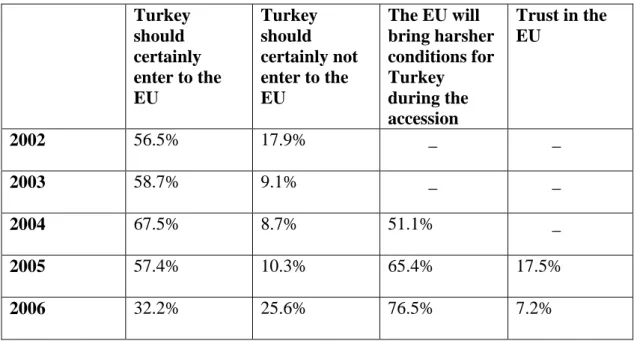
Similarly, public opinion studies and surveys are crucial in demonstrating to what extent people believe in the prospect of the EU membership and, therefore, how far they can internalize the changes required by the EU in the name of democracy. Hence, although there is no one to one correlation in the strict sense between the findings of these studies and decreasing credibility of the EU, the change in the findings throughout the years is crucial in illustrating how the change in the EU’s approach towards Turkey affects public opinion in Turkey. The important point is to see whether the increase in level of public mistrust towards the Union is correlated with the decrease in the credibility of the EU or not. The existence of such correlation has important implications for Turkey’s democratic consolidation process, since for a democratic consolidation in any country, public’s acceptance and internalization of the reforms are crucial for effective implementation of the reforms undertaken by the governments.
The fifth chapter covers pre- 1999 period, when the EU did not offer a credible membership promise although the relations between Turkey and the EU dates back to 1963, when two sides signed the Ankara Agreement. Therefore,
depending on the rationalist and constructivist accounts, there will be explanations of why the EU could not be effective in helping Turkey consolidate its democracy and what the impacts of the EU approach are in governmental and societal domains in Turkey. In the absence of progress reports and public opinion surveys conducted in Turkey as regards to the issue of EU membership in this period, the overall assessment will mostly depend on the assumption that since there was no significant impact of the EU in this process, there was not much effort to measure and analyze the change.
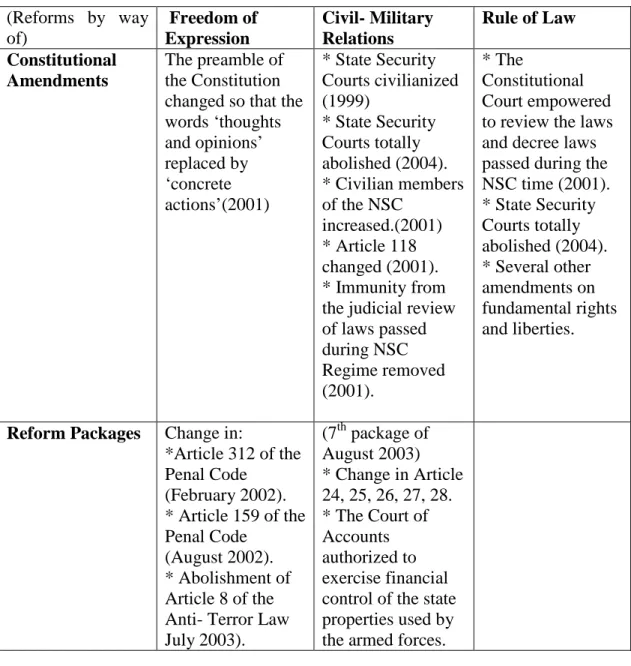
The sixth chapter covers the 1999- 2004 period, which starts with Turkey getting the official candidacy status in 1999 Helsinki Summit that is considered to be a turning point in Turkey- EU relations. Throughout this period, Turkey adopted serious reform packages in line with the EU democratic conditionality with an aim to fulfill the Copenhagen criteria. In the chapter, the reforms and the EU’s impact on Turkish governments and society will be elaborated in detail, again by relating them to rationalist and constructivist accounts. I will analyze progress reports since 1999 with an aim to analyze the developments in the process of Turkey’s democratic consolidation and the EU’s impact on it. I will also analyze the impact on society at large with reference to main literature and to limited number of public opinion surveys conducted in this period.
The seventh chapter is crucial for the main argument of the thesis and covers the post- 2004 period. In this period, some ambiguities have appeared in the EU’s overall policy of enlargement, particularly towards Turkey, leading to considerable decrease in its credibility. The differences in the EU’s approach, its manifestations and its consequences will be analyzed in order to depict a general picture of “how the modalities of EU behavior toward Turkey” (Patton, 2007) affect the process of
democratic consolidation in Turkey in governmental and societal domains. In the overall assessment part, I will refer to the evaluations of EU’s progress reports and Freedom House results for the analysis of the EU’s impact on democratic consolidation at the governmental domain, while I will benefit from several public opinion surveys for the analysis of the EU’s impact on the societal domain.
The thesis will end with a conclusion briefly explaining the impact of the credibility of EU democratic conditionality on democratic consolidation of Turkey depending on the overall historical analysis outlined above. It concludes by arguing that the process of democratic consolidation in Turkey may enter into a stalemate due to decrease in the credibility of the EU and due to its impact on the governmental and societal domains. Moreover, the conclusion will include a brief analysis of what this would mean for the EU and Turkey, in terms of its normative role as a democracy promoter and its progress towards more substantive democracy, for the EU and Turkey respectively. Last, but not least, there will be some suggestions as to how this negative process can be reversed and what responsibilities fall on to each side.
CHAPTER II
RESEARCH DESIGN
This chapter covers the research design of the thesis and explains the variables, case selection and methodology in order to provide the necessary framework for the intended analysis. In the chapter, I will clarify how the central hypothesis of this thesis is formulated; to what extent it is justifiable in methodological terms and to what extent it can be analyzed by the Turkish case. I will also make definitions of the main concepts in order to prevent conceptual conflict. Last, I will mention about the intended contributions of the thesis to the field.
2. 1. Variables:
The independent variable (IV) of this study is ‘credibility of EU conditionality’. In other words, my work mainly draws upon the international dimension of democratization while at the same time emphasizing a specific character (credibility) of the international actor (EU).
Here, one can ask the question of why such an approach is taken and why domestic actors are treated as secondary in democratic consolidation of Turkey. First, external factors have a greater and deeper impact on the consolidation of democracy rather than on the starting of transitions to democracy (Gürleyen, 2004: 3).
Second, the thesis is interested in the impact of EU democratic conditionality (and more specifically its credibility) on democratic consolidation of Turkey, rather than in the causes of democratic consolidation more generally. The thesis does not argue that the EU credibility is the only factor for explaining democratic consolidation in Turkey; rather it aims to study how Turkey reacted to the demands of the EU and under what conditions it complied with these demands. Hence, I acknowledge that even if the EU- Turkey relations proceed smoothly without further problems, there may still be continuing problems in Turkey’s democratic consolidation due to domestic obstacles in the process of internalization and implementation of the reforms.
Third, although democracy was established a long ago, it was not consolidated enough and “without pressure from the outside, it is highly doubtful that such reforms would have been adopted” (Kubicek, 2005c: 373). As Oğuzlu (2004: 110-111) states:
The democratization alongside the EU accession process and the democratization per se are not the same in the context of Turkey. The former is superior to the latter in the sense that the way in which the former unfolds would certainly affect the way in which Turkish elites would perceive the latter.
Moreover, notwithstanding the existence of several internal factors emphasized for the decrease in democratic reforms in the post- 2004 period, such as ‘election fever’ of the Justice and Development Party (Adalet ve Kalkınma Partisi-AKP) government and ‘Kemalist institutional resistance’ (Patton, 2007), I choose the
EU factor due to its significant impact on the domestic factors also. Therefore, while recognizing the plausibility of each factor and not ignoring any of them, decreasing level of EU credibility will be highlighted as the prime factor for explaining the slow down in Turkey’s reform process most competently since it is the facilitating factor for understanding other considerations. There will be more emphasis on the impact of the EU and its credibility on domestic factors throughout the thesis.
In this thesis, I will take ‘democratic consolidation’ as my dependent variable (DV). Democratization covers a much wider process of regime change and includes liberalization and transition stages prior to consolidation. Since liberalization and transition stages of the overall process of democratization have long been completed in Turkey, the main focus of the thesis will be on the last stage; democratic consolidation.
Governmental and societal domains will be analyzed as the two main domains, on which we can observe the EU’s impact on the Turkey’s democratic consolidation. Although most of the studies on EU democratic conditionality tends to consider conditionality in a rationalist framework and emphasize the intergovernmental character of the process (e.g. Schimmelfenning et al. 2003), the thesis will argue that democratic consolidation is not just about making reforms in governmental domain, but also implementing them in societal domain. Thus, constructivist and sociological institutionalist approaches deserve attention due to their conceptual starting point of an assumption of a link between the social construction of institutions and the successful implementation of rules, norms and principles (Wiener, 2006: 54). Even if the reforms continue at the governmental level despite decreasing credibility of EU conditionality, the process of implementation
and internalization at the societal level may be at stake due to decrease in the perceived legitimacy of the EU.
2. 2. Case Selection, Why Turkey?:
Turkey is a crucial test case to analyze the impact of the EU on the democratization process. The process of reform in Turkey and the EU’s incentives for Turkey to democratize follow the same direction. We observe increasing pace of democratic reform after the EU incentive of membership in the post-Helsinki Period. Similarly, “all the democratization bills were brought to the parliament in the form of packages aiming to harmonize with the EU” (Gürleyen, 2004: 11).
Second reason of why Turkey constitutes an important case to study stems from its problematic and uneasy nature. If we only focus on the EU role in countries where a consolidated democracy is established without any serious problem, we could easily conclude that the EU plays a crucial role in democratization (Kubicek, 2003a: 3). However, in cases of significant conflict that involve bigger challenges to conditionality (Schimmelfenning et al. 2003: 501); we can learn more about under what conditions conditionality is more effective. Moreover, in problematic cases, “it is easier to distinguish the international impact from endogenous change, that is, change that would have occurred in the absence of political conditionality” (Schimmelfenning, 2004: 11).
Third, Turkish case is a complex one and requires special attention due to its relation to the EU’s other interests (Yeşilada, 2007: 4). Turkey is the only candidate that the EU behaves so ambiguously with so many double standards and changes in
its approach. Misrahi (2004: 22) comments that since the EU’s approach to Turkey is distinctive, “more nuanced analysis” is necessary.
2. 3. Methodology:
As regards to the methodology, this thesis is a (crucial) case study to the international aspects of democratization and the EU democratic conditionality. Crucial case studies provide in-depth analysis of a specific case. So, this thesis gives detailed account of the EU-Turkey relations in terms of democratic consolidation. The method of the thesis is not comparative case study in the sense that Turkey is not directly compared to the other countries. However, there are some insights driven from the other similar cases to explain better the differences in the EU’s approach towards the other candidates. Furthermore, the thesis could be regarded comparative in the sense that three different periods of EU-Turkey relations (pre- 1999, 1999- 2004, post- 2004) are compared. This comparison reveals that the EU’s impact on democratic consolidation in Turkey is highly correlated with a credible application of conditionality.
2. 4. Definitions of the Basic Concepts:
In this part, I will clarify what I mean by democracy, democratization, democratic consolidation, EU conditionality and credibility, and absorption capacity in order to prevent any confusion as regards to the meaning throughout the thesis.
2.4.1. Democracy:
The term democracy is one of the most problematic concepts in the literature and there are endless disputes as regards to its appropriate definition, meaning, indicators and measurement. It is “neither codified in international agreements nor widely agreed” (Smith, Karen, 2003: 131). So, it is above the capacity of this study to refer all of these different conceptualizations.
Although there is no consensus yet on the universal meaning of the term, Robert Dahl’s criteria for democracy has often been accepted for the minimal procedural definition of democracy. Dahl (1989: 221- 222) considers ‘polyarchy’ as bearing of democracy, and assigns seven institutions to it. These are; elected officials, free and fair elections, inclusive suffrage, right to run for office, freedom of expression, alternative information and associational autonomy.
Moreover, arguing that democracy signifies a political system, separate and apart from the economic and social systems, Diamond, Linz and Lipset (1995: 6- 7) set up three essential conditions for democracy. These are meaningful and extensive political competition among individuals and parties or other organizations, a highly inclusive level of political participation in the selection of leaders and policies and certain level of civil and political liberties, such as freedom of thought and expression, freedom of the press, freedom of assembly, guaranteed through political equality under rule of law.
As Videt (2006: 19) argues, definition of democracy, based on Dahl’s seven institutional requirements and Diamond, Linz and Lipset’s three dimensions of democracy is both similar to common understanding of democracy, and compatible
with the EU’s Copenhagen political criteria requiring member states to achieve ‘stability of institutions guaranteeing democracy, rule of law, human rights and respect for and protection of minorities.’ It is important to note that the EU Commission prefers to use ‘democratic principles’ to ‘democracy’, since it emphasizes the universally accepted principles underpinning the organization of the state and guaranteeing the usage of fundamental rights and freedoms (Smith, Karen, 2003: 132).
In the existence of several approaches to define democracy, the thesis will follow the general tendency that is to divide them into two main groups. The first group includes ‘procedural’ (or ‘minimalist’) definitions of democracy as done by Dahl, and the second group includes substantive definitions of democracy, such as the definition of Diamond, Linz and Lipset provided above.
While procedural democracy is more concerned with rules and institutions, substantive democracy emphasizes free media, civil society, social pluralism, human rights and effective administration (Kubicek, 2003a: 21). In the substantive democracies, the emphasis is placed “on the normative primacy of individual rights and freedoms” (Keyman and Öniş, 2004: 176). This thesis utilizes the substantive definition that includes a wider range of rights, including “participatory and responsiveness elements” in addition to the procedural dimension (Kobzar, 2006: 3).
Notwithstanding the existence of various other definitions of democracy, it is important to note here that in the current era, with the spread of democracy and democratization to many regions of the world, the attention has shifted from concentration on democracy versus anti- democracy, the possible varieties of democracy and its evolving nature (Nagle, 1999: 12). In line with this trend, the
thesis’s central focus will be on democratic consolidation of Turkey as a process rather than on the static concepts of democracy versus anti- democracy.
2. 4. 2. Democratization and Democratic Consolidation:
If we understand the concept of democracy as something that can be placed on a continuum, it is better to understand democratization as a process that can be ever ongoing. In the most general terms, “the word ‘democratization’ refers to political changes moving in a democratic direction” (Potter, 1997: 3). Thus, democratization should be understood as “the outcome of complex, contingent and prolonged processes of interaction among actors and between actors and context” (Renwick, 2006: 36), not just as “the establishment of sets of governing institutions” (Grugel, 1999: 11).
Democratization can be broken into three stages and democratic consolidation can best be understood as the final stage of this process (Kubicek, 2003a: 21). It is quite ironic that the European Commission has never defined clearly what a ‘democratic consolidation’ is, despite it regularly uses the term in its regular reports for candidate countries (Pridham, 2006: 377- 378). Liberalization is the initial stage when political restrictions are removed, transition is the process of regime change and consolidation refers to the “process, often a lengthy one and in a certain sense always ongoing, of stabilizing and institutionalizing democratic institutions and practices, as well as the internalization of democratic norms by elites and masses” (Kubicek, 2003a: 21).
Thus, the process of democratic consolidation is much lengthier process and has wider and deeper effects. The process involves the gradual removal of the remaining uncertainties surrounding transition and the internalization of rules and procedures and “dissemination of democratic values through a ‘remaking’ of the political culture” (Pridham, 2005: 12).
2. 4. 3. Conditionality (of the EU):
Conditionality is generally conceptualized as a top- down approach in which donors try to influence the governments of target countries by using certain incentives (Smith, Karen, 2003: 134) for the advancement of democratic principles and institutions in a ‘target’ state (Kubicek, 2005b: 273). Similarly, Schimmelfenning et al. (2003: 495) defines conditionality as a strategy of ‘reinforcement by reward’ which works through intergovernmental material bargaining”.
I acknowledge that conditionality has been more successful in institutional and legislative aspects than in implementation. (Pridham, 2006: 398). However, democratic conditionality is also dependent on the responsiveness of domestic actors and their European commitment is a decisive factor. In other words, “European signals are interpreted and modified through domestic traditions, institutions, identities and resources in ways that limit the degree of convergence and homogenization” (Olsen, 2002: 936).
Thus, the thesis argues that it is not only through material bargaining mechanism that democratic conditionality works. So, implementation and societal
change should also be considered as necessary and desirable outcomes of conditionality in the process of democratic consolidation. As stated by Doğan (2006: 256), the EU criticized Turkey mostly for the problems in the implementation of the reforms rather than the problems in legal reforms.
2. 4. 4. Credibility (of the EU):
There is a widespread consensus in the literature that credible and consistent application of conditionality is the most crucial factor for its effectiveness. Hence, one needs to analyze credibility of conditionality in order to account for its effectiveness.
Drazen and Masson (as cited in Bronk, 2002: 6) defined the credibility as “the expectation that an announced policy will be carried out”. In other words,
When a regime has credibility it will be able to alter the expectations of other actors favorably because it is trusted or at least believed. Credibility helps overcome the fear that a given policy may be short lived because it is ‘time inconsistent’ (Bronk, 2002: 6-7).
Tocci (2005) points to this ‘time inconsistency’ of the EU conditionality in Turkish case. She states that “the process is front- loaded with obligations and back- loaded on the delivery of the benefits” (2005: 78). Therefore, policy makers in Turkey are inclined to delay reforms until the time of the rewards becomes foreseeable and credible. Without doubt, the absence of credibility and existence of time inconsistency undermine the effectiveness of an ongoing policy.
Within this framework, I define credibility of the EU conditionality as the expectation that membership promise given by the EU will be kept as long as the
candidate fulfills its obligations. As long as the candidate fulfills its obligations arising out of the membership process, no other discrimination, such as the absorption capacity debate, should be allowed for a credible and effective policy making in the EU.
2. 4. 5. Absorption Capacity:
The concept is used first in the conclusion of the Copenhagen Summit of 1993 and it is stated here that “the Union’s capacity to absorb new members, while maintaining the momentum of European integration, is an important consideration in the general interest of both the Union and the candidate countries.”4 The debate about the concept has increased especially after the 2004 enlargement and rejection of the draft Constitution in 2005, and the revival of the concept in 2005 has been linked to further enlargements, especially Turkey’s possible membership (Emerson et al. 2006: 1- 2).
Therefore, with the increasing usage of the concept, there occurred a necessity to define it in official texts. In this vein, Enlargement Strategy Paper of the Commission on November 2005 (European Commission, 2005b: 3) defined it as the “capacity to act and decide according to a fair balance within institutions; respect budgetary limits and implement common policies that function well and achieve their objectives.”
In June 2006 European Council Summit the debate about the term has again intensified and Jacques Chirac defined the term as “an institutional, financial and
political capacity, the latter concerning the views of the receiving population, which should be able to say if they accept or not” (as cited in Emerson et al., 2006: 2- 3).
It is possible to find many other definitions of the concept done by several member states and bodies of the Union. These definitions show great variation in the emphasis attached to the meaning depending on whether the state or the institution that makes the definition favor more enlargements (especially of Turkey) or not. However, there is still no clear-cut and agreed definition of the concept in the academic circles. Actually, due to its ambiguous and non- scientific character, Emerson et al. (2006: 1) even suggests that the term should not be used in official texts of the EU any more unless it is deconstructed into objective elements. There will be further reference to the vagueness of the absorption capacity term and the implications of the absorption capacity debate when analyzing change in the EU’s approach towards Turkey in post- 2004 period.
2. 5. The Intended Contributions of the Thesis to the Field:
First of all, the literature on democratization has mainly emphasized the importance of domestic factors. Similarly, “there has been little effort to analyze domestic politics in an interactive dynamic with the accession process” (Pridham, 2006: 376). The interaction between domestic structures and international pressure is crucial since the well functioning of the democratic reforms depends on the responsiveness of domestic actors and institutions in a country (Gürleyen, 2004: 5- 6).
Therefore, this thesis aims to contribute to the field with its emphasis, not only on the role of an international actor, but also on the interaction between the international and domestic actors in the process of democratic consolidation of Turkey. While mainly focusing on the impact of an international factor (EU credibility) on Turkey’s democratic consolidation, the thesis also acknowledges the continuing importance of domestic factors in this process, and also investigates how these domestic factors are affected by credible application of EU conditionality.
The thesis utilizes both rationalist and constructivist accounts while analyzing this interaction. By so doing, the thesis will be an attempt to contribute to the studies of EU’s impact on domestic change with its ability to analyze two different logics behind conditionality and its credibility. While the conditionality and credibility is generally used within a rationalist framework (Gürleyen, 2004: 7), the study will also consider the constructivist logic behind domestic transformation.
Last but not least, the thesis intends to fill the gap in the literature that stems from taking the transnational factors as given and unchanging. While the EU’s accession policy’s scope has been extended to further issues, the EU’s leverage over candidate countries has been characterized by new doubts about the EU’s credibility (Pridham, 2007: 455). So, the thesis gains its strength from explaining the change in the EU’s conditionality approach (in terms of its credibility), which gets tougher in time, and analyzing its impact on the democratic consolidation of Turkish democracy.
CHAPTER III
THEORETICAL BACKGROUND
This chapter will try to provide the necessary theoretical framework for our analysis of the impact of the EU’s credibility on Turkey’s democratic consolidation. There will be emphasis on both two key dimensions of change; first is about the changes in political organizations and governance, the second is about changes in people’s minds and the structures of meaning (Olsen, 2002: 926). While the former will be explained with reference to rationalist accounts, the latter will be analyzed through the lenses of social constructivism.
More specifically, the analysis will be based on “two alternative models of international influence on domestic change: the external incentives model and the social learning model” (Schimmelfenning, 2004: 3), while differentiating itself in certain respects. My analysis recognizes the significance of the variables used by both the former (size of rewards and domestic adoption costs) as well as the latter (legitimacy, resonance and identity). Yet, the analysis emphasizes the concept of ‘credibility’ as the main explanatory variable having substantial impact on the above mentioned variables also. Hence, the basic question to answer is “how does variation in the size and credibility of EU conditionality impact on its effectiveness?” (Schimmelfenning and Scholtz, 2007: 4).
3.1. Rationalist Accounts- External Incentives Model and Its Reformulation:
External incentives model is a rationalist model, based on rationalist bargaining and cost- benefit calculations of decision makers. The underlying rationale is that the decision makers are interested in the maximization of their own power. So, the rationalist institutionalism assumes that rational actors follow ‘logic of consequentialism’ (March and Olsen: 1989 and 1998; as cited in Börzel, 2005: 52) and try to maximize their power by using the resources and knowledge available to them.
Rationalist institutionalism sees Europe as an emerging political opportunity structure that leads to redistribution of resources at domestic level in the existence of certain misfit between European and domestic policies (Börzel, 2005: 53). Thus, “Europeanization leads to domestic change through differential empowerment of actors resulting from a redistribution of resources at the domestic level” (Börzel and Risse, 2000: 2).
When applied to the EU, external incentives model holds that the EU pays the reward (ranging from trade agreements to full membership) if the target government complies with the criteria and withholds it in case of noncompliance. Hence, the dominant logic behind EU conditionality is a “bargaining strategy of reinforcement by reward under which the EU provides external incentives for a target government to comply with its conditions” (Schimmelfenning and Sedelmeier, 2004: 662).
Through the intergovernmental channel, the EU affects candidate governments directly. Therefore, accession governments are the central and pivotal domestic actors and their commitment to the process is significant (Pridham, 2005:
64). The external incentives model argues that cost- benefit calculations are more important than the commitment of the governments in this process. That is why although Turkish state elites are committed to the idea of Europe generally, compliance depended on and limited by political cost- benefit calculations (Schimmelfenning et al. 2003: 509).
Here, one should also note the importance of ‘domestic equilibrium’ that shows the “current distribution of preferences and bargaining power in domestic society” (Schimmelfenning, 2004: 4). The EU conditionality is significant since it contributes to the change in this equilibrium by providing incentives in case of compliance. In line with this reasoning the most general hypothesis of the external incentive model is that:
A state complies with the norms of the organization if the benefits of the rewards exceed the domestic adoption costs.
More specifically, this cost- benefit balance depends on (i) the size of international rewards, (ii) the credibility of threats and promises, and (iii) the size of domestic adoption costs (Schimmelfenning, 2004: 4).
As regards to (i) and (iii), the likelihood of compliance increases with the increase in the size of the rewards and with the decrease in the power costs for the target government. As regards to (ii), the impact of external incentives increases with the clarity and credibility of EU conditionality.
Determinacy of conditions is also crucial in enhancing the credibility of conditionality. The reasoning is that when conditions are determinate, it becomes much more difficult for the EU to claim unjustly that they have not been fulfilled by the candidates and to withhold the reward due to noncompliance (Schimmelfenning and Sedelmeier, 2004: 664). So, in general, conditionality is more effective when the rewards are high, determinate and credible enough to exceed the domestic costs of compliance with EU requirements (Schimmelfenning and Schwellnus, 2006: 3).
Not ignoring the validity of the other two factors (size of the rewards and domestic adoption costs) given above, I argue that the credibility is a more central factor for explaining compliance/ non- compliance on part of the target state. Moreover, credibility factor is crucial due to its considerable impact on these two factors also.
The reasoning is that sizeable incentives result in compliance as long as they are credible and that when the incentives are credible, the domestic adoption costs are decreased significantly. The necessity of a credible EU or NATO membership perspective for the target country is the strongest determinant of an effective policy of human rights and democracy promotion (Schimmelfenning et al., 2006: 236). If the credibility factor is absent, there will not be compliance even if other conditions are highly favorable (Schimmelfenning et al., 2006: 236).
In relation to size, the argument is that higher credibility has a stronger positive impact on democracy for each size of the incentives provided (Schimmelfenning and Scholtz, 2007: 21). In relation to domestic costs, the related argument is that the EU’s external incentives have been effective in removing domestic obstacles to further democratic reform in many of the cases (Schimmelfenning and Scholtz, 2007: 3). Similar argument holds that “once a credible membership perspective has been established, adoption costs in individual policy areas are discounted against the (aggregate) benefits of membership, rather than just the benefits in this particular policy area” (Schimmelfenning and Sedelmeier, 2004: 672).
Schimmelfenning and Scholtz (2007:23) also find out that countries with a credible EU membership perspective have three points more on the average (on the seven point Freedom House political rights scale) when compared to those without
tangible EU incentives. Moreover, they also found that measured in terms of Freedom House civil liberties scale, significance of conditionality decreases further and only highly credible conditionality produces significant impact (Schimmelfenning and Scholtz, 2007: 24). Their general finding is that the credible membership perspective is highly significant in all kind of specifications and consistently stronger when compared to lower levels of conditionality (Schimmelfenning and Scholtz, 2007: 26).
The credibility and the effectiveness of conditionality are at stake when the Union gives more importance to other considerations of the member states and employs different standards for different countries. In such situations, target state may believe that it will not get the rewards even if it complies with the conditions specified, and therefore may change its cost- benefit calculations according to the rationalist reasoning. In other words, “credibility depends on the consistency of an organization’s allocation of rewards” (Schimmelfenning and Sedelmeier, 2004: 666). If the EU’s capabilities are questionable, than the EU’s credibility may decrease in candidate countries and this would decrease the effectiveness of conditionality regardless of the conditions fulfilled by the candidates (Savic, 2007: 18). Thus, in the absence of credibility of policy maker or policy, it is rational that other actors will expect policy inconsistency over time, and therefore will act accordingly (Bronk, 2002: 7).
In sum, recognizing the importance of other variables specified by the external incentives model (size of the rewards and domestic adoption costs), the argument here holds that credibility is the main motive effecting both the cost- benefit calculations of domestic decision makers and the impact of sizeable
incentives. In the absence of credibility factor EU’s conditionality policy will not work, or will not be as effective as it would be in the existence of credibility.
3. 2. Constructivist Accounts- Social Learning Model and Its Reformulation:
While the external incentives model is a rationalist model, social learning model is based on the social constructivism, and constitutes the most prominent alternative explanation to conditionality in our case. In general, socialization approaches belong to sociological strand of neo- institutionalism.
For sociological institutionalism, institutions do not only determine actors’ behaviors by redistributing resources, rather they constitute these actors by providing them with the understanding of what their interests are and what appropriate means they may use to pursue these interests. Therefore, actors internalize the institutional norms and rules and follow them out of habit, not choose to comply with them to maximize power (Börzel, 2005: 54). In other words, there is a distinction between internalization of democratic norms and changes stimulated by instrumental, utilitarian calculations (Kubicek, 2005c: 364). For the successful integration of reforms, their acceptance, diffusion and legitimization in the society are essential (Erdoğan, 2006: 11).
While reinforcement strategies work through the usage of incentives, persuasion strategies work through convincing the target of their validity, and they result in internalization of the rules (Schimmelfenning et al. 2006: 31). This type of influence is also named as “framing integration” (Knill and Lehmkuhl, 1999: 14).
Within this general framework, social learning model follow ‘logic of appropriateness’ (March and Olsen, 1989: 160-161; as cited in Schimmelfenning, 2004: 8). This logic holds that there are collectively shared understandings of what constitutes proper behavior in a given rule structure and actors are shaped by these in their effort to ‘do the right thing’ (Börzel, 2005: 54). Within this regard, the EU represents a European community with collective identity, common values and norms, and the degree to which these common rules are deemed appropriate determines whether a non- member complies with these rules or not (Schimmelfenning, 2004: 8).
Hence, constructivist or sociological institutionalist approaches suggest that referring only to strategic and rational interest calculation at a particular point in time is not enough to understand democratization that is the result of a complex interaction of international and domestic factors, leading to slow re- framing of the interests and behaviors of the actors (Schmitz and Sell, 1999: 33). On the basis of information, I will cite the most commonly used hypothesis of the social learning model:
A state adopts EU rules if it is persuaded of the appropriateness of the EU rules. Three main factors impinge
upon the persuasive power of European regional organizations: legitimacy, identity, and resonance (Schimmelfenning, 2004: 8- 9).
As regards to legitimacy, Gürleyen (2004: 6) mentions that the likelihood of target country’s compliance increases with the legitimacy of the democratic norm. In order to be legitimate, there must be commonly held organizational rules and demands on the target states must be based on these rules, not on the ad hoc interests of certain member states. For instance, the EU enjoyed strong prestige and
legitimacy in the CEECs during the accession process and this inhibited outright opposition to membership (Pridham, 2005: 95).
Not ignoring the validity of this factor, I argue that the credibility is a central factor with crucial impact also on the legitimacy. The underlying rationale is that in the absence of credible promises by the EU, it is nearly impossible that the target governments believe in the legitimacy of rules. The community must treat candidates impartially and equally according to legitimate conditions and thus it is constrained in the application of reinforcement conditions across target states (Schimmelfenning et al. 2006: 24). So, the perceived legitimacy of the organizational rules is highly dependent on whether or not the rule makers and their promises are deemed credible. As regards to the identity, the social learning model argues that it is more likely that non- members are persuaded by international organizations if they identify themselves with these organizations (Schimmelfenning, 2004: 9). Therefore, the compliance is assumed to be high with the increase in the identification of non- members and actors with high identification strive to be recognized as part of the ‘European family of democratic nations’ (Schimmelfenning et al. 2003: 498).
Although Turkey has identified itself with the West since the last days of the Ottoman Empire, and has a history of democracy since the beginning of multi- party politics in 1946, the process of democratic consolidation has always been problematic due to serious identity conflicts over sensitive issues, such as minority rights (Öniş, 1999: 109). There is an unspoken assumption in the literature that “there is something inherently uncivilized in Turkish political culture, which prevents the realization of fully functioning democracy” (Gürleyen, 2004: 10).
In relation to this, Kubicek (2003b: 206) mentions about two discourses in Turkey. While one tries to identify Turkey with the West, the other emphasizes
Turkey’s own traditions and special circumstances requiring attention as regards to the immediate adoption of Western norms. This prevents rhetorical ‘spillover’ due to ambiguous character of the rhetoric itself that complicates the perception of the EU in Turkey whose Europeanness has been subject to many debates. As observable in recent years, the public in Turkey have become more and more skeptical about the EU and its motives due to increasing ambiguity in the EU’s approach in Turkey. Thus, in the absence of firmly established identity and internalization in Turkey despite long years of identification with Europe, credibility again turns out to be important variable with its impact on the process of identity formation.
The third variable used in social learning model, resonance, basically means the “cultural or institutional match of a specific external rule with the already existing domestic values, norms, practices, and discourses in a specific issue area” (Schimmelfenning, 2004: 9). Therefore, when the ‘degree of normative fit’ of an European rule, norm or practice is high and when they show similarity with those at the domestic level, it is more likely that these will be conceived as legitimate by the target government and translated into existing domestic institutions without much problem.
Similar to the problematic nature of identity, resonance is also fragile in Turkish case. Although there is certain degree of identification and resonance with the European values and rules in Turkey, the process is problematic due to certain ambiguities in the EU’s approach and resulting ups and downs in the relations between Turkey and the EU. Even though there is a certain degree of resonance with respect to specific external rule in the beginning, due to change in the perceptions of public and decision makers, the degree may fluctuate throughout the process.
In sum, not ignoring the significance and validity of three constructivist variables used by the social learning model (legitimacy, identity and resonance), the study argues that credibility is a central factor due to its impact on shaping these three variables. This is an important point to consider in Turkish case where the process of constructing an identity, legitimacy and resonance is fragile and liable to ups and downs due to changes in the credibility of promises given by the EU.
3.3. Juxtaposition of Rationalist and Constructivist Models:
Overall, when we utilize credibility as our main variable that is suitable to conceptualization in both external incentives and social learning models; we are able to juxtapose these two models in our analysis of domestic change without prioritizing one over another. The related argument holds that “rationalist and constructivist perspectives are both useful frameworks for analysis, and are not necessarily mutually exclusive” (Bourne and Cini, 2006: 14). This is also in conformity with the recent direction in the theoretical debate away from either- or arguments between rationalism and constructivism towards underlining the need to comprehend the link between rationality and norm- conforming behavior (Schimmelfenning and Sedelmeier, 2005: 137).
Therefore it is more useful to consider these two institutionalisms as not only competing but also complementary sources of theoretical background while studying enlargement (Schimmelfenning and Sedelmeier, 2005: 10). Similarly, Checkel (2007: 18) argues that when practiced in isolation neither rationalist nor softer and more participatory approaches do not work. In his words, “advocates of both the
‘bring- them- into- the- club- where- we- can- socialize- them’ and the ‘keep- them- outside- the- club- until- they- are- already- compliant’ policies are wrong” (Checkel, 2007: 18).
In the end, although these models are competing explanations, they might be present also at different stages of political transformations. Therefore, in addition to purely intergovernmental channels of EU influence, we should give more attention “to the processes of elite socialization and learning, ideational changes, international legal frameworks, and EU influence coupled with domestic processes of change and the empowerment of new societal actors in Turkey” (Ulusoy, 2007: 478).
While conditionality can affect the target state directly through intergovernmental material bargaining, it may also have an indirect effect through the differential empowerment of domestic actors (Schimmelfenning and Sedelmeier, 2004: 664). This is because the establishment of democratic regimes is not the only objective of the democratization throughout the EU accession process, there is also the consideration of internalization of the EU’s identity (Oğuzlu, 2004: 97).
In this vein, the thesis does not claim the superiority of neither rationalist nor constructivist accounts; rather it aims to benefit from both perspectives while understanding different domains of influence throughout different periods of relations.
CHAPTER IV
THE EUROPEAN UNION AS AN ACTOR IN INTERNATIONAL
DIMENSION OF DEMOCRATIZATION
Due to increasing significance of the international factors in explaining democratization, it is no longer proper to focus only on domestic actors and to ignore the reality that the international community has involved in the process with a lot of programmes and institutions (Bruneau and Trinkunas, 2006: 776). In this context, the EU and its mechanism of conditionality have become significant areas of concern. In this chapter, I will first, briefly mention about the international dimension of democratization, and then, analyze the EU’s place in this area.
4.1. International Dimension of Democratization:
Due to the changed balance between hard security interests and the promotion of democracy in the 1990s, international actors started to have not only more diverse impact, but also more institutionalized channels of influence (Pridham, 2005: 4- 5). The policies, tools and institutions developed for promoting democracy have become consolidated and operational, as can be observed in the forms of democracy and
human rights clauses in the international agreements and foreign policies of several international actors (Buxton, 2006: 709).
Laurence Whitehead (1996: 4- 24) provides the most comprehensive assessment of the internal- external debate and talks about three sets of international dynamics under which international factors may be grouped and analyzed: contagion, control and consent. Schmitter adds one more crucial dynamic to the Whitehead’s argument; ‘conditionality’ of which “hallmark is the deliberative use of coercion- by attaching specific conditions to the distribution of benefits to recipient countries- on the part of multilateral institutions” (Schmitter, 1996: 30).
However, despite increasing interest, the international dimension of democracy promotion is still understudied and poorly understood (Schraeder, 2002: 217- 224). Moreover, there are certain constraints and challenges of democratization by external actors. First serious challenge is related to the possibility of reverse effects of democracy promotion by external actors. For instance, the political conditionality used by the EU to fix institutional deficiencies in the candidates may widen the gap between elites and the public if there is lack of deliberation over new legislation (Dimitrova and Pridham, 2004: 108). Second, it is possible that clash occurs between democracy promotion and other foreign policy interests of the democracy promoters. The democracy promotion activities of the EU are severely constrained by the continuing importance of national interests of its members (Schraeder, 2003: 39). In the following part, I will analyze the EU’s role in democracy promotion in more detail.