TUR KI SH S O CIET Y of ANAESTHESIOLOGY and R EA NIM ATIO N
Duygu Taşkın , Ender Gedik , Zeynep Kayhan
Department of Anaesthesiology, Başkent University School of Medicine, Ankara, Turkey
Cite this article as: Taşkın D, Gedik E, Kayhan Z. Effects of Minimal Flow Sevoflurane or Desflurane Anaesthesia on Hemodynamic Parameters Body Temperature and Anaesthetic Consumption. Turk J Anaesthesiol Reanim 2020; 48(5): 356-63.
Introductıon
Low-flow anaesthesia is described as a technique that results in a return of at least 50% of the exhaled gas mixture to the lungs following the absorption of carbon dioxide (CO2) by using a rebreathing system (1). This anaesthesia technique in which the fresh gas flow was reduced to 1 L min-1 was administred by Foldes for the first time in 1952 (2). In 1974, Virtue stated that use of a fresh gas flow of 0.5 L min-1 that was a type of low flow was economical and safe (3). Minimal flow anaesthesia could be considered as a subtype of low-flow anaesthesia with the lowest possible gas volume and full re-breathing. It can be safely applied with the modern devices of anaesthesia.
Following routine induction of anaesthesia, intubation, and attachment to the respiratory system, high fresh gas flow anaesthesia is applied for 15 min at the beginning. Early reduction of fresh gas flow increases the risk of gas volume deficiency since a low gas volume of 0.5 L min-1 cannot fulfill the initial high uptake and losses due to the leaks. The lack of gas volume also causes inadequate respiration. After the onset period, the flow of the fresh gas is reduced to 0.5 L min-1 and the gas composition is adjusted as 0.3 L min-1 oxygen (O
2) and 0.2 L min-1 air or nitrous oxide (N2O). Since the rebreathing rate is increased with minimal flow compared to low-flow anaesthesia, O2 content of fresh gas should also be increased to at least 50% or even 60% in order to prevent hypoxic gas mixture (4). Further-more, the concentration of the anaesthetic agent should be increased to enable target minimal alveolar anaesthetic concentration (MAC) (1-2%).
Effects of Minimal Flow Sevoflurane or
Desflurane Anaesthesia on Hemodynamic
Parameters, Body Temperature and
Anaesthetic Consumption
Abstract
Objective: We aimed to compare minimal flow sevoflurane and desflurane anaesthesia in terms of hemodynamic parameters, body tempera-ture, anaesthetic gas consumption and cost.
Methods: 120 patients with ASA I-II (>18yo) who underwent elective surgery for longer than 60 min after general anaesthesia were randomized into two groups. The Dräger Perseus® A500 workstation was used. Pre-oxygenation was performed for 3 min with 6 L min-1 to 100% oxygen. Fractional inspirium oxygen concentration (FiO2) was reduced to 40%, fresh gas flow was 4 L min-1 after intubation. Sevoflurane or desflurane was started at 1.5 minimal alveolar concentration (MAC). When the MAC value reached 0.9, fresh gas flow was reduced to 0.5 L min-1, FiO2 was increased to 68%. At the end of the surgery, the vaporizer was switched off, the fresh gas flow was increased (4 L min-1, FiO
2 100%). When the train-of-four (TOF) ratio was 100%, extubation was carried out.
Results: There were no differences in patient characteristics and initial hemodynamic parameters of the groups. There were statistically signif-icant differences between the times to reach 0.9 MAC, extubation and eye opening; anaesthetic, O2 and air consumption in both groups. Conclusion: With minimal flow, the time to reach target MAC, time to extubation and eye opening were significantly faster for desflurane and anaesthetic, oxygen and air consumption in desflurane anaesthesia were less than sevoflurane. Thus, we can say that desflurane has faster anaes-thetic induction and recovery time with lower anaesanaes-thetic consumption than sevoflurane.
Keywords: Consumption, desflurane, minimal flow anaesthesia, sevoflurane
Sevoflurane and desflurane have low blood/gas solubility and are preferred as ideal and safe inhalation anaesthetics for low and minimal flow anaesthesia. With technical advantages of modern anaesthesia devices, these agents are widely used in general anaesthesia practice and in our clinics (5). There is a limited number of studies comparing these two inhalation anaesthetics with minimal flow. In this study, we compared groups of 120 patients randomized either to sevoflurane or desflurane who were switched to minimal flow with 0.5 L min -1 in maintenance phase by using 4 L min-1 flow for anaesthesia induction. The aim of our study is to compare the groups in terms of hemodynamic parameters, anaesthetic consump-tion and cost, as well as body temperatures since conserving the temperature is an important advantage attributed to this technique.
Methods
After obtaining the approval of Başkent University, Clinical Research and Ethics Committee (number KA17/222), 120 patients with American Society of Anaesthesiologists (ASA) I-II physical status aged 18 years and older scheduled to un-dergo a minimum of 60 min of surgeries between September 2017 and March 2018 were examined prospectively in order to evaluate the minimal flow anaesthesia using the Dräger Perseus® A500 anaesthesia workstation at Baskent University Faculty of Medicine Ankara Hospital.
Patients having co-morbidities such as chronic obstructive pulmonary disease, coronary artery disease, congestive heart failure, marked anemia, unregulated diabetes mellitus, local or general circulatory failure, having more than 30% of their ideal body weight, using microsomal enzyme induction drugs and being heavy smokers, chronic alcoholics and whose
liv-er and kidney function tests wliv-ere significantly impaired, and who received general anaesthesia in the last two weeks were excluded from the study.
For the study, an anaesthesia workstation (Dräger Perseus® A500, Lubeck, Germany) providing minimal flow was used. After the preoperative evaluations in outpatient anaesthe-sia clinic or at the bedside, the patients were taken to the operation room following an appropriate period of fasting. Demographic data such as age, gender, body weight, height, and body surface area were recorded. Before induction, the standard monitorization of electrocardiography, non-in-vasive blood pressure, pulse oximetry; and after induction nasopharyngeal temperature and end-tidal carbondiox-ide pressure (EtCO2) were performed. The neuromuscular transmission monitor (TOF-Guard) was used for the eval-uation of muscle relaxant effect. In all cases, the operating room temperature was kept stable at 21℃ and the patients were heated with the help of the blankets. All cases were pre-oxygenated with 6 L min-1 100% O
2 for 3 min by means of face masks.
The standard induction of 40 mg of prilocaine, 2.5 mg kg-1 of propofol, and 1 µg kg-1 of fentanyl, followed by 0.6 mg kg-1 of rocuronium bromide for muscle relaxation was carried out, and endotracheal intubation was performed. After en-dotracheal intubation, sevoflurane or desflurane was initiated according to the groups. Medical air was utilized as the carri-er gas. Patients wcarri-ere ventilated in a volume-controlled mode with a tidal volume of 6–8 mL kg-1, respiratory frequency 12 min-1, and positive end expiratory pressure (PEEP) of 5 cmH2O. The target EtCO2 value was set as 30–40 mmHg. Patients were randomly divided into two groups, and ran-domization was performed using an internet-based software program (Research Randomizer, http://www.randomizer. org/). Minimal flow anaesthesia was administered to all pa-tients. MAC value was set as 1.5; Group S: 1 L min-1 O
2, 3 L min-1 air (total fresh gas flow 4 L min-1, FiO
2 40%) sevoflurane at a concentration of 2.7%, Group D: 1 L min-1 O
2, 3 L min-1 air (total fresh gas flow 4 L min-1, FiO
2 40%) desflurane at a concentration of 9.9% were used. When the target inhalation agent MAC value reached 0.9 in all groups, the fresh gas flow was reduced to 0.5 L min-1 (0.3 L min-1 O
2 + 0.2 L min-1 air, FiO2 68%). Inhalation agent concentrations were also adjust-ed to ensure the continuity with 0.9 MAC (6). The anaesthe-sia depth required for the surgery in the period of anaestheanaesthe-sia maintenance was provided by remifentanil infusion (0.05–0.1 µg kg-1 min-1).
Basal measurements of heart rate (pulse/min), systolic arte-rial pressure (SAP, mmHg), diastolic artearte-rial pressure (DAP, Main Points:
• Minimal flow anaesthesia is an anaesthesia method that should be encouraged due to its cost-reducing effect and reducing intraopera-tive hypothermia.
• Minimal flow anaesthesia with both sevoflurane and desflurane were hemodynamically safe with modern technical equipment and did not make any difference in body temperature. They did not dif-fer in body temperature during minimal flow.
• Both anaesthetic agents can be used safely in terms of hemodynam-ically providing and maintaining oxygenation.
• Desflurane was found to achieve a faster target MAK value com-pared to sevoflurane. Extubation and eye opening times were short-er with desflurane. It was seen that thshort-ere was less expenditure with desflurane than sevoflurane, and the consumption of O2 and air was lower in desflurane group compared to sevoflurane.
• Minimal flow desflurane anaesthesia has more positive results on anaesthetic consumption than sevoflurane anaesthesia.
mmHg), mean arterial pressure (MAP, mmHg), and periph-eral oxygen saturation (SpO2, %) were recorded when the pa-tient entered the operating room. Then the processes of all these measurements were repeated after every 5 min. After induction, the measurements recorded at 1st, 5th, 10th, 15th, 30th min and every 30 min were considered for statistical evaluation. Nasopharyngeal temperature (°C), inspiratory (Fiagent) and expiratory anaesthetic concentration (Feagent), inspiratory oxygen and carbon dioxide concentration (FiO2, FiCO2, %), MAC values, expiratory minute volume (MVe, L min-1), and EtCO
2 (mmHg) values were recorded every 5 min after intubation. After induction, the measurements recorded at 1st, 5th, 10th, 15th, 30th min, and every 30 min were com-pared for statistical evaluation.
When the surgical procedure was completed, the vaporizer was turned off, and fresh gas flow (4 L min-1, FiO
2 100%) was increased. 0.05 mg kg-1 of neostigmine and 0.02 mg kg-1 of atropine were given to the patient for the reversal of muscle relaxant. At the 3rd and 6th min after the vaporizer was shut down and later every minute, patients were instructed to open their eyes. Extubation was performed when the TOF ratio was 100%. The time from vaporizer closure to extubation and to opening the eyes were recorded.
Inhalation anaesthetics, O2, and medical air consumption were determined and recorded for each case with the data obtained from the anaesthesia workstation (7). These values were multiplied by the average current unit prices and cost analysis was performed. Total durations of surgery and an-aesthesia were recorded. During the anan-aesthesia period, the onset period after induction, the maintenance period, and the recovery period following complete discontinuation of inha-lation anaesthesia were further specified. According to the formula defined by Biro (8), as shown below, the amount of liquid volatile agent was calculated separately for the initial period and maintenance period and then the whole amount was determined.
Liquid volatile agent = (fresh gas flow (mL min-1) x volatile agent concentration (% volume) x anaesthesia time (min) / (gas volume saturation (mL mL-1) x 100)
The volume of saturated gas (it was 1 mL volatile anaesthesia evaporation volume when room temperature was accepted as 22°C and vaporization temperature was accepted as 20°C) was 184 mL mL-1 for sevoflurane and 210 mL mL-1 for des-flurane (8).
Statistical analysis
IBM Statistical Package for the Social Sciences (IBM SPSS Corp.; Armonk, NY, USA) version 20.0 program was used to analyze the data. The Mann-Whitney U test was used for comparison between the groups. Paired samples Wilcoxon tests were used for intra-group comparisons, and chi-squared and Fisher’s exact chi-squared tests were used for the analy-sis of other data. Results were presented as mean±standard deviation. A value of p<0.05 was considered statistically sig-nificant.
Results
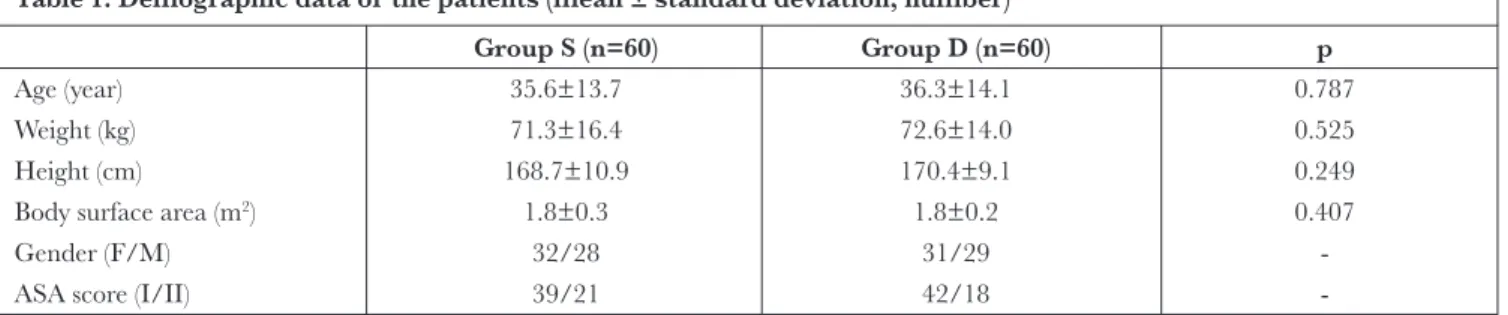
A total of 120 patients with ASA I-II physical status aged 18 years and older who received minimal flow sevoflurane and desflurane anaesthesia for elective surgeries lasting more than 60 minutes were examined prospectively. The sevoflu-rane group was named as group S and the desflusevoflu-rane group as group D. Demographic data of the patients are shown in Table 1. Age, body weight, height, and body surface area av-erage, gender and ASA score distributions were found to be similar in both groups (p>0.05).
When the intraoperative heart rate, systolic, diastolic, and mean arterial pressures values of the patients were examined, no significant difference was found between the two groups in any period of anaesthesia (p>0.05).
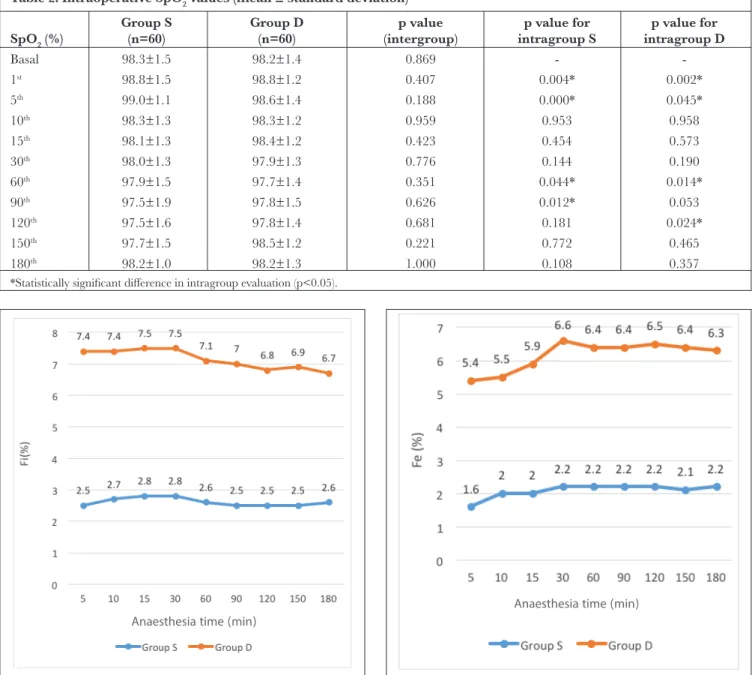
Intraoperative SpO2 values are given in Table 2. No statisti-cally significant difference was found between the two groups in any period of anaesthesia (p>0.05). In intra-group com-parison, basal SpO2 value and SpO2 values in the 1st, 5th, 60th, and 90th min of anaesthesia were statistically different in group S (p<0.05). It was found that SpO2 values in the 1st, 5th, 60th, and 120th min of anaesthesia and basal SpO
2 value were statistically different in group D (p<0.05).
Table 1. Demographic data of the patients (mean ± standard deviation, number)
Group S (n=60) Group D (n=60) p
Age (year) 35.6±13.7 36.3±14.1 0.787
Weight (kg) 71.3±16.4 72.6±14.0 0.525
Height (cm) 168.7±10.9 170.4±9.1 0.249
Body surface area (m2) 1.8±0.3 1.8±0.2 0.407
Gender (F/M) 32/28 31/29
-Intraoperative body temperatures were similar in all periods of anaesthesia for group S and group D (p>0.05).
Fiagent values were found as statistically different in group S and group D. In the intra-group comparisons of Fiagent considering the change during anaesthesia with minimal flow, it was found that Fiagent values at the 5th min of anaesthesia was significantly different than at the 10th, 15th, 30th, and 60th min of anaesthesia in group S whereas Fiagent values at the 5th min of anaesthesia was found significantly different com-pared to the 60th, 90th, 120th, and 180th minutes of anaesthesia in group D (p<0.05). Figure 1 shows the change of Fiagent values during anaesthesia.
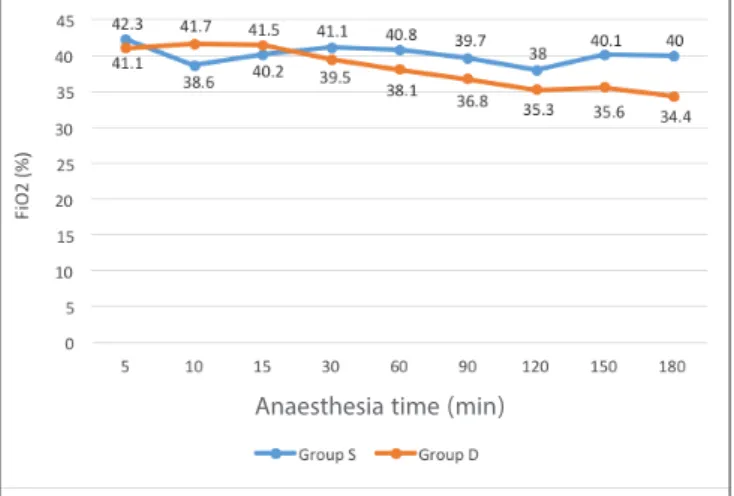
Feagent values were also found to be different in group S and group D (p<0.05). In the intra-group comparisons performed to see the change during anaesthesia, a significant difference was found in Feagent values at the 5th min of anaesthesia and in all other periods for group S (p<0.05). For group D, except for the 10th min, a difference was observed in all other periods (p<0.05). Figure 2 shows the change of Feagent values during anaesthesia. When FiO2 values were examined during anaesthesia, FiO2 percentages were found different between the 5th, 10th, 15th, 60th, 90th, and 180th min of anaesthesia in the two groups (p<0.05). For intra-group comparison, it was found that FiO2 value at the 5th min and FiO
2 values at the 10th, 15th, and 120th Table 2. Intraoperative SpO2 values (mean ± standard deviation)
Group S Group D p value p value for p value for
SpO2 (%) (n=60) (n=60) (intergroup) intragroup S intragroup D
Basal 98.3±1.5 98.2±1.4 0.869 - -1st 98.8±1.5 98.8±1.2 0.407 0.004* 0.002* 5th 99.0±1.1 98.6±1.4 0.188 0.000* 0.045* 10th 98.3±1.3 98.3±1.2 0.959 0.953 0.958 15th 98.1±1.3 98.4±1.2 0.423 0.454 0.573 30th 98.0±1.3 97.9±1.3 0.776 0.144 0.190 60th 97.9±1.5 97.7±1.4 0.351 0.044* 0.014* 90th 97.5±1.9 97.8±1.5 0.626 0.012* 0.053 120th 97.5±1.6 97.8±1.4 0.681 0.181 0.024* 150th 97.7±1.5 98.5±1.2 0.221 0.772 0.465 180th 98.2±1.0 98.2±1.3 1.000 0.108 0.357
*Statistically significant difference in intragroup evaluation (p<0.05).
Figure 1. Change of Fiagent values during anaesthesia
Anaesthesia time (min)
Figure 2. Change of Feagent values during anaesthesia
Anaesthesia time (min)
min in group S were different. In Group D, FiO2 value in the 5th min and FiO
2 values in 60th, 90th and 120th min were found different (p<0.05). The change of FiO2 values during anaes-thesia is shown in Figure 3.
When the durations between the two groups were compared (Table 3), it was concluded that differences between the du-ration of onset period, extubation, and eye-opening times
were found statistically significant. These three periods were found to be shorter in group D compared to group S. Anaesthetic, O2, and air consumption averages are given in Table 4. The mean sevoflurane consumption calculated by the anaesthetic workstation was 23.6±10.9 mL, and mean desflurane consumption was 31.6±12.0 mL. When the ox-ygen and air consumption were compared, there was a dif-ference between the two groups with the consumption being lower in desflurane group (p<0.05).
According to Biro’s formula (8), the mean sevoflurane sumption was 11.5±3.8 mL and the mean desflurane con-sumption was 21.6±8.1 mL. Although, these values were lower than the consumption values obtained from the Dräger Perseus® A500 anaesthesia workstation, the difference was found statistically significant (p<0.05). Table 5 shows the comparison of anaesthetic agent consumption.
Oxygen and air consumption were found to be lower in the desflu-rane group when the two groups were compared. The unit prices of desflurane and sevoflurane were 0.8085₺/mL and 1.2458 ₺/ mL respectively. When we performed the cost analysis, the cost of sevoflurane per case was 29.4₺ and the desflurane cost was 25.6₺. Table 3. Time periods compared between two groups (mean ± standard deviation)
Durations (min) Group S (n=60) Group D (n=60) p
Surgery 119.8±58.3 102.6±46.1 0.099 Anaesthesia 135.5±59.7 117.6±49.3 0.061 Onset1 7.3±3.2 4.2±1.5 0.000* Maintenance2 124.9±59.4 110.3±49.3 0.147 Extubation3 7.1±2.5 6.1±1.8 0.009* Eye-opening4 10.7±2.7 7.9±2.2 0.000* Recovery 39.1±17.9 43.8±16.0 0.094
*Statistically significant difference in intergroup evaluation (p<0.05). 1Time from intubation to MAC reached 0.9. 2Time from MAC reached 0.9 to vaporizer closure. 3Time from vaporizer closure to extubation. 4Time from vaporizer closure to eye-opening.
Table 4. Anaesthetic, O2, and air consumption (mean ± standard deviation)
Consumption Group S (n=60) Group D (n=60) p
Sevoflurane (mL) 23.6±10.9 -
-Desflurane (mL) - 31.6±12.0
-Oxygen (L) 115.2±34.0 95.7±19.6 0.000*
Air (L) 49.8±19.5 32.5±11.8 0.000*
*Statistically significant difference in intergroup evaluation (p<0.05).
Table 5. Comparison of anaesthetic agent consumption (mean ± standard deviation)
Consumption Dräger algorithm (mL) Biro’s formula (mL) p
Group S (n=60) 23.6±10.9 11.5±3.8 0.000*
Group D (n=60) 31.6±12.0 21.6±8.1 0.000*
*Statistically significant difference in intergroup evaluation (p<0.05). Figure 3. Change of FiO2 values during anaesthesia
Discussion
Technological advancements in terms of anaesthesia devic-es, increased environmental sensitivity, new inhalation agents being more expensive, and the limited economical resources in the healthcare sector across the globe have led to a ten-dency toward utilization of low-flow anaesthesia techniques (9). Within the scope of the Common European Standard (EN740) in terms of safe application of low flow anaesthesia, airway pressure, expired gas volume, FiO2, volatile anaesthet-ic concentration, CO2 concentration, and SpO2 values are required to be monitored continuously (10).
In a study conducted by Isik et al. (11), it was shown that sevoflurane and desflurane anaesthesia with a flow rate of 1 L min-1 did not adversely affect hemodynamic parameters. In the study of Ceylan et al. (12), no hemodynamically sig-nificant difference was found in desflurane and sevoflurane anaesthesia with a flow rate of 1 L min-1. When hemody-namic data were evaluated, it was concluded that minimal flow anaesthesia technique was a hemodynamically safe and stable method. In the study of Elmacioglu et al. (13), it was noted that perioperative hemodynamics were stable when desflurane anaesthesia was used at three different fresh flow rates (0.5, 1 and 2 L min-1). Minimal flow had no negative effect on recovery. Therefore, it was concluded that minimal flow desflurane anaesthesia may be an alternative to mid-flow desflurane anaesthesia in patients with ASA I-II score. These results have shown that minimal flow anaesthesia could be applicable.
High flow was required for a certain period of time before minimal flow was applied for removal of the nitrogen. In our study, high flow was applied until the MAC reached 0.9 before the fresh gas flow was reduced. In order to maintain the depth of safe anaesthesia, the end-expiratory anaesthetic agent con-centration was suggested to be in the range of 0.7–1.3 MAC (5, 14). Horwitz (5) adjusted the vaporizer to 0.8 MAC during surgery in his study. After our pilot studies, the target MAC value was determined as 0.9 in this study.
Inspiratory oxygen concentration should be at least 40% in low-flow techniques to prevent hypoxia and provide adequate oxygen support (1). When the flow becomes lower, the oxygen content in the fresh gas should be increased in order to ensure adequate oxygen concentration in the inspired gas (15). As the re-ventilation rate is increased, when low-flow anaesthesia compared to low flow, O2 concentration of fresh gas should be increased minimum 50% or even 60% to prevent hypoxic gas mixture (4). In our study, O2 concentration of the inspired gas was adjusted at 68% in the period passing to the minimal flow.
According to the expiratory minute volume ratios of Gedik (16), it was noted that the SpO2 value did not fall below 97% in any group, and the technique was found to be safe in the low-flow anaesthesia method where the sevoflurane – O2/ N2O mixture was applied and the fresh gas flow was not be-low 1 L min-1. In our study, fresh gas flow was reduced to 0.5 L min-1 and the lowest SpO
2 value was observed as 93% in group S. No intervention was required for the increase. For group D, the lowest SpO2 value was observed as 92%. Mean-while, it was seen that the patient’s FiO2 was 21% due to the fact that 3.33 min passed in order to reach a MAC value of 0.9 and keeping the high flow period short. Then the system was rinsed with high flow, and the routine values were ob-tained.
Another concern in low-flow administration, other than hy-poxia, was the lightening of anaesthesia (17). It was suggested to keep vaporizer settings higher in adults in low flow tech-niques compared to the high ones (18). Minimal and low-flow desflurane anaesthetics were compared. Minimal increase in desflurane concentration of 1–2% was required, while a low flow vaporizer setting was not changed (19). In our study, ini-tial vaporizer settings were set at 2.7% for sevoflurane and 9.9% for desflurane, equivalent to 1.5 MAC value. During the transition period to minimum flow, our vaporizer settings were increased in such a way that the MAC remained con-stant at 0.9.
It is known that the interactions of volatile anaesthetics with absorbers increase due to the increase in CO2 load re-inhala-tion in low flow anaesthesia techniques (20). When the fresh gas flow is reduced to 0.5 L min-1, the absorber usage increas-es four timincreas-es. Therefore, EtCO2 and FiCO2 monitorization should be performed in low flow anaesthesia applications (21). In our study, continuous EtCO2 monitoring was performed during anaesthesia and the target values (30–40 mmHg) were maintained in all groups during anaesthesia. In order to avoid hypercapnia, regular and frequent replacement of sodalime is recommended (21, 22).
Temperature and humidity values measured during low flow techniques were found to be higher than high flow ap-plications (15). The returning gas is heated and moistened. Therefore, it is given to the patient under more physiolog-ical conditions (23). In our study, temperature values were recorded during anaesthesia by placing nasopharyngeal heat probe after intubation in all patients. No significant difference was found in the body temperature between two groups. As warm air was inhaled by re-inhalation, no decrease in body temperature was observed. Minimal flow helped to maintain body temperatures. It was also due to our use of routine blan-kets to warm our patients.
The durations of surgery, anaesthesia, maintenance, and re-covery were found to be similar for both groups. The onset time showing the time to reach MAC value of 0.9 from an-aesthesia induction was found significantly shorter in the des-flurane group. Moreover, times to extubation and eye-open-ing were shorter in the desflurane group than the sevoflurane group. Our results support the study results (5) where minimal and low flow desflurane and sevoflurane anaesthetics were compared. In the study, the time required for desflurane to reach 1 and 1.5 MAC values and the duration of extubation and eye-opening were significantly shorter than the time re-quired for sevoflurane. Desflurane is known to provide rapid induction and recovery in high-flow anaesthesia due to low blood/gas partition coefficient (5). Due to this characteristic, filling and emptying the system with the agent is short, there-fore induction and recovery are fast. Agent concentrations can be adjusted more quickly and easily.
One of the most important advantages of low flow anaesthe-sia techniques is the reduction in anaesthetic consumption. Parallel to this decrease, cost efficiency could be counted as one of the positive effects. It is particularly important for ex-pensive inhalers such as sevoflurane and desflurane agents. In order to determine consumption in our study, the data ob-tained from the Dräger Perseus® A500 anaesthesia worksta-tion and the inhalaworksta-tion anaesthesia, oxygen and medical air consumption were determined and then recorded for each case (7). These values were multiplied by the average flow unit prices, then the cost analysis was performed. According to the formula defined by Biro (8), the calculated amount of liquid volatile agent was calculated separately for the onset and maintenance periods and then the total amount was found. The cost of minimal-flow anaesthesia with desflurane was found to be lower than the cost of low-flow anaesthesia with sevoflurane and cost of TIVA (24). It was also found that the cost of minimal flow anaesthesia with sevoflurane was slightly lower than the cost of TIVA. In another study (25), fresh gas flow was reduced from 7 L min-1 to 0.5 L min-1 and a gain of 146 mL was achieved for 1 h of isoflurane consumption. In a study of fresh gas flows of 1 L min-1 and 0.3 L min-1, sevo-flurane consumption was found to be 0.26 mL min-1 and 0.17 mL min-1, respectively (26).
Anaesthetic agent consumption can be calculated by various methods. In our study comparing cost calculation with the additional software developed by the new anaesthesia work-stations and the formula defined by Biro (8), a difference was observed between the amounts of consumption for sevoflu-rane and desflusevoflu-rane obtained from the Dräger Perseus® A500 anaesthesia workstation and the formula defined by Biro. The amounts obtained with the formula were found to be low-er. The main reason for this difference could be considered
as continuous updates to the vaporizer settings to maintain a constant 0.9 MAC value for both agents after the onset phase. Calculation of appropriate MAC value for the ages of pa-tients in the Dräger Perseus® A500 anaesthesia workstation, and the use of the same MAC value for each patient in the Biro’s formula could have also caused the difference in the re-sults. Increased reliability of the anaesthesia workstations and less leakages as a result of advanced technological develop-ments have indicated that the results of the anaesthesia work-station are more valuable. In addition, in cases where these workstations are not available and an old type of anaesthesia device is used that cannot perform consumption calculation, Biro’s formula can provide a general data.
Conclusion
In our study, it was concluded that sevoflurane and desflurane used with minimal flow were hemodynamically safe with mod-ern technical equipment and did not cause any differences in body temperature. The body temperature could be maintained with the two agents during minimal flow, and a decrease in vol-atile anaesthetic consumption was enabled. These two anaes-thetic agents could also be used safely to provide and sustain oxygenation from an hemodynamic perspective. It was noted that the target MAC value was reached faster with desflurane anaesthesia. Moreover, extubation and eye-opening periods were shorter. In our cost calculation, it was found that desflu-rane had a lower cost than the sevofludesflu-rane, and O2 and air consumption were less in desflurane. Considering our results, it was concluded that minimal flow desflurane anaesthesia had more positive results on hemodynamic stability and anaesthetic agent consumption compared to sevoflurane anaesthesia. Ethics Committee Approval: Ethics committee approval was re-ceived for this study from the ethics committee of Başkent University (number KA17/222).
Informed Consent: In our study, informed consent was not ob-tained because any interventional procedure was not performed on patients and minimal flow anaesthesia was applied to all.
Peer-review: Externally peer-reviewed.
Author Contributions: Concept – D.T., E.G., Z.K.; Design – E.G.; Supervision – D.T., E.G., Z.K.; Resources – E.G.; Materials – D.T.; Data Collection and/or Processing – D.T.; Analysis and/or Interpretation – D.T., E.G.; Literature Search – D.T., Z.K.; Writing Manuscript – D.T., E.G., Z.K.; Critical Review – D.T., E.G., Z.K.; Other – D.T., E.G., Z.K.
Conflict of Interest: The authors have no conflicts of interest to declare.
Financial Disclosure: The authors declared that this study has received no financial support.
References
1. Baum JA. Low flow anaesthesia: Theory, practice, technical preconditions, advantages and foreign gas accumulation. J An-aesth 1999; 13: 166-74. [Crossref]
2. Foldes FF, Ceravolo AJ, Carpenter SL. The administration of nitrous oxide-oxygen anaesthesia in closed systems. Ann Surg 1952; 136: 978-81. [Crossref]
3. Virtue RW. Minimal flow nitrous oxide anaesthesia. Anaesthesi-ology 1974; 40: 196-8. [Crossref]
4. Baum JA. Düşük akımlı anaestezi, minimal akımlı ve kapalı sistemle anaestezide kuram ve uygulama (Tomatır E, Çev.) İs-tanbul, Nobel Tıp Kitabevleri. 2002; Kısım X: Klinik Uygu-lamada Düşük Akımlı Anaestezi; syf: 225-41.
5. Horwitz M, Jakobsson JG. Desflurane and sevoflurane use during low- and minimalflow anaesthesia at fixed vaporizer set-tings. Minerva Anaesthesiol 2016; 82: 180-5.
6. Hönemann C, Mierke B. Low-flow, minimal-flow and metabol-ic-flow anaesthesia. Clinical techniques for use with rebreathing systems. Drägerwerk AG&Co. Lübeck, Germany 2014. 7. Instructions for use Perseus® A500. Drägerwerk AG&Co.
Lü-beck, Germany 2015.
8. Biro P. Calculation of volatile anaesthetics consumption from agent concentration and fresh gas flow. Acta Anaesthesiol Scand 2014; 58: 968-72. [Crossref]
9. Baxter A. Low and minimal flow inhalation anaesthesia. Can J Anaesth 1997; 44: 643-53. [Crossref]
10. Sykes O. Metabolic oxygen requirements. Anaesthesia 2017; 72: 405-16. [Crossref]
11. Isik Y, Goksu S, Kocoglu H, Oner U. Low flow desflurane and sevoflurane anaesthesia in children. Eur J Anaesthesiol 2006; 23: 60-4. [Crossref]
12. Ceylan A, Kırdemir P, Kabalak A, Aksu C, Baydar M, Göğüş N. Düşük akım desfluran ve sevofluran anaestezisinde karboksi-hemoglobin, hemodinami ve uyanma kriterlerinin karşılaştırıl-ması. Gülhane Tıp Dergisi 2004; 46: 291-7.
13. Elmacıoglu MA, Göksu S, Kocoglu H, Oner U. Effect of flow rate on hemodynamic parameters and agent consumption in low-flow desflurane anaesthesia: An open labels prospective
study in 90 patients. Curr Ther Res Clin Exp 2005; 66: 4-12. [Crossref]
14. Hendrickx JFA, Coddens J, Callebaut F, Artico H, Deloof T, Demeyer I, et al. Effect of N2O on Sevoflurane Vaporizer Set-tings During Minimal- and Low-flow Anaesthesia. Anaesthesi-ology 2002; 97: 400-4. [Crossref]
15. Welch E. Low-flow anaesthesia (how to do it). South Afr J An-aest Analg 2002; 8: 36-9. [Crossref]
16. Gedik E. Ekspiryum dakika volümü oranlarına göre düşük akımlı anaestezi uygulaması. İnönü Üniversitesi Anaesteziyoloji ve Reanimasyon Anabilimdalı Uzmanlık Tezi. Malatya, 2001. 17. Yam IP, Goh MH, Chan YH, Kong CF. Clinical evalution of
the mapleson theorical ideal fresh gas flow squence at the start of low flow anaesthesia with isoflurane, sevoflurane and desflu-rane. Anaesthesia 2001; 56: 160-4. [Crossref]
18. Tomatır E, Sabuncu C, Sentürk Y. Minimal akım anaestezi ru-tin olarak kullanılabilir mi? Türk Anaest Rean Cem Mecmuası 1997; 25: 257-62.
19. Baum J, Berghoff M, Stanke HG, Petermayer M, Kalff G. Low flow anaesthesia with desflurane. Anaesthesist 1997; 46: 287-93. [Crossref]
20. Eger El II, Koblin DD, Bowland T, Ionescu P, Laster MJ, Fang Z, et al. Nephrotoxicity of sevoflurane versus desflurane anaes-thesia volunteers. Anaesth Analg 1997; 84: 160-8. [Crossref] 21. Baum JA. Low flow anaesthesia with Dräger machines. Lübeck,
Drägerwerk AG 1993; 6-65.
22. Baum JA. Clinical aplications of low flow and closed circuit an-aesthesia. Acta Anaesthesiol Belg 1990; 41: 239-47.
23. Lajunen M. What and why of low flow anaesthesia. Da-tex-Ohmeda, 2001.
24. Erbay RH, Tomatır E, Hancı V, Serin S, Atalay H. Des-fluran-N2O, Sevofluran-N2O Minimal Akım ve Propo-fol-Remifentanil Anaestezilerinde Maliyetlerin Karşılaştırıl-ması. Turkiye Klinikleri J Anaest Reanim 2009; 7: 11-8. 25. Lockwood GG, White DC. Measuring the cost of inhaled
an-aesthetics. Br J Anaesth 2001; 87: 559-63. [Crossref]
26. Lindqvist M, Jakobsson J. Minimal flow anaesthesia for short elective day case surgery; high vaporiser settings are needed but still cost-effective. Ambul Surg 2011; 17: 27-9.