Procedia - Social and Behavioral Sciences 47 ( 2012 ) 2044 – 2048
1877-0428 © 2012 Published by Elsevier Ltd. Selection and/or peer review under responsibility of Prof. Dr. Hüseyin Uzunboylu doi: 10.1016/j.sbspro.2012.06.946
CY-ICER 2012
I Read I Play:
Beste Sahin
a*, Birsen G. Ozdemir
ba
bDepartment of Computer Engineeringi
Abstract
In latest years, there is a consisting trend in creating increasingly rich educational opportunities involving for children. Epistemology and technology act for an important set to determine innovative educational materials. Computers can engender a bridge over the educational distances for every child. Realizing a demand, a Web-based application has been developed with a creative reading approach in order to improve the child's reading-comprehension, narrative skills involving activities such as reading, writing, visual reading, relating, comprehension, criticizing, estimation and playing educational computer games. This study aims to offer to children many learning benefits such as motivation, engagement and fun in addition to providing many skills for instance logical thinking and problem solving as well as understanding of abstract concepts. This paper focuses on sharing implementation experiences of our application that expand a positive attitude for reading in children.
Keywords: ss, multiple choice tests, visual matching tests, educational computer games
1. Introduction
Learning processes of children have been modifying by the use of multimedia in education.
performance in science, mathematics and literacy have been enriching by properly designed multimedia in respect of several researches (Gee, 2003). In the same way, the disjunction with prospects of kids and the school obtaining have been discussed by a number of authors like M. Prensky. As maintained by him, today, kids are growing up with digital technology. They interact each other with technologic devices like cell phones, gaming boxes or computing machines. The coaction conflicts the education system in terms of substance and interplay (Prensky, 2001; Aldrich, 2005). Some assumptions have been evolved on effects of multimedia in education. To consider this issue in detail, the current educational method should be improved by updating the subject matters and coactions used to endorse the process of learning.
Using the computer games and other type of interactive materials can be seen as one of the offers in order to overcome the disjunction between children wants and what they get in the classroom (Gee, 2003; Malone, 1981). It is a fact that, computer game platforms is a rising vogue in educational area. There are multiple ways to advance the learning processes of children with computer games which have capability to do it. Children can unrestrictedly explore game worlds on the internet for supporting the self-directed and scaffolded learning.
* . Tel.: +90-533-396-0196 E-mail address: [email protected]
educational computer games (Squire, 2003; Freitas & Oliver, 2006; Prensky, 2006).
range in education domain can be improved by using educational games as a learning chic so that they are rational, affective on the side psychomotor ability (Garris, Ahlers & Driskell, 2002). The strength of games in education is also proven by a number of studies (Hill, 2006; Virvao, 2005; Lieberman, 2001). On the authority of these studies, computer games provoke learning process of children, await instant response, strengthen skills such as logical thinking and problem solving as well as understanding of abstract concepts, and effects changeover in behaviour. Consequently, computer games which are provided by the stimulus would be seen as chance to investigate its advanced opportunities of practice in education.
The attention in the usage of educational computer games, visual matching and multiple choice tests set the heart of the I Read I Play application. I Read I Play has been developed with a creative reading approach in order to develop the child's reading-comprehension, narrative skills. The study involves activities such as reading, writing, visual reading, comprehension, relating, criticizing, estimation and evaluating in order to create a positive attitude for reading in children. The web site is composed of chosen stories and comprehension activities. The content is formed in a way that children would read the story and play educational games or making visual matching and multiple choice tests regarding this story.
Following paper is systematized as follows. The approach of the application will be clarified in Section 2. Section 2.1, 2.2 and 2.3 represents researches and descriptions of the subject matters which are used for developing I Read I Play and how subjects were implemented in this web based application. Final remarks are given in Section 3 and future works will be introduced in Section4 that concludes the paper.
2. Approach of the Application
Nowadays, whilst the Science of Psychology did wide-ranging studies about group behaviors, styles of learning keeps on holding the lead role in how children learn. Two different kids get, operate and finally reach to the same stage of knowledge but the interesting situation is that a child operates the information pack one way where the other one operates it oppositely. Deciding on proper ways of teaching, and also items for adapting the dissimilar techniques of learning will help teachers and instructors when they utilize the different learning ways.
The three different ways for learning are very commonly known: Visual, auditory, and kinesthetic techniques are functioned by kids for obtaining, operating, keeping the data. To measure the intelligence stages appropriately, it is a fact that, children are guided by the ways of learning mentioned above for bringing out characteristics.
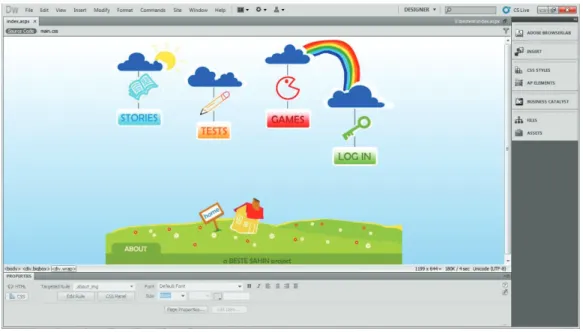
In I Read I Play application ability of understanding is checked with three different ways: Multiple choice tests, visual matching tests and educational computer games (Figure 1).
2.1. Multiple Choice Tests
ent, it can be seen that the multiple-choice tests are efficient tool. Children can get the instant criticism and rectification, thanks to multiple choice tests which supply quick outcome. Multiple choice tests are error-free, simple to manage and perceive and equitable. One of the most important properties is that also check the ch
deductions. Classification of advanced stages of thinking drive to strength children to examine, estimate and combine the information packs. As aforementioned, the information has been taking in and processing preferentially by children in different ways such as seeing and hearing.
Figure 2.2. Visual Matching Tests
A cognitive development index had thought over via likeness or unlikeness decisions of kids (Daehler, Lonardo & Bukatko, 1979; Scott & House, 1978). Decisions of unlikeness may be considered as against to a work of conception by some investigators (Soraci, 1991; Deckner, Baumeister & Carlin, 1990; Soraci et al 1981). The connections of stimuli are shown with learning of likeness or unlikeness, according to the both situations.
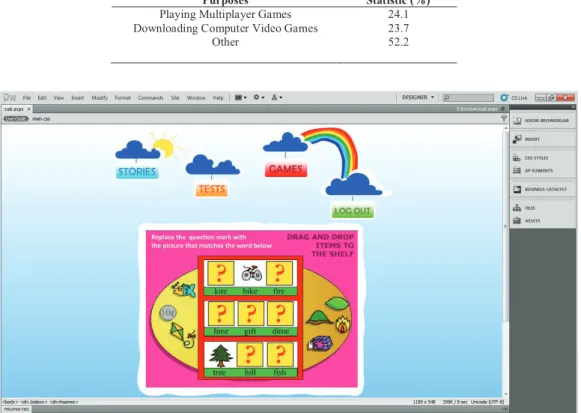
The ability of kids related to condition of proper framework construction is checked by visual matching tests. In the test, the spotlight is on recollecting data and pinpointing accurate data that are gauged with respect to the purposes. Among visual matching and visual multiple-choice, questioning and evaluating likeness or unlikeness from explanation is a must for kids to pair exact terms according to the dissimilarity (Figure 2).
Computer based exercising is one of the methods to improve efficiency of kids. That is why this study has started. Besides it is suitable for testing, teaching fundamental judicial efficiency and relation based efficiency to kids; the method of identity-matching is also utilizable (Daehler, Lonardo, & Bukatko, 1979; Rosenberger, Stoddard, & Sidman, 1972; Constantine & Sidman, 1975).
2.3. Educational Computer Games
Computer games are becoming a part of our life1 (Table 1). For children, it is enormously common ease action to play with them. After studies, it is established that computer games has substantial worth and have chance to be a part of the scholastic system in schools.
It might not be the major preference to have children play computer games for improving narrative skills, reading comprehension, relating and estimation; nevertheless, computer games have been perceived that they essentially aid to develop understanding skills regarding the stories by the investigators. For instance, the optical and musical encouragement of Dance Dance Revolution2 has been exposed by the teaching expert of Appalachian Educational Laboratory, Tammy McGraw to help children to learn focusing and grow into superior readers3. Educational games
1. http://www.dpt.gov.tr/DocObjects/View/12808/Bilgi_Toplumu_Istatistikleri_2011.pdf 2. Dance Dance Revolution is a music video game series produced by Konami. 3. http://hal.archives-ouvertes.fr/docs/00/19/04/53/PDF/kirriemuir-j-2004-r8.pdf
in this study n incentive method which further systems do not.
As a final point, it should be accepted that computer games support worthful talent improvement, such as strategic thinking, planning, negotiating skills and data-handling.
Table 1. The Statistic of Why Using the Internet in Turkey
Purposes Statistic (%)
Playing Multiplayer Games 24.1 Downloading Computer Video Games 23.7
Other 52.2
Figure 2. An example of visual matching test on I Read I Play
3. Conclusion
For a better pedagogy of kids, educational computer games, visual multiple choices and matching tests are ideal s learning process. In this paper it is mentioned about that a developed web site application I -comprehension, criticizing, estimation with equipping narrative, rational thinking and problem solving skills for children.
4. Future Work
There are children whose learning styles are auditory as well as visual. Getting new dimension and development for this study, to make kids who are auditory learners understand and not to meet any trouble with written information, children will listen to chosen stories in I Read I Play application as soon as possible.
References
Aldrich, C. (2005). Learning by Doing: A Comprehensive Guide to Simulations, Computer Games, and Pedagogy in e-Learning and Other Educational Experiences. San Francisco, CA: Pfeiffer.
Daehler, M.W.,& Lonardo, R., & Bukatko, D. (1979). Matching and Equivalence Judgements in Very Young Children.
Freitas, S. de, & Oliver, M. (2006). How can exploratory learning with games and simulations within the curriculum be most effectively evaluated?, Computers & Education (pp. 249-264).
Garris, R., & Ahlers, R., & Driskell, J.E. (2002). Games, Motivation, and Learning: A Research and Practice Model. Simulation and Gaming (pp. 441-467).
Gee, J. P. (2003). What Video Games Have to Teach Us About Learning and Literacy. New York: Palgrave Macmillan. Hill, J. (2006). Impacts of playing video games on learning in children. Literature Synthesis for Applying Research 2006 Available from: jinayang.myweb.uga.edu/edit6900/resources/report.pdf.
Lieberman, L.J., & McHugh, B.E. (2001). Health related fitness of children with visual impairments and blindness. Journal Of Visual Impairment and Blindness.
Malone, T. (1981). Toward a Theory of Intrinsically Motivating Instruction, Cognitive Science (pp. 333-369). (2nd ed.).
Mettam, G. R., & Adams, L. B. (1994). How to prepare an electronic version of your article. In B. S. Jones, & R. Z. Smith (Eds.), Introduction to the electronic age (pp. 281-304). New York: E-Publishing Inc.
Mettam, G. R., & Adams, L. B. (1994). How to prepare an electronic version of your article. In B. S. Jones, & R. Z. Smith (Eds.), Introduction to the electronic age (pp. 281-304). New York: E-Publishing Inc.
Prensky, M. (2001). Digital Game Based Learning. New York: McGraw-Hill.
Soraci, S. A., Jr., & Deckner, C. W. & Haenlein, M. & Baumeister, A. A., & Murata-Soraci, K., & Blanton, R. L. (1987). Oddity performance in preschool children at risk for mental retardation: Transfer and maintenance. Research in Developmental Disabilities, (pp. 137-151). Soraci, S. A., Jr., & Deckner, C. W., & Baumeister, A. A., & Bryant, J. T., & Mackay, H. A., & Stoddard, L. T., & Mcilvane, W. J. (1991).
Generalized oddity performance in preschool children: A bimodal training procedure. Journal of Experimental Child Psychology. (pp. 280-295).
Soraci, S. A., Jr., & Deckner, C. W., & Baumeister, A. A., & Carlin, M. T. (1990). Attentional functioning and relational learning. American Journal on Mental Retardation. (pp. 304-315).
Squire, K. (2003). Video games in education. International Journal of Intelligent Simulations and Gaming (pp. 333-369).
Virvao, M., & Katsionis, G., & Konstantinos M. (2005). Combining software games with education: Evaluation of its educational effectiveness. Educational Technology & Society (pp. 54-65).