T.R.
SELCUK UNIVERSITY
GRADUATE SCHOOL OF NATURAL SCIENCES
DECISION SUPPORT SYSTEM FOR A FOOTBALL TEAM MANAGEMENT BY USING MACHINE LEARNING TECHNIQUES
Mustafa Aadel Mashjal AL-ASADI MASTER'S THESIS
Computer Engineering Department
August -2018 KONYA All Right Received
TEZ KABUL VE ONAYI
Mustafa Aadel Mashjal AL-ASADI tarafından hazırlanan “Decision Support System for a football team management by using machine learning techniques” adlı tez çalışması 01/08/2018 tarihinde aşağıdaki jüri tarafından oy birliği / oy çokluğu ile Selçuk Üniversitesi Fen Bilimleri Enstitüsü Bilgisayar Mühendisliği Anabilim Dalı’nda YÜKSEK LİSANS TEZİ olarak kabul edilmiştir.
Jüri Üyeleri İmza
Başkan
Doç. Dr. Halife KODAZ ……….. Danışman
Prof. Dr. Şakir TAŞDEMİR ……….. Üye
Dr. Öğr. Üyesi Abdullah Erdal TÜMER ………..
Yukarıdaki sonucu onaylarım.
Prof. Dr. Mustafa YILMAZ FBE Müdürü
iii
TEZ BİLDİRİMİ
Bu tezdeki bütün bilgilerin etik davranış ve akademik kurallar çerçevesinde elde edildiğini ve tez yazım kurallarına uygun olarak hazırlanan bu çalışmada bana ait olmayan her türlü ifade ve bilginin kaynağına eksiksiz atıf yapıldığını bildiririm.
DECLARATION PAGE
I hereby declare that all information in this document has been obtained and presented in accordance with academic rules and ethical conduct. I also declare that, as required by these rules and conduct, I have fully cited and referenced all material and results that are not original to this work.
Sign
Mustafa Aadel Mashjal AL-ASADI Date: 01/08/2018
iv ÖZET
YÜKSEK LİSANS TEZİ
MAKİNE ÖĞRENMESİ TEKNİKLERİ İLE BİR FUTBOL TAKIMI YÖNETİMİ İÇİN KARAR DESTEK SİSTEMİ
Mustafa Aadel Mashjal AL-ASADI Selçuk Üniversitesi Fen Bilimleri Enstitüsü
Bilgisayar Mühendisliği Anabilim Dalı
Danışman: Prof. Dr. Şakir TAŞDEMİR
2018, 110 Sayfa Jüri
Prof. Dr. Şakir TAŞDEMİR Doç. Dr. Halife KODAZ
Dr. Öğr. Üyesi Abdullah Erdal TÜMER
Futbol oyuncu ve izleyici sayısı bakımından dünyadaki en popular spordur. Futbolun popülerliği son yıllarda artmıştır ve küresel ekonominin önemli bir parçası olmuştur. 2017 yılı içerisinde sadece Avrupa kulüplerinin geliri 27 milyar dolardır. Bu spordaki başlıca zorluklardan birisi, belli bir takım formasyonu için her pozisyona uygun oyuncunun yerleştirilmesidir. Bu zorluğun sebebi takımdaki her oyuncunun uygun olduğu pozisyonu verecek bilimsel bir formül veya denklemin olmayışıdır. Futbolcuların uygun pozisyonlarının belirlenmesi takım koçları tarafından gözlemlere ve tecrübeye dayalı olarak yapılmaktadır ve bu durum kişisel yargılara sebep olmaktadır. Bu zorlukların üstesinden gelebilmek için bir karar destek sistemi oluşturulmuştur.
Bu tez çalışmasında futbol takımı yönetimi için makine öğrenmesi yöntemlerinden faydalanan yeni bir zeki karar destek sistemi önerilmiştir. Bu karar destek sisteminin başlıca hedefi takımdaki her oyuncu için kişisel yeteneklerini temel olarak en uygun pozisyonu belirlemek ve istenen formasyona göre en iyi takımı oluşturmaktır. Son olarak, sistem her oyuncunun top sürme yeteneğini belirleme yeteneğine sahiptir. Oyuncunun top sürme becerisinin gözlenmesi yöneticilerin oyucu alım, satım ve sözleşme yenileme işlemlerinde daha uygun kararlar vermesine yardımcı olur.
Bu tez çalışmasında bir sezon için 17359 oyuncu içeren FIFA futbol oyunu verileri kullanılmaktadır. Oyuncu verilerini analiz ederken, sınıflandırma ve regresyon problemleri için makine öğrenmesi teknikleri kullanılmıştır (linear and logistic regression, random forest, neural network and k nearest neighbor). Ayrıca, veri boyutunu düşürmek için principal component analysis ve recursive feature elimination algoritmalarından yararlanılmıştır. Bu algoritmalar ile 29 nitelik içerisinden 17 tanesini kullanarak her oyuncunun uygun pozisyonunun belirlenebileceği görülmüştür.
Önceki çalışmalardan farklı olarak bu tezde, her oyuncunun uygun pozisyonunu bulmak için rastgele orman algoritması kullanılmıştır. Bu algoritma ikili sınıflandırma için % 88.60 ve çoklu sınıflandırma için % 58.53 doğruluk değerleri ile diğer algoritmalardan daha verimli değerler vermiştir. Bu algoritmaların performanslarının değerlendirilmesi için üç teknik kullanılmıştır (Hold-out, Cross Validation and Repeated Random Hold-out). Her oyuncunun uygun pozisyonunu belirledikten sonra istenilen formasyona göre en iyi takım her oyuncunun derecesi dikkate alarak oluşturulmaktadır.
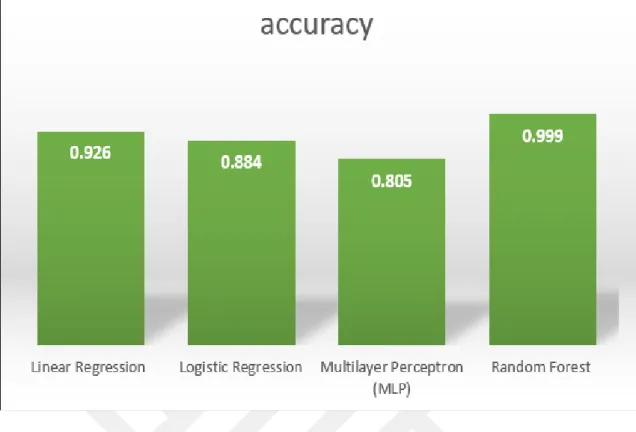
Son olarak top sürme becerisini belirlemek için dört farklı algoritma kullanılmıştır (linear regression, logistic regression, random forest and neural network). En iyi sonucu 17 performans niteliği kullanılarak % 99.90 doğruluk değeriyle rastgele orman algoritması vermiştir.
Keywords— Karar Destek Sistemleri (KDS), Makine Öğrenmesi, Futbol, Takım Yönetimi, Oyuncu Seçimi, Takım Seçimi, Bireysel Yetenekler, Top Sürme, FIFA Futbol Video Oyunu
v ABSTRACT
MS THESIS
DECISION SUPPORT SYSTEM FOR
A FOOTBALL TEAM MANAGEMENT BY USING MACHINE LEARNING TECHNIQUES
Mustafa Aadel Mashjal AL-ASADI
THE GRADUATE SCHOOL OF NATURAL AND APPLIED SCIENCE OF SELÇUK UNIVERSITY
THE DEGREE OF MASTER IN COMPUTER ENGINEERING Advisor: Prof. Dr. Şakir TAŞDEMİR
2018, 110 Pages Jury
Prof. Dr. Şakir TAŞDEMİR Assoc. Prof. Dr. Halife KODAZ Assist. Prof. Dr. Abdullah Erdal TÜMER
Football considered as most popular sport in the world in both number of spectators and players. Popularity of football has increased in the last years and it became an important contributor to the global economy. Where, the revenue for European football clubs alone for 2017 rated at $27bn. In football, team management consider as one main challenges in this sport especially those related to choosing the suitable player for the suitable position in a specific formation because there is no formula or scientific equations used to identify the preferred available position for player in team. where, the assignment generally is done by the coaches by use their experiences and observations about the players, these making selecting of players subject to many biases. Therefore, we need to build intelligent decision support systems to face these challenges. This thesis proposes a new intelligent decision support system for a football team management by using algorithms of machine learning. The main purpose of this decision support system is to find intelligent solutions based on skills of players (technical, physical and mental) to find preferred available position for player in team and find the best available squad according to formations of play. finally, the system has ability to predict dribbling skill for each player in the team to monitor the growth and performance of players because predicting player's skill (like dribbling) will help managers to make suitable decisions like sell, buy and contract renewal.
In this thesis we use dataset of FIFA Soccer video game, that contains data for 17359 players for one season. When analyzing players data, we have used machine learning techniques (linear and logistic regression, random forest, neural network and k nearest neighbor) for classification and regression problems. Further, we use recursive feature elimination algorithm (RFE) and principal component analysis (PCA) algorithm for reducing data dimension. where, we found 17 performance attributes using which we can predict the preferred available position for each player in team out of 29 attributes.
Differently from the previous studies, in this thesis we use random forest algorithm to find preferred available position for each player in team, and it has proved to be more efficient in classification of players position's than other algorithms, where we obtained a predictive accuracy of 88.6% for binary classification (2 position) and predictive accuracy of 58.5% for multi classification (14 position). Where,
vi
the performance of all these algorithms are evaluated using three common techniques (Hold-out (train and test split), Cross Validation (CV) and Repeated Random Hold-out) and comparison the result among them. After assigning each player to the position we determine the best team squad according to formation plays (like 4-3-3 or 3-5-2) based on rating of player.
Finally, to predict the skill of dribbling, we used four algorithms (linear regression, logistic regression, random forest and neural network). We got best result by using random forest, where predictive accuracy was 99.9% by using 17 performance attributes.
Keywords— Decision Support Systems (DSS), Machine learning, Football, Team management, Player selection, Team selection, Individual Skills, Dribbling, FIFA video game series system.
vii
ACKNOWLEDGMENTS
First of all, I would like to thank ALLAH almighty to enabling me to complete this thesis, his continuous mercy was with me through my life and ever more during the tenure of my study.
Now, I would like to express my deep and sincere gratitude to my supervisor Prof. Dr. Sakir Tasdemir for his continuous support, great guidance, endless help and huge confidence that gave for me to grow as a research scientist. Further, I would thank all professors in computer engineering department, whom I have worked with over the last two years.
I am also very grateful to Research Assistant Burak Tezcan for the advice and support who has shown a large interest in my work.
I would like to thank Assist. Prof. Dr. Ilker Ali Ozkan and Lecturer Ali Yasar for their ideas and advices which have been absolutely invaluable.
Also, I wish to thank Mr. Suheyb Tumer to help us connect with specialists in the Sports Science Faculty at the Selcuk University.
Further, I would like to express my deep gratitude to my friend Ahmed Meften to help me in gathering data set from the web and all other great services.
Dearest friend Mouaz Al-habal, I thank his for his constant support and encouragement throughout my graduate career and for his valuable information about football that helped me a lot to achieve this study.
Nearest friend Mustafa Hussein, thank you for being in my life.
Finally, I am extremely grateful to my parents, brothers and amazing sister for their love, prayers and sacrifices for educating and preparing me for my future.
Mustafa Aadel Mashjal AL-ASADI KONYA-2018
viii
TABLE OF CONTENTS
ÖZET ... iv
ABSTRACT ... v
ACKNOWLEDGMENTS ... vii
TABLE OF CONTENTS ... viii
SYMBOLS AND ABBREVIATIONS ... xi
TABLES ... xiii
FIGURES ... xiv
1. INTRODUCTION ... 1
1.1. General ... 1
1.2. Define of Problem and Aim of Study ... 2
1.3. Overview of This Thesis ... 3
2. LITERATUARE REVIEW ... 5
2.1. Result Prediction ... 5
2.2. Player Injury Prediction ... 9
2.3. Evaluation Players & Select Best Players for Formation ... 11
2.4. Predicting of Player Skill's, Wages and Value ... 13
2.5. Football Analytics ... 14
3. GENERAL CONCEPTS AND INFORMATION ABOUT FOOTBALL ... 17
3.1. Definition of Football and its Importance ... 17
3.2. Rules and Facts of Game ... 17
3.2.1. Play field ... 17 3.2.2. Ball ... 18 3.2.3. Players number ... 18 3.2.4. Equipment ... 18 3.2.5. Referee ... 18 3.2.6. Assistant referees ... 18
3.2.7. Duration of the match ... 18
3.2.8. Start and restart of play ... 19
3.2.9. Ball in and out of play ... 19
3.2.10. Scoring methods ... 19 3.2.11. Offside ... 19 3.2.12. Fouls/Misconduct ... 19 3.2.13. Free kicks ... 19 3.2.14. Penalty kicks ... 20 3.2.15. Throw in ... 20 3.2.16. Goal kick ... 20
ix 3.2.17. Corner kick ... 20 3.3. Player attributes ... 20 3.3.1. Mental attributes ... 20 3.3.2. Physical attributes ... 21 3.3.3. Technical attributes ... 23
4. DECISION SUPPORT SYSTEM AND MACHINE LEARNING... 24
4.1. Decision Support System ... 24
4.2. Intelligent Decision Support System (IDSS) ... 26
4.3. Machine Learning Methods for Intelligent Decision Support ... 27
4.4. Classification of Machine Learning Algorithms ... 28
4.4.1. Algorithms classified by learning Style ... 28
4.4.1.1. Supervised learning ... 28
4.4.1.2. Unsupervised learning ... 28
4.4.1.3. Semi-supervised learning ... 29
4.4.2. Algorithms classified by similarity ... 29
4.4.2.1. Regression algorithms ... 31
4.4.2.1.1. Linear regression ... 31
4.4.2.1.1.1. Fitting the regression line ... 32
4.4.2.1.1.2. Scoring linear regression model (R2) ... 33
4.4.2.1.2. Logistic regression ... 34
4.4.2.2. Instance-based algorithms ... 35
4.4.2.2.1. k-nearest neighbors algorithm ... 35
4.4.2.3. Ensemble algorithms ... 36
4.4.2.3.1. Random forest ... 36
4.4.2.3.1.1. Characteristics of random forest ... 37
4.4.2.3.1.2. How random forest work ... 37
4.4.2.4. Dimensionality reduction algorithms ... 38
4.4.2.4.1. Feature extraction ... 38
4.4.2.4.1.1. Principal component analysis (PCA) ... 38
4.4.2.4.2. Feature selection ... 39
4.4.2.4.2.1. Filter strategy ... 40
4.4.2.4.2.2. Wrapper strategy ... 40
4.4.2.5. Artificial neural network algorithms ... 40
4.4.2.5.1. Description ... 40
4.4.2.5.2. Perceptron ... 41
4.4.2.5.2.1. Single-layer perceptron ... 42
4.4.2.5.2.2. Perceptron learning rule ... 42
4.4.2.5.2.3. Multi-layer perceptron ... 43
4.5. Evaluate the Performance of Algorithms ... 44
4.5.1. Hold-out (Train and Test Split) ... 44
4.5.2. Cross Validation (CV) ... 44
4.5.2.1. K-fold cross validation ... 44
4.5.2.2. 2-fold cross validation ... 44
4.5.3. Repeated Random Hold-out ... 45
4.6. Describe the Performance of Classifier ... 45
4.6.1. Confusion Matrix ... 45
x
5. MATERIAL AND METHODS ... 47
6. DATASET ... 50
6.1. Dataset Collection ... 50
6.2. Dataset Description ... 50
6.3. Dataset Analysis ... 51
6.3.1. Expletory data analysis ... 51
6.3.1.1 Dimensions of dataset ... 51
6.3.1.2. Peek at the data ... 51
6.3.1.3. Statistical summary ... 52
6.3.1.4. Missing data ... 53
6.3.2. Dataset reduction based on filter strategy ... 54
6.3.2.1. Heat map ... 54
6.3.2.2. Scatter plot ... 55
6.3.2.3. Heat map and Scatter plot analysis ... 57
6.3.2.4. Reduce dimensionality through (PCA) ... 58
7. PREDICT DRIBBLING SKILL ... 60
7.1. Regression Based on Filter Strategy ... 60
7.1.1. Results ... 62
7.2. Regression Based on Wrapper Strategy ... 65
7.2.1. Recursive feature elimination algorithm (RFE) ... 65
7.2.2. All possible subset to linear model ... 66
7.2.3. Results ... 67
8. PREDICT PLAYER PREFERRED POSITION ... 69
8.1. Required Skills for Determining Player Position ... 69
8.2. Player Positions in Football Team ... 70
8.3. Principal Component Analysis (PCA) ... 74
8.4. Recursive Feature Elimination Algorithm (RFE) ... 74
8.5. Classification Algorithms ... 75
8.6. Results ... 77
8.6.1. Result for binary classification ... 77
8.6.2. Result for multi classification ... 79
9. FIND THE BEST AVAILABLE SQUAD ACCORDING TO FORMATIONS OF PLAY ... 82
9.1. Procedures to Find Best Available Squad According to Formations of Play .... 83
9.2. Result ... 84
10. RECOMMENDATION AND CONCLUSION ... 85
11. REFERENCES ... 87
xi
SYMBOLS AND ABBREVIATIONS
ANNs Artificial Neural Networks Bagging Bootstrapped Aggregation Blending Stacked Generalization
CNN Convolutional Neural Network CV Cross Validation
DCNNs Deep Convolutional Neural Networks DSS Decision Support System
EM Expectation Maximization EPL English Premier League FC Football Club
FS Feature selection
FDA Flexible Discriminant Analysis
FIFA Fédération International de Football Association FIFA Soccer Video Game
FIS Fuzzy Inference System FM Football Manager
GBM Gradient Boosting Machines GBRT Gradient Boosted Regression Trees GPS Global Positioning System
KBS Knowledge based systems ID3 Iterative Dichotomiser 3
IDSS Intelligent Decision Support System K-NN k-Nearest Neighbor
LDA Linear Discriminant Analysis LR Logistic regression
LED Light Emitting Diode
LOESS Locally Estimated Scatterplot Smoothing LVQ Learning Vector Quantization
LWL Locally Weighted Learning
MARS Multivariate Adaptive Regression Splines MCFC Manchester City Football Club
xii MDS Multidimensional Scaling ML Machine Learning
MLP Multi-layer perceptron
OLSR Ordinary Least Squares Regression OOM Object Oriented Methodology OOB Out-Of-Bag
PCA Principal component analysis RFE Recursive Feature Elimination RSS Residual sum of squares ReLU Rectified Linear Unit RF Random Forest TSS Total Sum of Squares W Weight coefficients ∆w Change of the weight TP Number of true positives. FP Number of false positives. TN Number of true negative. FN Number of false negatives. X Input data
y Output data
R2 Coefficient of determination rxy Correlation coefficient
β0 Intercept from the linear regression equation
β1 Regression coefficient
f Activation function t Target value 𝜂 Learning rate 𝜃 Threshold
xiii TABLES
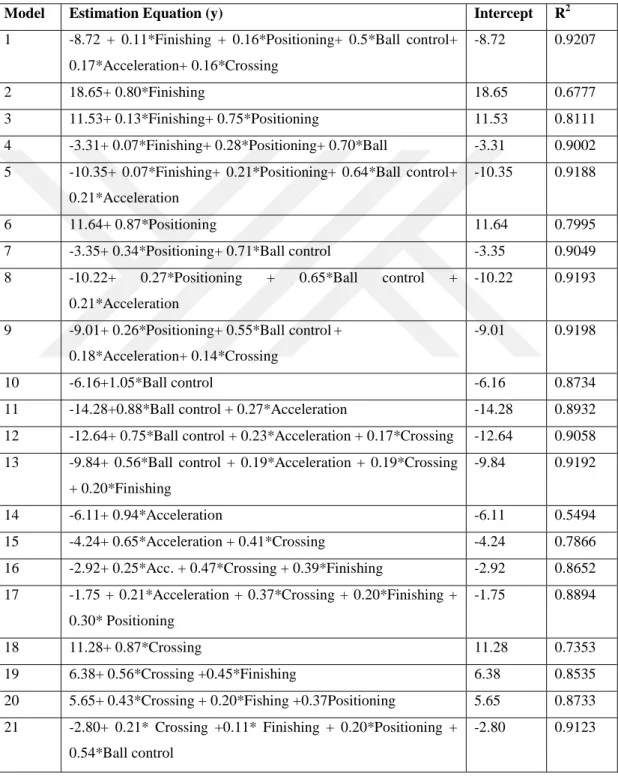
Table 6.1. Dropped attributes according to correlated ... 57 Table 7.1. Performance comparison among algorithms using Hold-out Based on Filter Strategy ... 62 Table 7.2. Performance comparison among algorithms using K-fold cross-validation Based on Filter Strategy ... 62 Table 7. 3. Performance comparison among algorithms using Repeated Random Based on Filter Strategy ... 62 Table 7.4: R2 and Linear Equation for all Models ... 67 Table 8.1. Skills required among football players ... 69 Table 8.1. Performance comparison among algorithms using Hold-out for Group A ... 77 Table 8.2. Performance comparison among algorithms using K-fold cross-validation for Group A ... 77 Table 8.3. Performance comparison among algorithms by using Repeated Random Hold-out for Group A ... 77 Table 8.4. Performance comparison among machine using Hold-out for Group B ... 79 Table 8.5. Performance comparison among algorithms by using K-fold cross-validation for Group B ... 79 Table 8.6. Performance comparison among algorithms by using Repeated Random Hold-out for Group B ... 80 Table 10.1. Compare the results of previous research with the current research ... 86
xiv FIGURES
Figure 3.1. Field of Play in Football Game ... 17
Figure 4.1. Block diagram of DSS ... 26
Figure 4.2 The Main Kinds of Machine Learning Algorithms ... 30
Figure 4.3 Relation between the independent variable (x) dependent variable (y) ... 31
Figure 4.4. Relationship between TSS, RSS and ESS ... 33
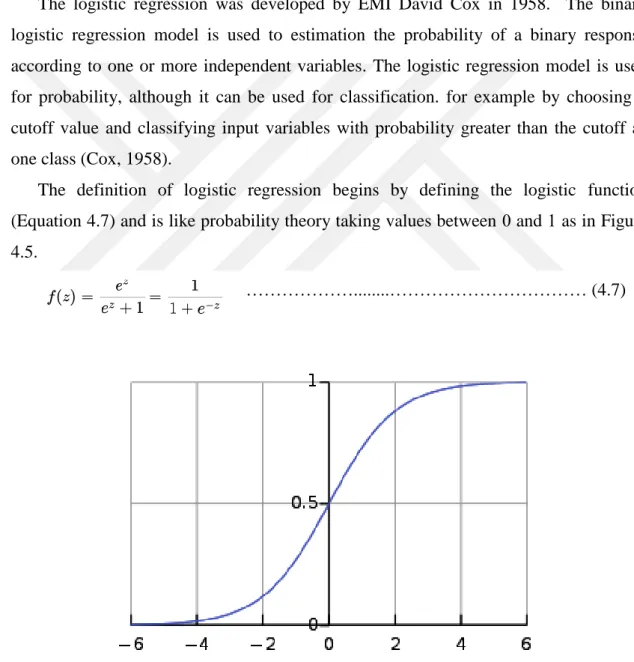
Figure 4.5. The standard logistic function ... 34
Figure 4.6. Random forest classifier ... 37
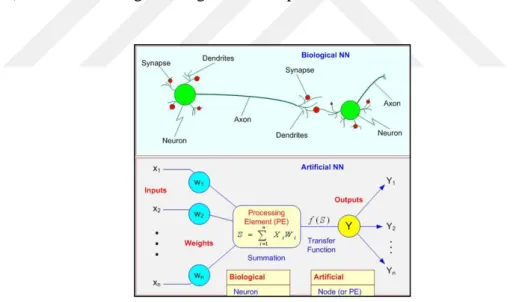
Figure 4.7. Neuron in Artificial neural network vs Biological neural networks ... 41
Figure 4.8. Simple multi-layer perceptron. ... 43
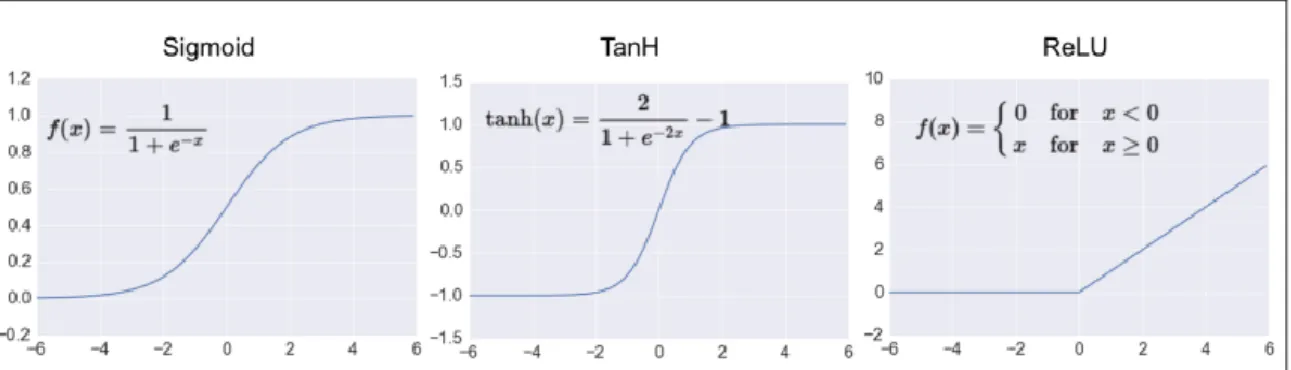
Figure 4.10. Three different activation functions for unites ... 43
Figure 4.11. Confusion Matrix ... 45
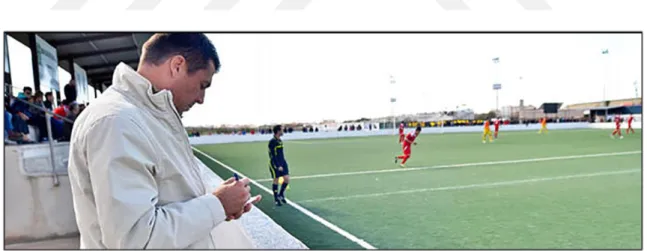
Figure 6.1. Football scout ... 50
Figure 6.2. Use shape command in python code. ... 51
Figure 6.3. Use head command in python code ... 51
Figure 6.4. Use describe command in python code. ... 52
Figure 6.5. Test missing data use describe command in python. ... 53
Figure 6.6. Heatmap (correlation matrix for 28 attributes) ... 54
Figure 6.7. Scatter matrix for Sliding tackle, standing tackle, Interceptions and Marking ... 55
Figure 6.8. Scatter matrix for Positioning, Volleys, Long shots and Finishing... 55
Figure 6.9. Scatter matrix for Long shots and Shot power ... 56
Figure 6.10. Scatter matrix for Curve and Free kick accuracy ... 56
Figure 6.11. Scatter matrix for Acceleration and Sprint speed ... 56
Figure 6.12. Scatter matrix for Long passing, Short passing and Ball control ... 57
Figure 6.13. Heatmap (correlation matrix for 17 attributes) ... 58
Figure 6.14. PCA plot ... 59
Figure 7.1. Summarize Performance comparison among algorithms using Hold-out Based on Filter Strategy ... 63
Figure 7.2. Summarize Performance comparison among algorithms using K-fold cross-validation Based on Filter Strategy ... 63
Figure 7.3. Summarize Performance comparison among algorithms using Repeated Random Based on Filter Strategy ... 64
xv
Figure 7.4. Summarize Performance comparison among all possible subset to linear
models Based on Wrapper Strategy ... 64
Figure 7.5. The flowchart of constructing the IDSS for predict dribbling skill ... 64
Figure 8.1: Classification of skills importance for (RW) position according to the opinion of specialists ... 71
Figure 8.2. Mean of each skill in data set according to position of player ... 72
Figure 8.3. The most important skills required in each position ... 73
Figure 8.4. Features importance in random forest. ... 74
Figure 8.5. The flowchart of constructing the IDSS for predict player preferred position ... 76
Figure 8.6. Summarize the accuracy results of classification algorithms Performance comparison among algorithms by using Hold-out for Group A ... 78
Figure 8.7. Summarize the accuracy results of classification algorithms Performance comparison among algorithms by using K-fold cross-validation for Group A ... 78
Figure 8.8. Summarize the accuracy results of classification algorithms Performance comparison among machine by using Repeated Random Hold-out for Group A ... 79
Figure 8.9. Summarize the accuracy results of classification algorithms Performance comparison among algorithms by using Hold-out for Group B ... 80
Figure 8.10. Summarize the accuracy results of classification algorithms Performance comparison among algorithms by using K-fold cross-validation for Group B ... 80
Figure 8.11. Summarize the accuracy results of classification algorithms Performance comparison among algorithms by using Repeated Random Hold-out for Group B ... 81
Figure 8.12. Random forest classification report by using K-fold cross-validation for Group B ... 81
Figure 9.1. The 4–2–4 formation ... 82
Figure 9.2. The flowchart of constructing the IDSS for find the best available squad according to formations of play ... 83
Figure 9.3. Result of group 1 to find best available squad ... 84
1 1. INTRODUCTION
Football considered as most popular sport in the world in both number of spectators and players (Cotta ve ark., 2016). Popularity of football has increased in the last years and have become a new emerging industry. The sports industry has seen a lucrative rise in stature and has now become an important contributor to the global economy (Asif ve ark., 2016). where the revenue for European football clubs for 2017 rated at $ 27 billion (Davis, 2017). Therefore, the European clubs have become trade organizations (Moor, 2007).
1.1. General
Technological advances led to increase the generation of football data (for players and matches), In this regard, a number of commercial companies have emerged to provide data analysis and collection. For example, in the UK, three data companies have been provided since the late 1990s: Opta, Amisco and Prozone. All these data systems provide detailed data on players and matches, as well as the clubs' reliance on these systems to provide information after the matches (Schulenkorf, 2016). The FIFA video game considered as another source of football data, where it offering detailed data about players (Markovits ve Green, 2017). This volume of data, combined with the development of sports technology led to facilitated the build new decision support systems in sports management.
In football, each player in game is allocate to one of 11 specific locations in the playing field. All these positions in the law of game represent the main role of the player and his operating area on the pitch. The problem of identifying football players by their position on the pitch is complicated because of the fluid nature for the game. The means of fluid nature of game refer to the positions in football game are not constant for each player in team like American football or rugby (Kennelly, 2010).
Sport teams, usually require the coach to set the team formation and choose the best available players for all positions in this formation, where the success of any football team lies in the players skills who make up the team. The selecting of players and forming a team is a complex problem, where final success for coaches is determined by gathering players to form a strong and effective team (Tavana ve ark., 2013). Generally,
2
coaches do not disclose the criteria they use to classify players, therefore the selection of players can be prone to biases by coaches, where the process is done by the coaches by use their experiences and observations about the players.
Based on above, obviously people could not check whether a certain selection of players is fair. Coaches usually are using game statistics in the evaluation, such as: total shots of player on target, total number of passed, goals scored, shot efficiency, steals, turnovers and others. that is mean, there is a lack of criteria that enable coaches to evaluate players accurately (Hraste ve ark., 2008). therefore, one of the crucial criteria’s that must be considered when assigning the position for each member is taking into account his individual attributes (physical, mental and technical) (Abidin ve ark., 2016a). It is necessary to define accurately those criteria and to determine the degree of importance of each and every criterion in relation to playing positions because the lack of suitable criteria that can be used to judge a player, in addition to the current analyses and researches on systematic analysis of the team and Organizing players through information technology and artificial intelligent have not been widely used and very insufficient (Papić ve ark., 2009).
In the same context, talent identification considered as one of important tasks in football. Therefore, all clubs (especially the European) seek to determine the football talent of players at an early age (Roderick, 2006). Predicting of player's skill is one of the most important ways of talent identification. as well as predicting may help managers to make suitable decisions like sell, buy and contract renewal. Therefor coaches are in great need for a modern technological solution for team management (Silva ve ark., 2009).
1.2. Define of Problem and Aim of Study
Machine learning algorithms are widely used in many different disciplines. One of them is a sports field. Research in football analytics with Machine Learning techniques is limited and is mostly employed on result prediction, as well as there are very few researches about algorithms or decision support systems have been made that could be used by decision makers to aid in the process of forming a strong team.
One of main challenge in team management is concern on how to choose preferred available position for player in team. there is no formula or scientific equations used to
3
identify the preferred available position for player in team. where, the assignment generally is done by the coaches by use their experiences and observations about the players. In the same context, one of the other challenges for football managers is knowing how the skill of players changed over time because predicting player's skill will help managers to make suitable decisions like sell, buy and contract renewal.
For all these reasons, there is a need for research and studies to determine how machine learning applications can yield results in soccer analytics. To achieve this purpose, we will seek to build a decision support system (DSS) based on machine learning techniques has the ability to:
i. Predict preferred available position for each player in team such as striker, wing backs, right and left back, etc.
ii. Find the best available squad according to formations of play such as 4-4-2, 3-5-2, etc.
iii. Predict player skills (especially dribbling skill) for each player (where previous studies indicated the most important technical skill and most discriminating variable among players skills is dribbling (Soto-Valero, 2017)).
1.3. Overview of This Thesis
This thesis is organized as follows. Introduction and our contributions are outlined in Chapter 1. Chapter 2 provides a literature review about using machine learning in football, and decision support system models that built for this purpose.
Chapter 3 introduces the general concepts and information about football game. In addition to explain players’ individual qualities (physical, mental, and technical).
In Chapter 4, introduces the general information about traditional decision support systems (DSS) and intelligent decision support systems (IDSS), addition to explain main algorithms in machine learning according to their learning style, similarity and main methods in evaluate the performance of algorithms. Chapter 5 provides a material and methods.
In Chapter 6, introduces the general information about dataset and analyzes
In Chapter 7, introduces decision support system model to predict dribbling skill based on filter and wrapper strategy.
4
In Chapter 8, introduces decision support system model to predict preferred available position for each player in team. Further, the first section in this chapter explained player positions in football team and required skills for determining player position in team.
In Chapter 9, introduces decision support system model to find the best available squad according to formations of play such as 4-4-2, 3-5-2, etc.
5 2. LITERATUARE REVIEW
Machine learning have been successfully applied in sport. and there are many researches focused on developing DSS to be used to help in sport management (Abidin ve ark., 2016b). As a result of literature review, machine learning has been used to assists coaches and managers in five topics in football which are:
- Result prediction - Player injury prediction
- Evaluation players & Select best players for formation - Predicting of player skill's, wages and value
- Football Analytics
2.1. Result Prediction
The selection of important variables in football and the prediction of match results has made many efforts. Prediction is very important in football to help club managers and coaches to make the right decision to win in tournaments and matches. As well as businesses and gamblers have been trying to prediction game results in football for both tournaments and single matches. Organized football gambling on the other hand has developed into a growing industry and is now worth billions. As a result, there is literature on match prediction models. Studies below are the most important studies regarding to match result prediction using machine learning techniques:
Hijmans et al., (2017) proposed a learning algorithm through multiple data mining are analyzed and prediction outcomes are compared to come to a right model for predicting matches of the Dutch football team. Based on the prediction results of Naïve Bayes model, a random tree model, and a k-nearest neighbor model one single model is selection and results are looked at more in-depth. From the random tree model, which was the most predictive power (Hijmans ve Bhulai, 2017).
Razali et al., (2017) proposed a learning algorithm by using Bayesian Networks to predict the outcome of matches in win of term of home (H) or away (A) win and draw (D). The English League are selected for three seasons of 2011, 2012, 2013 and reviewed. K-fold has been used for testing the accuracy of prediction. Bayesian Networks done predictive accuracy at 75.09% (Razali ve ark., 2017).
6
Kınalıoğlu et al., (2017) predicted result of 15 elimination rounds including 8 2nd round, 4 quarter, semi-final and final will be played in 2017 UEFA Champions using ANN, SVM and K-nn algorithm methods. The statistical data of 7 seasons played between 2010-2016 which is obtained from "whoscored.com". This host regularly publishes soccer statistics are compiled and used as training data. In the last part of the study, the successes of the prediction methods were compared (Kınalıoğlu ve ark., 2017).
Velcich (2017) using machine learning techniques researcher attempted to predict the results of European league fixtures. Using match statistics from the Football-Data.co.uk, researcher calculated parameters to use in several diff erent machine learning algorithms: polynomial regression, quadratic discriminant analysis (QDA), SVM and RF classifier (Velcich, 2017).
Prasetio (2016) proposed a logistic regression model is construct to predict outcome of English League for 2015/2016 season for home or away win. they are also used data from video game FIFA. the prediction accuracy of built model was 69.5% (Prasetio, 2016).
Bo Shen (2016) proposed a learning algorithm by using a neural network to predict the results of soccer games Depending on the many factors like players skills, coach abilities, home ground away ground eff ect, team tactics, etc. Their data source was a computer game called Football manager (FM). in the result they proved the neural network is the appropriate model for the problem and their able to predict soccer football results with test error about 25% (Shen, 2016).
Wang et al., (2015) proposed a learning algorithm by using ANN to predict the results for soccer matches depending on the many factors like players skills, coach abilities, home ground away ground eff ect, team tactics, etc. Their data source was a computer game called Football manager (FM) (Wang ve ark., 2015).
Tax et al., (2015) proposed a public data-based match prediction system for the Dutch Eredivisie. Model training was done on a self-made dataset from public sources, consist of thirteen seasons of Dutch Eredivisie match data. Several combinations of dimensionality reduction techniques and classification algorithms have been tested on the public data training set in a structured way. The highest prediction accuracy on the public data feature set was achieved by using a combination of PCA (with 15% variance) with a Multilayer Perceptron classifier or a Naive Bayes (Tax ve Joustra, 2015).
7
Igiri (2015) seek to investigate the ability of the Support Vector Machine to predict match results, in this model was used Gaussian combination kernel to generate 79 support vectors at 100000 iterations. 16 example football match results were trained to predict 15 matches. The result showed 53.3% prediction accuracy, which is comparatively low. an SVM-based system (as devised here) is not good enough in this application domain (Igiri, 2015).
Gomes et al., (2015) proposed decision support system (DSS) to support bookmaker's users to increase their profits on bets related to football matches. The aim of the project is to support betting users to increase their profits in bets that related with football (away win, home win or draw) (Gomes ve ark., 2015).
Shin et al., (2015) proposed using data from virtual games like FIFA to predict the match result. several features of the players were combined and compared that with the real-time prediction by applied Logistic Regression and Linear support vector machines. Accuracy predictor at 75% and virtual predictor at 80% (Shin ve Gasparyan, 2014).
Arabzad et al., (2014) proposed a machine learning algorithms and neural networks to predict the result of one week in the Iranian football league for the 2013-2014 season Based on previous games in the last seven leagues, the results have proved the ability of neural networks to predict match results (Arabzad ve ark., 2014).
Yezus (2014) proposed using data set from two sources to predict the football match result. in order to achieve the highest accuracy. Classifiers used are nearest neighbor and Random forest. The accuracy of these two models was at 55.8% and 63.4% (Yezus, 2014).
Moroney (2014) proposed analyses football scores from football-data.co.uk and check if match facts, such as goals, fouls, shots on target etc. can predict match outcomes. The aim is to further develop the skills obtained during the course, such as databases, programming, statistics, Business Analysis and Data Mining. The analysis was conducted through the construction of an SQL database, statistical analysis in R and machine learning in WEKA. The study proved that there are relationships between fouls, shots on goal etc. and that the outcome of the game can be predicted by match facts (Moroney, 2014).
Igiri et al., (2014) proposed analyses a complex set of data, they predict the match winner with assist tool called rapid miner in addition to using another process called Knowledge Discovery in Database. Classifiers used are logistic regression and artificial
8
neural network. The accuracy of at 93% is obtained in predicting the match winner (Igiri ve Nwachukwu, 2014).
Ulmer et al., (2013) proposed a machine learning algorithms (Naïve Bayes, Linear from stochastic gradient descent, Random forest and Support Vector Machine, hidden Markov model) to predict the football match results in English Premier League. The accuracy of each model was calculated to find the best approach. After comparing all the previous methods, they found that SVM had the best approach, where the accuracy at 55%-69% was showed in the prediction (Ulmer ve ark., 2013)
Owramipur et al., (2013) proposed using BN to predict the results of football matches for Barcelona Football club. The period under study was the 2008-2009 season in Spanish football league. they found BN can uses this to predict football results in future matches and they saw the final result in predictions was correct in 92%(Owramipur ve ark., 2013).
Constantinou et al., (2012) proposed using a Bayesian network model for prediction Football result according to knowledge and data, to predict English Premier League (EPL) matches before they start, and demonstrated profitability against all of market odds, and compared with another published football prediction models, pi-football it proved exceptionally accurate in prediction (Constantinou ve ark., 2012).
Hucaljuk et al., (2011) proposed using machine learning model are developed to solve the problem of Predicting football result. During the development of the model, several of tests have been made in order to determine the optimal attributes and classifications. The results of this model show a good ability of prediction (Hucaljuk ve Rakipović, 2011).
Huang et al., (2010) proposed a prediction model based on using multi-layer perceptron with back propagation learning rule. Based on the MLP prediction way, the prediction accuracy can achieve 76.9% if the draw games are excluded. prediction system is based on the Multilayer perceptron (MLB) with back propagation neural network learning, the prediction accuracy of the model was 76.9% (Huang ve Chang, 2010).
Buursma (2010) proposed a system for predicting the results of football matches that beats the bookmakers’ odds is presented. The predictions for the matches are based on previous results of the teams involve (Buursma, 2010).
Van Gemert et al., (2010) proposed a statistical model to fulltime scores of Premier League football matches. the statistical model accounts for dependence between the
9
number of goals scored by the home and away team. For the marginal distributions of the number of home and away goals, the censored zero inflated Poisson distribution and the censored Negative Binomial distribution are compared. Also, the profitability of these models against the bookmakers is investigated (Van Gemert ve van Ophem, 2010).
Joseph et al., (2006) proposed a machine learning algorithms and Bayesian network to predicting the matches outcome (win, lose and draw) for Tottenham hotspur football club, machine learning techniques are Naive Bayesian learner, Data Driven Bayesian, MC4, K-nearest neighbor learner and a decision tree learner. The results showed that Bayesian network outperforms other techniques in predictive accuracy (Joseph ve ark., 2006).
Rotshtein et al., (2005) proposed using a fuzzy knowledge base and based on the outcome of previous matches. They conclude, it is possible to predict the outcome of the match based on previous outcomes (Rotshtein ve ark., 2005).
It is clear from the study of literature in this region that most of the machine learning algorithms were used to predict the results of the matches but were limited to predicting (win, lose and draw).
2.2. Player Injury Prediction
Injuries are a big problem in football and It is considered as the one main factor that prevents football players from not being able to participate in Matches and training, as well as costs of rehabilitation for players. As a result, there is literature on injury prediction in football players. Studies below are the most important studies regarding to prediction player injuries using machine learning techniques:
Rossi et al., (2017) proposed a multidimensional approach to injury prediction in professional football which is based on machine learning and GPS measurements. By using GPS technology, they collect data describing the training workload of players in a professional football club during a season. their show that their injury predictors are both accurate and interpretable by providing a set of case studies of interest to football practitioners (Rossi ve ark., 2017)
Carey et al., (2016) proposed a learning algorithm to predict athlete ratings of perceived exertion (RPE) was studied for Australian football players. The data used was
10
collected from the global positioning system such as accelerometers and heart rate from 45 players across a full season. The study has proved by using a machine learning approach that RPE can be predicted in Australian football players. Regression modelling outperformed classification approaches and linear approaches (Carey ve ark., 2016)
Kampakis (2016) proposed a learning algorithms to investigate the predictability of football injuries. This work was completed in cooperation with Tottenham Hotspur FC, three investigate were conducted, which are predicting injuries of players, Predicting the recovery time of injuries and predicting an intrinsic injury, for predicting injuries They used Gaussian process model, for Predicting the recovery time of injuries They used negative binomial and ordinal regression as well as Poisson. finally, the third problem of predicting intrinsic injury was solved by using a different type of algorithm which are (supervised PCA, naïve Bayes, random forests, SVM, ANN, Ridge Logistic Regression (RLR) and k-nn) (Kampakis, 2016).
Ehrmann et al., (2016) examines the relationship between variables measured by GPS in gameplay and training, 19 football players competing in the Australian League were monitored for 1 full season using (GPS) units in training and preseason games. Noncontact soft tissue injuries were documented during the season and results proved indicating a raise in training and gameplay intensity leading to injuries (Ehrmann ve ark., 2016)
Kampakis (2011) attempt to detect the possibility of predicting the recovery time of the injured player based on information at the moment of injury, also he used three methods of machine learning (neural networks, support vector machines and gothic processes). The tests were making on data from the Tottenham Hotspur FC. The results of the study show that this task can be done with amount of accuracy (Kampakis, 2011).
Venturelli et al., (2011) examines the factors that increase the risk of muscle pull by using a multivariate survival model (Specifically, Cox regression) for youth players. The study has shown that the previous injuries are the most serious factor. further, proved that an elevated stature increased the probability of muscle pull (Venturelli ve ark., 2011).
Brink et al., (2010) seek to investigate how measures to monitor stress and recovery, and its analysis, provide useful information for the prevention of injuries and sicknesses in elite young football players. The study involved 53 elite footballers aged between 15 and 18. To identify physical stress, football players recorded training, duration of the game and evaluation of the course of stress for two competitive periods through daily
11
training logs. Using FIFA's standard recording system, injury and sickness data were collected, OR and 95% CIs were calculated for injuries and illnesses using MRA. MR demonstrated that Injuries are related to physical stress (Brink ve ark., 2010).
From the literature study in this region, machine learning algorithms were used to predict the occurrence of injury in the players, especially those related to the heart and muscles and the times of recovery from injury according to the medical analysis of the players.
2.3. Evaluation Players & Select Best Players for Formation
The goal of selecting players and team formation is a complex problem where the final success is specified by how the collection of players forms an effective team. Highly structured models have been developed to support trainers in this domain. Studies below are the most important studies regarding to evaluation players & select best players for formation using machine learning techniques:
Sathe et al., (2017) proposed a machine learning algorithms such as support vector machine, random forest and naïve bayes for English premier league football for making features selection (Sathe ve ark., 2017) .
Vroonen et al., (2017) proposed a projection system for football players called APROPOS which is inspired from the CARMELO system. APROPOS predicts the player potential's via searching in a historical dataset (Vroonen ve ark., 2017).
Soto-Valeroet et al., (2017) proposed using (PCA) in related with a model based Gaussian clustering method in order to describe football players. this model is tested using 40 features from FIFA video for 7705 players. The players were classified according to these roles. They found the dribbling skill is the most distinct variable between different combinations of mixed players (Soto-Valero, 2017).
Asif et al., (2016) presented a unique situation where by a rating system for quantitatively measuring a player’s performance was desired. This would eventually enable predictions derivations on various factors, such as player performance or match outcomes. Data for player rating had to be gathered from different sources; however, this Case Study outlines the solutions that were used to gather such data (Asif ve ark., 2016).
12
Klaiber (2016) proposed design a statistic based performance rating system which is called the Player Performance Index (PPI) for the Bundesliga (Klaiber, 2016).
Abidin et al., (2016) proposed appropriate research procedure that can be referred to while conducting a Decision Support System (DSS) study, especially when the development activity of system artifacts becomes one of the research objectives. The design of the research procedure was based on the completion of a football DSS development that can help in determining the position of a player and the best team formation to be used during a game. After studying the relevant literature for this research, researchers found that it is necessary to combine the conventional rainfall System Development Life Cycle (SDLC) approach with Case Study approach to help in structuring the research task and phases, which can contribute to the fulfillment of the research aim and objectives (Abidin ve ark., 2016b).
Cotta et al., (2016) proposed using data from FIFA video game as dataset. they justify its use and discuss probable implementations by analyzing two recent widely discussed subjects (Cotta ve ark., 2016).
Uzochukwu et al., (2015) proposed a model that groups the attributes needed for player selection into four major categories which include the player’s technique, the player’s speed, the player’s physical status and the player’s resistance using neural network technique to determine these major attributes for each player. The result has shown that Neural Network is a good tool for selecting players in a football team (Uzochukwu ve Enyindah, 2015).
Sarda et al., (2015) proposed a solution for problem of team Selection by using of genetic algorithm to find the best solution for these problem and formation of team. In this paper they created a model which collect the commonly used quantitative approach with some new extensions such as features related personal and team performances along with the collaborative performance of a player in the presence of other players in the team (Sarda ve ark., 2015).
Enefiok et al., (2015) proposed an improved system was developed using fuzzy logic and ANN to help managers in the operation of team selection. The result shows that the new system for decision support has an improved accuracy in determining the player selection decision (Enefiok ve ark., 2015).
Tavana et al., (2013) proposed a model for selecting the best football team formation through two phases, the first to choose the players and the second to choose the best formation. The first phase evaluates the players with a fuzzy ranking and selects
13
the maximum performers for inclusion in the team. The second phase evaluates the alternative combinations of the selected players with a Fuzzy Inference System and selects the better combinations for team formation. this approach assists the coaches in decision making problems and improves the quality of their decisions. The coaches’ judgments are essential in evaluating players; therefore, the efficiency of the model depend on the cognitive abilities of the coaches (Tavana ve ark., 2013).
Kumar (2013) attempt to find a way to classify football players according to the most important attributes of player’s performance to find the hidden knowledge which the experts use to assign ratings to players. Researcher performed three classifications experiments and different algorithms from Machine Learning. The better results for predicting ratings using performance metrics had mean absolute error of 0.17 (Kumar, 2013).
Bazmara et al., (2013) proposed K-nn learning algorithm use to evaluate football talents for proper positions considering player skills. The selection of players done by using the proposed method is done using real data, further the results show this method are very efficiency (Bazmara ve Jafari, 2013).
Febianto (2010) proposed AHP decision support system (DSS) to support the ideal placement of a player using multiple criteria to select an appropriate player. DSS would help the trainer make the right decision and use AHP as a model for multiple weighing in the selection process. In the method of data collection techniques, literature, observation and interviews are used for related problems. In addition, techniques and data analysis models using an organized method in which the flow of tools used are a data flow diagram (DFD) and an entity relationship diagram (ERD) (Febianto, 2010).
It is seeming from the literature study in this region that a few models were developed to predict the preferred position of the player in the team, where it was limited to three positions (attack, defense and the midfielder). In addition to, there are a few algorithms used for this purpose.
2.4. Predicting of Player Skill's, Wages and Value
Predicting of player skill's, wages and value may help managers to make suitable decisions like sell, buy and contract renewal. As well as predicting of player's skill like passing, dribbling and ball control is one of the most important ways of talent
14
identification. Where these skills are the basic technical skills of the player (Reilly ve Holmes, 1983) Especially Dribbling skill is considered critical to the outcome of the match (Huijgen ve ark., 2010) in addition to a previous study (Soto-Valero, 2017) indicated the most discriminating variable among player skills is dribbling. Studies below are the most important studies regarding to predicting of player skill's, wages and value using machine learning techniques.
Dey (2017) proposed a multilayer perceptron neural network to predict the price of a football (soccer) player using data on more than 15,000 players from the football simulation video game FIFA 2017. The network was optimized by experimenting with different activation functions, neurons and layers, learning rate and its decay, Nesterov momentum based stochastic gradient descent, L2 regularization, and early stopping. Simultaneous exploration of various aspects of neural network training is performed and their trade-offs are investigated. final model achieves a top-5 accuracy of 87.2% among 119 pricing categories and places any footballer within 6.32% of his actual price on average (Dey, 2017).
Yaldo et al., (2017) proposed an objective quantitative method for determining the wages of football players based on their skills. By using data for 6082 players, the experimental results that the Pearson correlation is ∼0.77 (p < 001) between the actual and expected salary of the players (Yaldo ve Shamir, 2017).
He et al., (2015) showed how the market value of players and their performance of La Liga players can be designed by using extensive data sources using machine learning techniques (He ve ark., 2015).
From the study of literature in this region. We noted that a number of models have been developed to classify players and national teams according to their performance, and a model has been developed to predict the market value of the player according to his skills and performance.
2.5. Football Analytics
Sports analysis is the use of quantitative data analysis of performance data to support training decisions. Sports analysis is not only analysis of performance data, but also analysis with a clear practical purpose. Sports analysis it also useful for making training programs, building strategies and development of game, and player recruitment
15
(Schulenkorf ve Frawley, 2016). Recently with technological advances, a number of commercial companies have emerged to provide data collection and analysis for the sports elite. The provision of tracking data from matches had led to an explosion of interest in the area of football analytics but research in football analytics with Machine Learning techniques is limited and involves on analyzing football game play like formation identification (Vroonen ve ark., 2017). In fact, there are many Sports Analytics Companies which are providing vast volumes of data in statistical packages and data visualizations and the most important of these companies are Prozone and Opta Sports. researches below are the most important studies related to football analyzes:
Wagenaar et al., (2017) explored how to use the machine learning to predict the opportunities for achieving goals in the football of the position data. they propose the use of deep learning convolutional neural networks for this problem. The results show that the Google Net architecture better than all another method with an accuracy of 67.1% (Wagenaar ve ark., 2017).
Brooks et al., (2016) proposed design a player ranking system called (novel) according to the value of passes completed. This value based on the relation between pass locations in a possession and shot opportunities generated. The data used to build the model was taken from La Liga for 2012-2013 season (Brooks ve ark., 2016).
Sgro et al., (2016) analyses the differences amongst the technical performance profiles of the teams involved in the 2016 European Football Championship. A k-means cluster analysis was preliminarily performed to identify the close matches of that tournament. Then, the team-match statistics gathered from the official website of the Union of European Football Championship (UEFA) (Sgro ve Lipoma, 2016).
Horton et al., (2014) proposed constructed a Framework for classifying passes made during a football match according to the quality of the pass and rates each pass as Good, OK or Bad. where it takes player trajectories and a list of passes made. The chosen approach is to use supervised machine learning algorithms in order learn the classification function. The experiments were conducted on five classifiers. First, they used multinomial logistic regression with three different regularized cost functions. Second, they used classifiers RUSBoost and Support Vector Machine algorithms. in general, they produced a classifier with 86% accuracy on the pass labelling mission (Horton ve ark., 2014).
16
Lasek et al., (2013) provided an overview of the predictive ability of various rating systems of football teams. The main benchmark was the FIFA ranking. Their experiences have shown that this system can outperform FIFA ranking (Lasek ve ark., 2013).
Gedikli et al., (2007) proposed system called ASPOGAMO. ASPOGAMO is a vision system have ability to estimating motion trajectories of football players taped on video. The system achieves a high level of robustness through the use of model-based vision algorithms for camera estimation and player estimation (Gedikli ve ark., 2007).
From the study of literature in this region, we noted that there are a few studies have been conducted for analysis sports (especially in football) due to lack of data. Some sports analytics data has been conducted by using video games such as FIFA Soccer, PES and Football Manager.
17
3. GENERAL CONCEPTS AND INFORMATION ABOUT FOOTBALL
3.1. Definition of Football and its Importance
Football is sport that played between two teams, each team have 11 players with a spherical ball. The aim of the game is to score the goals by kicking the ball. Football played in over 200 countries, So it is considered the most famous sport in the world in both number of spectators and players (Dunning, 1999).
Recently, Football have become a new emerging industry, where the revenue for European football clubs for 2017 rated at $ 27 billion (Davis, 2017). Therefore, the European clubs have become trade organizations (Moor, 2007).
3.2. Rules and Facts of Game
There are 17 laws in football game, (Association, 1995) which are:
3.2.1. Play field
The game played on natural surfaces, the surface should be green and have rectangular shape. The long side of the rectangle called side lines and ranges between 100 and 110 meters and have ranges between 64 and 75 meters. The field is split in half by the center line Figure 1.3.
18 3.2.2. Ball
Ball is should spherical, made from leather and Its perimeter shall not exceed 70 and not less than 68 in specific pressure.
3.2.3. Players number
Football matches consist of two teams, each with 11 players, and each team is allowed to switch 3 players during the match. Players are classified into three groups: Defender, midfielder and Forward player.
3.2.4. Equipment
In the match Players should wear jersey shirt, shorts, high knee socks, guards for shin and footwear.
3.2.5. Referee
He is the supervisor of the game, has the power to make decisions, apply laws and declare the outcome, from a neutral point of view.
3.2.6. Assistant referees
In the football game, the assistant referee is one of the officials who help the referee manage the game. Two of them are called assistant referees, standing on the line of contact, while the fourth referee assists the referee in managing the match and all related matters as directed by the referee.
3.2.7. Duration of the match
Football game is played in 90 minutes Divided into two halves and the duration of each half is 45 minutes. The duration between two halves is 15 minutes. According to referee estimates, it can be compensated more time for any interruption during play.
19 3.2.8. Start and restart of play
The starting kick is a way to start or resume a game and is executed at the start of the game or after scoring a goal. When the starting kick is made, all players must be in their own half, and the opponents must be at least 9.15 m from the ball.
3.2.9. Ball in and out of play
When the ball is outside of play a goal have scored. otherwise the ball is in play at any times.
3.2.10. Scoring methods
The goal is calculated when the entire soccer passes over the goal line and under the crossbar provided that the team that scored the goal has not committed a violation of the rules of the game beforehand.
3.2.11. Offside
Offside occurs when the player "any part of the head, body or feet" is closer to the line of his opponent than the ball, the moment the ball passes him, not at the moment of receiving him.
3.2.12. Fouls/Misconduct
Fouls are many and varied and generally occur as a result of the use of excessive force in playing in a deliberate or unintended way. The referee may offer a yellow card to warn players and red card to exclude players from game.
3.2.13. Free kicks
Given due to players' mistakes. A free kick may be either be direct or indirect. from a direct free kick, goal can be scored.
20 3.2.14. Penalty kicks
Are given when a player doing any Fouls or Misconduct in his own Penalty box. the ball is kicked from the penalty region.
3.2.15. Throw in
Is a way of restarting play in a match when the ball has exited the side of Play Field?
3.2.16. Goal kick
Is a way of restarting play after a goal?
3.2.17. Corner kick
Is a way of restarting play in a match and Are given when the ball goes outside of border along the end line and was last touched from the defending team?
3.3. Player Attributes
The player's attributes represent his skills and are the most important factor in determining his performance. player's attributes are divided into three categories are technical, mental and physical.
3.3.1. Mental Attributes
A player's mental attributes indicate the player's sound and stable in matches and is when performing training. Generally, players with high mental toughness will be more consistent even when suffering from bad Morale. mental toughness consider very important in any environment that requires performance setting, adversities and challenges (Miçoogullari ve ark., 2017). The main mental attributes are:
21
Indicates the player's desire to participate in the game and how aggressive it will be in tackling.
ii. Composure
Indicates the ability of the player to be calm and professional regardless of the situation of the game.
iii. Interceptions
Indicates the ability of player to read the game and intercept passes during any particular moment in a match.
iv. Marking
Marking is the ability to mark, defend and track an opposing player. it is also player’s ability to stay close to an opposing attacker to stop him from a pass or cross from a teammate.
v. Positioning
Refers to the player's ability to judge the play properly and move to a strategic place when he does not control the ball on the defense.
vi. Vision
It refers to a player’s mental awareness about position of his teammates for passing the ball to them.
3.3.2. Physical Attributes
A physical like speed, height, balance, strength and agility are all very important in the football game, we notice the most growth of the Physical Attributes during youth of players And it will develop naturally during this period, where studies have shown
22
increased physical activity in children and young people at an early age (ŞİMŞEK ve ark., 2014). The main Physical attributes are:
i. Acceleration
Indicates the player's fast to reach his highest running speed.
ii. Agility
Indicates the ability of the player to change directions quickly or stop, especially during dribbling.
iii. Reactions
Reactions measure a quickly of a player to responds for a situation happening around him.
iv. Sprint Speed
Sprint speed measures the speed rate of a player’s sprinting. v. Stamina
It determines the average at which a player will tire during a match.
vi. Strength:
It the player physical strength. The higher the strength, the more probable the player will win a physical challenge.
23
Indicates the player's ability to maintain balance after challenged by a tackle, or any physical challenge.
3.3.3. Technical Attributes
A Technical like passing, shooting, dribbling and Finishing, all these skills are learned and practiced from player. Often, these skills combined and used in unusual ways (Giacomini, 2009). The main technical attributes are:
I. Curve
it is used to measures ability of player to curve the ball when shooting or passing.
II. Ball Control
It is the ability of a player to control in the ball when he receives it.
III. Finishing
Indicates the player's power and accuracy of any given shot using foot.
IV. Crossing
Indicates to the accuracy of a player's ability when performing a cross pass during normal running or free kick.
V. Dribbling
24 VI. Free Kick
Indicates the ability of player to kick a free kick.
VII. Heading
Indicates the ability of player to accurately head the ball.
VIII. Passing
Indicates the accuracy of all the passes of the player.
IX. Penalties
Indicates the ability and accuracy of the player to shots penalty.
X. Tackling
Indicates the ability and accuracy of the player to tackles.
4. DECISION SUPPORT SYSTEM AND MACHINE LEARNING
The current review contributes to a comprehensive review of decision support systems and the most important machine learning algorithms and their integration into sport.
4.1. Decision Support System
Decision Support Systems (DSS) refer to the role of computers in the decision-making process. For some writers, DSS mean are management-level information systems that link data, complex analytical models, and data analysis tools to support