59 Zekiye ÖZKAN 1 Serkan Tevabil AKA 2 Erdal ARI 3 İbrahim CAN 4 Rasim KALE 5
THE EXAMINATION OF FEAR LEVELS FROM
PHYSICAL EDUCATION AND SPORTS LESSON OF
STUDENTS BY ILLUSTRATED PHOBIA TEST
12345ABSTRACT
Physical education and sports classes are generally amongst the students’ favourite classes. Children manifest themselves primarily with their behaviours in social life. Thus, physical education classes play a crucial role in improving individual differences and biological structure. The behaviours that were seen in the other classes may differ from those in the physical education classes. While the danger of injury in physical education classes may discourage the students, that is not the case in the other classes. The aim of this study is to investigate the sixth-graders' fears towards physical education classes by taking into consideration some variances.The study that was done in 2012-2013 spring term was carried out in the provinces of Van, Trabzon, Gümüşhane, Erzurum, Muş and Ağrı with 262 sixth-graders consisting of 147 females and 115 males by testing them with the illustrated phobia test. In the study, it has been investigated whether the variances such as the students' genders, residences, number of siblings, educational background of their parents, type of the movies they watch have any effects on liking or having phobia of the physical education lesson with the help of the illustrated phobia test. As a method, the illustrated phobia test’s part that was prepared for the sports hall and that was improved by Bös / Mechling (1985) has been used. It consisted of 6 pictures that were taken in sports hall and 7 pictures that were taken in water. In the data analysis t-test, analysis of variance (ANOVA) and correlation analysis were used.According to analysis of variance results, thoughts of jumping over the vault overcoming the medic ball obstacle, walking over balance beam, hands free hanging downward on chin-up bar with feet differentiated significiantly according to their love rates of physical education (p<0.05). Also, thoughts of hanging one handed on the climbing hawser, hands free hanging downward on chin-up bar with feet differentiated significiantly according to their sort of movie subjects watch (p<0.05) and thoughts of walking over balance beam differentiated according to their maternal education levels (p<0.05). According to independent t-test results, thoughts of jumping over vault overcoming the medic ball obstacle, hanging one handed on the climbing hawser, hands free hanging downward on chin-up bar with feet differentiated significiantly according to gender of students (p<0.05). According to being a homeowner or tenant, it was seen significiantly difference in terms of thoughts of jumping over the vault overcoming the medic ball obstacle (p<0.05). In conclusion, it can be said that exercise perceptions of students could be affected by various properties of students.
Keywords: fear, physical education, verbal, motoric
RESİMLİ KORKU TESTİ İLE ÖĞRENCİLERİN BEDEN
EĞİTİMİ VE SPOR DERSİNDEN KORKMA
DÜZEYLERİNİN İNCELENMESİ
ÖZET
Genel olarak beden eğitimi ve spor dersleri öğrencilerin en sevdiği dersler arasındadır. Çocuklar, sosyal hayatta öncelikle kendilerini, davranışlarıyla belli ederler. Bu nedenle, beden eğitimi dersleri bireysel farklılıkların ve biyolojik yapının geliştirilmesinde anahtar bir rol oynar. Diğer derslerde ortaya konulan davranışlar ile beden eğitimi dersinde gösterilen tepkiler birbirlerinden farklı olabilmektedir. Beden eğitimi dersinde sakatlanma tehlikesi, öğrencide bir ön korku oluşturabilirken diğer derslerde bu durum söz konusu değildir. Bu çalışmada, ilköğretime devam eden 6. sınıf öğrencilerinin, bazı değişkenler göz önünde bulundurularak beden eğitimi ve spor dersine karşı korku durumlarının araştırılması amaçlanmıştır. 2012 -2013 yıllı bahar döneminde gerçekleştirilen bu çalışma; Van, Trabzon, Gümüşhane, Erzurum, Muş ve Ağrı illerinde 147’si kız 115’i erkek olmak üzere toplam 262 6. sınıf öğrencisine resimli korku testi uygulanarak yapılmıştır. Öğrencilerin cinsiyeti, yaşadığı yer, kardeş sayısı, anne ve baba eğitim durumu, izlediği film türü gibi değişkenlerin; beden eğitimi ve spor dersini sevme veya korkma üzerinde etkili olup olmadığı, resimli korku testi ile araştırılmaya çalışılmıştır. Bu çalışmada yöntem olarak 6 tanesi spor salonunda 7 tanesi suda olmak üzere toplam 13 resimden oluşan Bös / Mechling (1985) tarafından geliştirilen resimli korku testinin spor salonuna yönelik olarak hazırlanan bölümü kullanılmıştır. Veri analizinde T testi, varyans analizi (ANOVA) ve korelasyon analizi uygulanmıştır. Varyans analizi sonuçlarına göre, öğrencilerin kasanın üzerinden sağlık topu engelini aşarak yere atlama, barfiks barında ayaklar asılı, eller serbest aşağı asılma durumlarına ilişkin düşüncelerinin beden eğitimi dersini sevme derecesine göre anlamlı derecede farklılık gösterdiği görülmüştür (p<0.05). Bunun yanında öğrencilerin tırmanma halatında tek elle asılı kalma ve barfiks barında ayaklar asılı eller serbest aşağı asılma durumlarına ilişkin düşüncelerinin izlenilen film türüne göre anlamlı derecede farklılaştığı (p<0.05), denge aleti üzerinden yürüyerek geçme durumuna ilişkin düşüncelerinin ise anne eğitim düzeyine göre anlamlı derecede farklılık gösterdiği tespit edilmiştir (p<0.05). İlişkisiz örneklemler için t testi sonuçlarına göre ise, öğrencilerin kasanın üzerinden sağlık topu engelini aşarak yere atlama, tırmanma halatında tek elle asılı kalma ve barfiks barında ayaklar asılı eller serbest aşağı asılma durumlarına ilişkin düşüncelerinin cinsiyete göre anlamlı farklılık gösterdiği tespit edilmiştir (p<0.05). Oturulan evin kendine ait olma durumuna göre ise öğrencilerin kasanın üzerinden sağlık topu engelini aşarak yere atlamaya ilişkin düşüncelerinin anlamlı derecede farklılaştığı tespit edilmiştir (p<0.05). Sonuç olarak, öğrencilerin Beden eğitimi ve spor dersine karşı algılarının çeşitli özelliklerinden etkilenebileceği söylenebilir.
Anahtar Kelimeler: korku, beden eğitimi, sözel, motorik
1 Yüzüncü Yıl University Physical Education and Sports School 2Ağrı İbrahim Çeçen University Physical Education and Sports School 3 Ordu University Physical Education and Sports School
4 Gümüşhane University Department of Physical Education and Sport 5 İstanbul GelişimUniversityPhysical Education and Sports School
60 INTRODUCTION
In 21st century when machines replaced
the motoric human actions, the importance of physical movement for health and to feel well has increased. Moreover, to get rid of the stress and the tension in business life, physical movement has become indispensable (1). In this respect,
physical loading effectuates positive
influence on the personage, and a well personage has a good impact on the behaviours of a person towards his / her entourage. Physical well-being / fitness (having muscular strength) is not as simple as it seems. Because especially the juvenile expresses himself / herself with his / her body or muscles. That is why sports lecture have a key role in enhancing the personage and the biological structure in schools or the social clubs.
Compared to the other field, the aims of the physical education differ from the others. The reactions given and the
manners asserted in the physical
education lecture may be different from the ones in other lectures. For example, the risk of mutilation in the physical education lecture may lead to a prior phobia. In other lectures - maths, science, social studies, etc. - there is no similar manner or pattern
of behaviour. Students may be
unsuccessful or show a dimmer
performance in the other classes.
There are so many different definition of phobia in the literature but in accord with Bos and Mechling (4) and Furntratt (9)
and according to Hackfort and
Schwenkmezgez (11) phobia is a physical and affective reaction given to a specific situation under the hazard or the expectancy of danger or anxiety. Mental criterions emerge depending upon the idiosyncratic value processes of the individual. From this point of view, it can be articulated as a theory with two subcomponents. In the first level phobia is a process occurred in brain and the central nervous system. Second, it is a concept including a large scale of situations,
propounded by the other systems of the organism.
Scientists and researchers had interest in phobia problem in the context of many different life styles and proposed a great
number of hypotheses. Taking the
complex structure of a human into consideration, defining the fear requires the use of impartial and standard methods. It is inevitable that the data gathered with these methods will be explained with conclusion sentence. The phobia concept in illustrated phobia test is based on mental field (17, 24). In this sense, as the results of cognitive point of view, the fear can be diagnosed with the statements one will make. Hereby the statements child will make have a key role. Bierbaumer (3) insists that there are three different stages in the diagnosis of fear: Verbal individual
stage, non-verbal motoric stage
(movement and behaviour) and
physiological stage.
Lazarus et al. (18) and Huber (13) conformably stated that circulation and respiration, biochemical rate and electro-physiologic indicators are the fields in analyzing phobia and the ways of phobia’s efficiency. In conjunction with these fields phobia should be researched taking heart frequency measurement EMG, EEG, endocrinological and biological feedback measurement methods with physiological
and psychological processes into
consideration. In observing the behaviours relevant to psychological and physiological processes and building projects related to these, survey methods and laboratory methods can be used. But analysing non-verbal motoric fields needs to be based on the well observation of behaviours. This process is presented as a high reality
relation and, indeed, poses some
obstacles in diagnosing the routine. Because many concepts such as the
observation criteria, observation
categories, forming an observation,
standardization, building scales etc. should be summed up. The illustrated phobia test
61
must be used in terms of this topic’s validity. Survey method is thought to be
appropriate to express the verbal
individual field. However, different from this (14) proposed school phobia test, in this study applied illustrated phobia test addresses a larger scale.
Due to the state characteristic of
movement and sports, illustrated phobia test mentions more than one aspect of the person, who will be diagnosed, using a
multi-perspective approach and this
manner gains validity by shedding light on the behaviours. From this point of view, there are also different phobia tests to define different fields generated by Heckhausen (12) and Schmalt (22). Advantages of defining the fear with pictures are also a sort of making definition of the status of fear. Interpreting the answers received by showing the pictures to the test subjects is highly important in terms of demonstrating the validity of the test as well as being dependant on the test’s content. As it is known, illustrated phobia test is a test measuring the fear of physical education lecture in children. The pictures and their meaning are especially important. It is obvious that a high importance is placed on the material generated in this context. In this test, the fear of lecture is measured especially with reactions given by child to the pictures (8, 19). If the positions of individuals and the movement in the pictures are ideal images, identification and distance effects are especially seen in the results acquired. That the value rates are high is the result of not only the displayed figures’ being realistic, but also the given answers’ categorizing statistical evaluation. While choosing the answer categories, it is also important to handle the possible fear statuses based on the answer analysis. Applying the illustrated phobia test to students before applying to The Physical Education and Sports will be effective in determining the students’ fears related to this area. Sports educators will get the
opportunity to determine the students’ fears and concerns, which will help them improve some strategies for solution. The students can enter puberty safely and healthy in the age of 12 which is important for growing. Their possibility of being successful in the applications that they haven’t encounter previously will increase significantly.
MATERIALS and METHODS
In this study, 147 female and 115 male, 262 in total, students is chosen as the sample group. The study is applied in the
provinces of Trabzon, Erzurum,
Gümüşhane, Ağrı, Van and Muş in 2012-2013 spring term. The students were asked to express their thoughts on
performing the relevant movements
according to the pictures they saw in the illustrated phobia test.
Illustrated phobia test is an important
implementation used in movement
education, physical education, exercise and theraphy; it is also a cheap, simple and viable test. In 1976-1980’s the authors Bös and Mechling (in the institute of sport sciences) proposed that test in their study on dimensional analysis of sports-motoric performance in Sport University Cologne. Project supervisor Rieder (21) also made many contributions to the shaping of the illustrated phobia test. Fear-related factors which may have an impact on the cognitive and sports-motoric performance of the children was investigated. The core of fear includes recognitory dimension of motoric characteristics and of mental development. Different tests of phobia may be evolved on mental field.
It gives important results at short notice towards lecture and exercise and in terms of therapeutic decisions. Trainer or the teacher can notice if there is a fear against the movement fast. Thus, pays dividends in training and shaping the exercise process. Practice strategies underlie the test results (fear reduction in movement training and annihilation of fear). Also,
62
according to the results given by the test, emerges the chance to check the test on. Psychologists and therapists may take advantage of the test to measure the fear involvement shows up in relevant fields as an instrument. In this test, the magnitude of fear can also be measured. In practice, 0.08 point correlation sample was found between the illustrated phobia test and child phobia test (26). Children afraid of movement, detected by this test, can be
supervised with proper therapic
precaution. Also it must be taken into consideration that applied related with
other test processes and fear
measurements, illustrated phobia test may annihilate the phobia connected with movement and sports.
In this study an illustrated phobia test consists of 13 images, 6 in the gym and 7 in the water, is used. These images are visual materials about the situations relevant to the lecture. Images reflect so many aspects of behaviour in the daily life and sports. There are 5 choices for every image. The answers were received via a verbal intercourse. Every image was shown to the children one by one and the
children were asked to mark their choice between 5 choices. The 5 choices of the phobia test were: ‘I can do it immediately’, ‘I can do it after a consideration’, ‘I don’t know if I can do it’, ‘I don’t think I can do it’ and ‘I can’t do it’; and with these choices, the fear degree in movement education was tried to analyse or comprehend (15). Personal information forms that were prepared by reearchers were applied to the students in order to compare the results obtained from the illustrated phobia test with the students’ demographic features (gender, parents’ educational background, the number of siblings, place of residence, the condition of being home owner or living in e rented house, the degree of liking the physical education class, the kinds of the movies they watch). With the SPSS program, the frequency data was gathered by applying the descriptive statistics. In the analysis of data, Independent sample t test and analysis of variance (ANOVA) were used. In addition, relationships between the illustrated movements were analyzed by
using the Kendal Tau correlation
63 RESULTS
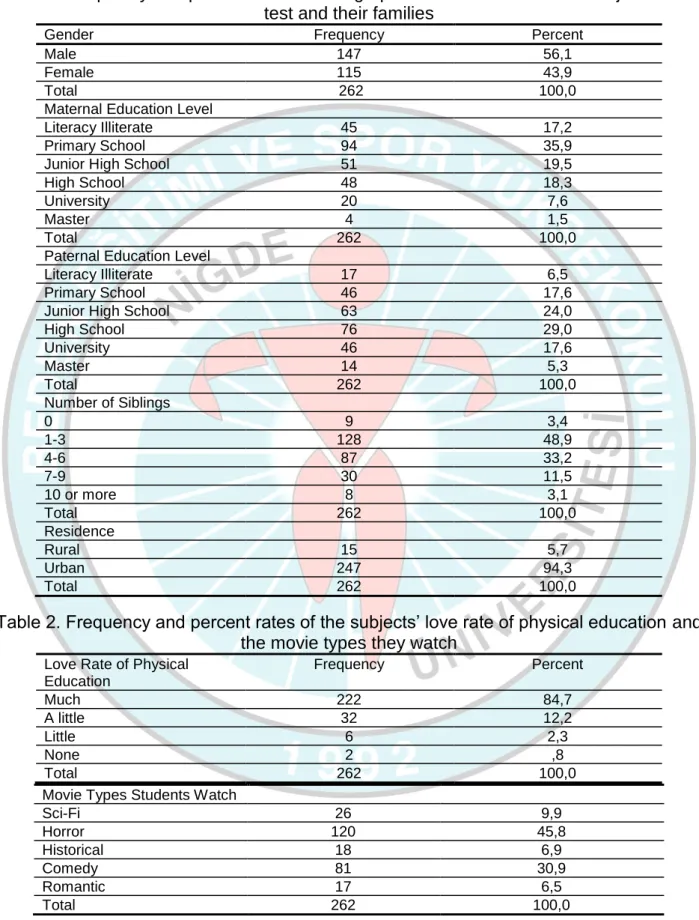
Table 1. Frequency and percent rate of demographic characteristics of the subjects of the test and their families
Table 2. Frequency and percent rates of the subjects’ love rate of physical education and the movie types they watch
Movie Types Students Watch
Sci-Fi 26 9,9 Horror 120 45,8 Historical 18 6,9 Comedy 81 30,9 Romantic 17 6,5 Total 262 100,0
Gender Frequency Percent
Male 147 56,1
Female 115 43,9
Total 262 100,0
Maternal Education Level
Literacy Illiterate 45 17,2
Primary School 94 35,9
Junior High School 51 19,5
High School 48 18,3
University 20 7,6
Master 4 1,5
Total 262 100,0
Paternal Education Level
Literacy Illiterate 17 6,5
Primary School 46 17,6
Junior High School 63 24,0
High School 76 29,0 University 46 17,6 Master 14 5,3 Total 262 100,0 Number of Siblings 0 9 3,4 1-3 128 48,9 4-6 87 33,2 7-9 30 11,5 10 or more 8 3,1 Total 262 100,0 Residence Rural 15 5,7 Urban 247 94,3 Total 262 100,0
Love Rate of Physical Education Frequency Percent Much 222 84,7 A little 32 12,2 Little 6 2,3 None 2 ,8 Total 262 100,0
64
Table 3. Results of ANOVA on the thoughts of 6th graders’ on doing the backbend
according to their maternal education level, paternal education level, number of siblings and the sort of movie they watch (Backbend).
F p value
Maternal Education Level 2,146 0,061
Paternal Education Level 0,489 0,784
Number of Siblings 1,843 0,121
Love Rate of Physical Education 1,021 0,384
Sort of Movie Subjects Watch 0,387 0,818
No important difference was found
according to 6th graders’, in primary
school, doing the backbend and their Maternal/Paternal education level, number of siblings, love rate of physical education
and sort of movie they watch (p>0.05). Namely, it is observed that the data given in the former sentence have no connection with or no influence on students’ doing the backbend.
Table 4. Independent t-test results on the 6th graders’ thoughts of doing backbend
according to their gender, residence and being a homeowner or a tenant
t p value
Gender 1,246 0,214
Residence 1,102 0,272
Being a homeowner or a tenant -0,732 0,465
No important difference was detected in 6th
graders’ thoughts on doing the backbend in terms of their gender, residence and being a homeowner or a tenant (p>0.05).
So, it was observed that subjects’ gender, residence and being a homeowner or a tenant have no important impact on their thoughts of doing the backbend.
Table 5. ANOVA results on students thoughts of jumping over the vault overcoming the medic ball obstacle according to their maternal education level, paternal education level,
number of siblings, love rate of physical education and the sort of movie they watch (Jumping Over the Vault Overcoming the Medic Ball Obstacle)
F p value
Maternal Education Level 0,534 0,750
Paternal Education Level 0,667 0,649
Number of Siblings 0,740 0,566
Love Rate of Physical Education 2,759 0,043*
Sort of Movie Subjects Watch 1,733 0,143
*Significiant difference at p<0.05 level
No important difference was found
between the 6th graders’ thoughts of
jumping over the vault overcoming the medic ball obstacle according to their
maternal education level, paternal
education level, number of siblings and the
sort of movie they watch (p>0.05). But an important difference was found between the 6th graders’ thoughts of jumping over
the vault overcoming the medic ball obstacle according to their love rate of physical education (p<0.05). So, it was
65
observed that the students’ maternal education level, paternal education level, number of siblings and the sort of movie they watch have no influence on their thoughts of jumping over the vault
overcoming the medic ball obstacle; however, their love rate of physical education has a strong influence on their thoughts of jumping over the vault overcoming the medic ball obstacle.
Table 6. Independent t- test results on 6th graders’ thoughts of jumping over the vault
overcoming the medic ball obstacle according to gender, residence and being a homeowner or a tenant
t p value
Gender -3,336 0,001**
Residence 1,058 0,291
Being a homeowner or a tenant -2,637 0,009**
**Significiant difference at p<0.01 level
No important difference was found
between the th graders’ thoughts of
jumping over the vault overcoming the medic ball obstacle with their residence (p>0.05). But a great difference was detected between students’ thoughts of jumping over the vault overcoming the medic ball obstacle according to their gender (p<0.001) and being a homeowner
or a tenant (p<<0.01). Thus, it is observed that the residence don’t have an influence on the students’ thoughts of jumping over the vault overcoming the medic ball obstacle, but their gender and being a
homeowner or a tenant have an
undeniable influence on students’ thoughts of jumping over the vault overcoming the medic ball obstacle.
Table 7. The ANOVA results on the 6th graders’ thoughts of hanging one handed on the
climbing hawser according to their maternal education level, paternal education level, number of siblings, love rate of physical education and the sort of movie they watch
(Hanging One Handed on the Climbing Hawser)
F p value
Maternal Education Level 2,053 0,072
Paternal Education Level 1,523 0,183
Number of Siblings 0,588 0,671
Love Rate of Physical Education 1,689 0,170
Sort of Movie Subjects Watch 4,358 0,002**
**Significiant difference at p<0.01 level.
No important difference was found
between the 6th graders’ thoughts of
hanging one handed on the climbing hawser according to their maternal education level, paternal education level, number of siblings and love rate of physical education (p>0.05). But an important difference was found between
the 6th graders’ thoughts of hanging one
handed on the climbing hawser according to the sort of movies they watch (p<0.01). According to analyze results of
inter-groups, significiant difference was found between students watching horror films and students watching sensational films (p<0.01). Namely, it was observed that the
students’ maternal education level,
paternal education level, number of siblings and love rate of physical education have no influence on their thoughts of hanging one handed on the climbing hawser; however, the sort of movies they watch has a strong influence on their
66
thoughts of hanging one handed on the climbing hawser.
Table 8. Independent t-test results on the 6th graders’ thoughts of hanging one handed on
the climbing hawser according to their gender, residence and being a homeowner or a tenant
t p value
Gender -4,559 0,000**
Residence 0,655 0,513
Being a homeowner or tenant -0,818 0,414
**Significiant difference at p<0.01 level
No important difference was found
between the 6th graders’ thoughts of
hanging one handed on the climbing hawser according to their residence and being a homeowner or a tenant (p>0,05). But an important difference was found
between the 6th graders’ thoughts of
hanging one handed on the climbing
hawser according to their gender
(p<0.001). Thus, it was observed that the
students’ residence and being a
homeowner or a tenant have no influence on their thoughts of hanging one handed on the climbing hawser; however, their gender has a strong influence on their thoughts of hanging one handed on the climbing hawser.
Table 9. The ANOVA results on the 6th graders’ thoughts of walking over balance beam
according to their maternal education level, paternal education level, number of siblings, love rate of physical education and the sort of movie they watch (Walking Over Balance
Beam)
F p value
Maternal Education Level 2,335 0,043*
Paternal Education Level 0,821 0,536
Number of Siblings 0,835 0,504
Love Rate of Physical Education 5,852 0,001**
Sort of Movie Subjects Watch 1,108 0,353
*Significiant difference at p<0.05 level, **significiant difference at p<0.01 level.
No important difference was found
between the 6th graders’ thoughts of
walking over balance beam according to their paternal education level, number of siblings and the sort of movies they watch (p>0,05). But an important difference was
found between the 6th graders’ thoughts of
walking over balance beam according to their maternal education level (p<0.05) and love rate of physical education (p<0.001). According to analyze results of inter-groups, significiant difference was found between students liking physical activity highly and students liking physical
activity ratherly, students not liking
physical activitiy (p<0.01). Namely, it was observed that the students’ paternal education level, number of siblings and the sort of movies they watch have no influence on their thoughts of walking over
balance beam; however, maternal
education level and love rate of physical education have a strong influence on their thoughts of walking over balance beam. Here are the Independent t-test results on the 6th graders’ thoughts of walking over
balance beam according to their gender, residence and being a homeowner or a tenant.
67
Table 10. Independent t-test results on the 6th graders’ thoughts of walking over balance
beam according to their gender, residence and being a homeowner or a tenant
t p value
Gender -0,005 0,996
Residence 1,641 0,102
Being a homeowner or tenant -0,995 0,321
No important difference was detected in 6th
graders’ thoughts on walking over balance beam in terms of their gender, residence and being a homeowner or a tenant (p>0,05).
So, it was observed that the subjects’
gender, residence and being a homeowner or a tenant have no important impact on their thoughts of walking over balance beam.
Table 11. The ANOVA results on the 6th graders’ thoughts of hands free hanging
downward on chin-up bar with feet according to their maternal education level, paternal education level, and number of siblings, love rate of physical education and the sort of
movie they watch (Hands Free Hanging Downward on Chin-up Bar With the Feet)
F p value
Maternal Education Level 1,090 0,366
Paternal Education Level 0,799 0,551
Number of Siblings 1,642 0,164
Love Rate of Physical Education 4,881 0,003**
Sort of Movie Subjects Watch 2,778 0,027*
**Significiant difference at p<0.01 level, *significiant difference at p<0.05 level.
No important difference was found
between the 6th graders’ thoughts of hands
free hanging downward on chin-up bar with feet according to their maternal education level, paternal education level, number of siblings (p>0.05). But an important difference was found between
the 6th graders’ thoughts of hands free
hanging downward on chin-up bar with feet according to their love rate of physical education (p<0.01) and the sort of movies they watch (p<0.05). According to analyze
results of inter-groups, significiant
difference was found between students
watching horror films and students
watching funny films (p<0.05). So, it was observed that the students’ maternal education level, paternal education level and the number of siblings have no influence on their thoughts of hands free hanging downward on chin-up bar with feet; however, love rate of physical education and the sort of movies they watch have a strong influence on their thoughts of hands free hanging downward on chin-up bar with feet.
Table 12. Independent t-test results on the 6th graders’ thoughts of hands free hanging
downward on chin-up bar with feet according to their gender, residence and being a homeowner or a tenant
t p value
Gender -4,027 0,000**
Residence 0,451 0,652
68
**Significiant difference at p<0.01 level
No important difference was found
between the 6th graders’ thoughts of hands
free hanging downward on chin-up bar with feet according to their residence and being a homeowner or a tenant (p>0.05). But an important difference was detected
between the 6th graders’ thoughts of hands
free hanging on chin-up bar with feet according to their gender (p<0.001). Thus,
it was observed that the students’ residence and being a homeowner or a tenant have no influence on their thoughts of hands free hanging on chin-up bar with feet; however, gender has a strong influence on their thoughts of hands free hanging downward on chin-up bar with feet.
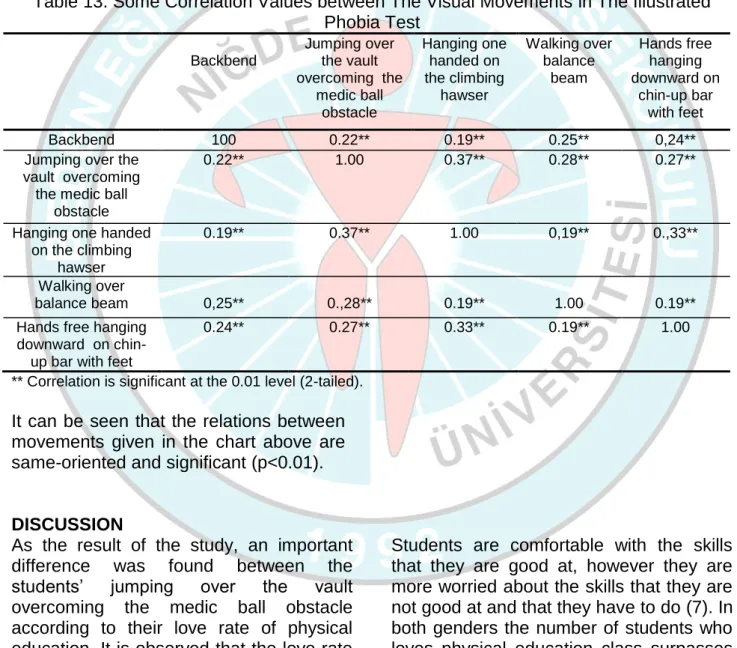
Table 13. Some Correlation Values between The Visual Movements in The Illustrated Phobia Test Backbend Jumping over the vault overcoming the medic ball obstacle Hanging one handed on the climbing hawser Walking over balance beam Hands free hanging downward on chin-up bar with feet Backbend 100 0.22** 0.19** 0.25** 0,24**
Jumping over the vault overcoming
the medic ball obstacle
0.22** 1.00 0.37** 0.28** 0.27**
Hanging one handed on the climbing
hawser
0.19** 0.37** 1.00 0,19** 0.,33**
Walking over
balance beam 0,25** 0.,28** 0.19** 1.00 0.19**
Hands free hanging downward on
chin-up bar with feet
0.24** 0.27** 0.33** 0.19** 1.00
** Correlation is significant at the 0.01 level (2-tailed).
It can be seen that the relations between movements given in the chart above are same-oriented and significant (p<0.01).
DISCUSSION
As the result of the study, an important
difference was found between the
students’ jumping over the vault
overcoming the medic ball obstacle according to their love rate of physical education. It is observed that the love rate of physical education has an influence on jumping over the vault overcoming the medic ball obstacle.
Students are comfortable with the skills that they are good at, however they are more worried about the skills that they are not good at and that they have to do (7). In both genders the number of students who loves physical education class surpasses the number of those who don’t. In studies also that here is a link between the gender and the love rate of physical education stands out. It is inevitable that this situation
69
leads to positive results in skill training and applying movements (25).
An important difference was found
between the students’ thoughts of jumping over the vault hurxdling the medic ball according to their gender and being a homeowner or a tenant. Thus, it was observed that students’ residence has no influence on their thoughts of jumping over the vault overcoming the medic ball obstacle, but that their gender and being a homeowner or a tenant have a strong impact.
According to the study, being in
coeducational classes in more effective for males. Because they feel more confident to learn basketball,whereas males in in same-sex classes are worse in terms of confidence. Consequently ,students in middle school chose same-sex classes , while students in high schools chose
coeducation classes (20). Physical
educators should develop sense of gender equity whic helps them know the
importance of student behaviour in
learning environment . According to the study, the middle-school girls were facing various troublea because of their male classmates (10).
An important difference was found
between students’ thoughts of hanging one handed on the climbing hawser according to the sort of movies they watch. Thus, it was observed that the students’
maternal education level, paternal
education level, number of siblings and love rate of physical education have no influence on their thoughts of hanging one handed on the climbing hawser; however, the sort of movies they watch has a strong influence on their thoughts of hanging one handed on the climbing hawser.
Tutal (27) found a significant difference between the education of parents and the students’ manners towards physical education class. The higher parents’ education level, the more positive their manners towards physical education and that positive attitude reflect on children.
There found an important difference between students’ thoughts on walking over balance beam according to their maternal education level and love rate of physical education class.
Kangalgil et al. (16) expressed that the university students have the highest attitude scores among the students having sport license. That is because the physical education classes that university students having sport license attended were too many and they had choosen it on their own request.
Çelik and Pulur (6) stated that the general attitude scores towards Physical Education and Sport of Secondary School Students. According to conclusions of their study, it was determined that attitude scores of male students and students who does sports and one person of their family do sports were high. Also, it was seen that attitude scores towards Physical Education and Sport of students didn’t differentiate according to type of school. An undeniable difference was detected between the students’ thoughts of hands free hanging downward on chin-up bar with feet according to the love rate of physical education class and sort of movies they
watch. When the previous studies
reviewed, it can be seen that the children of that time period are highly affected by the movies and TV programs.
A strong evidence has been found for a specific casual direction from TV viewing,
especially of violent moviesand programs,
to high verbal and physical
aggressiveness when children’s initial levels of aggression is taken into consideration (23).
The study in which 1.511 sixth grade girls completed baseline assessments for the Trial of Activity in Adolescent Girls has shown that 50% of girls enjoyed PE class a lot.(2)
CONCLUSIONS
Although children start to know better as they get older, most of their first
70
impressions take shape with the television which they see as a source of information about the world outside their homes. In case of severe stress, violence may come out. In such cases, adolescents and adults
are more likely to revert to their earliest sense of what violence is and what its role is in society. This sense is mostly a result of television (5).
REFERENCES
1. Amelang, M., Barttussek, D. “Differentierte Psychologie und Personlichkeitsforschung’’, 2. Erw. Auflage Stuttgart, 1985.
2. Barr-Anderson, D.J., Neumark-Sztainer, D., Schmitz, K.H., Ward, D.S., Conway, T.L., Pratt, C., Baggett, C.D., Lytle, L. and Pate, R.R. ‘’But I Like PE: Factors Associated with Enjoyment of Physical Education Class in Middle School Girls’’ Research Quarterly for Exercise and Sport. 79(1). pp. 18-27, 2008.
3. Bierbaumer, N. “Neuropsychologie der Angst [Neuropsychology of Anxiety’’, Fortschritte der Klinischen Psychologie, Bd 3. München: Urban & Schwarzenberg Verlag, 1973
4. Bös, K., Mechling, H. “Bilder-Angst-Test für Bewegungssituationen’’. Handanweisung. Göt 3, 1985. 5. Centerwall, B. “Television and Violence: The Scale of the Problem and Where to Go From Here’’ Journal of the American Medical Association. 267. pp. 3059-3063, 1992.
6. Çelik, Z., Pulur, A. ‘’Ortaöğretim Öğrencilerinin Beden Eğitimi ve Spora İlişkin Tutumları’’, Van Yüzüncü Yıl Üniversitesi Eğitim Fakültesi Dergisi Özel Sayısı. pp. 115-121, 2011. [In Turkish]
7. Demirhan, G. Saçlı, F. Cengiz, C. Çiçek, Ş., Beden Eğitimi Dersleri ve Öğretmen Eğitimine İlişkin Yaplan Araştırmaların İncelenmesi, Beden Eğitimi ve Spor Öğretiminde Yeni Yaklaşımlar: Öğretim Modelleri ve Güncel Araştırmalar. Spor Yayınevi ve Kitabevi, s.116-174, Ankara, 2010. [In Turkish]
8. Drever, J., Fröhlich, WD. “Wörterbuch der Psychologie’’. München, 1975.
9. Fürnratt, E. “Ngst und Instrumentelle Aggression’’. Eine Analyse auf der Grundlage Experimental Psychologischer Forschungsbefunde, Weinheim: Beltz Verlag, 1974.
10. Gibbons S.L. and Humbert L.‘’What Are Middle-School Gırls Lookıng for in Physıcal Educatıon?’’ Canadian Journal of Education. 31(1). pp. 167-186, 2008.
11. Hackfort, D., Schwenkmezger, P. “Angst und Angstkontrolle im Sport’’, bps- Verlag, c/o
Psychologisches Institut der deutschen
Sporthochschule Köln, 1. Auflage, Hrsg.: Jürgen R. Nitsch, 1980.
12. Heckhausen, H. “Hoffnung und Furcht in der Leistungsmotivation’’. Meisenheim, Germany: Hain, 1963.
13. Huber, H. “Denkverlauf’’, Einsamkeit und Angst, Bern- Stuttgart, 1976.
14. Husslein, E. “Der Schulangst-Test (SAT) e. Psychodiagnost. Verfahren zur Qualitativen Erfassung Schul’’. Ängste ; Handanweisung Göttingen Toronto Zürich Verlag für Psychologie Hogrefe,1978.
15. Kale, R. “Vorstellung Des Bilder- Angst für Bewegungsstuationen (BAT) von Dr. Klaus Bös und Dr. Heinz Mechling” Mainz Üniversitaet, Fachberich Sport,Seminararbeit, Mainz: Campus, 1989.
16. Kangalgil, M., Hünük, D., Demirhan, G. ‘’İlköğretim, Lise ve Üniversite Öğrencilerinin
Beden Eğitimi ve Spora İlişkin Tutumlarının Karşılaştırılması’’ Hacettepe Üniversitesi Spor Bilimleri Dergisi. 17 (2), pp. 48-57, 2006. [In Turkish with English Abstract]
17. Lazarus, R.S. “Psychological Stress and the Coping Process”, New York: McGraw-Hill, 1966.
18. Lazarus, R.S., Monat, A., Averill, JR. “Anticipatory Stress and Coping Under Various Conditions of Uncertainly’’, Journal of Personality and Social Psychology. 24(2). pp. 237-253, 1972.
19. Levitt, E.E. “Die Psychologie Der Angst’’, Kohlhammer, 1973.
20. Lirgg, C.D. “Effects of Same-Sex Versus Coeducational Physical Education on The Self Perceptions of Middle and High School Students’’ Research Quarterly for Exercise and Sport. 64(3). pp. 324-334, 1993.
21. Rieder, H. “Motoric und Bewegungsforschung’’, Hoffmann Verlag, Schorndord, 1983.
22. Schmalt, H.D. “Die Messung des Leistungsmotivs’’. Göttingen, Germany: Hochgreife, 1976.
23. Singer, D.G., Singer, J.L. “ Imagination and Play in the Electronic Age’’, First Harvard University Press paperback edition. pp. 83-110, 2007.
24. Spielberger, D.C. Current Trends in Theory and Research, New York Academic Press, 1972.
25. Taşmektepligil, Y., Yılmaz, Ç., İmamoğlu, O., Kılcıgil, E. “İlköğretim Okullarında Beden Eğitimi Ders Hedeflerinin Gerçekleşme Düzeyi” SPORMETRE Beden Eğitimi ve Spor Bilimleri Dergisi. 4(4). pp. 3045-3050, 2006.
26. Thurner, F., Tewes, U. “Der Kinder-Angst-Test’’, Göttingen: Hogrefe. Neues über Rudolf-Steiner-Schulen, 1972.
27. Tutal, V. “İlköğretim Öğrenci Velilerinin Beden Eğitimi Dersine Karşı Tutumlarının Bazı Değişkenlere Göre İncelenmesi’’, Van Yüzüncü Yıl Üniversitesi Eğitim Fakültesi Dergisi Özel Sayısı. pp. 142-153, 2011. [In Turkish with English Abstract]