Abstract
Economic stability, political stability, market structure, market size, trade openness, and various regulations related to tax advantages have crucial importance to attract foreign direct investments (FDI) to an economy. In addition to the factor aforementioned, One of the other potential determinants for foreign direct invest-ments (FDI) inflow might be the degree of unionization tendency in a particular host country. As unionization causes increase in the wages and brings some fringe be-nefits to labors which are extra financial burdens for employers, the profit of an enterprise reduces. Owing to this fact, willingness to invest of entrepreneurs diminis-hes and right after they may redirect their investment to abroad. Therefore, unionization rate may discoura-ge investors and speed up the capital flight. This study investigates the association between unionization rate and capital outflow by using panel data. Our prior ex-pectation is a positive relationship between unionizati-on rate and capital flight. The findings obtained in the literature show thatunions, always act in the favor of protective policies, resisted against policies which sup-port both free trade and FDI.
Keywords: Trade unions, Unionization Rate, Foreign Direct Investment, Panel Data
Öz
Doğrudan yabancı sermaye için ülkedeki ekonomik ve siyasi istikrar, piyasanın yapısı ve büyüklüğü ve dışa açıklığı, vergi avantajlarını içeren çeşitli düzenlemeler önem kazanmaktadır. Doğrudan yabancı sermaye ya-tırımlarının çıkış ülkeleri için belirleyicilerinden biri de ev sahibi ülkedeki sendikalaşma eğilimidir. Sendi-kalaşma çalışanlara ücret artışı ve bazı ek faydalar sağlamakla birlikte işverenler açısından da ilave mali yükümlülüklere ve dolayısıyla kârlılığın azalmasına neden olur. Böylece yatırım yapma arzusu azalan gi-rişimciler, yatırımlarını yurtdışına yönlendirebilirler. Bundan dolayı sendikalaşma oranı, yatırımcıların ce-saretini azaltarak sermaye kaçışını hızlandırabilir. Bu çalışma, panel veri kullanılarak sendikalaşma oranı ve sermaye çıkışı arasındaki ilişkiyi araştırmaktadır. Bi-zim öncelikli beklentimiz, sendikalaşma oranı ve ser-maye kaçışı arasında pozitif bir ilişkinin olduğu yön-dedir. Literatürde konu ile ilgili elde edilen bulgular da, sendikaların her zaman, korumacı politikalar lehine hareket eden, hem serbest ticareti ve hem de doğrudan yabancı sermaye yatırımlarını destekleyen politikalara karşı direnç gösteren kuruluşlar olarak göstermektedir. Anahtar Kelimeler: Sendikalar, Sendikalaşma Oranı, Doğrudan Yabancı Yatırımlar, Panel Veri
Does Unionization Rate Accelerate Flight of Capital?: Panel Analysis*
Sendikalaşma Oranı Sermaye Kaçışını Hızlandırır mı?: Panel Analiz
Prof. Dr. Cuneyt Koyuncu - Assoc. Prof. Dr. İsmail Hakkı İşcan
Prof. Dr. Cuneyt Koyuncu, Bilecik Şeyh Edebali University Faculty of Economics and Administrative Sciences, [email protected] Assoc. Prof. Dr. İsmail Hakkı İşcan, Bilecik Şeyh Edebali University Faculty of Economics and Administrative Sciences, [email protected] * This article was presented by the authors at the International Osmaneli Social Sciences Congress, between 12-14 October 2016.
Başvuru Tarihi: 26.05.2017 Kabul Tarihi: 02.06.2017
Introduction
Recently the recognition of the economic benefits that foreign direct investment (FDI)1 may provi-de in to economy such as employment, growth and productivite, has caused to a revival of interest in the factors that make a country a more or less attractive location for investment by multinational enterprises (MNEs). As a reaction to an uncertain economic situ-ation, transnational companies have reported cutting their FDI expenditure which will have implications for employment as the MNEs attempt to cut costs (UNCTAD, 2009). MNEs produce in multiple count-ries to avoid costs associated with international trade. In this respect, economic situation of host countries, market size and stability plays a critical role in deter-mining the distribution of FDI, since international trade costs are proportional to the size of the market and to the scale of sales. Most studies about the relati-onship between FDI flows and labour standards focus on the role of labour costs (Bellak et al., 2008). On the other hand it is important that arrangements and ins-titutional changes on the labor market in a country. For example, the power level of the trade unions and legal structure about trade union bargaining arrange-ments are important factors affecting foreign direct investment as inflow or outflow.
According to the traditional view on this issue is that a presence of strong trade union in a country will make less attractive location for FDI. Because a trade unions with their decisions and their activities will tend to cause to reduce the profitability of FDI. In this perspective argued that MNEs will prefer the econo-mies in which there are weak regulations delimiting the degree of trade union power in bargaining nego-tiations about working conditions and wage level. The degree of centralisation or co-ordination in working conditions and wage bargaining is clearly of relevance in this context. Because MNEs will prefer relatively free to determine the wage and employment conditi-ons in its own plants and investment.
Briefly, a strand of international economics literature dealing with labour markets suggest that MNEs will prefer to locate in economies in which they can
ex-1 Foreign Direct investment (FDI) is investment made to acc-quire a lasting interest in or effective control over an enterprise operating outside of the economy of the investor. (UNCTAD, 2016).
pect to enjoy a high degree of discretion in the de-termination of wages in the plants that they operate. Naylor and Santoni (2003) and Leahy and Montagna (2005) suggest that a strong trade unionisation could render a country less attractive for FDI, due to the unions’ rent-extraction activities that would limit the potential gains of firms. High levels of trade union density and a regime of centralised or co-ordinated wage bargaining will therefore tend to have a nega-tive effect on the inflows of foreign direct investment into an economy. Therefore these factors are negative effects to FDI inflow, at the same time pozitive affects to FDI outflow.
There has been relatively scarce empirical evidence on the effect of trade unionization on the location of FDI and both theoretical predictions and empi-rical findings are often inconclusive. At the same time there is very little empirical evidence about the impact of industrial relations factors on FDI flows (Krzywdzinski, 2014). Cooke (1997) and Cooke and Noble (1998) find that FDI by U.S. MNEs is attrac-ted to economies with decentralised wage bargaining systems. According to their study MNEs have disco-uraged by high levels of trade union density, which support the conventional wisdom in this area. Cooke (2003) argues that employment protection legislation has an important impact on American FDI flows to OECD countries and that companies prefer countries with weaker regulation. Cooke’s analysis (1997, 2003) shows that the degree of unionisation and the level of collective-bargaining centralisation have a negative effect on the amount of FDI inflows from the US. Skaksen and Sorensen (2001) examine the prefe-rence of workers and a firm for FDI. Considering a monopolistic firm and decentralised labour unions, they show that both the workers and the firm share the same interest for FDI if there is a big degree of complimentarity between activities in the home and the host countries. On the other hand, conflicting in-terests arise if there is a big degree of substitutability between activities in the home and the host countries where the firm gains but the workers lose from FDI. Naylor and Santoni (2003) suggest that FDI is less li-kely to occur, the greater is union bargaining power, the stronger the weight the union attaches to wages and the more substitutable are firms products in the potential host country.
Lommerud, Meland and Straume (2005), presents a theoretical model of low unionization and outso-urcing decisions. The main result of their analysis is that low unionization can in fact trigger outsourcing. According this study, low trade unionization reduces the wage hike following outsourcing and makes out-sourcing more attractive. Kinkel and Zander (2007) argue that working time length and flexibility is an important factor to attract FDI but this argument has not been systematically examined yet (Krzywdzinski, 2014).
Ishida and Matsushima (2005) examine the welfare impacts of outward FDI. In a duopoly market struc-ture with decentralised unions, they show that while first FDI is always welfare improving, second FDI is always welfare reducing.
Mukherjee and Suetrong (2007) show that the in-centive for outward FDI by the home firms is higher under a centralised labour union than under decent-ralised labour unions. They suggest that this may not be true in an open economy with FDI. According to this study, if all home firms export irrespective of the unionisation structure, the wage rates and the union utility are higher under a centralised union. They also show that if the number of firms undertaking FDI is higher under a centralised union than under decent-ralised unions, there may not be a conflict of interest between the labour union and the domestic industry, and both the union and the domestic industry may be better off under decentralised unions than under a centralised union.
Rodelscu and Robson (2008), examines the theoreti-cal foundations of the relationship between trade uni-on strength, wage bargaining co-ordinatiuni-on and fore-ign direct investment and undertake an econometric analysis of FDI flows using cross-national time-series data on 20 OECD economies. They have set out a theoretical model that illustrates the potential relati-onships between trade union bargaining strength, the degree of co-ordination – as distinct from the degree of centralisation - in wage bargaining, and the attrac-tiveness of an economy to FDI. Their results provide further evidence in support of the view that a high rate of union membership in an economy helps to de-ter inward investment by multinational ende-terprises. The effects that this study has identified concerning the impact of trade union density on inflows of FDI are quantitatively as well as statistically significant.
Their most conservative estimates suggest that a dec-line of 10 percent in the level of trade union density might be expected to lead to an increase in real inf-lows of FDI of around 5.7 percent.
Gross and Ryan (2008) show that employment pro-tection legislation affects negatively the inflows of FDI from the US and Japan, respectively. In other words, companies are more likely to locate in count-ries with weaker employment protection. According to this study, a negative significant effect of the emp-loyment protection seems to emerge.
Brandl et al. (2010), unionisation and workplace employee representation had no significant effect on the localisation of US FDI. Only the collective-barga-ining centralisation showed a negative influence on FDI inflows.
There exists almost no study on the relationship bet-ween unionization rate and FDI outflow in the litera-ture. Therefore this study examines the aforementio-ned association by using unbalanced panel data. The study reveals that higher unionization rate causes to higher FDI outflow in an economy. The remaining part of the study proceeds as follows: data and metho-dology is explained in the next section; third section reports and discusses estimation results; and the last section provides concluding remarks.
Data and Methodology
This study examines the impact of unionization rate on outward flow of foreign direct investment (FDI) level in that particular country by using three FDI outflow indicators. The period under study is betwe-en 2000 and 2013.
By using unbalanced panel data we estimated the fol-lowing univariate random effect model (REM);
(1) and the following multivariate random effect models (REM);
(2)
where it subscript stands for the i-th country’s obser-vation value at time t for the particular variable.
0 1
it it i it
FDIOUT =β β+ UNION + +η u
0 1 2 3 4 5
it it it it it it i it
FDIOUT =β β+ UNION +βCPI +βENROLTER +βCELLPHONE +βECOFREE + +η u
0 1 2 3 4 5
it it it it it it i it
FDIOUT =β β+ UNION +βCPI +β ENROLTER +βCELLPHONE +β ECOFREE + +η u
0i
represents country specific factors not considered in the regression, which may differ across countries but not within the country and is time invariant. is a stochastic term, which is constant through the time and characterizes the country specific factors not considered in the regression. uit is error term of the
regression and independently and identically distri-buted among countries and years.
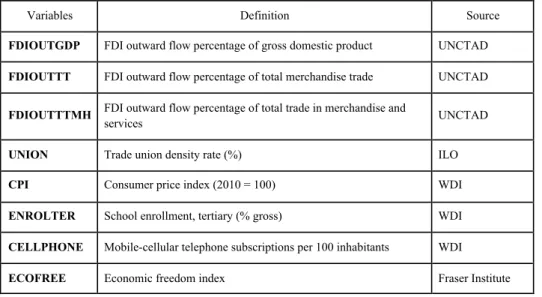
Our dependent variable is FDIOUT. Three FDI outf-low indicators are FDIOUTGDP, FDIOUTTT, and FDIOUTTTMH. We also introduced four more po-tential determinants of FDI outflow into our models. The list of dependent and independent variables, the-ir definitions, and the data sources are given in Table 1 below.
i η
Table 1. List of Dependent and Independent Variables
Variables Definition Source
FDIOUTGDP FDI outward flow percentage of gross domestic product UNCTAD
FDIOUTTT FDI outward flow percentage of total merchandise trade UNCTAD
FDIOUTTTMH FDI outward flow percentage of total trade in merchandise and services UNCTAD
UNION Trade union density rate (%) ILO
CPI Consumer price index (2010 = 100) WDI
ENROLTER School enrollment, tertiary (% gross) WDI
CELLPHONE Mobile-cellular telephone subscriptions per 100 inhabitants WDI
ECOFREE Economic freedom index Fraser Institute
The expected association between labor unionizati-on rate and three proxies of FDI outflow is positive. Countries having higher level of unionization are anticipated to experience more outward flow of FDI. Studies in the literature about the effect of unionizati-on show that high uniunionizati-onizatiunionizati-on density cunionizati-onsiderably prevents foreign direct investments. FDI prefers the countries having lower unionization density and weak bargaining power and allowing flexible wage settings. Therefore, higher unionization rate may en-courage capital flight.
CPI reflects the three things; namely degree of un-certainty in an economy, political instability, and eco-nomic instability. FDI does not prefer to invest in an atmosphere in which there exists higher uncertainty and less political and economic stability. Hence, we expect to have a positive relationship between CPI and FDI outflow.
ENROLTER is gross tertiary school enrolment in terms of percentage and represents the human capital level in an economy. Countries investing more on hu-man capital and improving quality of huhu-man capital may attract more FDI. On the other hand, lower hu-man capital level may discourage FDI and thus speed up FDI outflow. Therefore we expect to have a negati-ve coefficient for ENROLTER variable.
CELLPHONE is a proxy for the penetration of in-formation communication technology (ICT) in a country. Some studies in the literature indicate that countries with higher penetration of ICT attract more FDI. In other words, foreign capital are inclined to not to stay in countries possessing lower ICT penet-ration. Thus we anticipate a negative coefficient for CELLPHONE.
ECOFREE is an index of economic freedom. FDI is prone to invest more in countries in which economic freedom is widespread. Therefore a negative coeffici-ent for ECOFREE variable is expected.
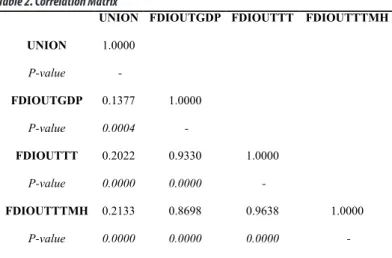
Before proceeding to evaluate the empirical results, it will be better to check the correlation between unio-nization rate and three FDI outflow variables. Table
2 provides correlation coefficients and P-values for each particular variable pairs. As in the table, corre-lation coefficient values between unionization rate and three FDI outflow proxies (i.e., FDIOUTGDP, FDIOUTTT, and FDIOUTTTMH) are positive and range from 0.137 to 0.213. Also all of them are highly statistically significant.
Table 2. Correlation Matrix
Table 2: Correlation Matrix
UNION FDIOUTGDP FDIOUTTT FDIOUTTTMH UNION 1.0000 P-value - FDIOUTGDP 0.1377 1.0000 P-value 0.0004 - FDIOUTTT 0.2022 0.9330 1.0000 P-value 0.0000 0.0000 - FDIOUTTTMH 0.2133 0.8698 0.9638 1.0000 P-value 0.0000 0.0000 0.0000 -
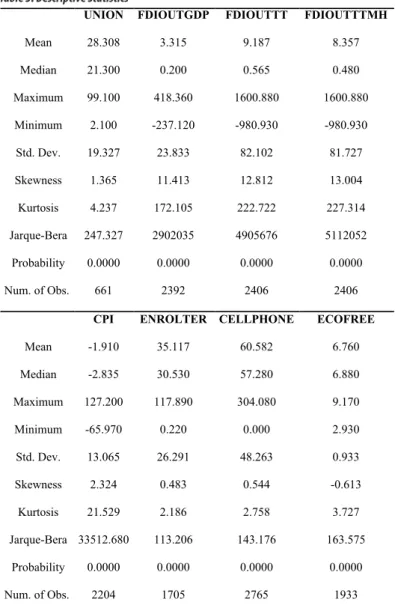
Table 3 below provides descriptive statistics of all va-riables used in the models.
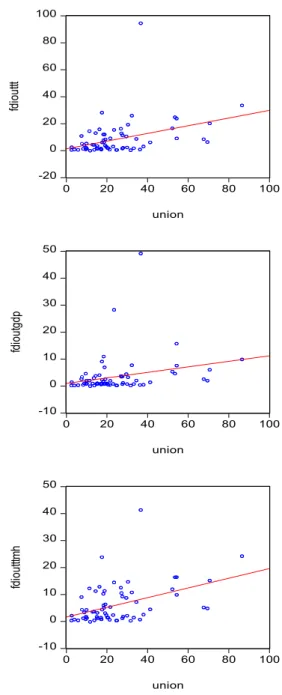
By using period average values for the years of 2004-2013, we provided scatter plot of three indicators of
FDI outflow and unionization variable in Figure 1 below. As the figure hints that there is positive asso-ciation between unionization rate and proxies of FDI outflow.
Table 3. Descriptive Statistics
UNION FDIOUTGDP FDIOUTTT FDIOUTTTMH
Mean 28.308 3.315 9.187 8.357 Median 21.300 0.200 0.565 0.480 Maximum 99.100 418.360 1600.880 1600.880 Minimum 2.100 -237.120 -980.930 -980.930 Std. Dev. 19.327 23.833 82.102 81.727 Skewness 1.365 11.413 12.812 13.004 Kurtosis 4.237 172.105 222.722 227.314 Jarque-Bera 247.327 2902035 4905676 5112052 Probability 0.0000 0.0000 0.0000 0.0000 Num. of Obs. 661 2392 2406 2406
CPI ENROLTER CELLPHONE ECOFREE
Mean -1.910 35.117 60.582 6.760 Median -2.835 30.530 57.280 6.880 Maximum 127.200 117.890 304.080 9.170 Minimum -65.970 0.220 0.000 2.930 Std. Dev. 13.065 26.291 48.263 0.933 Skewness 2.324 0.483 0.544 -0.613 Kurtosis 21.529 2.186 2.758 3.727 Jarque-Bera 33512.680 113.206 143.176 163.575 Probability 0.0000 0.0000 0.0000 0.0000 Num. of Obs. 2204 1705 2765 1933
Estimation Results
The results of univariate and multivariate estimations are reported in Table 4 and 5 respectively for three different FDI outflow indicators.
Univariate REM estimation results in Table 4 below show that coefficient of UNION variable takes the prior expected positive sign and are statistically sig-nificant in all models.
Figure 1. Scatter Plot of FDI Outflow and Unionization Variables
-20 0 20 40 60 80 100 0 20 40 60 80 100 union fdi ou ttt -10 0 10 20 30 40 50 0 20 40 60 80 100 union fdi ou tgd p -10 0 10 20 30 40 50 0 20 40 60 80 100 union fdi ou tttm h
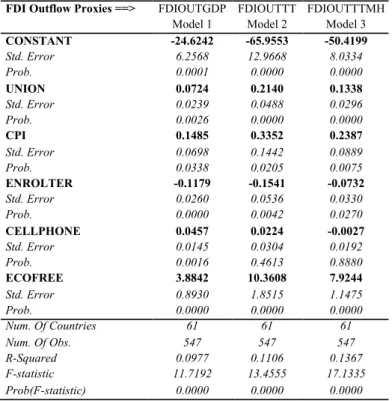
After adding the other control variables into the mo-dels, multivariate REM estimation results in Table 5 above indicate the following;
1. Estimation results using FDIOUTGDP as depen-dent variable in Model 1 indicates that:
The coefficient of UNION variable is highly statisti-cally significant and takes the expected positive sign, indicating that higher unionization rate leads to an increase in the outward flow of FDI in an economy. 2. Estimation results using FDIOUTTT as
depen-dent variable in Model 2 indicates that:
Table 4. Univariate REM Model Estimation Results
Table 5. Multivariate REM Model Estimation Results
FDI Outflow Proxies ==> FDIOUTGDP FDIOUTTT FDIOUTTTMH
Model 1 Model 2 Model 3
CONSTANT -24.6242 -65.9553 -50.4199 Std. Error 6.2568 12.9668 8.0334 Prob. 0.0001 0.0000 0.0000 UNION 0.0724 0.2140 0.1338 Std. Error 0.0239 0.0488 0.0296 Prob. 0.0026 0.0000 0.0000 CPI 0.1485 0.3352 0.2387 Std. Error 0.0698 0.1442 0.0889 Prob. 0.0338 0.0205 0.0075 ENROLTER -0.1179 -0.1541 -0.0732 Std. Error 0.0260 0.0536 0.0330 Prob. 0.0000 0.0042 0.0270 CELLPHONE 0.0457 0.0224 -0.0027 Std. Error 0.0145 0.0304 0.0192 Prob. 0.0016 0.4613 0.8880 ECOFREE 3.8842 10.3608 7.9244 Std. Error 0.8930 1.8515 1.1475 Prob. 0.0000 0.0000 0.0000 Num. Of Countries 61 61 61 Num. Of Obs. 547 547 547 R-Squared 0.0977 0.1106 0.1367 F-statistic 11.7192 13.4555 17.1335 Prob(F-statistic) 0.0000 0.0000 0.0000
FDI Outflow Proxies ==> FDIOUTGDP FDIOUTTT FDIOUTTTMH
Model 1 Model 2 Model 3
CONSTANT 1.6605 2.5257 2.3023 Std. Error 1.3424 2.5329 1.4259 Prob. 0.2165 0.3191 0.1069 UNION 0.0713 0.2426 0.1650 Std. Error 0.0400 0.0754 0.0423 Prob. 0.0754 0.0013 0.0001 Num. Of Countries 66 66 66 Num. Of Obs. 657 657 657 R-Squared 0.0048 0.0158 0.0230 F-statistic 3.1877 10.5311 15.4212 Prob(F-statistic) 0.0747 0.0012 0.0001
The coefficient of UNION variable is highly statisti-cally significant and takes the expected positive sign, implying that countries having higher unionization rate experience higher FDI outflows.
3. Estimation results using FDIOUTTTMH as depen-dent variable in Model 3 indicates that:
The coefficient of UNION variable is highly statisti-cally significant and takes the expected positive sign, implying that FDI tends to escape from the countries in which labor unionization rate is high.
In regard to other control variables in the model, the estimated coefficient of CPI variable takes the theore-tically expected positive sign and is statistheore-tically signifi-cant at least at 5% significance level in all models. Thus, as the uncertainty and instability in terms of political and economic sense increase in an economy, FDI outf-lows in that particular economy increases as well. The coefficient of the ENROLTER variable is statis-tically significant at least at 5% significance level and takes the anticipated negative sign in all models. This result implies that countries with higher human ca-pital endowment experience lower outward flow of FDI.
The coefficient of the CELLPHONE variable is statis-tically significant and takes the opposite sign in just one out of three models. The reason for taking unex-pected sign might be presence of multicollinearity problem among explanatory variables.
The coefficient of the ECOFREE variable is statisti-cally significant and takes the opposite sign in all one model. The reason for taking unexpected sign might be presence of multicollinearity problem among exp-lanatory variables.
Conclusion
This study test the hypothesis that higher unioniza-tion rate in an economy leads to an increase in FDI outflow. In order to test this hypothesis, both uni-variate and multiuni-variate random effect models are constructed and estimated. Three distinct indicators of FDI outflow (i.e., FDIOUTGDP, FDIOUTTT, and FDIOUTTTMH) are used in the models. The dataset utilized in analyses is unbalanced and the period un-der study is between 2000 and 2013.
The main finding of the study is that countries with higher unionization experience higher level of fore-ign direct investment outflows. This result remains valid once we added other potential determinants peculiar to FDI outflow into our models. Also, our results are robust in the sense that our primary fin-ding do not alter no matter which proxy is used for FDI outflow in our models.
References
Bellak, C. M. Leibrecht & Rield, A. (2008). Labour Costs and FDI Flows into Central and Eastern Eu-ropean Countries: A Survey of the Literature and Empirical Evidence. Structural Change and Econo-mic DynaEcono-mics, 19(1), 17-37.
Brandl, B., S. Strohmer and Traxler, F. (2010). US fore-ign direct investment, macro markets and labour relations: the case of enlarged Europe. Industrial Relations Journal, 41(6), 622-638.
Cooke, W. N. (1997). The Influence of Industrial Re-lations Factors on U.S. Foreign Direct Investment Abroad. Industrial and Labor Relations Review, 51(1), 3-17.
Cooke, W. N. (2003). The Influence of Industrial Re-lations System Factors on Foreign Direct Invest-ment. In: Cooke W (ed.) Multinational Companies and Global Human Resource Strategies. Westport: Quorum Books, 65-86.
Cooke, W. N. & Noble, D. S. (1998). Industrial Rela-tions Systems and US Foreign Direct Investment Abroad. British Journal of Industrial Relations, 36, 581-609.
Gross, D. M. & Ryan, M. J. (2008). FDI location and size: Does employment protection legislation mat-ter? Regional Science and Urban Economics, 38(6), 590–605.
Ishida, J. & Matsushima, N. (2005). Outward Foreign Direct Investment in Unionized Oligopoly: Some Welfare Implications. Discussion Paper, 2005-39, Graduate School of Business Administration, Kobe University.
Kinkel, S. and Zanker, C. (2007),.Globale Produktionss-trategien in der Automobilzulieferindustrie. Berlin: Springer.
Krzywdzinski, M. (2014). Do Investors Avoid Strong Trade Unions and Labour Regulation? Social Dumping in the European Automotive and Che-mical Industries. Work, Employment & Society: A Journal of the British Sociological Association, 28(6), 926–945.
Leahy, D. & Montagna, C. (2005). Union Legislation and Export Platform FDI. The Journal of Inter-national Trade & Economic Development, 14(4), 437–452.
Lommerud, K. E., Meland, F. and Straume, O.R. (2005). Can Deunionization Lead to International Outsour-cing? Cesifo Working Paper No. 1545, 1-28. Mukherjee, A. & Suetrong, K. (2007). Unionisation
Structure and Strategic Foreign Direct Investment. Research Paper Series, Globalisation and Labour Markets, Research Paper No: 2007/22, 1-27.
Naylor, R. & Santoni, M. (2003). Foreign Direct Invest-ment and Wage Bargaining. J. Int. Trade & Econo-mic Development, 12(1), 1–18.
Radulescu, R. & Robson, M. (2008). Trade Unions, Wage Bargaining Coordination and Foreign Direct Investment. Labour, 22(4), 661-678.
Skaksen, M. Y. & Sørensen, J. R. (2001). Should Trade Union Appreciate Foreign Direct Investment. Jour-nal of InternatioJour-nal Economics, 55, 379 – 90. UNCTAD, (2009). Global FDI Flows Halved in 1st
Quarter of 2009, UNCTAD Data Show; Prospects Remain Low For Rest of Year. Geneva: UNCTAD, (Press Release), Retriewed July 12, 2016, from http://unctad.org/en/Pages/PressReleaseArchive. aspx?ReferenceDocId=11666
UNCTAD, (2016). Foreign Direct Investment (FDI) Net Inflows and Net Outflows as Share of GDP, UNCTAD, Retriewed March 22, 2016, from http:// www.un.org/esa/sustdev/natlinfo/indicators/met-hodology_sheets/global_econ_partnership/fdi.pdf