ANT COLONY OPTIMIZATION FOR
THE SINGLE MODEL U-TYPE
ASSEMBLY LINE BALANCING PROBLEM
A THESIS
SUBMITTED TO THE DEPARTMENT OF INDUSTRIAL ENGINEERING AND THE INSTITUTE OF ENGINEERING AND SCIENCE
OF BILKENT UNIVERSITY
IN PARTIAL FULFILLMENT OF THE REQUIREMENTS FOR THE DEGREE OF
MASTER OF SCIENCE
By
Arda Alp
January, 2004
Prof. Dr. İhsan Sabuncuoğlu (Supervisor)
I certify that I have read this thesis and that in my opinion it is fully adequate, in scope and in quality, as a thesis for the degree of Master of Science.
Prof. Dr. Erdal Erel
I certify that I have read this thesis and that in my opinion it is fully adequate, in scope and in quality, as a thesis for the degree of Master of Science.
Asst. Prof. Dr. Mehmet Taner
Approved for the Institute of Engineering and Sciences:
Prof. Dr. Mehmet Baray
Director of the Institute of Engineering and Science
ABSTRACT
ANT COLONY OPTIMIZATION FOR
THE SINGLE MODEL U-TYPE
ASSEMBLY LINE BALANCING PROBLEM
Arda Alp
M.S. in Industrial Engineering
Supervisor: Prof. Dr. İhsan Sabuncuoğlu
January, 2004
The assembly line is a production line in which units move continuously through a sequence of stations. The assembly line balancing problem is the allocation of tasks to an ordered sequence of stations subject to the precedence constraints with the objective of minimizing the number of stations. In a U-line the line is configured into a U-shape topology.
In this research, a new heuristic, Ant Colony Optimization (ACO) meta-heuristic, and its variants are proposed for the single model U-type assembly line balancing problem (UALBP). We develop a number of algorithms that can be grouped as: (i) direct methods, (ii) modified methods and (iii) methods in which ACO approach is augmented with some metaheuristic.
We also construct an extensive experimental study and compare the performance of the proposed algorithms against the procedures reported in the literature.
Keywords: U-type assembly line balancing problem, Ant Colony Optimization
meta-heuristic.
iii
ÖZET
TEK MODELLİ U-TİPİ
MONTAJ HATTI DENGELENMESİ PROBLEMİ İÇİN
KARINCA KOLONİSİ OPTİMİZASYONU
Arda Alp
Endüstri Mühendisliği, Yüksek Lisans
Tez Yöneticisi: Prof. Dr. İhsan Sabuncuoğlu
Ocak, 2004
Montaj hattı ürünlerin sıralı olarak istasyonlardan geçtiği bir üretim hattıdır. Tek modelli montaj hattı dengelenmesi problemi istasyon sayısının en küçüklenmesi amacına yönelik olarak işlerin öncüllük kısıtı dikkate alınarak sıralı istasyonlara atanmasıdır. U-tipi hatta ise üretim hattı U şeklinde düzenlenmiştir.
Bu çalışmada yeni bir sezgisel olan Karınca Kolonisi Optimizasyonu (KKO) ve çeşitleri U-tipi montaj hattı dengelenmesi problemi için önerilmiştir. Geliştirilen algoritmalar üç grup altında incelenebilir: (i) direkt metodlar, (ii) modifiye edilmiş metodlar ve (iii) KKO yaklaşımının diğer bazı sezgisellerle beraber kullanıldığı metodlar.
Ayrıca kapsamlı bir deneysel çalışma yapılmış ve önerilen algoritmaların performansı literatürdeki diğer metodlarla karşılaştırılmıştır.
Anahtar sözcükler: U-tipi montaj hattı dengelenmesi problemi, Karınca Kolonisi
Optimizasyonu meta-sezgiseli.
To my family,
Acknowledgement
I would like to express my deepest gratitude to my supervisor Prof. Dr. İhsan Sabuncuoğlu for his instructive comments in the supervision of the thesis and also for all the encouragement and trust during my graduate study.
I am also indebted to Prof. Dr. Erdal Erel for his invaluable guidance, recommendations and everlasting interest for this research and for my future work. I would like to express my special thanks and gratitude to Asst. Prof. Dr. Mehmet Taner for showing keen interest to the subject matter, for his remarks, recommendations and accepting to read and review the thesis.
I am grateful to Asst. Prof. Bahar Yetiş Kara for her understanding and her recommedations and also to Asst. Prof. Oya Karaşan for her suggestions and her guidance.
I would like to express my deepest thanks to Banu Yüksel for all her encouragement and academic support. I would like to extend my sincere thanks to Savaş Çevik, Nur Beğen, Emrah Zarifoğlu and Pınar Tan. Their endless morale support and friendship during all my desperate times, makes me to face with all the troubles.
Finally, I would like to express my gratitude to my family for their love, understanding, suggestions and their endless support. I owe so much to my family.
Contents
Abstract...iii Özet...iv Acknowledgement...vi Contents ...vii List of Figures...xiList of Tables ...xiv
1 Introduction...1
2 Literature Survey...10
2.1 Ant Colony Optimization Meta-Heuristic ...10
2.2 U-Type Line Balancing ...21
3 Ant Algorithms and Applications...28
3.1 Introduction...29
3.2 Biological Fundamentals...30
3.3 The Ant Colony Optimization Approach...35
3.3.1 Similarities and Difference with Real Ants ...36
3.4 The ACO Meta-heuristic ...38
3.5 Some Applications of ACO Algorithms ...42
4.1 Overview of the Proposed Approaches...43
4.1.1 Motivation...43
4.1.2 Fundamentals...44
4.1.2.1 The Graph Representation of the Problem ...45
4.1.2.2 The Autocatalytic Process...46
4.1.2.3 The Greedy Force...46
4.1.2.4 The Constraint Satisfaction ...48
4.1.3 Generation of a Solution...49
4.2 Proposed Methods ...56
4.2.1 Ant System (AS)...56
4.2.2 Ant System with Elitist Strategy (ASelite) ...61
4.2.3 Ant System with Ranking (ASrank)...62
4.2.4 Ant Colony System (ACS)...63
4.2.5 Modified Ant Colony System (ACS) with Random Search ...68
4.2.6 A New Ant Colony Optimization (ACO) Method ...76
Version 1 ...77
Version 2 ...83
4.2.7 Ant Colony System Augmented with Simulated Annealing (ACS with SA)...86
4.2.8 Ant Colony System Augmented with Beam Search (ACS with BS)...86
5.1 Experimental Setting for AS ...94
5.1.1 Number of Ants ...94
5.1.2 Parameters Setting ...96
5.2 Experimental Setting for ASelite...98
5.2.1 Number of Ants ...98
5.2.2 Parameters Setting ...100
5.3 Experimental Setting for ACS...102
5.3.1 Number of Ants ...102
5.3.2 Parameters Setting ...104
5.4 Experimental Setting for Modified ACS with Random Search ...106
5.5 Experimental Setting for New ACO Approach, Version 1...106
5.5.1 Number of Ants ...106
5.5.2 Parameters Setting ...108
5.6 Experimental Setting for New ACO Approach, Version 2...113
5.6.1 Number of Ants ...113
5.6.2 Parameters Setting ...115
6 Computational Results...116
6.1 Computational Results for AS...118
6.2 Computational Results for ASelite...123
6.3 Computational Results for ACS...128
6.4 Computational Results for Modified ACS with Random Search ...133
6.6 Computational Results for New ACO Approach, Version 2 ...141 7 Conclusion ...147 Bibliography ...151 Appendix ...159 A1 Appendix A...159 A2 Appendix B ...163 A3 Appendix C ...165 A4 Appendix D...168 x
List of Figures
1.1 U-shaped line with multi-function workers. ...3
1.2 Example of a precedence graph...5
1.3 Solution of example problem for c=10.. ...6
3.1 Single Bridge Experiment.. ...31
3.2 Double Bridge Experiment...33
3.3 A general description of ACO meta-heuristic. ...41
4.1 Jackson problem with 11 tasks...47
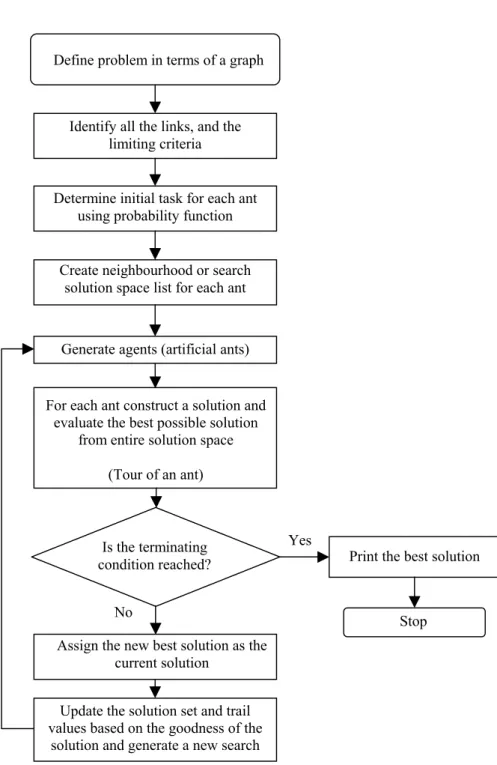
4.2 A flowchart of the proposed algorithm.. ...50
4.3 The task allocation for Jackson problem, c = 10. ...55
4.4 Flowchart of Ant System...60
4.5.a Optimal task allocation for the Jackson problem, c =10. Location of tasks is not given...65
4.5.b Optimal task allocation for the Jackson problem, c =10. Location of tasks is given.. ...65
4.6 Flowchart of Ant Colony System...67
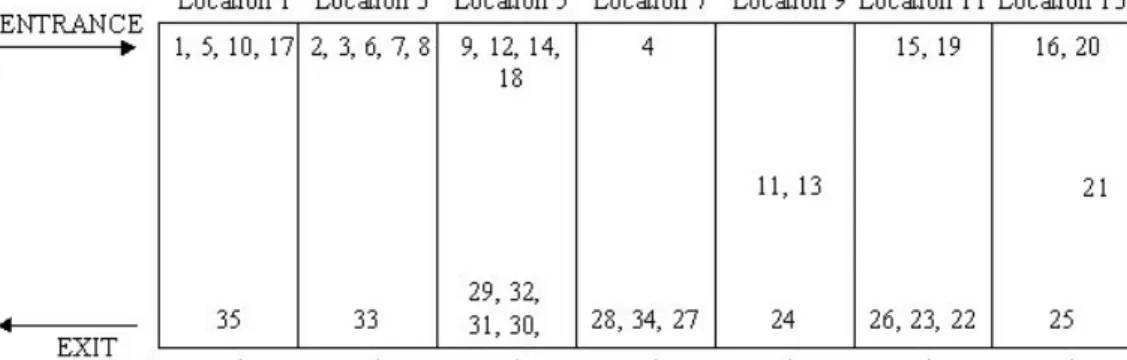
4.7 Scholl and Klein’s (1999) optimal task allocation for Gunther problem.70 4.8 Two similar optimal allocation for Jackson problem, c =10...73
4.9.a Trail accumulation for ACS, α =1, β =1, ρ1 =ρ2 = 0.4, q0 =0.2, initial trail =1 ...80
α =1, β =1, ρ1 = ρ2 =0.9, q0 =0.3, initial trail =1 ...80
4.9.c Trail accumulation for the new method,
α =1, β =1, ρ1 = ρ2 =0.95, q0 =0.3, initial trail =1. ...80
4.9.d Trail accumulation for the new method,
α =1, β =1, ρ1 = ρ2 =0.99, q0 =0.3, initial trail =1. ...80
4.9.e Trail accumulation for the new method,
α =1, β =1, ρ1 = ρ2 =0.99, q0 =0.8, initial trail =1. ...80
4.10 Scholl and Klein’s (1999) optimal task allocation for Buxey problem ..81 5.1.a. Number of replications required to obtain the optimum number
of stations. Jackson problem with 11 tasks, C=10...95 5.1.b. Number of replications required to obtain the optimum number
of stations. Gunther problem with 35 tasks, C=54.. ...95 5.1.c. Number of tours required to obtain the optimum number
of stations. Barthold problem with 148 tasks, C=805.. ...95 5.2.a. Number of replications required to obtain the optimum number
of stations. Jackson problem with 11 tasks, C=10...99 5.2.b. Number of replications required to obtain the optimum number
of stations. Gunther problem with 35 tasks, C=54.. ...99 5.2.c. Number of tours required to obtain the optimum number
of stations. Barthold problem with 148 tasks, C=805.. ...99 5.3.a. Number of replications required to obtain the optimum number
of stations. Jackson problem with 11 tasks, C=10...103 5.3.b. Number of replications required to obtain the optimum number
of stations. Gunther problem with 35 tasks, C=54.. ...103 5.3.c. Number of tours required to obtain the optimum number
of stations. Barthold problem with 148 tasks, C=805.. ...103 5.4.a. Number of replications required to obtain the optimum number
of stations. Jackson problem with 11 tasks, C=10...107
of stations. Gunther problem with 35 tasks, C=54.. ...107 5.4.c. Number of tours required to obtain the optimum number
of stations. Barthold problem with 148 tasks, C=805.. ...107 5.5.a. Number of replications required to obtain the optimum number
of stations. Jackson problem with 11 tasks, C=10...114 5.5.b. Number of replications required to obtain the optimum number
of stations. Gunther problem with 35 tasks, C=54.. ...114 5.5.c. Number of tours required to obtain the optimum number
of stations. Barthold problem with 148 tasks, C=805.. ...114
List of Tables
2.1 List of applications of ACO algorithms to static combinatorial
optimization problems. ...19
2.2 List of applications of ACO algorithms to dynamic combinatorial optimization problems. ...20
2.3 Summary of work done on the U-type assembly line problems.. ...27
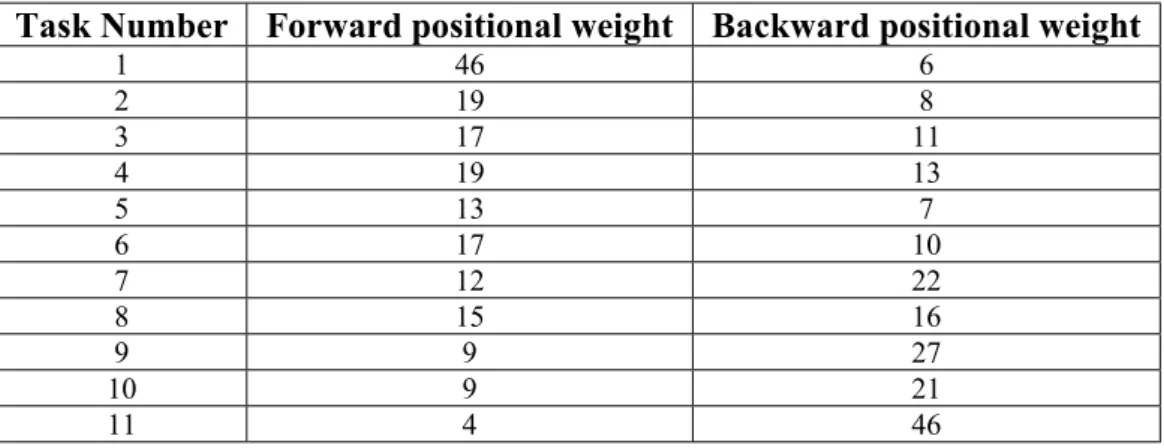
4.1 Forward and backward positional weights for Jackson problem. ...48
4.2 Ranking of most possible location alternatives for each task depending on T2 matrix...71
4.3 Ranking of most possible location alternatives for each task depending on trail matrix...82
4.4 Ranking of most possible location alternatives for each task depending on trail matrix
.
...855.1 Fine tune-up of the parameters α, β, and ρ for AS. ...97
5.2 Fine tune-up of the parameters α, β, and ρ for ASelite...101
5.3 Fine tune-up of the parameters β, q0,ρ1 and ρ2 for ACS...105
5.4 Fine tune-up of parameters α, q0,ρ1 and ρ2 for New ACO Approach, Version 1...110
5.5 Fine tune-up of the parameters β, q0,ρ1 and ρ2 for New ACO Approach, Version 1...111
5.6 Fine tune-up of parameters α, β, q0,ρ1 and ρ2 for New ACO Approach, Version 1...112
6.1 Computational Results of Ant System. ...119
6.2 Computational Results of ASelite. ...124
6.4 Computational Results of the New ACO Approach, Version 1...136
6.5 Computational Results of the New ACO Approach, Version 2...143
A.1.1 Trail matrix gathered for tour number 10. ...159
A.1.2 Trail matrix gathered for tour number 100. ...160
A.1.3 Trail matrix gathered for tour number 500. ...161
A.1.4 Trail matrix gathered for tour number 1000. ...162
A.2.1 T2 matrix gathered for tour number 5000...163
A.2.2 T2 matrix gathered for tour number 10000...164
A.3.1 Trail matrix gathered for tour number 100. ...165
A.3.2 Trail matrix gathered for tour number 250. ...166
A.3.3 Trail matrix gathered for tour number 1000. ...167
A.4.1 Trail matrix gathered for tour number 100. ...168
A.4.2 Trail matrix gathered for tour number 250. ...169
A.4.3 Trail matrix gathered for tour number 1000. ...170
1
Chapter 1
Introduction
The assembly line is a production line in which the units move continuously through a sequence of stations where the assembly operation is performed. Typical examples of these assembly lines are car assembly, electronic appliances and computer assemblies. The first example of an assembly line is credited to Henry Ford who developed such a line and produced Ford automobiles in 1913. However after 1913, for over 40 years only trial-and-error methods were used for balancing lines. The first analytical statement of the assembly line balancing problem was made by Salveson and it was published in 1955 (Salveson, 1955). Many researchers became interested in assembly line balancing after the 1950s.
In todays business environment, demand for products fluctuates significantly, and is very difficult to forecast. It is especially difficult for the mass production line to quickly respond to the fluctuating demand. The design of such a line requires grouping of tasks into stations such that line efficiency is maximized. This problem is known as the simple assembly line balancing problem. Traditionally, these lines are arranged in a straight line. However, as a consequence of the just-in-time production principles, recently many lines are
being arranged in a U-line. Arranging the stations in a U-line has several advantages over the traditional configuration (Scholl and Klein, 1999). Demand fluctuations can be tackled easily by the U-line relative to the straight-line version due to increased search space. Thus, there are more possibilities for grouping tasks into stations on a U-line.
As stated by Scholl and Klein (1999), the traditional type of ‘straight’ assembly lines have some problems. These are: monotone and boring type of work, low-level skilled, unmotivated operators, inflexibility of the production system concerning failures, the sensitivity to changing demand rates, and large inventories due to rigid output rates. In order to overcome these problems, many firms nowadays incorporate JIT principle and group technology into assembly line production, and these modern assembly lines are often organized as a ‘U-line’.
The U-line balancing problem considered in this thesis is the U-shaped line with constant operation times, no waiting times, and no walking times. The objective is to find a proper allocation of tasks to the stations that require minimum number of stations. Every station processes only one item in a given cycle time. Cycle time is defined as the time interval between two successive outputs. The sum of all necessary operation and processing times are intended to be equal among the stations. This is a synchronous process of items flowing through the stations and no items exist between adjacent stations. This concept is called as a single-unit production and conveyance (“ikko-nagashi,” in Japanese).
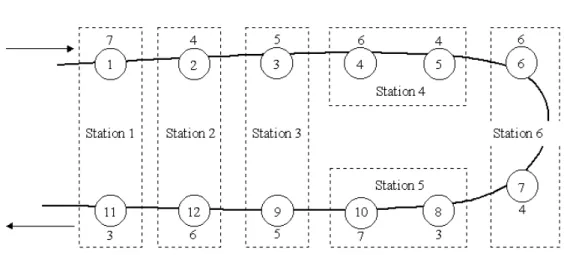
In (JIT) production system, this concept is applied to a production line with conveyors. U-lines are balanced again when production requirements change. This is much easier with U-lines than with traditional straight lines. This requires operators to be multi-skilled to operate several different machines or processes. To accomplish this goal with a low production cost, a U-shaped layout with multi-function workers is used. As seen in Figure 1.1, this multi-multi-function worker is
responsible from multiple tasks. In a U-shaped layout, stations are organized in such a way that the same worker can handle tasks, which are located both at the entrance side and at the exit side. First worker handles tasks both at the entrance and the exit. A new item can enter the system only after one product is completed. Thus work-in-process in the system stays constant in these systems.
When compared with traditional layout, fewer workers are allocated to machines in the U-shaped layout. Thus this type of allocation is more effective when demand fluctuates since it is easier to reallocate workers in order to balance the cycle time of workers. This is the reason why U-shaped layout allows for adapting to the changes in the circumstances more easily than the traditional layout. Miltenburg and Wijngaard (1994) note advantages of U-lines over straight lines as follows:
• Visibility and communication are improved because operators work close to each other.
• Multiskilling allows more operators to understand the relationships between operations and participate in efforts to improve the process.
Figure 1.1: U-shaped line with multi-function workers.
• The output rate of a U-line can be adjusted by adding or removing workers. While, rebalancing on a traditional line is more difficult because of its low-skilled operators.
• The number of stations required on a U-line is less than or equal to that required on a traditional line. For a U-line there are more alternatives for grouping tasks.
The line balancing problem in a U-shaped line is more complex than balancing a traditional straight line because there are more possibilities to group the tasks while moving forward, backward or simultaneously in both directions. Based on this fact, the number of stations required on a U-line is never more than that required on a traditional line.
Scholl and Klein (1999) define the U-type assembly line balancing problem (UALBP) as an extension of the single assembly line balancing problem (SALBP) with respect to the precedence constraints. The authors describe three problem versions:
• UALBP-1: Minimize the number m of stations, given the cycle time c. • UALBP-2: Minimize the cycle time c, given the number m of stations. • UALBP-E: Maximize the line efficiency E for c and m being variable. Most of the characteristics of SALBP defined by Baybars (1986) are also valid for UALBP. These are:
• A single product is manufactured in large quantities. The task j = 1,…, n takes
deterministic operation times tj , and tsum denotes the sum of all operation
times.
• The tasks are partially ordered by precedence relations. These relations defined as precedence network with the tasks denoted by nodes and the precedence relations denoted by directed arcs. Therefore, for an arc (i, j), task i must be finished before task j can be started. In Figure 1.2, an example of a
precedence network is given. The task numbers are written on the nodes and the duration of operations are written as weight of nodes.
• Each task can only be assigned to only one station. Sk denotes the set of tasks
assigned to station k = 1,…, m .
• T(Sk) denotes the station time, the total operation time of tasks assigned to
station k, and must not exceed the cycle time:
( )
S t c k m T k S j j k =∑
≤ =1,..., ∈ (1.1) In SALBP, all direct or indirect predecessors of task j, performed at stationk, have to be assigned to one of the stations 1,…, k. A task and its indirect
predecessors or successors can share the same station only if all intermediate tasks defined with this precedence relationship are also in the same station. For example, in Figure 1.2, task 3 and task 8 can only be at the same station if tasks 5 and 6 are also assigned to the same station.
In UALBP, each task and any of its predecessors and/or successors can share the same station but it must be satisfied that, all predecessors and/or successors of a task j, performed at station k, have to be assigned to one of the stations 1,…, k. (Miltenburg and Wijngaard, 1994).
Scholl and Klein (1999) state that the optimal line efficiency of a SALBP instance is a lower bound on the optimal line efficiency, E, of the corresponding UALBP instance due to above given relaxed precedence constraints. Thus a higher efficiency is possible with UALBP (Line efficiency directly related with smoothness of station utilization). The line efficiency is defined with the following formulation: 100 × × = c m t E sum % (1.2)
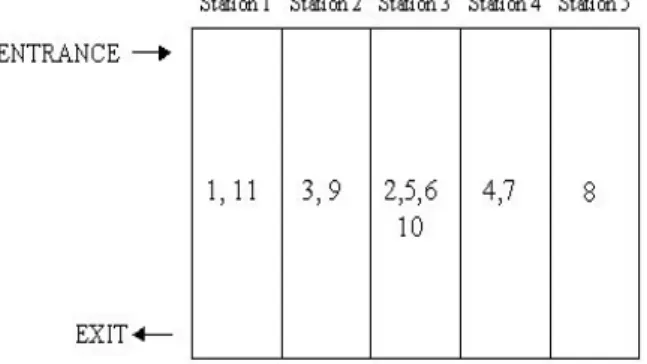
In Figure 1.3 the optimal solution of UALBP-1 for c = 10, with 6 stations
is given. In station 3, S3 = {3, 9}, the tasks 3 and 9 are processed. A unit product
crosses the station 3 from left to right (the task 3 is performed at that time) after its predecessors have been processed in station 1 and 2, respectively and returns to station 3 from right to left (the task 9 is performed at that time) after all the predecessors of task 9 have been processed in stations 1-6. Then the successors of task 9 are performed in stations 2 and 1, respectively.
When Scholl and Klein’s (1999) optimal solution of for SALBP-1 (S1 = {1}, S2 = {2, 4}, S3 = {3, 5}, S4 = {6, 7}, S5 = {8, 10}, S6 = {9, 11}, S7 = {12};
is compared with the optimal solution of UALBP-1, it is seen that the line
efficiency of the U-line is 100% (tsum = 60, 100
10 660 ×× =
E ) and the line
efficiency of the straight line is 85.7% (tsum = 60, 100
10 760 ×× =
E ).
In order to find a simple lower bound on minimal number of stations for
UALBP-1 and SALBP-1 Scholl and Klein (1999) define LB=
tsum/c
where
x is the smallest integer larger than x. For the given example the LB is 6.We consider the U-line balancing problem such that it is the U-shaped line with constant operation times, no waiting times, and no walking times. Our objective is to minimize the number of stations, given the cycle time c. This can be achieved by finding a proper allocation of tasks to the stations that require minimum number of stations.
In this thesis, a new heuristic, an Ant Colony Optimization (ACO) meta-heuristic, and its variants are proposed for the single model U-type assembly line balancing problem (UALBP). In fact, there are two ant algorithms proposed for the single assembly line balancing problem (Bautista and Pereira, 2002; McMullen and Tarasewich, 2003). However, this study is the first application of ACO meta-heuristic to U-shaped production lines. The work by McMullen and Tarasewich (2003) considers only six problems (ranging in size from 21 to 74 tasks) and their objective function is different from our objective function. Bautista and Pereira (2002) consider the same objective function of minimizing the number of stations given a fixed cycle time, but this model is proposed for only the single assembly line balancing problem (SALBP).
Even though several heuristics have been developed for SALBP (Erel and Sarin, 1998) for single model UALBP, there are only three heuristics in the literature. These are: Ranked Positional Weight Technique (RPWT)-based
heuristic (Miltenburg and Wijngaard, 1994), branch and bound based heuristic (Scholl and Klein, 1999) and simulated annealing based heuristic (Erel, Sabuncuoglu and Aksu, 2001).
Since the first ant algorithm developed by Dorigo and colleagues (1991), several variants of the Ant System (AS) have also been proposed in the literature. In general, ACO is an umbrella term for a number of similar metaheuristics: Ant
System (AS), Ant System with Elite Strategy (ASelite), Ant System with Ranking
(ASrank), Ant Colony System (ACS), MAX-MIN Ant System (MMAS) are some of
these meta-heuristics.
In this research, we develop a number of algorithms that can be grouped as: (i) direct methods, (ii) modified methods and (iii) methods in which ACO approach is augmented with some metaheuristic. The first group includes
algorithms such as AS, ASelite, ASrank, and ACS that is directly applied to UALBP.
No modification is done in the structure of the algorithms. The second group includes new methods in which the structure of the algorithms in the first group is modified. The last group includes two specialized methods that ACO is augmented with simulated annealing (SA) and beam search (BS).
AS is the first algorithm used to solve UALBP. Later, we apply ASelite, and
ACS that perform better than AS. However, none of the algorithms give sufficient
performance for UALBP. Structure of these algorithms, especially ASelite, ASrank,
are not suitable for UALBP.
Actually this is related with the topology of the cost function. Hertz and Widmer (2003) state that the topology of the cost function should not be too flat for the heuristics for searching the optimal solution. The cost function can be considered as an altitude with mountains, valleys and plateaus. If the cost function is too flat, it is difficult for the search algorithms to escape from the large plateaus to fall into the valleys. To tackle this problem Hertz and Widmer (2003) suggest
adding a component to the cost function to discriminate the solutions with the same original cost function value.
The algorithms in the second group are modified from the first group of algorithms to tackle this problem. Their task selection and pheromone trail update
mechanisms are totally modified and improved. In general, the performance of the
second group is better than the first group.
The third group includes algorithms in which ACO approach is augmented with a metaheuristic. One of them is a modified version of ACS augmented with SA and the other one is a modified version of ACS augmented with beam search (BS). ACS with SA performs poor in terms of computational time. Even for the small problems (Jackson with 11 elements) the computation time ranges between 2.53 hours and 164.63 hours. Even though the structure of beam search is very suitable for ACS, its performance is poor in terms of computational time. It requires excessive amount of time to complete a single tour.
The rest of the thesis is as follows. The relevant literature on the U-type line-balancing problem and the ACO meta-heuristic are given in Chapter 2. Detailed information about the ACO meta-heuristic is given in Chapter 3. This is followed by the structure of the proposed approaches in Chapter 4. Experimental setting is explained in Chapter 5. Computational results are presented in Chapter 6. Conclusions and future research directions are given in Chapter 7.
10
Chapter 2
Literature Survey
2.1 Ant Colony Optimization Meta-Heuristic
Today, heuristics are widely used to solve real life problems. Especially, in the last three decades (Zanakis, Evans, Vazacopoulos, 1989), researchers have applied heuristics to produce near optimal solutions to their difficult optimization problems.Heuristics from nature take inspiration from biology, physics, and social systems. These heuristics utilize some analogies with natural or social systems and use these analogies to develop non-deterministic heuristic methods for NP-hard combinatorial optimization problems (Glover and Greenberg, 1989; Reeves, 1993). Most heuristic algorithms use a problem specific mechanism. Such a mechanism may employs a single agent or more agents (neurons, particles, chromosomes, ants, etc). This agent may operate for a certain number of repeated trials to construct a solution or to improve a given solution. In case of multiple agents, these agents operate with a mechanism of competition-cooperation. In fact, these agents work with a cooperation, however each agent aims to find the best solution and beat the other agents. Some of these algorithms are genetic algorithms (GA), evolution strategies (ES), simulated annealing (SA), tabu search
(TS), neural nets (NN), immune networks (IN), ant colony optimization algorithms (ACO) (Reeves, 1993; Colorni, Dorigo, Maffioli, Maniezzo, Righini and Trubian, 1996; Colorni, Dorigo and Maniezzo, 1992).
The first ant algorithm is proposed by Colorni, Dorigo and Maniezzo (1991 and 1992) and it is named as Ant System (AS). It is a multi-agent approach, a class of distributed algorithms for combinatorial optimization. Like other ant type heuristics the main characteristics of this heuristic is simulating or imitating the behaviour of a group of ants. These ants work cooperatively by using simple communication to solve an optimization problem. First use of AS was to solve the well known Travelling Salesman Problem (TSP). Dorigo, Maniezzo and Colorni (1991a, 1991b) describe their methodology as a combination of distributed computation, positive feedback and constructive greedy heuristic. The authors apply their methodology to the classical TSP that the proposed system quickly provides very good solutions. Colorni, Dorigo and Maniezzo (1991 and 1992) state that this new approach can be used to solve any Combinatorial Optimization Problem (COP). The authors also state that a proper representation must be found as given below: (i) the problem (a graph representation which is suitable for a
search by many simple agents); (ii) the autocatalytic process1; (iii) the heuristic
rule that acts as a greedy force and allows a constructive definition of the solution, (iv) the constraint satisfaction method or tabu list. The authors apply AS to the problems such as Satisfiability (SAT), Quadratic Assignment (QAP) and Job-Shop Scheduling (JSP) by using representation rules.
Later, Dorigo, Maniezzo and Colorni (1996) apply AS to the classical TSP. They discuss the parameter selection process and compare AS with TS and SA on TSP. They also illustrate how the AS can be applied to other optimization problems (asymmetric TSP, QAP, JSP). Finally they discuss important
1 Due to Dorigo, an autocatalytic process (ex: positive feedback) is a process that reinforces itself
and causes very rapid convergence. If no limitation is given, this leads to combinatorial explosion. Dorigo, M., Maniezzo, V., Colorni, A. (1996)
characteristics of proposed methodology in terms of global data structure, distributed communication and probabilistic transitions. The authors state its main characteristics as (i) positive feedback (that contributes AS to rapidly discover better solutions), (ii) distributed computation (that provides AS to avoid early convergence), (iii) the use of constructive greedy heuristic (that helps AS to find acceptable solutions in the early stages).
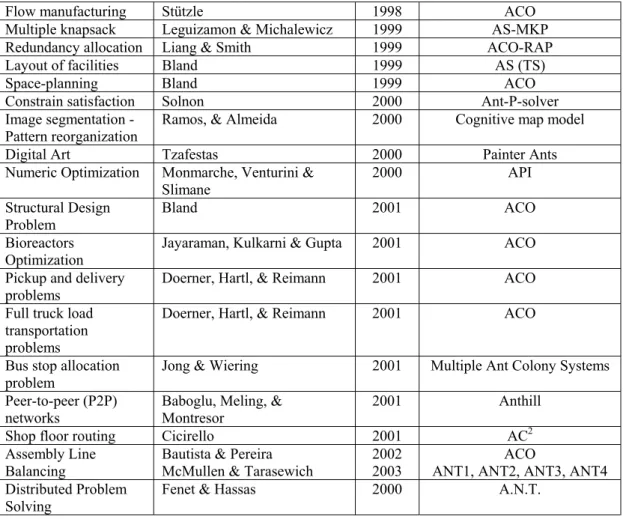
In a later study, Dorigo, Caro, and Gambardella (1999) provide an overview of the recent work on ant algorithms. They give detailed information about biological findings on real ant colonies and define the ants’ artificial counterpart the ACO meta-heuristic. The authors also list the applications to other combinatorial optimization problems (Table 2.1 and Table 2.2).
AS is applied to small instances of TSP with up to 75 cities. In spite of encouraging results, in general AS can not compete with state-of-the-art algorithms designed for large TSP instances. However, it has stimulated further research on its different variants that these new algorithms produce much better results on different optimization problems. A considerable amount of research has focused on ACO algorithms. In general, ACO algorithms yield better performance than AS. For that reason, the ACO is usually proposed as a common, unifying framework for the existing applications and algorithmic variants (Dorigo and Stützle, 2000). Next we focus on the variants of ACO meta-heuristic.
Several improvements and variants of the basic AS algorithm proposed in the literature. These improved versions have been mainly tested on the TSP. Indeed, these versions differ in how their search mechanism is controlled. Moreover, the best performing ACO algorithms for the TSP improve the solutions of ants using local search algorithms.
In their work; Gambardella and Dorigo (1995), Dorigo and Gambardella (1996) focus on some properties of Ant-Q (Ant-Q is an extension of AS and Q-learning algorithm, a distributed approach based on reinforcement Q-learning. It is the first and only application of a Q-learning technique to a COP), its sensitivity to parameters, and investigation of synergistic effects when more than a single ant is used. The number of agents used makes Q different from Q-learning. Ant-Q uses a set of cooperating agents to explore the state space whereas Ant-Q-learning works with a single agent. The authors compare Ant-Q with AS, GA, evolutionary programming (EP) and SA, and they state that the covered set of problems are efficiently solved by Ant-Q. Moreover, Ant-Q outperforms AS and on the average Ant-Q is always very close to the optimal solution. Also in the comparison of average behaviour of Ant-Q with the following heuristic methods: Elastic Net (EN), SA, Self Organizing Map (SOM) and Farthest Insertion (FI), Ant-Q is almost always the best performing algorithm.
In their paper, Gambardella and Dorigo (1996) represent Ant Colony System (ACS) as an extension of AS with Q-learning. ACS finds its ground in AS and Ant-Q. The authors state ACS as a revisited version of Ant-Q where a different way of updating ants’ experience is discussed. With this approach, it is aimed to improve the system performance in terms of speed and quality by using a different local updating policy. Results show that ACS finds good solutions to symmetric and asymmetric TSP.
In another study, Dorigo and Gambardella (1997a, 1997b) work on Ant Colony System (ACS) and try to understand its operation. Their work includes detailed information on ACS. Their results indicate that ACS outperforms other nature-inspired algorithms such as simulated annealing (SA) and evolutionary computation (EC). They also compare ACS-3-opt (a version of ACS augmented with a local search procedure based on the 3-opt neighborhood) with some of the
best performing algorithms for symmetric and asymmetric TSP. The authors show that ACS is an interesting approach to parallel stochastic optimization of TSP. Also it looks like a very good constructive heuristic to provide a starting solution for the local optimizers. They also compare the performance of ACS with the performance of other naturally inspired meta-heuristics: SA, GA, NN, EC, EP, EN, SOM, FI, and some of their combinations.
Botee and Bonabeau (1998) apply ACO to the TSP and use a GA in order to find the best set of parameters for ACO. They also analyze how the parameters scale with problem size and tour length. Botee and Bonabeau (1998) report that tuning the parameters of the ACO algorithms with an automated search results in better solutions and savings from the computation time.
In another study, Stützle (1998) develop an ACO method, MAX-MIN Ant System, for the Flow Shop Problem (FSP). In their previous research, Stutzle and Hoos (1997) and Dorigo and Gambardella (1997) determine that a local search procedure can improve the solution of each ant. Stützle (1998) use a fast local search procedure and show that this approach yields high quality solutions to the FSPs in a short time. This approach performs better or at least comparable to other state-of-art algorithms proposed for the FSP.
Bullnheimer, Kotsis, and Strauss (1998) find the structure of AS highly suitable for parallel implementation of the algorithm. They develop two parallelization strategies and analyze the factors that have influence on computational complexity. They also dwell upon the design parameters and compare the performance of their parallelization strategies.
Later, Stützle and Dorigo (1999) give an overview of the ACO algorithms available for the TSP. They outline how ACO algorithms can be applied to that problem, present the available applications for the TSP, and briefly discuss local search applications to the TSP. Stützle and Dorigo (1999) work with MAX-MIN
Ant System (MMAS is one of the improved versions of AS). MMAS can find high quality solutions for all instances and it yields better average solutions than the iterated local search algorithm (ILS is one of the best algorithms for the TSP).
Bullnheimer, Hartl and Strauss (1999) introduce a new rank based version
of the AS, called as ASrank. The authors compare this new version with AS, ASelite,
SA and GA on several TSP instances. Their results indicate that AS compete well with the two meta-heuristics and it outperforms the other methods for large problems in terms of average and especially the worst case behaviour.
Besten, Stutzle and Dorigo (2000a, 2000b) present an application of the ACO metaheuristic to the single machine total weighted tardiness problem. The authors introduce a simple but very effective local search and combine it with the constructive phase of ACO. Thus they obtain a new ACO algorithm that uses a heterogeneous colony of ants. The authors state that this new algorithm is highly effective in finding the optimal or the best-known solutions on all instances of benchmark problems in ORLIB within reasonable computation times.
In another study, Fenet and Hassas (2000) propose a new problem-solving framework, A.N.T. This method employs mobile reactive agents for distributed problem solving (on different machines) and remote control. This distributed mechanism leads to improvement in the complex collective behaviour based on local interactions of ants.
In their overview Maniezzo and Carbonaro, (2001) compare the ACO approach with other metaheuristics (SA, TS, GA and GRASP) for COP. They focus on ANTS metaheuristic, which is an extension of AS. The ANTS tested on the quadratic assignment and frequency assignment problem (QAP and FAP, respectively). The results indicate that ANTS is the best performer among the algorithms, both considering the best and the average quality of the solutions
proposed for QAP. Also, ANTS is competitive with the best approaches developed for FAP.
In another study, Gagné, Gravel and Price (2001) add a look-ahead mechanism to the ACO algorithm and test their method on an industrial scheduling problem. The look-ahead mechanism allows combining information on the expected decisions, which are beyond the immediate choice horizon. The results indicate that the look-ahead information improves the solution quality, but increases the computation time.
Montgomery and Randall (2002) work on alternative pheromone representations for ACO. They propose three different alternatives for structuring and using pheromone. Their results on TSP indicate that memory requirements decrease but these alternatives are not as effective as ACO. Montgomery and Randall (2002) state that if pheromone representation matches closely with the problem representation, then better results are obtained.
Blum and Samples (2002) deal with the FOP Shop scheduling problem (First Order Parallel Shop scheduling; a general scheduling problem including Job Shop scheduling, Open Shop scheduling and Mixed Shop scheduling). They compare different pheromone representations taken from the literature with a new pheromone representation for ACO to solve the FOP Shop scheduling problem. The new pheromone representation results in a clearly improved performance when compared to the known pheromone representations.
In a recent work, Middendorf, Reischle and Schmeck (2002) propose multi colony ant algorithms (MCAA). In MCAA, several colonies of ants cooperatively work to find the better solutions for a given problem by exchanging information about good solutions at certain time steps. The authors state that if the amount of exchanged information is not too large, then MCAA can easily parallelized by placing colonies on different processors. The authors study the behavior of
MCAA by using different kinds of information exchange between the colonies; and they also compare the behavior of multi colony ant algorithms to a single colony ant algorithm. TSP and QAP are the test problems. The authors observe that for the TSP the multi colony approach with a moderate number of colonies is better than a single colony. For QAP, multi colony ant approach is not better but at least not much worse than having only one large colony. The important part is the exchange of information related with good solutions between the colonies.
T’kindt, Monmarche, Tercinet and Laugt (2002) consider the 2-machine flowshop scheduling problem with the objective of minimizing the total completion time and the makespan criteria. The proposed method (SACO) is an ACO approach with additional feature of SA search and local search. Their results indicate that SACO heuristic is effective and yield better results when compared to existing heuristics. Especially for large problems (problems having more than 200 jobs) the SACO is the most efficient heuristic.
Bautisca and Pereira (2002) work on the simple assembly line balancing and generalized assembly line balancing problems and try to minimize the number of stations given a fixed cycle time. The problem is solved using the ACO metaheuristic with different features. In their research, the authors study several trail information management policies and trail information reading techniques. Also new ideas (solving the direct and reverse instance of a problem concurrently) and priority rules are used together. The authors state that after a long computation time the results obtained with proposed algorithms are better than the results obtained with the exact procedure and also these results are very close to the known problem bound.
McMullen and Tarasewich (2003) present a heuristic, based on ant techniques. This heuristic uses concepts derived from ACO techniques. They state that their approach effectively address the assembly line balancing problem with
complicating factors (parallel workstations, stochastic task times, and mixed models). The assembly line layouts obtained by the proposed heuristic are used for simulated production runs in order to collect some output performance measures. These output performance measures are compared to output performance measures obtained from several other heuristics such as SA. The results indicate that their proposed approach is competitive with the other heuristic methods.
Finally, Krishnaiyer and Cheraghi (2002) present an overview of ant algorithms in their paper and they propose a review of ant applications for real life problems faced in business and industrial environments. The applications of ACO algorithms to static and dynamic combinatorial optimization problems are given in Tables 2.1 and Table 2.2.
This table is adapted from Dorigo and Stützle (2000), Krishnan and Cheraghi (2002)
Problem Name Authors Year Algorithm Name
Traveling salesman Dorigo, Maniezzo & Colorni Gambardella & Dorigo Dorigo & Gambardella Dorigo & Gambardella Gambardella & Dorigo Stützle & Hoos
Bullnheimer, Hartl & Strauss Bullnheimer, Kotsis & Strauss Botee & Bonabeau
Stützle & Dorigo Cordon, et al.
Middendorf , Reischle & Schmeck
Montgomery & Randall
1991 1995 1996 1996 1996 1997 1997 1998 1998 1999 2000 2002 2002 AS Ant-Q Ant-Q ACS & ACS-3-opt
ACS MMAS
ASrank
AS & Parallelization Evolving ACO AS, ACS, MMAS, ANTelite,
ANTrank
BWAS
Multi Colony Ant Algorithms Alternative pheromone representations for ACS Quadratic assignment Maniezzo, Colorni & Dorigo
Gambardella, Taillard & Dorigo
Stützle & Hoos Maniezzo & Colorni Maniezzo
Maniezzo & Carbonaro Middendorf , Reischle & Schmeck 1994 1997 1998 1998 1998 2001 2002 AS-QAP HAS-QAPa MMAS-QAP AS-QAPb ANTS-QAP ANTS-QAP
Multi Colony Ant Algorithms Scheduling problems Colorni, Dorigo & Maniezzo
Forsyth & Wren Stützle
Bauer et al.
den Besten, Stützle & Dorigo den Besten, Stützle & Dorigo Merkle, Middendorf & Schmeck
Gagne, Gravel & Price Blum & Sampels
T’kindt, Monmarche, Tercinet & Laugt 1994 1997 1998 1999 1999 2000 2000 2001 2002 2002 AS-JSP AS AS-FSP ACS-SMTTP ACO-SMTWTP ACO-SMTWTP ACO-RCPS fACO ACO-FOP Shop ACO Vehicle routing Bullnheimer, Hartl & Strauss
Gambardella, Taillard & Agazzi
1997
1999 HAS-VRP AS-VRP Sequential ordering Gambardella & Dorigo 1997 HAS-SOP
Graph coloring Costa & Hertz 1997 ANTCOL
Shortest common
supersequence Michel & Middendorf 1998 AS-SCS Frequency assignment Maniezzo & Carbonaro
Maniezzo & Carbonaro 1998 2001 ANTS-FAP ANTS-FAP Generalized
assignment Ramalhinho Lourenço & Serra 1998 MMAS & GAP
a HAS-QAP is an ant algorithm but does not follow all the aspects of the ACO meta-heuristic. b This is version of the original AS-QAP.
Flow manufacturing Stützle 1998 ACO Multiple knapsack Leguizamon & Michalewicz 1999 AS-MKP Redundancy allocation Liang & Smith 1999 ACO-RAP
Layout of facilities Bland 1999 AS (TS)
Space-planning Bland 1999 ACO
Constrain satisfaction Solnon 2000 Ant-P-solver
Image segmentation -
Pattern reorganization Ramos, & Almeida 2000 Cognitive map model
Digital Art Tzafestas 2000 Painter Ants
Numeric Optimization Monmarche, Venturini & Slimane
2000 API Structural Design
Problem Bland 2001 ACO
Bioreactors
Optimization Jayaraman, Kulkarni & Gupta 2001 ACO Pickup and delivery
problems Doerner, Hartl, & Reimann 2001 ACO
Full truck load transportation problems
Doerner, Hartl, & Reimann 2001 ACO
Bus stop allocation
problem Jong & Wiering 2001 Multiple Ant Colony Systems Peer-to-peer (P2P)
networks Baboglu, Meling, & Montresor 2001 Anthill
Shop floor routing Cicirello 2001 AC2
Assembly Line Balancing
Bautista & Pereira McMullen & Tarasewich
2002 2003
ACO
ANT1, ANT2, ANT3, ANT4 Distributed Problem
Solving Fenet & Hassas 2000 A.N.T.
Table 2.2: List of applications of ACO algorithms to dynamic combinatorial optimization problems. This table is adapted from Dorigo and Stützle (2000), Krishnan and Cheraghi (2002)
Problem Name Authors Year Algorithm Name
Connection-oriented
network routing Schoonderwoerd, Holland, Bruten & Rothkrantz White, Pagurek & Oppacher Di Caro & Dorigo
Bonabeau, Henaux, Guerin, Snyers, Kuntz & Theraulaz
1996 1998 1998 1998 ABC ASGA AntNet-FS ABC-smart ants Connection-less network routing
Di Caro & Dorigo Subramanian, Druschel & Chen
Heusse, Guerin, Snyers & Kuntz
van der Put & Rothkrantz
1997 1997 1998 1998
AntNet & AntNet-FA Regular ants
CAF ABC-backward Optical networks
routing Navarro Varela & Sinclair 1999 ACO-VWP Dynamic routing in
telecommunication networks
2.2 U-Type Line Balancing
U- type line balancing (ULB) concept is a new and promising topic in the assembly line balancing literature. The literature in this area is accumulated since Monden (1993) first introduced the U-type configuration to the attention of the scientific community. Erel, Sabuncuoglu and Aksu (2001) classify the research into two categories: line balancing and production flow lines. The first group includes the studies for balancing the U-type assembly lines to minimize the number of stations for a given cycle time or minimize the cycle time for a given number of stations. The second group includes the studies to identify the importance of design factors, and their effects on the performance of U-type flow lines. Since this research focuses on the line balancing problem, we refer the reader to the following papers: Nakade et al. (1997), Nakade and Ohno (1997, 1999, 2003), Miltenburg (2000, 2001a, 2001b).
The first study in this area is due to Miltenburg and Wijgaard (1994) who analyze the U-line line balancing problem and develop solution procedures. They also show how a solution method (developed for the traditional line-balancing problem) can be adopted to the U-line. They work on twelve well-known sets of line balancing problems taken from the literature. Each problem consists of a number of tasks, task completion times, precedence constraints, and a number of cycle times. Thus each cycle time corresponds to a new problem. (Indeed this data set consists of 61 problems). In order to obtain an optimal balance for the U-line and traditional line, Miltenburg and Wijgaard (1994) propose a dynamic programming (DP) formulation, and solve 21 relatively small problems (up to 11 tasks). The authors also develop a heuristic which is based on maximum ranked positional weight heuristic (RPWT) for the large size problems. They also use standard version of this heuristic to obtain the optimal traditional line balances.
Later, Miltenburg and Sparling (1995) develop three exact algorithms for the ULB problem: a reaching dynamic programming algorithm, a breadth-first branch and bound algorithm, and a depth-first branch and bound algorithm. The authors solve 180 problem instances (up to 40 tasks). The computational experiments indicate that the breadth-first and depth-first B&B algorithms are more efficient than the DP approach.
In another study, Urban (1998) develops an integer programming (IP) formulation to determine the optimal solution for ULB problem. Standard test problems of Miltenburg and Wijngaard (1994) are solved using this model. Urban (1998) considers only the “larger” problems (21 or more tasks). Problems of up to 45 tasks can be solved using proposed model.
To solve large size problems encountered in practice Scholl and Klein (1999) propose a new branch and bound procedure, ULINO, which is adapted from SALOME (previously developed algorithm for traditional straight line balancing problem). SALOME is chosen as the basis of the ULINO, because it has been shown to be very effective in several computational tests (Scholl and Klein, 1999). ULINO is a branch and bound procedure that performs a depth-first search by considering bounds and some dominance rules. Computational experiences with their method are presented for 256 instances (complete data set), problems with up to 297 tasks. The results indicate that the proposed method yields very good results for Type-1 problem, (UALBP-1; minimizing the number of stations given the cycle time) and Type-2 problem (UALBP-2; minimizing the cycle time given the number of stations) in limited computation time. For the most general problem type (UALBP-E; maximizing the line efficiency for variable cycle time and number of stations). Scholl and Klein (1999) suggest a further research to find more efficient solution procedures.
Erel, Sabuncuoglu and Aksu (2001) propose a simulated annealing (SA)-based algorithm for the UALB problem. Their algorithm employs with an intelligent mechanism to search a large solution space effectively. The performance of the proposed method is tested on a large number of benchmark problems from the literature. Their computational results indicate that the proposed method is quite effective and its computational requirements are not as high as expected. The computational success of this SA-based heuristic can be attributed to the intelligent way of searching a larger search space.
Miltenburg (2001) presents a detailed study on the theory and practice of U-shaped production lines. He gives the related history of U-shaped production lines, describes the JIT production environment, the layout and operation of the U-line in an JIT production environment. He also provides useful information for designers to design and manage the U-lines.
Some researchers focus on the mixed-model U-line balancing. In recent years, manufacturers change their production lines from single product or batch production to mixed-model production lines. This is an expected reason related with their objective: implementing the just-in-time principles. Different products or models are produced on the same line in mixed-model production and manufacturers are able to respond their customers with a variety of products in a timely and cost-effective manner. As Sparling and Miltenburg (1998) state, U-lines are widely used for the mixed model production.
Sparling and Miltenburg (1998) study on the mixed model production and the mixed-model U-line balancing (MMULB) problem. MMULB assigns the tasks required producing all models to a minimum number of stations on a U-shaped line. They develop an approximate algorithm to solve the problem. Their algorithm transforms the multi-model problem into an `equivalent’ single-model problem and finds the optimal balance to this problem using a branch and bound
algorithm from the literature. The proposed algorithm is capable of solving the single-model problem with up to 25 tasks.
Miltenburg (1998) work on the problem of balancing and rebalancing line facilities. A line facility is defined as a unit that consists of numerous U-lines connected by multi-line stations. The objective is to assign tasks to a minimum number of stations while satisfying cycle time, precedence, location, and station-type constraints when balancing such a facility. A secondary objective is to concentrate the idle time in a single station. A reaching DP algorithm is proposed to determine optimal balances for the facilities with any number of U-lines. Miltenburg state that this reaching DP algorithm is effective for balancing and rebalancing facilities with any number of U-lines, providing that individual U-lines do not have more than 22 tasks and do not have wide, sparse precedence graphs.
Sparling (1998) also work on U-line facilities. He introduces the concept of a JIT production unit, where a number of U-lines produce and assemble parts for the same production line. Balancing a JIT production unit problem is considered as the N U-line balancing problem. For both cases (for the case where U-line locations are not fixed and for the fixed case) problems are modelled and heuristic algorithms are developed. This heuristic algorithm solves problems with up to nine individual U-lines that each of them having tasks up to 18.
Kim et al. (2000) work on balancing and sequencing mixed-model U-lines with a co-evolutionary algorithm. They develop a new approach using an artificial intelligence search technique, called as cooperative co-evolutionary algorithm. It is possible to solve the line balancing and the model sequencing problems at the same time with this approach. In order to promote the population diversity and the search efficiency authors adopt some strategies (these strategies are localized evolution and steady-state reproduction) and develop some methods (selection of
environmental individuals and evaluation of fitness). They also provide efficient genetic representations and operator schemes. Based on the experimental results the authors indicate that the proposed algorithm is much better than the other two cooperative co-evolutionary algorithms and the traditional hierarchical approach. They also state that with a little modification, the proposed algorithm can be applied to many variants of the problem.
Also some of the researches work on different but interested subjects to investigate some properties of the U-shaped production lines.
Nakade and Ohno (1999) deal with a U-shaped production line with multiple-function workers. They consider an optimization problem of finding an allocation of workers to the production line. The objective is to maximize the overall cycle time under the minimum number of workers while satisfying the demand.
Miltenburg (2000) investigates the effect of the U-shape of the line on the production line’s effectiveness when breakdowns occur. The author finds that the effectiveness of the U-line is greater than or equal to the effectiveness of the straight line when buffer inventories are located between stations.
Miltenburg (2001) works on one-piece flow production system on U-shaped production lines and examines the research literature on one-piece flow manufacturing. Miltenburg state that if implemented carefully, in a situation where it is appropriate impressive results are obtained. In this research the author dwells upon the decision rules that determine when one-piece flow is appropriate, and unique elements of this production system. Also he examines the mathematical models used to design one-piece flow system.
Nakade and Ohno (2003) consider a U-shaped production line with multiple workers. Each worker is a multi-function worker and takes charge of multiple machines. They consider two types of allocations of workers to
machines; a separate allocation and a carousel allocation. By using these allocations they derive some upper and lower bounds for the expected overall cycle times in U-shaped production line and they propose an approximate expressions for the expected overall cycle times. The authors show that when the processing, operation, and walking times are constant, the overall cycle time in the carousel allocation is less than or equal to that in the separate allocation. In their numerical study Nakade and Ohno (2003) compare these allocations and they discuss the performance of their approximation.
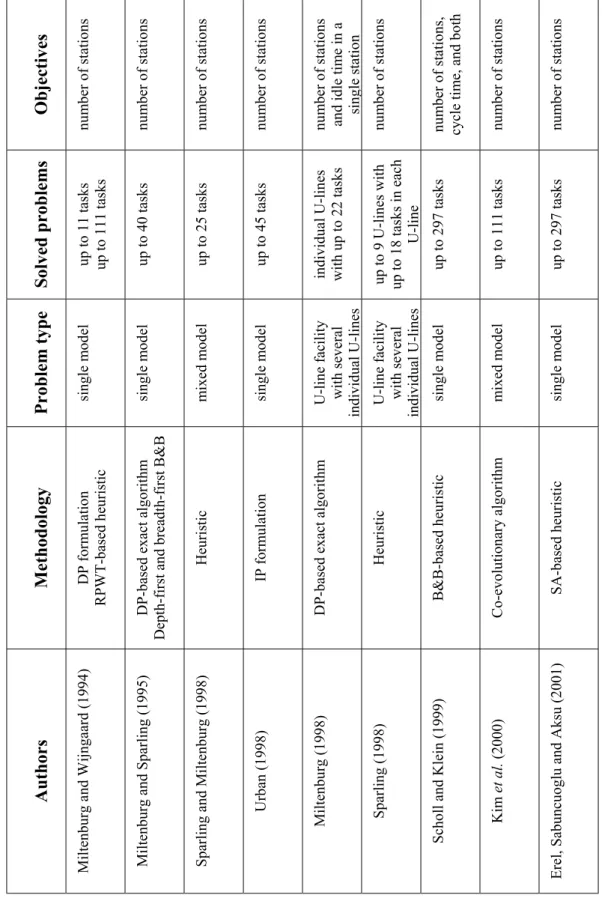
Summary of the work done on the U-line line balancing problem is given in Table 2.3.
Tabl e 2.3: Sum m ary of work done on t he U-t ype assem bl y l in e probl em s. Objectives num ber of st at ions num ber of st at ions num ber of st at ions num ber of st at ions num ber of st at ions an d id le tim e in a sin gle statio n num ber of st at ions num ber of st at ions, cycle tim e, and both num ber of st at ions num ber of st at ions Solved problems up t o 11 t asks up t o 111 t asks up t o 40 t asks up t o 25 t asks up t o 45 t asks indi vi dual U-l in es with u p to 2 2 task s up to 9 U-lin es with up to 18 tasks in each U-lin e up t o 297 t asks up t o 111 t asks up t o 297 t asks Problem type si ngl e m odel si ngl e m odel m ixed m odel si ngl e m odel U-lin e facility with sev eral indi vi dual U-l in es U-lin e facility with sev eral indi vi dual U-l in es si ngl e m odel m ixed m odel si ngl e m odel Methodology DP form ul at ion RPW T -b ased h eu ristic
DP-based exact algorithm
Depth-first and breadth-first
B&B
Heu
ristic
IP form
ulation
DP-based exact algorithm
Heu ristic B & B -based heuri st ic C o-evol ut ionary al gori th m SA-b ased h eu ristic Authors Miltenburg and W ijngaard (1994)
Miltenburg and Sparling (1995) Sparling and Miltenburg (1998)
Urban (1998) Miltenburg (1998) Sparl ing (1998) Schol l and Kl ei n (1999) Kim et al. (2000) Erel , Sabuncuogl u and Aksu (2001)
28
Chapter 3
Ant Algorithms and Applications
This chapter focuses on pure ant algorithms. Most parts are writen with the guide of Dorigo, Caro, and Gambardella’s (1999) paper (This paper overviews the recent work on ant algorithms, gives detailed information about the biological findings on the real ant colonies and defines ants’ artificial counterpart the ACO meta-heuristic. Their paper mainly focuses on the most important aspects of the ACO meta-heuristic. It is a very detailed study including every aspect of ant algorithms and can be stated as a sort of handbook).
3.1 Introduction
Ant heuristics are proposed as a new approach to combinatorial optimization in the literature ( Dorigo, Maniezzo and Colorni, 1991a, 1996). Their main characteristics are: positive feedback (that helps to discover better solutions),
distributed computation (that avoids early convergence), and the use of constructive greedy heuristic (that helps ants to find acceptable solutions in the
early stages.
This new heuristic attracts the attention of the scientific community because it is versatile (which is applicable to similar versions of the same problem), robust (with only minimal changes it can be applied to other combinatorial optimization problems), and a population based approach (which allows the exploitation of positive feedback as a search mechanism). This last property makes these systems suitable for parallel implementation. Detailed information on the parallelization strategies for the Ant System can be found in Bullnheimer, Kotsis, and Strauss (1998).
The first ant algorithm is developed by Dorigo and colleagues (Dorigo, Maniezzo, Colorni, 1991) to difficult combinatorial optimization problems, such as the travelling salesman problem (TSP) and the quadratic assignment problem (QAP). Since then many researchers work on ant-based algorithms to apply ant algorithms to various discrete optimization problems. These applications and other details of ant colony optimization algorithms (ACO) are summarized in Table 2.1 and Table 2.2.
3.2 Biological Fundamentals
Similar to other nature based heuristics (such as genetic algorithms, evolution strategies, simulated annealing, tabu search, neural nets, immune networks) ant algorithms are ‘derived’ from nature and inspiration comes from the observation of real ant colonies. The behaviour of ants in the colony constitutes the main power of the ant algorithms. Members of the colony do not act selfishly, only by focusing on their individual needs. On the contrary, everyone acts cooperatively, as a whole in order to provide the survival of the colony. Ants have no chance to survive when they are alone but when they form a group, then they are more structural and their colonies can survive. This surviving mechanism and their foraging behaviour have captured the attention of many scientists. Foraging behaviour is an important and interesting behaviour. It is an ability to find the shortest paths between the food sources and their nest.
On the way between the food source and the nest, ants deposit on the ground a substance called pheromone which forms a trail of pheromone. Ants have ability to detect (smell) the pheromone and chose their way according to their detection level. This means the probability of choosing one of the possible ways depends on the level of pheromone that is deposit on this way. By using this pheromone trails the ants find their way back to the nest or the food source and also other member of the colony detects the location of the food sources by following the trails of the previous ants. Many paths are available between the nest and the food source. When this pheromone trail following behaviour is exploited by ants then a group of ants are able to find the shortest path between the nest and the food source by following the previously laid pheromone trails of the individual ants.
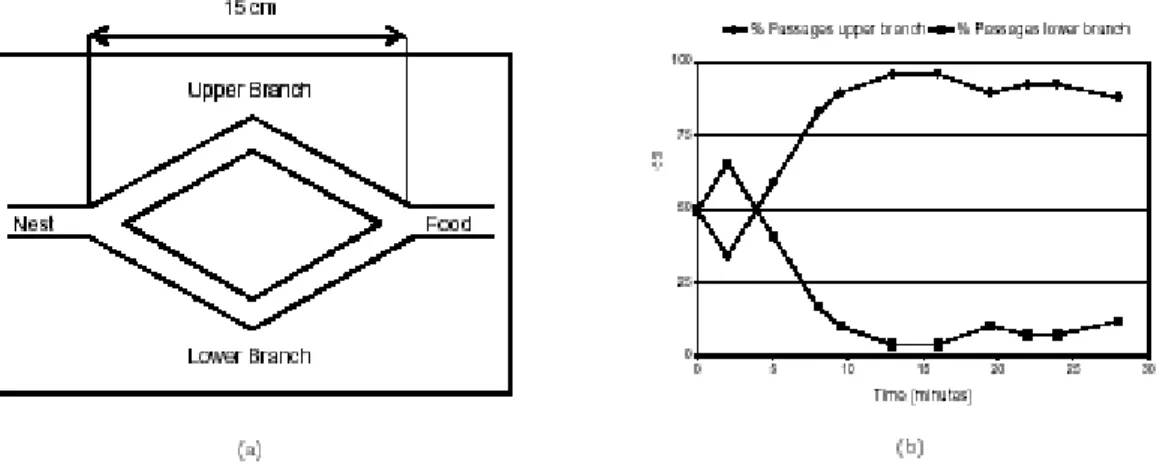
Deneubourg et al. (1990) study the ants’ foraging behaviour by using an interesting experiment, ‘the binary bridge experiment’. This experiment is done
under controlled conditions. As seen in Figure 3.1a, a double bridge in which each branch has the same length is put to separate the nest of a colony of ants and a food source. Then, the ants are left free to move between the nest and the food source. During the experiment the percentage of ants which choose one or the other of the two branches is observed over time. The result is given in Figure 3.1b. After an initial transition phase, ants tend to converge on the same path. It is stated that arising of some oscillations during the transition state is normal.
Figure 3.1: Single Bridge Experiment. a)Experiment setup and b) Results for a typical single trial; showing the percentage of passages on each of the two branches per unit of time as a function of time. After an initial short transition phase, the upper branch becomes the most used. Deneubourg et al., (1990)
In the first stage of the experiment the selection probability of any branch is equal to each other because initially no pheromone is left. During the transition phase some fluctuations occur because the amount of trail accumulated is not enough yet to direct the ants. After an initial transition phase the number of ants that randomly select one passage (let it be the upper passage) increases and more pheromone accumulates on this passage over the other. As more pheromone accumulates for the upper passage then there is more chance for an ant to choose that way. This attitude continues as a vicious cycle.
Dorigo, Caro, and Gambardella (1999) describe this phenomenon with a probabilistic model. The authors state that this model closely matches with the
experimental observation. The amount of pheromone on a branch is proportional to the number of ants that used that branch in the past and the pheromone evaporation is not taken into account. In this model, the probability of choosing a branch at a certain time depends on the total amount of pheromone accumulated on the branch. Thus the probability is proportional to the number of ants that used
the branch until that time. Let Um and Lm be the numbers of ants that have used the
upper and lower branch after m ants have crossed the bridge, with Um +Lm = m.
The probability PU(m) which the (m+1)th ant chooses the upper branch is given as:
h m h m h m U k L k U k U m P ) ( ) ( ) ( ) ( + + + + = (3.1)
and the probability PL(m) that ant chooses the lower branch is PL(m) = 1-PU(m).
This form of the probability is obtained from experiments on trail-following. The
parameters h and k allow the user to fit the model to experimental data. Then Um+1
is updated as follows: Um+1 = Um +1, if ψ ≤ PU, Um+1 = Um otherwise, where ψ is a
random variable uniformly distributed over the interval (0,1). Lm is also updated
by the same way.
Another experiment is done by preserving the same pheromone laying mechanism and using the bridge with branches of different lengths. Mostly the shortest branch is selected in this case. This result can be explained by the pheromone laying mechanism: the first group of ants on the way to the food source do not have chance to use the pheromone advantage and they choose the shortest way arbitrary. But on the way to the nest those ants that took the shortest branch will cause much pheromone to be accumulated on the short branch when compared with the long branch. For a same unit of time more ant pass through the short branch and cause more pheromone to be laid on the ground. This mechanism and the result of the double bridge experiment with branches of different length is given in Figure 3.2.
Figure 3.2: Double Bridge Experiment.
a) Ants start exploiting the double bridge, b) As a result most of the ants choose the shortest path. c) Distribution of the percentage of ants that selected the shorter path. Goss et al. (1989)
Dorigo, Caro and Gambardella (1999) explain this process as a
‘distributed optimization mechanism’. A single ant is capable of finding a path between the nest and the food source. Nevertheless, each single ant gives only a very small contribution. On the contrary, with the corporation of ants only a colony can present the “shortest path finding” behaviour. The ants perform this specific behaviour by using a simple form of indirect communication with the
help of pheromone trails. This is known as stigmergy1.
Grasse (1946) defines stigmergy as follows: “stimulation of workers2 by
the performance they have achieved.”
Stigmergy is a different style of communication because the information released by the communicating ants is a physical substance. This released
1 Dorigo, Caro and Gambardella (1999) state that the term stigmergy not only used to explain the
behavior of termite societies, the same term is also used to describe indirect communication mechanism observed in other social insects.