EFFECTS OF DIFFERENT PLANT CONTROLLING HERBICIDES ON HAY YIELD AND BOTANICAL COMPOSITION OF A MAQUISBRUSH VEGETATION IN CUKUROVA Kağan KÖKTEN 1* and Tuncay TÜKEL 2 1 University of Bingöl Faculty of Agricultural Department of Field Crops, BingölTurkey 2 University of Çukurova Faculty of Agricultural Department of Field Crops, Adana Turkey *Corresponding Author: [email protected] ABSTRACT
This study was conducted to determine the effects of different herbicides on the control of shoot regrowth of shrubs cut at 510 cm above soil surface at the experimental area of Cukurova University in the years of 2001 and 2002.
The Experiment was arranged in a randomized complete block design with 3 replications. In the experiment, three herbicides, such as 2,4D (2 l/ha), Glyphosate (10 l/ha) and Paraquat (10 l/ha) were evaluated for the control of shrubs in the range vegetation.
The results of the study showed that herbicides applied effectively prevented shoot regrowth of the root crowns of Calicotome infesta, but they were not effective on control of shoot regrowth ofQuercus coccifera. The hay yield and botanical composition of the vegetation were not significantly influenced by herbicide applications in the two years of the study. It was concluded that more research work needed in order to determine the long term effects of herbicides on a maquisbrush vegetation. Key Wor ds: Maquisbrush vegetation, Herbicides, Hay Yield. INTRODUCTION
Maquisbrush vegetation with an understory of some important grasses and legumes covers a great portion of 434 300 ha grazing land in a total 3 850 787 ha very productive agricultural land in Cukurova (Tukel and Hatipoglu, 1997 and DSI, 1998). They are commonly used as for winter grazing primarily by sheep and goats of both sedentary and nomadic animal raisers. Therefore, the majority of the roughage material, especially for sheep and goats, are obtained from these common grazing lands.
Increasing human population in the cities of the region due to increasing urbanization and recently occurring immigration from other less developed regions cause excessive demands for animal products. Applying proper management techniques and development practices in such lands are of great importance for increasing animal production in the region.
Different range improvement tools are widely practiced on shrubby type range lands of the world such as clear cutting (Tanner and et al., 1988; Bartolome and et al., 1994; Mc Daniel and Taylor, 2003), prescribed burning (Papanastasis, 1980; Fitzgerald and Tanner, 1992), spraying chemicals (Passera and et al., 1992; Ansley and et al., 2003) and fertilization (Wikeem and et al., 1993; Jacobs and Sheley, 1999).
However, very few research works (Tukel and Hatipoglu, 1990; Hatipoglu and Tukel, 1997) have been done to improve such lands in our region. Researches for brush control with herbicides were very limited. Therefore, our primary purpose in this study was to determine the effects of different herbicides on the regrowth potential of the dominant brushes as well as understory vegetation after clearing the brush layer in early spring.
MATERIALS AND METHODS
The study area was located at 37 0 21’N latitude and 35 0 10’E longitude in the
agricultural research farm of Cukurova University, Adana, Turkey. This land has an elevation of about 40 m and has been placed in the Land Use Capability Class VII according to the classification of Ozbek et al. (1974). The study area has a typical coastal Mediterranean climate. According to the long term averages, the coolest month is January with a monthly mean temperature of 9.9°C and the hottest month August with 28.1 °C. During the course of the study, they in turn became 7.9 °C in January in 2002 and 29.2 °C in August in 2001. Longterm total yearly precipitation received is 647.1 mm in the area. There was more total precipitation (756.8 mm) in 2001 than the long term average. However, less precipitation (328.4 mm) in the vegetative growth period of 2002 was recorded than the long term average (370.5 mm).
The vegetation is a typical Mediterranean maquibrush plant community mainly
composed ofQuercus coccifera, Calicotome infesta and Cistus salviifolius, having a rich
understory vegetation dominated byHyparrhenia hirta together with such valued forage
grass asDactylis glomerata, Hordeum bulbosum, Oryzopsis miliacea, Themeda triandra,
Chrysopogon gryllus. A detailed list of the vegetation found in the area has been given by Tukel and Hatipoglu (1987).
Three blocks, each having about 500 m 2 size represented in three different
locations were selected as homogenous as possible in this vegetation type. Brushes were cleared at 510 cm over ground level by a hatchet at the beginning of March, 2001. The branches cut were used as an exclosure to protect vegetation from grazing by sheep and
goats. Within each block, the treatments were allotted to plots of 2.5 m X 5 m = 12.5 m 2
each in a randomized way. Each block had a total 10 treatment plots as (1) Cleared as Control, (2) Cleared + Glyphosate sprayed once, (3) Cleared + Glyphosate sprayed twice, (4) Cleared + Glyphosate sprayed thrice, (5) Cleared + 2,4 D sprayed once, (6) Cleared + 2,4 D sprayed twice, (7) Cleared + 2,4 D sprayed thrice, (8) Cleared + Paraquat sprayed once, (9) Cleared + Paraquat sprayed twice, and (10) Cleared + Paraquat sprayed thrice. Chemicals were sprayed just on the cut trunks and twigs of the
widely distributed brushes ofCalicotome infesta and Quercus coccifera at the rate of 2.5
ml chemicals + 1247.5 ml water / 12.5 m 2 with a hand pulverizer in every 15 days after
clear cutting the brushes. Measuring and counting number of sprouts on main and secondary branches as well as crown sprouts of dominant brushes, namely Calicotome infesta and Quercus coccifera were performed just a couple days before spraying chemicals.
Four quadrats (33 cm x 33 cm in size) randomly placed in each treatment plots were clipped at ground level to determine forage production when the dominant grass plants reached flowering stage. They were separated into components as grasses, forbs,
legumes and shrubs and dried at 78 0 C for 24 hours in an oven. Thus, the contribution of
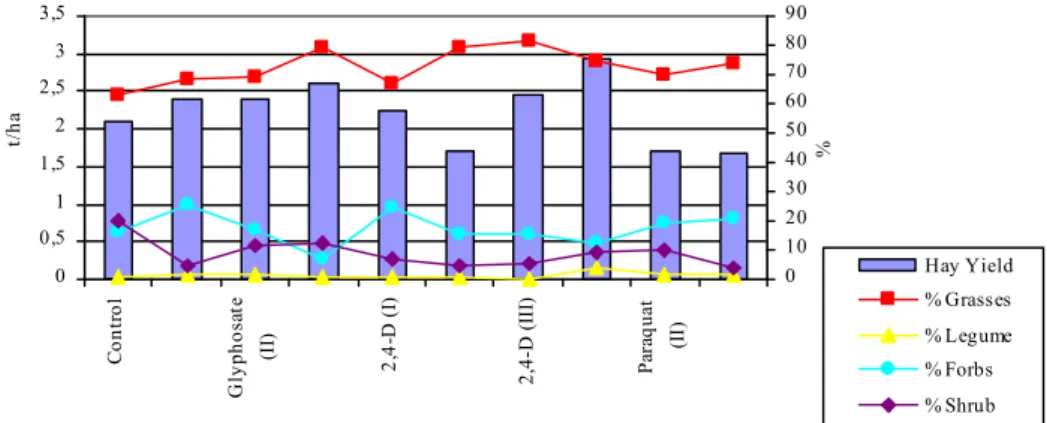
The experiment was conducted by a randomized complete block design with tree replications. For that reason, data were analysed by a randomised complete block design by using MSTATC statistical package program. RESULTS AND DISCUSSION Hay Yields and Botanical Composition Hay yields (t/ha) and botanical compositions of the treatments averaged over two years were presented in Figure 1. Although the differences were not statistically significant, the highest hay yield (2.93 t/ha) was obtained from cleared + paraquat sprayed once, but the lower hay yield was determined from cleared + 2,4D sprayed twice (1.72 t/ha), and cleared + paraquat sprayed twice and thrice (1.70 t/ha and 1.68 t/ha, respectively). Grass proportions of hay yield in all treatments were increased. The highest grass proportion (82 %) in the hay yield was obtained from cleared + 2,4D applied sprayed thrice. Similar results were reported by Kufeld (1977) and Ralphs (1995). On the contrary, legumes in all treatments produced the lowest proportion of all components. This finding is supported by the results of Gokkus and Koc (1995). 0 0,5 1 1,5 2 2,5 3 3,5 C o n tr o l G ly p h o sa te (I I) 2 ,4 D ( I) 2 ,4 D ( II I) P ar aq u a t (I I) % 0 10 20 30 40 50 60 70 80 90 t/ h a Hay Yield % Grasses % Legume % Forbs % Shrub
Figure 1. Effects of different herbicide treatments on hay yield and botanical composition (twoyear data).
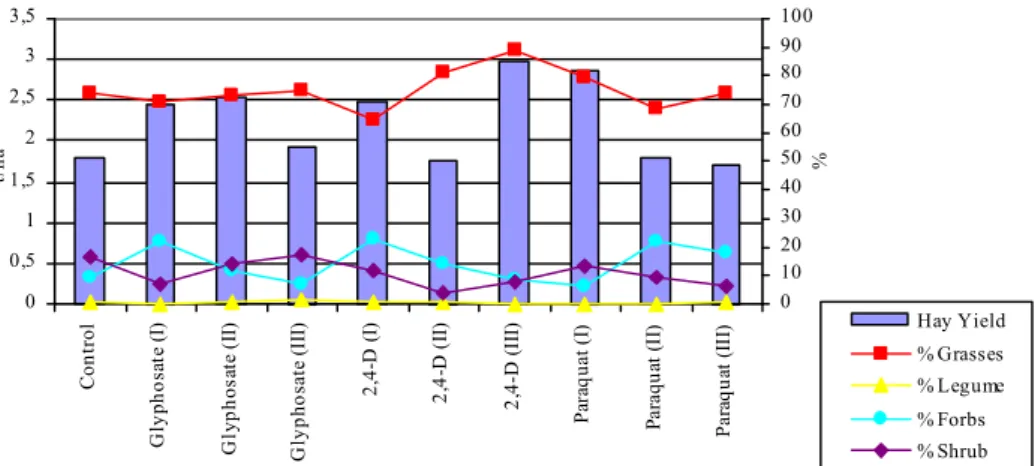
However, according to the data of single years the highest hay yield occurred in the plots treated with 2,4D sprayed twice, including the highest grass percentage. In contrast, the lower hay yields were found in the plots sprayed with 2,4D twice and paraquat twice and thrice. All were close to the hay yields of control plots. However, only brush components in hay yield in the second year produced very significant results (Figures 2 and 3). The highest hay yield together with the highest grass and the lowest brush percentages was obtained from plots sprayed with glyphosate thrice. Thus, the application of glyphosate thrice in 15 day periods steadily reduced the contribution of the regrowths in the second year. This indicates that an effective brush control was performed in the first year, but regrowths of the brushes in the second year took more part in the hay yield and produced significant differences between treatments.
0 0,5 1 1,5 2 2,5 3 3,5 C o n tr o l G ly p h o sa te ( I) G ly p h o s at e ( II ) G ly p h o sa te ( II I) 2 ,4 D ( I) 2 ,4 D ( II ) 2 ,4 D ( II I) P ar aq u a t (I ) P a ra q u at ( II ) P a ra q u at ( II I) % 0 10 20 30 40 50 60 70 80 90 100 t/ h a Hay Yield % Grasses % Legume % Forbs % Shrub
Figure 2. Effects of different herbicide treatments on hay yield and botanical composition in 2001 0 0,5 1 1,5 2 2,5 3 3,5 C o n tr o l G ly p h o s at e ( I) G ly p h o s at e ( II ) G ly p h o sa te ( II I) 2 ,4 D ( I) 2 ,4 D ( II ) 2 ,4 D ( II I) P ar aq u a t (I ) P a ra q u at ( II ) P a ra q u at ( II I) % 0 10 20 30 40 50 60 70 80 90 t/ h a Hay Yield % Grasses % Legume % Forbs % Shrub
Figure 3. Effects of different herbicide treatments on hay yield and botanical composition in 2002
Response of the Dominant Br ushes to Her bicides
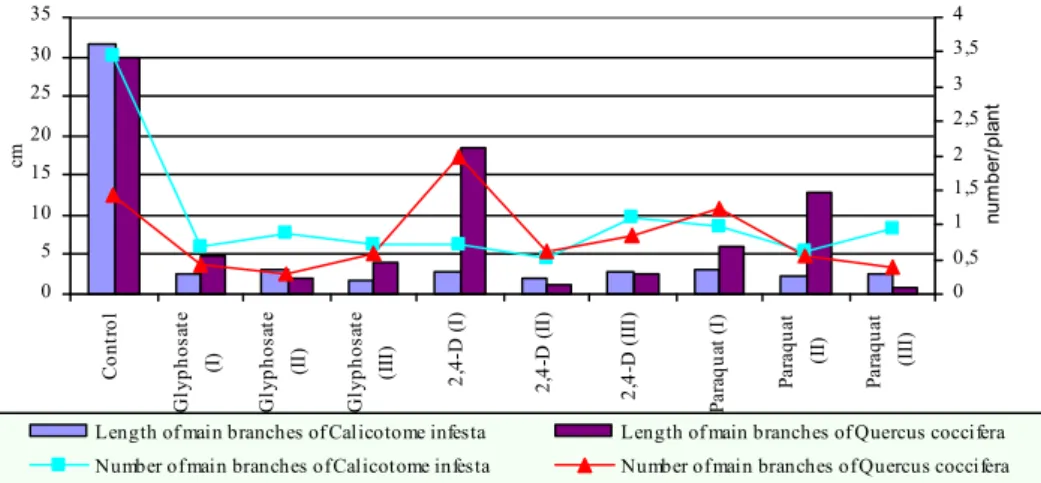
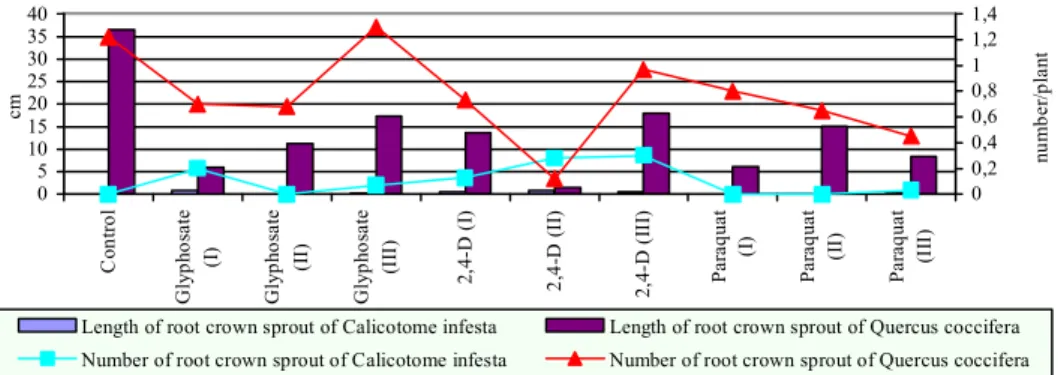
Clearing and application of herbicides based on two years average data significantly affected numbers and lengths of resprouts of main and latheral branches of Calicotome infesta but not the resprouts of root crown (Figures 4, 5, and 6). Resprouts of root crown were affected most severely by just clearing Calicotome infesta brushes. On the contrary, clearing and spraying herbicides did not make any significant differences on the numbers and lengths of resprouts of the main, latheral branches and
0 5 10 15 20 25 30 35 C o n tr o l G ly p h o s at e (I ) G ly p h o s at e (I I) G ly p h o s at e (I II ) 2 ,4 D ( I) 2 ,4 D ( II ) 2 ,4 D ( II I) P a ra q u at ( I) P a ra q u a t (I I) P a ra q u a t (I II ) n u m b e r/ p la n t 0 0,5 1 1,5 2 2,5 3 3,5 4 cm Length of main branches of Calicotome infesta Length of main branches of Quercus coccifera Number of main branches of Calicotome infesta Number of main branches of Quercus coccifera Figure 4. Effects of different herbicide treatments on main branch lengths and numbers
ofQuercus coccifera and Calicotome infesta (twoyear data).
0 10 20 30 40 50 60 C o n tr o l G ly p h o sat e (I) G ly p h o sat e (II ) G ly p h o sat e (I II ) 2 ,4 D ( I) 2 ,4 D (I I) 2 ,4 D ( II I) Pa ra q u a t (I) Pa ra q u a t (II ) Pa ra q u a t (I II ) n u m b er /p lan t 0 0,2 0,4 0,6 0,8 1 1,2 1,4 1,6 1,8 2 c m Length of latheral branches of Calicotome infesta Length of latheral branches of Quercus coccifera Number of latheral branches of Calicotome infesta Number of latheral branches of Quercus coccifera
Figure 5. Effects of different herbicide treatments on latheral branch lengths and
0 5 10 15 20 25 30 35 40 C on tro l G lyp ho sa te (I ) G lyp ho sa te (I I) G lyp ho sa te (I II ) 2, 4 D ( I) 2 ,4 D ( II ) 2, 4 D ( II I) P a ra q ua t (I ) P a ra q ua t (I I) P a ra q ua t (I II ) nu mb e r/p la nt 0 0,2 0,4 0,6 0,8 1 1,2 1,4 c m Length of root crown sprout of Calicotome infesta Length of root crown sprout of Quercus coccifera Number of root crown sprout of Calicotome infesta Number of root crown sprout of Quercus coccifera
Figure 6. Effects of different herbicide treatments on root crown sprout lengths and
numbers ofQuercus coccifera and Calicotome infesta (twoyear data).
All the parameters in the first year showed insignificant results except that of the length of resprouts of root crown in Quercus coccifera (Figures 7, 8 and 9). 0 5 10 15 20 C on tro l G lyp ho sa te (I ) G lyp ho sa te (I I) G lyp ho sa te (I II ) 2, 4 D ( I) 2 ,4 D ( II ) 2, 4 D ( II I) P a ra q ua t (I ) P a ra q ua t (I I) P a ra q ua t (I II ) nu mb e r/p la nt 0 0,5 1 1,5 2 2,5 3 c m Length of main branches of Calicotome infesta Length of main branches of Quercus coccifera Number of main branches of Calicotome infesta Number of main branches of Quercus coccifera Figure 7. Effects of different herbicide treatments on main branch lengths and numbers
ofQuercus coccifera and Calicotome infesta in 2001
0 2 4 6 8 10 12 14 16 18 C o ntr ol G ly ph os a te (I ) G ly ph os a te (I I) G ly ph os a te (I II ) 2 ,4 D ( I) 2, 4 D ( II ) 2 ,4 D ( II I) P a ra qu a t (I ) P a ra qu a t (I I) P a ra qu a t (I II ) n um b e r/p lan t 0 0,2 0,4 0,6 0,8 1 1,2 1,4 1,6 1,8 2 c m Length of latheral branches of Calicotome infesta Length of latheral branches of Quercus coccifera Number of latheral branches of Calicotome infesta Number of latheral branches of Quercus coccifera
Figure 8. Effects of different herbicide treatments on latheral branch lengths and
0 5 10 15 20 C o n tr o l G ly p h o sa te (I ) G ly p h o sa te (I I) G ly p h o sa te (I II ) 2 ,4 D ( I) 2 ,4 D ( II ) 2 ,4 D ( II I) P ar aq u a t (I ) P a ra q u a t (I I) P a ra q u a t (I II ) n u mb e r/ p la n t 0 0,2 0,4 0,6 0,8 1 c m Length of root crown sprout of Calicotome infesta Length of root crown sprout of Quercus coccifera Number of root crown sprout of Calicotome infesta Number of root crown sprout of Quercus coccifera
Figure 9. Effects of different herbicide treatments on root crown sprout lengths and
numbers ofQuercus coccifera and Calicotome infesta in 2001
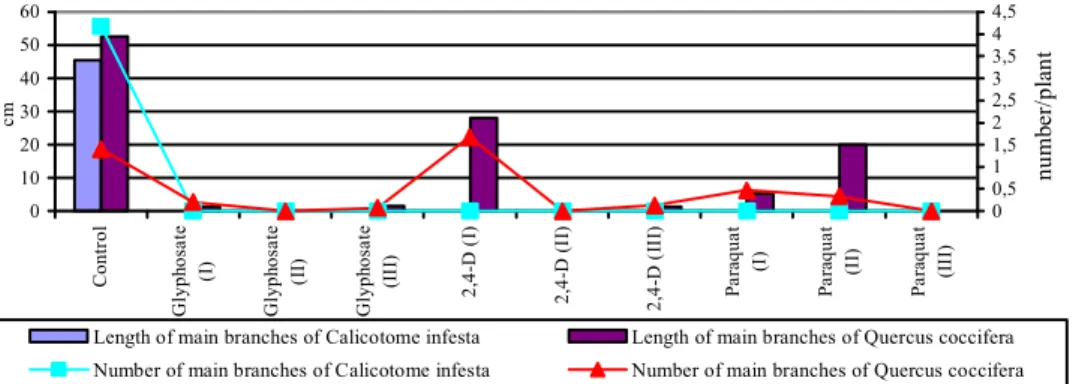
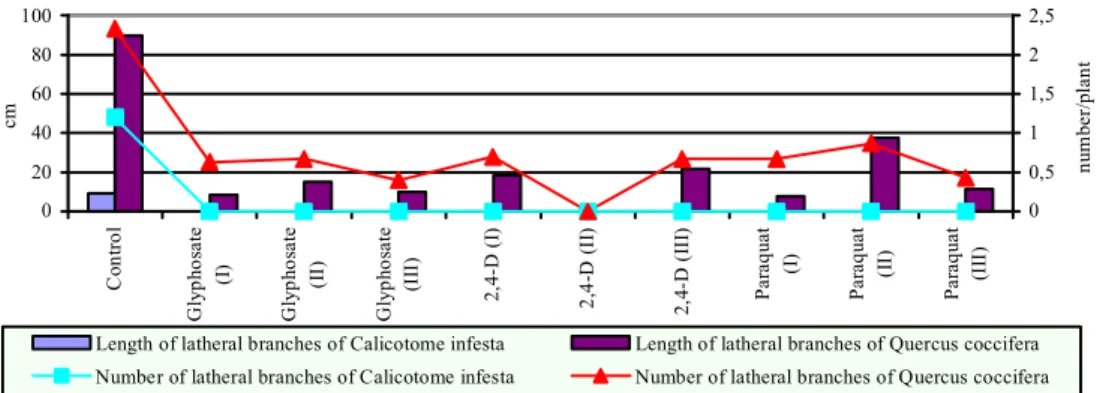
However, the results of the second year indicated significant differences in the effects of all chemical treatments on the numbers and lengths of the resprouts (Figures 10, 11, and 12). Although the number of the resprouts at the main trunck and latheral branches and the length of latheral branches of Quercus coccifera were significantly affected by the herbicides, neither the number of the resprouts at main branches nor the number and length of the resprouts of latheral branches as well as the root crowns were influenced. These results agree with the conclusion stating that removal of terminal buds or twigs generally stimulates twig production (Lay, 1965). 0 10 20 30 40 50 60 Co n tr o l G ly p h o sa te (I) G ly p h o sa te (II) G ly p h o sa te (II I) 2 ,4 D ( I) 2 ,4 D (I I) 2 ,4 D ( II I) Pa raq u a t (I ) Pa raq u a t (I I) Pa raq u a t (II I) n u m b e r/ p lan t 0 0,5 1 1,5 2 2,5 3 3,5 4 4,5 c m Length of main branches of Calicotome infesta Length of main branches of Quercus coccifera Number of main branches of Calicotome infesta Number of main branches of Quercus coccifera
Figure 10. Effects of different herbicide treatments on main branch lengths and
0 20 40 60 80 100 C on tro l G lyp ho sa te (I ) G lyp ho sa te (I I) G lyp ho sa te (I II ) 2, 4 D ( I) 2 ,4 D ( II ) 2, 4 D ( II I) P a ra q ua t (I ) P a ra q ua t (I I) P a ra q ua t (I II ) n um be r/pl a n t 0 0,5 1 1,5 2 2,5 c m Length of latheral branches of Calicotome infesta Length of latheral branches of Quercus coccifera Number of latheral branches of Calicotome infesta Number of latheral branches of Quercus coccifera
Figure 11. Effects of different herbicide treatments on latheral branch lengths and
numbers ofQuercus coccifera and Calicotome infesta in 2002
0 10 20 30 40 50 60 70 C on tro l G lyp ho sa te (I ) G lyp ho sa te (I I) G lyp ho sa te (I II ) 2, 4 D ( I) 2 ,4 D ( II ) 2, 4 D ( II I) P a ra q ua t (I ) P a ra q ua t (I I) P a ra q ua t (I II ) n um be r/pl a n t 0 0,5 1 1,5 2 c m Length of root crown sprout of Calicotome infesta Length of root crown sprout of Quercus coccifera Number of root crown sprout of Calicotome infesta Number of root crown sprout of Quercus coccifera
Figure 12. Effects of different herbicide treatments on root crown sprout lengths and
numbers ofQuercus coccifera and Calicotome infesta in 2002
CONCLUSION
Our research showed that clearing brushes in a maquis vegetation by cutting will ease grazing by reducing brushes and increasing ratios of grasses in the hay yield. After
clearing,Calicotome infesta brushes in the first year produced no crown resprouts at all.
However, root crown sprouts of Calicotome infesta brushes in the second year started to appear due to the controlling effects of the herbicides applied on trunks and latheral branches consequently forcing root crowns to rejuvenate crown sprout.
It was also determined that the controlling Quercus coccifera by spraying glyphosate after clearing the brush could be more effective on retarding the resprouts of main branches in the second year than the application of the 2,4D and paraquat.
In addition, the highest hay yield together with the highest grass and the lowest brush percentages was obtained from plots sprayed with glyphosate thrice. Thus, glyphosate sprayed thrice in 15 day periods steadily reduced the contribution of the root crown resprouts in the second year.
It was concluded that more research work needed in order to determine the long term effects of herbicides on the maquis vegetation.
LITERATURE CITED
Ansley R.J., Kramp B.A. and Jones D.L. (2003) Converting mesquite thickets to savanna through foliage modification with clopyralid. J. Range Manage., 56(1): 7280. Bartolome J.W., AllenDiaz B.H. and Tietje W.D. (1994) The effect of Quercus
douglasii removal on understory yield and composition. J. Range Manage., 47(2):151154.
DSI (1998) Statistical Bulletin. VI. regional directorate of state hydroulic works, Adana. Fitzgerald S.M. and Tanner G.W. (1992) Avian community response to fire and
mechanical shrub control in South Florida. J. Range Manage., 45(4):396400. Gokkus A. and Koc A. (1995) Effects of fertilizer and herbicide applications on hay
yield, botanical composition and ratio of valuable hay in the meadows of Erzurum. Tr. J. of Agriculture and Forestry. Vol: 19(1), 1995. P. 2329. TUBITAK.
Hatipoglu R. and Tukel T. (1997) Competition among plants in agricultural ecosystems. J. Agri Col. Adana. 12 (1), 177186.
Jacobs J.S. and Sheley R.L. (1999) Spotted knapweed, forbs, and grass response to 2,4D and Nfertilizer. J. Range Manage., 52:482488.
Kufeld R.C. (1977) Improving gambel oak ranges for elk and mule deer by spraying with 2,4,5TP. J. Range Manage. 30(1): 5357.
Lay D.W. (1965) Effects of periodic clipping on yield of some common browse species. J. Range Manage. 18: 181184.
McDaniel K.C. and Taylor J.P. (2003) Saltcedar recovery after herbicideburn and mechanical clearing practices. J. Range Manage., 56(5): 439445.
Ozbek H., Dinc U. and Kapur S. (1974) Detailed etude and map of the soils of settlement areas of Cukurova University. Agricultural Faculty Publications, 73: 1149. [In Turkish with English summary].
Papanastasis V.P. (1980) Effects of season and frequency of burning on a phryganic rangeland in Greece. J. Range Management. 33:251–255.
Passera C.B., Borsetto O., Candia R.J. and Stasi C.R. (1992) Shrub control and seeding influences on grazing capacity in Argentina. J. Range Manage., 45(5):480482. Ralphs M.H. (1995) Longterm change in vegetation following herbicide control of
larkspur. J. Range Manage. 48:459464.
Tanner G.W., Wood J.M., Kalmbacher R.S. and Martin F.G. (1988) Mechanical shrub control on flatwoods range in South Florida. J. Range Manage., 41(3):245248. Tukel T. and Hatipoglu R. (1987) Effects of different nitrogen dozes on the yield and
botanical composition of a rangeland dominated by hairy bluestem (Hyparrhenia hirta L. Stapf) under Cukurova Conditions. J.Agricul. Faculty, Cukurova Univ., 2(1):1024, Adana.
Tukel T. and Hatipoglu R. (1990) Burning and nitrogen fertilazition effects on the understory vegetation of a typical Mediterranean maquibrush plant community in Cukurova, Turkey. Agr. Med. 120:310315.
Tukel T. and Hatipoglu R. (1997) Pasture management. Agricultural Faculty of Cukurova University General Pub. No: 191. Cours Books No: A59, Adana. Wikeem B.M., Newman R.F. and Van Ryswyk A.L. (1993) Forage response to N, P, and