593
Evaluation of Empowering Leadership and Knowledge Sharing on
Organization and Organization Employees
Fatma SÖNMEZ ÇAKIR*,Zafer ADIGÜZEL
ABSTRACT
Knowledge and knowledge sharing is very important in the service sector, which has a dynamic structure. It is also important to share knowledg efficiently among employees in order to get things right. The aim of the study is to examine the impact of empowering leadership and knowledg sharing in terms of performance criterias in the service sector (logistics companies). As a result of surveys collected from logistics companies, the effect of empowering leadership and knowledge sharing on employee performance, organizational performance and job performance variables were determined. In the scope of aim of the study, a survey was conducted with 386 personnel working in the logistic companies. Data analysis was done using SPSS 25 and LISREL 8.80 programs. After factor and reliability analyses, correlation analysis, regression analysis were performed and also sobel test was done for the analysis of measuring the mediating variable effect.
Keywords: Empowering Leadership, Knowledge Sharing, Employee Performance, Organizational
Performance, Job Performance
JEL Classification: M510, M540, L250
Güçlendirici Liderlik ve Bilgi Paylaşımının Örgüt ve Örgüt Çalışanları Üzerine
Etkilerinin İncelenmesi
ÖZ
Dinamik bir yapıya sahip olan hizmet sektöründe bilgi ve bilgi paylaşımı oldukça önemlidir. Bilgi paylaşımının çalışanlar arasında verimli yapılması işlerin doğru yapılması açısından da önemlidir. Bilgi paylaşımının istenilen seviyede verimli olabilmesi için liderlik özellikleri ön plana çıkabilmektedir. Güçlendirici liderliğin çalışanlar üzerinde olumlu yönde etkisinin olduğu açıklanabilmektedir. Bu kapsam da, çalışmanın amacı hizmet sektörün de (lojistik firmaları) güçlendirici liderlik, bilgi paylaşımı, çalışan performansı, örgüt performansı ve iş performansı değişkenleri arasındaki ilişkilerin analiz edilmesidir. Analizler sonucunda; güçlendirici liderliğin ve bilgi paylaşımının; çalışan performansı, örgütsel performansı ve iş performansı değişkenlerine olumlu yönde etkisi olduğu tespit edilmiştir. Gönüllülük esasına dayalı olarak lojistik firmalarında çalışan beyaz yakalı 386 personele anket uygulanmıştır. SPSS 25 ve LISREL 8.80 programları kullanılarak elde edilen veriler değerlendirilmiştir. Değişkenleri temsil eden ölçeklerle ilgili olarak faktör ve güvenirlilik analizi yapıldıktan sonra, korelasyon analizi, hipotezlerin test edilmesinde regresyon analizi ve sobel testi de aracı değişken etkisinin analizi için yapılmıştır.
Anahtar Kelimeler: Güçlendirici Liderlik, Bilgi Paylaşımı, Çalışan Performansı, Örgütsel Performans, İş
Performansı
JEL Sınıflandırması: M510, M540, L250
Geliş Tarihi / Received: 04.04.2020 Kabul Tarihi / Accepted: 16.05.2020
* Öğr. Gör. Dr., Bartın Üniversitesi, İİBF, Yönetim Bilişim Sistemleri, fsonmez@bartın.edu.tr, ORCID: 0000-0001-5845-9162.
Dr. Öğr. Üyesi., İstanbul Medipol Üniversitesi, İşletme ve Yönetim Bilimleri, İnsan Kaynakları Yönetimi Bölümü, [email protected], ORCID: 0000-0001-8743-356X.
594
1. INTRODUCTION
Conger (1989) has found that the common feature of the leaders who successfully manage their businesses is that they perform positively when they are under the influence of empowering leader behaviors. Organizations now need active and self-confident employees who are able to go beyond the habitual taboos, see the problems, look for solutions and share knowledge. If we explain the need for this figure, Turkey's approximately 15 billion dollars in exports of services in 1995, rose to 46 billion dollars in 2015 and this digits regressed in 2016 and realized as 38 billion dollars. Turkey's export target of services is expected to be 150 billion dollars by 2023. At the same time, according to the HSBC Foreign Trade Forecast Report, global service trade is expected to be 12.4 trillion dollars in 2030 with an annual average growth of 7 %. In other words, in order to realize this performance, the importance of the leadership style, where the employees do not restrict themselves with the job description, take the initiative and share the important part of the organizational success, emerges. Empowering is the ability of a leader to use his own individual potentials for more effective organizational behavior. Empowering requires individuals to create the advantages they can express themselves better, to explain the value of their work, and to promote their personal and professional development as well as self (Dhladhla, 2011). Empowering leadership is defined as leader’s attempt to strengthen employees in various ways such as autonomy, appreciation, control, freedom of decision or power (Albrecht & Andreetta, 2011). Manz and Sims (2001) explain the empowering leadership as directing others to lead themselves and they define such leaders as the "super leader". Main followers are essentials of such leadership. The reason of why leader is super is the power of followers. The leader's task is to help his followers develop their leadership skills in a way that contributes more to the organization. What is important here is that followers need knowledge to develop their leadership skills. The essence of empowering leadership is to discover and reveal the potential within the followers (Sims et al., 2009). Researchs shows that employees feel strengthened when their leaders and managers have an empowering leadership style or leader behavior (Albrecht & Andreetta, 2011). Empowering is a multidimensional concept of managerial practices such as giving more power, responsibility and autonomy to employees in work environment, perceptions of leader behavior and perceptions that employees feel strengthened. When considering the employment distribution of sectors, agriculture has 25%, industry has 28%, service sector has 47% ratios. The intensity of employee potential in the service sector can be clearly seen. When considering the employment distribution of sectors to current economy, agriculture has1.8%, industry has 19.6%, service sector has 72.6% ratios. The importance of knowledge in terms of the relationship between the leader and the employees and the relations among the stakeholders within the organization emerges once again in terms of service sector. The fact that the largest number of people working in terms of employment and the biggest pie segment in terms of the share of the economy is in the service sector raises the importance of the relationship between leadership, knowledge sharing and performance. Knowledge sharing is to share the knowledge, ideas, suggestions and experiences of the employees with other people or persons (Bartol & Srivastava, 2002). Therefore, the aim of this research is to analyze the effects of empowering leadership and knowledge sharing on employee performance, organizational performance and job performance, and the relationship between them.
1.1. Empowering Leadership
Today's organizations, contrary to the traditional management approach, need flexible and fast decision-making management. It is stated in the organizations that have traditional structures and processes, the understanding of empowering subordinates is not possible (Arnold et al., 2000). The duties and responsibilities of the employees in traditional organizations are
595
clearly defined, and these organizations have a structure where there are no employees at all stages of the decision-making process. In organizations that have an empowering understanding, employees can take decisions and responsibilities related to their work. The emergence of the concept of empowering in the present sense is based on the 1980s. The role of empowering in management theory and practice is accepted as a part of management techniques, but the nature and underlying structure of empowering was not highlighted (Conger & Kanungo, 1988). Empowering is currently being studied in terms of psychological aspects, contingency models and leadership (Hough, 2011). Empowering leadership not only focuses on leading behaviors such as greater responsibility, delegation of authority and power sharing to employees, but also focuses on motivation and trust on employees (Srivastava et al., 2006). Pearce et al. (2008) describe the empowering leadership as a result of the literature review and research-based studies, as a set of behaviors aimed at sharing the administrative power with the subordinates. In this style of leadership, powers and responsibilities can be assigned to subordinates and hence subordinates may have the opportunity to decide on the issues that they are responsible for. Manz and Sims (1991) describe the empowering leadership as the leadership of the employees to gain leadership skills and to lead in order to develop their own leadership skills. Coleman (1996) attributes the need for empowering leader behaviors in organizations to the following factors; - Global competition and sensitivity to customer demands,
- The need to be fast and flexible,
- Horizontal structuring in business processes,
- The capacity of personnel and need to expand their social responsibilities, - Taking risks at every level,
- Promoting participation and creativity,
- Delegating managers to support their authorities,
- Increasing the importance of communication, cooperation and corporate trust.
Empowering leaders provide the environment that sub-ordinates need to fully utilize their abilities and try to increase the leadership capacity of employees (Yun et al., 2006). Empowering leaders focus on developing employees' leadership skills by setting participatory goals (Pearce & Sims, 2002), enabling employees to explore the potential within themselves (Sims et al., 2009), giving employees authority and responsibility (Pearce et al., 2008). According to Tamkin (2010), empowering leaders, unlike other leaders, empower and give attention to employees, increase social capital and deem themselves as facilitators for employees. A empowering leader with these qualities will be seen as a supportive leader who recognizes the values of his/her followers, guides them in their actions (Xue et al., 2011). In the study, with the features underlying empowering leadership concept, the effects on the performance of employee in the organizations, performance of the job, and organizational performance were analyzed with the mediation effect of knowledge sharing.
1.2. Knowledge Sharing
An important part of empowering is knowledge sharing. According to Gao and Bai (2011), informing employees ensures that they feel responsible for their work. Knowledge sharing can increase motivation for employees to recognize irregularities and problems, to develop business and to offer solutions to problems. Knowledge sharing is an important factor between employees and management in order to get things done right in organizations. Knowledge sharing is considered as an important part of empowering in theoretical studies. In achieving organizational tasks, knowledge sharing about their tasks is a fundamental step in the
596
decision-making of employees in their respective fields. It is necessary to look at the knowledge sharing behavior of employees in the organizations from the perspective of welfare and organizational behavior. In the study of Wasko and Faraj (2005), it is explained that the characteristics of individuals have a positive effect on knowledge sharing. For this reason, leadership style also has an effect on revealing the characteristics of individuals. It is stated that if employees are highly motivated and satisfied with their work, their commitment to the organization increases and they improve themselves better (George & Brief, 1992). Today, organizations are struggling to survive in an environment where knowledge is the most important basic resource, knowledge production and sharing becomes widespread, and continuous learning and knowledge become unavoidable. In this process, the basic element that keeps the organizations alive is knowledge. Çapar (2005) specified characteristics of knowledge concept as; It states that it is about data and knowledge-based decision making, planning, comparison, evaluation, analysis, prediction, diagnosis and future decisions. One way for organizations to increase productivity and performance is to strengthen employees. The positive features of the leaders also have an important effect on the sharing of knowledge within the organization. It can be explained that the organizational performance has changed positively especially if the knowledge sharing is at the desired level (Srivastava et al., 2006). In a strengthened organizational structure, leaders have the ability to increase the self-efficacy of the members of the organization and control over the working environment. When employees are strengthened to make business decisions on their own, they should have sufficient knowledge to make reasonable and justifiable decisions. Therefore, It can be explained that empowering leadership has an important effect in sharing knowledge among employees (Xue et al., 2011). An empowering leader is likely to share his/her valuable knowledge with others with a fair acceptance of ideas and knowledge (Srivastava et al., 2006). In this research, it is aimed to analyze the role of knowledge sharing in terms of the mediation variable effect, the relationship between employee performance, organizational performance and job performance. In the context, examined and tested hypotheses;
H1: Empowering leadership has a positive effect on knowledge sharing.
1.3. Employee Performance
Individual performance, which is the result of employee behavior, is an important issue for managers. Although increasing the performance of the organization is one of the leaders' duties, it is necessary to accept the impact of the employees on the performance of the organization, but it is the manager's responsibility to raise the performance of employees (Bayram, 2005). The concept of performance is defined as the expression of where the individual or a group doing a job within the organization can achieve the intended goal (Kurar, 1996). The most important variable affecting the performance of employees in organizations is leadership (Cummings & Schwab, 1973). It is essential to provide the necessary knowledge and skills to interact effectively to ensure that employees understand what their organization expects from them to appreciate the values of the organization (Kelley, 1992). Many studies show a significant relationship between leader behavior and/or leadership style and employee performance (Avolio & Bass, 1995; Sikander, 2010; Laschinger et al., 1999). Empowering leader behavior among the various leading behaviors is of particular importance with the consistent tendency towards providing increased autonomy to employees (Townsend & Bennis, 1997). Cohen et al. (1997) and Manz and Sim (1987) argue that empowering leadership will be beneficial because of the rapid resolution of the problems of the employees by taking initiative and increasing the quality of work life. Performance is a qualitative and quantitative expression of what an individual, a group, a unit, or an organization doing a job can achieve and where it can achieve what is intended for that purpose (Baş, 1999). Başaran (2000) defines performance
597
as a function of the relationship between expectations about what employees should do and what they actually do. According to Erdoğan (1991), performance is “the performance of the work, which is appropriate to the characteristics and abilities defined for them, within the acceptable limits.” Every process and action that employees perform to fulfill their duties can be considered as a performance behavior. Performance is one of the key elements that enables organizational management to achieve its goals and objectives. Palmer (1993) defines the performance evaluation as a process of evaluating the performance of the employees at work by comparison and measurement with predetermined standards. Empowering leadership style is one of the important leadership styles that can positively affect the performance of employees. We examine the concept of empowering leadership in terms of analysis of the impact on employee performance. In the context, examined and tested hypotheses;
H3: Empowering leadership has a positive effect on employee performance. H6: Knowledge sharing has a positive effect on employee performance.
H8: Knowledge sharing has a mediation variable effect on the relationship between empowering
leadership and employee performance.
1.4. Organizational Performance
Organizational performance is defined as comparing the results with the intended results, evaluating the performance of the employees and examining the progress towards fulfilling the intended objectives (Ngah & İbrahim, 2010). Organizational performance is defined as the extent to which organizations with specific resources and tools have the appropriate capacity and perform their objectives without adding extra loads to their employees (Georgopoulos et al., 1997). According to Montes et al. (2005) organizational performance, business processes, team/group communication and interaction, leadership and innovation are the result of various factors that encourage creativity (Montes et al., 2005). The concept of performance is of particular importance in examining the ability of employees to perform their duties, and in determining their skills. Employees' personal performance is influenced by the strengths or weaknesses of the companies. It is the duty of managers to ensure that the organizational performance is at the targeted level and it is also the responsibility of the managers to keep the performance of the employees high (Schermerhorn & Hunt, 1994). The performance is related to the ratio of the work to be performed in line with the determined purpose. The fulfillment of the task is defined as the service, product or idea which is put forward for reaching the aim. The ability of the organization to use its resources in an effective and healthy manner for predetermined purposes describes its performance in terms of institutional (Karacan, 2010). At organizational level, performance is no different from the overall performance. The performance of an organization is the result of activities at the end of a certain period. Organizational performance is the interpretation of efforts to achieve the objectives. Determining performance is possible by measuring and evaluating the relationships and results between the inputs and outputs of the organization. Organizations evaluate outcomes or results according to different dimensions of performance (Benligiray, 1999). The performance of a particular profit center is assessed by criteria such as profitability, market share, error rate evaluated by criteria such as the ratio of units delivered on time to total units. It is difficult to clearly determine how much each individual contributes to these measurable performance indicators (Kılınç & Akkavuk, 2001). Therefore, the effect of empowering leadership style and knowledge sharing within the organization on the performance of the organization are analyzed through analysis. In the context, examined and tested hypotheses;
598
H5: Knowledge sharing has a positive effect on organizational performance.
H9: Knowledge sharing has a mediation variable effect on the relationship between empowering
leadership and organizational performance.
1.5. Job Performance
The relationships between leadership style and work performance are discussed in detail in different contexts based on the view that reasonable explanations and findings about the nature of these relations will support the resolution of the relations between the behaviors of the leader and the attitudes of the followers (Howell & Hall-Merenda, 1999). Borman and Motowidlo (1997) Job performance is defined as behaviors based on role definitions, which differ from job to job and contribute to the technical infrastructure of the organization. Employees will be inclined to exhibit performance to help their colleagues if they are satisfied with their work, leaders and organizations, and they will seek to pay for the opportunities offered by the organization/leader. On the other hand, individuals who have lower level of satisfaction with their jobs/leaders/organizations will disobey or fail to fulfill their duties and responsibilities and will decrease their job performance levels. Under these circumstances, employees will be expected to assume additional responsibilities, to support the organization and to demonstrate job performance in the form of defending the organization (Edwards et al., 2008). Hence, disabling or reducing performance has some sanctions, however, the lack of job performance behaviors is mostly due to the attitudes and behaviors of senior management towards employees. As a matter of fact, Edwards et al. (2008) found that the relationship between the satisfaction of the leader and the job performance was high. Similarly, Kinicki et al. (2002) found that job satisfaction would be high depend on satisfaction with management. It has been demonstrated in different studies that employees will have a tendency to perceive equality in their mutual relations, to assist their colleagues in business situations where they are satisfied with their leaders and colleagues, and to tend to exhibit performance beyond the formal requirements of the work (Moorman, 1991). Empowering leadership provides a positive contribution to job performance by providing a shared vision and directing followers to common goals beyond personal interests and encourages individuals to strive in ways that transcend formal role requirements and to perform individually. Yukl (2013) states that the use of social power by the leader has direct effects on employee commitment and social power, and that the secondary effects on performance and satisfaction are indirect. Wang et al. (2005) also investigated the relationships between leadership style and work performance on a scale of employees on which Ferris and Rowland (1981) pointed out that the workplace perceptions and situational factors played a mediating role in the relationship between leadership and performance. In the findings of the study, leadership has direct and indirect effects on performance. In the context, examined and tested hypotheses;
H4: Empowering leadership has a positive effect on job performance. H7: Knowledge sharing has a positive effect on job performance.
H10: Knowledge sharing has a mediation variable effect on the relationship between
empowering leadership and job performance.
2. METHODOLOGY
The survey was conducted with a total of 386 employees in scope of the aim of the research. Factor analysis, regression, correlation, reliability analysis and Sobel test were performed with the data obtained by using LISREL 8.80 and SPSS 25 software programs. In the
599
first part of the survey, while the demographic knowledge of the participants were included, in the second part the questions of empowering leadership, knowledge sharing, employee performance, organizational performance and work performance were included. The survey consists of questions which represent 5 variables. Empowering leadership scale was adopted from the studies of Konan and Celik (2018). Knowledge sharing scale was adopted from the studies of Öztürk (2005), Demirel and Seckin (2011), Aksoy et al. (2016). Employee performance scale was adopted from the studies of Ellinger et al. (2008), Avcu (2016) and Başar (2016). Organizational performance scale was adopted from the studies of Ellinger et al. (2008) and Akgül (2015) and job performance scale was adopted from the studies of Goodhue and Thompson (1995), Igbaria and Tan (1997), Marchese and Muchinsky (2003), Boyd et al. (2007), and Saetang et al. (2010).
2.1. Research Goal
In this study, it was aimed to determine the effects of relationships between empowering leadership, knowledge sharing, employee performance, organizational performance and job performance on white-collar employees working in service sector. The reason for choosing the service sector is that the knowledge sharing activities have dynamic effects in this sector and they are realized instantly. The reason why the sample group is selected from white-collar employees is that these personnel have important duties and responsibilities both for knowledge sharing and within the organization. Therefore, the aim of the research is to evaluate and analyze the firms in service sector in terms of both leadership and knowledge sharing and performance variables. To test the propositions, a field survey was conducted using the survey. In this study, empowering leadership is taken as independent variable, knowledge sharing is taken as a mediation variable and employee performance, organizational performance and job performance are examined as dependent variables.
2.2. Demographic Information
The survey was applied to 386 employees working in different departments of 19 firms. A total of 252 male 134 female white-collar workers responded to the survey. Of the participants, 104 (27%) of them were in the 20-29 age group; 162 (42%) of them were in the 30-39 age group. 120 (31%) of participants are aged 40 years and over. While 89% of them graduated from university; and 11% of them have postgraduate/doctorate degree.
2.3. Research Framework
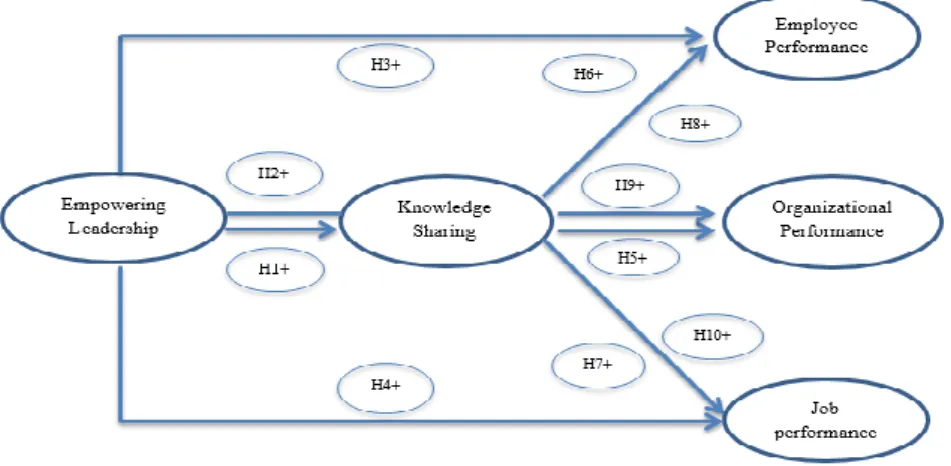
Based on literature search, a research model as independent variables; empowering leadership, mediation variable; knowledge sharing, dependent variables; employee performance, organizational performance and job performance was applied. The model of the research is given in Figure 1. The hypotheses defined according to this model will be tested and interpreted.
600
Figure 1: Research Model
3. ANALYSIS
Factor analysis was performed to investigate the construct validity of the scales. Özdamar (2004) describes the factor analysis as a method used to transform the data structures associated with each other into independent and fewer new data structures and to reveal common factors. In order to determine the normal distribution of the data in the factor analysis of the data before the factor analysis, Kaiser-Mayer-Olkin (KMO) criteria and Barlett test were examined. The KMO value for the data of this study was found to be .948 and Barlett's test of Sphericity was 8375.171 (p <.01). KMO value in Social Sciences is greater than 0.60 indicates that the sample size is sufficient (Büyüköztürk, 2014). When the data were analyzed, it was determined that the scale was suitable for factorization. The P-value value obtained as a result of the Bartlett test is less than 0.05, indicating that the correlation matrix was not a unit matrix, that the data were normally distributed and that the data were suitable for factor analysis. Since the factors were thought to be related to each other, Promax rotation technique was used. In the explanatory factor analysis (AFA), while the factor was determined, Kaiser (1960) states that the factors with an eigenvalue less than 1 should be removed from the analysis. It is also recommended that the item factor load should be at least 0.40 (DeVellis, 2016). In the analysis process, the items that did not have sufficient factor load (<40) and were burdened with multiple factors were excluded from the scale and the analysis was repeated. As a result of the AFA, a structure consisting of 5 factors with an eigenvalue greater than 1 was obtained. The study consists of a 5-point Likert scale because it is a quantitative research, a questionnaire with 50 questions was conducted. 19 questions were removed because factor distribution also affects reliability. Table 1 shows the distribution of the remaining 31 questions to 5 factors.
Table 1: Factor Loads of Expressions
Component
1 2 3 4 5
EL3. My manager encourages me to develop my own solutions to the problems I encounter related to my work.
.862
EL4. My manager provides me with the knowledge I need to meet the demands of students and parents.
.850
EL2. My manager encourages me to follow the scientific problem-solving stages in problem-solving a problem I have encountered.
601
EL5. My manager ensures that continuous learning and skill development are priorities in our school.
.833
EL1. My manager authorizes me to take the decisions I need in order to determine and develop the processes and stages of my work.
.828
EL8. My manager focuses on corrective actions instead of blaming me when I make a mistake.
.816
EL6. My manager takes the risk of not making a mistake, thinking that I will learn and develop as a result of my experiences.
.797
EL10. My manager often provides me opportunities to develop new skills.
.784
EL11. My manager authorizes me to make the necessary changes to improve the business.
.772
EL12. My manager encourages me to try new ideas, even though I may not succeed.
.771
EL13. My manager tries to help me to create my own solutions instead of telling me what to do when a problem occurs.
.764
EL14. My manager holds me responsible for the performances of my students.
.687
KSB3. I am happy to share my work reports with colleagues in the institution I work with.
.850
KSB4. In my institution, I always share with my colleagues that the where or who holds the knowledge they need.
.825
KSB5. I like to share with my colleagues the knowledge I have learned using the knowledge and communication technologies in my institution.
.764
KSB6. I share multimedia files, such as knowledge, media, images or videos, with colleagues in my institution.
.719
KSB8. I actively participate in the discussion on complex issues in my institution.
.622
KSB9. If I have a specific knowledge of how to fulfill the organizational task, I will tell other employees.
.500
KSB10. In my institution, I always help my colleagues to find the knowledge they need.
.438
OP1. The number of Employee recommendations at the institution where I work is more than last year.
.891
OP2. Customer satisfaction at my institution is more than last year. .829 OP3. The percentage of total expenditure allocated to technology and
knowledge in my institution is greater than one year in processing.
.773
OP4. The number of customer suggestions applied in the institution I work with is more than last year.
.661
EP2. I know what my managers expect from me in my institution. .437 EP3. I fulfill the expectations of the managers in my institution. .943 EP1. I receive positive feedback from my managers at my institution. .813 EP5. I have knowledge about all the services of the institution I work in. .729 EP4. I am good at my job at the institution I work in. .691
JP1. I evaluate my activities. .897
JP2. I investigate the problems I have in my area of responsibility. .775 JP3. In the institution where I work, the importance of recruiting
appropriate staff is given.
.664
EL: Empowering Leadership, KS: Knowledge Sharing, EP: Employee Performance, OP: Organizational Performance, JP: Job Performance
602
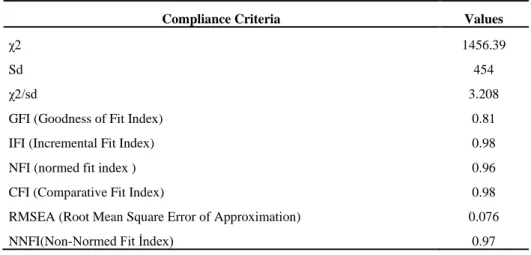
As a result of confirmatory factor analysis, CFA was used to examine the construct validity of the scale consisting of 31 items and 5 factors. A variety of goodness-of-fit indices are used to assess whether the model is compatible with CFA. In this study, the fit indices of Root Mean Square Error of Approximation Normed Fit Index (NFI), Non-Normed Fit Index (NNFI), Comparative Fit Index (CFI), Goodness of Fit Index (GFI) and Inceremental Fit Index (IFI) were examined and fit indexes obtained from DFA as a result of Table 2 were presented.
Table 2: Confirmatory Factor Analysis Results
Compliance Criteria Values
χ2 1456.39
Sd 454
χ2/sd 3.208
GFI (Goodness of Fit Index) 0.81
IFI (Incremental Fit Index) 0.98
NFI (normed fit index ) 0.96
CFI (Comparative Fit Index) 0.98
RMSEA (Root Mean Square Error of Approximation) 0.076
NNFI(Non-Normed Fit İndex) 0.97
The RMSE value of less than 0.05 is excellent and less than 0.08 shows good compatibility (Jöreskog & Sörbom, 1993). The fact that χ2/sd value is lower than 5 corresponds to moderate compliance (Kline, 2015). The NFI and CFI values are between 0 and 1 and they are interpreted as compatible so close to 1 (Schermelleh-Engel et al., 2003). The value obtained for NNFI is between 0.97 and 1, indicates good compatibility (Erkorkmaz et al., 2013). As a result of the reliability analysis, 0.70 and above cronbach alpha value, which is deemed appropriate for social sciences, is considered sufficient (Nunnally, 1978; Santos, 1999; Büyüköztürk, 2014).
Table 3: Reliability Analysis
Variables N Cronbach Alfa (α) AVE CR
Empowering Leadership (EL) 12 .952 0.64 0.96
Knowledge Sharing (KS) 8 .895 0.48 0.86
Employee Performance (EP) 5 .860 0.64 0.88
Organizational Performance (OP) 4 .866 0.63 0.87
Job Performance (JP) 3 .781 0.62 0.83
Validity is the degree to which the feature is accurately measured by the scale without mixing it in another particular feature (Tekin, 1977; Tavşancıl, 2002). According to Garrett-Mayer (2006), the validity is measured by the measurement instrument in a suitable way. Factor analysis was used to determine the construct validity. The KMO and Bartlett test values were used to determine the suitability of the scales for factor analysis, the adequacy of the sample size and whether the data were in normal distribution. AVE and CR values were calculated to obtain the structural validity results of the model. It is desired that AVE values are more than 0.50 and CR values are more than 0.70. This value was found close to 0.50 for the variable KSB. In addition, the CR values of all factors are greater than their AVE values. The correlation coefficient is a measure of the relationship between variables. The closer this value is to 1, the more the values are related to each other. The relations between 5 different variables are given in Table 4.
603 Table 4: Correlation Results Between Factors
Relationships between variables EL KS EP OP
KS EP OP JP EP OP JP OP LP JP Pearson correlation .600 .554 .505 .447 .694 .568 .543 .582 .524 .558 Significance (two-tailed) .000 .000 .000 .000 .000 .000 .000 .000 .000 .000 EL: Empowering Leadership, KS: Knowledge Sharing, EP: Employee Performance, OP: Organizational Performance, JP: Job Performance
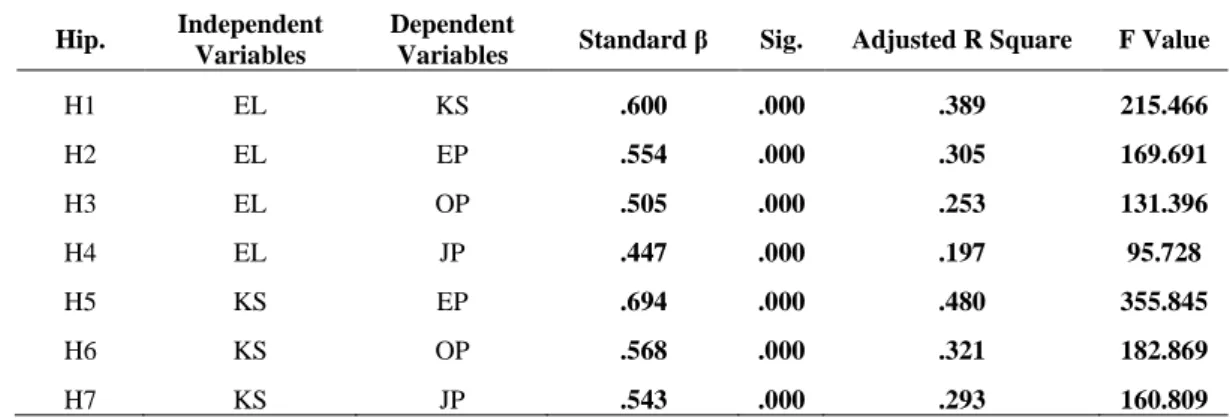
According to the data in Table 4. there is a significant correlation between all factors at 1% significance level. Sig. values are less than 0.01. This indicates that the hypothesis of significance is accepted connected as “Correlation between variables is important.” In order to test the predicted research model, regression analysis was used and 7 hypothesis which is considered to be outside the variable effect according to the results of these regression analyzes is shown in Table 5 and Table 6.
Table 5: Regression Analysis Results of Impact of Independent Variables on Dependent Variables
Hip. Independent Variables
Dependent
Variables Standard β Sig. Adjusted R Square F Value
H1 EL KS .600 .000 .389 215.466 H2 EL EP .554 .000 .305 169.691 H3 EL OP .505 .000 .253 131.396 H4 EL JP .447 .000 .197 95.728 H5 KS EP .694 .000 .480 355.845 H6 KS OP .568 .000 .321 182.869 H7 KS JP .543 .000 .293 160.809
Regression analysis was used to test predicted research hypotheses. The structure of the installed model can be seen in Figure 1. First, simple regression equation was established for each dependent variable using empowering leadership which is an independent variable. With these regression equations, the effect of independent variable on each dependent variable was examined separately. Adjusted R‐squared is statistics derived from analyses based on the general linear model. It represents the proportion of variance in the outcome variable which is explained by the predictor variables an estimate in the population. Adjusted R square values calculated for the current data are given in Table 5. When the results in Table 5. are examined, it is seen that 7 hypotheses given in Table 6. are accepted. The established hypotheses were found to be less than 0.01 and all sig. values were tested at 1% significance level. Therefore, all hypotheses given in Table 6. were accepted. Empowering leadership and knowledge sharing variables are effective on each other and on other variables.
604 Table 6: Reject / Accept Status of Research Hypotheses
Hypotheses Reject/ Accept (Sig.)
H1: Empowering Leadership has a positive effect on Knowledge Sharing. Accept P<0.001 H2: Empowering Leadership has a positive effect on Organizational
Performance.
Accept P<0.001
H3: Empowering Leadership has a positive effect on Employee Performance. Accept P<0.001 H4: Empowering Leadership has a positive effect on Job Performance. Accept P<0.001 H5: Knowledge Sharing has a positive effect on Organizational
Performance.
Accept P<0.001
H6: Knowledge Sharing has a positive effect on Employee Performance. Accept P<0.001
H7: Knowledge Sharing has a positive effect on Job Performance. Accept P<0.001
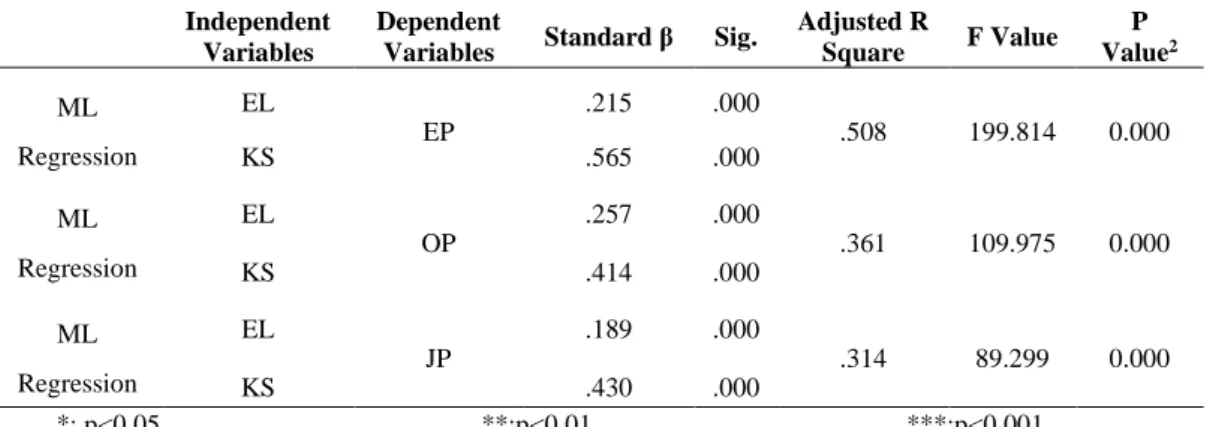
The single and multiple regression analyses were performed on our factors to determine the mediation variable effect. Multiple regression analysis shows the effect of more than one independent variable on the dependent variable, to what extent independent variables explain the dependent variable. For this, Adjusted R square values can be examined. And this values calculated for multiple linear (ML) regression analysis are given in Table 7.
Table 7: The Effect of The Mediation Variable According to Regression Analysis Results Independent
Variables
Dependent
Variables Standard β Sig.
Adjusted R Square F Value P Value2 ML Regression EL EP .215 .000 .508 199.814 0.000 KS .565 .000 ML Regression EL OP .257 .000 .361 109.975 0.000 KS .414 .000 ML Regression EL JP .189 .000 .314 89.299 0.000 KS .430 .000 *: p<0.05 **:p<0.01 ***:p<0.001
In ML Regression1, the effect of EL and KS variables on EP was analyzed together. In simple regression, Adjusted R square value of EL on EP was 0.305, and Adjusted R square value of KS on EP was 0.480. In ML Regression1, Adjusted R square value of EL and KS on EP was 0.508. In other words, when two variables are together, they have more explanation effect. When ML Regression2 and ML Regression3 are examined, it can be seen that similar results are obtained. P value1 indicates whether the coefficient of each independent variable is significant in the model. If this value is less than 0.05, it means that the coefficients are significant. P value2 values give information about whether multiple linear regression model is significant as a whole and if this value is less than 0.05 indicates that the model is significant overall. According to the results given in Table 7, both variables are significant and the model as a whole.
Baron and Kenny (1996) in their study, stated that between the dependent variable and the dependent variable, the mediation effect was used to explain "why" and "how". Therefore, the sobel test is performed to measure the effect between the independent and dependent variable (Sobel, 1982). The results were obtained by using sobel test calculation tool by using single and multiple regression results. Table 8. It shows the results of the mediation effect of knowledge sharing in the relationship between empowering leadership and employee performance.
605
Table 8: Mediation Variable Effect of Knowledge Sharing in Relation between Empowerment Leadership and Employee Performance
Input: Test statistic: Std. Error: p-value:
A .481 Sobel test: 9.54785203 28010.06961791 .000 B .556 Aroian test: 9.53504919 28047.67911967 .000 Sa .033 Goodman test: 9.56070658 27972.40954941 .000
Sb .044
If p-value is <0.05, it can be said that there is a mediation effect (Aroian 1947; Goodman, 1960). According to this, it can be said that there is a mediation effect of knowledge sharing in the relationship between empowering leadership and employee performance.
Table 9: Mediation Variable Effect of Knowledge Sharing in Relation between Empowering Leadership and Organizational Performance
Input: Test statistic: Std. Error: p-value:
A .481 Sobel test: 7.11766215 35275.908663 .000 B .522 Aroian test: 7.10493963 35339.07576607 .000 Sa .033 Goodman test: 7.13045326 35212.62824613 .000
Sb .064
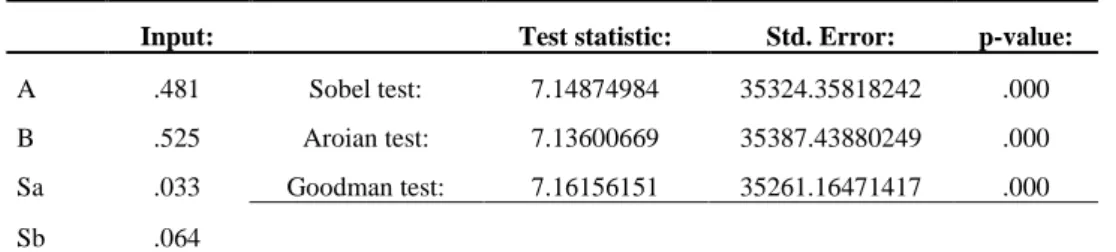
Since the p value for all tests is <0.05, it can be said that the knowledge sharing has the variable effect in the relationship between empowering leadership and employee performance. Table 10: Mediation Variable Effect of Knowledge Sharing in Relationship between Empowering Leadership and Job Performance
Input: Test statistic: Std. Error: p-value:
A .481 Sobel test: 7.14874984 35324.35818242 .000 B .525 Aroian test: 7.13600669 35387.43880249 .000 Sa .033 Goodman test: 7.16156151 35261.16471417 .000
Sb .064
As with other tests, all p values in this test were smaller than 0.05. This indicates that KS has a mediation effect in all relationships established for the model. The setup and results of hypotheses in which mediation variable effects are investigated are given in Table 11.
Table 11: Reject/Accept Status of Research Hypotheses
Hypotheses Reject/ Accept (Sig.)
H8: Knowledge sharing has a mediation variable effect on the relationship
between empowering leadership and employee performance.
Accept P<0.001
H9: Knowledge sharing has a mediation variable effect on the relationship
between empowering leadership and organizational performance.
Accept P<0.001
H10: Knowledge sharing has a mediation variable effect on the
relationship between empowering leadership and job performance
Accept P<0.001
It has been supported by hypotheses that organizations that carry out knowledge sharing successfully within the organization and that provide empowering leadership within the organization positively affect employee performance, organizational performance and job
606
performance. Organizations that perform knowledge sharing in a competitive environment demonstrate a successful performance.
4. DISCUSSION
The empowering leader has an important impact on how to communicate effectively with employees and how to solve problems by cooperating with employees. However, if the data of this study were collected from blue collar employees in the production sector, it would be possible to obtain different results. Because there are differences between both white collar and blue collar management and knowledge sharing. In addition, the working environment in the white collar sector in the service sector and the blue collar sector in the production sector is very different from each other because of the different results can be foreseen. Employees who deal with empowering leadership style see themselves as an important part of the decision process and are motivated to share their knowledge. The empowering system identifies and reduces the concerns that can be experienced among employees within the leader organization and eliminates the obstacles experienced in knowledge sharing. However, by analyzing the attitudes and behaviors of employees in positions such as salespeople and customer representatives, who are interested in one-to-one customers other than white-collar employees in the service sector, we will be able to reach a definitive conclusion. In order for the knowledge sharing to take place at the desired level, the relations and communication between the employees must be strong. For this, a strong leadership understanding is needed (Brown & Woodland, 1999; Rastogi, 2000). As a result of the research, the positive effect of strong leadership on knowledge sharing is supported theoretically. For this reason, as George (1991) stated in his research, employees may be more willing to help customers when they are happy. For this reason, leadership style and knowledge sharing are of great importance not only for the white collar workers in the service sector but also for the employees who are not white collar workers and for the employees in different sectors such as the production sector. Marques et al. (2008) explained that there is a positive relationship between knowledge sharing behaviors and individual performance, indicating that individuals with more knowledge about sharing activities have better individual performances. At the same time, Beckman (1999) states that empowering leadership positively affects employees' knowledge, skills and abilities. In this way, both the performance of the employees and the organizational performance can be positively affected by providing knowledge sharing within the organization. For this reason, it is possible for managers to have positive effects on the activities and experiences within the organization and on the performance as a part of the daily relationship with the employees in the workplace (Phillips, 1994). At the same time, leaders need to provide the resources need in order to gain efficiency from the employees (Goleman, 2000). In this way, the contribution of the employees and the work performance to the performance of the organization can be mentioned. Actions are needed to demonstrate that employees are valued in organizations. Leaders are required to provide the order that meets the demands and needs of the employees, gives morale to the employees and increases the performance of the employees. Only in this way can success be achieved (Craumer, 2001).
5. CONCLUSION
Knowledge sharing is one of the most important factors that can positively affect both employee performance and job performance. For this, it is necessary to strengthen the potential size of knowledge sharing (Marques et al., 2008). Organization employees in the field of knowledge sharing have ensured team coordination and strengthened the potential size (Lauring & Selmer, 2011). Mohd and Zawiyah (2009) in their study revealed that there is a positive
607
relationship between knowledge sharing and performance and it is emphasized that the performance of the employees who are willing to share knowledge within the organization is better and explained that the improved performance positively affects the service delivery (Mohd & Zawiyah, 2009). The performance of employees working in organizations is determined according to whether they are successful in their work or not. In other words, performance evaluation can be defined as the determination of the level of accomplishment of the job and task of a certain subject and of the time period in which the tasks are performed (Saruhan & Özdemir, 2004). Performance management, which is carried out by human resources departments continuously in organizations, aims to reflect the activities of the organization to its employees' skills and positive results in fulfilling the responsibilities of employees. It is among the tasks of performance management to examine performance, to provide feedback, and to reveal the importance of the determined target for the purposes of consensus. Performance management consists of the process which includes evaluating the behavior of employees. In other words, performance management aims to make organizations and employees more efficient, and deals with issues such as knowledge, skills, work and development plans (Cemaloğlu, 2002). When the findings obtained from the Regression and Sobel Test analyzes are examined, the positive leadership style of the top management of the organizations as well as the clear and comprehensible knowledge sharing within the organization are positively reflected both in the performance of the employees and in the performance of the organization. Knowledge sharing has an important purpose in transforming the necessary and realistic steps within the organization in the most efficient way. As a result of the research, it can be explained that both the independent variable and the mediation effect of knowledge sharing are positive. Organizational performance includes social, cultural and technical skills, communication, knowledge management, efficiency, productivity, time, cohesion, roles and norms, stability, and environment (Robbins & Barnwell, 2006). Davenport and Völpel (2001) listed the common features of successful organizations as dignification of knowledge and its use, adaptability, broad social interest and active participation, tolerance and financial management. Employees are considered not only as employees, but also as teammates. The reason for this is that the knowledge shared among the employees can be at a level that will affect the performance of the organization. For this reason, organizational management is required to assist the development of the employees and encourage the employees to share knowledge. As the constraints of the research are collected survey from the employees in certain companies in a certain sector, there may be differences in the results to be obtained in the researches conducted in different companies. In addition, the results obtained by comparative analysis by making researches in different companies can contribute to the literature. It is important to make comparisons between employees, who are in different positions in different cultures, in order to obtain interesting results. We can state that it will be better to take into account the limitations and suggestions mentioned in future research.
REFERENCES
Akgül, Y. (2015). Örgüt stratejileri destekli bilgi yönetim sürecinin örgütsel yenilik ve teknoloji
aracılığıyla örgütsel performansı etkilemesi: Borsa İstanbul örneği (Doctoral dissertation, Süleyman
Demirel Üniversitesi Sosyal Bilimler Enstitüsü).
Aksoy, Y., Ayranci, E., & Gozukara, E. (2016). A Research on the Relationship between Knowledge Sharing and Employee Performance: The Moderating Role of Unethical Behaviors in Organizational Level. European Scientific Journal, 12(4).
Albrecht, S. L., & Andreetta, M. (2011). The influence of empowering leadership, empowerment and engagement on affective commitment and turnover intentions in community health service workers: Test of a model. Leadership in health services, 24(3), 228-237.
608
Arnold, J. A., Arad, S., Rhoades, J. A., & Drasgow, F. (2000). The empowering leadership questionnaire: The construction and validation of a new scale for measuring leader behaviors. Journal of Organizational
Behavior, 21(3), 249-269.
Aroian, L. A. (1947). The probability function of the product of two normally distributed variables. The
Annals of Mathematical Statistics, 265-271.
Avcu, M. S. (2016). Stratejik yönetim süreçlerinin örgütsel vatandaşlık ve çalışan performansı uzerine
etkileri ve Atatürk Havaalanı ofis çalışanları örneği (Master's thesis, İstanbul Gelişim Üniversitesi Sosyal
Bilimler Enstitüsü).
Avolio, B. J., & Bass, B. M. (1995). Individual consideration viewed at multiple levels of analysis: A multi-level framework for examining the diffusion of transformational leadership. The leadership
quarterly, 6(2), 199-218.
Baron, R. M., & Kenny, D. A. (1986). The moderator–mediator variable distinction in social psychological research: Conceptual, strategic, and statistical considerations. Journal of personality and
social psychology, 51(6), 1173.
Bartol, K. M., & Srivastava, A. (2002). Encouraging knowledge sharing: The role of organizational reward systems. Journal of Leadership & Organizational Studies, 9(1), 64-76.
Baş, İ. M. (1999). Şirket toplam performans yönetimi: Kimya sektöründe bir uygulama. 8. Kalite Kongresi.
Başar, D. (2016). Stratejik İnsan Kaynakları Yönetimi Uygulamaları, Rekabetçi Örgüt Kültürü
Oryantasyonları ile Firma ve Çalışan Performansı Arasındaki İlişki: Türkiye’de Faaliyet Gösteren Katılım Bankaları Üzerinde Bir Araştırma, Gebze Teknik Üniversitesi, Sosyal Bilimler Enstitüsü, Doktora
Tezi, Gebze.
Başaran, İ. E. (2000). Örgütsel Davranış: İnsanın Üretim Gücü, Ankara: Bilim Kitap Kırtasiye. Bayram, L. (2005). Yönetimde Yeni Bir Paradigma: Örgütsel Bağlilik. Sayiştay Dergisi, 59, 125-139. Beckman, T. J. (1999). The current state of knowledge management. Knowledge management handbook, 1(5), 1-1.
Benligiray, S. (1999). İnsan kaynakları açısından otellerde performans yönetimi. Anadolu Üniversitesi. Borman, W. C., & Motowidlo, S. J. (1997), Task performance and contextual performance: The meaning for personnel selection research. Human Performance, 10(2), 99-109.
Boyd, M., Huang, S. M., Jiang, J. J., & Klein, G. (2007). Discrepancies between desired and perceived measures of performance of IS professionals: Views of the IS professionals themselves and the users.
Information & Management, 44(2), 188-195.
Brown, R. B., & Woodland, M. J. (1999). Managing knowledge wisely: A case study in organisational behaviour. Journal of applied management studies, 8(2), 175.
Büyüköztürk, Ş. (2014). Sosyal Bilimler İçin Veri Analizi El Kitabı: İstatistik, Araştırma Deseni SPSS
Uygulamaları ve Yorum (Genişletilmiş 20. Baskı), Ankara: Pegem Akademi.
Cemaloğlu, N. (2002). Öğretmen performansının artırılmasında okul yöneticisinin rolü. Milli Eğitim
Dergisi, 153(154), 153-154.
Cohen, S. G., Chang, L., & Ledford Jr, G. E. (1997). A hierarchical construct of self‐management leadership and its relationship to quality of work life and perceived work group effectiveness. Personnel
psychology, 50(2), 275-308.
Coleman, H. J. (1996). Why employee empowerment is not just a fad. Leadership & Organization
Development Journal, 17(4), 29-36.
Conger, J. A. (1989). The charismatic leader: Behind the mystique of exceptional leadership. Jossey-Bass. Conger, J. A., & Kanungo, R. N. (1988). The empowerment process: Integrating theory and practice.
609
Craumer, M. (2001). How to coach your employees. Harvard Management Communication Letter, 4(12), 9-11.
Cummings, L. L., & Schwab, D. P. (1973). Performance in organizations: Determinants & appraisal. Good Year Books.
Çapar, B. (2005). Bilgi Yönetimi. Coşkun Can Aktan-İstiklal Y. Vural, Çizgi Kitabevi, Konya.
Davenport, T. H., & Völpel, S. C. (2001). The rise of knowledge towards attention management. Journal
of knowledge management, 5(3), 212-222.
Demirel, Y., & Seçkin, Z. (2011). Örgütsel adaletin bilgi paylaşımı üzerine etkisi: İlaç sektörü çalışanlarına yönelik bir araştırma. Bilig Dergisi, 56, 99-119.
DeVellis, R. F. (2016). Scale development: Theory and applications (Vol. 26). Sage publications.
Dhladhla, T. J. (2011). The influence of leader behaviour, psychological empowerment, job satisfaction,
and organizational commitment on turnover intention (Doctoral dissertation, Stellenbosch: University of
Stellenbosch).
Ellinger, A. E., Ketchen Jr, D. J., Hult, G. T. M., Elmadağ, A. B., & Richey Jr, R. G. (2008). Market orientation, employee development practices, and performance in logistics service provider firms.
Industrial Marketing Management, 37(4), 353-366.
Erdoğan, İ. (1991). İşletmelerde personel seçimi ve başarı değerleme teknikleri. İstanbul Üniversitesi. Edwards, B. D., Bell, S. T., Arthur, Jr, W., & Decuir, A. D. (2008). Relationships between facets of job satisfaction and task and contextual performance. Applied psychology, 57(3), 441-465.
Erkorkmaz, Ü., Etikan, I., Demir, O., Özdamar, K., & Sanisoğlu, S. Y. (2013). Doğrulayıcı faktör analizi ve uyum indeksleri. Turkiye Klinikleri Journal of Medical Sciences, 33(1), 210-223.
Ferris, G.R., & Rowland, K.M. (1981). Leadership, job perceptions, and influence: A conceptual integration. Human Relations, 34, 1069-1078.
Gao, F. Y., & Bai, S. (2011). The effects of transformational leadership on organizational commitment of family employees in Chinese family business. In International Conference on Economic Trade and
Development (Vol. 7, pp. 43-48).
Garrett-Mayer, E. (2006). Statistics in Psychosocial Research, Lecture 8, Factor Analysis I. Johns Hopkins
Bloomberg School of Public Health, 4-43.
George, J. M. (1991). State or trait: Effects of positive mood on prosocial behaviors at work. Journal of
applied Psychology, 76(2), 299.
George, J. M., & Brief, A. P. (1992). Feeling good-doing good: a conceptual analysis of the mood at work-organizational spontaneity relationship. Psychological bulletin, 112(2), 310.
Georgopoulos, Basil S., & Arnold S. T. (1997). A Study Of Organizational Effectiveness. American
Sociological Review, 22, 534-540. http://dx.doi.org/10.2307/2089477 23.05.2015.
Goleman, D. (2000). Leadership that gets results. Harvard Business Review, 78, 78−90.
Goodhue, D. L., & Thompson, R. L. (1995). Task-technology fit and individual performance. MIS
quarterly, 213-236.
Goodman, L. A. (1960). On the exact variance of products. Journal of the American Statistical
Association, 55, 708-713.
Hough, L. (2011). Superintendents’ empowering leadership and district achievement: Does humility
produce results? Doctoral Thesis, The George Washington University.
Howell, J. M., & Hall-Merenda, K. E. (1999). The ties that bind: The impact of leader-member exchange, transformational leadership and transactional leadership, and distance on predicting follower performance.
610
Igbaria, M., & Tan, M. (1997). The consequences of information technology acceptance on subsequent individual performance. Information & management, 32(3), 113-121.
Jöreskog, K. G., & Sörbom, D. (1993). LISREL 8: Structural equation modeling with the SIMPLIS
command language. Scientific Software International.
Kaiser, H. F. (1960). The application of electronic computers to factor analysis. Educational and
psychological measurement, 20(1), 141-151.
Karacan, E. (2010). Performans esaslı bütçeleme sistemi ve Türkiye uygulaması. DPT.
Kelley, S. W. (1992). Developing customer orientation among service employees. Journal of the Academy
of Marketing Science, 20, 27−36.
Kılınç, T., & Akkavuk, E. (2001). Takım Performansının Ölçümüne Metodolojik Bir Yaklaşım. Akdeniz
Üniversitesi İktisadi ve İdari Bilimler Fakültesi Dergisi, 2, 103-120.
Kinicki, A.J., McKee-Ryan, F.M., Schriesheim, C.A., & Carson, K.P. (2002), Assessing the construct validity of the Job Descriptive Index: A review and meta-analysis. Journal of Applied Psychology, 87, 14– 32.
Kline, R. B. (2015). Principles and practice of structural equation modeling. Guilford publications. Konan, N., & Celik, O. T. (2018). Turkish Adaptation of the Empowering Leadership Scale for Educational Organizations: A Validity and Reliability Study. Kastamonu Education Journal, 26(4), 1043. Kurar, H. N. (1996). Performans yönetim sistemleri (Doctoral dissertation, Fen Bilimleri Enstitüsü). Laschinger, H. K. S., Wong, C., McMahon, L., & Kaufmann, C. (1999). Leader behavior impact on staff nurse empowerment, job tension, and work effectiveness. Journal of Nursing Administration, 29(5), 28-39.
Lauring, J., & Selmer, J. (2011). Multicultural organizations: common language, knowledge sharing and performance. Personnel Review, 40(3), 324-343.
Manz, C. C., & Sims Jr, H. P. (1991). Superleadership: Beyond the myth of heroic leadership.
Organizational dynamics, 19(4), 18-35.
Manz, C. C., & Sims Jr, H. P. (1987). Leading workers to lead themselves: The external leadership of self-managing work teams. Administrative science quarterly, 106-129.
Manz, C. C., & Sims, H. P. (2001). The new superleadership: Leading others to lead themselves. Berrett-Koehler Publishers.
Marchese, M. C., & Muchinsky, P. M. (2003). Concept Charts for Study and Review for Muchinsky's"
Psychology Applied to Work". Wadsworth/Thomson.
Marques, D. V., Cardoso, L., & Zappalá, S. (2008). Knowledge sharing networks and performance.
Comportamento Organizacionale Gestão, 14(2), 161-192.
Mohd, B. E., & Zawiyah, M. Y. (2009). The relationship between knowledge sharing, employee performance and service delivery in public sector organization: A theoretical framework. Public Sector
ICT Management Review, 3(1), 37-45.
Montes, F. J. L., Moreno, A. R., & Morales, V. G. (2005). Influence of support leadership and teamwork cohesion on organizational learning, innovation and performance: an empirical examination.
Technovation, 25(10), 1159-1172.
Moorman, R.H. (1991), Relationship between organizational justice and organizational citizenship behaviors: Do fairness perceptions influence employee citizenship? Journal of Applied Psychology, 76, 845–855.
Ngah, R., & Ibrahim, A. R. (2010). The effect of knowledge sharing on organizational performance in small and medium enterprises.
611
Özdamar, K. (2004). Paket Programlar ile İstatistiksel Veri Analizi-1: MINITAB-NCSS-SPSS,
Genişletilmiş 5. Baskı, Eskişehir: Kaan Kitabevi
Öztürk, A. (2005). İşletmelerde bilgi yönetimi ve bilgi paylaşımı: Eskişehir Türk Telekom’da örnek bir
uygulama. Yüksek Lisans Tezi, Dumlupınar Üniversitesi Sosyal Bilimler Enstitüsü, Kütahya.
Palmer, M. J. (1993). Performans Değerlendirmeleri. Rota Yayın Yapım Tanıtım Tic. Ltd. ti., İstanbul. Pearce, C. L., Conger, J. A., & Locke, E. A. (2008). Shared leadership theory. The Leadership Quarterly, 19(5), 622-628.
Pearce, C. L. & Sims Jr, H. P. (2002). Vertical versus shared leadership as predictors of the effectiveness of change management teams: An examination of aversive, directive, transactional, transformational, and empowering leader behaviors. Group dynamics: Theory, Research, and Practice, 6(2), 172-197.
Phillips, R. (1994). Coaching for higher performance. Management Development Review, 7(5), 19−22. Rastogi, P. N. (2000). Knowledge management and intellectual capital–the new virtuous reality of competitiveness. Human systems management, 19(1), 39-48.
Robbins, S. P., & Barnwell, N. (2006). Organisation theory: Concepts and cases. Frenchs Forest, NSW: Pearson Education Australia.
Saetang, J., Sulumnad, K., Thampitak, P., & Sungkaew, T. (2010). Factors affecting perceived job performance among staff: A case study of Ban Karuna Juvenile Vocational Training Centre for boys. The
Journal of Behavioral Science, 5(1), 33-45.
Santos, J. R. A. (1999). Cronbach’s alpha: A tool for assessing the reliability of scales. Journal of
extension, 37(2), 1-5.
Saruhan, S. C. & Özdemir, A. Ö. (2004). Değer Hedefli İşletmecilik, Marmara Üniversitesi Nihad Sayar Eğitim Vakfı Yayınları, İstanbul, 11.
Schermerhorn, J. R. & Hunt, J. G. (1994). Managing Organizational Behavior, Wiley Publishing, New York, 4.
Schermelleh-Engel, K., Moosbrugger, H., & Müller, H. (2003). Evaluating the fit of structural equation models: Tests of significance and descriptive goodness-of-fit measures. Methods of psychological
research online, 8(2), 23-74.
Sikander, W. (2010). Impact of Leadership Styles on Emplyee’s Performance and Their Health In SME
Sector, Superior University (Doctoral dissertation, Master Thesis MBA, Unpublication, 99: 20-34).
Sims Jr, H. P., Faraj, S., & Yun, S. (2009). When should a leader be directive or empowering? How to develop your own situational theory of leadership. Business Horizons, 52(2), 149-158.
Sobel, M. E. (1982). Asymptotic intervals for indirect effects in structural equations models. In S. Leinhart (Ed.), Sociological methodology (290-312). San Francisco: Jossey-Bass.
Srivastava, A., Bartol, K. M., & Locke, E. A. (2006). Empowering leadership in management teams: Effects on knowledge sharing, efficacy, and performance. Academy of management journal, 49(6), 1239-1251.
Tamkin, P. (2010). In search of the empowering leader. Training Journal [May 2010), 59-62. Tavşancıl, E. (2002). Tutumların ölçülmesi ve SPSS ile veri analizi. Nobel Yayıncılık, Ankara. Tekin H., (1977). Eğitimde Ölçme ve Değerlendirme. Ankara: Mars Matbaası.
Townsend, R., & Bennis, W. (1997). Reinventing Leadership: Strategies to Empower the Organization. William Morrow & Company, New York, NY.
Yukl, G. (2013). Leadership in organizations, 8th global ed., Edinburgh Gate, Harlow, England: Pearson Education Limited.
Yun, S., Cox, J., & Sims Jr, H. P. (2006). The forgotten follower: A contingency model of leadership and follower self-leadership. Journal of Managerial Psychology, 21(4), 374-388.
612
Wang, H., Law, K.S., Hackett, R.D., Wang, D., & Chen, Z.X. (2005), Leadermember exchange as a mediator of the relationship between transformational leadership and followers’ performance and organizational citizenship behavior. Academy of Management Journal, 48, 420-432.
Wasko, M. M., & Faraj, S. (2005). Why should I share? Examining social capital and knowledge contribution in electronic networks of practice. MIS quarterly, 35-57.
Xue, Y., Bradley, J., & Liang, H. (2011). Team climate, empowering leadership, and knowledge sharing.