THE C. 1907 OTTOMAN CENSUS AND THE
DEMOGRAPHY OF ARMENIANS IN SOUTHERN ISTANBUL
DANIEL OHANIAN
ISTANBUL BILGI UNIVERSITY 2016
Abstract of the Thesis of Daniel Ohanian submitted to the Graduate School of Social Sciences
in September 2016
for the Degree of Master of Arts in History
Title: The c. 1907 Ottoman Census and the Demography of Armenians in Southern Istanbul
This interdisciplinary thesis draws from a variety of fields to introduce a new source and new methods to Ottoman, Armenian, and Middle Eastern studies. It has at its core a copy of a population register developed by the Armenian Apostolic (i.e., Gregorian) Patriarchate of Constantinople and stored at the Krikor and Clara Zohrab Information Center in New York City, USA. The thesis uses that register to investigate the c. 1907 census conducted by the Ottoman General Directorate of Statistics (Nüfus-u Umumi İdaresi), upon which it was based. It uses cross-tabulation analysis, digital cartography, and research in English, French, Turkish, and Armenian to answer three guiding questions: How was this census conducted in the imperial capital, and what are its strengths and weaknesses? How can it be used to interrogate the relationship between an Armenian religious institution and the Ottoman state? And what does it reveal about Armenians living in southern Istanbul (i.e., the districts of Gedikpaşa and Kumkapı)? Its research outcomes include criticism concerning the use of districts and sub-districts as units of scholarly analysis and a detailed comparison of household formation and structure between Istanbul’s Armenian and Muslim populations.
Sosyal Bilimler Enstitüsü’nde Tarih Yüksek Lisans derecesi için
Daniel Ohanian tarafından Eylül 2016’de teslim edilen Tezin Özeti
Başlık: 1907 Dolaylarında Yapılmış Osmanlı Nüfus Sayımı ve Güney İstanbul’daki Ermenilerin Demografisi
Çeşitli alanlardan yararlanan bu disiplinlerarası tez Osmanlı, Ermeni, ve Orta Doğu araştırmalarına yeni bir kaynak ve yeni yöntemler sağlar. Merkezinde Ermeni Resuli (i.e., Gregoryan) Kilisesi’nin İstanbul Patrikhanesi’nin tarafından yapılmış ve New York’daki (ABD) Krikor ve Clara Zohrab Bilgi Merkezi’nde bulunan bir nüfus defterinin kopyası vardır. O nüfus defterini kullanarak, bu tez Osmanlı Nüfus-u Umumi İdaresi’nin tarafından idare edilmiş ve defterin esası olan 1907 dolaylarında yapılmış nüfus sayımını inceler. Çapraz tablo analizi (cross-tabulation analysis), sayısal haritacılık, ve İngilizce, Fransızca, Ermenice, ve Türkçe araştırmalardan faydalanarak, üç esas soru sorar; Bu nüfus sayımı nasıl idare edilmiştir, ve güçlü ve zayıf noktaları nelerdir? Bir Ermeni dini kurumun ve Osmanlı devletinin ilişkisini incelemek için nasıl kullanılabilir? Ve güney İstanbul’daki (i.e., Gedikpaşa ve Kumkapı bölgelerindeki) Ermenilere dair ne gösterir? Bu araştırmanın sonuçları bölge ve altbölgelerin bilimsel analiz için kullanılmasının eleştirisini ve İstanbul’daki Ermeni ve Müslüman nüfusların hane duşumu ve hane yapısının detaylı karşılaştırmasını içerir.
TABLE OF CONTENTS
Table of Contents ... iv
List of Tables ... v
List of Figures ... vi
Notes on Transliteration, Place Names, and Dates ... viii
Introduction ... 1
Chapter 1. Population Registration and Historiography ... 11
Chapter 2. The Scope and Regulations of the c. 1907 Census ... 21
Chapter 3. A Critical Look at the c. 1907 Census and the Patriarchal Register ... 28
Chapter 4. Southern Istanbul and Its Social Makeup ... 44
Chapter 5. Armenian and Muslim Households in Comparative Perspective ... 63
Conclusion ... 77
LIST OF TABLES
Table 1. Geographic coverage of the population register ... 29
Table 2. Extraordinarily dense dwellings... 40
Table 3. Birthplaces of those manufacturing footwear ... 57
Table 4. Explanation of household types ... 65
Table 5. Types and proportions of Armenian households ... 66
Table 6. Types and proportions of Muslim households ... 67
Table 7. Numbers of households headed by Armenian vs. Muslim males vs. females ... 70
LIST OF FIGURES
Figure 1. Istanbul today and the area covered in this thesis... 9
Figure 2. Census hierarchy ... 22
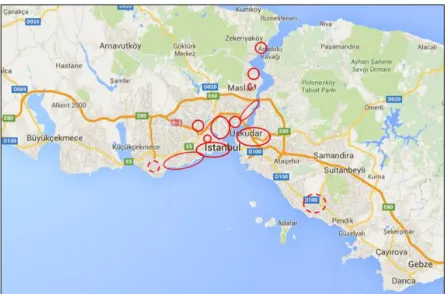
Figure 3. Approximate geographic coverage of the population register ... 29
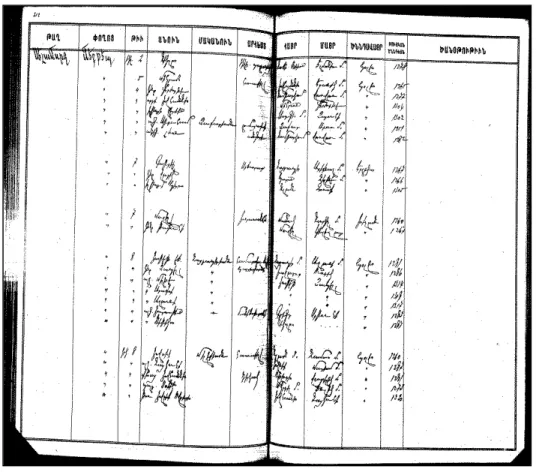
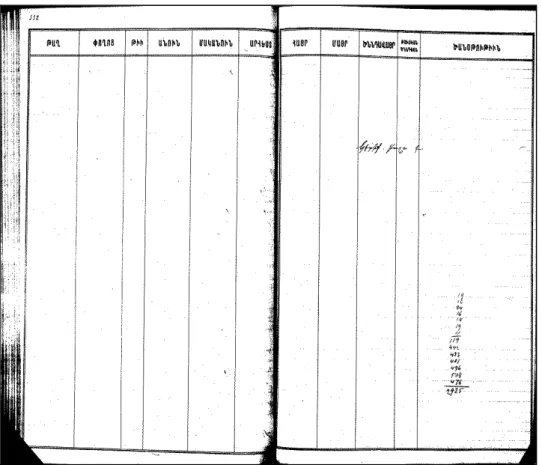
Figure 4. Page 312 of volume 1 ... 31
Figure 5. Page 474 of volume 2 ... 31
Figure 6. Page 332 of volume 2 ... 32
Figure 7. Two scribal notes ... 33
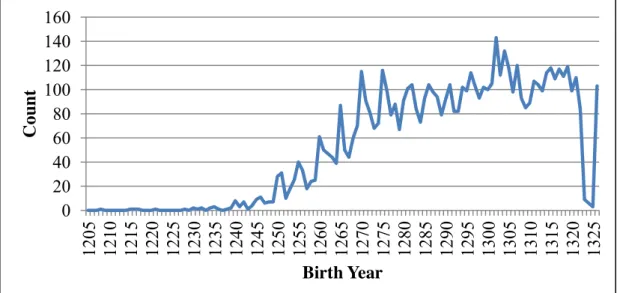
Figure 8. Count of people by birth year ... 42
Figure 9. Age/sex correlations ... 43
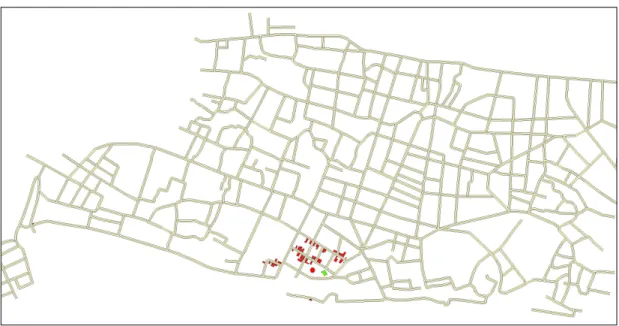
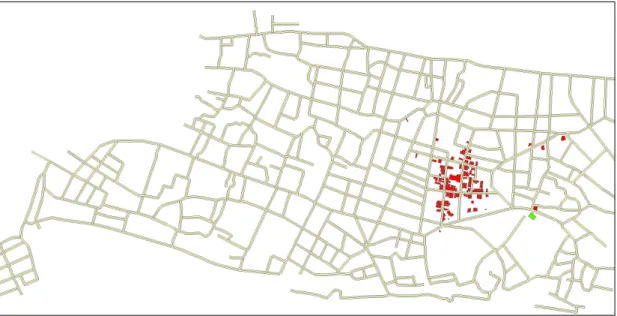
Figure 10. Organization of the Tavala Süleyman Ağa sub-district ... 48
Figure 11. Organization of the Bostan-ı Ali sub-district... 49
Figure 12. Organization of the Esir Kemal sub-district ... 49
Figure 13. Buildings recorded under more than one sub-district ... 50
Figure 14. The Gedikpaşa and Kumapı districts, with overlap highlighted ... 51
Figure 15. Detail of the Gedikpaşa-Kumkapı overlap ... 52
Figure 16. Most significant regions of birth... 54
Figure 17. Most significant regions and settlements of birth other than Istanbul ... 55
Figure 18. Map of birthplaces in Ottoman territory ... 56
Figure 19. Correlations between birth region and major secondary-sector occupational groups ... 58
Figure 20. Correlations between birth region and major tertiary-sector occupational groups ... 59
Figure 21. Places of residence for those born in Tekirdağ ... 60
Figure 23. 8 Müsellim Sokak or Caddesi ... 61
Figure 24. Proportions of household types among Armenians vs. Muslims ... 68
Figure 25. Proportions of residents living in Armenian vs. Muslim households ... 68
Figure 26. Average sizes of Armenian vs. Muslim households ... 69
Figure 27. Proportions of households headed by males vs. females—Armenians vs. Muslims ... 70
NOTES ON TRANSLITERATION,PLACE NAMES, AND DATES
Where commonly-used versions in Latin script do not exist, individuals’ Armenian names have been transliterated using the Turkish alphabet.
Where modern place-names in English or Turkish resemble closely those found in the sources, the preferably English but otherwise Turkish versions have been used (thus, Istanbul rather than İstanbul, Constantinople, or Bolis, Ankara rather than Engüri or Angora, and so on). Where they do not resemble, both the modern and the historical name have been indicated, giving preference to that used at the time (thus, Eğin is accompanied by Agın and Kemaliye and Kale-i Sultaniye is followed by Çimenlik Kalesi).
Dates have been converted from the Hijri and Rumi systems to the Gregorian system using the Turkish Historical Society’s calendar translation tool.i Conversions from Julian to Gregorian have been made using the United States National Aeronautics and Space Administration’s software.ii
i “Tarih Çevirme Kılavuzu,” Türk Tarih Kurumu, http://www.ttk.gov.tr/index.php?Page=
Sayfa&No=385.
ii “JavaScript Calendar Converter,” National Aeronautics and Space Administration,
INTRODUCTION
The thesis that follows draws from a variety of fields to introduce a new source and new methods to Ottoman, Armenian, and Middle Eastern studies. It has at its core a population register1 developed by the Armenian Apostolic (i.e., Gregorian) Patriarchate of Constantinople2 based on an early-twentieth-century census
conducted by the Ottoman General Directorate of Statistics (General Population Administration, Nüfus-u Umumi İdaresi). Relying primarily on this register, this thesis uses cross-tabulation analysis, digital cartography, and research in English, French, Turkish, and Armenian to answer three guiding questions: How was this census conducted, and what are its strengths and weaknesses? How can it be used to interrogate the relationship between an Armenian religious institution and the Ottoman state? And what does it reveal about Armenians living in southern Istanbul?
By drawing on the material that it does, this thesis aims to help bridge two sets of historiographic gaps, the first being linguistic. Given the multi-linguistic nature of the Ottoman Empire and its eventual dissolution into nation-states, historiographies on the Ottoman past have often been divided among language-based
1 In this thesis, following the common distinction made by sociologists and demographers, I use the
term census to refer to a synchronic process wherein all denizens or subjects of a state are counted and their individual characteristics are recorded in a systematic and, in intent, universal manner. Censuses—which, then, are not material records (e.g., notebooks, which are census records) but the processes that produce them—are different from population registers. Population registers are material records; they also aspire to systemacity and universality, but, unlike censuses and census records, they are continuously updated and are, therefore, living documents. Mark Mather, “Demographic Data: Censuses, Registers, Surveys,” in The Blackwell Encyclopedia of Sociology, ed. George Ritzer (Oxford: Blackwell Publishing, 2007), 1011–1014, 1011. Thus, around 1907, a census took place in Istanbul, and out of that process came a number of population registers.
2 Often forgotten is that there were two Armenian patriarchates in the city. While the better-known,
Apostolic one had been there since the fifteenth century, its Catholic counterpart was moved from Lebanon to the imperial capital and merged with the “community leadership” (milletbaşılık, ազգապետութիւն) there in 1866. H. Dj. Sirouni (Յ. Ճ. Սիրունի), Պոլիս եւ իր դերը [Bolis and its role], vol. 3 (Antelias, Lebanon: Տպարան Կաթողիկոսութեան Հայոց Մեծի Տանն Կիլիկիոյ, 1987), 420–421. For a biography of Sirouni, whose work is drawn on often in this thesis and who lived in Istanbul from 1901 to 1922, see “Կենսագրութիւն Յ. Ճ. Սիրունիի” [Biography of H. C. Siruni], Siruni, Bolis, III:Է–Ը. Bolis, referred to in the title of his book, is an Armenian name for Istanbul derived from the Greek Κωνσταντινούπολις/Konstantinoúpolis.
silos; a majority of studies are published in only one language (e.g., Arabic, Bulgarian, Greek, etc.) and draw mostly from literature in their own tongues. The limited fields of vision this creates—when coupled with the politics involved in writing for and against specific national narratives—has given rise to separate historiographic silos that do not speak to one another. This thesis helps bridge such gaps by drawing from scholarship in four languages and from a population register written first in Ottoman Turkish and then Armenian and Armeno-Turkish (i.e., Turkish in Armenian script).
The second gap this thesis helps bridge is that between Ottoman studies on the one side and Armenian and genocide studies on the other. For decades, the elision of the Armenian Genocide from Ottomanist research has created the false impression that genocide scholars have nothing to offer those not researching mass violence.3 But genocide studies has much to offer Ottomanists by way of data, arguments, and synthesis; given their focus on the destruction of Armenian collective existence in Anatolia, those in this field have discussed population and population recording often, and they have not shied away from literature in Armenian.
This thesis should be seen as part of a trend that took off in 2000, catalyzed by the establishment of the Workshop for Armenian/Turkish Scholarship (WATS) at the University of Michigan, Ann Arbor,4 and it follows along the lines of Taner
3 Howard Eissenstat, “Children of Özal: The New Face of Turkish Studies,” Journal of the Ottoman
and Turkish Studies Association 1, no. 1–2 (2014): 23–35, 24–28; Ayda Erbal, “The Armenian Genocide, AKA the Elephant in the Room,” International Journal of Middle East Studies 47, no. 4 (2015): 783–790; David Gutman, “Ottoman Historiography and the End of the Genocide Taboo: Writing the Armenian Genocide into Late Ottoman History,” Journal of the Ottoman and Turkish Studies Association 2, no. 1 (2015): 167–183.
4 “The Workshop for Armenian/Turkish Scholarship (WATS),” University of Michigan, last accessed
5 September 2015, http://www.ii.umich.edu/asp/academics/specialprojects/theworkshopforarmenian turkishscholarshipwats_ci; Ronald Grigor Suny, “Truth in Telling: Reconciling Realities in the Genocide of the Ottoman Armenians,” American Historical Review 114, no. 4 (2009): 930–46, 937– 946; Ronald Grigor Suny and Fatma Müge Göçek, “Introduction: Leaving It to the Historians,” in A Question of Genocide: Armenians and Turks at the End of the Ottoman Empire, ed. Ronald Grigor
Akçam’s 2004 call for the development of a “common body of shared knowledge” that can be trusted and used by all scholars working on Armenian, Ottoman, and Turkish history.5
My work also sits between social and quantitative history, and it remains conscious of a tension between these two approaches: whereas quantitative research is often seen as dehumanizing and positivistic, qualitative research is often considered ungrounded and imprecise. To balance these, this thesis asks questions about institutions, migration, patterns of settlement, and household formation by drawing from both demographic data and narrative texts. In its quantitative aspect, it is part of a popular tradition of numbers-backed economic research common among Ottomanists as well as Soviet-era Armenologists. In my commitment to connecting the numeric with the narrative, I have been inspired particularly by Ping-ti Ho, whose classic Studies on the Population of China exemplifies well the importance of putting
Suny, Fatma Müge Göçek, and Norman A. Naimark (Oxford: Oxford University Press, 2011), 3–11; Eissenstat, “Children of Özal,” 27–28.
5 Taner Akçam, “The Creation of a Common Body of Shared Knowledge for Armenian-Turkish
History,” c. 2004, University of Minnesota, last accessed 5 September 2015, http://chgs.umn.edu/ histories/turkisharmenian/atrpcommonknowledge.pdf.
The works of Tolga Cora and Murat Cankara, for example, stand at the cutting edge of this move to bring together Armenological and Ottomanist work. See, for instance, Yaşar Tolga Cora, “Why Was Pastırmacı Khatchatur Efendi Killed? The Life of an Ottoman-Armenian Elite in Mid-19th-Century Erzurum/Karin,” in Ottoman Armenians: Life, Culture, Society, ed. Vahe Tachjian (Berlin: Houshamadyan, 2014), 65–87; and Murat Cankara, “Rethinking Ottoman Cross-Cultural Encounters: Turks and the Armenian Alphabet,” Middle Eastern Studies 51, no. 1 (2015): 1–16.
Hagop Levon Barsoumian’s “The Armenian Amira Class of Istanbul” (PhD diss., Columbia University, 1980) and Stephan Astourian’s “Testing World-System Theory: Cilicia, 1830s–1890s; Armenian-Turkish Polarization and the Ideology of Modern Ottoman Historiography” (PhD diss., University of California, Los Angeles, 1996) are important milestones predating the creation of WATS. Barsoumian’s dissertation was published only recently, as Hagop Levon Barsoumian, The Armenian Amira Class of Istanbul (Yerevan: American University of Armenia, 2007); and Hagop L. Barsoumian, İstanbul’un Ermeni miralar Sınıfı, trans. Solina Silahlı (İstanbul: Aras Yayıncılık, 2013).
For a longer discussion on this topic, see Lerna Ekmekçioğlu, “Osmanlı ve Türkiye Kadın Hareketi Hakkındaki Tarihyazımında Türk ve/veya Müslüman Olmayan Kadınlar: Bir Yokluğun Anatomisi,” in Bir dalet Feryadı: Osmanlı’dan Türkiye’ye Beş Ermeni Feminist Yazar, 1862–1933, ed. Melissa Bilal and Lerna Ekmekçioğlu (İstanbul: Aras Yayıncılık, 2006), 327–340.
demographic data into their historical contexts—that is, uncovering how and why such data find their way into archives and understanding what local and institutional conditions were like when they were compiled.6
This thesis is also a digital humanities project, which means that it “us[es] digital technologies to study the humanities in ways not possible otherwise.”7 As a
method, it represents something new in Ottoman, Armenian, and Middle Eastern studies. At its back stands a one-year (December 2015–December 2016) research project run by M. Erdem Kabadayı and me at Istanbul Bilgi University, which is called Recovering Armenians in Late-Ottoman Istanbul and Making Ottoman-Era Population Data Available for All and is funded by the Calouste Gulbenkian Foundation. The project is based on two sets of records, of which the second is the core source of this thesis: Turkish-language, mid- to late nineteenth century registers of Armenian men living in southern Istanbul and stored now at the Ottoman Archives of the Office of the Prime Minister (Başbakanlık Osmanlı Arşivleri), in Istanbul;8 and a copy of the patriarchate’s population register for Apostolics living in Greater Istanbul during c. 1907, which is stored at the Krikor and Clara Zohrab Information Center of New York City, USA.9
The method by which the patriarchal register was transcribed and analyzed is as follows. These records were microfilmed some 35 years ago and copies were
6 Ping-ti Ho, Studies on the Population of China, 1368–1953 (Cambridge: Harvard University, 1959),
esp. 3–97.
7Michael Polczyński, “Digital Humanities, Mapping, and GIS,” 42–45, 42, in Chris Gratien, Michael Polczyński, and Nir Shafir, “Digital Frontiers of Ottoman Studies,” Journal of the Ottoman and
Turkish Studies Association 1, no. 1–2 (2014): 37–51. For more on such methods, see Anne Burdick et
al., ed., Digital_Humanities (Cambridge, Mass.: MIT Press, 2012).
8 Various items from populations register series Nüfus Defterleri (NFS.d) 200, 300, and 500, TC
Başbakanlık Osmanlı Arşivi, Istanbul, Turkey.
9 Items 1213461, 1213462, and 1213463, microfilm collection, Krikor and Clara Zohrab Information
given to various parties, including the Diocese of the Armenian Church (Eastern) in New York,10 which now houses the Zohrab Center. We were alerted to their existence by George Aghjayan of Boston, who, along with me, scanned them. Our research project assistant Sayat Tekir and I then transcribed the information in Armenian and Armeno-Turkish and transliterated it into Latin script, arranging it in a table, or cross-tabulation. This transcription was edited and the occupational information was categorized by Kabadayı and me according to a version of the Primary, Secondary, Tertiary System, an international system devised for comparative economic history.11 One tier of my analysis is tied to the tables developed through this process and involves classical methods of data manipulation such as sorting, filtering, and arithmetic.
The second tier of my analysis adds a spatial aspect to the work. Because the census recorded the residential addresses of Istanbul’s denizens, and because we have sufficiently detailed, contemporaneous maps for southern Istanbul, our project cartographer, Mehmet Başkurt, was able to map our transcriptions by geo-referencing cadastral maps created by Jacques Pervititch in the 1920s and by layering them on top of a modern, digital base. After ensuring that the warp and angling of the two lined up, he created a hybrid: a new layer representing the layout of streets and buildings as they were one century ago but using as its reference the same satellite
10 Armenian Genealogical Research Society Foundation co-founder Audrey Megerian, conversation
with Daniel Ohanian, 19 April 2015.
11 This system is managed by the Cambridge Group for the History of Population and Social Structure
(Campop) and was first adapted to the Ottoman Empire for Kabadayı’s project An Introduction to the Occupational History of Turkey via New Methods and New Approaches, 1840–1940 (Scientific and Technological Research Council of Turkey project 112K271). It was then adjusted to our collaborative project, Recovering Armenians. For more on it, see “Occupational Coding—the PST System,” Cambridge Group for the History of Population and Social Structure, http://www.geog.cam.ac.uk/research/projects/occupations/britain19c/pst.html (last accessed 10 May 2016).
cartography trusted by Google Maps and similar services.12 The geographic information systems (GIS) software with which this was done has allowed me to use cartography as an investigative tool and not only as an illustrative one. By allowing the “reconstruction of historical spaces and social relationships,” explains Michael Polczyński, GIS “enabl[es] the visualization of patterns … that [are] not otherwise … apparent.”13
This thesis’s reliance upon Armenian church demographic records is also part of an older trend, though the depth of its analysis is unprecedented. Over the past 25 years, Haroutune Armenian and his colleagues have used population, baptism, marriage, and death registers for epidemiological work;14 Anne Kazazian has surveyed such records to write a social-historical article on nineteenth-century Egypt;15 Hayg Jamgoçyan has drawn on them for biographical information;16
12 For more on Pervititch, see Müsemma Sabancıoğlu, “One Woman’s Quest to Trace the Legacy of
an Istanbul Cartographer,” Levantine Heritage: The Story of a Community, last accessed 27 March 2015, http://levantineheritage.com/testi48.htm; Müsemma Sabancıoğlu, “Jacques Pervititch and His Insurance Maps of Istanbul,” Dubrovnik Annals 7 (2003): 89–98; and Jacques Pervititch, Istanbul in the Insurance Maps of Jacques Pervititch, ed. Seden Ersoy and Çağatay Anadol (Istanbul: History Foundation of Turkey, [2001]).
13 Polczyński, “Digital Humanities,” 43. For overviews of historical GIS, see Anne Kelly Knowles,
“GIS and History,” in Anne Kelly Knowles and Amy Hillier, eds., Placing History: How Maps, Spatial Data, and GIS are Changing Historical Scholarship (Redlands: ESRI Press, 2008), 1–26; David J. Bodenhamer, “History and GIS: Implications for the Discipline,” in Knowles and Hillier, Placing History, 219–234; Anne Kelly Knowles, Amy Hillier, and Roberta Balstad, “Conclusion: An Agenda for Historical GIS,” in Knowles and Hillier, Placing History, 267–274; and Ian N. Gregory and Richard G. Healey, “Historical GIS: Structuring, Mapping and Analysing Geographies of the Past,” Progress in Human Geography 31, no. 5 (2007): 638–653. For a wide variety of examples of its application, see Knowles and Hillier, Placing History; and “Statistical Atlas,” A Vision of Britain through Time, http://www.visionofbritain.org.uk/atlas/.
14 Haroutune K. Armenian, James F. McCarthy, and Sevan G. O. Balabanian, “Patterns of Mortality in
Armenian Parish Records from Eleven Countries,” American Journal of Epidemiology 130, no. 6 (1989): 1227–35; Haroutune K. Armenian, James F. McCarthy, and Sevan G. O. Balabanian, “Patterns of Infant Mortality from Armenian Parish Records: A Study from 10 Countries of the Diaspora, 1737–1982,” International Journal of Epidemiology 22, no. 3 (1993): 457–62.
15 Anne Kazazian, “Les Arméniens en Égypte au XIXe siècle, identité et enregistrement,” Revue des
mondes musulmans et de la Méditerranée 127 (2010), http://remmm.revues.org/6617.
16 Հայկ Ա. Ժամկոչեան [Hayg A. Jamgoçyan], Յիշատակարան 125 ամեայ յոբելեանի ծնունդ Ս.
Աստուածածին Եկեղեցւոյ եւ Տատեան Վարժարանի Պաքըրգիւղի. 1844–1969 [Memorial volume for the 125th anniversary of the foundation of Surp Asdvadzadzin Church and the Dadyan Academy, 1844–1969] (Istanbul: OYA Matbaası, 1969).
Raymond Kévorkian, Paul Paboudjian, and many others have analyzed patriarchal population surveys from 1878 to 1914;17 and George Aghjayan has proposed comparing the c. 1907 register at the core of this thesis with a patriarchal count from 1913–1914, and he has published part of a 1914–1915 baptism register from a church in Kayseri.18 These studies are different from the present thesis in fundamental ways:
Haroutune Armenian’s group drew on small samples for research on disease; Kazazian provided only an overview of her observations; Jamgoçyan was interested in the birth dates and residential addresses of certain individuals; Kévorkian and Paboudjian—whose study is the largest in scale and the most ground-breaking of the set—did not have access to microdata (i.e., detailed information on individuals rather than group aggregates); and Aghjayan, in regard to this source, has only proposed an avenue of research. What is unprecedented, therefore, is the level of demographic detail—made possible by the availability of an immense, essentially untapped wealth of microdata—that is drawn on in this text.
Without a doubt, this thesis’s closest parallel is Alan Duben and Cem Behar’s unsurpassed 1991 study, Istanbul Households: Marriage, Family and Fertility,
1880–1940. That monograph drew on part of the c. 1907 population records as well
as other sources to conduct a demographic study of the city’s local Muslim population over the course of some sixty years. Chapter 5 of this thesis is inspired by Duben and Behar’s interdisciplinary work, though it differs from theirs in its scale and parameters. Duben and Behar, having been given limited access to only some of
17 Raymond H. Kévorkian and Paul B. Paboudjian, Les rméniens dans l’Empire ottoman à la veille
du génocide (Paris: Les Editions d’art de d’histoire, 1992). Also available as 1915 Öncesinde Osmanlı İmparatorluğu’nda Ermeniler, trans. Mayda Saris (Istanbul: Aras Yayıncılık, 2013).
18 George Aghjayan, “A Glimpse into the Armenian Patriarchate Censuses of 1906–1907 and 1913–
1914,” special issue, “Commemorating Genocide: Images, Perspectives, Research,” Armenian Weekly, April 2008, 14–16; George Aghjayan, “Weekly Publishes Baptism Records from Gesaria, 1914–15,” Armenian Weekly, 16 January 2014, http://armenianweekly.com/2014/01/16/baptism-records/.
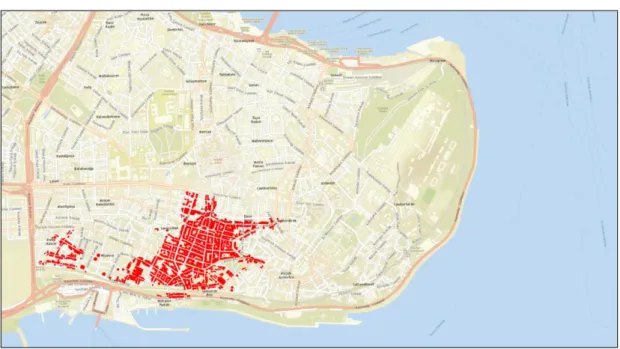
these registers, had drawn from them a sample of 4,932 Muslims living permanently in certain parts of Istanbul. This represented a 5% sample of about 100,000 Muslims, of whom only 1,634 were in the area dealt with in this thesis.19 In contrast to their work, I focus on 6,265 Armenians—most of them Apostolics but also including some Catholics and Protestants—registered in one part of the city: what were then the districts of Gedikpaşa and Kumkapı, now Binbirdirek, Emin Sinan, Küçük Ayasofya, Mimar Hayrettin, Mimar Kemalettin, Muhsine Hatun, Saraçishak, and Şehsuvar Bey (i.e., the southern regions of today’s municipality of Fatih) (see Figure 1).20 Also, while Duben and Behar, by layering their sample from c. 1907 with other sources that covered c. 1880 – c. 1940, had been able to add a diachronic aspect to their work, this study is mostly a synchronic one wherein the information recorded by census enumerators represents a much shorter snapshot of time.
Because of how the c. 1907 census was organized and due to subsequent historical developments, some of these census records are now held by certain post-Ottoman states. These have been used to write the histories of Palestine, a region of Greece, and two Western Anatolian villages.21 But many other records have been lost
19 “Istanbul Households,” SALT Research, last accessed 15 May 2015,
https://www.archives.saltresearch.org/R/NL99MCX92VM1ALXIILVKGMDVKDPJJSQLETS5F91 MESVEQF9DCR-04529?func=collections&collection_id=3241&pds_handle=GUEST; Alan Duben, “1907 Census of Istanbul,” version 1.0, Mosaic historical microdata file, Mosaic Project, 2013, http://censusmosaic.org/web/data/mosaic-data-files; Alan Duben and Cem Behar, Istanbul Households: Marriage, Family and Fertility, 1880–1940 (Cambridge: Cambridge University Press, 1991), 15–20. The latter is also available as İstanbul Haneleri: Evlilik, ile ve Doğurganlık, 1880– 1940, trans. Nuray Mert (Istanbul: İletişim Yayınları, 1996; Istanbul: Boğaziçi Üniversitesi Yayınevi, 2013). For the districts and sub-districts in which these 100,000 lived, see Duben and Behar, Istanbul Households, 252.
20 “Coğrafi Bilgi Sistemi,” version 4.0, TC Fatih Belediyesi, https://gis.fatih.bel.tr/webgis/default.
aspx, last accessed 18 June 2016.
21 See, for example, U. O. Schemlz, “Population Characteristics of Jerusalem and Hebron Regions
according to Ottoman Census of 1905,” in Ottoman Palestine, 1800–1914: Studies in Economic and Social History, ed. Gad G. Gilbar (Leiden: E. J. Brill, 1990), 15–68; Johann Büssow, Hamidian Palestine: Politics and Society in the District of Jerusalem, 1872–1908 (Leiden: Brill, 2011); Roxane Caftanzoglou, “Shepherds, Innkeepers, and Census-Takers: The 1905 Census in Two Villages in Epirus,” Continuity and Change 12, no. 3 (1997): 403–424; Necat Çetin, “Ödemiş İlkkursun (Hacı İlyas-Burhaniye) Köyü’nde 1320 (M. 1904) Yılı Nüfus Sayımı,” Atatürk Dergisi 1 (2012): 405–424;
or destroyed. While the registers Duben and Behar had consulted have survived, they are no longer being made available to researchers.22 Thus, the patriarchate’s copy has been, for some time, the only version of the c. 1907 census results available to scholars of Istanbul. According to Oktay Özel, this block by the Archives of the General Directorate of Civil Registration and Citizenship (Nüfus ve Vatandaşlık İşleri Genel Müdürlüğü Arşivi) has stunted the development of Ottoman historical demography—a situation that this thesis stands in a position to help correct.23
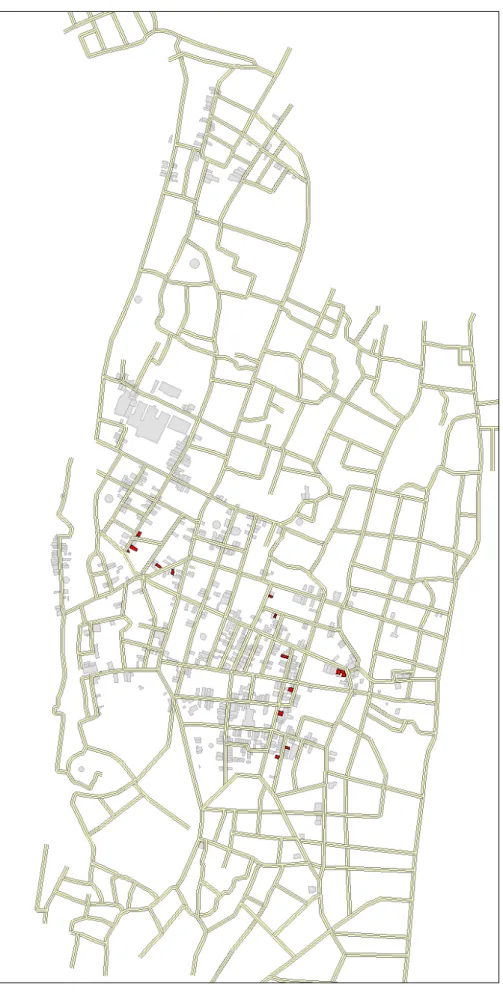
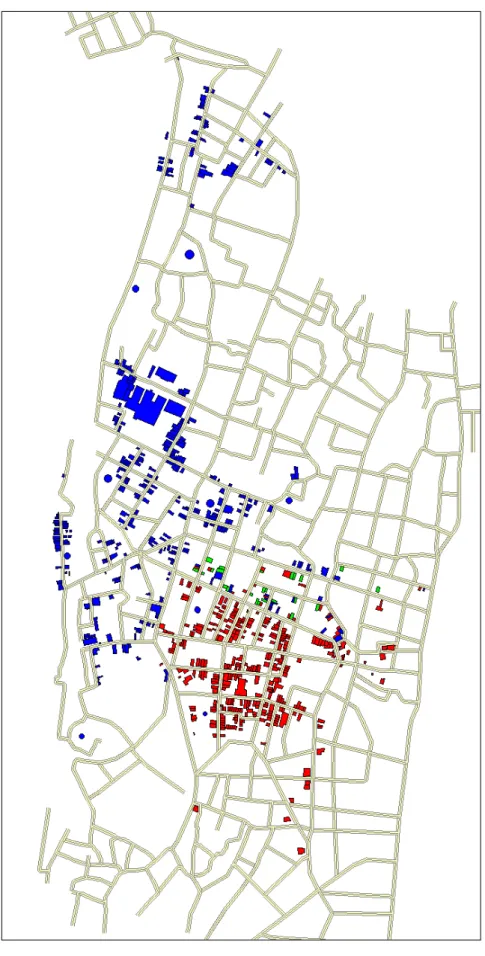
Figure 1. Istanbul today and the area covered in this thesis
The text that follows unfolds in the following way. Chapter 1 provides an introduction to population registration in the Ottoman Empire, the politics involved in it, and the historiographic discussions regarding the reliability of “Ottoman” vs.
and Necat Çetin, “Tiryanda Nahiyesi Çengele Karyesinde (Torbali-Ormanköy) 1321 (Miladi 1905) Yılı Osmanlı Nüfus Sayımı,” Çağdaş Türkiye Tarihi raştırmaları Dergisi 12, no. 24 (2012): 47–85. See also İpek K. Yosmaoğlu, “Counting Bodies, Shaping Souls: The 1903 Census and National Identity in Ottoman Macedonia,” International Journal of Middle East Studies 38 (2006): 55–77, which discusses not the contents of population records but the socio-political dynamics involved in their production.
22 Cem Behar, “Sources pour la démographie historique de l’Empire ottoman. Les tahrirs
(denombrements) de 1885 et 1907,” Population 1–2 (1998): 161–178, 167.
23 Oktay Özel, “Osmanlı Demografi Tarihi ve Osmanlı Arşivleri,” in Uluslararası Türk rşivleri
Sempozyumu: 17–19 Kasım 2005, İstanbul; Tebliğler-Tartışmalar, ed. Nuran Koltuk (Ankara: T. C. Başbakanlık Devlet Arşivleri Genel Müdürlüğü, 2006), 52–63, 61, 63.
“Armenian” data. It posits that this population register gives us a good opportunity to complicate this dichotomy and to remember that the patriarchate (i.e., “Armenians”) was very much involved in producing “Ottoman” data. In chapter 2, the c. 1907 census’s regulations are summarized, and, in chapter 3, the involvement of the patriarchate is taken up, as are the process by which it created its own copy of those records, the strengths and weaknesses of its copy, and the strengths and weaknesses of the census itself. Chapter 4 then deals with migration and settlement patterns and chapter 5 provides a comparison between Armenian and Muslim household structures. My hope is that, by its end, readers will come away from this text with new ideas on how the digital humanities might be brought into Ottoman, Armenian, and Middle Eastern studies and with new data and arguments to work with in their own endeavours.
CHAPTER 1.POPULATION REGISTRATION AND HISTORIOGRAPHY
As had been the case with polities around the world since ancient times, in the pre–c. 1830 Ottoman Empire, counts of the imperial population had been conducted systematically and frequently. These pre–c. 1830 counts are best described as pre-modern in that they revealed pre-modern administrations’ narrower interests in their populace. Concerned mainly with resources they could exploit, administrators, when looking to their human resources, focused on the individuals who could provide the state with manpower and material wealth. Because these resources were extracted through levies of cash and products (i.e., taxes) or bodies and services (e.g., conscription, corvée), pre-modern Ottoman censuses focused on young and adult males.24
Over the course of the nineteenth century, states around the world sought increasingly to usurp the roles of the parallel, non-state institutions in their domains; to collect and analyze quantitative information about previously uninteresting topics; and to fashion more direct and powerful bonds with—and, thereby, strengthen their control over—their denizens.25 Thus, over the course of the nineteenth century, the scope of censuses in the Ottoman Empire changed in tandem with global trends.26 Although scholars differ on what they consider to have been the first modern
24 Gilles Veinstein, “Les registres de recensement ottomans. Une source pour la démographie à
l’époque moderne,” Annales de Démographie Historique 1 (1990): 365–378; Halil İnalcık and Şevket Pamuk, eds., Osmanlı Devleti’nde Bilgi ve İstatistik (Ankara: TC Başbakanlık Devlet İstatistik Enstitüsü, 2000); Özel, “Osmanlı Demografi Tarihi.”
25 The literature on pre-modern vs. modern states and what characteristics are typical of each is
immense. Among the best places to start is Michael Mann’s provocative and quantitatively-backed The Sources of Social Power, vol. 2, The Rise of Classes and Nation States, 1760–1914 (Oxford: Cambridge University Press, 1993).
26 Kemal H. Karpat, “The Ottoman Adoption of Statistics from the West in the 19th Century,” in
Studies on Ottoman Social and Political History: Selected Articles and Essays (Leiden: Brill, 2002), 132–145 (first published in Transfer of Modern Science and Technology to the Muslim World … , ed. Ekmeleddin İhsanoğlu [Istanbul: Research Centre for Islamic History, Art, and Culture, 1991], 283– 295).
Ottoman census, most agree that it appeared at some point between c. 1830 and c. 1885.
For Servet Mutlu, Enver Ziya Karal, and Kemal Karpat, this designation belongs to an enumeration in the Balkans and Anatolia conducted beginning in 1830 or 1831. It was never completed, however, and the data that was collected was not recorded systematically.27 Other censuses followed, including several surveys of Istanbul and empire-wide counts in the 1870s and c. 1885.28 These two later imperial censuses were not completed either, but they did demonstrate the state’s growing appetite for information as well as its increasing skill at standardizing and regulating the collection of demographic data.
This growing appetite for information and regulation was demonstrated in the new questions asked by enumerators and the new templates they used. For instance, in c. 1885, the state shifted from writing out demographic information in paragraphs to using likely Belgian-style cross-tabulations.29 Infant males—a group previously excluded because they were much too young to have their wealth or service levied and because a significant proportion would die before reaching adulthood—came to be recorded in the middle of the nineteenth century, and only in c. 1885 did females—a group whose wealth or service was never levied by the Ottoman state, as
27 Enver Ziya Karal, Osmanlı İmparatorluğunda İlk Nüfus Sayımı, 1831 (Ankara: TC Başbakanlik
Devlet İstatististik Enstitüsü, 1943); Stanford J. Shaw, “The Ottoman Census System and Population, 1831–1914,” International Journal of Middle East Studies 9 (1978): 325–338, 325–327; Kemal H. Karpat, Ottoman Population, 1830–1914: Demographic and Social Characteristics (Madison: University of Wisconsin Press, 1985), 8, 18–23; Servet Mutlu, “Late Ottoman Population and Its Ethnic Distribution,” Nüfusbilim Dergisi 25 (2003): 3–38, 4; Cem Behar, “Osmanlı Nüfus İstatistikleri ve 1831 Sonrası Modernleşmesi,” in İnalcık and Pamuk, Osmanlı Devleti’nde Bilgi ve İstatistik, 61– 72, 63, 68–69. For Behar, this was the first “early modern” census and a “precursor” to the modern ones.
28 Regulations for an 1880s attempt were promulgated in 1881 and the census was conducted in the
years that followed. Scholars have referred to it as the 1300, 1301, 1881, 1881/1882, 1881/1882–1893, 1881–1893, and 1885 attempt. I use “c. 1885” to remind us that the process took several years, and that its start and end points are not known. On the uncertainty regarding dates, see Karpat, Ottoman Population, 33, 103–104.
with most other states—draw the attention of census takers.30 Similarly, it was only in the 1880s that administrators began to collect information on vital events (i.e., births, marriages, divorces, and deaths) in a systematic manner.31
As the scope of censuses and the format of census records changed, so, too, did the organization of enumerating bodies. A centralized body responsible for collecting demographic information from across the empire first appeared in 1874; it was established within the Ministry of the Interior and was tasked with conducting censuses from that date onward, including in c. 1907.32
In the clarity of its regulations, its adoption of uniform tabulation sheets, its inclusion of females, its level of individual precision, and in that it was “undertaken for purposes other than … taxation or military conscription,” the c. 1885 census represented a milestone in the development of Ottoman statistics.33 While much progress was made, it was not completed either, however, and, for this and other reasons, in 1900, administrators decided to make a renewed attempt at conducting a count along similar lines but with an improved system of implementation—what became the c. 1907 census.34
After c. 1907 came a final attempt at imperial recording: a “secret census” carried out in 1915.35 Finally, a 1919 report called Memalik-i Osmaniye’nin 1330
30 Duben and Behar, Istanbul Households, 15–16. 31 Behar, “Osmanlı Nüfus İstatistikleri,” 65.
32 Behar, “Osmanlı Nüfus İstatistikleri,” 70. The introduction of this style of enumeration, which
represented an increasingly intrusive state and an increasingly professionalized civil service, was in line with the development of modernization that had expanded out from the United States, Great Britain, France, and Germany over the course of the nineteenth century. C. A. Bayly, The Birth of the Modern World, 1780–1914: Global Connections and Comparisons (Oxford: Blackwell Publishing, 2004), 274–283.
33 Duben and Behar, Istanbul Households, 15–16. 34 Karpat, Ottoman Population, 35.
35 Fuat Dündar, Crime of Numbers: The Role of Statistics in the Armenian Question, 1878–1918 (New
Senesi Nüfus İstatistiği represented the final involvement of the Ottoman
administration in this domain. An “updated” version of the c. 1907 census, it was an aggregate report of the sizes of various religious and linguistic groups living in the dissolving empire’s provinces and sub-provinces.36
* * *
Ever since the politicization of Ottoman population statistics in 1878, there has been disagreement over the reliability of numbers computed by the state. Such political and historiographic discussions have been active especially among those wishing to comment on whether or not the Ottoman administration targeted Armenians with mass violence between the 1890s and 1920s.37 The disagreement is by now firmly polarized and calcified: those arguing against mass violence have expressed great confidence in state sources and lack of confidence in numbers published by Armenian institutions, and those arguing for state complicity have said the opposite. The population register at the heart of this thesis invites us to complicate this dichotomy, as it can be used as a case study of how both the Ottoman central administration and the Armenian Apostolic Patriarchate of Constantinople were involved in the development of population data. Thus, and in order to understand the strengths and weaknesses of that data, a discussion of this historiographic debate is in order.
36 Mutlu, “Late Ottoman Population,” 8.
37 Dündar, Crime of Numbers; Ռոբերտ Թաթոյան [Robert Tatoyan], Արևմտահայության
թվաքանակի հարցը 1878–1914 թվականներին [The question of the number of Western Armenians during 1878–1914] (Yerevan: Հայոց ցեղասպանության թանգարան-ինստիտուտ, 2015), esp. 71– 164. There was also a parallel debate between Ottomanists and Hellenists. See, for example, Paschalis M. Kitromilides and Alexis Alexandris, “Ethnic Survival, Nationalism and Forced Migration: The Historical Demography of the Greek Community of Asia Minor at the Close of the Ottoman Era,” Δελτίο Κέντρου Μικρασιατικών Σπουδών (Bulletin of the Centre for Asia Minor Studies) 5 (1985): 9– 44, 9–10, 21–30.
As the majority of Ottoman Armenians lived in the empire’s eastern provinces, these discussions have focused upon population figures for those regions, and researchers have used those case studies to comment on the collection and use of data for the empire overall.
One broad critique has come from Sarkis Karayan, who, in referring to Vital Cuinet’s large and oft-cited demographic and geographic work, has stated the following: “Cuinet’s figures, based presumably on Ottoman data, are often so off the mark that they cast heavy doubt on the degree of accuracy of the published Ottoman data.”38 Based on a case study of the province of Van, Karayan has concluded that “basing one’s numbers on official Ottoman statistics is a guarantee of nothing.”39 Similar arguments have been made by Fuat Dündar and Vahakn Dadrian.40
Daniel Panzac, Justin McCarthy, and Karpat have argued for the reliability of state data. Their arguments have been premised on the conviction that Ottoman administrators would not have manipulated their own information because they would have needed reliable figures to conduct their fiscal and military programs.41 While intuitive, this argument has only really been a postulate, for administrators could conceivably have been willing to have lost tax revenue and conscripted fewer people if they had had a compelling reason to do so. Dündar has responded to this
38 Sarkis Y. Karayan, “Vital Cuinet’s La Turquie d’ sie: A Critical Evaluation of Cuinet’s
Information about Armenians,” Journal of the Society for Armenian Studies 11 (2000): 53–63, 53.
39 Karayan, “Vital Cuinet,” 54.
40 Dündar, Crime of Numbers, 3; Vahakn N. Dadrian, “Ottoman Archives and Denial of the Armenian
Genocide,” in The Armenian Genocide: History, Politics and Ethics, ed. Richard G. Hovannisian (New York: Palgrave MacMillan, 1992), 280–309, 294–296. Dündar’s argument is more tempered than that of Dadrian.
41 Justin McCarthy, Muslims and Minorities: The Population of Ottoman Anatolia and the End of the
Empire (New York: New York University Press, 1983), 3, 57–63; Karpat, Ottoman Population, ix, 6– 11; Daniel Panzac, “L’enjeu du nombre. La population de la Turquie de 1914 à 1927,” special issue, “Turquie, la croisée des chemins,” Revue de l’Occident musulman et de la Méditerranée 50 (1988): 45–67. McCarthy’s book is also available as Müsülmanlar ve zınlıklar: Osmanlı nadolusu’nda Nüfus ve İmparatorluğunun Sonu (İstanbul: İnkılap Kitabevi, 1998).
line of reasoning, “The population census was not carried out simply for military or taxation purposes. … They were also carried out to determine the ratio according to which non-Muslims would participate in state administrative mechanisms through local and central meclises, or councils.” Given the politicization of statistics, “Ottoman authorities tended to control [i.e., manipulate?] population data where non-Muslims formed a local majority.”42
Servet Mutlu, like Karpat and McCarthy, has expressed distrust in non-state sources. But he has neither identified the non-state sources he is referring to nor has he explained the difference between these two categories. McCarthy, on the other hand, has been aware of such sources but has systematically mischaracterized or ignored them.43 For Mutlu, while “the Ottomans produced figures based on censuses,” others—“protagonists of various political causes”—only “advanced … numbers.” “Population figures were produced to justify [the] separatist and irredentist demands” of the “principal ethnic minorities,” including Armenians.44
Raymond Kévorkian, Paul Paboudjian, and Robert Tatoyan have done the most with demographic material on Armenians produced by Armenians themselves.45 In his account of the underpinnings of the Armenian Genocide, Kévorkian has been in agreement with Dündar and Tatoyan that the collection of
42 Dündar, Crime of Numbers, 3. On how appointments to these councils had been set up to seem
democratic and proportional but were not really so, see Édouard Driault, La question d’Orient depuis ses origines jusqu’à la paix de Sèvres (1920), rev. 8th ed. (Paris: Librairie Félix Alcan, 1921), 187. On how provincial and municipal government were supposed to be run in the late nineteenth century, see Stanford J. Shaw and Ezel Kural Shaw, History of the Ottoman Empire and Turkey, vol. 2, Reform, Revolution, and Republic: The Rise of Modern Turkey, 1808–1975 (Cambridge: Cambridge University Press, 1977), 83–95.
43 Levon Marashlian, Politics and Demography: Armenians, Turks, and Kurds in the Ottoman Empire
(Cambridge: Zoryan Institute, 1991), 13–28.
44 Mutlu, “Late Ottoman Population,” 3. The best account of what sorts of information were collected
by ecclesiastical bodies and how that was done is Tatoyan, Question of the Number, 71–120.
45 See especially Kévorkian and Paboudjian, Arméniens; and Tatoyan, Question of the Number, 71–
demographic data on Armenians was, after 1878, a political act. He has argued that Ottoman central administrators systematically falsified their records and artificially minimized the number of Armenians especially in the eastern provinces in order to undermine the bases upon which they could call for greater political rights.46 While he states, without going into any detail, that the numbers for the western half of the empire, including Istanbul, seem not to have been doctored in this way, his arguments seem to draw those data into question, too.
Regarding the aggregate population counts produced by the patriarchate during 1878–1914, Kévorkian has argued for their accuracy based on the logic that it was the patriarchate’s intention to secure European oversight over the eastern provinces. If the patriarchate had grossly doctored its reports, these overseers would have uncovered this manipulation upon their arrival. Such manipulation would therefore have been a self-defeating enterprise.47 Tatoyan, in his recent and much-needed intervention, has differed from others by shedding light on the aspects of these projects that enumerators and observers had found to be problematic or insufficient.48
What is often missing from this well-worn historiographic debate is recognition that the patriarchate was not an isolated and solely religious institution. It was a complex one fulfilling a number of conflicting roles (and not always able to balance them).
46 For the details of his argument, see Raymond H. Kévorkian, Le génocide des Arméniens (Paris:
Odile Jacob, 2006), 332–343. Also available as The Armenian Genocide: A Complete History (New York: IB Tauris, 2011); and Ermeni Soykırımı (Istanbul: İletişim, 2015).
47 Kévorkian, Génocide, 332–343. For a parallel argument, see Astourian, “Testing World-System
Theory,” 109–122.
48 In his study of the eastern and eastern Mediterranean provinces, he outlines how the patriarchate’s
lack of experience, local factors to do with safety and the strength of patriarchal institutions, and interference by the central administration resulted in incomplete results. Tatoyan, Question of the Number, 71–120.
Part of this complexity came out of its affinity with the Ottoman administration, an institution with which it was interconnected and interdependent. This affinity had been a feature of the patriarchate since its founding. It had been created by an Ottoman ruler in the fifteenth century and, as the empire’s borders and the administration’s power had expanded, so, too, had the jurisdiction and authority of the patriarchate. This had been true to such an extent that, from the fifteenth until the eighteenth centuries, the patriarchate, by virtue of its special relationship, had been able to annex property and populations under the purview of its parallel and superior bodies across the Ottoman realms (i.e., the patriarchate in Jerusalem, the catholicosate in Sis [Kozan], and the catholicosate on Aktamar Island).49 During the 1760s, when the catholicos at Echmiadzin had tried to impose its authority over the patriarchate, it had been by sultanic decree that Echmiadzin’s representative in Istanbul had been expelled.50 This cooperation had continued into the nineteenth century, during the early part of which the patriarchate and the central administration had worked together to oppose the common threat of Roman Catholicism; during 1827–1828, a coordinated campaign had led to the expulsion from the capital of 12,000 Catholic Armenians.51 When, during 1852–1855, the state was working to usurp and redistribute the unprecedented wealth of Mkrdich Cezayirliyan, it was at
49 Sebouh Aslanian, Dispersion History and the Polycentric Nation: The Role of Simeon
Yerevantsi’s Girk‘ or koči partavčar in the 18th Century National Revival (Venice: Saint Lazarus,
2004), 21–23, 38; Վարուժան Քէօսէեան [Varujan Köseyan], Պատրիարքական Աթոռի պատմութիւնը [History of the Patriarchate] (Istanbul: Ժամանակ, 1999), 103–104.
50Aslanian, Dispersion History, 43–44.
51 Վարուժան Քէօսէեան [Varujan Köseyan], 250 յոբելինական յուշամատեան Մայր Եկեղեցւոյ
դպրաց դասուն, 1719–1924 [250th anniversary memorial volume of the choir of the Mother Church of
Kumkapı] (Istanbul: Մարմարա, 1971), 24–25; Վ. Ա. Պարսամյան and Շ. Ռ. Հարությունյան [V. A. Parsamyan and Sh. R. Harutyunyan], Հայ ժողովրդի պատմություն. 1801–1978 թթ. [History of the Armenian people, 1801–1978]. (Yerevan: «Լույս» հրատարակչություն, 1979), 118.
the patriarchate that this banker was imprisoned for one and a half years.52 This relationship seems to have become more strained after 1878, but it did not break. During the 1890s, the two worked together to monitor the emigration of Armenian peasants from the eastern provinces, which, according to David Gutman, had become a shared threat.53 After the Hamidian Massacres, it was under pressure from the
administration that Madteos İzmirlyan was replaced by Malachia Ormanian as patriarch (r. November 1896 – July 1908). From then until now, the verdict on Ormanian’s tenure has remained divided: while some have seen him as having done the best he could have under unforgiving circumstances, others have seen him a collaborator—so much so that, in 1903, he was the target of an unsuccessful assassination attempt and, in 1908, the subject of a scathing book titled The Lair of
Corruption; or, Ormanian’s Patriarchate.54
The affinity between these institutions is not new knowledge. It was known to many Ottoman Armenian intellectuals and, thus, has been an underlying assumption in much—though not all—scholarship that has used Armenian sources. But, as with the scholarship on Orthodox Christians (i.e., “Greeks,” Rum), it has been entirely absent from the work of most Ottomanists.55 As we will see in the next chapter, the
52 Mustafa Erdem Kabadayı, “Mkrdich Cezayirliyan; or, The Sharp Rise and Sudden Fall of an
Ottoman Entrepreneur,” in Merchants in the Ottoman Empire, ed. Suraiya Faroqhi and Gilles Veinstein (Paris: Peeters, 2008), 281–299.
53 David Edward Gutman, “Sojourners, Smugglers, and the State: Transhemispheric Migration Flows
and the Politics of Mobility in Eastern Anatolia, 1888–1908” (PhD diss., Binghamton University, 2012), 60–61.
54 Ա. Գրիգորեան [A. Krikorian], Փտութեան օճախը կամ Օրմանեանի պատրիարքութիւնը [The
lair of corruption; or, Ormanian’s patriarchate] (Boston: «Ազգ», 1908).
55 The revisionist, amalgamative historiography on Orthodox Christians has been increasing over the
past 30 years. For an account of its rise, see Evangelia Balta, “Turkish Archival Material in Greek Historiography,” in Koltuk, Uluslararası, 355–285. For but four diverse examples of this genre that can serve as sources of inspiration for researchers of Armenian history, see Ayşe Ozil, Orthodox Christians in the Late Ottoman Empire: A Study of Communal Relations in Anatolia (New York: Routledge, 2013); Christine M. Philliou, Biography of an Empire: Governing Ottomans in an Age of Revolution (Berkeley: University of California Press, 2011); Anastasios G. Papademetriou, “Ottoman Tax Farming and the Greek Orthodox Patriarchate: An Examination of State and Church in Ottoman
patriarchate and its clergymen were not segregated from but intimately involved in the c. 1907 census and the updating of its resultant population registers.
Society, 15–16th Century” (PhD diss., Princeton University, 2001); and Elif Bayraktar Tellan, “The
Patriarch and the Sultan: The Struggle for Authority and the Quest for Order in the Eighteenth-Century Ottoman Empire” (PhD diss., İhsan Doğramacı Bilkent University, 2011).
CHAPTER 2.THE SCOPE AND REGULATIONS OF THE C.1907CENSUS
In 1902, the publishing house Manzume, likely owned by Hovhannes Ferit Kayseryan,56 published a 60-page booklet called The Latest Regulation Concerning
Population Enumeration.57 It was an Armenian translation of a 12 June 1902 (i.e., 5
Reb-ül-evvel 1320, 30 May 1318) regulation (Sicill-i Nüfus Nizamnamesi) and was marketed as “necessary for every individual.”58
This booklet was meant to give clear and detailed instructions to counters and counted about how the census should take place across the empire. It outlined who should be involved in the process and what penalties would apply to those who did not conform. It succeeded a regulation of 28 June 1900 (i.e., 29 Safer 1318, 14/15 June 1316)59 and applied the lessons learned from preceding attempts.60 In order to understand how the c. 1907 census was conducted, an overview and discussion are in order.
To understand the census regulations, it is first necessary to emphasize that administrators’ main intention was to produce population registers for all denizens of the empire—a feat of unmatched scale. Those who had created the 1902 regulations
56 Ամալյա Գեղամի Կիրակոսյան [Amalya Geghami Kirakosyan], comp., Հայ պարբերական
մամուլի մատենագրություն. 1794–1967 [Bibliography of the Armenian periodical press, 1794–1967] (Yerevan: ՀՍՍՀ Ալ. Մյասնիկյանի անվան հանրապետական գրադարանի կոմպլեկտավորման բաժին, 1970), 115, 294, 614; Թէոդիկ [Teotig], Ամէնուն տարեցոյցը. Զբօսալի ու պիտանի. 1907 [Everyone’s almanac: Entertaining and useful, 1907] (Constantinople: տպ. Վ. եւ Հ. Տէր-Ներսէսեան, [1906]), 237.
57 Մարդահամարի վերջին կանոնագիրը [The latest regulation concerning population enumeration]
(Constantinople: Մանզումէ, 1902).
58 For Ottoman Turkish versions, see Karakoç Sarkis, Külliyât-ı Kavânîn, ed. M. Akif Aydın et al.
(Ankara: Türk Tarih Kurumu, 2006), 934.
59 For Ottoman Turkish versions, see Sarkis, Külliyât-ı Kavânîn, 915.
60 Latest Regulation, 75. Manzume had also published the regulations for the c. 1885 census, which,
being much less detailed, were encapsulated in a mere 15 pages. Մասնաւոր հրահանգ վերանորոգման մարդահամարին Կ. Պօլսոյ [Special orders concerning the renewal of the population enumeration of Constantinople] (Constantinople: Մանզումէ, 1884). For a comparison between the 1874, 1881, 1900, and 1902 regulations that reveals the strong continuities between them as well as what was new in each, see Shaw, “Ottoman Census System,” 329–335. Great care should be taken with this text, which conflates what was stipulated in regulations with what was actually done.
had therefore gone to great pains to explain clearly which officials should be involved in creating the population rosters, which should be responsible for keeping them up to date, how the enumerated should be categorized, and in what media the resulting data should be organized.
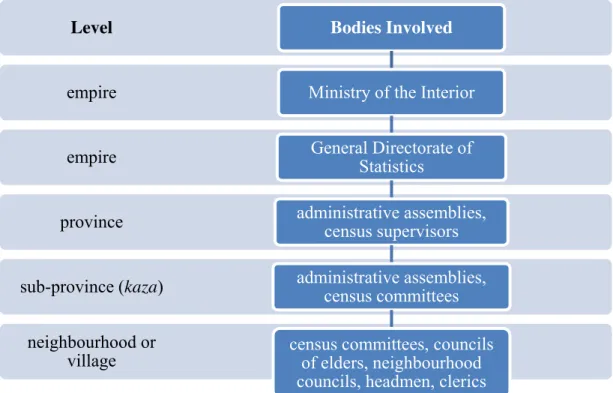
The first theme that comes across from reading the regulation is that the census was envisioned as unfolding within a relatively new, strict hierarchy that was linked with older and more established systems. Figure 2 illustrates these links between the General Directorate of Statistics and other bodies.61
Figure 2. Census hierarchy
To produce the initial rosters, a specially trained62 census enumeration committee would begin its work by setting up an office in a sub-province’s (kaza’s) most central village or neighbourhood.63 As the census would be a de facto rather
61 Latest Regulation.
62 Latest Regulation, art. 14–21. 63 Latest Regulation, art. 63.
neighbourhood or village sub-province (kaza) province empire empire
Level Bodies Involved
Ministry of the Interior General Directorate of Statistics administrative assemblies, census supervisors administrative assemblies, census committees census committees, councils
of elders, neighbourhood councils, headmen, clerics
than a de jure count—that is, it would record people where they actually were, rather than in other places that might be considered their official places of residence64—it would record information on all those physically present in that sub-province.65 Present at the time of enumeration was supposed to have been quite a large assembly, made up of the neighbourhood’s or village’s headman (muhtar), council of elders (ծերերու ժողով, ihtiyar meclisi), and clerics (an imam, secular priest,66 or rabbi, as applicable) in addition to the census committee members.67 The old census registers were to be present, too, to allow enumerators to inquire into any inconsistencies.68
During and after the census, at least five types of records were expected to be produced, with one set for each ethno-religious “community” (հասարակութիւն): preliminary notebooks (նախնական ձեռատետրեր), main registers for locals (հիմնական տոմարներ, մայր տոմարներ, esas defterleri, basic registers), non-locals’ registers (օտարականներու տոմարներ, ecnebi defterleri, yabancı defterleri), vital events registers (պատահական դէպքերու տոմարներ, vukuat defterleri), and summary registers (icmal).69 The preliminary notebooks were to be produced at the moment of census taking.70 When a neighbourhood’s or village’s enumeration was completed, these preliminary notebooks were to be signed by the headman, clerics,
64 Mather, “Demographic Data,” 1012.
65 Behar interprets this in the opposite fashion, identifying the c. 1885 and c. 1907 censuses as de jure
counts. Cem Behar, Osmanlı İmparatorluğunun ve Türkiye’nin Nüfusu, 1500–1927 (Ankara: TC Başbakanlık Devlet İstatistik Enstitüsü, 1996), 42n6, 53n2, 57–58n1.
66 That is, married priests (քահանաներ, kahanas), ranked below celibate ones (վարդապետներ,
vartabeds).
67 Latest Regulation, art. 66. 68 Latest Regulation, art. 66. 69 Latest Regulation, art. 63, 71. 70 Latest Regulation, art. 63.
council of elders, and neighbourhood council as well as each enumerator.71 The ratified preliminary notebooks would be stored with the neighbourhood’s or village’s headman and clergymen, as these people would be responsible for keeping track of vital events (i.e., births, marriages, divorces, and deaths) thereafter.72 Within one month of their enumeration being completed, officials were responsible for forwarding the aggregate data for their sub-province to the Ministry of the Interior in tidier summary registers.73 The ministry would make an announcement each time it considered the enumeration of a specific sub-province complete.74 Annually, sub-province–level census officials would prepare lists of men who had reached military age and would deliver them, through the proper channels, to the military.75
As with earlier censuses and in order to facilitate the maintenance of accurate population registers, locals (տեղացիներ, yerliler) and non-locals (օտարականներ,
yabancılar) were to be recorded in separate volumes: a main register and a
non-locals’ register.76 The regulation went into great detail in differentiating between these two categories, the gist of which was that locals were those who had established permanent residence in their place of enumeration while non-locals were those who had not.77
Presumably, in the minds of those who had drawn up the regulations, the issuance of mandatory (մէճպուրի, mecburi) identity papers (Osmaniye tezkereleri,
71 Latest Regulation, art. 68. 72 Latest Regulation, art. 68. 73 Latest Regulation, art. 63, 71. 74 Latest Regulation, art. 72. 75 Latest Regulation, art. 25. 76 Latest Regulation, art. 63.
77 The latter category therefore included temporary labour migrants, merchants, sailors, visitors, and
nüfus tezkereleri) was a mechanism that would ensure that the maximum number of
people presented themselves for registration. Tying a census committee’s funding to the income it generated through the issuance of these papers seems to have had the same goal in mind but from the opposite point of view; committee members had it in their interest to ensure that no one was missed.78 People paid a sum unspecified in
the regulations to receive these documents,79 which reflected the same information they had presented to enumerators.80 For the counted, identity papers would be necessary for buying and selling immovable assets, being appointed to official positions, registering for school, receiving pensions, being issued other official documents, interacting with police, going to court, and getting married.81
Fines were also outlined with the same goal in mind. Parents who did not have their newborns recorded on time would be fined 1 lira (i.e., 1 gold coin); headmen and clergymen who delayed on relaying birth information to their superiors would be fined 0.5 liras.82 Fines were to be given to people who did not report their moving to new areas as well.83 Those who avoided being enumerated in order to escape conscription would also be fined 1 lira and would be imprisoned for up to 3 months.84 Those who avoided the census or provided false information for disruptive
78 Latest Regulation, art. 61. 79 Latest Regulation, art. 69. 80 Latest Regulation, art. 3. 81 Latest Regulation, art. 5. 82 Latest Regulation, art. 26. 83 Latest Regulation, art. 41. 84 Latest Regulation, art. 70.
(խռովարարական) purposes would be fined 1–15 liras and imprisoned for 1–3 years.85
Researchers arguing for the accuracy of the c. 1907 census have pointed to these preventative measures as proof of the reliability of the source; that is, they have placed too much trust in what administrators intended rather than how successful they had been in reality. But this is fallacious reasoning, for these rules would have also encouraged people—some groups more than others—to avoid being enumerated; and indeed, the regulations themselves hint at this having been done before. Making changes to one’s identity papers required the paying of fees.86 Those wishing to relocate had to receive government permission and had to have settled all their debts in their place of origin.87 With rules such as these, the state sought to increase its opportunities for surveilling its populace beyond the moment of enumeration. Such rules would have been deterrents for the poor, leading us to expect that a disproportionately higher number of the impoverished, uneducated, and unpropertied, as well as those involved in illegal occupations such as smuggling, would have gone unregistered. Also, that there were penalties for those who used counterfeit identity papers hints that people probably did just that.88
If the poor and the criminal represented two groups that would have been under-registered, non-locals represent a third. While stressing the de facto nature of the census, the regulations also allowed for the use of proxies and tried
85 Latest Regulation, art. 70. 86 Latest Regulation, art. 12. 87 Latest Regulation, art. 42.
88 Latest Regulation, art. 5. For another study (focusing on Ottoman Macedonia) that considers
specific ways in which these regulations were not—and could not be—followed perfectly and that pays attention to the socio-political issues at stake when it came to the census, see Yosmaoğlu, “Counting Bodies.”
unsuccessfully to outline how married labour migrants, travellers, and those in privileged (առանձնաշնորհեալ) and autonomous (ինքնօրէն) provinces would be recorded. These rules were especially cumbersome, and they must have led to inconsistent decision-making on the part of enumerators.89
Having thus summarized the census regulations, the chapter that follows first explains the process by which the patriarchate created its own population register and then uses that register to critique the actual enumeration of the census.