TARIM BILIMLERI DERGİSİ 1997, 3 (3) 52-56
Feed Values of Sunflower Heads and Stovers Treated with Different
Methods and Possibilities of Using as Roughage
B.Zehra SARIÇİÇEK 1 Ali Vaiz GARİPOĞLU 1 Geliş Tarihi : 21.12.1997
Abstract: This study was carried out to determine the effects of different urea treatments (4% urea; US. 4% urea+molasses; UMS, and 4% urea+soybean extract treated stovers and heads; USS) on the digestibilities of the
-sunflower stovers and heads and also to determine the possibilities of utilizing of these stovers and heads as an
alternative roughage source. Four native Karayaka hoggets were used in digestion trial. Digestibility coefficients related to dry matter, organic matters, crude protein of the untreated stovers and heads (UTS), US, UMS, and USS were determined as; 35.771, 46.232, 6.037 %; 42.478, 47.742, 37.916%; 62.334, 51.085, 45.311%; 55.232, 59.340, 56.330%, respectively. Energy values (SV) were determined as; 5.468, 14.353, 15.550, 26.757 SV, respectively.
Fattening period was 70 days and animal materials were 40 hoggets.Total weight gains, daily weight gains, daily forage intakes, daily concentrate intakes and feed efficiency ratios (feed/gain) were found as: 7.02, 7.54. 7.70, 9.23 Kg; 100.00±12.95, 107.72±15.78, 109.57±11.56, 127.43±15.70 g; 553.86, 550.00, 574.36, 575.86 g; 599.21, 592.43, 598.21, 598.79 g; 11.53, 10.61, 10.71, 9.22 for UTS, US, UMS, and USS, respectively.
Key Words: Sunflower stovers and heads, urea treatment, digestion coefficients.
Farkl
ı
Yöntemlerle Muamele Edilmi
ş
Ayçiçeği Sap ve Tablalar
ı
n
ın Yem Değerleri
ve Kaba Yem Olarak Kullan
ı
labilme Olanaklar
ı
Özet: Bu çalışma, farklı şekillerde uygulanan üre muamelelerinin (%4 üre; ÜA, %4 üre+melas: OMA, %4 üre+soya fasülyesi ekstraktı; ÜSA) ayçiçeği sap ve tablalarının (AST) sindirilme düzeyleri üzerindeki etkilerinin ve bu şekilde muamele edilmiş AST'nin kaba yem kaynağı olarak kullanılabilme olanaklarının belirlenmesi amacıyla yürütülmüştür. Sindirim denemesinde 4 Karayaka koçu kullanılmıştır. Muamelesiz AST ile 0A, OMA ve OSA'nın kuru madde, organik maddeler, ham protein sindirilme dereceleri sırasıyla; %35.771, 46.232, 6.037; % 42.478, 47.742. 37.916; %62.334, 51.085, 45.311; %55.232, 59.340, 56.330, enerji değerleri ise 5.468, 14.353. 15.550, 26.757 Nişasta .Değeri (ND) olarak saptanmıştır. Yemleme denemesi 40 tokluyla 70 gün sürdürülmüştür. Toplam ve günlük ağırlık kazancı sırasıyla, 7.02, 7.54, 7.70, 9.23 Kg;100.00±12.95, 107.72±15.78, 109.57±11.56, 127.43±15.70; günlük kaba yem tüketimi ve kesif yem tüketimi 553.86, 550.00, 574.36, 575.86 g; 599.21, 592.43, 598.21. 598.79 g ve yemden yararlanma oranları sırasıyla; 11.53, 10.61, 10.71, 9.22 olarak saptanmıştır.
Anahtar Kelimeler: Ayçiçeği sap ve tablaları, üre muamelesi, sindirilme derecesi.
Introduction
In our country, roughage production level isn't enough to satisfy the demand of animal husbandry. This fact encouraged the researchers to fınd alternative roughage sources. Sunflower heads and stovers (SS) is one of these alternative sources that can be used to
achieve aim mentioned above. Due to excessive production of sunflower in Turkey, a large quantity of heads and stover is produced. It is obtained some 2.850.000 tons of SS annually from the production ot sunflower (Tosun, 1993). It is well known that the crude
TARIM BILIMLERI DERGISI 1997, Cilt 3, Sayı 3 53
protein (CP) content of the SS is very low; the•crude fiber (CF) content and the lignification rate are high. Consequently, the digestibility of nutrients, particularly that of the protein fraction, is low. The consumption is also very low due to the fact that they are unpalatable and the passage through the digestive tract is slow (Akyıldız, 1986).
The digestibility and consumption of the straws can be elevated by means of several technical practices. One of these practices is urea treatment. In this practice, while lignocellulose linkages are loosened, the linkages between lignin and hemicellulose in the CF fraction of the feed are broken by the NH3 released from the urea hydrolization( Orskov, 1988; Ergül, 1993).
Drackley et al (1985) found dry matter (DM), CP contents and DM digestibilities of SS as 65.4, 6.1 and 40.6 °/0, respectively These researchers indicated that increase in SS content caused decrease in DM digestibility and increase in acetat/propionat ratio.
Cafantaris et al (1983) reported that urea and soybean extract (SBE) raised the digestibilitieS of organic matters in barley straws from 42% to 56%. In some of the other researchs, similar results have been obtained ( Williams et al. 1984, Munoz et al. 1991, Du et al. 1992, Joy et al. 1992, Sarıçiçiçek and Ocak, 1994, Ocak, 1992, Dias da Silva et al. 1988).
Some of the researchers have conducted researchs in order to determine the effects of urea+molasses treatment. While some of these researchers indicated that urea+molasses treatment gaye better results than urea treatment (Williams et al, 1984, Cheva-Isarakul et al. '1986, Stephenson et al. 1992, Sarıçiçek and Ocak, 1994), the other researchers reported that molasses addition had no positive effect on urea treatment ( Karabulut, 1986, Trung et al. 1989, Nakanishi et al. 1992, Hai et al. 1993).
•Haoque et al., (1983), have suggested that rice straws treated with urea caused higher daily live weight gains according to the untreated rice straws at calves.
Du et al., (1992), have treated wheat straws and corn straws with urea+SBE(%5.4) and NH3, respectively. These researchers couldn't find any significant differences between animal groups consumed these feed sources ın respect of daily live weight gains.
Results obtained in some of the experiments(Çheva-isarakul et al. 1986, Hai et al. 1993) showed that urea and
urea+molasses treatments have decreased feeding costs per Kg live weight gain.
In this study, it was aimed to investigate the effects of urea, urea+molasses and urea+SBE treatments on digestibilities of nutrients and starch value (SV) of SS. In addition, it was aimed to determine the feeding value of SS.
Materials and Methods Material
In the digestion experiment, four Turkish native Karayaka rams, aging between 9 to 12 months, were used. In the second part of experiment (fattening trial) 40 Karayaka hoggets were used.
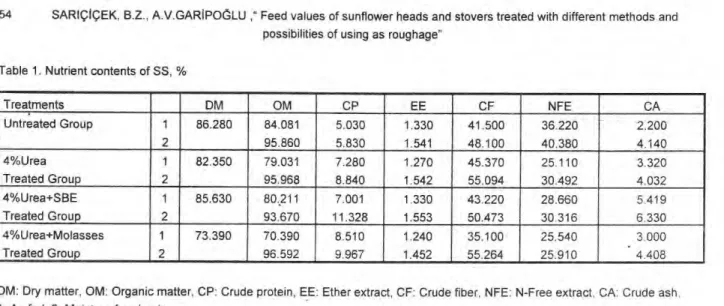
Sunflower heads and stovers used in this study were prepared by chopping with a thresher, and then treated with urea, urea+molasses and urea+SBE, respectively. The nutrient contents of the untreated and treated SS were giyen in Table 1.
Methods
By means of a preliminary study, amount of SS needed for each experiment group along the experiment was found as 600 Kg.
During the urea treatment 24 Kg urea was used for 600 Kg straw. 4 Kg urea was dissolved in 50 It water for each 100 Kg straw.
For urea+molasses treatment 4 Kg urea and 5 Kg molasses was dissolved in 50 It water. 24 Kg urea and 30 Kg molasses were used for 600 Kg straw.
During the urea+SBE treatment 30 Kg soy bean meal was dissolved in 150 It water,and was strained after 24 hours and afterwards 24 Kg urea was added into this extract. 24 Kg urea and 30 Kg soy bean meal were used for 600 Kg straw.
This study consists of two distinct part, namely digestion trial and fattening trial.
The digestibilities related to feeds used in the experiment were determined by means of classical digestion trial as explained by Akyildiz (1984). Each trial
54 SARIÇİÇEK, B.Z., A.V.GARİPOĞLU ," Feed values of sunflower heads and stovers treated with different methods and possibilities of using as roughage"
Table 1. Nutrient contents of SS,
Treatments DM OM CP EE CF NFE CA Untreated Group 1 86.280 84.081 5.030 1.330 41.500 36.220 2.200 2 95.860 5.830 1.541 48.100 40.380 4.140 4%Urea 1 82.350 79.031 7.280 1.270 45.370 25.110 3.320 Treated Group 2 95.968 8.840 1.542 55.094 30.492 4.032 4%Urea+SBE 1 85.630 80.211 7.001 1.330 43.220 28.660 5.419 Treated Group 2 93.670 11.328 1.553 50.473 30.316 6.330 4%Urea+Molasses 1 73.390 70.390 8.510 1.240 35.100 25.540 3.000 Treated Group 2 96.592 9.967 1.452 55.264 25.910 4.408
DM: Dry matter, OM: Organic matter, CP: Crude protein, EE: Ether extract, CF: Crude fiber, NFE: N-Free extract. CA: Crude ash, 1: As fed, 2: Moisture free basis.
consisted of a 7-day of transition, a 8-day of prel;minary and a 10-day of main periods, being a total 25 days.
40 Karayaka hoggets used in the fattening trial were weighed for 3 successive days and then were allocated to four groups according to their initial weights. Fattening trial lasted for 70 days.
Untreated SS, 4% urea treated SS, 4% urea:Fmolasses treated SS and 4%urea+SBE treated SS
.-.nd ,
were giyen to the 1 st Z 3 rd and 4th groups, respectively. SS and concentrate feed amounts being giyen to the groups were calculated as mentioned below.
First, daily dry matter (DM) requirerrients were determined by using initial live weights of groups (daily DM requirements were accepted as 4.3 %of initial live weight) (Çakır et al. 1981). While 60% of the daily DM. requirements was met with roughage, the rest (40%) was met with concentrate feed.
Daily weight gains and feed consumptions were determined for every week.All of the data were evaluated by variance analyse(Düzgüneş et al. 1987).
Results
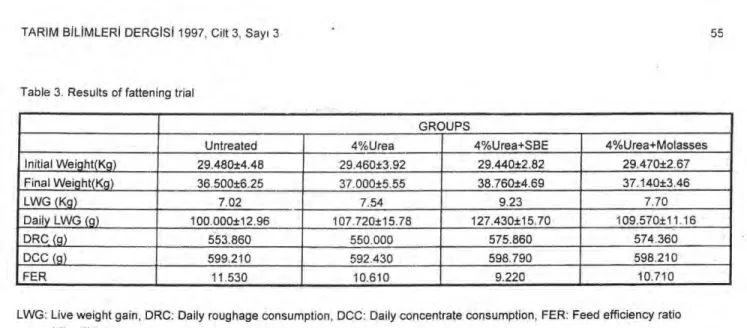
Results of the digestion and feeding experiments were giyen in Table 2 and Table 3, respectively.
Discussion
It can be understood that different treatments caused some changes in the crude nutrient contents of SS (Table 1). The most outstanding change was observed in CP content. Highest and lowest CP contents were observed at urea+SBE treated group and untreated group, respectively The increase observed at CP contents of treated groups results from the supplements (urea and SBE).
Table 2. Results of digestion trial, %
Treatments DM OM CP EE CF NFE SV Untreated Group DC 35.771 46.232 6.037 18.672 43.157 29.642 DNR 35.771 44.318 0.352 0.288 20.758 11.727 5.468 4%Urea DC 42.478 47.742 37.916 49.423 47.325 51.246 Treated Group DNR 42.478 45.817 3.352 0.762 26.076 15.626 14.353 4%Urea+SBE DC 55.232 59.340 56.330 58.655 59.240 60.664 Treated Group DNR 55.232 55.583 6.381 0.911 29.900 18.391 26.757 4%Urea+MolassTreated DC 62.334 51.085 45.311 48.293 51.218 52.919 Group DNR 62.334 49.344 4.517 0.702 28.305 13.711 15.550
TARIM BILİMLERİ DERGISI 1997, Cilt 3, Sayı 3 55
Table 3. Results of fattening trial
GROUPS
Untreated 4%Urea 4%Urea+SBE 4%Urea+Molasses
Initial Weight(Kg) 29.480±4.48 29.460±3.92 29.440±2.82 29.470±2.67 Final Weight(Kg) 36.500±6.25 37.000±5.55 38.760±4.69 37 140±3.46 LWG (Kg) 7.02 7.54 9.23 7.70 Daily LWG (g) 100.000±12.96 107.720±15.78 127.430±15.70 109.570±11.16 DRC (g) 553.860 550.000 575.860 574.360 DCC • 599.210 592.430 598.790 598.210 FER 11.530 10.610 9.220 10.710
LWG: Live weight gain, DRC: Daily roughage consumption, DCC: Daily concentrate consumption, FER: Feed efficiency ratio ( Feed/Gain)
It is a well-known fact that cell membrans are damaged by means of treatments and cell contents are released (Karabulut, 1986). Addition of SBE increases hydrolysition of urea (Munoz et al. 1991). The higher N content of urea+SBE treated group is raised from urea and soybean addition which have a higher N content.
Digestibility and digestible nutrient content of UTS incresed due to the urea treatment. This result is consistent with the findings of other researchers (Joy et al. 1992, Hai et al. 1993, Dias da Silva et al. 1988, Sarıçiçek and Ocak, 1994). The increase observed at digestibilities are arised from the damaging effect of NH3 released from urea hydrolysition
4 % urea+molasses treatment caused higher increases in digestibilities of nutrients (except for crude fat) compared to 4%urea treatment. This finding is supported by some of the researchers' findings (Cheva-Isarakul et al. 1986, Sarıçiçek and Ocak. 1994). The increase in digestibilities of various nutrients in 4% urea+molasses treated SS compared to the urea treated SS can be attributed to the stimulating effect of energy supplied by molasses addition on efficiency of rumen microorganisms.
The highest increases in digestion coefficients of all nutrients were observed at 4%urea+SBE treatment. However, digestibility belonging to DM (55.232%) of 4%urea+SBE treatment was lower compared to that of 4%urea+molasses treatment (62.334%). This difference can be attributed to the differences in the initial DM contents of these feed groups. The reason why the 4%urea+SBE treatment caused higher digestibilities and digestible nutrient ratios compared to the other treatments was the increasing effect of urease activity of SBE on
hydrolysition rate of urea (Çerçi and Sarı, 1990, Ocak, 1992). The Starch Values of untreated group, 4%urea treated group, 4%urea+molasses group and 4%urea+SBE treated group were determined as 5.468, 14.353, 26.757 and 15.550, respectively.
According to the some of the researchers the increases in digestibilities of treatment groups are raised from stimulating effects of urea, molasses and soybean additions on activities and amounts of rumen microorganisms (Orskov, 1988).
From the Table 3., it can be seen that there were differences, albeit nonsignificant statistically, between the various performance traits. Results in fattening trial is consistent with some of the researchs (Cheva-Isarakul et al. 1986, Du et al. 1992) and is contrasted with the other researchs (Trung et al. 1989, Haoque et al. 1983).
These results indicate that the treatments mentioned above have no positive effects on feeding value of SS. But, it should be remembered that the inclusion of SS in the rations of ruminants cause the feeding costs to decrease (Cheva-Isarakul et al. 1986, Hai et al. 1993). Beside this, more detailed researchs should be carried out on some of the novel treatments (acid treatment etc.) which can be used to improve the feeding value of SS.
References
Akyıldız, A.R., 1984. Yemler Bilgisi Laboratuar Klavuzu. A.O. Zir. Fak.Yay.895., Uyg. Klav. 213.
Akyıldız, A.R.,1986. Yemler Bilgisi veTeknolojisi. A.O. Fakültesi, Yayın No: 97.
56 SARIÇİÇEK, B.Z., A.V.GARIPOĞLU ," Feed values of sunflower heads and stovers treated with different methods and possbilities of using as roughage"
Cafantaris, B., Khan, J., MenkeK.H.,1983. Treatment of Straw with Urea and Plant Extract Containing UreaseNutrition Abst. and (Series B) 54:6.
Cheva-Isarakul, B.; KanjanapruthipongJ., 1986. A Comparison of Urea-treated Rice Straw with Urea-molasses Sprayed Rice Straw as Basal Diets for Growing Cattle.
Proceedings of the Sixth Annual Workshop of the Australian-Asian fibrous Agricultural Residues Research Network.
Çakır, A., Haşimoğlu, S., Aksoy, A., 1981. Çiftlik Hayvanlarının Uygulamalı Besleme ve Yemlenmesi. A.Ü. Zir. Fak. Yay., (Ders Notu)
Çerçi, i.H., Sarı, M.,1990. Ürenin Rasyonlara Farklı
Yöntemlerle ilave Edilmesinin Keçilerde Sindirilme Dereceleri ve Azot. Dengesi Üzerine Etkileri. A.Ü.Zir. Fak. Derg. 37(1): 160-172.
Dias-da-Silva, A.A., Ferreira, A.M., Guedes, C.V.M., Mascarenhas Ferreira, A., 1988. Effects of Moisture Level, Treatment Time and Soybean Addition on the NutritiveValue of Urea-treated Maize Stover. Anim. Feed Sci. and Tech. 19 (1-2):67-77.
Drackley, J.K., Clark, A.K., Sahlu, T., Schingathe, D.J., 1985.
Evaluation of Sunflower Crop Residue in Rations for Growing Holstein Heifers. Nutr. Abst. and Reviews (Series B), 56:4.
Du, Z Y., Ji Y.L., Huang, Y.X., Zhany, S.W., Liu, M.X., 1992.
Effects of Ammonia Treatment on Nutritive Value of Wheat Straw and Maize Stover for Beef Cattle. Nutr. Abst. and Reviews (Series B), 62:12.
Düzgüneş, O., Kesici, T., Kavuncu, O., Gürbüz, F., 1987..
Araştırma ve Deneme Metodları (istatistik Metodları 2).
Ank. Only. Zir. Fak. Yay. 1021., Ders kitabı, 295. Ergül, M., 1993. Yemler Bilgisi veTeknolojisi. E.Ü. Ziraat
Fakültesi, Yayın No:487,
Hai, N.V., Singh, G.P., 1993. Effect of Feeding Urea Supplemented and Urea-treated Oat Straw on Nutrient Utilization and Cost of Feeding in Crossbred Cattle.
Nutr. abst. and.reviews (Series B), 63:10.
Haoque, M., Davis, C.H., Saadulah, M., Dolberg, F., 1983. A Note on the Performance of Cattle Fed Treated Paddy Straw with Animal Urine as a Source of Ammonia. Nutr. Abst. And Reviews (Series B), 54:9.
Joy, M., Alıbes, X., Munoz, F., 1992. Chemical Treatment of Lignosellülosic Residues with Urea. Nutr. Abst. and Reviews (Series B), 64:2.
Karabulut, A., 1986. Üre ve NaOH ile Muamele Edilmiş Buğday Samanının Yem Değeri Üzerinde Bir Araştırma. U.Ü. Zir. Fak. Derg., 5: 1-9.
Munoz, F., Joy, M., Facı, R., Alıbes, X.,1991. Treatment of Lignosellülosic Residues with Urea. Influence of Dosage, Moisture, Temperature and Addition of Ureases. Nutr. Abst. and Reviews (Series B), 62:11. Nakanishi, M., Perera, N., Okamoto,M., Yoshida, N., 1992. Effect
of Molasses on Utilization of Urea Treated Straw.
Research Bulletin of Obihiro University,17:4.
Ocak, N.,1992. Üre ile Muamelenin Çeltik ve Mısır Samanının Sindirilebilirlikleri ve Yem Değeri Üzerindeki Etkileri.
O.M.Ü. Fen Bil. Ens. Yük. Lis. Tzi.
Orsko, E.R., 1988. lmprovement of oor Quality Forages and oughages. In: Feed Science. World Animal Science. B.Ed. Sarıçiçek, B.Z., Ocak, N., 1994. Mısır Koçanının Yem Değeri Üzerine Bir Araştırma. Hay. Araş. Der., 4 (1): 43- 46.
Stephenson, R.G.A., Huff, J.L., Krebs, G., Hawitt, C.J., 1992.
Effect of Molasses, Sodium Bentonite and Zeolite on
Urea Toxicity. Nutr. Abst. and Reviews (Series B), 6-16. Trung, L.T., Rowar, N.B., Velasco, N.B., Vınh, P.Q., Palo, L.P.,
1989. Urea-treated vs Urea- molasses-sprayed Rice Straw with two concentrate Feeding Frequencies for Yearling Brahman Grades. Nutr. Abst. and Reviews (Series B), 61:9.
Tosun, A., 1993. Waste Biomass in Turkey and Solar Drying as a New Alternative for its Utilization as Feed. B.Ü. Enviromental Sciences Instute.
Williams, P.E.V., lnnes, G.M., Brewer, A., 1984. Ammonia Treatment of Straw via the Hydrolysis of Urea. 1. Effects of Dry Matter and Urea Concentrations on the Rate of Hydrolysis of Urea. Nutrition Abst. and