Yazışma Adresi/Address for Correspondence: Dr. Neslim Güvendeğer Doksat, Beykent Üniversitesi Psikoloji Bölümü, İstanbul, Turkey E-mail: [email protected]
ARAŞTIRMA / RESEARCH
Relationship between child rearing attitudes of mothers and behavioral
problems in primary school children
İlköğretim çağı çocuklarında annelerin çocuk yetiştirme tutumlarının davranışsal
sorunlarla ilişkisi
Neslim Güvendeğer Doksat
1, Cansu Ersoy
1, Arzu Önal Sönmez
1, Mehmet Kerem Doksat
11Beykent Üniversitesi Psikoloji Bölümü, İstanbul, Turkey
Cukurova Medical Journal 2018;43(1):180-185.
Abstract Öz
Purpose: The aim of the study was to investigate the
relation between child rearing attitudes in mothers and behavioral problems in elementary school children.
Materials and Methods: 128 children were selected with
convenient sampling method from a school in Istanbul, 60 girls and 68 boys, were enrolled in the study. The Parental Attitude Research Instrument (PARI) and Child Behavior Checklist for Ages 6-18 (CBCL/6-18) were administered to mothers as data collection tools, and a Sociodemographic Information Form prepared by the authors was also used.
Results: Increment was observed in the scores of
children’s anxiety/depression levels, social introversion, thought problems and internalization levels in line with the scores of the mothers’ over-controlling mothering. As the democratic attitude level scores increased, children’s sociability scores also increased. Additionally, as the strict discipline level scores increased, scores related with children’s aggressive behavior, social problems and externalization levels also increased.
Conclusion: As a summary, a significant relation was
determined between parenting attitudes in mothers and behavioral problems encountered in children.
Amaç: Bu çalışmanın amacı, annelerdeki çocuk yetiştirme
tutumlarıyla ilköğretim çağındaki çocuklarda görülen davranışsal sorunlar arasındaki ilişkiyi araştırmaktır.
Gereç ve Yöntem: Bu amaçla, İstanbu’daki bir okuldan,
60’ı kız, 68’i erkek olacak şekilde, kolay örnekleme yöntemiyle 128 çocuk çalışma kapsamına alınmıştır. Veri toplama aracı olarak çocukların annelerine “Aile Hayatı ve Çocuk Yetiştirme Tutum Ölçeği (PARI) “ ve çocuklarda görülen davranış problemlerini belirlemek için “6-18 Yaş Çocuk ve Gençler İçin Davranış Değerlendirme Ölçeği (CBCL/6-18 yaş için)” kullanılmıştır. Ayrıca katılan annelerden, kendilerine dağıtılan ve araştırmacı tarafından hazırlanmış demografik bilgi formunu doldurmaları istenmiştir.
Bulgular: Bulgulara baktığımızda, annelerin aşırı
kontrolcü tutum puanı arttıkça çocuklardaki anksiyete/depresyon, sosyal içe dönüklük puanları ve düşünce sorunları ilâ içe yönelme düzeylerine yönelik puanlarında artış tespit edilmiştir. Annelerdeki demokratik tutum düzeyi puanı arttıkça çocukların sosyallik puanlarında; baskı ve disiplin puanı arttıkça da çocukların saldırganca davranış, sosyal sorun ve dışa yönelim puanlarında artış olduğu görülmüştür.
Sonuç: Sonuç olarak, çalışmamızda annelerdeki yetiştirme
tutumları ile çocuklarda karşılaşılan davranış problemleri arasında anlamlı bir ilişki bulunmuştur.
Key words: Child rearing, mother’s attitude, behavior Anahtar kelimeler: Çocuk yetiştirme, anne tutumu, davranış
INTRODUCTION
Parents’ attitude towards their children in childhood is an important factor in terms of personality
development and behavioral adjustment. Social relations and particularly the nature of the bond that children form with their parents play an important role in child’s behavior1.
181 Studies concerning parent-child relations have concentrated on the mother-child relationship, and the role of this issue has been emphasized in the psychological development of the child2. Positive
attitudes in parents, effective communication between mother, father and child, and a peaceful family environment are constructive agents in children’s development. The resolution of problems encountered in adolescence and adulthood is correlated with effective family communication and parenting attitudes. Children capable of establishing communication with their parents and receiving attention from them are thought to be more successful in solving problems they encounter at later ages. In addition, lack of academic success at school, peer maladjustment and unresolved conflicts are associated with the attitudes of the child’s parents3-4.
Baumrind considers parenting styles under three main headings: authoritarian, authoritative, and democratic. The authoritarian parenting style expects the child to comply entirely with the rules imposed while disregarding the child’s own wishes and personality. Loss of control or disregarding the rules is punished. The authoritative parenting style is that of mothers and fathers who keep the child under significant control. Parents themselves do most of the things that the child could do, and the child is prevented from learning by experience. This generally develops due to a wish to protect the child and to ensure that he avoids bad habits. The mother generally thinks the child does not eat enough, and a tendency to over-feed is observed5-8.
The democratic parenting style is the one in which parents impose limited bounds, exchange ideas with their children on an abundant basis, the children are well supported, shown attention and actively listened to and which supports love. Supervision and love are both present in the democratic parenting style9. Parents with such a style regard
their children as individuals and support the development of an independent personality.
Parental attitudes constitute an important factor in terms of the development of personality and social behavior in children. Therefore, the objective of this research was to identify parenting styles adopted by mothers and problem behaviors observed at school age children and to determine the relation between parenting styles in mothers and behavioral problems in children.
MATERIALS AND METHODS
Participants
This survey was conducted in accordance with the Helsinki ethics statement. The compliance with the ethical rules is under the responsibility of the authors, who proceeded in accordance with the principles of this declaration. The research was carried out after receiving the "written informed consent volunteer form" documents from the participants of the study.
One hundred twenty-eight elementary and high school students were selected from Cekmekoy Private Final Schools, in Istanbul during the academic period of 2015-2016 to be included in the study. Official permission was obtained from the school administration in order to conduct this study. Convenient sampling method was used for this investigation. Participants consisted of volunteer mothers of children between ages 6 to 18. Sampling was arranged by means of the classification of gender and ages of the children. Researchers accompanied mothers face to face while filling the scales.
Sociodemographic form
Sociodemographic characteristics associated with the study were elicited using a sociodemographic data form developed by the authors. Information concerning age, sex, mother and father’s education levels and occupation, and place of residence were obtained using this form.
Parental Attitude Research Instrument
(PARI)
The PARI was adapted into Turkish by LeCompte10.
Five subdomains are evaluated in 60 items. It consists of five factors; overprotective mothering, democratic attitude and equality, rejection of the homemaker role, marital conflict-discord and strict discipline. This is a four-point Likert-type scale. One of “I find it highly appropriate” (4), “I find it rather appropriate” (3), “I find it slightly appropriate”(2) or “I do not find it at all appropriate” (1) is marked for each statement. However, items 29 and 44 are reverse scored. A "1" response receives a score of 4, "2" responses receive a score of 3, "3" responses receive a score of 2 and "4" responses receive a score of 1. Separate scores are obtained for subtests
representing each domain. The higher the subtest score, the greater the approval of the attitude reflected in that domain. The structural validity of the PARI subscales was supported by Küçük (1987) in a study of high school students and parents11.
Child Behavior Checklist for ages 4-18
(CBCL)
The CBCL was developed by Achenbach and Edelbrock for the purpose of assessing the competency areas and problem behaviors of children and young people in the 4-18 age group, in the light of information obtained from the mother and father. The scale consists of 20 competency and problem items. Problem behaviors are scored 0, 1 or 2 depending on the prevalence in the previous 6 months, and the items are grouped into various subscales12.
Two separate behavioral symptom scores are elicited, ‘Internalizing problems’ and ‘Externalizing problems.’ The internalizing problems group consists of the combined ‘Social Introversion, Somatic Complaints and Anxiety/Depression’ subtests and the externalizing problems group of the ‘Rule Breaking and Aggressive Behavior’ subtests. Additionally, the scale also contains Social Problems, Attention Problems and Thought Problems subscales that are not part of either of these groups. A ‘Total Problem’ score is obtained from the total of all these subscales12. The Turkish
language test-repeat test reliability of the scale Total Problem was determined at 84%. The internal consistency of the scale was calculated with the Cronbach alpha coefficient at 88% in the Total Problem. These results show that the scale can be reliably used in the evaluated age and sex groups13.
Statistical analysis
The data obtained were analyzed on SPSS (Statistical Package for Social Sciences) for Windows 21.0 software. Descriptive statistical methods (number, percentage, mean and standard deviation) were used during data analysis. The PARI subscales and behavioral checklist subscales are not normally distributed.
The Mann Whitney U test was therefore used to compare quantitative data between two groups and the Kruskal Wallis H test for intergroup comparison of parameters between more than two groups. Relations between dependent and independent
variables were tested using Spearman correlation analysis.
RESULTS
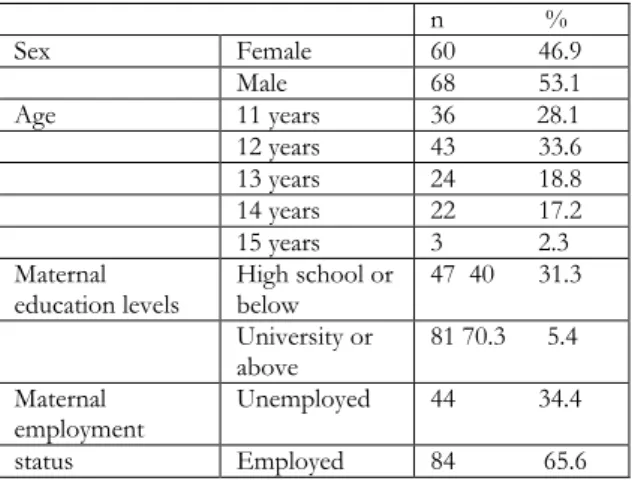
Based on the sociodemographic data elicited, males constituted 53.1% (n=68) of the cases in the study and females 46.9% (n=60). Mean age of the children in the study was 12.32±1.12. In terms of employment, 33.5% (n=44) of mothers were unemployed and 65.6% (n=84) were employed (Table 1).
Table 1. Distribution of variables among the children in the study (n=128) n % Sex Female 60 46.9 Male 68 53.1 Age 11 years 36 28.1 12 years 43 33.6 13 years 24 18.8 14 years 22 17.2 15 years 3 2.3 Maternal
education levels High school or below 47 40 31.3 University or
above 81 70.3 5.4 Maternal
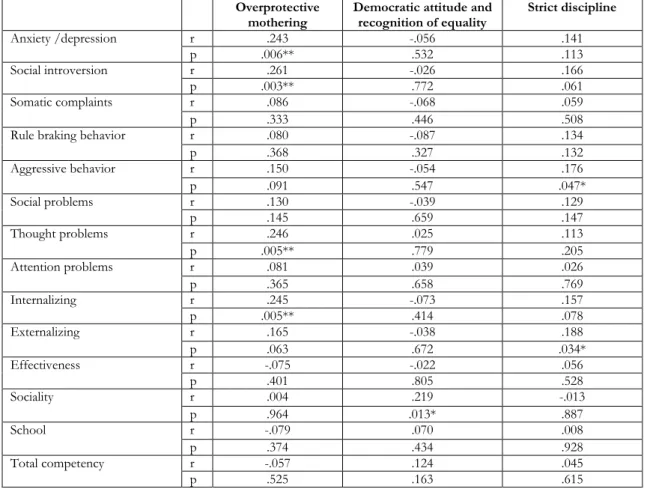
employment Unemployed 44 34.4 status Employed 84 65.6 Mothers’ scores from the overprotective mothering scale were statistically significantly positively correlated with children’s anxiety/depression, social introversion, thought problems and internalization scale scores (r=.243, r=.261, r=..246 and r=245, respectively; p<0.01). Children’s anxiety/depression, social introversion, thought problems and internalization levels increased in line with mothers’ overprotective mothering scores (Table 2).
Mothers’ scores from the democratic attitude scale were statistically significantly correlated with children’s scores from the sociability scale (r=.219; p<0.05). Children’s sociability scores increased in line with mothers’ democratic attitude scores (Table 2).Mothers’ strict discipline scale scores were statistically significantly positively correlated with children’s aggressive behavior and externalization scale scores (r=.176 and r=.188, respectively; p<0.05). Children’s aggressive behavior, social problems and externalization levels increased in line with mothers’ strict discipline scores (Table 2).
183
Table 2. Analysis of correlations between mothers’ scores from the Parental Attitude Research Instrument and Child Behavior Checklist subscales
Overprotective
mothering Democratic attitude and recognition of equality Strict discipline
Anxiety /depression r .243 -.056 .141 p .006** .532 .113 Social introversion r .261 -.026 .166 p .003** .772 .061 Somatic complaints r .086 -.068 .059 p .333 .446 .508
Rule braking behavior r .080 -.087 .134
p .368 .327 .132 Aggressive behavior r .150 -.054 .176 p .091 .547 .047* Social problems r .130 -.039 .129 p .145 .659 .147 Thought problems r .246 .025 .113 p .005** .779 .205 Attention problems r .081 .039 .026 p .365 .658 .769 Internalizing r .245 -.073 .157 p .005** .414 .078 Externalizing r .165 -.038 .188 p .063 .672 .034* Effectiveness r -.075 -.022 .056 p .401 .805 .528 Sociality r .004 .219 -.013 p .964 .013* .887 School r -.079 .070 .008 p .374 .434 .928 Total competency r -.057 .124 .045 p .525 .163 .615 *P<0.05 , **P<0.01
DISCUSSION
The purpose of this research was to identify parenting styles adopted by mothers and problem behaviors observed in school age children and to determine the relation between parenting styles in mothers and behavioral problems in children. Positive attitudes adopted by mothers, effective communication between mother-father and child, a positive relationship between mother and father and a peaceful family environment are important factors in terms of children’s emotional and behavioral development. This study examined the relation between maternal attitude and behavioral problems seen in children. An excessively protective and authoritative parental style increases anxiety levels in children14. Behavioral problems are more common and social adjustment is compromised in the
children of mothers who over-react15-17. Kaufmann et
al. revealed that an authoritative and overprotective parenting style is negatively correlated with appropriate behavior and emotional problems in children18. The increases in anxiety/depression,
social introversion, thought problems and internalization of problems with this overprotective parenting style in this study are in agreement with the previous literature. Parents with a democratic style allow the child to develop himself and acquire an independent personality. A positive correlation exists between children’s social adjustment and a democratic parenting style19. In our research,
increased levels of socialization were observed in children raised by mothers who adopted a democratic parenting style. Similarly, Lamborn et al. also observed that the children of families with a democratic style scored highest on psychosocial development measurement and scored lowest on
psychosocial and behavioral disorder measurement20. As a summary, children’s
socialization levels increase in line with mothers’ democratic parenting styles.
A strict parenting style with a high level of discipline is thought to lead to an increase in externalizing and internalizing behavior in children21. Similar research
has emphasized the relationship between an over-reactive and disciplinary parenting style and increased externalizing and internalizing behavior and adjustment problems16,22-23. The determination
of a significant relation between mothers’ scores from the strict discipline scale and children’s aggressive behavior and externalization scores in our study is compatible with the literature. In this study, children’s scores of aggressive behavior, social problems and levels of externalization increased in line with mothers’ strict discipline levels. According to some studies, an increase in aggression and hostile behavior is observed in male children who are particularly brought up under an authoritarian and strict parenting style24. Similar to our results,
some researchers investigated the association between parental authority patterns and adjustment behaviors in children and determined a tendency to internal and external conflicts and aggression in children raised in authoritarian families25. Children’s
aggressive behavior, social problems and externalization levels increase in line with strict discipline levels.
Additionally, since the importance of other environmental factors such as sibling and peer relations are undeniable, these variables may also play a role in child behavior. One of limitations of this study is its cross-sectional nature, in which no cause and effect relations could be investigated. Also, the limited sampling size and the fact that potential effects of paternal behavioral styles were not evaluated may also be regarded as limitations. Further extended studies in which more factors are evaluated in larger sampling groups, will assist with a better understanding of the behavior that the child develops in association with the family attitudes. We think that better understanding of parenting styles in childhood will result in better interpretation of psychiatric conditions in adulthood and thus make a contribution to prevention and treatment.
REFERENCES
1. Ersoy Ö, Şahin, FT. 0-6 yaş döneminde anne-baba
eğitiminin önemi. Mesleki Eğitim Dergisi. 1999;1:58-62.
2. 2.Bowlby J. Attachment and Loss: Separation: Anxiety and Anger, New York: NY Basic Books. 1993;25-52. (English).
3. Kazdin AE, Rotella C (editors). The Kazdin Method for Parenting the Defiant Child. 1 st ed., New York: Houghton Mifflin Harcourt Publishing Comp. 2009;168-181.
4. Walker H M, Ramsey E, Gresham FM (editors). Antisocial Behavior in School: Evidence-Based Practices. 2 nd ed., Belmont CA: Wadsworth Publishing Company. 2004;220-250.
5. Bakırcıoğlu R. Çocuk ve Ergende Ruh Sağlığı, Ankara: Anı Yayıncılık. 2010;200-350. (Turkish). 6. Baumrind D. Current patterns of parental authority.
Dev psychol. 1971;4:1-103.
7. Baumrind D. The development of instrumental competence through socialization. Minnesota symp on child psychol. 1973;7:3-46.
8. Dornbusch SM, Ritter P L, Leiderman PH, Roberts DF, Fraleigh M J. The relation of parenting style to adolescent school performance. Child development. 1987;58:1244-57.
9. Baumrind D. Parenting styles and adolescent development. The encyclopedia of adolescence. 1991;2:746-58.
10. Le Compte G, Le Compte A, Özer S. Üç sosyoekonomik düzeyde Ankaralı annelerin çocuk yetiştirme tutumları: Bir ölçek uyarlaması. Turk J Psychol. 1978;1:5-8.
11. Küçük S. The validity of the Turkish form of PARI subscales. (Unpublished doctorship thesis), Bogazici University, Istanbul. 1987.
12. Achenbach TM, Dümenci L, Rescorla LA. (editors). Ratings of Relations BetweenDSM- IV Diagnostic Categories and Items of the CBCL 1-5 and C- TRF. 1st ed., Burlington : VT: University of Vermont, Research Center for Children, Youth and Families. 2000 .
13. Dumenci, Ero, N, Achenbach TM, Simsek Z. Measurement structure of the Turkish translation of the Child Behavior Checklist using confirmatory factor analytic approaches to validation of syndromal constructs. J Abnorm Child Psychol. 2004;32:335-40. 14. Guiding theory for therapy with children and adolescents. In Kendall PC (editör). Child and Adolescent Therapy: Cognitive-Behavioral Procedures. Newyork: The Guilford press. 2006;3-33.
15. Azimi A L, Vaziri S, Kashani F L. Relationship between Maternal Parenting Style and Child's Aggressive Behavior. Procedia Soc Behav Sci. 2012;69:1276-81.
16. Evans S, Shipton EA, Keenan T. The relationship between maternal chronic pain and child adjustment: the role of parenting as a mediator. J of Pain. 2006;7:236-43.
185 17. Sangawi H, Adams J, Reissland N. The effects of
parenting styles on behavioral problems in primary school children: a cross-cultural review. Asian J Soc Sci. 2015;11:171-86.
18. Kaufmann D, Gesten E, Santa Lucia RC, Salcedo O, Rendina-Gobioff G, Gadd R. The relationship between parenting style and children's adjustment: The parents' perspective. J Child Fam Stud. 2000;9:231-45.
19. Muhriz N, Ahmad A, Al-Atum A. Asaalieb Almaamala alwalidaya wa elaqatuha biltawafuq alteefl alejtimae wa shakhsi fe ryad atffal. Parenting styles and their relationship with child’s social and personal adjustment in Kindergarten. Mujala jamia Dimashq. 2005;12: 285-324.
20. Steinberg L, Blatt‐Eisengart I, Cauffman E. Patterns of competence and adjustment among adolescents from authoritative, authoritarian, indulgent, and neglectful homes: A replication in a sample of serious juvenile offenders. J Res Adolesc. 2006;16:47-58.
21. Rinaldi C M, Howe N. Mothers’ and fathers’ parenting styles and associations with toddlers’ externalizing, internalizing, and adaptive behaviors. Early Child Res Q. 2012;27:266-73.
22. Bayer J K, Ukoumunne O C, Mathers M, Wake M, Abdi N, Hiscock H. Development of children’s internalising and externalising problems from infancy to five years of age. Aust N Z J Psychiatry. 2012;46:659-68.
23. Kim HJ, Arnold DH, Fisher PH, Zeljo A. Parenting and preschoolers' symptoms as a function of child gender and SES. Child Fam Behav Ther. 2005;27:23-41.
24. Maccoby EE, Martin JA. Socialization in the context of the family: Parent-child interaction. In Mussen PH (editör). Handbook of Child Psychology: Formerly Carmichael's Manual of Child Psychology. Newyork: Wiley. 1983;700-35.
25. Erozkan A. Examination of Relationship between Anxiety Sensitivityand Parenting Styles in Adolescents. Educational Sciences: Theory and Practice. 2012;12:52-7.