THE REPUBLIC OF TURKEY
BAHÇEŞEHİR UNIVERSITY
THE INSTITUTE OF SOCIAL SCIENCES MARKETING GRADUATE PROGRAM
THE FACTORS AFFECTING SOCIAL NETWORK
PLAFORM ENGAGEMENT FOR ONLINE
INFORMATION SEARCH AND COLLECTION
MASTER’S THESIS
ÇİĞDEM MUTLU
Thesis Supervisor: Assist. Prof. Dr. ELİF KARAOSMANOĞLU
ACKNOWLEDGEMENTS
First and foremost, I would like to express my deep appreciation and sincere gratitude to Assist. Prof. Dr. Elif Karaosmanoğlu, my supervisor, for her wisdom, invaluable guidance and professionalism from the beginning to the end of my research. I would also like to extend my heartiest thanks to 243 survey participants for their patience and kind involvement in this study.
Finally, this thesis is dedicated to my compassionate father, to my kind mother, to my sisters and to my fiancé whom devoted whole life for me.
ii
ABSTRACT
THE FACTORS AFFECTING SOCIAL NETWORK PLAFORM ENGAGEMENT FOR ONLINE INFORMATION SEARCH AND COLLECTION
Mutlu, Çiğdem Marketing Management
Thesis Supervisor: Assist. Prof. Dr. Elif Karaosmanoglu June 2011, 131 pages
In today’s conditions, both companies and Internet users intensely carry on their online existence. Being present on the Internet is especially important for companies. Yet there isn’t enough information available on how they will position themselves in the social platforms that are rapidly growing in recent years and how they will manage the flow of information about themselves. This study focuses on the factors affecting social network platform engagement for online information search and collection and what kind of information Internet users trust and what information they disregard, in spite of the tons of information available in the online world.
Since the dawn of time, communication has played a very important role in mankind’s historic progress. After beginning to speak and write, mankind aggregately used mass communication methods and went on to exercise mass communication as a result of technological developments. The Internet changed mass communication, which marked a new era in communication history, by making communication interactive. The Internet also brought with it radical, far-reaching changes for every industry. Social platforms, on the other hand, caused companies’ approach to communication flow to change drastically by paving the way for innovation, transparency and one-on-one communication.
Prior to the Internet, consumers conducted information search via offline communication tools such as newspapers, magazine advertisements, television commercials and word-of-moth. The Internet, however, allowed consumers to form their own communication groups, called virtual communities, based on their interests and needs. Meanwhile, social platforms took the information flow between consumers one step further and gave people the ability to receive accurate information, services and products directly, or firsthand, from users.
iii
Research was done on what different consumer groups paid attention to and what they cared about when receiving information. Factors that shape consumers’ method of getting information and social media engagement are anxiety level, the Internet usage capacity, personal involvement with online information search, openness to social platforms, perceived credibility of online information, perceived benefit of Social Platforms and the Internet.
Following detailed examination of the academic literature and keeping in mind the elements stated above, this study was conducted to determine the factors that determine the factors affecting consumers’ engagement in social platforms that they already use intensely. The factors that affect the research done via social platforms were found, and whether these factors lead to engagement with social platforms was examined as a result of findings. A quantitative research method was used to set forth the factors that affect social platform engagement, and a questionnaire was compiled based on items that measure these factors’ effects on social platforms. Participants answered the prepared survey on the Internet.
The first fundamental finding that as consumers’ interest in the service they research and their Internet usage capacities increase, the credibility they feel for online information sources also increases. Secondly, consumers’ positive approach to social platforms allows them to perceive the information they receive from online information sources as beneficial. Lastly, an increase in consumers’ anxiety level towards a service they will purchase affects their social platform engagement negatively, while the sense of credibility they feel towards online information sources affects their social platform engagement positively. Additionally, the benefits consumers experience via the Internet and social platforms positively affect their social media engagement, as well.
Since a Web-based survey was used, the study’s limitations could be summarized as very little control over participants as well as the fact that participants’ attention could easily be diverted during the survey. In order to enhance the credibility and validity of the theoretical model, the findings of this study could be further researched using one of the qualitative methods of research, and the results could be considered together.
Keywords: Social media engagement, online information search, information collection,
iv
ÖZET
ONLINE BİLGİ ARAŞTIRMASI VE EDİNİLMESİ İÇİN SOSYAL MECRALARA BAĞLILIĞI ETKİLEYEN FAKTÖRLER
Mutlu, Çiğdem Pazarlama Yönetimi
Tez Danışmanı: Yrd. Doç. Dr. Elif Karaosmanoğlu Haziran 2011, 131 Sayfa
Günümüz koşullarında gerek firmalar gerekse internet kullanıcıları online olarak varlıklarını yoğun olarak sürdürmektedir. İnternette var olmak özellikle firmalar oldukça önemli olsada son yıllarda hızla yükselen sosyal platformlarda kendilerini nasıl konumlandıracakları, kendileriyle ilgili bilgi akışını nasıl yönetecekleri konusunda yeterli bilgi bulunmamaktadır. Bu çalışma ve online bilgi araştırması ve edinilmesi için sosyal mecralara bağlılığı etkileyen faktörler ve online dünyada tonlarca bilgi olmasına rağmen kullanıcıların elde ettikleri bilgilerden hangisine güvenip hangisini göz ardı ettiği üzerinde durmaktadır.
İlk çağlardan bu yana iletişim insanların tarihsel gelişiminde çok önemli bir rol oynamıştır. İnsan’ın konuşması ve yazmasını takiben kitlesel olarak gerçekleştirilen toplu iletişim yöntemleri kullanan insanlık, teknolojik gelişmeler neticesinde kitlesel iletişime geçebildi. İletişim tarihinde çığır açan kitlesel iletişimi değiştiren İnternet, iletişimi interaktif bir hale sokarken tüm sektörler için sarsıcı ve kökten değişiklikler getirdi. Sosyal mecralar ise firmalar için yeniliğe, açıklığa, birebir iletişime yönelterek bilgi aktarma mantığının tümden değişmesini sağladı.
Tüketicilerin yaptıkları bilgi araştırması internet öncesinde gazete, dergi ilanları, televizyon reklamları, WOM gibi offline iletişim araçlarıyla olmaktaydı. İnternet ise tüketicilerin ilgileri ve ihtiyaçları doğrultusunda kendi iletişim gruplarını kurmalarına olanak verdi, virtual communities. Sosyal mecralar ise tüketicilerin kendi aralarında edindikleri bilgi akışını bir adım daha öteye götürerek doğru bilgiyi, hizmeti ve ürünü direk kullanan kişiden yani birinci ağızdan bilgi edinmeye olanak sağladı.
v
Tüketicilerin bilgi edinirken farklı tüketici gruplarının neye dikkat ettiği, neyi önemsediği araştırıldı. Tüketicilerin Online bilgi araştırması ve edinilmesi için sosyal mecralara bağlılıklarını etkileyen faktörler ve bilgi edinme biçimini şekillendiren unsurlar, algılanan risk, müşterilerin internet kullanma kapasitesi, online bilgi araştırmasına kişisel bağlılık, sosyal platformlara karşı açıklık, online bilgiye karşı algılnan güven, sosyal mecralar ve internetten algılanan yararlardır..
Bu çalışma akademik literatür detaylıca incelendikten sonra yukarıda sayılan unsurlar göz önünde bulundurularak tüketicilerin hali hazırda yoğun bir biçimde kullandıkları sosyal mecralara karşı bağlılıklarını etkileyen faktörleri ortaya çıkarmak için yapılmıştır. Sosyal mecralar üzerinden yapılan araştırmayı etkileyen faktörleri bulmak ve bulgular neticesinde bu faktörlerin sosyal mecralara karşı bir bağlılık yaratıp yaratmadığı incelenmiştir.
Sosyal mecralara bağlılığı etkileyen faktörlerin ortaya çıkarılması için niceliksel araştırma yöntemi kullanılmış olup bu faktörlerin sosyal mecralara olan etkisini ölçen maddeler oluşturularak anket formu hazırlanmıştır. Katılımcılar hazırlanan anketi internet ortamında yanıtlamışlardır.
Bu çalışmadan elde edilen en temel bulgulardan ilki tüketicilerin araştıracakları hizmete karşı olan ilgileri ve internet kullanma becerileri arttıkça online bilgi kaynaklarına karşı duydukları güvenin artmasıdır. İkinci olarak tüketicilerin sosyal mecralara karşı olan olumlu tutumu online bilgi kaynaklarından elde ettikleri bilgiyi faydalı olarak algılamalarını sağlamaktadır. Son olarak tüketicilerin satın alacakları hizmete karşı hissettikleri kaygı seviyesinin artması sosyal mecralara olan bağlılıklarını olumsuz; online bilgi kaynaklarına karşı algıladıkları güven hissi sosyal mecralara bağlılıklarını olumlu; internet ve sosyal mecralar aracılığıyla elde ettikleri fayda ise sosyal mecralara bağlılıklarını olumlu yönde etkilemektedir.
İnternet tabanlı bir anket kullanıldığı için katılımcılar üzerinde kontrolün az olması ve anket süresince katılımcıların düşebilecek olan dikkatleri çalışmanın kısıtlılıkları olarak özetlenebilir. Teorik modelin güvenilirliğinin ve geçerliliğinin arttırmak için araştırmadan elde edilen bulgular kalitatif araştırma yöntemlerinden biri kullanılarak da araştırılabilir ve sonuçlar birlikte değerlendirilebilir.
Anahtar Kelimeler: Sosyal mecralara bağlılık, online bilgi araştırması, online bilgiye karşı
vi
TABLE OF CONTENTS
LIST OF TABLES ... VIII LISTOFFIGURES ... IX LISTOFABBREVIATIONS ... X
1. INTRODUCTION ... 1
1.1COLLECTINGINFORMATION ... 1
1.2TOWARDSSPEECHANDWRITING ... 2
1.2. 1 The Primitive Era ... 2
1.2.2 Other Steps before Speech ... 3
1.2.3 Writing ... 4
1.3AFTERTECHNOLOGICALADVANCEMENTS ... 5
1.3.1 Telecommunications ... 5
1.3.2 The Printing Revolution ... 6
1.3.3 Newspaper ... 6
1.3.4 The Internet ... 7
1.4THETRANSFORMATION ... 8
1.5THEEVOLUTIONOFSOCIALMEDIANETWORKS ... 10
1.6VIRTUALCOMMUNITIES ... 12
1.7THENEWMEDIA ... 13
2. INFORMATION SEACRH BEHAVIOR ... 16
2.1REASONSFORCONSUMERINFORMATIONSEARCHBEHAVIOR ... 16
2.2FACTORSAFFECTINGINFORMATIONSEARCHBEHAVIOR... 20
2.2.1 Personal Involvement ... 20
2.2.2 Self Oriented Factors ... 22
2.2.3 Price ... 31
2.2.4 Experience ... 31
2.2.5 Perceived Risk ... 32
2.3ONLINEVERSUSOFFLINEINFORMATIONSEARCHBEHAVIOR ... 33
2.4INFORMATIONSEARCHINPRODUCTVERSUSSERVICE CONTEXTS ... 36
2.4.1 Ways of Collecting Information on Services ... 36
2.4.2 Ways of Collecting Information on Products ... 38
2.5SEARCHBEHAVIORINTHEONLINEWORLD ... 41
3. CONCEPTUAL FRAMEWORK ON SOCIAL MEDIA ENGAGEMENT ... 49
3.1PERSONALINVOLVEMENT WITH ONLINEINFORMATIONSEARCH .... 51
3.2 RATIONAL VS. AFFECTIVE INVOLVEMENT TO ONLINE INFORMATION SEARCH ... 52
3.3OPENNESSTO SOCIALPLATFORMS ... 53
vii
3.5LEVEL OF ANXIETY ... 55
3.6PERCEIVEDCREDIBILITY OF ONLINEINFORMATION ... 56
3.7PERCEIVEDEASE OF USE ... 57
3.8PERCEIVEDBENEFITS OF SOCIALMEDIAPLATFORMS ... 58
3.9PERCEIVEDBENEFITOF THEINTERNET ... 59
4. RESEARCH DESIGN ... 60
4.1AIMAND THESCOPEOFTHESTUDY ... 60
4.2SAMPLINGANDDATACOLLECTION ... 60
4.3SURVEYDESIGN ... 63
5. ANALYSES AND RESULTS ... 64
5.1FACTORANALYSISAND RELAIBILTYTEST ... 65
5.2FINDINGSRELATEDTODEMOGRAPHICS ... 70
5.3HYPOTHESESTESTING ... 76
5.3.1 Relation of level of anxiety with personal involvement with online information search and consumers’ internet usage capacity ... 76
5.3.2 Relation of perceived credibility of online information with personal involvement with online information search and consumers’ Internet usage capacity ... 77
5.3.3 Relationship between Personal Involvement with Online Information Search and Perceived easiness and Perceived Ease of Use of Online Environment ... 79
5.3.6 Relationship between Perceived Ease of Use of Online Environment and Personal Involvement with Online Information Search ... 80
5.3.7 Relation of Social Media Engagement with Level of Anxiety, Perceived Credibility of Online Information, Perceived Benefit of Social Platforms and Perceived Benefit of the Internet ... 80
5.4DISCUSSION AND IMPLICATIONS ... 83
5.5MANAGERIALIMPLICATIONS ... 88
5.6RESEARCHLIMITATIONS ... 89
REFERENCES ... 91
APPENDICES ... 104
APPENDIX 1: MEASUREMENT ITEMS ... 105
APPENDIX 2: SURVEY FOR THE STUDY IN ENGLISH ... 112
viii
LIST OF TABLES
Table 2.1: Effect of increases in attribute importance weights on marginal
benefit of source ... 18
Table 2.2: Summary of information search behavior habits for tourism ... 30
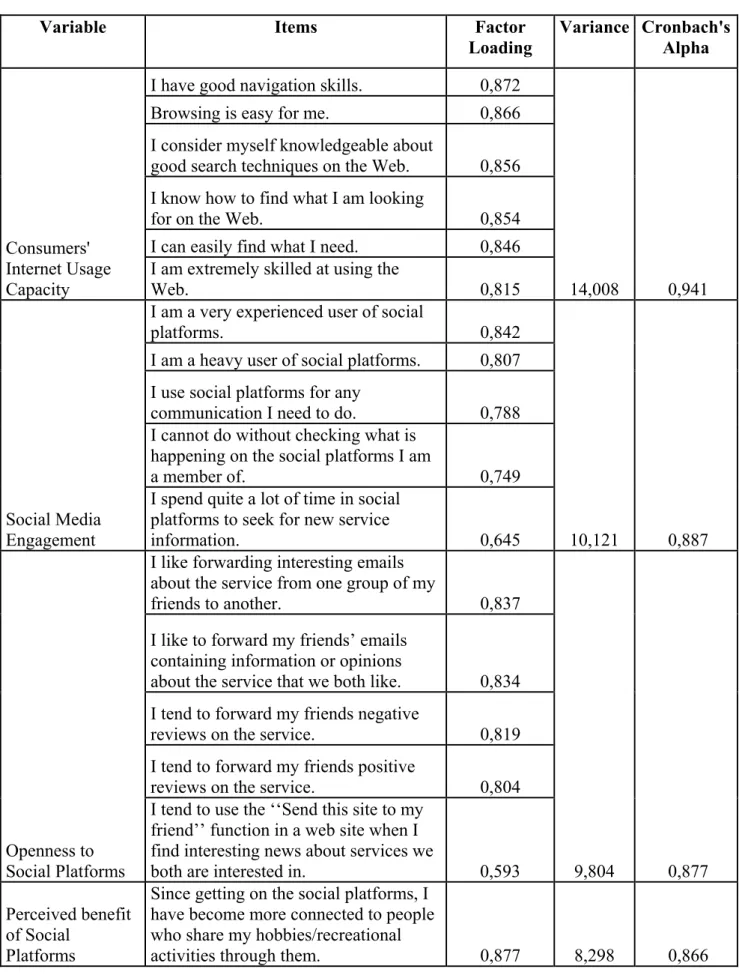
Table 5.1: Factor analysis and reliability test ... 66
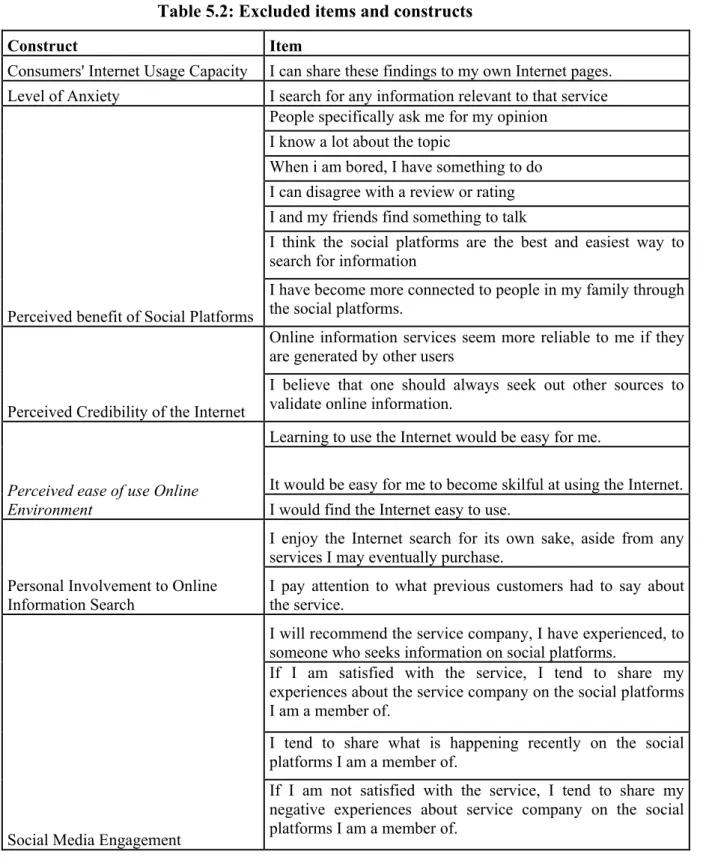
Table 5.2: Excluded items and constructs ... 69
Table 5.3: Gender ... 70
Table 5.4: Age ... 70
Table 5.5: Marital status ... 71
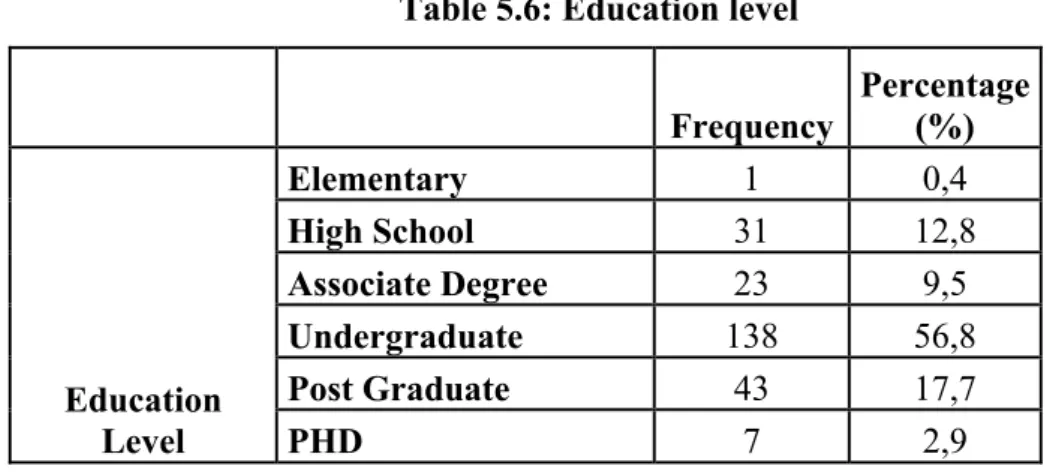
Table 5.6: Education level ... 71
Table 5.7: Occupation ... 72
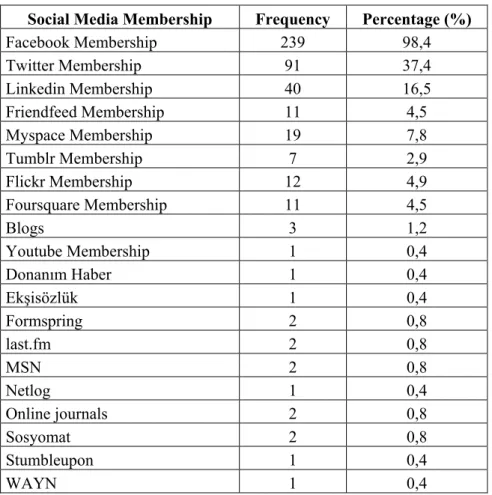
Table 5.8: Social media membership ... 72
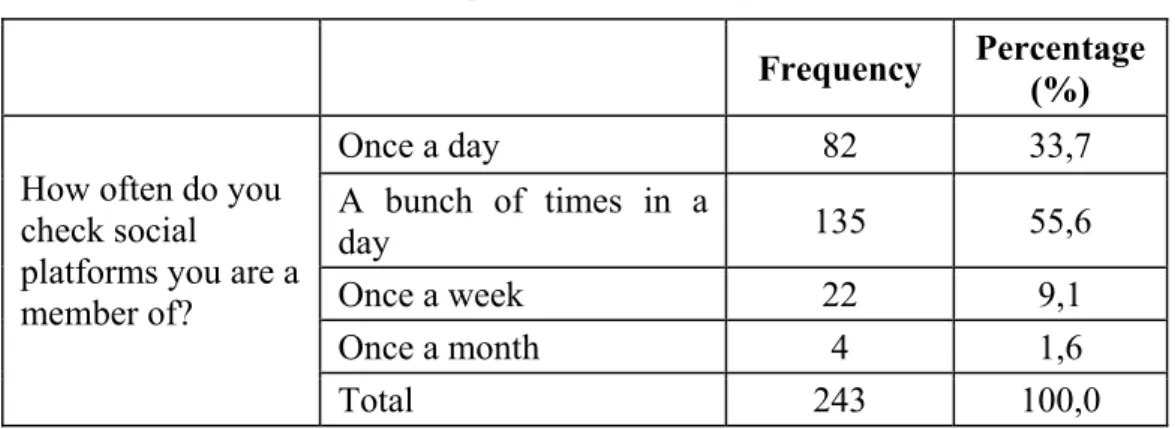
Table 5.9: The frequency of checking social media channels ... 73
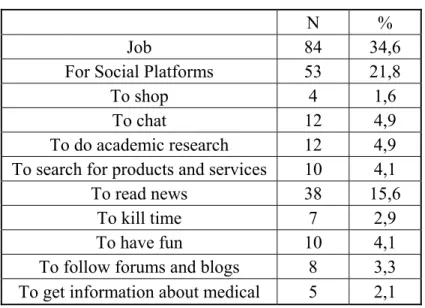
Table 5.10: Purposes of the Internet usage ... 74
Table 5.11: Pearson correlation matrix of variables ... 75
Table 5.12: Regression analysis of the effect personal involvement with online information search and consumers’ Internet usage capacity have on anxiety level ... 77
Table 5.13: Regression analysis of the effect personal involvement with online information search has on the level of perceived credibility of online information ... 78
Tablo 5.14: Regression analysis of how the level of openness to social platforms affects the level of perceived benefits of social slatforms ... 80
Table 5.15: Regression analysis of the effect independent variables have on social media engagement ... 82
ix
LIST OF FIGURES
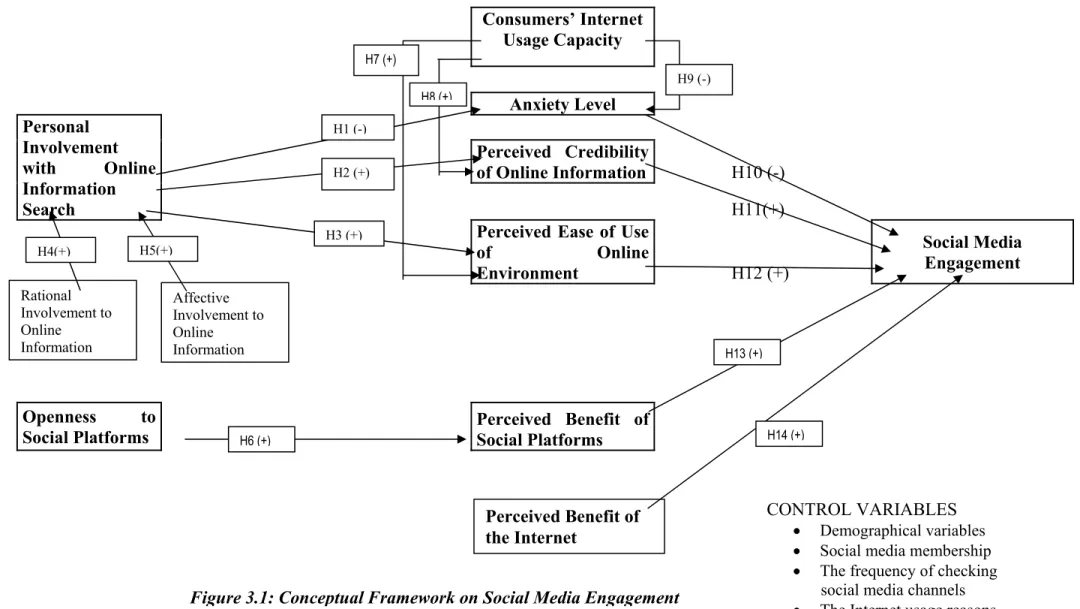
Figure 2.1: Product types and projected search behaviour ... 36 Figure 3.1: Conceptual Framework on Social Media Engagement ... 50 Figure 5.1: Summary of Hypotheses ... 85
x
LIST OF ABBREVIATIONS
Expressive Attributes : E
Functional Attributes : F
Consumers' Internet Usage Capacity : CUIC
Level of Anxiety : LA
Openness to Social Platforms : OSP
Price : P
Perceived benefit of the Internet : PBI
Perceived Credibility of the Internet : PCI
Perceived Benefit of Social Platforms : PBSP
Perceived Ease of Use Online Environment : PEU Personal Involvement to Online Information Search : PI
Social Media Engagement : SME
Turkish Statistics Institute : TÜİK
User-Generated Content : UGC
Uniform Resource Locators : URL
Word-of-Mouth : WOM
1. INTRODUCTION
The aim of this study is to reveal the factors affecting social network platform engagement for online iInformation search and collection of the younger Turkish population who is between 18 – 39 years old.
To better examine the variables, information collection methods have been clarified. How information gathering has evolved throughout history; the radical changes that have taken place in line with the telecommunications revolution; and the rise of virtual communities with the emergence of the Internet have all been investigated. Following this section, factors influencing individuals’ information search behavior and what causes those behaviors to vary from individual to individual have been examined.
Previous studies in the literature indicate that individual involvement, demographics, price and risk perception and the Internet usage experience appear as the primary drivers that can significantly affect information search behavior. Later, to extract meaningful results from this study, the difference between information search behavior for products and services have been examined and highlights of anxiety level while buying a product and service have been presented. The theoretical model for social media engagement for consumer decision making with regard to services industry, composed with findings in the literature. Using a theoretical model, the measurement items (independent variables) of the study have been taken from the literature, modified in some cases, and collected to compose a questionnaire. The design, data collection and sampling of the survey will be explained in detail.
1.1 COLLECTING INFORMATION
Communication has always played a significant role for human beings in collecting information and conveying this information others their surroundings. Primitive communication methods were not meant to convey massive amounts of information to the public as we do in the 21st century. But the more we scrutinize how information
2
was conveyed in the past the more we understand how collecting information evolved into speaking and writing and eventually into telecommunications.
Communication [is] transfer of information, such as thoughts and messages, as contrasted with transportation, the transfer of goods and persons. The basic forms of communication are by signs (sight) and by sounds. The reduction of communication to writing was a fundamental step in the evolution of society for, in addition to being useful in situations where speech is not possible, writing permits the preservation of communications, or records, from the past (Communication, Columbia Electronic Encyclopedia, p.1).
1.2 TOWARDS SPEECH AND WRITING
Before examining how information collection has evolved throughout history, it is essential to understand how communication collection - the most important information source has evolved. This section covers in detail the evolution of the communication process.
1.2.1 The Primitive Era
Though writing in human history has only existed for approximately seven thousand years, the real meaning of communication goes back two hundred millennia with the evolution of speech (History of Communication, Wikipedia, 18/04/2010). Therefore, as the initial form of communicating, speech itself was the beginning of human communication. Speech has tremendous sociological effects and has made people more alert to their surroundings, giving them more understanding and the desire to learn even more. “Like apes and other primates, humans have a system to convey very basic information about emotional state using signals such as crying, laughter and cries of pain or joy. However, parallel to this system, humans use speech to convey complex abstract information” (Bart 2006). On the other hand, to be able to speak, human beings went a step further by conveying their sorrow, happiness, intellect, and even complex moods to other people.
3
Speech is unique to the human species. It is a means by which a people's history can be handed down from one generation to the next. It enables one person to convey knowledge to a roomful of other people. It can be used to amuse, to rouse, to anger, to express sadness, to communicate needs that arise between two or more humans (Speech - Evolution of speech, the physiology of speech, the brain, speech impediments, Science Jrank, http://science.jrank.org/pages/6374/Speech.html).
Of special note, human beings started living together in clans and chose leaders as history evolved. These leaders rendered their messages through speech to keep their clans together, which made the leaders even more powerful. One clan leader also communicated to another via speech, even if a translator was needed. “. . . The individuals still heard speeches of their leaders, or they voiced their own opinions in tribal meetings. The spoken words of tribal leaders were viewed with respect and were obeyed without any objections” (Carlin [no date]). With the invention of writing, the golden rules of communication changed. Moreover, the formal means of communication turned into mass communication tools, a topic discussed further in this study.
1.2.2 Other Steps before Speech
“…. adaptations for speech must have first appeared in the common ancestor of Homo sapiens and Homo neanderthalensis and that complex speech must have had at least 400,000 years to evolve” (Bart 2006). Previous steps in human communication may be summarized first as cave paintings and petroglyphs, further developing into pictograms and ideograms. These steps were milestones for Homo sapiens before the advent of speech.
Even though specific evidence is not available, countries that had amicable relations presumably used visual and audio signs to communicate and to give warnings of danger. Beacons, smoke signals, fire, drums, and horns depict some of the methods used to pass on information. In Ancient China, smoke signals alerted soldiers on the other side of the Great Wall in case of enemy attacks. Other examples of information conveyed through smoke signals include the following:
4
a) The Native Americans in North America communicated with smoke signals; each tribe had their own signaling system and meanings.
b) The Australian Aborigines would send up smoke signals to notify others of their presence, particularly when entering lands that were not their own.
c) The Yámanas sent messages by smoke signals, for instance, when a whale drifted ashore. Since whales produced a large amount of meat, many people needed to be notified so that the meat would not decay (Smoke Signals, Wikipedia, 17/04/2010).
1.2.3 Writing
Even though the first examples of writing would originally be logographic, this advanced method is still a big leap in history. The first examples were writing through pictures; though unlike contemporary writing, these examples still give us insight on the living conditions of that era. Actually this method was unique and formed the basis of research for history, anthropology, sociology, and so on.
[…] 30,000-40,000 years ago, people started by drawing graffiti and paintings on rocks and walls of caves. It is more or less from the same period that the oldest fragments of bones and pebbles with notches have been found. Unfortunately, we do not know with certainty what was the purpose of these beautiful images of animals painted on caves, nor the purpose of repeated signs (Carboni 2006).
The main purpose of this method is seemingly to regulate agricultural information; the Sumerians and Egyptians had known agriculture for some millennia and felt the need for a system of notation for agricultural products (Carboni 2006). With veritable writing systems, history began to be recorded and conveyed information to the next generation more easily. Prehistory was based on stories before the dawn of recorded history.
The invention of writing was the beginning of literature, giving birth to cultures throughout the world. In ancient times, written literature was a means to publicly express bravery, heroism, friendship, loss, or the quest for eternal life, while oral literature told of great sagas, proverbs, and epics to a wide audience. However used,
5
literature was a significant communication method for people to share their common interests, needs and desires along with describing to the masses the meaning of a meritorious life in moral messages.
Other means of communication included mail pigeons and the hydraulic telegraph. Trained pigeons carrying the mail, dropping off messages and returning was a very common way of communicating.
Another important way of communication was in the form of ambassadors, perhaps the first mass communication method, with diplomats carrying messages from their own countries to other countries. Though neither electronic nor fast, nations could, nevertheless, sign pacts or find out what neighboring countries were doing and provide information in turn. This demonstrated that mass communication could not be accomplished without some kind of mass media since messages carried by a single person arrived after lengthy periods of time. Nonetheless, this centuries-old method was widespread and seemingly worked as a form of mass communication.
1.3 AFTER TECHNOLOGICAL ADVANCEMENTS
This section covers the way in which communication and technological developments have opened a new era in how individuals live.
1.3.1 Telecommunications
Technological developments throughout history have further facilitated communication when compared to the era of prerecorded history and the era after the invention of writing. By definition telecommunication means transmitting signals to distant locations. In this respect, message transmissions or telecommunication was accomplished by various means such us smoke signals or horns. However, technological developments widened the scope of both the definition and usage in terms of receiving information from other people in distant countries. Even more significant
6
is the speed of communicating and the quality of transmitting. What one wants to communicate is much clearer.
One such technological development was the telegraph invented by Charles Wheatstone and Sir William Fothergill Cooke in 1839. Mohanbir Sawhney tells us about the reaction to the telegraph in the 1860s: “The media and industry experts were declaring that the telegraph would embrace the whole world, bringing with it peace and prosperity. Similarly, in 1877 Western Union refused to purchase the Bell patents, seeing no future in them” (2001). However, the reaction was not altogether positive but the surge in wanting to learn about and hear from others prevailed. Hence, the telegraph was widely used and became a stepping stone to other transmission methods such as the radio, telephone, television, and finally the Internet.
1.3. 2 The Printing Revolution
A printing press is simply a teletype ink machine to print texts on cloth or paper. With this machine, the production process was shortened and turned into publishing. Beginning in Europe, the printing revolution spread across the world with Gutenberg’s invention of the printing press. The rapid publication of books is one of the reasons why revolutionary ideas flourished publicly.
In the early days of the Reformation, the revolutionary potential of bulk printing took princes and papacy alike by surprise: Just in the short period from 1518 to 1524, the publication of books in Germany alone skyrocketed sevenfold; between 1518 and 1520, Luther's tracts were distributed in 300,000 printed copies (Printing Press, Wikipedia, 17/04/2010).
This development alone signified that the sharing of ideas and feelings with people was edifying; people learned to interact with each other, eventuating in reformist activities.
1.3.3 Newspapers
Rapid printing production facilitated the daily conveyance of information to the public. Because of political and sociological changes in society in that era, newspapers became a common way of sharing political ideas. “The rapidness of typographical text
7
production, as well as the sharp fall in unit costs, led to the issuing of the first newspapers which opened up an entire new field for conveying up-to-date information to the public” (Weber 2006). From 1900 to 1990, newspapers were commonly used by the masses. In fact, people had their complaints over products printed in the consumer columns of newspapers, long before the invention of the Internet. Newspapers were also a platform for classified advertising to sell cars or homes or to even rent homes. And the unemployed found jobs through newspapers. Losing your ID card meant that you could announce the loss in a newspaper to prevent your ID from being misused.
On the other hand, newspapers were never interactive, with their one-way communication dependent on current events and on what people wanted to read. When compared to the decades following the Internet, the print media decided what news to report whether on governmental issues or on famous people. Today with so much news, the coverage of daily events and of more interesting people is much higher statistically.
1.3.4 The Internet
“You may associate the Internet with electronic mail and business applications – but it came into being with global thermonuclear war in mind” (The Internet: The Promise and the Perils, The Church of Scientology International, http://www.freedommag.org/english/vol2704/EVOLVE.HTM).
The Advanced Research Project Agency (ARPA) of the U.S. Department of Defense was looking for a way to strengthen the communications of military personnel in times of national emergencies. They were definitely seeking solutions to rapid, instant messaging, and therefore communications. In the 1960s, computers were not able to share information. “In 1969, the Department of Defense Advanced Research Projects Agency (ARPA) developed an experimental network called ARPAnet to link together four supercomputing centres for military research” (History and The Evolution of The Internet, Bizymoms, http://www.bizymoms.com/computers-and-technology/evolution-of-the-internet.html). However, the system was neither reliable nor fast and
8
cumbersome to use but became a good starting point for sharing information. Finally, the beginning of the Information Age started with this development.
Today, the Internet has diverse means of information sharing from texts, documents, graphic files and sound and video files to downloadable games and software or demo games and software to mass data storage. “Internet uses can be simply categorized as publishing and getting information on various subjects like marketing, management, science, new technologies, training materials, jobs, higher education, mathematics, music, games, software, etc. and E-Commerce” (History and The Evolution of The Internet Bizymoms, http://www.bizymoms.com/computers-and-technology/evolution-of-the-internet.html).
The Internet cannot be defined by a single word or concept. It has changed the face of people, and therefore the face of the globe. A single event or situation can either cause an enormous disturbance or stimulate gratitude. You can become famous with your 140-character blog or Twit in a matter of seconds. Companies are suddenly ousted in less than thirty minutes because of news spreading so quickly across the globe. “Today, although far from its original concept, the Internet satisfies far more needs and wants than ever envisioned. It is a true example of technology that can help mankind move into the future” (The Internet: The Promise and the Perils, The Church of Scientology International, http://www.freedommag.org/english/vol2704/EVOLVE.HTM).
1.4 THE TRANSFORMATION
Nightly Business Report partnering with Knowledge@Wharton conducted research to glean the top 30 innovations of the last thirty years. According to their research, ranking at the top of the list were the Internet, broadband, and the World Wide Web (browsers and html pages). In fact, the Internet has definitely transformed our lives by closing the gap with fast, reliable and close-knit communications.
The nature of communication has undergone a substantial change in the past 20 years – and the change is not over. Email has had a profound effect on the way people keep in touch. Communications are shorter and more frequent than when
9
letters were the norm; response time has greatly diminished; we are even surprised if someone we wish to contact does not have an email address (Social Networking, the “Third Place,” and the Evolution of Communication, The New Media Consortium, 2007, p. 2).
Parents can now go online and watch their children with their nannies. Moreover, children essentially use their home computers like telephones to chat and exchange instant messages with their school friends. When anyone needs any kind of information, they can Google it to find out the answer. Furthermore, new technologies provide online information on where you are, including the street, via GPS. In addition to television and newspapers, companies now use the Internet to reach the populous. People go online and gather in social communities to participate in life, to shop or gamble, or to express their feelings and desires on personal blogs or they join Facebook or participate in microblogs such as Twitter – all online.
ScienceBuzz is a website where people share their ideas, post articles, create new communities, and so on. On May 9, 2007, a person named Gene started a discussion on “How the Internet Has Changed Our Lives (The Free Library, 28/04/2010).” Here are some of the comments posted by readers:
Anonymous says: I couldn't do my job without the Internet. Literally. I live in Michigan, but work for the Science Museum of Minnesota. Everything I do is via e-mail, FTP site, or shared server.
Anonymous says: I keep in touch with family and friends all over the country, through e-mail and a personal photo blog. In fact, I maintained a long-distance relationship with a girlfriend in another country, thanks to e-mail.
Toria says: I use the internet for everything.. i don't know what i would do without it. I find information that can help me with my assignment work and to meet knew people. It's amazing how easy it is to find exactly what your looking for.
Karan says: I like the way in which internet has changed our lives. We get everything that we want at home. We don't have to go to malls for shopping or to pay electricity bills. It's just cool to have internet.
On December 29, 2003, the Nielsen NetRatings issued a press release on “How the Internet Has Changed Our Lives,” which started eight years ago (Nielsen-Net Ratings, 2003). This report chose ten websites that had affected our lives the most. These sites included Google, eBay, Microsoft Outlook, AOL Instant Messenger, Nepster, Amazon, Friends Reunited, Easyjet, Kelkoo and Blogger. The article was written in view of what
10
was happening at that time but could not have foreseen up and coming trends such as Wikipedia and YouTube. Friends Reunited, “the first and eponymous website, was created by a husband and wife team in the classic back bedroom Internet start-up; was the first online social network to achieve prominence in Britain; and it weathered the dotcom bust” (Friends Reunited, Wikipedia, 17/04/10). In this respect, the report got caught up in the microblogging frenzy and found Friends Reunited entering the world of blogs.
While influencing the way our lives have evolved sociologically, the Internet has also set up its own rules for user profiles. In fact, the Internet and users altogether define the rules of engagement. Right now, standardization on how to communicate and what to say is on the horizon, with its own unique language.
The Internet has also generally changed our lifestyle and culture. The way that we communicate off-line has been impacted by IM lingo. You may have already heard someone say ?lol? or ?brb? in person. If you haven’t, you probably will soon. There was even a national ad campaign where someone asked another person what they were doing, and they said ?Idk, talking to my bff.? These abbreviations are out of control! Who would have thought that we would start saying abbreviated phrases in our everyday lives, verbally!? When people meet new friends, they often give out an email address instead of a phone number. People might even say ?myspace me? (meaning to message them on their Myspace page) (How the Internet Has Changed Our Everyday Lives, The Free Library, 28/04/2010).
The Internet is used for both person-to-person and individual-to-public interfacing, which has become a unique means to communicate, greater than any other human beings have used in the past. “[Internet] is interactive: Like the telephone and the telegraph (and unlike radio or television), people can overcome great distances to communicate with others almost instantaneously. It is a mass medium: Like radio and television (and unlike the telephone or telegraph), content and advertising can reach millions of people at the same time” (Bargh and McKenna 2003, p. 573).
1.5 THE EVOLUTION OF SOCIAL MEDIA NETWORKS
Web Designer Depot reviewed the evolution of social networks, noting several milestones. For example, bulletin board systems (BBS) were the first attempt for users to login and interact with others. “After BBS came “online services” like CompuServe
11
and Prodigy which were the first real “corporate” attempts at accessing the Internet” (The History and Evolution of Social Media, Web Designer Depot,
http://www.webdesignerdepot.com/2009/10/the-history-and-evolution-of-social-media/). ICQ was the first real instant messaging and probably the most important milestone in people getting used to the online world via the Internet, though with limited access because of dial-up technologies.
Internet discussion forums and blogs are the next comers to the online world. They are basically platforms where people can come together to ask questions, network, gossip, talk about love, and share ideas, experiences and happiness. “World of Warcraft, often referred to as WoW, is a massively multiplayer online role-playing game (MMORPG)” (World of Warcraft, Wikipedia, 19/04/10). Within MMRGPG forums, participants interact in games or on other platforms related to the games on any topic in which players may want to engage. “LinkedIn allowed users to post a profile (basically a resume) and to interact through private messaging. They also work on the assumption that you should personally know the people you connect with on the site” (The history and Evolution of Social Media, Web Designer Depot,
http://www.webdesignerdepot.com/2009/10/the-history-and-evolution-of-social-media/). While MySpace differs from others by having a feature that enables users to customize their profiles and post videos from other websites, Facebook allows users to post videos and photos and to update the contents. On the other hand, Flicker is another online community that lets users host images and videos. As a micro-blogging platform, Twitter users may update their status daily, hourly or even every second via “twits.” YouTube is also a video sharing website.
While these platforms are the most popular and take in a wide range of people from all over the world, the number of online platforms is increasing day by day. From Levy Cohen’s perspective, social circles are those that bring people together around very specific topics, diseases, technological developments, recipes, home employment, politics, economic crises, and so on. These social circles tie people together as one in the online world. “A decade ago, we began expanding our networks by joining list serves, forums, chats and specific destinations where sharing tools were available. Our
12
connections could happen whenever we wanted and they also became bi-directional. The very act of joining interests groups was born back then” (Cohen 2008).
Beyond the changes of the Internet in people’s lives, all of these social networks have been seen as a way of coming together and living an online community life. Social platforms are not only the way of revealing of our lives but also the way of living a commune life all together in terms of reacting to the issues of life, politics, and social problems and so on. That kind of a union is being called as virtual community which has a function of binding people, creating a group of people within the same interest and ideas. In the next section, what the virtual communities are will be explained in a detailed way.
1.6 VIRTUAL COMMUNITIES
Without any geographical barriers, online platforms have allowed people who share the same interests, desires, and future goals to connect. “Virtual communities are social aggregations that emerge from the Net when enough people carry on those public discussions long enough, with sufficient human feeling, to form webs of personal relationships in cyberspace” (Rheingold 2000). Steve Jones defines virtual communities by comparing them to the offline way of life in his book, Virtual Culture: Identity and Communication in Cyber Society. The Internet would . . . make the community better. It was to result in a community free of the constraints of space and time, and so us to engage with fellow humans irrespective of geographic proximity and the clock, and it would construct the community from communication, rather than inhabitance and being, which do not guarantee communication” (Jones 1997, p. 10). These types of communities began to form after the use of the Internet expanded rather rapidly in mid-1990s. Web 2.0 technologies also triggered information sharing among people, i.e., feelings, new trends, habits, and complaints, love life, and so on. A virtual community can even form an emotional support group: “I was in the Parenting conference on the WELL, participating in an informational and emotional support group for a friend who just learned his son was diagnosed with leukemia” (Rheingold 2000).
13
To some extent, who you are, what you look like or what you do is not so important in a virtual community. As long as you have something to say within the context of a particular community you can join the “neighborhood.”
People in virtual communities use words on screens to exchange pleasantries and argue, engage in intellectual discourse, conduct commerce, exchange knowledge, share emotional support, make plans, brainstorm, gossip, feud, fall in love, find friends and lose them, play games, flirt, create a little high art and a lot if idle talk. People in virtual communities do just about everything people do in real life, but we leave our bodies behind. You can't kiss anybody and nobody can punch you in the nose, but a lot can happen within those boundaries (Rheingold 2000).
Online communication is also found to be “more effective, productive and therefore more enjoyable” as noted by Licklider and Taylor in 1968 when the computer-mediated communication (CMC) concept first took shape (cited in Jones 1997, p. 31).
It is observed that, in addition to the changes virtual communities cause in our personal lives, they also alter people’s lives in a societal sense, within specific measures and in different forms. It is widely accepted that the biggest example of this is in the share or flow of information. For example, at the New Media Order Conference (Istanbul, 2010), which is a platform that brings together all journalists, news people shared their discomfort and worries about all of the information sharing that has occurred in an adverse direction due to the Internet and all social platforms. It was discussed that, in the face of a social mass that adheres to the logic of “Share is a new search,” each individual is a “journalist” with a small column. It is observed that, even if it is not within the context of official “journalism,” each individual has a serious contribution in the accumulation and spread of information and the reactions to it. With technological advances, it is now possible for us to reach information every second of every moment. It is certain that, as of this point, information will not be distributed single-handedly and that control is no longer possible. Media has a brand new face in the 21st century, and the name of this new face is The New Media.
1.7 THE NEW MEDIA
The New Media Consortium, a non-profit organization that researches how new technological developments support our learning and effect our lives, clarifies the
14
differences in our communication since the 1990s to 2000s in their article, “Social Networking, the Third Place and the Evolution of Communication”.
Online communication tools also have the potential to increase our awareness of the movements of our professional or social contacts. Twitter, for instance, offers an at-a-glance update of things people we know happen to be doing: who is outside cleaning their gutters, who is writing a new blog post, who is about to have lunch with a friend (2007, p. 2).
Tools like Facebook and LinkedIn help to relieve the additional social burden of these ties by making it easy to keep track of contacts and keep a record of when we last “touched” them (2007, p. 4).
Conclusively, the way human beings communicate with each other has grown leaps and bounds. Thanks to the Internet, communication in terms of how people gather information from their surroundings has a new face due to digital technology – faster, more compact and interactive. However, before we focus on interpersonal communication with the Internet being a part of everyday life, the new media concept should first be defined to understand how we obtain information and process it in contemporary life, being surrounded by high-tech products.
The new media concept came about after the Internet. Undoubtedly, our acceptance of this new media was influenced by the personal computer and new technologies supporting the use of the Internet. According to Wikipedia, as of June 2008, the number of personal computers in use worldwide hit one billion, which means that at least one billion people have personal computers. In the modern world, businessmen and women usually have more than one PC. Thanks to technological developments, even the scope of what defines a PC is much wider than five years ago. A PC is a telephone, netbook, palmtop, tablet PC or even a television soon to be adapted to the Internet – all of which connect you to the entire world. Perhaps the second reason we have accepted this new media concept is the decreasing cost of connecting to the Internet but with greater speed compared to five years ago. Right now, anyone can connect to the Internet and get information from a regular cell phone via Edge, 3G, 4G or even GPRS.
15
Along with these technological developments, the services offered to people have evolved in terms of being open and interactive in these new systems. For example, at any given time, you can find your location with your cell phone or learn an enormous amount of information by playing Planescape: Torment, a computer role-playing game, or read your newspaper or the daily news from your iPad.
All these changes have aroused people’s curiosity, so much so that they want to be more connected to life. To know the most current tidbit, to do the newest thing, to keep up with new trends, and to contribute to the flood of information on the Internet are much more significant and stimulating nowadays. Companies whose missions are to be innovative excite even more curiosity in people by using new technologies via the newest communications tools.
The use of mass media channels like television and newspapers have undergone a tremendous change because of the Internet. Greater use of the Internet in everyday life and our exposure to digital marketing are on the rise. As a result, the Internet is now used as a channel for marketing and advertising products and services. One telling example is how U.S. President Obama used the Internet so effectively in his 2008 election campaign.
16
2. INFORMATION SEACRH BEHAVIOR
“Though humans were anciently dubbed the ‘speaking animal’ by Aristotle, only since the late nineteenth century have we defined ourselves in terms of our ability to communicate with one another” (Peters 1999, p. 1). For time immemorial, communication has been a functional tool binding people together while sharing their feelings, love, passions and thoughts. Furthermore, communication has consistently been bidirectional with at least two participants: receiver and speaker, whose interaction has been an indispensable feature of communication. “With interaction, interpersonal communication is contextual. That means communication does not happen in isolation”
(Four Principles of Interpersonal Communication,
http://www.pstcc.edu/facstaff/dking/interpr.htm).
2.1 REASONS FOR CONSUMER INFORMATION SEARCH BEHAVIOR When the subject matter becomes consumer behavior discipline, “people” as a term should be defined as consumers who seek information about products or services. In a world of multi-screened media, with advertising skyrocketing and diverse products and services offering so many choices, consumers sometimes find it difficult to make decisions. For consumers to decide what to choose or to make a good purchase or “to make a good purchase” (Bloch et al. 1986, p. 119) is a difficult matter that has been scrutinized for many years by retailers and academicians (Beatty and Smith 1987; Bloch, et al. 1986).
Information seeking is a result of unsolved consumption problems involving a pre-purchase, a post-purchase or an ongoing search for information. Bloch et al. (1986) argue that “consumer search behavior is an extended process that lasts before pre-purchase and after ongoing search which does not occur in order to solve a recognized and immediate purchase problem” (p. 119). On the other hand, according to Murray, risk avoidance is also one of the most important motives behind consumer search behavior while researchers have identified risk aversion as the fundamental reason
17
behind information search. “Risk aversion is a consumer’s natural predisposition to avoiding losses e.g., financial, performance, social through purchase activity” (Bauer, Cox, Jacoby and Kaplan in Murray 1991, p. 525).
Basically, the two main ways describing consumers as information seeking models are internal and external searches covering price, difference between product or service, product type, personal involvement and the role of experience that consumers play. Beyond these two information-seeking models – internal and external – other reasons as already mentioned such as search differentiation among consumers, under these two models as well, is discussed in the next section.
By definition, internal information search involves memory and occurs prior to external information search. External information search refers to everything but memory when searching for information (Merino and Peterson 2003, p. 101). The internal search refers to the activity that retrieves information stored in long-term memory. It is the information that was created from previous experience, past information searches, and repeated exposure to marketing stimuli (Jang 2004, p. 42).
This means that consumers first go to their memories and experiences; however, if sufficient information cannot be gathered, they look for alternative sources (external search).
On the other hand, other researchers think that internal search is not actually a search activity but a processing of stored information. “[Internal search] may be more closely related to processing than to search” (Moore and Lehman 1980, p. 296). Otherwise, the combination of both internal and external information is accepted by researchers. In other words, information processing does not develop separately but through both internal and external information. “Although internal and external information search behaviors are conceptually distinct, in reality they are related in that external information search is dependent on memory and the overall information search process is iterative” (Merino and Peterson 2003, p. 101).
There is one more derive for consumers to search to decide what to choose. The meaning of product or service to consumers shape the source of searching and Lee et al.
18
(2001) prepared a table to show the marginal benefit of sources for information collecting, in which both traditional and online searching instruments are combined.
Table 2.1: Effect of Increases in Attribute Importance Weights on Marginal Benefit of Source
Lee et al. 2001, p. 9.
Lee et al. summarized the benefit of information as functional attributes (F), which are more related to a product’s physical features and are measured objectively from external information sources (traditional or online); expressive attributes (E), which meet the self-satisfactory needs of searchers in that the meaning of the product is more important than its utility; and finally the price (P) of the alternative choices, which is related to comparing the prices of different sources (2001, p. 8).
According to these information sources, online and offline sources may be categorized as follows:
Offline information Sources: Salesperson, dealer/retailer inspection, television/radio ads, print ads in national media, print ads in local media, direct mail ads/catalogues/brochures, friends/relatives (word-of-mouth).
19
Online information Sources: Internet ads, Internet stores, Internet information, non-advocate impersonal sources.
According to this table, there are some specific results to be touched on.
I. While the Internet is a highly accepted and an applied source for obtaining functionality information, it is not acceptable for expressive attributes. This means that for products in which high involvement is required or for prestigious products in terms of social acceptance, the Internet is not an effective source and cannot be applied to these kinds of products.
II. Another significant result of online information searching is that Internet sources are the most widely accepted sources for collecting price information and comparing prices among alternatives.
III. On the other hand, television and radio ads are the most important offline information sources and the most applied sources for expressive attributes. But to obtain information on functionality and prices, television and radio ads are not reliable.
IV. More acceptable by society is information from relatives and friends about products whose importance is high in terms of social norms.
V. “Currently the Internet is a source that can be paged through and referred back to, but is not (yet) comparable to television in presenting sound and picture. Consequently, despite the advantage of being able to provide customized information in real time, the Internet has more in common with, and is a substitute for, local print media, direct mail, and impersonal sources” (Lee et al. 2001, p. 11).
2.2 FACTORS AFFECTING INFORMATION SEARCH BEHAVIOR
Behind any kind of information search, there are generally unresolved problems; beyond this, the factors, personal differences or product type or meanings of products
20
affect the type and extent of search activity. These factors have been described by Jang (1996) such a new product’s similarity or dissimilarity to categories already stored in the memory; the prices and quantities purchased; level of income, age, education, health status, previous experience, time constraints, presence of children, fulltime work and marital status (p. 157 – 159). However, the main factors shaping search activities focus on personal involvement, price, the role of experience, risk and the difference between product and service.
2.2.1 Personal Involvement
Kapferer and Laurent (1985) define involvement in that “[it] stems from the individual’s very personal and central values”; another explanation is that “involvement is an unobservable state of motivation, arousal or interest. It is evoked by a particular stimulus or situation. It has drive properties: its consequences are types of searching, information processing and decision-making” (1985, p. 42). As explained by Kapferer and Laurent (1985), personal involvement relates to the personal interests of consumers, with these two factors binding consumers together.
If personal involvement is high, consumer interest will focus on searching for products and services that interest them, meaning that the need is not necessarily an urgent need to satisfy but depends on how much the consumer is motivated to obtain information about a product. “The need of consumers to satisfy their information needs relating to product knowledge is the primary motivator for consumer information search” (Clarke et al. 2007, p. 524). Because of continuous search activities, consumers have information about a product or service they decide to buy in terms of product involvement and their interests. On the other hand, Bloch et al., argues that “consumer search behavior is an extended process that lasts before pre-purchase and after ongoing search which does not occur in order to solve a recognized and immediate purchase problem” (1986, p. 119). While pre-purchase search is more related to a consumer’s short-term involvement and fulfillment of urgent needs, ongoing search is described as a continuous search activity more related to long-term involvement and the consumer’s interests. In other words, visitors to specific stores and subscribers to magazines are
21
thought to have a broader knowledge of more products than other people, so the possibility of these consumers shopping at these stores or through these magazines is higher compared to that of other people.
Similar to Kapferer and Laurent, Clarke et al. supports the fact that personality has great impact on differentiating consumers’ searching activities even on the same product group. “... Personal factors lead to different search behavior for a common product” (Clarke et al. 2007, p. 520). For instance, a research conducted for student shopping orientation clarifies that brand or fashion consciousness and interest along with the joy of shopping are significantly and positively related to the information search of the youth of today (Bailey and Seock 2008, p. 118).
According to researchers, consumers with low involvement in products think that these products are not very critical. Therefore, the purchase decision for these product groups is relatively easier than products in which they are interested. At the same time, the perceived risk of low-involvement purchases is very little.
Low-involvement purchases are purchases that the consumer does not regard as very important, have very little relevance to the consumer, have little perceived risk associated with them and are characterized by little motivation to expend cognitive effort and time on processing information associated with a message (Boshoff, 2005, p. 4).
Otherwise, consumers with high-involvement are expected to search more and store gathered information in their long-term memory; consequently, this information becomes an internal information source and is tapped into by consumers first, especially when the needed information is close at hand. “High-involvement conditions cause the experience of a high level of motivation, arousal or interest that causes greater searching, information processing and decision-making by individuals” (Boshoff 2005, p. 5).
22 2.2.2 Self Oriented Factors
In this section, the personal factors in terms of personal skills and individual demographics will be scrutinized in terms of reaching information.
Personal Skills and Capabilities
Clarke et al. conceptualized information search behavior in terms of “individual skills in search and information processing” (2007, p. 523). According to this view, consumers actually shape their search by their personal skills. Moreover, they have suggested three primary skills that shape the search activity: technology skill, referring to “the consumer’s ability to engage with varied electronic networks and data processing”; search skill, or “the consumer’s knowledge regarding information access”, and the main consumer skill to reach required information more efficiently and faster; and information processing skill, meaning “... the ability of consumers to extract and process information that will satisfy their information needs” (Clarke et al. 2007, p. 524).
Individual Demographics Age Effect on Search Behavior
Notwithstanding discussions and the current status quo of the Internet, young people are the central point of every new trend, not precluding the Internet. While senior users are prejudice toward the Internet, young people embrace it as an ardent user group (Graeupl 2006). To illustrate the point, Kim and Park’s study addresses college students and shows the statistics of Internet usage among adults and young people:
59% of all US adults access online websites to obtain information; however, 86% of college students use online sources for their own purposes. In addition, apparently, about 20% of college students began using the Internet between five and eight years ago; 47% of them began utilizing the Internet the first time at home before attending college, and 85% possess their own computers (2010, p. 50).
23
with this increase, young people will continue to be the target market segment for any organization’s online shopping model. “As the use of the Internet increases and continues to develop as an important shopping medium, college students are becoming particularly active and heavy Internet users with greater access to the Internet than most other population segments” (Bailey and Seock 2008, p. 113).
College students’ heavy usage of the Web can be understood as a function of their familiarity with the Internet and Web, their ample opportunities to witness its use and experiment with it, and the resultant comfort they gain with this tool. Indeed, today’s college students have ‘‘grown up’’ with the Internet and thus may perceive it as very easy to use (Flanagin 2003, p. 275).
According to Kim and Park, college students are the major users of the Internet for tourism purposes, and they search online more than any other age group (2010, p. 50). Moreover, Lee et al. argues the same issue by saying, “Internet use will be highest among younger age groups because the investment in the required skills can be spread over the longest time horizon, and because they are most likely to have access to computers and be skilled at their use” (2001, p. 14). Kim and Park also propose that “in the case of tourism, the study conducted by Bai et al. (2004) revealed that about 80 percent of college students answered that they prefer online travel agencies when making trip plans, and 86.7 percent of students have experience in purchasing online products” (Kim and Park 2010, p. 50).
In addition, Harris Interactive suggests that technology and the media have been the most important interests of younger groups (Bailey and Seock, 2008, p. 113). The result of their search shows that the young spend most of their spare time on the Internet and in shopping online. “According to Cassis (2007) at The Daily Free Press, college students spend hours surfing the Internet each day, and are among the most eager consumers to make online purchases” (Bailey and Seock 2008, p. 113).
Similarly and more in the context of social change across the globe, Darley and Johnson contend that young people are now more involved in the decision-making process than ever before, especially with the increase of “single-parent families and working mothers world-wide” (1993, 149-150). This means that the younger generation has been learning the rules of general decision making and can think more like their family members who
24
would normally make decisions concerning household products. On the other hand, Paxton and John state that young people have a different searching mechanism than older consumers. They tend to decide based on their perceptual insights about products.
... younger kids tend to use fewer dimensions to compare and evaluate brands, use simple choice mechanisms based on single attributes rather than employing compensatory choice strategies, and tend to rely on dominant perceptual features (vs. functional features) of products in gathering information and making choices (Paxton and John 1995, p. 567).
Both Peter and Olson (1990) and Darley and Johnson (1993) indicate that young people are more brand loyal. Darley and Johnson also have found that “American female teenagers prefer a small store shopping experience” (1993, 160). With this preference, the enjoyment of shopping takes a higher precedence. Since this consumer group cares more about being social and belonging to a group they are more likely to shop together. In addition, another factor in young consumer search behavior is that female teenagers do not prefer to pre-plan their shopping trips and “are less likely to exhibit fashion innovativeness, less likely to be fashion opinion leaders, less likely to desire fashion-related information and less likely to search for fashion-fashion-related information” (Darley and Johnson 1993, 160).
According to research conducted by Flanagin et al., (2003) to understand the search behaviors of American college students, they discovered that college students trust heavily on Web-based information for a wide range of subjects. The main purposes of college student searches are summarized as entertainment (leisure time spent in chatting, playing games, and so forth); non-academic research (looking for medical information, driving directions, travel tips, and so forth); news and current events; and business transactions (purchasing products and services, online banking, and so forth) (Flanagin et al. 2003, p. 278). However, “[they] do not find it particularly credible in relation to traditional information sources and do not verify it very diligently” (Flanagin et al. 2003, p. 286). Furthermore, the participants in the research display agreement on verifying online information. If the information has subjective judgment or if there is an easy way of cross-referencing the information (e.g., checking the “date stamp” at the
bottom of many Web pages), they tend to verify the information obtained online
25
Flanagin et al.’s research (2003) defines how college students verify the information obtained online. These are the strategies:
a) Check to see if the information is current
b) Check to if the information is complete/comprehensive c) Consider whether the views represented are facts or opinions d) Seek out other sources to validate the information online e) Consider the author’s goals/objectives for posting information f) Check to see who the author is
g) Look for a stamp of approval or recommendation h) Check if contact information is provided for the author i) Verify the author’s qualifications or credentials
The results of this verification strategy of college students show that the most common verification strategy is to check whether the information on the website is correct, complete, and comprehensive while “considering whether the views represented by the author are facts or opinions, seeking out other sources to validate online information, and considering the author’s goals or objectives in posting information to the Web” (Flanagin et al. 2003, p. 285). According to this research, the less common strategies are to check who the author is, whether the contact details of the author are given, and whether an approval is provided, all of which basically relate to the physical status of the information source. But the most common strategy concerns the subject’s content and its verification.
According to Lynn Phillips and Brian Sternthal, the elderly population in the U.S. will increase over the next decades. “If the current trend of low fertility and mortality rates persists, almost half the growth of the American population in the next half-century will be attributable to the increase in the number of aged persons” (Phillips and Sternthal 1977, p. 444). The more important point is the enormous gap in information processing between younger consumers and senior consumers who have the most purchasing power.
Some of their findings on elderly people and consumer search behavior show that elderly people have a greater reliance on mass media than do younger consumers. The
26
main reason behind this finding is because the elderly (approximately 45 percent are 65) spend most of their leisure time on mass-media channels (Phillips and Sternthal 1977, p. 445).
On the other hand, Erdem et al. states that senior consumers tend to use all information sources but prefer retail, general, and advertising channels over computer and word-of-mouth sources (2004, p. 100). According to Phillips and Sternthal, senior consumers 65 and over “tend to develop friendship patterns with persons who are similar in age, sex, marital status, and social class” (1977, p. 446).These facts show that senior consumers prefer more traditional information sources as opposed to online sources and external sources to some extent. They do not prefer external information sources because of the trust factor regarding these information sources, so they are more likely to prefer information from people or sources they can fully trust.
Consumer experience on the Internet increases online consumer searches in that the more experienced consumers are the more they are open to other information sources and will use them more effectively. Furthermore, senior consumers cannot keep up with the most recent ways of collecting information as can younger consumers, primarily because of fast technological developments. As Erdem et al. (2004) also argued, senior consumers care more about people with whom they have close relationships, internal sources, prior knowledge, or past experiences in terms of searching information. Moreover, information processing for senior consumers is slower since they are not at the forefront of technological developments, e.g. the Internet merely directs them to information sources with which they are already familiar (Erdem et al. 2004, p. 100; Phillips and Sternthal 1977, p.448). Jang who researched tourism and search patterns in senior consumers concluded the same facts: “According to Javalgi et al. (1992), senior travelers engage less in external search, so they tend to buy more pre-packaged tours than non-seniors” (Jang 2004, p. 43). Despite the trust problem senior consumers have toward innovative information searching, according to Phillips and Sternthal, they are open to searching about a product’s functionality, expressive attributes, and price. The main issue is that they prefer internal sources of information, more so than younger consumers: “One common problem is that older persons are more likely to refuse to