International Forum of Educational Technology & Society
A Structural Model for Students' Adoption of Learning Management Systems: An
Empirical Investigation in the Higher Education Context
Author(s): Duygu Findik-Coşkunçay, Nurcan Alkiş and Sevgi Özkan-Yildirim
Source: Journal of Educational Technology & Society , Vol. 21, No. 2 (April 2018), pp. 13-27
Published by: International Forum of Educational Technology & Society
Stable URL: https://www.jstor.org/stable/10.2307/26388376
REFERENCES
Linked references are available on JSTOR for this article:
https://www.jstor.org/stable/10.2307/26388376?seq=1&cid=pdf-reference#references_tab_contents
You may need to log in to JSTOR to access the linked references.
JSTOR is a not-for-profit service that helps scholars, researchers, and students discover, use, and build upon a wide range of content in a trusted digital archive. We use information technology and tools to increase productivity and facilitate new forms of scholarship. For more information about JSTOR, please contact [email protected].
Your use of the JSTOR archive indicates your acceptance of the Terms & Conditions of Use, available at https://about.jstor.org/terms
International Forum of Educational Technology & Society is collaborating with JSTOR to digitize, preserve and extend access to Journal of Educational Technology & Society
Fındık-Coşkunçay, D., Alkış, N., & Özkan-Yıldırım, S. (2018). A Structural Model for Students’ Adoption of Learning Management Systems: An Empirical Investigation in the Higher Education Context. Educational Technology & Society, 21 (2), 13–27.
A Structural Model for Students’ Adoption of Learning Management
Systems: An Empirical Investigation in the Higher Education Context
Duygu Fındık-Coşkunçay
1, Nurcan Alkış
2*and Sevgi Özkan-Yıldırım
31Faculty of Economics and Administrative Sciences, Atatürk University// 2Technology and Knowledge
Management, Başkent University// 3Information Systems, Middle East Technical University //
[email protected] // [email protected] // [email protected]
*Corresponding author
(Submitted October 12, 2016; Revised December 01, 2016; Accepted January 31, 2017)
ABSTRACT
With the recent advances in information technologies, Learning Management Systems have taken on a significant role in providing educational resources. The successful use of these systems in higher education is important for the implementation, management and continuous improvement of e-learning services to increase the quality of learning. This study aimed to identify the factors affecting higher education students’ behavioral intention towards Learning Management Systems. A research model was proposed based on the belief factors of the technology acceptance model; namely perceived usefulness, perceived ease-of-use and external factors including self-efficacy, enjoyment, subjective norm, satisfaction, and interactivity and control. Then, a self-reported questionnaire was distributed online. A total of 470 higher education students participated in the survey. The proposed structural model was assessed and validated using structural equation modeling, in particular the partial least square method. The predictors of behavioral intention were identified as perceived usefulness, perceived ease of use, enjoyment, subjective norm, satisfaction, and interactivity and control with the validated structural model. The relationships between the influencing factors provided an insight about the students’ behavioral intention towards the use of Learning Management Systems. It is expected that the academicians and practitioners will benefit from the design and findings of the current study in their future research.
Keywords
Learning management systems, Student adoption, Technology acceptance model, Structural equation modeling, Partial least square
Introduction
With the advances in information and communication technologies, educational activities are now more dependent on the internet and online applications. These new developments have resulted in the emergence of a new concept, e-learning. E-learning refers to “technology-based learning in which learning materials are delivered electronically to remote learners via a computer network” (Zhang, Zhao, Zhou, & Nunamaker Jr, 2004, p. 76). Several applications are used to support e-learning activities; such as course, learning and student management systems, accounting systems, content creation tools and course websites (Paulsen, 2003). A Learning Management System (LMS) is one of the widely used applications in higher education institutions to support course activities in the digital environment. The effective implementation of this tool is important to improve the quality of learning, access to education and training, provide cost-effectiveness and reduce the cost of education (Bates, 1997). However, contrary to expectations, the implementation of this system may be problematic, often resulting in failure (Bhuasiri, Xaymoungkhoun, Zho, Rho, & Ciganek, 2012). Therefore, the problems and challenges involved in the adoption and implementation of LMS should be investigated.
The effective use of LMS in the education field mainly depends on certain factors related to the behavioral attitudes of instructors and students, university support and applied information technologies (Davis, Bagozzi, & Warshaw, 1989; Webster & Hackley, 1997). In particular, the users of these systems may have a different point of view towards technology adoption and acceptance; therefore, this is important to consider when evaluating technology-mediated online learning systems (Dillon & Gunawardena, 1995). In the education field, instructors and students are the end users of LMS; thus, they play a major role in the successful implementation of this system. Since students are the main target group to benefit from LMS, their adoption of this system is important, particularly in higher education. In this context, this study aimed to identify the key factors affecting students’ behavioral intention towards the use of LMS, namely NET-ClassR, in higher education by taking Technology Acceptance Model (TAM) as the theoretical basis. NET-ClassR was designed to meet the e-learning needs and manage courses without the requirement of extensive technical knowledge. NET-ClassR has three main users, the instructors, students and the administrator. It provides separate functions and graphical user interfaces for each type of user. The users can follow and manage web-based asynchronous courses using a web interface.
In the literature, there is a considerable amount of research on the acceptance of e-learning applications by students. In particular, recent studies have addressed the adoption of synchronous and asynchronous web–based technologies (Lee, Yoon, & Lee, 2009), e-learning systems (Lee, 2010; Pituch & Lee, 2006), web course tools (WebCT) (Sánchez-Franco, 2010), web-based streaming media (Liu, Liao, & Pratt, 2009), web-based learning systems (Lee, 2008; Saadé & Bahli, 2005), virtual learning environments (Van Raaij & Schepers, 2008), web-based educational tools (Ngai, Poon, & Chan, 2007), e-learning courses (Park, 2009), web-web-based class management systems (Yi & Hwang, 2003), discussion forum (Aucamp & Swart, 2015) and LMS (Murshitha & Wickramarachchi, 2016). However, research on the acceptance of LMS in blended learning environments remains relatively limited; therefore, conducting studies on acceptance of LMS to support traditional learning would contribute to the literature. The current study was based on the research question, “what are the factors influencing students’ acceptance of LMS?” This paper presents the behavioral intention of students in relation to LMS, NET-ClassR, via a new research model using the new LMS-TAM.
In the literature, different theoretical frameworks and research models have been developed and used to evaluate the individuals’ adoption or rejection of new technologies. Therefore, determining the influencing factors of the proposed research model is a challenging task. In addition to the in-depth systematic review of literature (Alkış, Fındık-Coşkunçay, & Özkan-Yıldırım, 2014), experts from academia were employed to assist in the development of the model. The constructs of the model were identified as: Perceived Usefulness (PU), Perceived Ease-of-Use (PEOU), Behavioral Intention (BI), Self-Efficacy (SE), Enjoyment (ENJ), Subjective Norm (SN), Satisfaction (STS), and Interactivity and Control (IC).
Theoretical background
Concept of e-learning and its advantages
In the information age, e-learning, also referred to as web-based learning, is one of the most popular learning environments (Liaw, Huang, & Chen, 2007). E-learning systems help use time and space efficiently; however, their success depends on end users’ acceptance and use of these systems (Van Raaij & Schepers, 2008). In order to support e-learning activities, several technology-based pedagogical tools have been developed; such as web course tools, web course homepage system, blackboard learning system and system for multimedia integrated learning (Ngai et al., 2007).
E-learning provides many benefits including an increased accessibility to information, better content delivery, personalized instruction, content standardization, accountability, on-demand availability, self-pacing, interactivity, confidence, and increased convenience (Bhuasiri et al., 2012). As benefits from e-learning systems depend on users’ adoption and continued use (Tai, Zhang, Chang, Chen, & Chen, 2012), users’ adoption of this technology needs to be examined with the help of behavioral intention theories. Therefore, it is important to understand the predictive factors of the students’ behavioral intention to use e-learning systems.
Technology acceptance model
Although information technology has grown dramatically, there is a considerably high level of resistance in end users to using e-learning applications. Many researchers have studied the behavioral intention of end users towards new technologies to reveal the dimensions affecting adoption or rejection of these technologies. These studies use TAM (Davis et al., 1989) as theoretical base since it is the most effective model in providing an understanding and predicting the acceptance of information technology.
TAM was developed by Davis in 1986 as an adapted version of the Theory of Reasoned Action (TRA) for the technology domain. TAM proposes that technology use is determined by behavioral intention, which is determined by perceived usefulness, perceived ease-of-use and attitude (Davis et al., 1989). This model is theoretically justified and provides an insight into end-user behavior across a broad range of computing technologies (Lee, Cheung, & Chen, 2005).
Methodology
Research model
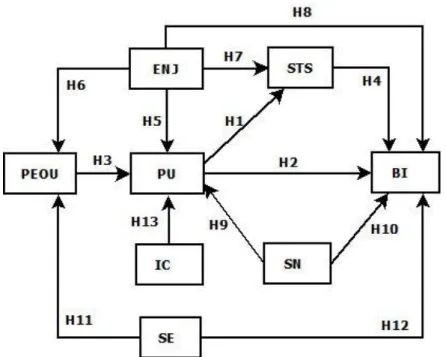
In this study, a structural research model LMS-TAM was proposed to predict students’ adoption of LMS (Figure 1) by using TAM as the theoretical framework. The main of aim of this model is to identify actual behavior with behavioral intention. To reach the actual behavior, it is important to identify behavioral intention and its direct predictors. Therefore, in the proposed model, attitude was excluded since it is aimed to identify the direct predictors of behavioral intention from external factors, differently from TAM. Additional factors and hypotheses were formed following the recommendations of Ma, Andersson and Streith (2005). The researchers emphasized that TAM included only two key explanatory factors that are PU and PEOU; for this reason, it is insufficient to fully understand the relations between information systems and users acceptance behavior. Therefore, additional factors and their relations were considered to increase predictive power of the model. After a systematic review of the literature on e-learning (Alkış et al., 2014), a number of theories and behavioral constructs were selected, examined and categorized by three experts with experience in the subject area. Then, the relationships between these constructs were explored.
For the development of the model, card-sorting and group discussion methods were used and eight constructs (BI, PU, PEOU, STS, ENJ, SN, SE and IC) were identified. The definitions of the selected constructs are given in Table 1. The reliability and validity of the constructs were assessed by a pilot study. Then, hypotheses were proposed related to the relationships between these constructs in accordance with the findings from the literature and experts’ opinions.
In the literature, PU, PEOU and BI are the major determinants of the acceptance of e-learning systems based on TAM. Thus, the following three hypotheses were proposed to assess the effects of these constructs on the acceptance of LMS:
H1: PU directly and positively affects STS. H2: PU directly and positively affects BI. H3: PEOU directly and positively affects PU.
In the proposed model, TAM was extended to include SE, ENJ, SN, STS, and IC constructs. A total of 10 hypotheses were formulated to examine the effect of each construct on LMS use:
H4: STS directly and positively affects BI. H5: ENJ directly and positively affects PU. H6: ENJ directly and positively affects PEOU. H7: ENJ directly and positively affects STS. H8: ENJ directly and positively affects BI. H9: SN directly and positively affects PU. H10: SN directly and positively affects BI.
H11: Self-efficacy directly and positively affects PEOU. H12: Self-efficacy directly and positively affects BI. H13: IC directly and positively affects PU.
Instrument development
A comprehensive survey was implemented to collect data. The survey instrument consisted of two parts. The first part contained eight questions for demographic data including gender, age, department, education level, experience and competency regarding computer use, familiarity with LMSs, and preferred learning style. The second part was based on a five-point Likert scale (1- “strongly disagree” to 5 “strongly agree”) comprising 44 items that measured the factors of the proposed research model. The items in the second part of the survey were adopted from the scales used in the literature (Table 2). The content validity of the instrument was assessed by an expert panel.
Figure 1. Proposed Research Model (LMS-TAM) Table 1.Model constructs, definitions and references
Constructs Definition Prior theories References
Perceived Usefulness
“The degree to which a person believes that using a particular system would enhance his or her job performance”
TAM Davis, 1989
Perceived Ease of Use
“The degree to which a person believes that using a particular system would be free of effort”
TAM Davis, 1989
Behavioral Intention “An individual’s performing a conscious act, such as deciding to accept (or use) a technology”
TAM Davis, 1989
Self-Efficacy “The belief an individual has in his/her ability to
successfully perform a certain behavior”
Social Cognitive Theory
Bandura, 1986
Enjoyment “The extent to which the activity of using a
specific system is perceived to be enjoyable in its own right, aside from any performance
consequences resulting from system use”
Self-determination theory- Intrinsic Motivation
Venkatesh, 2000
Subjective Norm “The social pressure from the social environment
on the users to use a system”
TRA Ajzen, 1991
Satisfaction The extent to which a user is pleased or
contented with the information system.
D&M Information Systems Success Model Delone & McLean, 2003 Interactivity and Control
The system characteristics by which user could interact with each other and control the form and content of a mediated environment.
No prior theories Martínez-Torres et al., 2008; Steuer, 1992
Table 2. The constructs, items and sources from which the items were adopted
Construct Code Item References
PU Item1 Using NET-ClassR improves my performance in courses. Davis, 1989
Item2 I think it is useful to support courses with NET-ClassR.
Item3 NET-ClassR helps me effectively perform my learning
activities.
Item4 NET-ClassR is useful to follow course activities online.
Item5 Through the internet connection, NET-ClassR provides several
advantages in terms of solving time- and location-related problems.
Item6 NET-ClassR improves my success in courses.
Item8 It is easy for me to learn to operate the NET-ClassR system.
Item9 It is easy for me to become skillful at using the NET-ClassR
system.
Item10 Interacting with the e-learning system does not require a lot of
mental effort.
Item11 I found it easy to get the e-learning system to implement what I
wanted.
BI Item12 In future, the courses should be supported with NET-ClassR. Davis, 1989
Item13 If I have access to NET-ClassR, I intend to use it.
Item14 If courses are supported with NET-ClassR, I intend to use it
frequently.
Item15 I think the instructors should support the use of NET-ClassR.
Item16 I think the instructors should continue to use NET-ClassR.
SE Item17 I am confident of using NET-ClassR even if there is no one
around to show me how to do it.
Compeau & Higgins, 1995
Item18 I am confident of using NET-ClassR even if I do not have an
online manual for reference.
Item19 I am confident of using NET-ClassR even if I have never used
such a system before.
Item20 I am confident of using NET-ClassR even if I do not watch
someone use it before trying it myself.
Item21 SE5: I could complete the learning activities using NET-ClassR
even if I could not call anyone for help when I got stuck.
ENJ Item22 I find it enjoyable to use NET-ClassR. Lee et al., 2005
Item23 I find it interesting to use NET-ClassR.
Item24 I find the interface of NET-ClassR enjoyable.
Item25 NET-ClassR is a fun activity.
Item26 The use of NetClasssR arouses my curiosity.
SN Item27 My instructors’ opinion about the use of NET-ClassR is
important for meNET-ClassR.
Taylor & Todd, 1995a; 1995b
Item28 My instructors think that we should use NET-ClassR.
Item29 My classmates think that I should use NET-ClassR.
Item30 My classmates’ opinion has an effect on my decision to use
NET-ClassR.
Item31 The course assistants think that I should use NET-ClassR.
Item32 The assistants’ opinion has an effect on my decision to use
NET-ClassR.
Item33 The school management encourages students to use
NET-ClassR.
STS Item34 I am satisfied with the performance of NET-ClassR in helping
me follow the courses.
Bhattacherjee, 2001a; 2001b
Item35 NET-ClassR is a satisfactory system to perform course
activities.
Item36 I am satisfied with the courses conducted with the support of
NET-ClassR.
Item37 The tools in the NET-ClassR are satisfactory to follow courses.
Item38 In general, supporting courses with NET-ClassR is satisfying.
Item39 NET-ClassR is a satisfactory system to encourage interactive
learning.
IC Item40 NET-ClassR enables interactive communication between the
instructor and students.
Martínez-Torres et al., 2008
Item41 NET-ClassR facilitates interactive communication between
students.
Item42 Communicational tools in NET-ClassR (chat, e-mail, and
forum) are effective in facilitating interactivity between the users.
Item43 NET-ClassR provides an opportunity to control communication
between instructors whenever students require.
Study setting
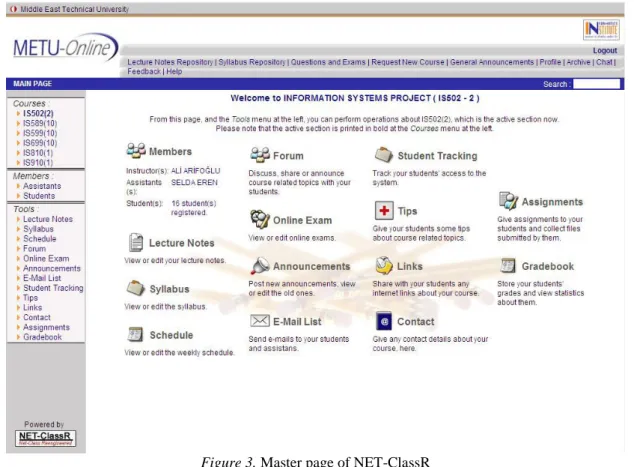
This study was carried out in the Middle East Technical University (METU), one of the leading universities in Turkey. The participants were METU students, users of NET-ClassR, which was used in METU from 1997 to 2014 as an LMS. The home and master pages of the system are shown in Figure 2 and Figure 3, respectively. By providing several tools, this LMS was used to support both traditional and completely online classes. Initially, this system organized and managed lecture notes and provided platforms for discussion and electronic mail. In addition, it offered the possibility for the evaluation of students through quizzes, assignments and exams. Instructors were able to track the students’ participation in discussions and their access to lecture notes. The system provided statistical data about the students’ achievement. Furthermore, the system was able to back up the entire course information including forums, discussions, assignments, grades and lecture notes. All students in the university used the same LMS and its basic functionalities. Also it is assumed that, all the students had similar pre-knowledge to use this system since, there is a must ICT course for all students in the university taken the first semester and the system was introduced to them in this course. The survey instrument was distributed to the participants in Turkish (the native language of the users) through a link to the survey sent to students’ school e-mail accounts and it was administered online over a period of three months.
Sample
The questionnaire was sent to 470 students. After data collection, null, incomplete and repetitive scores were removed and 253 complete responses were included in analysis. The sample consisted of 57.3% female and 42.7% male students. The age of the participants ranged from 19 to 40 with the mean age being 23.45. The participants ranged from freshmen to PhD students.
The study was conducted with students from six different educational areas. The percentages of the participants by educational area were 40.3% for educational sciences, 23% for engineering sciences, 14% for art and sciences, 10.9% for interdisciplinary sciences and 3.2% for architecture. Furthermore, 53.2% of the students had been using computer for more than 10 years and 75% reported to have good computers skills. Concerning other LMSs, 18% of the participants were familiar with Moodle, 13% with Blackboard and 4% with WebCT. Lastly, the participants were asked whether they were willing to use LMS to support traditional courses and 88% responded positively.
Figure 3. Master page of NET-ClassR
Data analysis and findings
The data was prepared for further analyses by detecting outliers, conducting a missing value analysis, valuating multicollinearity analysis and checking the normality assumption. Firstly, the outliers and their effect on the dataset were analyzed by comparing the mean and trimmed mean values (Walfish, 2006). The difference between these two values was not high; therefore, there was no problematic outlier value in the dataset. Secondly, since the missing values in the dataset did not exceed 10% (Hair, Black, Babin, Anderson, & Tatham, 2006), they were handled using the mean substitution method. Thirdly, VIF values were less than 5 (Hair et al., 2006) indicating that there was no multicollinearity issue between the interaction factors. Lastly, the normality assumption was evaluated with the Kolmogorov–Smirnov test (Field, 2009). According to the results, all the items were found to be significant (p < .05). In addition, the skewness and kurtosis (> -1 or < +1) were analyzed (Huck, 2000) and some problematic items were detected. According to the results, data was not normally distributed.
Factor and reliability analysis
The factor structure of the dataset was examined using an exploratory factor analysis (Stevens, 2012), which was conducted together with the principal axis factors extraction method since the assumption of multivariate normality is violated (Fabrigar, Wegener, MacCallum & Strahan, 1999). As rotation method direct oblimin was selected since the scale items were correlated (Field, 2009). Kaiser-Meyer-Olkin was found to be 0.941, which is higher than the minimum sample size required for factor analysis (0.5) (Field, 2009). In addition, Bartlett’s test of sphericity values were x2(946) = 8001.115 (p < .001), which indicated that the dataset provided a meaningful
factor structure.
With the exploratory factor analysis, seven different factors were obtained explaining 66.74% of total variance. In contrary to hypotheses, which proposed eight constructs, exploratory factor analysis released seven constructs. Each measurement item of SE was clustered under the PEOU factor. Table 3 presents the new factor structure, related factor loadings (FL) and Cronbach’s alpha of each factor. Seven constructs were found to be reliable having alpha values greater than the required score of 0.7 (Hair et al., 2006). In addition, the overall questionnaire was significantly reliable with an alpha value of 0.96.
Table 3. Factor analysis and reliability results
Item ID New item ID Factor loading
1 2 3 4 5 6 7 Cronbach Alpha Item1 PU1 -.846 .887 Item6 PU2 -.701 Item44 PU3 -.501 Item39 PU4 -.347 Item3 PU5 -.334 Item9 PEOU1 -.828 .902 Item18 PEOU2 -.802 Item20 PEOU3 -.802 Item8 PEOU4 -.750 Item17 PEOU5 -.704 Item10 PEOU6 -.631 Item7 PEOU7 -.616 Item21 PEOU8 -.516 Item19 PEOU9 -.503 Item11 PEOU10 -.349 Item12 BI1 .856 .948 Item15 BI2 .787 Item16 BI3 .807 Item14 BI4 .736 Item2 BI5 .649 Item13 BI6 .652 Item4 BI7 .547 Item5 BI8 .496 Item36 BI9 .481 Item22 ENJ1 .830 .890 Item25 ENJ2 .790 Item26 ENJ3 .802 Item23 ENJ4 .714 Item24 ENJ5 .628 Item30 ENJ6 .390 Item28 SN1 .780 .799 Item33 SN2 .764 Item31 SN3 .630 Item29 SN4 .418 Item27 SN5 .338 Item32 SN6 .384 Item34 STS1 -.433 .847 Item37 STS2 -.343 Item38 STS3 -.344 Item35 STS4 -.303 Item41 IC1 .686 .829 Item42 IC2 .704 Item40 IC3 .631 Item43 IC4 .437 Extraction Method: Principal Axis Factoring.
Rotation Method: Oblimin with Kaiser Normalization.a
a. Rotation converged in 15 iterations.
Model assessment
The dataset did not follow a multivariate normal distribution; therefore, the proposed model was assessed with component-based structural equation modelling, specifically partial least square (PLS) (Chin, 1998) using SmartPLS software. PLS was used since it is a method suitable to cases when relationships among theoretical constructs are explored and overall nomological network has not been well understood (Peng & Lai, 2012). Before the evaluation of the structural model, sample size requirement and preliminary data analysis including outlier detection, missing value analysis, multicollinearity analysis and normality checks were performed (Hair
et al., 2006). “10 times” rule of thumb (Peng & Lai, 2012) was used for sample size requirement, in which our sample size of 253 was adequate to conduct the analysis. The proposed research model was verified through measurement and structural assessment.
Measurement model
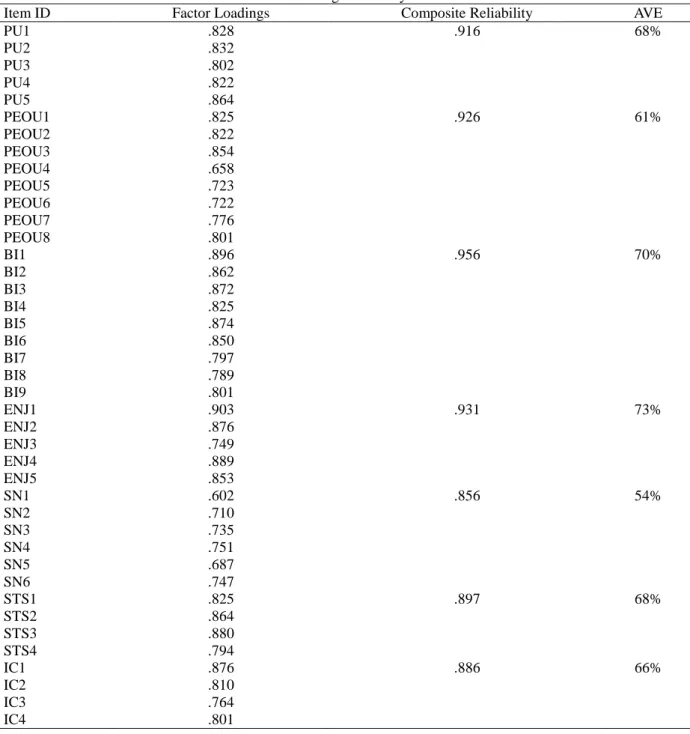
Confirmatory factor analysis (CFA) was employed to assess the measurement model in terms of convergent validity and discriminant validity. Convergent validity was assessed by FL, Average Variance Extracted (AVE) and Composite Reliability (CR) (Table 4). Each observed variable must load its latent variable with at least 0.7 to provide adequate convergent validity (Hair et al., 2006). PEOU9, PEOU10 and ENJ6 did not have an adequate load on the related latent variables and therefore they were extracted from the dataset. Since the loadings of PEOU4, SN1 and SN5 were only slightly lower than 0.7, they were not excluded. For internal consistency, the AVE value should be higher than 0.5 and CR value should be 0.7 or higher for each latent variable (Hair et al., 2006). Considering the AVE and CR values, the dataset had adequate convergent validity.
Table 4. Convergent validity results
Item ID Factor Loadings Composite Reliability AVE
PU1 PU2 PU3 PU4 PU5 .828 .832 .802 .822 .864 .916 68% PEOU1 PEOU2 PEOU3 PEOU4 PEOU5 PEOU6 PEOU7 PEOU8 .825 .822 .854 .658 .723 .722 .776 .801 .926 61% BI1 BI2 BI3 BI4 BI5 BI6 BI7 BI8 BI9 .896 .862 .872 .825 .874 .850 .797 .789 .801 .956 70% ENJ1 ENJ2 ENJ3 ENJ4 ENJ5 .903 .876 .749 .889 .853 .931 73% SN1 SN2 SN3 SN4 SN5 SN6 .602 .710 .735 .751 .687 .747 .856 54% STS1 STS2 STS3 STS4 .825 .864 .880 .794 .897 68% IC1 IC2 IC3 IC4 .876 .810 .764 .801 .886 66%
The discriminant validity refers that a measure does not correlate highly with another measure (Peter, 1981). In order to prove discriminant validity, the square root of the AVE values for each construct on the diagonal should be higher than the correlations with the related construct and all other correlations (Peter, 1981). Table 5 shows that square root of AVE for each construct on the diagonal was greater than the other values. Therefore, it can be concluded that the constructs of the dataset were adequately different from each other.
Table 5. Discriminant validity
BI ENJ IC PEOU PU SN STS BI 0.8417 ENJ 0.58064 0.85565 IC 0.573108 0.537491 0.813754 PEOU 0.669152 0.38486 0.391677 0.78381631 PU 0.729679 0.654968 0.713007 0.495454 0.82977 SN 0.463768 0.411048 0.514843 0.264658 0.535481 0.73714779 STS 0.662742 0.576064 0.641242 0.512061 0.699444 0.54901 0.8287 Structural model
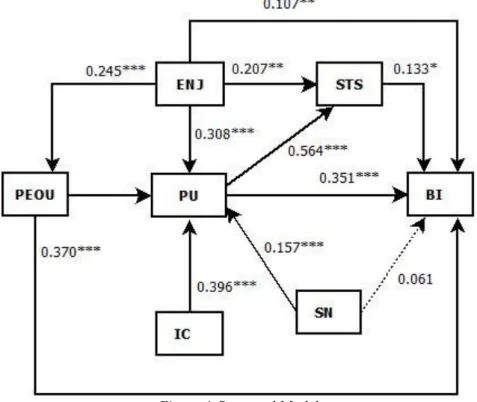
The structure of the proposed research model was examined by considering the path coefficient values to assess the statistical significance of each hypothesis. The dataset containing 253 samples was analyzed following a bootstrapping procedure and the significance of difference between the constructs was evaluated. Figure 4 presents the estimated path coefficients.
Figure 4. Structural Model
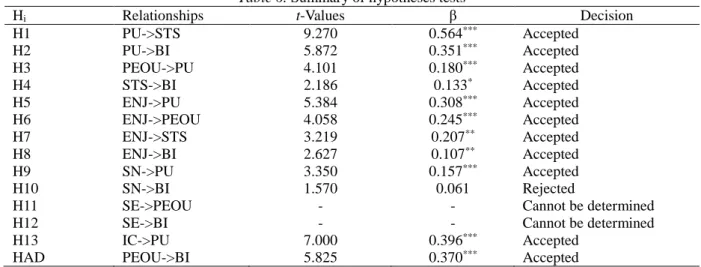
According to the results of the structural model (Table 6), none of the measurement items were clustered under SE; therefore, the model was assessed by extracting this construct, and H11 and H12 could not be evaluated. Except for H10, which examined the relationship between SN and BI, all the other hypotheses were accepted. A strong positive relationship was found between the constructs of H1, H2, H3, H5, H6, H9 and H13 at the level of
p < .001. In addition, PEOU and BI were related at p < .001, which had not been initially hypothesized. The
relationships between the constructs H7 and H8 were also significant at p < .01. Finally, H4 was supported and found to be significant at p < .05.
Table 6. Summary of hypotheses tests
Hi Relationships t-Values β Decision
H1 PU->STS 9.270 0.564*** Accepted H2 PU->BI 5.872 0.351*** Accepted H3 PEOU->PU 4.101 0.180*** Accepted H4 STS->BI 2.186 0.133* Accepted H5 ENJ->PU 5.384 0.308*** Accepted H6 ENJ->PEOU 4.058 0.245*** Accepted H7 ENJ->STS 3.219 0.207** Accepted H8 ENJ->BI 2.627 0.107** Accepted H9 SN->PU 3.350 0.157*** Accepted H10 SN->BI 1.570 0.061 Rejected
H11 SE->PEOU - - Cannot be determined
H12 SE->BI - - Cannot be determined
H13 IC->PU 7.000 0.396*** Accepted
HAD PEOU->BI 5.825 0.370*** Accepted
Note. *p < .05; **p < .01; ***p < .001; HAD: Additional Hypothesis.
Discussion
This research was conducted to examine the factors that affected students’ behavioral intention towards LMS use in higher education. The constructs of TAM (perceived usefulness, perceived ease-of-use and behavioral intention) were taken as the starting point of the proposed research model. TAM was extended by adding external factors to predict the constructs of original TAM; namely, satisfaction, enjoyment, subjective norm, and interactivity and control. The relationships between these constructs were analyzed using structural equation modeling.
Perceived usefulness and perceived ease-of-use
The results revealed that perceived usefulness and perceived ease-of-use are significant predictors of behavioral intention towards LMS use. When the relationship between these two predictors was examined, students’ perception of usefulness was found to directly and significantly affect students’ behavioral intention towards LMS use. This relationship implies that when the students perceive the system to be useful, their behavioral intention to use the system increases. This finding validates the findings of the previous studies conducted by Lee et al. (2005), Saadé and Bahli (2005), and Yi and Hwang (2003). E-learning systems should be designed and developed to add value to student learning and the value of these systems can be improved by providing enhanced e-learning services (Lee et al., 2009).
A positive relationship was found between perceived ease-of-use and perceived usefulness. This finding showed that perceived ease-of-use significantly affects perceived usefulness, which means that if students consider it easy to use an LMS, they feel that using an e-learning system is more useful. Similarly, Lee et al. (2009) reported that perceived ease-of-use is a significant antecedent of perceived usefulness and the design of learning content is important for increasing easiness perception. In addition, this finding has a significance in terms of designing systems with low complexity to improve the value of e-learning services (Lee et al., 2009). In addition to this relationship, a positive relationship was found between perceived ease-of-use and behavioral intention, which had not been hypothesized in the proposed research model. This relationship implies that when the users of the system perceive that the system is easy to use, their behavioral intention to use the system increases. This finding is supported by Lee (2008), who suggested that a system should be developed to target changes in perceived ease-of-use to increase students’ adoption of online learning systems.
Enjoyment
The results showed that enjoyment is another significant predictor of student’s intention towards LMS use. It also has significant relationships with the constructs of perceived ease-of-use, perceived usefulness and satisfaction. These results are similar to those reported by Yi and Hwang (2003) indicating that students’ perceived enjoyment has an important effect on their perception of the usefulness and easiness of LMS. Moreover, users’ perceived enjoyment has a more effective role than users’ perceived ease-of-use in determining
students’ perceived usefulness of the system. In addition to these relationships, it was observed that enjoyment had a significant and positive effect on satisfaction. This implies that if students enjoy and have fun throughout the interaction with LMS and using the e-learning services, they will be more willing to use it in the future. This finding is in parallel with the results of previous studies. Sørebø, Halvari, Gulli, and Kristiansen (2009) examined enjoyment as an intrinsic motivation and found a significant relation between intrinsic motivation and satisfaction for using e-learning technology. In addition, in the current study, enjoyment was found to have a significant effect on behavioral intention, which supports the findings of Lee et al. (2005). The researchers found that perceived enjoyment might be the key element for the adoption and use of internet-based learning media. Therefore, instructors should create a learning environment by considering content variation, fun creation, immediate feedback and interaction encouragement issues to increase the use of online learning environments.
Subjective norm
The results of the study showed that subjective norm significantly affects the students’ perceived usefulness of LMS in the higher education context. Similarly, Park (2009) found a significant relationship between subjective norm and perceived usefulness. The researcher provided one possible explanation for this relationship: Subjective norm is an extrinsic motivational factor that could help university students self-regulate their motivation on e-learning (Park, 2009). In the current study, in contrast to this finding of Park (2009), subjective norm was not found to be a predictor of behavioral intention towards LMS use. This may have resulted from the participant students being obliged to use the system. Therefore, their intention may not have been affected by their social environment.
Satisfaction
The results revealed that satisfaction is a significant predictor of students’ behavioral intention towards LMS use in higher education. A positive and significant relationship was found between satisfaction and behavioral intention towards LMS use. This relationship implies that when the users are satisfied with using LMS, their behavioral intention toward LMS use is affected positively for future use. Similarly, Roca, Chiu, and Martínez (2006), and Lee (2010) found that satisfaction positively affects continuance intention to use e-learning applications.
Interactivity and control
In the current study, the relationship between perceived usefulness and interactivity and control was also examined. The results showed that the interactivity and control construct has a significant direct effect on the participants’ perceived usefulness, which implies that this construct can determine students’ perceived usefulness of LMS. In addition, students’ perception of the usefulness of LMS increased after they used this system to have more control over their learning process. Therefore, e-learning systems and services should support interactivity and control by supporting communication between the instructor and students, offering tools such as chat, forum and e-mail to strengthen their relationship and providing an environment for students to learn at their own pace. In this study, the effect of self-efficacy on users’ perceived ease-of-use and behavioral intention could not be examined since none of the measurement items were clustered under the self-efficacy factor. However, the research available in the literature has already demonstrated that application-specific self-efficacy has a significant effect on the behavioral intention of the system’s users (Yi & Hwang, 2003) and is more powerful than behavioral intention in determining the actual use of the system. In addition, Park (2009) reported that self-efficacy plays an important role in affecting attitude towards learning and behavioral intention to use e-learning. However, further studies are needed to examine self-efficacy with a new sample and new measurement items to reveal its effect on students’ future intention of LMS use.
In brief, it was observed that the validity measures of the research model were effective in predicting the behavioral intention of the participants. The research model explained 68% of the behavioral intention of students towards LMS use. This result also provides a reliable prediction about students’ behavioral intention towards LMS use in future.
Limitations and implications for future research
We consider this research to be a valuable guideline for researchers who will undertake research on the acceptance of LMS in the e-learning context. However, the current study has certain limitations. First, the data was collected from the students of the same university, which affected the representativeness of the sample and the generalization of the results. The range of universities and the sample size of the students using this system should be extended to improve the generalizability of the results. In addition, the measurement items of self-efficacy did not load under one factor; therefore, this construct and its proposed relations could not be analyzed. This construct should be re-assessed with a new sample. Moreover, quantitative research methodology was applied in this study. However, an in-depth qualitative examination would reveal personal opinions and detailed reasons explaining the relationships between the proposed constructs. Therefore, furthers studies should support their quantitative findings with a qualitative approach. Finally, the model should be extended with an additional variable to improve the model’s prediction power to account for the remaining 32% of user intentions. In addition, further studies with cross-sectional and cross-cultural approaches are required to increase the predictive value of LMS-TAM.
Conclusion
This study examined the factors affecting students’ behavioral intention towards LMS use in the higher education context based on quantitative research. A structural research model was proposed and validated through an online survey. LMS-TAM is an extended version of TAM including the external factors of enjoyment, subjective norm, satisfaction and interactivity and control. In addition to perceived ease of use and perceived usefulness effects over behavioral intention validated in original TAM, LMS-TAM implies that users’ behavioral intention is influenced directly or indirectly by enjoyment, subjective norm, satisfaction and interactivity and control factors. Systems increasing students’ enjoyment, satisfaction and interactivity and control are more tended to be accepted by the students. The factors measuring students’ behavioral intention towards LMS use included in LMS-TAM model are not directly related to specific functions of the LMS, they are related to students’ general perceptions. The LMS used in this study, Moodle, and the other LMSs provides similar features to the end users, despite they have different user interfaces. Therefore, we believe that the results will be helpful to improve different type of LMSs and increase their usage. In this context, this study contributes to the related literature by developing a new model for students’ intention towards LMS use. LMS-TAM has potential to be a predictive model for studies on students’ acceptance of e-learning.
Acknowledgments
This research was supported by the Scientific and Technological Research Council of Turkey, under project
number 109K394.
References
Ajzen, I. (1991). The Theory of planned behavior. Organizational Behavior and Human Processes, 50(2), 179-211.
Alkış, N., Fındık-Coşkunçay, D., & Özkan-Yıldırım, S. (2014, September). A Systematic review of technology acceptance model in e-learning context. Paper presented at the XV International Conference on Human Computer Interaction, Tenerife, Spain.
Aucamp, J., & Swart, J. (2015). Extending the technology acceptance model to evaluate discussion forum adoption in a learning management system. Interim: Interdisciplinary Journal, 14(1), 124-138.
Bandura, A. (1986). Social foundations of thought and action: A Social cognitive theory. Englewood Cliffs, NJ: Prentice-Hall.
Bates, A. (1997, June). Restructuring the university for technological change. The Carnegie Foundation for the Advancement of Teaching. Paper presented at What kind of university? Carnegie Foundation for the Advancement of Teaching, London, England.
Bhattacherjee, A. (2001a). An Empirical analysis of the antecedents of electronic commerce service continuance. Decision Support Systems, 32(2), 201-214.
Bhattacherjee, A. (2001b). Understanding information systems continuance: An Expectation-confirmation model. MIS Quarterly, 25(3), 351-370.
Bhuasiri, W., Xaymoungkhoun, O., Zo, H., Rho, J. J. and Ciganek, A. P. (2012), Critical success factors for e-learning in developing countries: A Comparative analysis between ICT experts and faculty. Computers & Education, 58(2), 843–855. Chin, W. W. (1998). Issues and opinion on structural equation modeling. MIS Quarterly, 22(1), 7-16.
Compeau, D. R., & Higgins, C. A. (1995). Computer self-efficacy: Development of a measure and initial test. MIS Quarterly, 19(2), 189-211.
Davis, F. D. (1989). Perceived usefulness, perceived ease of use, and user acceptance of information technology. MIS Quarterly, 13(3), 319-340.
Davis, F. D., Bagozzi, R. P., & Warshaw, P. R. (1989). User acceptance of computer technology: A Comparison of two theoretical models. Management Science, 35(8), 982-1003.
Delone, W. H., & McLean, E. R. (2003). The DeLone and McLean model of information systems success: A Ten-year update. Journal of Management Information Systems, 19(4), 9-30.
Dillon, C. L., & Gunawardena, C. N. (1995, June). A Framework for the evaluation of telecommunications-based distance education. Paper presented at the 17th Congress of the International Council for Distance Education, Open University, Milton Keynes.
Fabrigar, L. R., Wegener, D. T., MacCallum, R. C. & Strahan, E. J. (1999). Evaluating the use of exploratory factor analysis in psychological research. Psychological Methods, 4(3), 272-299.
Field, A. (2009). Discovering statistics using SPSS. London, UK: Sage publications.
Hair, J., Black, W., Babin, B., Anderson, R., & Tatham, R. (2006). Multivariate data analysis. Upper Saddle River, NJ: Pearson Prentice Hall.
Huck, S. (2000). Reading statistics and research. New York, NY: Longman.
Lee, B.-C., Yoon, J.-O., & Lee, I. (2009). Learners’ acceptance of e-learning in South Korea: Theories and results. Computers & Education, 53(4), 1320-1329.
Lee, M.-C. (2010). Explaining and predicting users’ continuance intention toward e-learning: An Extension of the expectation–confirmation model. Computers & Education, 54(2), 506-516.
Lee, M. K., Cheung, C. M., & Chen, Z. (2005). Acceptance of Internet-based learning medium: the role of extrinsic and intrinsic motivation. Information & Management, 42(8), 1095-1104.
Lee, Y.-C. (2008). The Role of perceived resources in online learning adoption. Computers & Education, 50(4), 1423-1438. Liaw, S.-S., Huang, H.-M., & Chen, G.-D. (2007). Surveying instructor and learner attitudes toward e-learning. Computers & Education, 49(4), 1066-1080.
Liu, S.-H., Liao, H.-L., & Pratt, J. A. (2009). Impact of media richness and flow on e-learning technology acceptance. Computers & Education, 52(3), 599-607.
Ma, W. W.-K., Andersson, R., & Streith, K.-O. (2005). Examining user acceptance of computer technology: An Empirical study of student teachers. Journal of Computer Assisted Learning, 21(6), 387–395.
Martínez-Torres, M. R., Toral Marín, S., Garcia, F. B., Vazquez, S. G., Oliva, M. A., & Torres, T. (2008). A Technological acceptance of e-learning tools used in practical and laboratory teaching, according to the European higher education area. Behaviour & Information Technology, 27(6), 495-505.
Murshitha, S. M., & Wickramarachchi, A. R. (2016). A Study of students’ perspectives on the adoption of LMS at University of Kelaniya. Journal of Management, 9(1), 16-24.
Ngai, E. W., Poon, J., & Chan, Y. (2007). Empirical examination of the adoption of WebCT using TAM. Computers & Education, 48(2), 250-267.
Park, S. Y. (2009). An Analysis of the technology acceptance model in understanding university students’ behavioral intention to use e-learning. Educational Technology & Society, 12(3), 150-162.
Paulsen, M. F. (2003). Experiences with Learning Management Systems in 113 European institutions. Educational Technology & Society, 6(4), 134-148.
Peng, D. X., & Lai, F. (2012). Using partial least squares in operations management research: A Practical guideline and summary of past research. Journal of Operations Management, 30(6), 467-480.
Peter, J. P. (1981). Construct validity: A Review of basic issues and marketing practices. Journal of Marketing Research, 18(2), 133-145.
Pituch, K. A., & Lee, Y.-K. (2006). The Influence of system characteristics on e-learning use. Computers & Education, 47(2), 222-244.
Roca, J. C., Chiu, C.-M., & Martínez, F. J. (2006). Understanding e-learning continuance intention: An Extension of the Technology Acceptance Model. International Journal of Human-Computer Studies, 64(8), 683-696.
Sánchez-Franco, M. J. (2010). WebCT–The quasimoderating effect of perceived affective quality on an extending Technology Acceptance Model. Computers & Education, 54(1), 37-46.
Saadé, R., & Bahli, B. (2005). The Impact of cognitive absorption on perceived usefulness and perceived ease of use in on-line learning: An Extension of the technology acceptance model. Information & Management, 42(2), 317-327.
Steuer, J. (1992). Defining virtual reality: Dimensions of determining telepresence. Journal of Communication, 42(4), 73–93. Stevens, J. P. (2012). Applied multivariate statistics for the social sciences. New York, NY: Routledge.
Sørebø, Ø., Halvari, H., Gulli, V. F., & Kristiansen, R. (2009). The Role of self-determination theory in explaining teachers’ motivation to continue to use e-learning technology. Computers & Education, 53(4), 1177-1187.
Tai, D., Zhang, R., Chang, S., Chen, C., & Chen, J. (2012). A Meta-analytic path analysis of elearning acceptance model. World Academy of Science, Engineering and Technology, 6(5), 760–763.
Taylor, S., & Todd, P. (1995a). Assessing IT usage: The Role of prior experience. MIS Quarterly, 19(4), 561-570.
Taylor, S., & Todd, P. A. (1995b). Understanding information technology usage: A Test of competing models. Information Systems Research, 6(2), 144-176.
Van Raaij, E. M., & Schepers, J. J. (2008). The Acceptance and use of a virtual learning environment in China. Computers & Education, 50(3), 838-852.
Venkatesh, V. (2000). Determinants of perceived ease of use: Integrating control, intrinsic motivation, and emotion into the technology acceptance model. Information Systems Research, 11(4), 342-365.
Yi, M. Y., & Hwang, Y. (2003). Predicting the use of web-based information systems: self-efficacy, enjoyment, learning goal orientation, and the technology acceptance model. International Journal of Human-Computer Studies, 59(4), 431-449. Walfish, S. (2006). A Review of statistical outlier methods. Pharmaceutical Technology, 30(11), 82-87.
Webster, J., & Hackley, P. (1997). Teaching effectiveness in technology-mediated distance learning. Academy of Management Journal, 40(6), 1282-1309.
Zhang, D., Zhao, J. L., Zhou, L., & Nunamaker Jr, J. F. (2004). Can e-learning replace classroom learning? Communications of the ACM, 47(5), 75-79.