Effect of different denture cleansers on surface
roughness and microhardness of artificial
denture teeth
Bulem Yuzugullu1, Ozlem Acar1*, Cem Cetinsahin1, Cigdem Celik2 1Department of Prosthodontics, Faculty of Dentistry, Baskent University, Ankara, Turkey 2Department of Restorative Dentistry, Faculty of Dentistry, Baskent University, Ankara, Turkey
PURPOSE. The aim of this study was to compare the effects of different denture cleansers on the surface roughness and microhardness of various types of posterior denture teeth. MATERIALS AND METHODS. 168 artificial tooth specimens were divided into the following four subgroups (n=42): SR Orthotyp PE (polymethylmethacrylate); SR Orthosit PE (Isosit); SR Postaris DCL (double cross-linked); and SR Phonares II (nanohybrid composite). The specimens were further divided according to the type of the denture cleanser (Corega Tabs (sodium perborate), sodium hypochlorite (NaOCl), and distilled water (control) (n=14)) and immersed in the cleanser to simulate a 180-day immersion period, after which the surface roughness and microhardness were tested. The data were analyzed using the Kruskal–Wallis test, Conover’s nonparametric multiple comparison test, and Spearman’s rank correlation analysis (P<.05). RESULTS. A comparison among the denture cleanser groups showed that NaOCl caused significantly higher roughness values on SR Orthotyp PE specimens when compared with the other artificial teeth (P<.001). Furthermore, Corega Tabs resulted in higher microhardness values in SR Orthotyp PE specimens than distilled water and NaOCl (P<.005). The microhardness values decreased significantly from distilled water, NaOCl, to Corega Tabs for SR Orthosit PE specimens (P<.001). SR Postaris DLC specimens showed increased microhardness when immersed in distilled water or NaOCl when compared with immersion in Corega Tabs (P<.003). No correlation was found between surface roughness and microhardness (r=0.104, P=.178). CONCLUSION. NaOCl and Corega Tabs affected the surface roughness and microhardness of all artificial denture teeth except for the new generation nanohybrid composite teeth. [J Adv Prosthodont 2016;8:333-8]
KEYWORDS: Denture cleansers; Sodium perborate; Sodium hypochlorite; Complete denture; Mechanical properties; Physical properties
INTRODUCTION
Home care instructions provided to patients after insertion of complete dentures are important in maintaining oral
mucosal health and the longevity of the prostheses. Beyond the concern for esthetics, poor oral hygiene can lead to bio-film formation and oral infections, especially in elderly patients.1 The most commonly used method for cleaning
denture is mechanical cleaning using detergent, soap, or toothpaste.2 Older patients often face a difficulty in
mechani-cal removal of plaque because of reduced manual dexterity or impaired vision or physical limitations.3 Chemical
cleans-ers are alternatives to mechanical cleaning. For cleaning, dentures should be immersed in the chemical solutions for a certain period of time. These solutions may include one or a combination of various active agents, such as sodium hypochlorite (NaOCl), chlorhexidine, alkaline peroxides, enzymes, and diluted acids.4 An ideal denture cleanser
should reduce biofilm accumulation and be antibacterial, antifungal, non-toxic, short-acting, easy to use, and cost-Corresponding author:
Ozlem Acar
Department of Prosthodontics Faculty of Dentistry, Baskent University, 11. st. No: 26 Bahcelievler, Ankara 06490, Turkey
Tel. +9031221513 36: e-mail, [email protected]
Received January 14, 2016 / Last Revision June 29, 2016 / Accepted August 8, 2016
© 2016 The Korean Academy of Prosthodontics
This is an Open Access article distributed under the terms of the Creative Commons Attribution Non-Commercial License (http://creativecommons. org/licenses/by-nc/3.0) which permits unrestricted non-commercial use, distribution, and reproduction in any medium, provided the original work is properly cited.
effective.1,4,5 Also, an ideal denture cleanser should not have
any detrimental effect on the denture materials.4 However,
long-term immersion or incorrect use of chemical denture cleansers may adversely alter the physical and mechanical properties of the artificial denture teeth and base materials.5
Artificial teeth are an important component of conven-tional complete denture and play a significant role in the esthetics and functional treatment outcomes.6 Currently,
there are different types of artificial teeth available on the market. Porcelain teeth have been used because of their superior esthetics, resistance to wear and discoloration properties.7 However, acrylic resin teeth are more beneficial
because of their natural texture, high resiliency, adequate mechanical strength, ease of occlusal adjustment, and high bond strength to the denture base.8
Conventional acrylic resin denture teeth are primarily composed of polymethylmethacrylate (PMMA) polymers. To improve mechanical properties, highly cross-linked acryl-ic resin and macryl-icrofilled composite resin (Isosit) teeth have been developed.9 A newer generation of composite resin
teeth has been introduced, consisting of a nanohybrid com-posite (NHC) material on a urethane dimethacrylate (UDMA) matrix, which includes various types and sizes of fillers as well as PMMA clusters. The NHC material comprises a variety of fillers, including highly cross-linked inorganic macrofillers, highly densified inorganic microfillers, and silanized nanoscale fillers based on silicon dioxide.10
Artificial denture teeth usually consist of enamel and dentin layers, and some composite resin teeth may also have intermediate layers. Each layer has varying degree of hard-ness and roughhard-ness. The enamel layer is often removed due to masticatory wear or chairside occlusal or laboratory adjustments, leading to exposure of the subenamel layers.6
It has been reported that the different layers of denture teeth are affected differently by denture cleansers.11
Studies have shown that dental materials differ in their susceptibility to oral bacteria, which has most commonly been attributed to differences in their surface roughness-es.12-14 Surface roughness is of a particular clinical relevance
for artificial teeth as it can cause staining, biofilm retention, or difficult biofilm removal.5,15 Hardness, which is defined
as resistance of a material to plastic deformation measured as a force per unit area under indentation, has been used to assess the mechanical properties of materials, ease of fin-ishing and polfin-ishing, resistance to scratching, and wear resistance of many restorative materials, including artificial denture teeth.6,12
The immersion of a denture fabricated using these new generation artificial teeth to achieve disinfection or steriliza-tion is important. However, chemical denture cleansers may have negative effects on the physical and mechanical prop-erties of the artificial denture teeth.3,16-18 Therefore, the
findings of this study will enable dental practitioners to select the most appropriate artificial denture tooth materials and/or cleansers for their patients.
There are numerous studies that report the changes in the mechanical and physical properties of artificial teeth
exposed to sodium hypochlorite16,17,19,20 and sodium
perbo-rate.20 However, to our knowledge, there has been no study
evaluating the effects of cleansers on new generation artifi-cial denture teeth. Hence, this study aims to compare the effect of NaOCl and alkaline peroxide solutions on the sur-face roughness and hardness of different types of artificial teeth with various compositions. The hypothesis tested was that immersion in NaOCl and effervescent alkaline perox-ide tablets would influence the surface roughness and microhardness of all artificial teeth tested.
MATERIALS AND METHODS
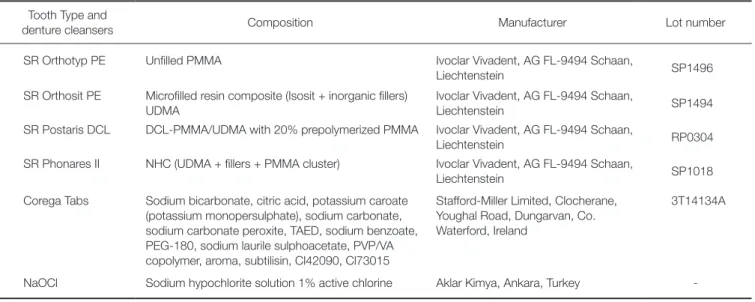
Four types of artificial molar denture teeth were used in this study (Table 1). All teeth were sectioned with a low-speed cutting machine (Isomet 1000, Buehler Ltd., Lake Bluff, IL, USA) to obtain bucco-lingual slices of 2.3 ± 0.1 mm thick-ness. Forty-two specimens were prepared for each artificial tooth group as described in Table 1. The slice at the each end of mesial and lingual sides that was thinner than 2.3 mm was not used. Each specimen was embedded in autopoly-merizing acrylic resin (Steady Resin Scheu-Dental GmbH, Iserlohn, Germany) using a rectangular plastic mold. A cus-tom-made surveyor was used to ensure the specimen surfac-es were parallel to the workbench. The specimen surfacsurfac-es were ground flat and finished with silicon carbide abrasive paper (English Abrasives & Chemicals, Stafford, England) in the order of 200-, 400-, 600-, 800-, and 1200-grit, and then polished using an aluminum oxide paste (Universal Polishing Paste, Ivoclar Vivadent, Schaan Fürstentum, Liechtenstein). The same operator performed all finishing procedures. The specimens were then stored in distilled water at room tem-perature (23 ± 2°C) for 7 days before the immersion proce-dures. According to the manufacturer, the denture teeth involved two to four layering schemes (cervical-dentine-enamel-pearl effect layers). Hence, surface roughness and microhardness tests were carried out on the dentine layer of each specimen to simulate clinical conditions.
The artificial teeth specimens were randomly divided into three subgroups according to the denture cleanser types (n = 14) (Table 1):
1. Corega Tabs 2. NaOCl
3. Distilled water (control)
Corega Tabs (effervescent denture cleanser) were pre-pared according to the manufacturer’s instructions, by add-ing one tablet to 200 mL of warm water (40°C). After each cycle of 5 minutes, the soaking solution was discarded and the specimens were rinsed thoroughly under running water. Between the soaking procedures, the specimens were kept in distilled water at room temperature. Immersion proce-dures were repeated 180 times to simulate 180-day of use. For the group immersed in NaOCl, the total immersion period was 15 hours to simulate 5 minutes of daily immer-sion.21 For the control group, the specimens were kept in
distilled water at room temperature for 15 hours. Distilled water was preferred because of its uniformity and purity.21
Following immersion procedures, all specimens were subjected to surface roughness measurement tests. Prior to the surface roughness analysis, all specimens were cleaned in an ultrasonic bath and dried. The surface roughness (Ra in µm) was measured on each specimen surface using the Mitutoyo Surftest-402 Surface Roughness Tester (Mitutoyo Corporation, Tokyo, Japan) with a standard cut-off value of 0.8 mm. Prior to measuring, the profilometer was cali-brated against a reference block, whose the Ra value was 3.05 μm. Three tracings at randomly selected locations on each specimen were made at a distance of 4 mm apart, and the mean value was calculated.
After surface cleaning using a steam cleaner, the Vickers hardness number (VHN) measurement was performed on all specimens with a microindentation system (HMV Micro Hardness Tester, Shimadzu Corporation, Tokyo, Japan) using the Vickers diamond indenter with a 0.5 N load for a dwell time of 15 seconds. Three indentations per specimen were made with a spacing of at least 50 µm between each indentation. The microhardness mean value was then calcu-lated for each specimen.
Data analysis was performed using SPSS for Windows, version 11.5 (SPSS Inc., Chicago, IL, USA). Data were shown as mean ± standard deviation or median (min–max), where applicable. The statistical analyses were performed using Kruskal-Wallis test, Conover’s nonparametric multiple comparison test, and Spearman’s rank correlation analysis. A P value less than .05 was considered statistically signifi-cant. However, for all possible multiple comparisons, the Bonferrroni correction was applied to control Type I error.
RESULTS
The data obtained after surface roughness and microhard-ness tests were determined by comparing each specimen val-ue after immersion in distilled water and denture cleansers.
Table 2 demonstrates the surface roughness values (Ra in µm) of the different artificial teeth groups subjected to vari-ous denture cleansers. While Orthotyp PE and Postaris DLC showed no significant difference (P > .005), the roughness values decreased in the control group in the order of SR Phonares II, SR Orthosit PE, and Orthotyp PE (P < .005). When comparing denture cleanser groups, NaOCl caused significantly higher roughness values on Orthotyp PE group (P < .001). However, there was no statistically significant dif-ference between denture cleansers for the other groups (P > .005).
Microhardness values for the different types of artificial teeth subjected to the various denture cleansers are shown in Table 3. Orthosit PE had significantly higher microhard-ness values after immersion in distilled water when com-pared with the other groups (P < .001). For SR Orthotyp PE, Corega Tabs caused higher microhardness values than distilled water and NaOCl (P < .005). Microhardness values decreased significantly for the SR Orthosit PE group in the order of immersion in distilled water, NaOCl, and Corega Tabs (P < .001). SR Postaris DLC specimens showed higher microhardness when immersed in distilled water or NaOCl compared with immersion in Corega Tabs (P < .003).
There was no statistically significant correlation between roughness and microhardness values (r = 0.104, P = .178). Table 1. Artificial teeth and denture cleansers used in this study
Tooth Type and
denture cleansers Composition Manufacturer Lot number
SR Orthotyp PE Unfilled PMMA Ivoclar Vivadent, AG FL-9494 Schaan,
Liechtenstein SP1496
SR Orthosit PE Microfilled resin composite (Isosit + inorganic fillers) UDMA
Ivoclar Vivadent, AG FL-9494 Schaan,
Liechtenstein SP1494
SR Postaris DCL DCL-PMMA/UDMA with 20% prepolymerized PMMA Ivoclar Vivadent, AG FL-9494 Schaan,
Liechtenstein RP0304
SR Phonares II NHC (UDMA + fillers + PMMA cluster) Ivoclar Vivadent, AG FL-9494 Schaan,
Liechtenstein SP1018
Corega Tabs Sodium bicarbonate, citric acid, potassium caroate (potassium monopersulphate), sodium carbonate, sodium carbonate peroxite, TAED, sodium benzoate, PEG-180, sodium laurile sulphoacetate, PVP/VA copolymer, aroma, subtilisin, Cl42090, Cl73015
Stafford-Miller Limited, Clocherane, Youghal Road, Dungarvan, Co. Waterford, Ireland
3T14134A
NaOCl Sodium hypochlorite solution 1% active chlorine Aklar Kimya, Ankara, Turkey
DISCUSSION
The present study evaluated the effect of various denture cleansers on surface roughness and microhardness of dif-ferent types of artificial denture teeth. The null hypothesis tested was partially accepted; NaOCl and effervescent alka-line peroxide tablets changed the surface roughness and/or hardness of only some of the artificial teeth tested. The SR Phonares II specimen surfaces showed no difference after immersion in any of the mediums.
There are controversial opinions in the literature related to the effects of denture cleansers on surface roughness and hardness of denture materials.17,18,22 Differing compositions
of cleansing solutions and materials, and different testing methods may be responsible for the controversy.
The surface roughness of dental materials has been
shown to be of particular importance for adhesion of oral bacteria;12-14 hence, smoother surfaces will result in denture
longevity.18 Profilometry and its numerical data has been
shown to be useful in the evaluation of the roughness of dental materials.18 Bollen et al.13 found a threshold value of
0.2 µm, suggesting that low roughness levels do not influ-ence adhesion. In the present study, although NaOCl caused significantly higher roughness values on Orthotyp PE group specimens, the surface roughness values were lower than the threshold for all tested specimens; therefore, adverse effects of denture cleansers on surface roughness may be neglected.
A valid tool for determining the hardness of rigid poly-mers is the Vickers microhardness test, which is based upon the ability of the surface of a material to resist point penetration under a certain load.23 Hence, this test has been
Table 2. Median (interquartile range) surface roughness (Ra in µm) values according to artificial teeth and denture
cleanser
SR Orthotyp PE SR Orthosit PE SR Postaris DLC SR Phonares II P value Distilled water 0.07 (0.04)A,B,a 0.10 (0.03)A,C 0.09 (0.03)D 0.13 (0.04)B,C,D < .001 Corega Tabs 0.10 (0.03)B,b 0.09 (0.03)C 0.09 (0.03)D 0.13 (0.03)B,C,D < .001 NaOCl 0.16 (0.06)A,E,a,b 0.11 (0.03)A,C 0.11 (0.02)D,E 0.13 (0.03)C,D < .001
P value < .001 .132 .096 .906
*Same superscript letters denote statistical significance (P < .05)
A: There are statistically significant differences between SR Orthotyp PE and SR Orthosit PE groups (P < .017) B: There are statistically significant differences between SR Orthotyp PE and SR Phonares II groups (P < .001) C: There are statistically significant differences between SR Orthosit PE and SR Phonares II groups (P < .01) D: There are statistically significant differences between SR Postaris DLC and SR Phonares II groups (P < .017) E: There are statistically significant differences between SR Orthotyp PE and SR Postaris DLC groups (P < .001) a: There are significant differences between distilled water and NaOCl groups (P < .001)
b: There are significant differences between Corega Tabs and NaOCl groups (P < .001)
Table 3. Median (interquartile range) VHN values according to artificial teeth and denture cleansers
SR Orthotyp PE SR Orthosit PE SR Postaris DLC SR Phonares II P value Distilled water 26.15 (4.05)A,a 33.85 (2.22)A,B,C,a,c 25.75 (3.47)B,a 27.80 (5.85)C <.001 Corega Tabs 32.45 (2.80)A,D,E,a,b 23.70 (1.97)A,C,a,b 23.55 (2.35)D,F,a,b 26.25 (2.90)C,E,F <.001
NaOCl 28.75 (10.27)b 28.20 (3.65)b,c 25.75 (1.60)b 27.85 (3.12) .049
P value .005 <.001 .003 .582
*Same superscript letters denote statistical significance (P < .05)
A: There are statistically significant differences between SR Orthotyp PE and SR Orthosit PE groups (P < .001) B: There are statistically significant differences between SR Orthosit PE and SR Postaris DLC groups (P < .001) C: There are statistically significant differences between SR Orthosit PE and SR Phonares II groups (P < .017) D: There are statistically significant differences between SR Orthotyp PE and SR Postaris DLC groups (P < .001) E: There are statistically significant differences between SR Phonares II and SR Orthotyp PE groups (P = .002) F: There are statistically significant differences between SR Postaris DLC and SR Phonares II groups (P = .004) a: There are significant differences between distilled water and Corega tabs groups (P < .001)
b: There are significant differences between Corega Tabs and NaOCl groups (P < .001) c: There are significant differences between Distilled water and NaOCl groups (P < .002)
used in many studies,19,20 including the present study, to
evaluate the hardness of denture base acrylic resin and arti-ficial denture teeth.
Cross-linkage is a descriptive term for the composition of artificial denture teeth, and the manufacturers do not indicate the number or exact type of covalent links present in the polymeric structure.17 It is possible that different
cleansing solutions have variable influences on commercial teeth. This suggests that the number of pressing during the tooth’s manufacturing process is equally as important as cross-linkage, mainly because of the residual monomer absence. In the present study, immersion in Corega Tabs increased the hardness of SR Orthotyp PE group speci-mens. This result may be explained by the fact that these artificial teeth are less resistant to the loss of plasticizers and do not have cross-linking chains, which reduce their resistance. This is also in accordance with the results of Pisani et al.16 However, a decrease in hardness was noted in
SR Orthosit PE and SR Postaris DCL group specimens immersed in Corega Tabs. In agreement with the results of previous studies,16,20 the absorption of aqueous cleansing
solutions may have caused a decrease in hardness because these solutions may have acted as plasticizers. Small mole-cules of water diffuse into the polymer mass and cause relax-ation of polymer chains, consequently reducing the hardness of the artificial teeth, which is similar to the process that occurs in acrylic resin.24 Grinding the tooth surfaces may
have formed microcracks, leading to infiltration of the solu-tions and accelerating the process of PMMA plasticization.
Denture cleaning by immersion in a chemical solution should not involve any physical, mechanical, or chemical change in the artificial teeth. No significant effect on sur-face roughness or microhardness of the new generation nanohybrid artificial teeth was found after immersion in any of the cleansing mediums used in the present study, which reflected a promising future preference. However, in vivo and further in vitro research should be carried out to clarify the mechanical, physical, and optical properties of this new material.
There are a number of limitations in the present in vitro study. Examination of the artificial teeth surfaces using scan-ning electron microscopy could have been carried out after immersion in the various cleansers for visual comparison. Furthermore, several types of artificial teeth of different compositions of only one brand have been evaluated in this study, and in vitro, not clinical, tests were performed. In future studies, other oral environment conditions, such as continuous cyclic loading and the use of artificial saliva, could be evaluated. Furthermore, chemical denture cleansers could be accompanied by mechanical brushing to determine the association related to changes in surface properties.
CONCLUSION
Within the limitations of the present in vitro study, the fol-lowing conclusions may be drawn:
NaOCl caused significantly higher roughness values on
Orthotyp PE group specimens (P < .001).
Corega Tabs caused higher microhardness values than distilled water and NaOCl for SR Orthotyp PE specimens (P < .005). Microhardness values decreased significantly for the SR Orthosit PE (P < .005) and SR Postaris DCL groups (P < .003) following immersion in Corega Tabs.
There was no statistically significant correlation between roughness and microhardness values (r = 0.104, P = .178).
Immersion in any of the tested cleansing solutions did not cause a significant change in the surface roughness or microhardness of the new generation SR Phonares II artifi-cial teeth.
ACKNOWLEDgEMENTS
The authors would like to thank Ivoclar Vivadent for sup-plying the artificial denture teeth used in this study.
ORCID
Ozlem Acar http://orcid.org/0000-0002-2866-1308
REfERENCES
1. Peracini A, Davi LR, de Queiroz Ribeiro N, de Souza RF, Lovato da Silva CH, de Freitas Oliveira Paranhos H. Effect of denture cleansers on physical properties of heat-polymer-ized acrylic resin. J Prosthodont Res 2010;54:78-83.
2. Jagger DC, Harrison A. Denture cleansing–the best ap-proach. Br Dent J 1995;178:413-7.
3. Razak PA, Richard KM, Thankachan RP, Hafiz KA, Kumar KN, Sameer KM. Geriatric oral health: a review article. J Int Oral Health 2014;6:110-6.
4. Felipucci DN, Davi LR, Paranhos HF, Bezzon OL, Silva RF, Pagnano VO. Effect of different cleansers on the surface of removable partial denture. Braz Dent J 2011;22:392-7. 5. Felton D, Cooper L, Duqum I, Minsley G, Guckes A, Haug
S, Meredith P, Solie C, Avery D, Chandler ND; American College of Prosthodontists; Academy of General Dentistry; American Dental Association Council on Scientific Affairs; American Dental Hygienists’ Association; National Association of Dental Laboratories; GlaxoSmithKline Consumer Healthcare. Evidence-based guidelines for the care and mainte-nance of complete dentures: a publication of the American College of Prosthodontists. J Am Dent Assoc 2011;142: 1S-20S.
6. Suwannaroop P, Chaijareenont P, Koottathape N, Takahashi H, Arksornnukit M. In vitro wear resistance, hardness and elastic modulus of artificial denture teeth. Dent Mater J 2011;30:461-8.
7. Phunthikaphadr T, Takahashi H, Arksornnukit M. Pressure transmission and distribution under impact load using artifi-cial denture teeth made of different materials. J Prosthet Dent 2009;102:319-27.
8. Kawano F, Ohguri T, Ichikawa T, Mizuno I, Hasegawa A. Shock absorbability and hardness of commercially available denture teeth. Int J Prosthodont 2002;15:243-7.
9. Suzuki S. In vitro wear of nano-composite denture teeth. J Prosthodont 2004;13:238-43.
10. SR Phonares II, Scientific Documentation, Ivoclar Vivadent AG, Research and Development Scientific Service. https:// www.ivoclarvivadent.com/zoolu-website/media/document/ 14851/SR+Phonares+II.
11. Neppelenbroek KH, Kurokawa LA, Procópio AL, Pegoraro TA, Hotta J, Mello Lima JF, Urban VM. Hardness and sur-face roughness of enamel and base layers of resin denture teeth after long-term repeated chemical disinfection. J Contemp Dent Pract 2015;16:54-60.
12. Powers JM, Sakaguchi L. Craig’s restorative dental materials. 13th ed. Philadelphia; PA; Elsevier; 2012. p. 19, 48-9.
13. Bollen CM, Lambrechts P, Quirynen M. Comparison of face roughness of oral hard materials to the threshold sur-face roughness for bacterial plaque retention: a review of the literature. Dent Mater 1997;13:258-69.
14. Teughels W, Van Assche N, Sliepen I, Quirynen M. Effect of material characteristics and/or surface topography on biofilm development. Clin Oral Implants Res 2006;17:68-81.
15. Berger JC, Driscoll CF, Romberg E, Luo Q, Thompson G. Surface roughness of denture base acrylic resins after pro-cessing and after polishing. J Prosthodont 2006;15:180-6. 16. Pisani MX, Macedo AP, Paranhos Hde F, Silva CH. Effect of
experimental Ricinus communis solution for denture cleaning on the properties of acrylic resin teeth. Braz Dent J 2012;23: 15-21.
17. Vasconcelos LR, Consani RL, Mesquita MF, Sinhoreti MA. Effect of chemical and microwave disinfection on the surface microhardness of acrylic resin denture teeth. J Prosthodont 2013;22:298-303.
18. Ayaz EA, Altintas SH, Turgut S. Effects of cigarette smoke and denture cleaners on the surface roughness and color sta-bility of different denture teeth. J Prosthet Dent 2014;112: 241-8.
19. Campanha NH, Pavarina AC, Jorge JH, Vergani CE, Machado AL, Giampaolo ET. The effect of long-term disin-fection procedures on hardness property of resin denture teeth. Gerodontology 2012;29:e571-6.
20. Pavarina AC, Vergani CE, Machado AL, Giampaolo ET, Teraoka MT. The effect of disinfectant solutions on the hardness of acrylic resin denture teeth. J Oral Rehabil 2003; 30:749-52.
21. Carolina Pero A, Mattos Scavassin P, Perin Leite AR, Mendoza Marin DO, Gustavo Paleari A, Antonio Compagnoni M. Effect of immersion cleansers on the bond strength between a den-ture base resin and acrylic resin teeth. Int J Adhes Adhes 2013;44:180-3.
22. Harrison Z, Johnson A, Douglas CW. An in vitro study into the effect of a limited range of denture cleaners on surface roughness and removal of Candida albicans from conven-tional heat-cured acrylic resin denture base material. J Oral Rehabil 2004;31:460-7.
23. Low IM. Effects of load and time on the hardness of a vis-coelastic polymer. Mater Res Bull 1998;33:1753-8.
24. Braun KO, Mello JA, Rached RN, Del Bel Cury AA. Surface texture and some properties of acrylic resins submitted to