A. V. Vet. Fak. Derg. 31 (3) : 508-516. 1984
CHARACTERIZATIO!\ OF AEROMONAS SOBRIA ISOLATED FROM DISEASED
CARPS (Cyprinus carpio)
K. Serdar Diker! Ömer Akay2 Ayşe Burgu3
Hasta Sazanlardan (Cyprinus carpio) izole Edilen Aeromonas sobria'nın Çeşitli Özellikleri Üzerinde İncelemeler
Özet: "Hareketli aeromonas septisemisi" belirtileri gösteren hasta sa-zanlardan bir Aeromonas sobria suşu izole edildi. Hasta balıklarda, deride ka-namalar ve karın boşluğunda kanlı sıvı birikimi görüldü. Balıkların ekim yapı-lan tüm dokularından i::.oleedilen mikroorganizma, biyokimyasql testlerle Aero-monas sobria olarak identifiye edildi. A sobria, A h)'drophila' dan negatif ara-binoz, salisin ve eskülin testleri ile ayrıldı. Mikroorganizma, tavşan ve koyun eritrositlerinin lizisine neden oldu. Izole edilen suş, süt emen fare deneyi ile en-terotoksijenik olarak bulundu. Canlı bakteri ııe bakterinin hücresiz sıvısı eriş-kin fareleri de öldürdü. Bakteri kültürüne katıldığında, amo,!yunı sii(fatın bak-terinin tüm toksijenik özelliklerini artırdığı saptandı . Bu bulgular sonucunda, sazanlardaki septiseminin A. sobria' dan ileri geldiği belirlendi.
Summary: An Aeromonas sobria strain was isolatedfrom the moribund
carps with motile aeromonas septicemia. Gross lesions of diseased fishes were mainly hemorrhagies on skin and the bloody fluid in abdominal caviry. The organism isolated in pure cullurefrom all tissues of fishes was identified as Aero-monas sobria on"the basis of biochemical tests. A. sobria was separatedfrom A. hydrophila with negative reactions in arabinose and salicin fermentation and aesculin hydrolysis tests. The organism caused the hemolysis of rabbit and sheep red blood cells. Rnterotoxigeniciry of A. sobria was tested by suckling mouse as-sayand the organism was considered as enterotoxigenic. Live bacteria and cell free supernatant of organism werefound to be lethal for adult mice. All the toxi-genic activities of microorganism were increased by the addition of ammonium
! Dr., A.C.Vcteriner Fakültesi, Mikrobiyoloji Anabilim Dalı, Ankara, Turkey. 2 Doç. Dr. ,A.C. Veteriner Fakültesi, Mikrobiyoloji Anabilim Dalı, Ankara, Turkey. 3 Doç. Dr. ,:\.D.Veteriner Fakültesi, Parazitoloji Anabilim Dalı, Ankara, Turkey
31 (3) : 508-516. 1984
CHARACTERIZATION OF AEROMONAS SOBRIA ISOLATED FROM DISEASED
CARPS (Cyprinus carpio)
K. Serdar Diker! Ömer Akay2 Ayşe Burgu3
Hasta Sazanlardan (Cyprinus carpio) Izole Edilen Aeromonas sobria'mn Çeşitli Özellikleri Üzerinde incelemeler
Özet: "Hareketli aeromonas septisemisi" belirtileri gösteren hasta sa-zanlardan bir Aeromonas sobria suşu izole edildi. Hasta balıklarda, deride ka-namalar ve karın boşluğunda kanlı sıvı birikimi görüldü. Balıkların ekim yapı-lan tüm dokularından i~.ole edilen mikroorganizma, biyokimyasql testlerle Aero-monas sobria olarak identifiye edildi. A sobria, A h]drophila' dan negatif ara-binoz, salisin ve eskülin testleri ile ayrıldı. Mikroorganizma, tavşan ve koyun eritrositlerinin lizisine neden oldu. hole edilen suş, süt emen jare deneyi ile en-terotoksijenik olarak bulundu. Canlı bakteri ııe bakterinin hücresi.:;.sıvısı eriş-kin jareleri de öldürdü. Bakteri kültürüne katıldığında, amo~vunı sü(latın bak-terinin tüm toksijenik özelliklerini artırdığı saptandı . Bu bulgular sonucunda, sazanlardaki septiseminin A. sobria' dan ileri geldiği belirlendi.
Sumınary: An Aeromonas sobria strain was isolatedjrom the moribund
carps with motile aeromonas septicemia. Gross lesiom oj diseased jishes were main(y hemorrhagies on skin and the bloody jluid in abdominal cavity. The organism isolated in pure culturejrom all tissues ollishes was identified as Aero-monas sobria on"the basis oj biochemical tests. A. sobria was separatedjrom A. hydrophila with negative reactiom in arabinose and salicin jermentation and aesculin hydro(ysis tests. The organism caused the hemo(ysis oj rabbit and sheep red blood cells. Rnterotoxigenicity oj A. sobria was tested by suckling mouse as-sayand the organism was considered as enterotoxigenic. Live bacteria and cell jree supematant of organism werejound to be lethal jor adult mice. All the toxi-genic activities oj microorganism were increased by the addition oj ammonium ıDr., A.O.Veteriner Fakültesi, Mikrobiyoloji Anabilim Dalı, Ankara, Turkey. 2 Doç. Dr. ,A.O. Veteriner Fakültesi, :VIikrobiyoloji Anabilim Dalı, Ankara, Turkey. 3 Doç. Dr. ,A.O. V~teriner Fakültesi, Parazitoloji Anabilim Dalı, Ankara, Turkey
CHARAC TERIZATION OF AEROMONAS ... 509
su/jate to cultım. In view of results, it is postulated that A. sobria is associat"d with septicemia found in carps.
Introduction
Motilc aeromonas scpticemia (MAS) is a common bacterial dise-ase syndrome in culturcd, farm pond and reservoir fish populations. Discascs causcd by aeromonaq organisms range from acute, rapidly fatal scpticemia to Iate nt infections and have been referred to as "in-fectious abdominal dropsy", "hemorrhagic septicemia" and "motile aeromonas septicemia" (I O). The many names given to these diseases unfortunately were based on some of the symptoms of the particular disease and has resulted in taxonomicaIly distinct bacteria being imp-licated in the same diseases.
The genus Aeromonas comprises species known to be pathogenic for a wide spectrum of hosts from fish to human (1, 13). In the last edition of Bergeys' Manual, the genus Acromonas has been divided to three species,A. hydrophila, A. punctata and A. salmonicida, with a further dividing in a total of eight subspecies (22). However, Popoff and Ve-ron (21), considered that A. hydrophila could not be distinguished from A. punctata and suggested a change in the classification of motile aero-monads. This taxonomic study resulted in a proposal for a division A. hydrophila (A. punctata syn.) into two biovars and crcation of a new spccies ofA. sobria (18). The current classification of aeromo-nads thus identifies three species: A. hydrophila, A. sobria and A. sal-monicida. Former two species contain motile strains whereas A. sal. monicida comprises nonmotile strains. Both A. hydrophila and A. sobria cause almost same diseases or closely rclated disease syndromes.
U nlike most other gram-negative organisms, Aeromonas species produce a range of extraceIlular enzymes and toxins (16). The extra-ceIlular protein profiles of A. hydrophila and A. sobria are similar. Two products mainly associated with the virulence of strains are he-molysin and enterotoxin (17). Enterotoxin produced by motile aero-monads is immunologically rclated to cholera toxin (12).
In the present study, an aeromonas strain isolated from the mo-ribund carps with hemorrhagic syndromes was characterized bioche-mically and examined for possible virulence determinants.
510 K. SERDAR - Ö. AKAY - A. BURGU
Materials and Methods
Diseased jishes: The diseased wild carps (Cyprinus carpio) on average lenght of 60 cm were taken from the Lake of Gölba~ı-Mogan, Ankara. The fishes were submitted to the laboratory in a moribund stage. Necropsies were performed on t~ese carps. During this proce-dure, macroscopic !esions wcre recorded and various tissues were ta-ken for the parasitological and bacteriological examinations. The main gross lesions of affccted fishes wc re exopht.halmus, prolapsus ani, focal dermal hemorrhagies particularly on the lateral sides and whole congestion of ventral part of body. Musculature lying under skin lesions was also found hemorrhagic. Fins wcre oedematous and pale. There were a foul -smelling bloody-watery fluid and a bloody gelatinous mass formed by the clotting of ascitic fluid. Peritoneal-vis-ceral adhesion was also recordcd. The liver and the kidney swo11cn and the color of liver was in palc. The gallbladder was distend and ga11 was dark in color. Gastrointestinal tract was almost empty and con-gestive.
Parasitological examinatioıı: The parasitological examination com-prised body surface, gills, abdominal cavity, digestive, tract, blood, swimming bladder, livcr, kidney and muscles.
Bacteriological examination: Samples takcn from skin, musculature, kidney, liver and gills were cu/tured on
%
7 shcep blood agar plates at 37"C and 25°C for 24 hours.lvIorphology and motility: Mter incubotion period, the morphology of isolated organism was investigated in gram staincd preparations from blood agar plates and nutrient broth. Motility in broth cultures was studied by dark field microscopy at 4°C, 25°C, 3/"C and 42°C. This property was furthermore confirmed by using a semisolid medium. Growth characteristics: The growth at diffcrcnt temparatures (5°C and 42°C) was dctermined by using nutrient broth and blood agar plates. The ability of growth on McConkey agar (Difco) was also determined. Pigment production was deteeted on TSA plates.
Biochemical activities: Procedures used in the determination of biochemical characteristics were taken from Cowan (7), but a fe\\' supplementary tests were eonducted. In all tcsts, incubation tempara-ture was always 25 oC . In earbonhydrate fermantation tests,
nut-CHARAC TERIZATION OF AEROMONAS ... 511
rient broth containing 1
%
of speeifie earbonhydratc along with bromt-thymol blue as indieateor was used to determine acid production from different carbonhydrates. Cas produetion from glucose was detected by inverted Durham tubes. Hydrogen sulfide production was detected by blaekening of Icad acetate paper strips above nutrient broth cuI-tures. The ability to hydrolyse aesculin was determined by a bIackening foııowing growth in mıtrient broth containing O. i%
of aesculin and O. i%
of ferric ehloricle. DNA hydrolysis were tested by using DNA ase test agar (Oxoid) and I.N HC i as described by Pham and Davis(20). .
Preparation of eell-free supernataııt: One colony from blood agar was inoeulated into 5 ml of BHI broth (Difco) eomplemented with i
%
(NH4)ıS04 and agitated at 25oC for 24 hours. Five millilitres of broth eulturc were centrifuged at 7000 rpm for i5 min and passed through a sterile 0.45 miııipore filter. The filtrate obtained was usecl a~ ecıı-free supernatan t.Detection of hemolysin: Two fold serial dilutions offiltrate in 0.85
%
saline containing 0.1%
boyine albumin (pH 7.2) werc mixed with an equal volume of a i%
suspension of washed rabbit red blood cells. The amount of hemolytic activity was expressed as the highest dilution offiltrate showing eomplete hemolysis after ineubation at 3rC for 45 min.Detection of entel'otoxigelıicity: Enterotoxin actıvıty was tested by suekling mouse assay in whieh both eell-free supernatant and eell-free supernatant ~,it1ı U'\H4)ıS04 were used as inoeulum. Both inoeulums (each O. i ml) were tested in the suckling miec foııowings Dean's (8) procedure exeept that three miee instead of four were used in eaeh test and oral administration route was used. A ratio of gut to body weight of 0.09 after 5 hours was considered as positive response.
Detection of pathogenicity: Adult miee were used as experimental animals. Three group of two miee were inoeulated with following rou-tes: i) O. i ml of eel I-free supernatant was injected intravenously, 2) 0.5 ml of 18 h broth culture was injceted intra-peritonally and 3) 0.5 ml of broth cu1ture was given oraııy.
Antibiotic susceptibility test: The sensitivity of organism to 16 dif-ferent antibioties was detel'mined on DST agar (Oxoid) plates by using disc-diffusion method (4).
Results
In parasitologieal examination, Daetylogyrus sp., Gyrodaetylus sp., Triehodina sp. and Triehodinella sp. were deteeted on gills and skin. Trypanosoma sp. and Myxosporidia spores were found in bload. There were alsa development stages of Coeeidia in intestine.
An organism was isolated in pure eulture from all tissues of disea-ased fishes eultured baeteriologieally. On the basis of following tests, the organism identified as Aeromonas sobria. On sheep blood agar, the eolonies were 2-3 mm in diameter, raund entire, flat raised, semitrans-lueent, greyish - white and hemolytie with a dear zone. A yellow pig-mcntatian was observed on TSA plates. Mieroseopie examination of Gram's stain revealed gram-negative straight rods with parallel sides and rounded ends showing same short ehains. The organism was abi e to grow at 5°C and 42°C with a faint turbidity or a few eolonies after 5 days ofineubation. The organism was motile at 5°C, 25°C and 37°C but not at 42°C. Growth was observed on MeConkey agar pla-tes (Tablc I).
Table 1. Several eharacteristies of A. sobr;a
ıExamination -- .. --- -s-uC-'-' 25°(;-1 .3"7oC--j4:iO
C--I
I Crowth --+-.-- +
i--ı--
--i~a--i
Hemolysis on sheep blood agar + i + - i
i Motility. -f + i -;- ,
, Pıgment produetlon ND i?\D ND!
.!-~Ow_tl_, on_M_e~onkey_~aı:...- 1\'_~ .__
=-__
J---.2" __.-.!.__~ ! (a) = ",ith a fcw eolonics or a faint turbidityND = 1\'ot Done
The organism was O
IF,
oxidase, eatalase, VP and DNA ase posi-tive. it redueed nitrate to nitrite. Negative reactions were found in indol, urea, HzS, aesculin and salicin tests. The organism attacked same carbonhydrates fermentatively and produce gas from glucose(Table 2). Cc ll-free supernatant eaused the eomplete hemolysis of rabbit red blood eeııs at 1
I
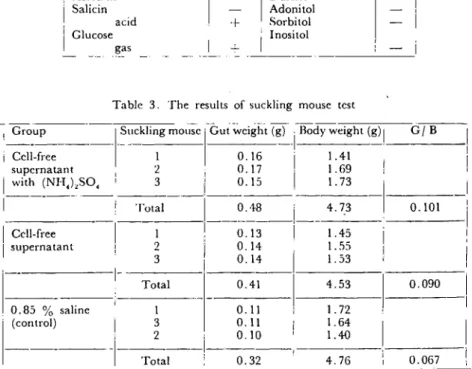
16 titre.The results of suckling mouse test are shown in Table 3. In groups given cell-free supernatant with (NH4)zS04, ceıı-free supernatant alone and 0.85
%
saline as control, the ratios of gut to body weight were 0.1, 0.09 and 0.06, respectively. In the view of this result, the organism was considered as enterotoxigenic.CHARAC TERIZATION OF AEROMONAS ... 513
Tablc 2. Biochcmical characteristics of A. sobria
--- .
__
._-- _o_o ______ • ______ i OLF +/+i
Lactose Oxidase Raffinose ! Cataıa~e Arabinose ]\itratc + Galactose + Urea Maltose + H,S Trehalose + Indole Mannose + VP -l- Fructose-+-DKA ase Xylose
Acsculin Dulcitol Salicin Adonitol acid + Sorbitol Glucose Inositol gas -- ---
-Table 3. The results of suckling mouse test
0.101 1 __ 0.090
-!
1.45 1.55 i. 53 4.53 1.72 0.41 0.11 3 i '2 Ccll.free supematant '---1--I Total . 0.85%.~~:---~ Gro_%.~~:---~ ı.~~ıckling mou;;; 'ı-cut ~eight (~~_i-n;;~eight (g)i
i Cdl.free i 0.16 i 1.41 supematant '2 O. 17 ' 1.69
!
with (NI-I.),SO. 3i
0.15 i i. 73 -_-_-_-_.~~_-__ Total.-i-?-~~-i---
4.73 i 0.13 ii
0.14 i 0.14 I,(controı). i 3 0.11i
1.64i
i
' 2 ; 0.10 1.40 ---'-I--T-o-ta-l--!-O~-2 --'---4-. 7-6--i--0-.-06-7--1Cell-free supernatant injeeted i.v eaused the death of mi cc after 24 "hours of infeetion. Miee inoculatcd i.p with broth eulture died 12 hours after injeetion. Broth eulture given orally eaused the death of miee 36 hours after inoeulation.
The organism was found sensitive to tetraeyclin, ehlorotetraeyc-lin, neomycin, colistin sulfate, chloromphenicol, streptomycin, rifa-mycin, nitrofurantoin, erythromycİn and trimethoprim-sulphamethax-ol, but rcsistant to penİcillin, ampieillİn, earbenİcillin, bacitracin and novobiocİn.
Discussion
Gross lesions on skin and musculature of diseased fİshes were simi-lar to septicemia and erythrodermatitis defined by Antrychowicz and Ragulska (2). However, other lesions on internal organs and bloo-dy-ascitic fluid indicated that the disease was hemorrhagic septicemia. Furthermore, the organism was very often found in pure culture from the kidney and liver indicating the presence of septicemia.
Since the initial of the genus Aeromonas, the taxonomic classi-fication of the motile aeromonads has presented a confusing picture, mainly due to the relativcly minor biochemical differences which have been found between strains (15, 22). The taxonomy of motile aero-monads is still under dispute but in this study wc fallowed Popoff and Veron's (21) simplifİed classification. The bacteriological methods used in the present study were effective in isolating motilc aero-monads from organ samples of affected fishes. The isolated organism showed typical biochemical characteristics of genus Aeromonas, furt-hermore A. sobria . A. hydrophila can use arabinose and salicin as source of carbon and energy (~2). it can also hydrolyse aesculin. On the other hand, A. sobria is negative to all these properties (21). Based on these biochemical tests, the organism was classified as A. sobria.
A. hydrophila and A. sobria both produce many extracellular enzy-mes and toxins rclated with their toxigenicity (16). De Figl1eiredo and Plumb (9) have reported that the differences in biochemical test bet-ween the different isolates of motile aeromonads were insufficent to separate the virulent from avirulent strains. Boulanger et al (5) and Olivier et al (I 9) have reported that A. sobria strains were less hemoly-tic than the A. hydrophila strains and the type of hemolysis produced by A. hydrophila and A. sobria was different. In contrast, A. sobria isoIate caused the hemolysis of rabbit red blood cells in saline and sheep "red blood cells on the sheep blood agar with a zone as clear as A. h)'droplıila. Boulanger et al (5) and 01ivİer et al (19) have reported that all the A. sobria İsolates were positive in suckling mouse test. it was detcr-mined that addition of ammonium sulfate to culture increased the pro-duction of hemolysin by Aeromonas (24). Olivier et al (19) also sho-wed that all the toxigenic activities were İncreased by the addition ofammonium sulfate. In the present study, the organismwas conside-red as enterotoxigenic by the suckling mouse assay. it was also obtained
CHARAC TERIZATION OF AEROMONAS ... ~Lj
a greater ratio (O. i) with ammonium su1fate than without ammonium sulfate (0.09). This ,,,ork has also shown that isobted organism \Vas very pathogenic for adult mice. In view of these results, it is postu la-ted that A. sobria strain could be associated with septiecmia found in earps.
Under normal conditions, motilc aeromonads normaııy found in water and usuaııy do not eause a problem in fish populations (I 4). But, when the fishes are under environmental and physiological stress, motile aeromonads are potential pathogens. So mc parasites mayaıso play a role in the initiation of bacterial diseases together with environ-mental faetors (I I). In Turkey, These parasites are not uncommon for wild and culturcd ca rp (6). These parasites were determined in affec-ted carps, but fishes were not heavily infecaffec-ted ""ith them. Teherefore, parasites mentioneel above wc re not found directly rclated with symp-toms and lesions.
Baran ct al (3) have reported an outbreak of bacterial hemorr-hagic septicemia in rainbow trout eaused by A. hydrophila in a fislı farming station in Turkey. Reeently, Timur (23) has described an outbreak of A. h)'drophila infeetion among the eıı at same station. In the present study., A. sobriais isolated from an outbreak ofmotile aero-monas scpticemia of diseased carps for the first time in Turkey.
Referenees
I. Allan, B.J. and Stevenson, R.M.W. (1981): Extracellıılar "irıı/eııccjnctor" nj Aeromo-ıws hydroplıila iıı/islı i'!fections. Can. J. MierobioL, 27: iı14-1 122.
2. Antyehowiez, J. and Rogulska, A. (1983): Studies on tlıe netinlng)' nj eı)'thmdemwtitis in cnrp. Medye. Wetery. 39: 15-18.
3. Baran, t.,Tirnur, M. ,Aydın, N., İstanbulluoğlu, E. and Aydıntuğ, M.K. (ı 981) : An outbrmk ~f bacterial hemorrlıagic septicemia nf rainbow trout (Sfılmo gl/irdııeri irideIL<) iıı
a./ishfarming stntion locnted iıı Eskişehir Çifteler, Sakaı)'nbaJl Turkcy. Aıık. Uııiv. Vet. Fak.
Dcrg., 27: 467-473.
4. Bauer, A.W., Kirby, W.M., Sherris, J.e. and Turek, M. (19G6): Aııtibioıic
S'ISCCP-tibility testing by a slaııdardi::.ed "iııgle disc method. Am ..J.Clin. PatlıoL, 45:493. 49G. 5. Boulanger, Y., Lallier, R. and Cousineau, G. (1977): isolalinıı nr eıılerotoxigelZic
AeromOlıasfromfish. Can. J.MierobioL, 23: 1161-1164.
6. Burgu, A., Oğuz, T., Korting, W. and Güralp, N. (1984): bwe"tigations into t/ufish parasitefamın iııSome arens ofCeııtral Anntolin. Proeccdings of 4 tlı European :\1ulıieollo-quium of Parasitology, İzmir.
7. Cowan, S.T. (1974): Cowmı aııd Steers Maııııalfoı ılıe Jdmıificatioıı oj Medical Bacım."
Cambridge University Press, Cambridge.
8. Dean, A.G., Ching, V.C., Williams, R.G. and Harden, L.B. (1972): Test for t;s-elurielıia coli mleroloxiıı ıısiııg iııfaııt mice: ap/ı/icaıioıı in a sıııd)' of diarrlıea iıı clıildım in
Hono-'11111. J. Infeet. Dis., 1:15:407-4 iı.
9. DeFigueiredo, J. and Plumb, J.A. (ı 977): Vmtlence qf diffmııı isolales of Aeıomo. ııas 'z.ydroplıila in elıanncl caifish. Aquaculture, ıi : 319-354.
LO. Eurell, T. E., Lewis, D.H. and Grumbles, L.C. (1978): eOIııPaıisOIl qlselecled diagnos-ıic ıestsfor deıeetion ofmoıile aeroıııonas sepıiceıııia iııfislı. Am. J.Yet. Res., 39: 1384-1386. i I. Hoffman, G.L. (I 967): Parasiles qf .Yorth AmClicalı Freshwaıer Fishes. University of Cali.
fornia Press, Berkele)".
l:i. Jiwa, S. F.H. (ı 983): I~ııterotoxigenicit)", lıeıııagglutillOıioll mıd cell surfaee lıydroplıobiciı)' zn Aeromoııas lıydro/ıhila, A. sobria aııd A. salmonicida. Vet. ~ıicrobioı., 8: 17-34.
13. Johnson, W. M. and Lior, H. (1981): Cyioloxiciry aııd suckliııg moııse reacıioiryqf Aeroıııoııas hydrophiltl isolaled .from Iıııman soıırces. Can. J. Microbiol., 27: 1019- 1027. 14. Kaper, J. P., Lockman, H., Colweıı, R. R. and Joseph, S. W. (1981): .1eromo-naS hydrophila: ccolog)' aııd luxigenocily qf isolates frum mı estuar)'. J. AppL. Bacterio!., 50: 359-377.
15. Larsen, J. L. and Jensen, N. J. (1977): Aıı aeromoılOS spceies iıııplicalcd iıı ıılce,.
discase of Ihe cod. Kord. Yet. Med .• 29: 199 - 21ı.
16. Ljungh, A. and Wadstrom, T. (1982): AerolııO/ıas loxiııs. Pharmac. Ther., 15: 339-354.
17. Ljungh, A., Wretlind, B. and Möllby, R. (198 I): Septlratioıı aııd elıoraeteri;;:atioıı of entemloxiıı aııd two Iıaeıııo(rsins from Aeromoııas hrdroplıila. Acta Path. Mierobiol. Scand. See!. B., 89 :387-397.
18. MacInnes, J.i., Trust .. T.J. and Crosa, J.H. (1979): DeoxyıibollUcleic acid rclatioııslıip amO/ıg numbers of ılıe genus Aemıııonas. Can.J.}'vlierobiol., 25: 579-586.
19. Olivier, G., Lallier, R. and Lariviere, S. (1981): A loxigmie profile of AerOlllOııas hydrophila aııd Aemıııoııas sobria i.wlatedfromfislı. Can. J.Microbiol., :i7: 330- 333. 20. Pham, A.V. and Davis, G.H.G. (1979): A ıııodified tlıeımoııuclease lesi for Sta/ıh)"loeocClls
Olıreııs ideııtificalioıı. Aust.J.Med. Technoı,. 10: 29-3 ı.
:iı. Popoff, M. and Veron, M. (I 976): A taxoııoıııic study <iftlıe Aeroıııoııas
lıydrophila-Aeromo-lios pUlıctala groııp.J.Gen. Mierobiol., 94: 11-22.
22. Schubert, R.H.W .. (1974): The gCIIIJ-' Aeromoııas. bı Bergey's .~1aııııal qf Determinalivc Baeteriology. 8 th ed., Editofs. R.E. Buchanan, K. E. Gihbons. pp. 34",-318. \,\'iııiams and \Vilkins Co., Baltimore.
23. Timur, M. (1983): Aıı out break of a disease offamıed eli (Aııgııilla oııguilla) due lo
Aeroıııo-110.1 h),droplıila iıı 7iITkey: lıistopatllOlogical and bacteriological stııdies. Ankara Univ.
Yet. Fak. Dcrg., 30:361 367.
:21. Wretling, B. and Hedes, L. (I 973): Formatioıı of extraeellıılar lıaeıılU(rsilı b)' Anomoııas I,J,dro/ıhila iıııe/aıiotl lo proıease aııd sıaplıylo(ytic cn'::)'IlIe.J.Gen. :Viinobiol., 78:57-6:1.