https://doi.org/10.1007/s11696-018-0511-x
ORIGINAL PAPER
Investigation of an alternative chemical agent to recover valuable
metals from anode slime
Aydın Rüşen1 · Mehmet Ali Topçu1
Received: 10 February 2018 / Accepted: 22 May 2018 / Published online: 28 May 2018 © Institute of Chemistry, Slovak Academy of Sciences 2018
Abstract
Anode slime (AS) including high content of precious metals is a by-product obtained after the electro-refining stage in copper production. In this study, it is aimed to recover Cu, Au, and Ag from the AS by using 1-butyl-3-methyl-imidazolium hydrogen sulphate ([Bmim]HSO4) ionic liquid (IL) as a green solvent. The effects of IL concentration, temperature, reaction time and pulp density on recovery of valuable metals were statistically investigated. A high copper recovery of 87.52% was obtained under optimum condition as in 60% (v/v) [Bmim]HSO4 at 50 °C after 2 h, pulp density at 40 g/L (1/25 solid/liquid ratio). Also, a remarkable gold recovery as 97.32% has been achieved in 80% (v/v) [Bmim]HSO4 at 95 °C after 4 h, pulp density at 40 g/L. Temperature and IL concentration were detected as the most effective parameters for copper and gold recovery from AS, respectively. Silver could not be recovered from the AS due to the lower solubility in [Bmim]HSO4 IL media. According to experimental results, [Bmim]HSO4 could be offered as an alternative leaching agent, instead of conventional solvents, to recover valuable metals from copper anode slime.
Keywords Anode slime · Recovery · Ionic liquids · 1-Butyl-3-methyl-imidazolium hydrogen sulphate [Bmim]HSO4 · Leaching
Introduction
Today, most of the copper demand in the world is supplied by the pyrometallurgical treatment of the existing copper ores in the following order; beneficiation, smelting, convert-ing, fire-refining and electro-refining. Also, in order to pro-duce copper, considerable efforts are performed by the treat-ment of copper alloyed scrap with fire and electro-refining stages. In both cases, copper refinery AS includes valuable metals such as Au, Ag, Cu, Se, Te, etc. (Kılıç et al. 2013). In recent years, numerous reviews have been reported on the treatment processes of AS (Biswas et al. 1998; Hait et al.
2009;Syed 2012; Tokkan et al. 2013; Ranjbar et al. 2014; Lu et al. 2015), which are carried out by pyrometallurgi-cal, hydrometallurgical or both of these chemical processes. Especially, some hydrometallurgical processes such as hot sulphuric acid leaching, alkali fusion-leaching, thiosulfate
leaching, decopperization, and oxidative leaching stand out as the main processes to recover the various metals from AS (Yavuz and Ziyadanoğulları 2000; Li et al. 2015; Xu et al.
2016; Wang et al. 2017; Liu et al. 2014). However, the huge amount of acid consumption, low metal recovery efficiency, recycling problem of acid waste and releasing the hazard-ous gases such as acid vapour, volatile organic compounds and chlorine gas are global difficulties of these methods. For this reason, scientists have focused their efforts to find environmentally sensitive solvents for producing efficiently valuable metals (Hu et al. 2017). Ionic liquids (ILs) are the most promising chemical solvents for metal production in hydrometallurgical routes with excellent properties, such as negligible vapour pressure, non-flammability, thermal stabil-ity and high conductivstabil-ity (Tian et al. 2010; Park et al. 2014). ILs formed fully of organic cations and inorganic/organic anions have a potential to leach ores and metal oxides greenly due to having ability to dissolve a wide range of inorganic and organic compounds (Hu et al. 2017). The first study on metal extraction using ionic liquid was carried out by Whitehead et al. (2004) with 1-butyl-3-methyl-imidazo-lium hydrogen sulphate ([Bmim]HSO4) to take out the pre-cious metals from gold bearing ore. This study was resulted
* Aydın Rüşen
1 Department of Metallurgical and Material Engineering, Karamanoğlu Mehmetbey University, 70200 Karaman, Turkey
85% Au and 60% Ag recoveries for 50 h leaching at room temperature. Whitehead et al. (2007) also performed another study based on imidazolium IL with hydrogen sulphate for 48 h at 50 °C by changing its alkyl chain length. The study showed that IL with short alkyl chain length is more efficient on gold extraction from sulphidic ores. Furthermore, authors emphasized that HSO4− anions presented superior effect on gold extraction. An experimental work by Dong et al. (2009) showed that 88% of copper recovery was obtained from chal-copyrite by using pure [Bmim]HSO4 in oxygen ambience at 90 °C. Recently, Hu et al. (2017) used 1-hexyl-3-methyl-imidazolium hydrogen sulphate ([Hmim]HSO4) in the pres-ence of hydrogen peroxide (H2O2) as oxidant. Results of the study showed that 10% (v/v) [Hmim]HSO4 aqueous solution with 25% H2O2 was an effective leaching agent for copper extraction with 98.3% from chalcopyrite at 45 °C.
A small number of studies have been conducted by using ILs on the recovery of valuable metals from secondary sources such as electric arc furnace dust, brass waste and printed circuit boards, but most of these studies have been limited to recover Cu, Zn, and Pb from the secondary wastes (Bakkar 2014; Huang et al. 2014; Kılıçarslan et al. 2014). A recent study on recovery of precious metals from AS has been carried out by 1-ethyl-3-methyl-imidazolium hydro-gen sulfate (EmimHSO4) IL (Rüşen and Topçu 2017a), and results of this study showed that gold can be recover higher than 89% from AS at optimum leach conditions: 80% IL concentration, 75 °C, 4 h and 1/25 g/mL solid/liquid ratio. Also, authors mentioned that, other metals such as Pb, Sn, Se, Te (except for gold and copper) in anode slime have low dissolution rate in ILs. Therefore, in the present study, we focused to recover main precious metals (Au, Ag and Cu) from AS by a hydrometallurgical route using [Bmim]HSO4 IL as a leaching agent. First of all, chemical, mineralogical and thermal characterization of AS were revealed in detail. Then, the effects of parameters such as IL concentration, temperature, reaction time and pulp density were investi-gated on copper, gold and silver recovery from anode slime by applying orthogonal array experimental design. Further-more, the optimum recovery condition for each metal was determined by Taguchi method which is the frequently used method for studies with several variables in recent times (Zarghami et al. 2014, Bayat et al. 2017). Lastly, the most effective parameters on metal recovery from AS were ana-lyzed by analysis of variance (ANOVA) method.
Experimental parts
Materials
The AS used in this study was collected from a copper plant located in Denizli province in Turkey. It was dried at 105 °C
for 24 h, and then ground by ball milling (Restch PM-100). After grinding, finer particle with lower than 45 micron was obtained homogeneously.
1-Butyl-3-methyl-imidazolium hydrogen sulphate ([Bmim]HSO4, ≥ 95%) IL (CAS number: 401788-98-5) was chosen as a leaching agent due to its acidic media in aqueous solution and miscibility in water and it was obtained com-mercially from Sigma-Aldrich.
Optimization method
Taguchi method which keeps experimental cost at minimum level was used in order to determine the optimum recovery conditions for each metal. To investigate optimum condi-tions for the leaching of anode slime, the effect of some parameter on the process was explored. Based on previous studies (Dong et al. 2009; Kılıçarslan et al. 2014) about leaching works, ionic liquid concentration, reaction tem-perature, reaction time and solid/liquid ratio were chosen as the four factors to be investigated. According to the Taguchi method, the orthogonal array experimental design L16 (44), which denotes four parameters, each with four levels, was chosen because it is most suitable for the conditions being investigated (Guo et al. 2010; Dhawan et al. 2011). The pos-sible interactions between factors in the orthogonal matrix were not considered and the order of leaching tests was per-formed randomly.
In Taguchi method, three different loss functions, viz., larger is the better (S/NL), smaller is the better (S/NS) and nominal is the better (S/NN), are used to measure the perfor-mance characteristics and then, the value of loss function is converted to signal to noise (SN) ratio to reduce variability (Safarzadeh et al. 2008; Kumar et al. 2015; Arce et al. 2017). In this study, for optimization of metal recovery, larger is the better has been evaluated by using the following equation:
where (S/N)L is performance statistics, n is number of repeti-tions done for an experimental combination, and xi perfor-mance value of ith experiment.
The collected data were then analyzed by Minitab 17 soft-ware program to evaluate the effect of each parameter on optimization criteria. By using SN analysis, it is possible to determine optimum level of each parameter and optimum set of parameter producing the maximum leaching efficiency. After determining optimum experimental conditions, the performance value corresponding to optimum conditions can be predicted by the following equation (Kim et al. 2009):
(1) (S N ) L = −10 log ( 1 n n ∑ i=1 1 x2 i ) , (2) [S N ] Predicted = [S N ] m + n ∑ n=1 ([S N ] i − [S N ] m ) ,
where (S/N)m is arithmetic mean of performance statistics (S/N)L for all experiments, (S/N)i is performance statistic value at optimum level of each investigated parameter.
After estimation of optimum condition, the validity of optimum condition was controlled by confirmation experi-ments conducted at the optimum conditions.
But Taguchi is insufficient of identifying which factor has influenced the output significantly and how much each factor contributed to the output. Therefore, analysis of variance (ANOVA) in accordance with the Taguchi method was done to determine which investigated parameters are dominant on the leaching performance (Mbuya et al. 2017; Behnajady and Moghaddam 2017). For this reason, the F test was used to specify which process parameters had a significant effect on the leach efficiency. Usually, the larger F value leads to the greater effect of the leaching efficiency due to the change of the process.
Leaching tests
All leaching tests were carried out in 100 ml Pyrex glass flasks placed on a hot plate with a Teflon-coated mag-netic stirrer. The heater was controlled by a thermocouple with sensitivity of ± 0.5 °C. During all the experiments, speed of the magnetic stirrer was fixed at constant value (600 rpm). The leaching tests were performed at constant volume of leaching solution (25 ml) with different pulp den-sities. Experimental parameters were selected as tempera-ture (25–95 °C), time (0.5–4 h), pulp density (100–40 g/L which corresponds to 1/10–1/25 g/ml solid/liquid ratio) and [Bmim]HSO4 IL concentration (20–80% v/v) prepared by mixing of deionized water. In addition, hot water leaching (HWL) was carried out to specify water-soluble compounds in AS at the following conditions; 95 °C for 120 min with a pulp density of 40 g/L.
After each of the leaching tests, the solid and leach liquor parts were separated by using a vacuum pump. The acidi-ties and conductiviacidi-ties of the initial and final leach solutions were recorded at room temperature by means of an Eh–pH meter. Atomic absorption spectroscopy (AAS, PerkinElmer PinAccle 900T) was used to analyze the Cu, Au and Ag concentrations in the leach solutions.
Anode slime characterization
Chemical characterization of AS was characterized with the fire-assaying method for precious metals (Au and Ag) at General Directorate of Mineral Research and Explora-tions (MTA). Inductively coupled plasma mass spectrometry (ICP-OES, Agilent ICP-OES 725) and X-Ray Fluorescence Spectrometry (XRF, Rigaku ZSX Primus II) were used for other base metals at. Chemical analysis results of the sample showed that AS was mainly composed of 23.1% Cu, 20.5%
Sn, 15.4% Pb, 5.87% Ba, 4.11% S, 0.82% Ni, 0.24% Sb, 0.14% Sr, 0.13% Zn, 0.11% Bi, 21.9 ppm Au, 2204.2 ppm Ag, 413 ppm Se, 83 ppm Te.
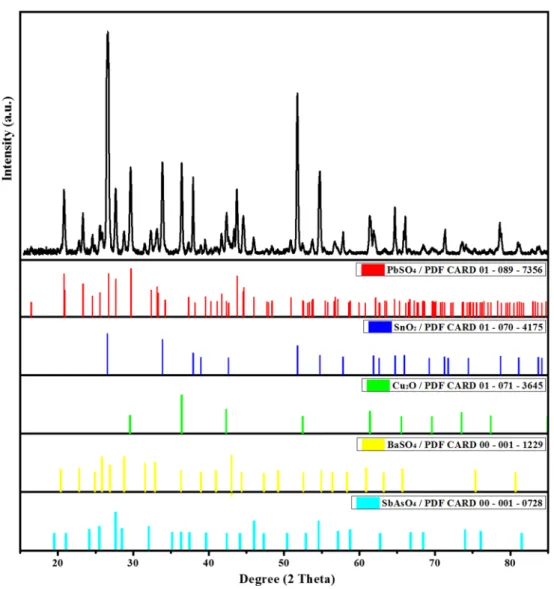
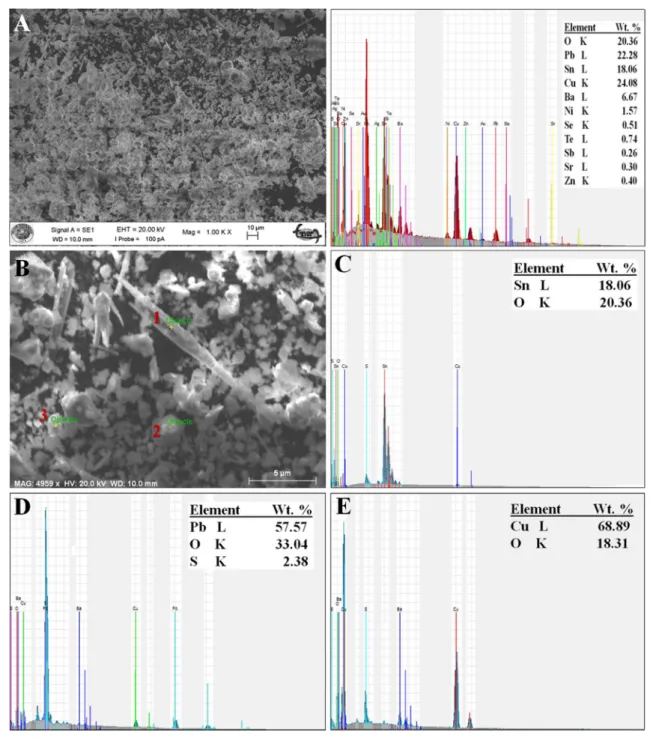
Component morphology of AS was detected by X-ray dif-fraction (XRD, Bruker Advance D8) and scanning electron microscope equipped with energy-dispersive X-ray spectros-copy (SEM–EDX, JSM-6400 electron microscope). Figure 1
and Fig. 2 indicate XRD patterns and SEM–EDX results of AS, respectively. Also, mineralogical analysis was carried out after leaching experiments under optimum conditions for Au and Cu for evaluating the change of morphology of AS.
As shown Fig. 1, PbSO4, SnO2 and Cu2O were detected as major components of the AS. Other minor components are determined as BaSO4 and SbAsO4. Besides these com-pounds, copper was also detected in CuS form and low amount of silver was determined by SEM–EDX analysis. According to the SEM images (Fig. 2), which show at dif-ferent magnifications for selected points, anode slime parti-cles have more complex morphology with different shapes especially spherical and rod (twiggy). EDX analysis shows that all of the SnO2 particles appear as rod form in the AS with different sizes. In addition, PbSO4 and Cu2O phases were detected by EDX analysis. SEM–EDX analysis results support the XRD and chemical analysis results of the anode slime.
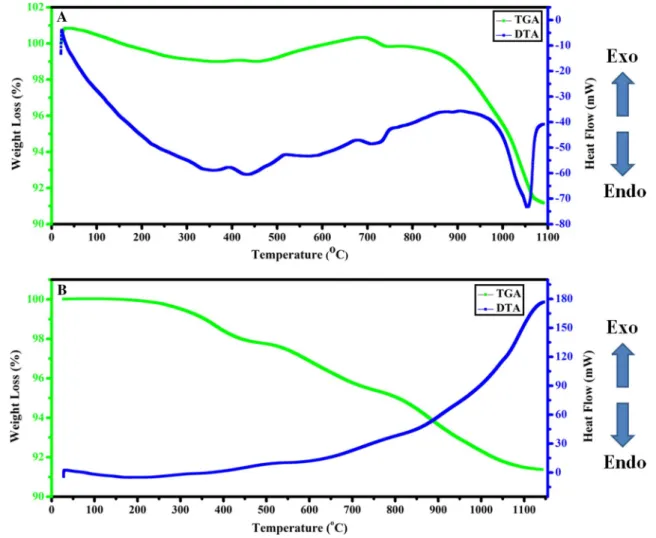
Simultaneous Thermogravimetric (TG) and Differential Thermal Analysis (DTA) of the sample were measured by Tetra TG/DTA 6300 in oxygen and argon environments to determine the thermal properties of the anode slime by heat-ing at 30–1100 °C with a heatheat-ing rate of 25 °C/min. TG and DTA curves of AS were given in Fig. 3.
First of all, when compared to both curves (Fig. 3a, b), it is obviously concluded that all mass gains in the curve obtained in oxygen atmosphere are caused by oxidation of different components in AS for all temperatures between 350 and 700 °C.
According to the thermal analysis in oxygen ambience (Fig. 3a), the TG curve can be divided into three main parts; (a) initial mass loss (up to 400 °C), (b) mass gain part (400–700 °C), (c) final mass loss (from 700 to 1100 °C).
(a) The mass losses at low temperatures in Fig. 3a stem from removing moisture, chemical bonded water and vola-tiles content of the anode slime, which corresponds to nearly 1.5%. The mass losses continuing up to 400 °C is probably due to evaporation of free selenium and removal SO2 gas emerged by oxidation of CuS compound present in anode slime (Shah and Khalafalla 1971, Hait et al. 1998).
(b) After 400 °C, the mass gain may be caused by inter-action of the elements available in the metallic form in the anode slime with an oxidizing atmosphere. From the chemi-cal analysis it is known that copper (with possible Cuo, CuS, Cu2O or Cu2Se forms in the AS) exists in the highest amount (23.1%) and it can be oxidized at lower temperatures. Most
of the copper in the AS was detected as Cu2O form by XRD analysis. According to the Won et al. (2006), Cu2O can be oxidized to form CuO in the range of 400–600 °C as Rx. 3. Also, authors stated that oxidation of Cu2O decreases with increasing temperature. Besides this, the mass gain occur-ring in temperature interval 550–600 °C may be attributed to oxidation of Cu2Se compound in the sample (Rx. 4) (Dunn and Muzenda 2001; Won et al. 2006):
According to these reactions, approximately %2 mass gain in the AS is expected. But, the mass gain correspond-ing to 1.5% indicates that the components could not be fully oxidized at the specified temperatures.
At the DTA curve, endothermic peak between 400 and 450 °C without significant mass change proved the phase transformation or phase formation in the anode slime. Taski-nen et al. (2014) described the phase transformation at these
(3) Cu2O + 1∕2O
2 → 2CuO (400−600◦C)
(4) Cu2Se + 2O2 → Cu2SeO4(550−600◦C).
temperatures as the conversion of Cu2O to CuSO4 in the presence of SO2 and O2 gases by the following reaction (Rx.
5):
(c) It is thought that the last mass losses and endother-mic peaks observed at about 700 and 1100 °C represent the decomposition of sulphated structures such as CuSO4, PbSO4 and BaSO4 by following chemical reactions (Rxs. 6–8). DTA curve reveals that CuSO4 decomposition takes place in the range of 700–740 °C (Minić 2005). Dissociation of lead sulphate starts at 705 °C and fully desulphurization is completed up to 980 °C (Abdel–Rehim 2006). Further temperature increment causes intensive decomposition of BaSO4 with the appearance of endothermic peak at higher than 1000 °C (Prameena et al. 2013):
(5) Cu2O + 2SO2+ 3∕2O2 → 2CuSO4(420−550◦C).
(6) PbSO4(s) → PbO(s) + SO3(g)
(7) BaSO4(s) → BaO(s) + SO2(g) +1∕2O2(g)
Fig. 1 XRD patterns of anode slime
On the other hand, as seen in Fig. 3b, the TGA curve decreases continuously during the entire analysis in argon ambience, which indicates removal of moisture and chemi-cal-bonded water (up to 450 °C), the evaporation of elements and volatile components in AS at different temperatures (from 450 to 750 °C), and decomposition of sulfated com-pounds (PbSO4, BaSO4, etc.) from 750 to 1100 °C according to Rx. 6–8.
(8)
CuSO4(s) → CuO(s) + SO2(g) + 1∕2O2(g).
Results and discussion
Leaching results
To optimize the leach conditions on recoveries of valuable metals (Cu, Au and Ag) from AS in IL system, four param-eters each at four levels were investigated by using L16 (44) orthogonal array experimental design. The HWL of anode slime showed that there is no water-soluble form of Cu, Au and Ag compounds in the AS. In the present study,
Fig. 2 a SEM image of anode slime with EDX result of all surface area, b SEM image of the selected area with higher magnification, c EDX
the highest Ag recovery from AS could be obtained as lower than 10% by using [Bmim]HSO4 as a leaching agent. This may be attributed to silver compounds available in AS which have low solubility in [Bmim]HSO4 IL. In this study, the structure of silver in AS could not be clearly determined. But, it is known that CuAgSe as a common type of compound in AS (Chen and Dutrizac 2005; Kılıç et al. 2013) can be dissolved in acidic media by formation of Ag2Se structure according to following chemical reac-tion (Rx. 9) (Chen et al. 2015):
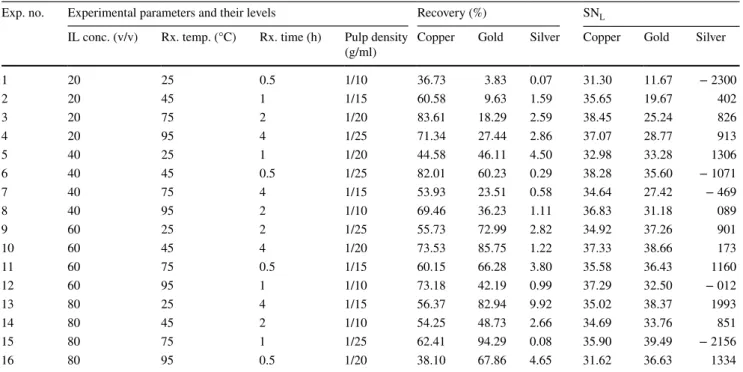
Since [Bmim]HSO4 has acidic properties with HSO4 anion, Rx. 9 may describe the low dissolution rate of sil-ver in IL media. For this reason, the optimum condition for silver recovery was not determined. The experimental conditions and results of leaching efficiency with the per-formance statistic for Cu, Au and Ag recoveries are given in Table 1 and Fig. 4.
(9)
2CuAgSe + O2+ 2H2SO4 → 2CuSO4+ Ag2Se + 2H2O.
As it is well known, in Taguchi method the performance statistic graphs are used to determine the optimum work-ing conditions by selectwork-ing maximum point for each param-eter. Therefore, the top of the peak in each column of Fig. 4
was marked to define the optimum condition for Cu and Au recovery separately. According to Fig. 4, the optimum condi-tion for copper recovery by using [Bmim]HSO4 was detected as; IL concentration: 60% (v/v), temperature: 50 °C, reac-tion time: 2 h and pulp density: 40 g/L, which corresponds to A3, B2, C3, and D4. Also, the optimum condition for gold recovery was determined as; ionic liquid concentration: %80 (v/v), temperature 95 °C, reaction time: 4 h and pulp density: 40 g/L, namely A4, B4, C4, and D4.
If the orthogonal array experimental design for Cu and Au recovery is analyzed carefully, it can be noticed that the detected optimum experimental conditions have not been performed during the experimental trials as a leach-ing experiment for both of them. Therefore, the predicted recovery rate for Cu and Au under the optimum conditions
must be calculated theoretically and confirmed experimen-tally (Kim et al. 2009). Under the optimum conditions (A3, B2, C3, and D4), the predicted theoretical recovery rate and the leaching efficiency obtained after the verification tests
for Cu are 90.31 and 87.52%, respectively. On the other hand, for Au at the optimum conditions (A4, B4, C4, and D4) calculated theoretical recovery value and experimental
Table 1 Experimental conditions and results of leaching efficiency with the performance statistics for Cu and Au recovery
Exp. no. Experimental parameters and their levels Recovery (%) SNL
IL conc. (v/v) Rx. temp. (°C) Rx. time (h) Pulp density
(g/ml) Copper Gold Silver Copper Gold Silver
1 20 25 0.5 1/10 36.73 3.83 0.07 31.30 11.67 − 2300 2 20 45 1 1/15 60.58 9.63 1.59 35.65 19.67 402 3 20 75 2 1/20 83.61 18.29 2.59 38.45 25.24 826 4 20 95 4 1/25 71.34 27.44 2.86 37.07 28.77 913 5 40 25 1 1/20 44.58 46.11 4.50 32.98 33.28 1306 6 40 45 0.5 1/25 82.01 60.23 0.29 38.28 35.60 − 1071 7 40 75 4 1/15 53.93 23.51 0.58 34.64 27.42 − 469 8 40 95 2 1/10 69.46 36.23 1.11 36.83 31.18 089 9 60 25 2 1/25 55.73 72.99 2.82 34.92 37.26 901 10 60 45 4 1/20 73.53 85.75 1.22 37.33 38.66 173 11 60 75 0.5 1/15 60.15 66.28 3.80 35.58 36.43 1160 12 60 95 1 1/10 73.18 42.19 0.99 37.29 32.50 − 012 13 80 25 4 1/15 56.37 82.94 9.92 35.02 38.37 1993 14 80 45 2 1/10 54.25 48.73 2.66 34.69 33.76 851 15 80 75 1 1/25 62.41 94.29 0.08 35.90 39.49 − 2156 16 80 95 0.5 1/20 38.10 67.86 4.65 31.62 36.63 1334
Fig. 4 Effects of each parameter on the statistics for a copper recovery, b gold recovery
leaching efficiency of verification test are obtained as 99.97 and 97.32%, respectively.
According to the results, almost whole of the gold (97.32%) and most of the copper (87.52%) could be extracted experimentally from AS by [Bmim]HSO4 IL leaching under the optimum conditions. Moreover, there is a remarkable agreement between theoretical and experimental quantities for Cu and Au recoveries. Both metal leaching efficiencies are within the 5% margin of error.
In Taguchi method, only the performance statistic graphs given in Fig. 4 are not sufficient to directly describe the effect of the studied parameters on the recovery process. Therefore, many scientists were used Analysis of Variance (ANOVA) approach to define which investigated parameters are predominant on the performance characteristics (Mbuya et al. 2017; Behnajady and Moghaddam 2017). For this rea-son, the F test was used to specify which process param-eters had a significant effect on the leach efficiency. Results of the ANOVA analyses and contribution percentages of
the investigated parameters for Cu and Au are presented in Table 2 and Fig. 5, respectively.
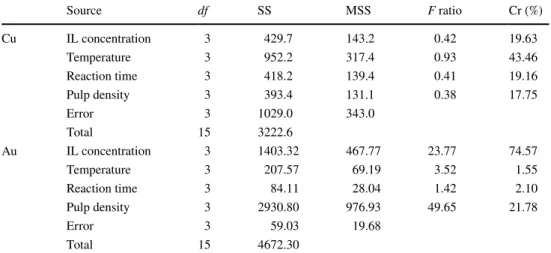
These results should be examined separately for these two metals (Cu and Au) in terms of four different parameters (IL Concentration, Temperature, Reaction Time, and Pulp Density). As seen from Fig. 5, temperature is the most effec-tive parameter on copper recovery from AS with 43.46 per-centage of the contribution (Cr %) in [Bmim]HSO4 media. When looking at the Fig. 4a, it can be seen that Cu extraction increased with increasing temperature until 50 °C. However, after this critical point Cu recovery decreased slightly. In aqueous solutions of ILs, there are several factors such as dissolved oxygen, acidity and ionic strength which affect the copper dissolution. Dong et al. (2009) was emphasized that dissolved oxygen decreased with increasing temperature. Thus, the low copper recovery from AS in [Bmim]HSO4 solution at high temperature could be attributed to a decrease in dissolved oxygen ratio. This may be overcome by adding H2O2 to the leach system as an oxidant.
Table 2 ANOVA results for
copper and gold recovery Source df SS MSS F ratio Cr (%)
Cu IL concentration 3 429.7 143.2 0.42 19.63 Temperature 3 952.2 317.4 0.93 43.46 Reaction time 3 418.2 139.4 0.41 19.16 Pulp density 3 393.4 131.1 0.38 17.75 Error 3 1029.0 343.0 Total 15 3222.6 Au IL concentration 3 1403.32 467.77 23.77 74.57 Temperature 3 207.57 69.19 3.52 1.55 Reaction time 3 84.11 28.04 1.42 2.10 Pulp density 3 2930.80 976.93 49.65 21.78 Error 3 59.03 19.68 Total 15 4672.30
Fig. 5 Contribution percentage
of the investigated parameters on Cu and Au leaching metal recovery
According to the ANOVA analysis, the other parameters which are IL concentration, Reaction time and Pulp density with 19.63%, 19.16, 17.75% contribution ratio, respectively, have similar effects on copper recovery from AS. The solu-bility as well as miscisolu-bility of ILs in water makes them a good hydrogen ion donor, which results in the acidic aque-ous solution. Acidity of the ILs depends on the concentra-tion and also highly dissolved hydrogen sulphate ions (Zhou et al. 2008). The decomposing of [Bmim]HSO4 in water was demonstrated by Crowhurst et al. (2003) by the following chemical reaction (Rx. 10):
Therefore, it is reasonable to propose Rx. 11 as the main dissolution reaction of copper in [Bmim]HSO4 IL, because Cu2O was detected as the main phase containing copper in AS by XRD analysis.
According to chemical reaction 8, the acidity level of the IL and the dissolved oxygen ratio are two main parameters which affect the dissolution of copper.
As illustrated in Fig. 4a, the copper recovery increased by increasing IL concentration up to 60% (v/v) and then decreased sharply at a high IL concentration. This could be attributed to the high viscosity of IL as compared to con-ventional solvents. In order to overcome this manner, higher agitation speed should be performed during the leaching process at high IL concentration.
As for gold recovery, experimental results showed that almost all of the gold contained in the AS could be recov-ered by IL leaching under the optimum condition. It is known from the previous studies that the aqueous solution of [Bmim]HSO4 IL has a suitable environment for oxidative (10) [Bmim]HSO4 ↔ Bmim++ H++ SO2−4 .
(11) Cu2O + 4H++ 1∕2O
2 ⟷ 2Cu2++ 2H2O.
leaching of gold extraction with acidic properties (White-head et al. 2004). The high [Bmim]HSO4 concentration used in this study with high acidity (measured as pH = 0.7) affects positively the gold recovery from AS. This is also supported by the ANOVA analysis as seen in Table 2 and Fig. 5 the most effective parameter on gold recovery from AS was IL concentration with 74.57% ratio. As given in Fig. 3b, the gold recovery increased with increasing IL concentration, and reached quite high level with 97.32% recovery ratio at 80% (v/v) IL concentration after verification test. Consider-ing the results of initial studies on gold recovery (White-head et al. 2004, Rüşen and Topçu 2017a), the leaching yield obtained in this study seems to be quite compatible with the literature.
Second effective parameter for gold recovery is pulp den-sity with 21.78% Cr-ratio. The last column in Fig. 4b shows that the gold recovery increases rapidly by decreasing the pulp density. Due to the volume enlargement of the solution, the decrease in pulp density is favourable for gold extraction by acceleration of the reaction and mass transfer between gold in AS and [Bmim]HSO4 IL. According to ANOVA analysis of Au, there is no significant effect of reaction tem-perature and time on Au recovery from AS in the presence of IL media.
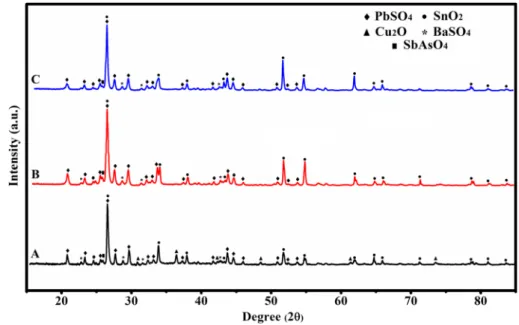
After the leach experiments under the optimum condi-tions for Au and Cu recovery, the residual secondary wastes were analyzed by X-ray diffractometer to reveal their min-eralogical contents, and they were compared to the origi-nal anode slime pattern. The XRD patterns are presented in Fig. 6.
As seen in XRD patterns, after the both optimum leach-ing, the Cu2O peaks (PDF# 01-071-3645) are diminished or disappeared due to the dissolution of the copper-containing phases in IL solution, which leads to become more apparent
Fig. 6 Comparison of XRD patterns belonging to a original anode slime, b the secondary residue after gold optimum leaching c the secondary residue after copper optimum leaching
in the peak intensities of the insoluble phases of SnO2 (PDF# 01-070-4175) in secondary leach residues of anode slime. This was also observed by SEM–EDX analysis of second-ary leach residues which obtained after the leach experi-ments carried out under the optimum conditions for both metals (Fig. 7). Figure 7c, d show that SnO2 and PbSO4 structures remained in the leach residue without any change after leach experiments. Since the phase of the gold could not be determined in the XRD pattern, comparison of XRD patterns only indicates that the copper-containing phases are dissolved and the copper recovery is realized by [Bmim] HSO4 leaching.
As seen from the EDX analyses (Fig. 7a, b.), consider-able amount of copper was dissolved in both experiments. The difference between copper content in the original AS (23.1%) and that of secondary leach residue determined by EDX result (~ 2% from Fig. 7b) is very prominent. These results almost coincide with leaching efficiency of copper (~ 90%) obtained under optimum conditions.
In the literature, recovery of valuable metals from AS has been tested by using several leaching agents such as H2SO4 (Dönmez et al. 1998; Hait et al. 2002; Khaleghi et al. 2014), thiourea (Amer 2003; Ranjbar et al. 2014), thiosulfate (Xu et al. 2016,) ammonia (Meng and Han 1996; Tan and Bedard
2013), EmimHSO4 (Rüşen and Topçu 2017a, b). Depending on the extraction processes and conditions, various leaching efficiency results have been obtained with these leach agents for Cu between 80 and 90%, for Au between 70 and 95%, and for Ag up to 85%. When the leaching efficiency results by [Bmim]HSO4 obtained under the optimum conditions compare to those by other methods, [Bmim]HSO4 represent very promising result for gold and copper.
Considering that the production cost of 1-methyl-imida-zolium hydrogen sulfate at bulk scale is ranging between 2.96 and 5.88 USD/kg which are relatively close to costs of organic solvents (Chen et al. 2014) the results showed that aqueous solution of [Bmim]HSO4 could be offer a suitable leaching media for copper and gold recovery from AS. By this way, low consumption of acid or cyanide based leach agent, less energy usage as well as low environmental pol-lution could be resulted. Beside this, due to the very high presence of the Pb and Sn in AS, removing of them from the original sample will cause to increase in the concen-tration of the precious metals, which results in less con-sumption of the [Bmim]HSO4 IL for chemical treatment of the AS. Moreover, as described in the previous studies (Nakashima et al. 2005; Abbott and McKenzie 2006; Zhang et al. 2009; Hoorgerstraete et al. 2013), most of the metals
have been extracted by liquid–liquid extraction and electro-deposition from ILs aqueous media due to their excellent physico-chemical properties such as high solubility of metal compound, high conductivity compared to non-aqueous sol-vents, adjustable hydrophobicity, wide temperature range and potential window for liquid phase.
Conclusions
In this study, copper, gold and silver recoveries were inves-tigated by using [Bmim]HSO4 ionic liquid which can be consider as an environmentally sensitive solvent. In the experimental trials, the copper anode slime was used as a valuable metal source in which PbSO4, SnO2 and Cu2O were detected as the main components. Under the optimum con-ditions, remarkable recovery ratios were obtained for cop-per and gold recovery as 87.52 and 97.32%, respectively. The Ag solubility in IL leaching could be remained very low due to the form of silver compound available in AS. After leaching experiments, it is seen clearly that [Bmim] HSO4 aqueous solution was an alternative leaching solution for copper and gold recovery from AS because of its acidic nature and oxidative media in water. Although a reasonable amount Cu and Au were recovered from the AS after the IL leaching step, it is necessary to evaluate the economics of the suggested process before industrial application due to the relatively high cost of ILs. However, as the costs of the ILs are lowered to feasible level, these solvents will play a very important role on the recovery of precious metals from primary or secondary sources in the future.
Acknowledgements This work was supported by Karamanoğlu Mehmetbey University Scientific Research Projects (BAP) Coordinat-ing Office with project no 04—YL—16.
References
Abbot AP, McKenzie KJ (2006) Application of ionic liquids to the electrodeposition of metals. Phys Chem Chem Phys 8(37):4265– 4279. https ://doi.org/10.1039/B6073 29H
Abdel–RehimA AM (2006) Thermal and XRD analysis of Egyp-tian galena. J Therm Anal Calorim 86(2):393–401. https ://doi. org/10.1007/s1097 3-005-6785-6
Amer A (2003) Processing of copper anodic-slimes for extraction of valuable metals. Waste Manag 23(8):763–770. https ://doi. org/10.1016/S0956 -053X(03)00066 -7
Arce GL, Neto TGS, Ávila I, Luna CM, Carvalho JA Jr (2017) Leach-ing optimization of minLeach-ing wastes with lizardite and brucite con-tents for use in indirect mineral carbonation through the pH swing method. J Cleaner Prod 141:1324–1336. https ://doi.org/10.1016/j. jclep ro.2016.09.204
Bakkar A (2014) Recycling of electric arc furnace dust through dis-solution in deep eutectic ionic liquids and electrowining. J Hazard Mater 280:191–199. https ://doi.org/10.1016/j.jhazm at.2014.07.066
Fig. 7 SEM images and EDX results of secondary leach residue;
a leaching experiments under Au optimum conditions, b leaching
experiments under Cu optimum conditions, c for PbSO4 structure, d for SnO2 (rod bar) structure
Bayat M, Nabavi MS, Mohammadi T (2017) An experimental study for finding the best condition for PHI zeolite synthesis using Tagu-chi method for gas separation. Chem Pap 68(9):1–11. https ://doi. org/10.1007/s1169 6-017-0366-6
Behnajady B, Moghaddam J (2017) Selective leaching of zinc from hazardous as-bearing zinc plant purification filter cake. Chem Eng Res Des 117:564–574. https ://doi.org/10.1016/j.cherd .2016.11.019
Biswas J, Jana RK, Dasgupta P, Bandyopadhyay M, Sanyal S K (1998) Hydrometallurgical processing of anode slime for recovery of val-uable metals. In: Bandopadhyay A, Goswani NG, Rao PR (eds) Environmental and Waste Management. National Metallurgical Laboratory, Jamshedpur, India, pp 216–224
Chen TT, Dutrizac JE (2005) Mineralogical characterization of a cop-per anode and the anode slimes from the La Caridad copcop-per refin-ery of Mexicana de Cobre. Metall Mater Trans B 36(2):229–240. https ://doi.org/10.1007/s1166 3-005-0024-1
Chen L, Sharifzadeh M, Mac DN, Welton T, Shah N, Hallett JP (2014) Inexpensive ionic liquids: [HSO4−]-based solvent pro-duction at bulk scale. Green Chem 16(6):3098–3106. https ://doi. org/10.1039/C4GC0 0016A
Chen A, Peng Z, Hwang JY, Ma Y, Liu X, Chen X (2015) Recovery of silver and gold from copper anode slime. JOM 67(2):493–502. https ://doi.org/10.1007/s1183 7-014-1114-9
Crowhurst L, Mawdsley PR, Perez-Arlandis JM, Salter PA, Welton T (2003) Solvent-solute interactions in ionic liquids. Phys Chem Chem Phys 5(13):2790–2794. https ://doi.org/10.1039/B3030 95D Dhawan N, Safarzadeh MS, Birinci M (2011) Kinetics of hydrochloric
acid leaching of smithsonite. Rus J Non-Ferr Metal 53(2):209– 216. https ://doi.org/10.3103/S1067 82121 10300 59
Dong T, Hua Y, Zhang Q, Zhou D (2009) Leaching of chalcopyrite with Brønsted acidic ionic liquid. Hydrometallurgy 99(1):33–38. https ://doi.org/10.1016/j.hydro met.2009.06.001
Dönmez B, Çelik C, Çolak S, Yartaşı A (1998) Dissolution optimiza-tion of copper from anode slime in H2SO4. Ind Eng Chem Res 37(8):3382–3387. https ://doi.org/10.1021/ie980 0290
Dunn JG, Muzenda C (2001) Thermal oxidation of covellite (CuS). Thermochim Acta 369:117–123. https ://doi.org/10.1016/S0040 -6031(00)00748 -6
Guo ZH, Pan FK, Xiao XY, Zhang L, Jiang KQ (2010) Optimization of brine leaching of metals from hydrometallurgical residue. T Nonferr Metal Soc 20(10):2000–2005. https ://doi.org/10.1016/ S1003 -6326(09)60408 -8
Hait J, Jana RK, Kumar V, Dasgupta P, Bandyopadhyay M, Sanyal SK (1998) Hydrometallurgical processing of anode slime for recovery valuable metals. In: Bandopadhyay A (ed) Environmental waste management in non ferrous metallurgical industries. Jamshedpur, NML, pp 29–30
Hait J, Jana RK, Kumar V, Sanyal SK (2002) Some studies on sulfuric acid leaching of anode slime with additives. Ind Eng Chem Res 42(25):6593–6599. https ://doi.org/10.1021/ie020 239j
Hait J, Jana RK, Sanyal SK (2009) Processing of copper electrorefining anode slime: review. Trans Inst Min Metall Sect C 115:9–12. https ://doi.org/10.1179/17432 8509X 43146 3
Hoogerstraete VT, Onghena B, Binnemans K (2013) Homogeneous uid-liquid extraction of metal ions with a functionalized ionic liq-uid. J Phys Chem Lett 4(10):1659–1663. https ://doi.org/10.1021/ jz400 5366
Hu J, Tian G, Zi F, Hu X (2017) Leaching of chalcopyrite with hydro-gen peroxide in 1-hexyl-3-methyl-imidazolium hydrohydro-gen sulfate ionic liquid aqueous solution. Hydrometallurgy 169:1–8. https :// doi.org/10.1016/j.hydro met.2016.12.001
Huang J, Chen M, Chen H, Chen S, Sun Q (2014) Leaching behav-ior of copper from waste printed circuit boards with Brønsted acidic ionic liquid. Waste Manag 34(2):483–488. https ://doi. org/10.1016/j.wasma n.2013.10.027
Khaleghi A, Ghader S, Afzali D (2014) Ag recovery from copper anode slime by acid leaching at atmospheric pressure to synthe-size silver nanoparticles. Int J Min Sci Technol 24(2):251–257. https ://doi.org/10.1016/j.ijmst .2014.01.018
Kılıç Y, Kartal G, Timur S (2013) An investigation of copper and selenium recovery from copper anode slimes. Int J Miner Pro-cess 124:75–82. https ://doi.org/10.1016/j.minpr o.2013.04.006 Kılıçarslan A, Sarıdede MN, Srecko Stopic, Friedrich B (2014) Use
of ionic liquid in leaching process of brass wastes for copper and zinc recovery. Int J Miner Metall Mater 21(2):138–143. https ://doi.org/10.1007/s1261 3-014-0876-y
Kim SM, Park KS, Do KK, Park SD, Kim HT (2009) Optimization of parameters for the synthesis of biomodal Ag nanoparticles by Taguchi method. J Ind Eng Chem 15(6):894–897. https ://doi. org/10.1016/j.jiec.2009.09.019
Kumar SR, Sureshkumar K, Velraj R (2015) Optimization of bio-diesel production from Manilkarazapota (L.) seed oil using Taguchi method. Fuel 140:90–96. https ://doi.org/10.1016/j. fuel.2014.09.103
Li W, Yang T, Zhang D, Chen L, Liu Y (2014) Pretreatment of cop-per anode slime with alkaline pressure oxidative leaching. Int J Miner Process 128:48–54
Li D, Guo X, Xu Z, Tian Q, Feng Q (2015) Leaching behavior of metals from copper anode slime using alkali fusion—leaching process. Hydrometallurgy 157:9–12. https ://doi.org/10.1016/j. hydro met.2015.07.008
Lu DK, Chang YF, Yang HY, Feng XIE (2015) Sequential removal of selenium and tellurium from copper anode slime with high nickel content. Trans Nonferrous Met Soc China 25(4):1307– 1314. https ://doi.org/10.1016/S1003 -6326(15)63729 -3 Mbuya B, Kime MB, Tshimombo AM (2017) Comparative study
of approaches based on the Taguchi and ANOVA for optimis-ing the leachoptimis-ing of copper –cobalt flotation tailoptimis-ings. Chem Eng Commun 204(4):512–521. https ://doi.org/10.1080/00986 445.2017.12785 88
Meng X, Han KN (1996) The principles and applications of ammo-nia leaching of metals-a review. Miner Process Extr Metall Rev 16(1):23–61. https ://doi.org/10.1080/08827 50960 89141 28 Minić D, Śtrbac N, Mihajlovic I, Živković Ž (2005) Thermal analysis
and kinetics of the copper-lead matte roasting process. J Therm Anal Calorim 82(2):383–388. https ://doi.org/10.1007/s1097 3-005-0906-0
Nakashima K, Kubota F, Maruyama T, Goto M (2005) Feasibility of ionic liquids as alternative separation media for industrial solvent extraction processes. Ind Eng Chem Res 44(12):4368–4372. https ://doi.org/10.1021/ie049 050t
Park J, Jung Y, Kusumah P, Lee J, Kwon K, Lee CK (2014) Application of ionic liquids in hydrometallurgy. Int J Mol Sci 15(9):15320– 15343. https ://doi.org/10.3390/ijms1 50915 320
Prameena B, Anbalagan G, Sangeetha V, Gunasekaran S, Ramkumaar GR (2013) Behaviour of Indian natural baryte mineral. Int J Chem Tech Res 5(1):220–231
Ranjbar R, Naderi M, Omidvar H, Amoabediny G (2014) Gold recov-ery from copper anode slime by means of magnetite nanoparticles (MNPs). Hydrometallurgy 143:54–59. https ://doi.org/10.1016/j. hydro met.2014.01.007
Rüşen A, Topçu MA (2017a) Optimization of gold recovery from cop-per anode slime by acidic ionic liquid. Korean J Chem 26(4):607– 610. https ://doi.org/10.1007/s1181 4-017-0200-4
Rüşen A, Topçu M (2017b) The effect of EmimHSO4 (1-Ethyl-3-Methyl-İmidazolium Hydrogen Sulfate) on copper recovery from anode slime. AKU J Sci Eng 17(2):696–703. https ://doi. org/10.5578/fmbd.58610
Safarzadeh MS, Moradkhani D, Ilkhci MO, Golshan NH (2008) Deter-mination of the optimum conditions for the leaching of Cd-Ni residues from electrolytic zinc plant using statistical design
of experiments. Sep Purif Technol 58:367–376. https ://doi. org/10.1016/j.seppu r.2007.05.016
Shah ID, Khalafalla SE (1971) Kinetics and mechanism of the con-version of covellite (CuS) to digenite (Cu1.8S). Metall Trans 2(9):209–216. https ://doi.org/10.1007/BF028 14907
Syed S (2012) Recovery of gold from secondary sources–a review. Hydrometallurgy 115:30–51. https ://doi.org/10.1016/j.hydro met.2011.12.012
Tan KG, Bedard PL (2013) Ammonia leach process for the treatment of copper refinery anode slimes containing high lead and low nickel. Can Metall Q 28(2):199–210. https ://doi.org/10.1179/ cmq.1989.28.3199
Taskinen P, Patana S, Kobylin P, Latostenmaa P (2014) Oxidation mechanism of copper selenide. High Temp Mater Proc 33(5):469– 476. https ://doi.org/10.1515/htmp-2013-0097
Tian G, Jian LI, Hua YX (2010) Application of ionic liquids in hydro-metallurgy of nonferrous metals. Trans Nonferrous Met Soc 20(3):513–520. https ://doi.org/10.1016/S1003 -6326(09)60171 -0 Tokkan D, Kuşlu S, Çalban T, Çolak S (2013) Optimization of silver
removal from anode slime by microwave irradiation in ammonium thiosulfate solutions. Ind Eng Chem Res 52(29):9719–9725. https ://doi.org/10.1021/ie400 345g
Wang S, Cui W, Zhang G, Zhang L, Peng J (2017) Ultra fast ultrasound-assisted decopperization from copper anode slime. Ultrason Sono-chem 36:20–26. https ://doi.org/10.1016/j.ultso nch.2016.11.013 Whitehead JA, Lawrance GA, McCluskey A (2004) ‘Green’
leach-ing: recyclable and selective leaching of gold–bearing ore in an ionic liquid. Green Chem 6(7):313–315. https ://doi.org/10.1039/ B4061 48A
Whitehead JA, Zhang J, Pereira N, McCluskey A, Lawrance GA (2007) Application of 1-alkyl–3–methyl–imidazolium ionic liquids in the oxidative leaching of sulphidic copper, gold and silver ores. Hydrometallurgy 88(1):109–120. https ://doi.org/10.1016/j.hydro met.2007.03.009
Won JL, Mimura K, Isshiki M, Zhu Y, Jiang Q (2006) Brief review of oxidation kinetics of copper at 350 °C to 1050 °C. Metall Mater Trans A 37(4):1231–1237. https ://doi.org/10.1007/s1166 1-006-1074-y
Xu B, Yang Y, Li Q, Yin W, Jiang T, Li G (2016) Thiosulfate leach-ing of Au, Ag and Pd from a high Sn, Pb and Sb bearleach-ing decop-perized anode slime. Hydrometallurgy 164:278–287. https ://doi. org/10.1016/j.hydro met.2016.06.011
Yavuz Ö, Ziyadanoğulları R (2000) Recovery of gold and silver from copper anode slime. Sep Sci Tech 35(1):133–141. https ://doi. org/10.1081/SS-10010 0147
Zarghami S, Kazemimoghadam M, Mohammadi T (2014) Cu(II) removal enhancement from aqueous solutions using ion-imprinted membrane technique. Chem Pap 68(6):809–815. https ://doi. org/10.2478/s1169 6-013-0509-3
Zhang QB, Hua YX, Wang YT, Lu HJ, Zhang XY (2009) Effects of ionic liquid additive [BMIM]HSO4 on copper electrodeposition from acidic sulfate electrolyte. Hydrometallurgy 98(3–4):291– 297. https ://doi.org/10.1016/j.hydro met.2009.05.017
Zhou XP, Wang YL, Meng FW, Fan XM, Qin SB (2008) Ionic liquid catalyst used in deep desulfuration of the coking benzene for pro-ducing sulfurless benzene. Chin J Chem 26(4):607–610. https :// doi.org/10.1002/cjoc.20089 0114