Fiscal decentralization, central bank independence
and inflation: a panel investigation
Bilin Neyapti*
Department of Economics, Bilkent University, 06800 Bilkent, Ankara, Turkey
Received 27 February 2003; received in revised form 23 June 2003; accepted 2 September 2003
Abstract
We reinvestigate the relationship between revenue decentralization (RD), central bank independence (CBI) and inflation by modifying the paper by (ECO 72 (2001) 95). We show that, in contrast to the earlier findings, RD has a negative impact on inflation if accompanied by both CBI and local accountability. In low inflation countries, however, RD has a negative impact on inflation even without these additional factors, though CBI accentuates this effect.
D 2003 Elsevier B.V. All rights reserved
Keywords: Fiscal decentralization; Central bank independence and inflation JEL classification: E58; E62; H29; H71
1. Introduction
Local governments may be more effective in revenue collection than the central government due to their informational advantage and potential for better collaboration between local governments and tax payers. Effectiveness in revenue collection, in turn, helps to control inflation. Accordingly, King and Ma (2001)suggest that revenue decentralization (RD), as a measure of fiscal decentralization, must be added as an additional variable in estimating inflation. They show that central bank independence (CBI) becomes more significant in determining inflation in developed countries once the degree of RD is controlled for. They also show, however, that neither RD nor CBI have significant negative effects
0165-1765/$ - see front matterD 2003 Elsevier B.V. All rights reserved doi:10.1016/j.econlet.2003.09.005
* Tel.: +90 – 312 – 290 – 2030; fax: +90 – 312 – 266 – 5140. E-mail address: [email protected] (B. Neyapti).
www.elsevier.com/locate/econbase
on inflation unless inflation is low. This study further investigates this issue in a modified context, leading to some findings that contradict with those in King and Ma (KM herein).
The modifications made in this paper with regards to the KM study concern both the theoretical perspective and empirical methodology. First, we argue that RD and CBI reinforce each other in determining the inflation rate since decentralising revenue collection by itself need not be efficient as local authorities have much more limited tax bases available to them as well as limited capacity to issue debt.1 Moreover, local autonomy in collecting local revenues may be constrained for political considerations.
Hence, we hypothesise that, revenue decentralization leads to lower inflation provided that monetary discipline exists, and not necessarily otherwise. This is because, even if local accountability exists, the cost of inflationary monetary expansion resulting from individual actions of local governments is not fully internalised by local governments. We thus take both local accountability, as a fiscal disciplinary device and CBI, as a proxy for monetary discipline, into account to assess the relationship between RD and inflation.
Our second modification is to use a panel data set that allows us to utilise time dimension as well that leads to a much larger sample size than in KM.2Thirdly, our empirical analysis explicitly controls for the size of the government3 that KM refer to be a possible cause of inefficiency.
Our empirical investigation demonstrates that, controlling for business cycles, openness and government size, RD has significant negative effect on inflation only in low inflation countries. Moreover, our observation that the additional effect of the interaction between RD and CBI is significant in low inflation countries is consistent with King and Ma’s observation of the significant effect of CBI. We observe, however, that RD has a significant negative effect on inflation also in higher inflation countries when coupled with both CBI and local accountability.
2. Data and methodology
Since we use a panel data set with fixed effects, we drop the country-specific variables used in KM. This way, we also refrain from using the data from various arbitrary dates used in KM, such as exchange rate regime in 1974, debt to GDP ratio in 1975, income and income per capita in 1980, and the average of import to GDP ratio over the period 1973 to 1994, many of which are also likely to be highly correlated with each other.4 In addition, due to the large variance in inflation across countries and over time, instead of inflation rates, we use a linear transformation of inflation, called D that scales it down to the range between zero and one.5
We use the current revenues of both local and state and provincial governments in ratio to total government revenues as the measure of revenue decentralization (RD).6 Following KM, we also use
Cukierman et al. (1992)’s measure of legal CBI. Considering that local accountability (measured by
6
Source: IMF – GFS (lines: [81YD, JZG + LZG]/[81YD+(81YD,JZG + LZG)]).
5 [inflation rate/(1 + inflation rate)] stands for the loss in the value of real money (seeCukierman et al., 1992). 4
The dates of some other variables used in KM, such as central bank independence and political instability, are not mentioned.
3
Measured as government expenditures as ratio to GDP.
2
The coverage of the countries is not the same as in KM due to lack of data.
1
See, for example,De Mello (2000).
B. Neyapti / Economics Letters 82 (2004) 227–230 228
the existence of local elections) is a possible determinant of the relationship between inflation and RD, we use the presence of local elections7, as a proxy for local accountability. Since CBI and local elections dummy (LE) are country-specific factors that cannot be used in a fixed effects model, in the following regressions, we use them both in interaction with RD.
3. Regression results
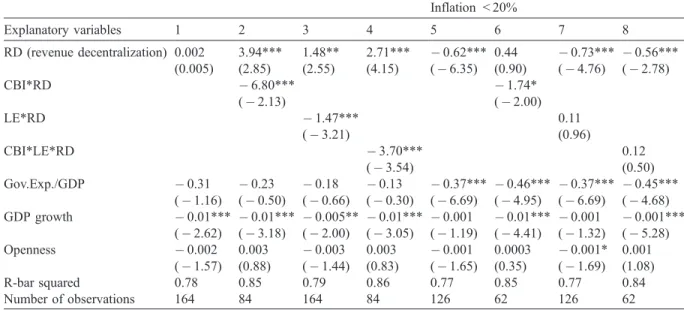
Table 1 summarizes the results of the estimation of inflation (D) using the fixed effects method. Column 1 reports the results of the estimation using RD as the explanatory variable as well as the government size (Gov.Exp./GDP), GDP growth and openness. In columns 2 to 4, in addition to these variables, we include the interaction terms of RD with CBI and LE, both individually and combined8, in that order.9 In these regressions, we test the hypothesis that RD is especially effective in reducing Table 1
Dependent variable: inflation (D)
Inflation < 20% Explanatory variables 1 2 3 4 5 6 7 8 RD (revenue decentralization) 0.002 3.94*** 1.48** 2.71*** 0.62*** 0.44 0.73*** 0.56*** (0.005) (2.85) (2.55) (4.15) ( 6.35) (0.90) ( 4.76) ( 2.78) CBI*RD 6.80*** 1.74* ( 2.13) ( 2.00) LE*RD 1.47*** 0.11 ( 3.21) (0.96) CBI*LE*RD 3.70*** 0.12 ( 3.54) (0.50) Gov.Exp./GDP 0.31 0.23 0.18 0.13 0.37*** 0.46*** 0.37*** 0.45*** ( 1.16) ( 0.50) ( 0.66) ( 0.30) ( 6.69) ( 4.95) ( 6.69) ( 4.68) GDP growth 0.01*** 0.01*** 0.005** 0.01*** 0.001 0.01*** 0.001 0.001*** ( 2.62) ( 3.18) ( 2.00) ( 3.05) ( 1.19) ( 4.41) ( 1.32) ( 5.28) Openness 0.002 0.003 0.003 0.003 0.001 0.0003 0.001* 0.001 ( 1.57) (0.88) ( 1.44) (0.83) ( 1.65) (0.35) ( 1.69) (1.08) R-bar squared 0.78 0.85 0.79 0.86 0.77 0.85 0.77 0.84 Number of observations 164 84 164 84 126 62 126 62
Figures in parentheses are the t-ratios; D=[inflation rate/(1 + inflation rate)]; RD = Ratio of local and state government revenues in total revenues of the government; CBI: Central Bank Independence(Cukierman et al., 1992); LE = 1 if there are Local Elections, 0 otherwise.
*** Reject null at 1% significance level.
** Reject null at 5% significance level but not 1%. * Reject null at 10% significance level but not 5% and 1%.
7
Local elections dummy is constructed from the database ofBeck et al. (2001), and takes the value of 1 if there are either municipal or state and provincial level of government elections and 0 otherwise.
8
As these interaction terms are highly correlated with each other, to avoid multicollinearity, we do not use CBI*RD and LE*RD and CBI*LE*RD simultaneously in the regressions.
9
Sample size is about halved in regressions that include the CBI index due to the limited number of countries for which this index is available. The results for columns 1 and 3 are nevertheless virtually the same as reported inTable 1when we use the sample of 84 observations used in columns 2 and 4.
inflation in cases of higher degrees of central bank independence and the presence of local accountability. The last four columns (5 to 8) of Table 1 repeat the same set of regressions only for countries that have low inflation (less than 20% per year).
In the regressions reported in columns 2 to 4 (whole sample), neither openness nor the size of the government appears to affect inflation, while growth of GDP, as a proxy for business cycles, has negative and significant effect on inflation. Moreover, the estimation results suggest that RD is inflationary. However, unlike the findings of KM, central bank independence, as well as the existence of local elections significantly reduce this effect.10 We also observe that, in low inflation countries (columns 5 to 8), RD is negatively related with inflation (significant at 1% level). In addition, CBI has an accentuating effect on this relationship (column 6), while the effect of local accountability disappears (columns 7 and 8). We further observe that, interestingly, the size of the government (and, though very weakly, openness) has negative effect on inflation in low inflation countries, possibly reflecting the effects of counter-cyclical fiscal policies.
4. Conclusions
The empirical evidence in this paper suggests that revenue decentralization has a negative impact on inflation—when it is accompanied by both central bank independence and local accountability. However, in low inflation countries, it has a negative impact on inflation even without these additional factors, and CBI accentuates this effect.
Acknowledgements
The author is grateful for the useful comments of an anonymous referee.
References
Beck, T., Clarke, G., Groff, A., Keefer, P., Walsh, P., 2001. New tools and new tests in comparative political economy: the database of political institutions. World Bank Economic Review 15 (1) 165 – 176.
Cukierman, A., Webb, S., Neyapti, B., 1992. Measuring the independence of central banks and its effect on policy outcomes. The World Bank Economic Review 6, 353 – 398.
De Mello, L., 2000, ‘‘Can Fiscal Decentralization Strengthen Social Capital?’’, IMF Working Paper, WP/00/129. King, D., Ma, Y., 2001. Fiscal decentralization, central bank independence and inflation. Economic Letters 72, 95 – 98. Neyapti, B., 2003, ‘‘Fiscal Decentralization and Deficits: International Evidence’’, manuscript, Bilkent University.
10 Neyapti (2003) shows that revenue decentralization also becomes effective in reducing both inflation and deficits in case
of large countries with good governance.
B. Neyapti / Economics Letters 82 (2004) 227–230 230