ORIGINAL ARTICLE / ÖZGÜN MAKALE
ANTIMICROBIAL EFFICACIES OF FOUR MULTI-PURPOSE
CONTACT LENS CARE SOLUTIONS
ÇOK AMAÇLI DÖRT KONTAKT LENS BAKIM SOLÜSYONUNUN
ANTİMİKROBİYAL ETKİNLİKLERİ
Mujde ERYILMAZ, Banu KASKATEPE, Merve Eylul KIYMACI, Duygu SIMSEK, Hilal Basak EROL*
Ankara University, Department of Pharmaceutical Microbiology, Faculty of Pharmacy, Ankara, TURKEY
ABSTRACT
Objective: Proper care of contact lens is important for preventing contact lens related infections and for maintaining eye health. Multi-purpose solutions are used for various purposes such as cleaning, rinsing, disinfecting, and storing soft contact lenses.
Material and Method: In our work, the activities of four commercially available multi-purpose contact lens care solutions (MPCLCSs) were investigated. For this purpose, six microorganisms, including five strains of bacteria and one of yeast, were used and four Multi-Purpose Solutions including ReNu® MultiPlus, Opti-Free® Express, All In One Light, BiotrueTM were evaluated. S. epidermidis ATCC 35948 (biofilm forming), S. epidermidis ATCC 12228 (non-biofilm forming), Pseudomonas aeruginosa ATCC 9027, Staphylococcus aureus ATCC 25923, S. aureus ATCC 43300 (methicillin resistant) and Candida albicans ATCC 10231 were used as test microorganisms. The quantitative suspension test was performed and results were evaluated in accordance with EN ISO 14729 Stand-alone test primary criteria. According to the mean log reduction values for 6 h contact time, all the MPCLCSs were found effective against test microorganisms. Result and Discussion: There are various types of commercial MPCLCSs available on the market. The antimicrobial efficacies of these products depend on the type and concentrations of the antimicrobial agents present in their content. In this study, all the MPCLCSs were found effective against test microorganisms at manufacturer's recommended contact time.
Keywords: Antimicrobial agents, biofilm, contact lens solutions, Staphylococcus aureus, Staphylococcus epidermidis
ÖZ
Amaç: Kontakt lens ile ilişkili enfeksiyonların önlenmesi ve göz sağlığının korunması için kontakt lenslerin uygun bakımı çok önemlidir. Çok amaçlı solüsyonlar, yumuşak kontakt lenslerin temizlenmesi, durulanması, dezenfekte edilmesi ve saklanması gibi çeşitli amaçlar için kullanılmaktadır.
Gereç ve Yöntem: Çalışmamızda ticari olarak satılan çok amaçlı dört kontakt lens bakım solüsyonunun (ÇAKLBS) etkinlikleri araştırılmıştır. Bu amaçla, beş bakteri ve bir maya olmak üzere altı mikroorganizma kullanılmış ve dört adet çok amaçlı kontakt lens bakım solüsyonu; ReNu® MultiPlus, Opti-Free® Express, All in One Light, Biotrue ™ değerlendirilmiştir. Test mikroorganizması olarak S. epidermidis ATCC 35948 (biyofilm oluşturan), S. epidermidis ATCC 12228 (biyofilm oluşturmayan), Pseudomonas aeruginosa ATCC 9027, Staphylococcus aureus ATCC 25923, S. aureus ATCC 43300 (metisilin dirençli) ve Candida albicans ATCC 10231 kullanılmıştır. Kantitatif süspansiyon testi yapılmış ve sonuçlar EN ISO 14729 bağımsız test birincil kriterlerine göre değerlendirilmiştir. 6 saatlik temas süresi sonunda ortalama log indirgeme değerlerine göre, tüm ÇAKLBS’ ler test mikroorganizmalarına karşı etkili bulunmuştur.
Sonuç ve Tartışma: Piyasada çeşitli ticari ÇAKLBS tipleri bulunmaktadır. Bu ürünlerin antimikrobiyal etkinlikleri, içeriklerinde bulunan antimikrobiyal maddelerin tipine ve konsantrasyonlarına bağlıdır. Bu çalışmada, tüm ÇAKLBS' ler, üreticinin tavsiye ettiği temas süresinde test mikroorganizmalarına karşı etkili bulunmuştur.
Anahtar Kelimeler: Antimikrobiyal ajanlar, biyofilm, kontakt lens solüsyonları, Staphylococcus aureus, Staphylococcus epidermidis
INTRODUCTION
Contact lenses (CLs) are optical medical devices, which are in direct contact of cornea. They are primarily used to correct refractive errors as myopia (nearsightedness), hyperopia (farsightedness), astigmatism (distorted vision), and presbyopia (need for bifocals). They can be used for both therapeutic and cosmetic purposes. Some of the clinical conditions that occur when contact lenses are used therapeutically are recurrent erosion, metaherpetic ulcers, epithelial defects, and keratitis sicca [1-3]. Thus, CLs can transfer microorganisms to the ocular surface. In addition, commensal microorganisms found on lid margins and conjunctivae, and the potential pathogens transiently present on the ocular surface can contaminate CLs. In case of the reduced tissue resistance, these resident microorganisms or transient pathogens can invade and colonize the cornea or the conjunctiva and cause serious eye infections [4]. CL related infections are often associated with imperfect hygiene practices. Therefore, proper care of CL is very important for preventing infections and for maintaining good health of the eyes. Lens care products should be sufficiently able to minimize the amount of pathogenic microorganisms [4-5]. Multi-purpose solutions are used for various purposes such as cleaning, rinsing, disinfecting, and storing soft CLs. They contain preservative, buffer system and other constituents that provide comfort and safe use of the lenses [6].
In the current study, in vitro antimicrobial efficacies of four commercially available multi-purpose contact lens care solutions (MPCLCSs) were investigated against six microorganisms including five bacteria and one yeast.
MATERIAL AND METHOD
Contact lens care solutions
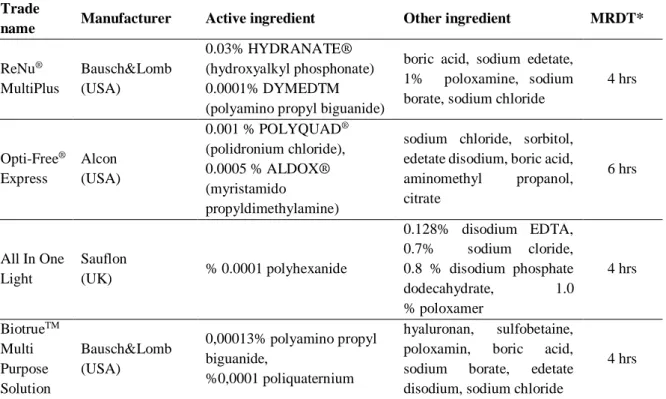
The used MPCLCSs are as listed in Table 1. They were evaluated before their specified expiration date and were included in the original packaging unpackaged. Three separate packages (from different lots) for each product were used.
Table 1. Contents and minimum recommended disinfecting times of the tested MPCLCs Trade
name Manufacturer Active ingredient Other ingredient MRDT*
ReNu® MultiPlus Bausch&Lomb (USA) 0.03% HYDRANATE® (hydroxyalkyl phosphonate) 0.0001% DYMEDTM (polyamino propyl biguanide)
boric acid, sodium edetate, 1% poloxamine, sodium borate, sodium chloride
4 hrs Opti-Free® Express Alcon (USA) 0.001 % POLYQUAD® (polidronium chloride), 0.0005 % ALDOX® (myristamido propyldimethylamine)
sodium chloride, sorbitol, edetate disodium, boric acid, aminomethyl propanol, citrate 6 hrs All In One Light Sauflon (UK) % 0.0001 polyhexanide 0.128% disodium EDTA, 0.7% sodium cloride, 0.8 % disodium phosphate dodecahydrate, 1.0 % poloxamer 4 hrs BiotrueTM Multi Purpose Solution Bausch&Lomb (USA) 0,00013% polyamino propyl biguanide, %0,0001 poliquaternium hyaluronan, sulfobetaine, poloxamin, boric acid, sodium borate, edetate disodium, sodium chloride
4 hrs
*MRDT: Minimum recommended disinfecting time
Microorganisms
Pseudomonas aeruginosa ATCC 9027, Staphylococcus aureus ATCC 25923, S. aureus ATCC 43300 (methicillin resistant strain), Staphylococcus epidermidis ATCC 35948 (biofilm forming strain), S. epidermidis ATCC 12228 (non-biofilm forming strain) and Candida albicans ATCC 10231 were used as test microorganisms. Except P. aeruginosa and C. albicans, all microorganisms are non-standard panel of organisms for EN ISO 14729 Stand-alone test. The bacteria were cultured on Tryptic Soy Agar (TSA) (Difco, USA) and the yeast was cultured on Saboraud Dextrose Agar (Difco, USA) at 35 °C for 24 h.
tested to determine whether it is appropriate to inactivate the active ingredients of the MPCLCSs. Initially, 100 μL of sterile distilled water was added to 900 μL of the MPCLCs, mixed and left for 1 min. Subsequently, 10 μL of this mixture was added to 990 μL of DENB. The undiluted test suspension of Escherichia coli ATCC 25922 (10 μL) was added to the mixture (neat), vortexed for 20 s and serially diluted to 10–5 in Ringer's solution. The neat solution (100 μL) and subsequent dilutions were spread onto TSA in duplicate, using sterile spreaders. The plates were incubated at 37°C for 24 h and colony-forming units (cfu) were determined. The undiluted test suspension was considered as the initial count. In the case of control, the test was repeated using sterile water instead of the contact lens solution. The neutralizer was considered suitable, as there was no difference in the colony size, growth rate or the number of cfu obtained for the tests and controls.
Quantitative Suspension Test Method
The quantitative suspension test was performed and results were evaluated in accordance with EN ISO 14729 Stand-alone test primary criteria (2001) [8,9]. From broth culture (adjusted to 1-2x10⁶cfu/mL), 0.1 mL was added to 9.9 mL MPCLCS and incubated at 25°C for 6 h. At the end of the
contact time, 0.1 mL of the incubated MPCLCs was transferred into 9.9 mL suitable neutralizing system (DENB) and serially diluted to 10–1 to 10–3. Of each dilution, 100 μL was placed onto TSA plates in duplicate by the spread-plate technique and incubated at 37°C for 24 h. Then surviving colonies were counted and expressed as cfu/mL. The reduction rate was calculated as the expression of the disinfectant efficacy, according to the following formula:
log10 reduction = log10 pre-disinfection count – log10 disinfection count
Log10 reductions of ≥3 were taken as an indication of satisfactory bactericidal activity, and ≥1
were taken as an indication of satisfactory fungicidal activity in accordance to EN ISO 14729 guidelines. All experiments were performed in triplicate.
RESULT AND DISCUSSION
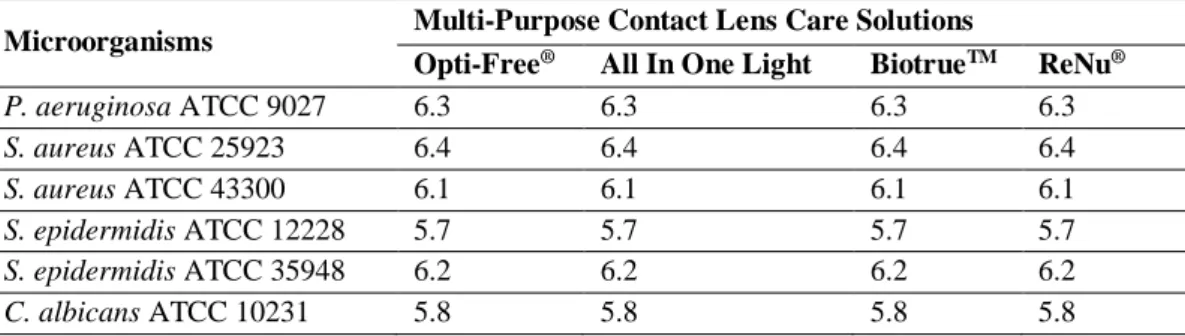
The mean log reduction values of MPCLCSs for 6 h are reported in Table 2. All the MPCLCSs were found effective against test microorganisms at manufacturer's recommended contact time.
Table 2. Mean log reduction values of MPCLCSs
Microorganisms Multi-Purpose Contact Lens Care Solutions
Opti-Free® All In One Light BiotrueTM ReNu®
P. aeruginosa ATCC 9027 6.3 6.3 6.3 6.3 S. aureus ATCC 25923 6.4 6.4 6.4 6.4 S. aureus ATCC 43300 6.1 6.1 6.1 6.1 S. epidermidis ATCC 12228 5.7 5.7 5.7 5.7 S. epidermidis ATCC 35948 6.2 6.2 6.2 6.2 C. albicans ATCC 10231 5.8 5.8 5.8 5.8
Accumulation of protein and other debris on CLs provide the proper conditions for growth and survival of microorganisms. Microbial contamination of CLs is associated with corneal infections that may lead to serious health problems like corneal ulcers and blindness. Inadequate hygiene practices and inappropriate use of CL care solutions are the most important factors that may lead to such unfavorable outcomes. Therefore, choosing a proper solution is very important for preventing CL related infections. MPCLCSs are used for cleaning, rinsing, disinfecting, and also for storing CLs. They contain preservatives, buffer systems and other ingredients that provide comfort usage and cleaning of lenses [4, 10-12].
The most common bacteria that cause CL related microbial keratitis are P. aeruginosa and S. aureus [13-14]. The virulence factor and ability of P. aeruginosa to survive on CLs, storage cases, and in ocular environment are the major contributors to its pathogenicity. It can adhere and colonize and then form biofilms on CLs and storage cases [15]. S. epidermidis is a member of normal human flora, which is considered as harmless skin commensal. According to the literature reports, it is increasingly being reported as an important cause of infections. A major factor that attributes to S. epidermidis pathogenicity in device-associated infections is biofilm formation that protects bacteria from the adverse environmental conditions. Bacteria within biofilms are more resistant to antimicrobials [16-17]. In a published report, the adherence of biofilm-forming and non-biofilm-forming S. epidermidis strains on different soft contact lenses was compared. Slime-negative strain of S. epidermidis was found to adhere to all contact lenses at a lower level than the slime-positive strains [18]. P. aeruginosa, S. aureus, Klebsiella pneumonia, Moraxella catarrhalis, S. epidermidis are the bacteria that are frequently related to biofilm associated eye infections [10].
MPCLCSs are used for one-step cleaning and disinfection of contact lenses. Active ingredients of these solutions should be non-toxic to ocular tissues. In contact lens care solutions, disinfecting compounds, such as biguanides, quaternary ammonium compounds, hydrogen peroxide, alcohol, sorbic acid and thimerosal, are frequently used [19]. Polyhexamethylene biguanide (PHMB) is a complex of cationic polymeric biguanides, which can bind to bacterial cell membrane and cause damage by lysis.
genome [19-20]. Polyquaternium–1 (PQ–1) is a quaternary ammonium compound (QAC), which is more effective against bacteria than fungi. PQ–1 damages the cell membrane leading to the leakage of cytoplasmic contents. Myristamidopropyl dimethylamine (MAPD) and other compounds are used to improve the antifungal activity of PQ–1 [19]. Hydrogen peroxide is a potent and effective microbicidal compound. It is a strong oxidizing agent and can easily damage cellular macromolecules, including proteins, lipids and nucleic acids by releasing oxygen radicals [19-21].
Manuj et al reported that Opti-Free® Express is effective against P. aeruginosa ATCC 27853 and
S. aureus ATCC 29213 for 72 h [22]. In another study, Opti-Free® Express was found to be most
effective solution against P. aeruginosa, which was obtained from organic soil [23]. Mohammadinia et al indicated that ReNu® MultiPlus did not achieve ISO stand-alone criteria for P. aeruginosa clinical
isolates [10]. In our study, four MPCLCSs were found effective Polyquad is a quaternary ammonium based antimicrobial agent and polyhexamethylene is a biguanide based antimicrobial agent[24]. In previous studies, polyquad-based contact lens care solutions such as Opti-Free® Express and BiotrueTM
Multi-Purpose Solution were found to be more effective than polyhexanide-based contact lens care solutions [4, 11]. Szczotka-Flynn et al reported that polyquaternium containing solutions are more effective against contact lens associated biofilms compared with the biguanide containing solutions [11]. In our study all the solutions met EN ISO 14729 Stand-alone test primary acceptance criteria.
In conclusion, there are various types of commercial CL care solutions available on the market. Their efficacies depend on the presence of ingredients and their concentrations, especially those of the antimicrobial agents. In this study, we found all the MPCLCSs effective against test microorganisms at manufacturer's recommended contact time. The contact lens wearers should comply with the manufacturer’s instructions for the proper and safe use of contact lens care solutions.
REFERENCES
1. Jones, L., Dumbleton, K. (2009). Contact lenses. Optometry: Science, Techniques and Clinical Management. Elsevier Health Sciences.
2. McDermott, M.L., Chandler, J.W. (1989). Therapeutic uses of contact lenses. Survey of Ophthalmology. 33(5), 381-394.
3. Inal, O., Yüksel, A. (1998). Kontakt lensler ve lens çözeltileri. Ankara Üniversitesi Eczacılık Fakültesi Dergisi, 27(1), 31-49.
4. Hildebrandt, C., Wagner, D., Kohlmann, T., Kramer, A. (2012). In-vitro analysis of the microbicidal activity of 6 contact lens care solutions. BMC Infectious Diseases, 12, 241.
5. Willcox, M.D., Holden, B.A. (2001). Contact lens related corneal infections. Bioscience Reports, 21(4), 445-61.
6. Demirbilek, M., Evren, E. (2014). Efficacy of multipurpose contact lens solutions against ESBL-positive Escherichia coli, MRSA and Candida albicans clinical isolates. Eye & Contact Lens, 40(3), 157-160.
7. Griffiths, P.A., Babb, J.R., Bradley, C.R., Fraise, A.P. (1997). Glutaraldehyde-resistant Mycobacterium chelonae from endoscope washer disinfectors. Journal of Applied Microbiology. 82, 519-526.
8. EN ISO 14729: Ophthalmic optics – Contact lens care products – Microbiological requirements and test methods for products and regimens for hygienic management of contact lenses, 2001. 9. Ekizoglu, M.T., Ozalp, M., Sultan, N., Gür, D. (2003). An investigation of the bactericidal effect
of certain antiseptics and disinfectants on some hospital isolates of Gram-negative bacteria. Infection Control Hospital Epidemiology. 24, 225-227.
10. Mohammadinia, M., Rahmani, S., Eslami, G., Ghassemi-Broumand, M., Aghazadh Amiri, M., Aghaie, G., Tabatabaee, S.M., Taheri, S., Behgozin, A. (2012). Contact lens disinfecting solutions antibacterial efficacy: comparison between clinical isolates and the standard ISO ATCC strains of Pseudomonas aeruginosa and Staphylococcus aureus. Eye. 26(2), 327-330.
11. Szczotka-Flynn, L.B., Bajaksouzian, S., Jacobs, M.R. (2009). Risk factor for contact lens bacterial contamination during continuous wear. Optometry and Vision Science. 86(11), 1216-1226. 12. Kilvington, S., Powell, C.H., Lam, A., Lonnen, J. (2011). Antimicrobial efficacy of multi-purpose
contact lens disinfectant solutions following evaporation. Contact Lens & Anterior Eye, 34, 183-187.
13. American Academy of Ophthalmology Cornea/External Disease Panel. Preferred Practice Pattern® Guidelines. (2013). Bacterial Keratitis. San Francisco, CA: American Academy of Ophthalmology. 14. Aldebasi, Y.H., Aly, S.M., Ahmad, M.I., Khan, A.A. (2013). Incidence and risk factors of bacteria
causing infectious keratitis. Saudi Medical Journal, 34(11), 1156-1160.
15. Stapleton, F., Carnt, N. (2012). Contact lens-related microbial keratitis: how have epidemiology and genetics helped us with pathogenesis and prophylaxis. Eye (London), 26(2), 185–193.
16. Rasheed, M., Awole, M. (2006). Staphylococcus epidermidis: A commensal emerging as a pathogen with increasing clinical significance especially in nosocomial infections. The Internet Journal of Microbiology, 3(2).
17. Fazly Bazzaz, B.S., Jalalzadeh, M., Sanati, M., Zarei-Ghanavati, S., Khameneh, B. (2014). Biofilm formation by Staphylococcus epidermidis on foldable and rigid intraocular lenses. Jundishapur Journal of Microbiology, 7(5), e10020.
18. Garcia-Saenz, M.C., Arias-Puente, A., Fresnadillo-Martinez, M.J., Paredes-Garcia, B. (2002). Adherence of Two Strains of Staphylococcus epidermidis to Contact Lenses. Cornea, 21(5),
511-19. Fraise, A.P., Maillard, J.Y., Sattar, S. (2013). Russell, Hugo and Ayliffe's Principles and Practice of Disinfection, Preservation and Sterilization, 5th Edition, Wiley-Blackwell.
20. Ashraf, S., Akhtar, N., Ghauri, M.A., Rajoka, M.I., Khalid, Z.M., Hussain, I. (2012). Polyhexamethylene biguanide functionalized cationic silver nanoparticles for enhanced antimicrobial activity. Nanoscale Research Letters, 7, 267.
21. McDonnell, G., Russell, A.D. (2001). Antiseptics and Disinfectants: Activity, Action and Resistance. Clinical Microbiology Reviews, 14, 227.
22. Manuj, K., Gunderson, C., Troupe, J., Huber, M.E. (2006). Efficacy of contact lens disinfecting solutions against Staphylococcus aureus and Pseudomonas aeruginosa. Eye & Contact Lens, 32(4), 216-218.
23. Codling, C.E., Maillard, J.Y., Russel, A.D. (2003). Performance of contact lens disinfecting solutions against Pseudomonas aeruginosa in the presence of organic load. Eye Contact Lens, 29(2), 100-102.
24. Santodomingo-Rubido, J., Mori, O., Kawaminami, S. (2006). Cytotoxicity and antimicrobial activity of six multipurpose soft contact lens disinfecting solutions. Ophthalmic & Physiological Optics, 26(5), 476-82.