Coupled Matrix
Pencil
Method for
Frequency Extrapolation
of
Electromagnetic
Solutions
tFerhat Yildmm and Levent Gurel*
DepartmentofElectricalandElectronicsEngineering
BilkentUniversity, TR-06800,Bilkent, Ankara,Turkey
E-mail:[email protected],[email protected] Abstact
Matrix pencilmethod(MPM) isused toextrapolatethe availableelectromagnetic solutions in frequency domain toestimatethehigh-frequencysolutions. Anewapproach, namely, coupled MPM,
isintroducedtoobtaintheelectromagnetic solutions atintermediatefrequencies using theavailable low-frequency andhigh-frequencydata.
I. INTRODUCTION
Accuratesolversof computational electromagneticsbecomeprohibitivelyexpensiveasthefrequency increases.High-frequency prediction techniques,which are notcomputationally expensiveatany fre-quency,become inaccurate as thefrequencydecreases. Thepurposeof thispaper is tobridgethegap atintermediate frequencies byperformingfrequency extrapolation.
Frequency-domain solutionsof electromagneticproblems, when discretized by the methodof mo-ments(MoM)or asimilarscheme,requiremorecomputationalresources asthefrequencyincreases. Fastsolvers, suchas thefastmultipolemethod(FMM) andthemulti-levelfastmultipole algorithm (MLFMA), also have frequency limits, albeit higher, even when theyare implemented in parallel computingenvironments. Inthispaper, we usephysical optics (PO)toobtainthesolutionsof elec-tromagnetic problemsathigherfrequencies, however,the accuraciesofthePOsolutionsdegrade for relatively lower frequencies.
Inthiswork,wepropose usingextrapolation toestimate the solution signal fortheintermediate frequencybandusingtheinformationinlow-frequencyandhigh-frequencybands. We construct the ex-trapolationproblembased on themodel-basedparameterestimation [1]-[2].Wechooseusing weighted sumofcomplexexponentialstomodel the solutionsignal,
M
y
[k]
=Rizk
k=O,** N-1, (1)i=l where
z1k
=eiFk.
(2)There are twopopular approaches forthe solutionof the parameters in (1), namely,thepolynomial method and thematrix pencil method [3]. Inthiswork,due toits noisetolerance and computational efficiency,weusethematrixpencil method (MPM)todeterminetheparametersof(1).
iI. MATRIX PENCIL METHOD(MPM)
In(1), the residuals
{RT}
and thecomplex exponentials{zi}
areunknowns tobe determined by the N known values of the solutionsignaly.Number ofexponentialsused in themodel, M, is a parameter ofchoice,whichhas a direct influence on the accuracyofthe constructed model. The method uses a mathematicaltoolcalledmatrixpencil,[Y21
-A[YI],
(3)
tThis workwassupportedby theTurkishAcademy of Sciences intheframework of the YoungScientist AwardProgram (LGITUBA-GEBIP/2002-1-12),by the Scientific and Technical Research Council ofTurkey (TUBITAK) under Research Grant
103E008,andbycontracts from ASELSAN and SSM.
0-7803-8883-6/05/$20.00 ©2005
IEEEwhere A is a scalarparameter.When[Y1]and[Y2]arechosenas
y[0]
y[1]
y[L-1]
1
YI]
= | ]y[2]
p[LI
(4)y[N-L-1]
y[N-L]
... y[N-2](N-L)xL
y
I[]
y[2]
* y[L]
[Y2]
L
y[21]
yf3]
*..
y[L+
1]
(y[N-L] y[N-L+1] ...
y[N-11
(N-L)xL
thegeneralized eigenvaluesofmatrixpencil(3) will be equaltothe unknowncomplex exponentials
of(1) [4]. Once wechooseM and determinethecomplex exponentials,we caneasilydetermine the residualsfrom
y[]
[
1
1 1 1 Ry
I']
= Zl Z2 ... ZM R2 (6y
[N-1]
ZN
1 ZN-1 .R..ZN-1
RMwhichfollowsfrom (1).
III. COUPLEDMATRIXPENCILMETHOD(COMPM)
Forelectromagnetic modelling problems, thefrequency-domain solution signal y(f) can be ob-tainedfrom twodifferentsources,i.e.,low-frequencydata from accurateelectromagnetic solversand high-frequency datafromhigh-frequency prediction techniques, such as thePOmethod. In order to incorporate all availableinformationinto themodel,a new modelling scheme,namely,thecoupled matrixpencilmethod(COMPM),isdeveloped.
COMPM, with its foundationsoverMPMtakes all the availablescatteringsolution data and constructs asinglemodel. If N is the indexofthehighestfrequencysolvedbythehigh-frequency solverand the scatteringsolutionsignal isy,theavailabledata can be written as,
YL
[k]
=y[0: N1], (7)YH
[k]
=Y[N2: N-1], (8)where YL is the available low-frequencydataandYHistheavailablehigh-frequencydata. Eqs. (7)-(8) aretreatedasseparatesignalsand MPMisused tofindtheircomplex exponentialsets.These two sets of exponentials carry the signatures of thecorresponding availabledata, which are indeed assumed to be theapproximate signature ofthe whole data.Therefore,the two setsofcomplex exponentialsare combinedintoasingleset.This combination ofcomplex exponentialsrequiresthecalculationof the residuals as
[YL
][ZL
ZH ]R,
(9)where
[ZLi
and[ZH] are thecorrespondinglow- andhigh-frequency exponentialmatricesdefinedin (6).Afterconstructing (1) withthecoupledresiduals andcomplex exponentials,wecanevaluate the signalmodel forkvalues between(N1+ 1:N2-1) toperform extrapolation.InCOMPM,there are two Mparameters,i.e.,onefor thelow-frequency signalandanotherfor the high-frequency signal.Wedeterminethe optimal choiceofthe M parameters by scanning all possible combinations of M values for bothlow-frequencyandhigh-frequencycases.
IV. NUMERICAL RESULTS
Inorder to demonstrate theeffectiveness of theproposed method, we will first consider the problem ofscattering from a conducting sphereunder plane-waveillumination, which also hasan analytical
solution. Hence theproposed methodcanbeappraisedby comparing theextrapolationresult with the analyticalsolution. As a second example,wewillconsider the scattering fromaconducting patch.In this case, there is noanalytical solution; therefore all of the available information is obtained from numerical solvers.
A. BackscatteringfromaConducting Sphere
For this example, thebackscattering signal ofaconducting sphere with a radius of 30cmin the 1-64GHz frequency range is analytically obtained. 1-5 GHz portion of this data is consideredas the available low-frequencyinformation. It is reasonable to assume that the low-frequency solution is notavailablebeyond 5GHz since the numerical solution of this scattering problemat5GHzwould
requireabout 100,000 unknowns. Even though we can solve larger problems with the MLFMA, a
100,000-unknownproblem is commonly considered tobe large by contemporary standards. Witha frequency-sampling interval of 40MHz,there are 101 samples of backscatteringdata available in the low-frequency region.
Initially, 1-5 GHz data is used toperform the MPM extrapolation in aneffort to estimate the data in the5-64 GHz region.Fig.
1(a)
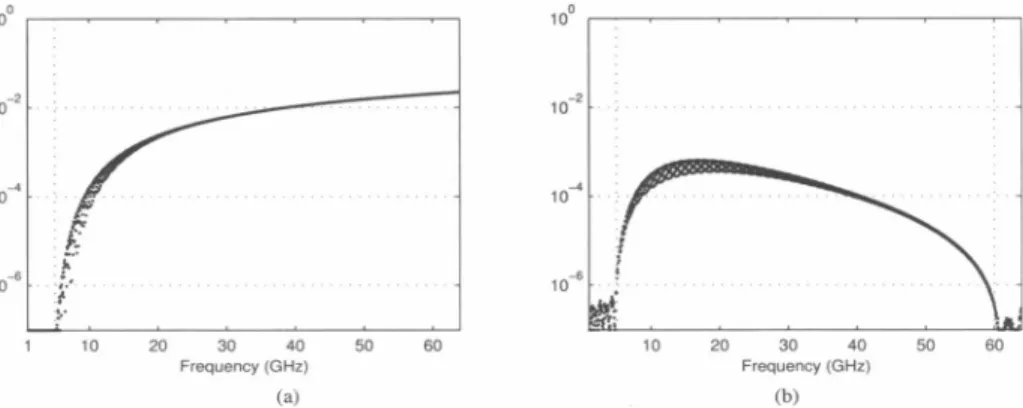
shows the performanceof the MPM extrapolation in terms of the errorbetween theextrapolated signal and theanalyticalsolution. It can be seen that the magnitude of the error grows with theincreasingfrequency.Note that theerroris below10-7
(differencein the7thdigitorsmaller) in theinterpolation region.
Next,both the low-frequency data in the 1-5 GHz band and the high-frequency data in the 60-64 GHz bandareassumedavailable, andaCOMPM extrapolation is performedtoestimate thedata in the intermediate5-60GHzregion. By using bothlow-frequency and high-frequencydata, coupled residuals andcomplex exponentialsaredetermined.Fig.I(b) shows theextrapolationerrorof COMPM. ComparingFig.
1(b)
toFig.1(a),
COMPM extrapolation is clearlysuperior to MPM extrapolation. Coupling the residuals and the complex exponentials increases the error performance of the extrapolation in the extrapolation region. Theslight increase oferrorin the interpolation region is acceptablesince the dataisalreadyknownin that region. Fig.1(b)
exhibits a maximumerrorbelow10',
i.e.,0.1%,overabroadfrequency band of5-60GHz.
1o
-s
lI4L
1 0-1 10 20 30 40 50 60 10 20 30 40 50 60 Frequency (GHz) Frequency(GHZ) (a) (b)Fig.1 (a)Error of the MPM extrapolation of the backscatteringsolubonof the conducting sphere.(b) Error of the COMPM
extrapolation,which incorporates the high-frequency solution of the conducting spherein themodel.
154
B. Backscatteringfrom a Conducting Patch
Theproblemofscatteringfromaconductingsquarepatchwithedgesof 60cmresidingonthe x-y planeis considered. The patch isilluminated withaplane-wave propagatingin the -z direction and thebackscattering solutionis sought. Since theanalyticalsolution of the patchproblemisnotavailable,
thebackscattering data is computed withan MLFMA solverin the 1-22 GHz range and withaPO solverin the 1-35 GHz range. 1-8 GHz portion of the MLFMA data is considered asthe available low-frequency information. We pretend as if the data in the 8-22 GHz range is not available and instead savethis portion of data as reference data to be used forcomparisons with the extrapolation results.
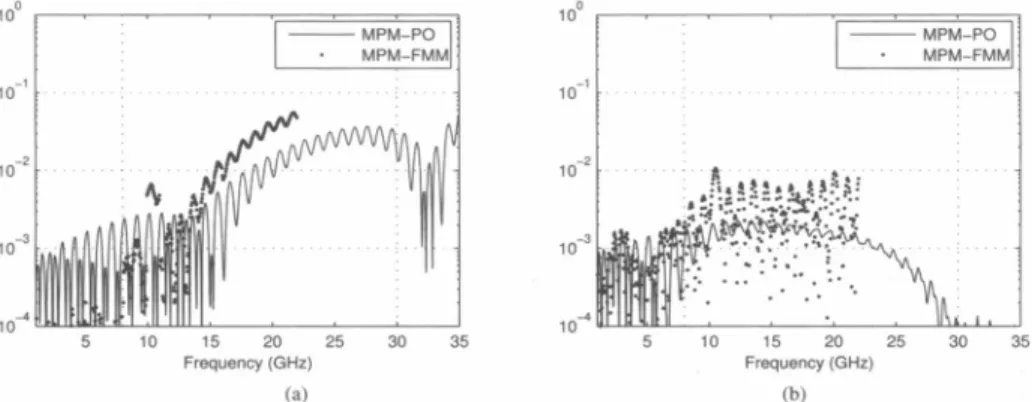
Fig. 2(a) shows the MPM extrapolation error, which is defined as the difference between the extrapo-lated signal and the reference MLFMA data. Fig. 2(b) presents the COMPM eror, where the 30-35 GHz
high-frequencyPO data is also incorporatedin the model. The errorinFig. 2(b) is below 102 for almost allfrequencies.Inthisexample,the datain the broad 8-30 GHz band issatisfactorilyestimated with theCOMPM by using only 7 GHz of computationally expensive low-frequency data and 5 GHz of computationallyinexpensive high-frequencydata.
10° 10o
.I.M.P. MPM-PO MPM-PO
i * ~MPM-FMMi MPM-FMM 10 10 10
-43
10-3t
10 10 5 10 15 20 25 30 35 5 10 15 20 25 30 3T Frequency(GHz) Frequency (GHz) (a) (b)Fig. 2. (a) Error of the MPMextrapolationof thebackscatteringsolution of theconductingpatch. (b)Errorof the COMPM
extrapolation.
When compared to the analytical case, extrapolation of computational data manifests higher error levels. In theanalytical case, bothlow-frequencyandhigh-frequency information are obtained from the sameanalytical expression; however,in the computational case, those two solutions are obtained from different numerical solvers, under different approximations and assumptions. Furthermore, numerical noise thatarises in the solution is also a cause of increase in the error levels. Nevertheless, COMPM extrapolation results are still accurate for practical applications.
V. CONCLUSION
In this paper, we present a method to extrapolate the solutions of electromagnetic scattering problems at intermediatefrequenciesusing the available low-frequency and high-frequency data. The proposed COMPM extrapolation scheme displays asignificantperformance improvement over the MPM extrap-olation.
REFERENCES
[I] Y.Wang, H. Ling, J. Song, and W. C. Chew, "A frequencyextrapolation algorithmfor FISC" IEEETrans. Antennas
Propagat.,vol. 45, pp. 1891-1893, Dec. 1997.
12] G. 1.Burke,E. K.Miller,S.Chakrabarti,and K.Demarest,"Usingmodel-basedparameter estimationtoincrease the efficiency ofcomputing electromagnetic transfer function" IEEETran.Magn., vol.25,pp.2807-2809,July 1989. [3] TapanK.Sarkarand OdilonPereia, "Usingthe matrixpencilmethodtoestimate the parameters ofa sumofcomplex
exponentials," IEEEAntennas and Propagation Mag., vol. 37, no. 1, pp. 48-55, Feb. 1995.
[4] RavirajS.Adve,T. K.Sarkar,OdilonMaroja,C.Pereira-Filko,and Sadasiva M. Rao, "Extrapolationof time domain responses from three-dimensional conducting objects utilizing the matrixpenciltechnique," IEEETram.Antennas Propagat.,
vol.45, no. 1, pp. 147-156, Jan. 1997.
155