-i T-< î; ί 1.7 . ·1 , J , _ J J ^ w' .J , . ^ ; ■; 'f'j ■ ‘ '';! : ' ’:) И -J J U . V ¿V : > . . : . J .4/-J J · J iJ--· V ^ .. I J ^ ^ J J
-T4
f s r . s
. к З Г
fSSS
A THESIS
SUBMITTED TO THE DEPARTMENT OF INDUSTRIAL ENGINEERING
AND THE INSTITUTE OF ENGINEERING AND SCIENCES OF BILKENT UNIVERSITY
IN PARTIAL FULFILLMENT OF THE REQUIREMENTS FOR THE DEGREE OF
MASTER OF SCIENCE
By
H. Yavuz Karapınar
June, 1995
fiillceat Univertu/ Libnif H- icvui tpi.rc.findcn Lc^i}lcnmi^Ur.r s
1 5^.5 • Ш І9в6
Assoc. Prof. Ihsan Sabuncuoğlu(Principal .Advisor)
I certify that I have read this thesis and that in my opinion it is fully adequate, in scope and in quality, as a thesis for the degree of Master of Science.
' _____ /
Assist. Prof. Selim Aktiirk
I certify that I have read this thesis and that in my opinion it is fully adequate, in scope and in quality, as a thesis for the degree of Master of Science.
Assist. Prof. Selçuk Karabati
Approved for the Institute of Engineering and Sciences:
Prof. Mehmet B a^y
ABSTRACT
AN ANALYSIS OF ORDER REVIEW/RELEASE
PROBLEMS IN A JOB SHOP
H. Yavuz Karapınar
M.S. in Industrial Engineering
Supervisor: Assoc. Prof. Ihsan Sabuncuoglu
June, 1995
Order Review/Release (ORR) activities have mostly been ignored in past job shop research. In the majority of these studies, arriving jobs are immediately released to the shop floor without considering any information about the job and the system status. In practice, however, jobs arriving at the shop are first collected in a pool and then released periodically according to some release criterion. Although practitioners use ORR mechanisms to improve shop floor performance, researchers have found limited supports for the use of these input regulation policies. In this thesis, we reexamine the problem in a capacitated system. Specifically, we compare the performances of the ORR policies in a job shop with finite buffer capacities and material handling considerations. A new ORR mechanism is also proposed and compared with other methods.
BİR ATÖLYE TİPİ ÜRETİM SİSTEMİNDE SİPARİŞ
TARAMA VE ÜRETİME BAŞLATMA PROBLEMLERİNİN
ANALİZİ
H. Yavuz Karapınar
Endüstri Mühendisliği Yüksek Lisans
Tez Yöneticisi: Doç. İhsan Sabuncuoğiu
Haziran, 1995
Atölye tipi üretim sistemlerinin incelenmesi ile ilgili geçmişte yapılan çalışmalarda sipariş taram a ve üretime başlatma safhası göz ardı edilmiştir. Bu çalışmaların çoğunda iş ve sistemin durumu hakkında hiç bir bilgi kul lanılmadan üretime hemen başlanır. Fakat uygulamada sisteme gelen siparişler önce bir havuzda biriktirilir ve bazı üretime başlatma kriterleri kullanılarak üretime başlatma kararları periyodik olarak alınır. Sipariş taram a ve üretime başlatma yöntemleri, uygulayıcıları tarafından üretim sisteminin performansını arttırm ak için kullanıldığı halde, araştırmacılar bu yöntemlerin yararı ile il gili sınırlı sayıda destek bulabilmişlerdir. Bu tezde, kapasiteli bir sistem kul lanılarak problem tekrar incelenmiştir. Daha açık bir ifade ile sipariş taram a ve üretime başlatma yöntemlerinin performansları kuyruk uzunlukları sınırlı ve malzeme taşıma sistemi içeren bir şistem kullanılarak karşılaştırılır. Yeni bir yöntem de önerilerek diğer yöntemler ile karşılaştırılmıştır.
A n a h ta r sö zcü k ler : sipariş tarama/üretim e başlatma, çizelgeleme, benze tim.
I would like to express my gratitude to Assoc. Prof. İhsan Sabuncuoğlu due to his supervision, guidance, understanding and encouragement throughout the development of this thesis. I am also indepted to Assist. Prof. Selim Aktürk and Assist. Prof. Selçuk Karabati for showing keen interest to the subject m atter and accepting to read and review this thesis.
I would like to extend my deepest gratitude and thanks to my parents for their morale support and encouragement.
C ontents
1 Introduction 1
2 L iterature R eview 4
3 E xperim ental Conditions 20
3.1 Release Mechanisms 20
3.2 System Considerations and Simulation Model 24
3.3 Experimental D e s ig n ... 29
4 E xperim ental R esults 34 4.1 Continuous Aggregate Loading 36 4.2 Interval Release 44 4.3 Periodic Aggregate L o a d in g ... 47
4.4 Workcenter Information Based L oading... 51
4.5 Finite and Infinite Loading... 55
5 Proposed O RR M ethod 63
6 Conclusion 78
A Tables 82
List of Tables
2.1 Classification of the lite r a tu r e ... 8
.3.1 Vehicle travel distance between stations in the layout,distance u n i t s ... 25
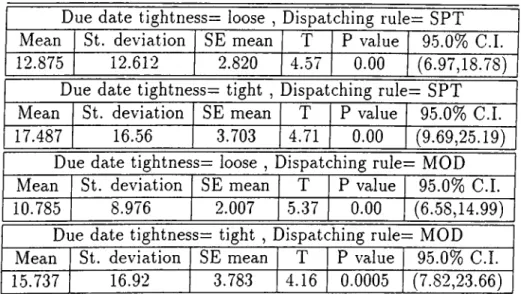
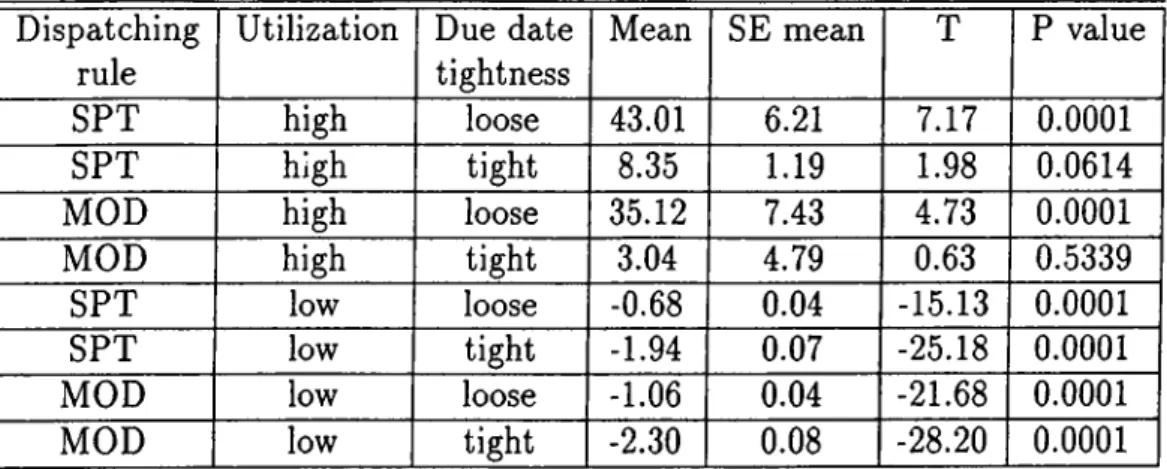
4.1 Paired t-test results for IMR and CAGG. Machine and trans porter utilizations are high. 38
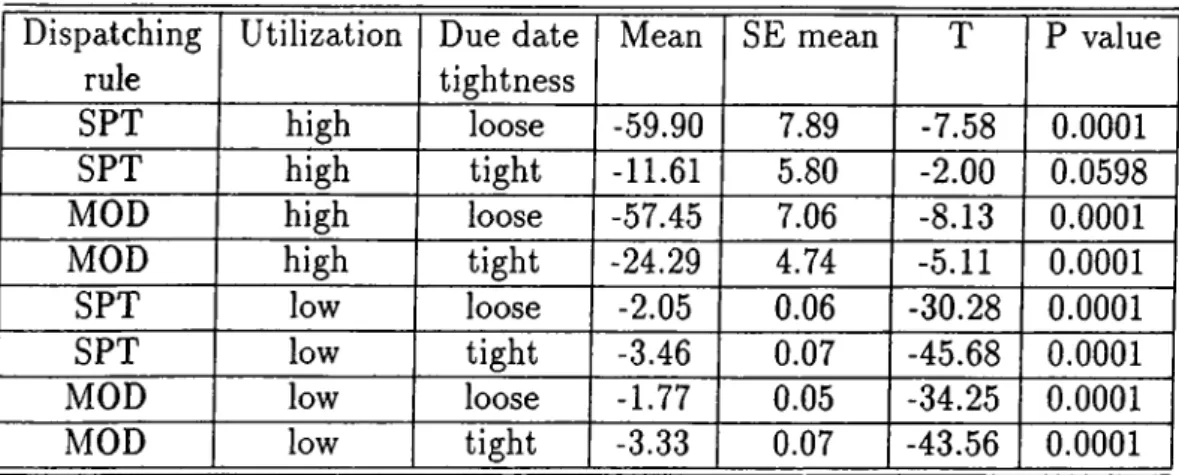
4.2 Paired t-test results for IR and PAGG. Machine and transporter utilizations are high... 48
4.3 Paired t-test results for IMR and Workcenter Information Based Loading. Machine and transporter utilizations are high... 54
4.4 Values of the planning factors used in infinite loading... 56
4.5 Values of the planning factors used in forward finite loading. . . 56
4.6 Analysis of Variance for Mean F lo w tim e ... 58
4.7 Duncan’s Multiple Range Test for Mean Flow tim e... 59
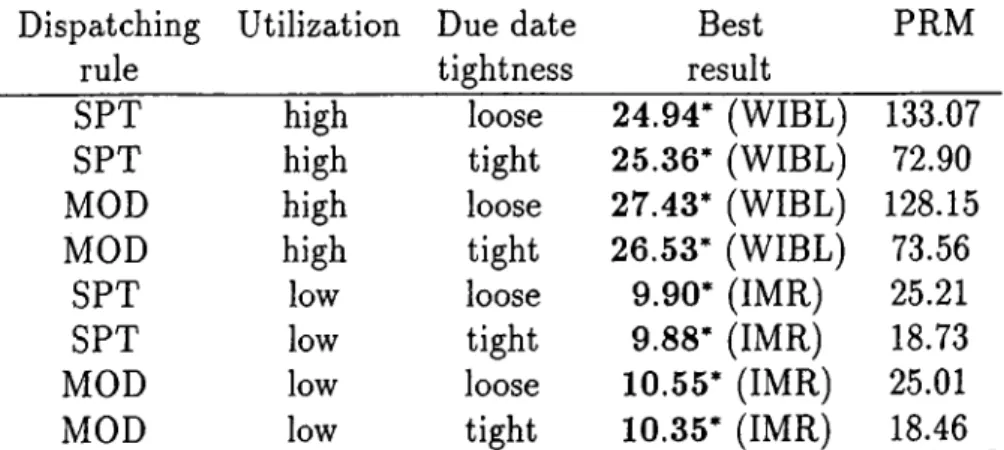
5.1 Comparison of the proposed release mechanism with other rules for mean absolute d e v ia tio n ... 69
5.2 Comparison of the proposed release mechanism with other rules for mean la te n e s s ... 69
5.3 Comparison of the proposed release mechanism with other rules for mean flowtim e... 69
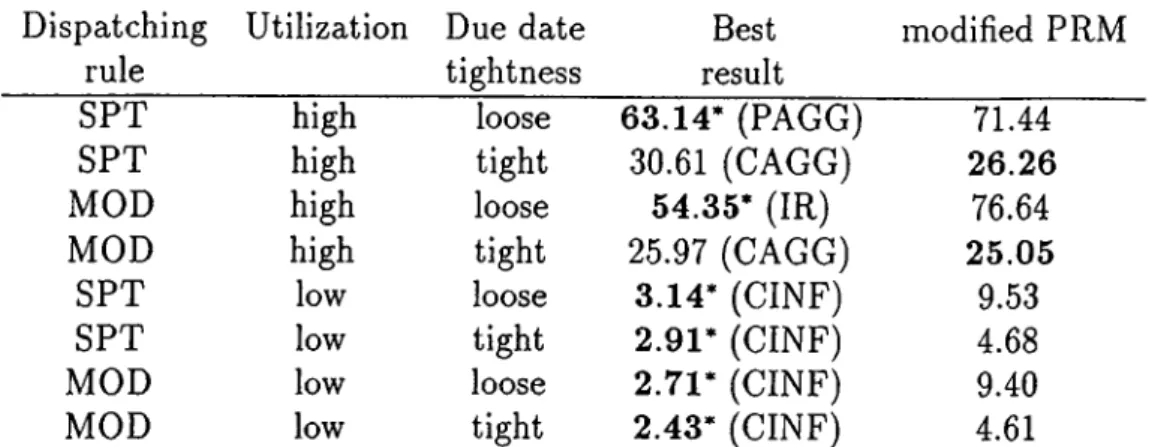
5.4 Comparison of the modified PRM with other rules for mean absolute deviation... 73
5.5 Comparison of the modified PRM with other rules for mean l a t e n e s s ... 73
5.6 Comparison of the modified PRM with other rules for mean flo w tim e... 73
5.7 Paired t-test results of PRM for mean absolute deviation measure 74
5.8 Paired t-test results of PRM for mean lateness m e a su re ... 75
5.9 Paired t-test results of PRM for mean flowtime measure 75
5.10 Paired t-test results of modified PRM for mean absolute devia tion m easure... 75
5.11 Paired t-test results of modified PRM for mean lateness measure 76
5.12 Paired t-test results of modified PRM for mean flowtime measure 76
5.13 Paired t-test results for IMR and modified PRM for mean flow time m e a s u r e ... 76
5.14 Change of mean flowtime by the WIP limit for the modified PRM under high utilization, loose due dates and SPT dispatch ing rule. (Interval length is 2.0 h o u r s . ) ... 76
5.15 Paired t-test result between WIBL and the modified PRM (WIP limit is 6.0 hours and period length is 2.0 hours.) 77
A.l Simulation results of Immediate R e le a s e ... 83
LIST OF TABLES
A.3 Simulation results of Interval R e le a s e ... 85
A.4 Simulation results of Aggregate Loading(cont.) with SPT dis patching rule under high machine,transporter utilization, and loose due dates... 86
A.5 Simulation results of Aggregate Loading(cont.) with SPT dis patching rule under high machine,transporter utilization, and tight due dates... 87
A.6 Simulation results of Aggregate Loading(cont.) with MOD dis patching rule under high machine,transporter utilization, and loose due dates... 88
A.7 Simulation results of Aggregate Loading(cont.) with MOD dis patching rule under high machine,transporter utilization, and tight due dates... 89
A.8 Simulation results of Aggregate Loading(cont.) with SPT dis patching rule under low machine,transporter utilization, and loose due dates... 90
A.9 Simulation results of Aggregate Loading(cont.) with SPT dis patching rule under low machine,transporter utilization, and tight due dates... 91
A.10 Simulation results of Aggregate Loading(cont-) with MOD dis patching rule under low machine,transporter utilization, and loose due dates... 92
A.11 Simulation results of Aggregate Loading(cont.) with MOD dis patching rule under low machine,transporter utilization, and tight due dates... 93
A. 12 Simulation results of Aggregate Loading(cont.) with SPT dis patching rule under high machine,transporter utilization, and loose due dates, for the shop that does not include material handling system and capacitated queues... 94
A. 13 Simulation results of Aggregate Loading(cont.) with SPT dis patching rule under high machine,transporter utilization, and loose due dates for the shop that includes material handling system and uncapacitated queues... 95
A. 14 Simulation results of Aggregate Loading(cont.) with SPT dis patching rule under high machine,transporter utilization, and loose due dates, for the shop that does not include material handling system and includes capacitated queues... 96
A. 15 Simulation results of Aggregate Loading(per.) with SPT dis patching rule under high machine,transporter utilization, and loose due dates... 97
A. 16 Simulation results of Aggregate Loading(per.) with SPT dis patching rule under high machine,transporter utilization, and tight due dates... 98
A. 17 Simulation results of Aggregate Loading(per.) with MOD dis patching rule under high machine,transporter utilization, and loose due dates... 99
A. 18 Simulation results of Aggregate Loading(per.) with MOD dis patching rule under high machine,transporter utilization, and tight due dates...100
A. 19 Simulation results of Aggregate Loading(per.) with SPT dis patching rule under low machine,transporter utilization, and loose due dates... 101
LIST OF TABLES Vll
A.20 Simulation results of Aggregate Loading(per.) with SPT dis patching rule under low machine,transporter utilization, and tight due dates... 102
A.21 Simulation results of Aggregate Loading(per.) with MOD dis patching rule under low machine,transporter utilization, and loose due dates...103
A.22 Simulation results of Aggregate Loading(per.) with MOD dis patching rule under low machine,transporter utilization, and tight due dates... 104
A.23 Simulation results of W^rkcenter Information Based Load- ing(cont.) with SPT dispatching rule under high...ma chine,transporter utilization, and loose due dates 105
A.24 Simulation results of Workcenter Information Based Load- ing(cont.) with SPT dispatching rule under high.. ma chine,transporter utilization, and tight due dates 106
A.25 Simulation results of Workcenter Information Based Load- ing(cont.) with MOD dispatching rule....under...high ma chine,transporter utilization, and loose due dates 107
A.26 Simulation results of Workcenter Information Based Load- ing(cont.) with MOD dispatching rule under high ma chine,transporter utilization, and tight due dates 108
A.27 Simulation results of Workcenter Information Based Load- ing(cont.) with SPT dispatching rule....under.... low ma chine,transporter utilization, and loose due dates 109
A.28 Simulation results of Workcenter Information Based Load- ing(cont.) with SPT dispatching rule....under.... low ma chine,transporter utilization, and tight due dates 110
A.29 Simulation results of Workcenter Information Based Load- ing(cont.) with MOD dispatching rule under low ma chine, transporter utilization, and loose due dates... I l l
A.30 Simulation results of Workcenter Information Based Load- ing(cont.) with MOD dispatching rule under low ma
chine,transporter utilization, and tight due dates... 112
A.31 Simulation results of Infinite L o ad in g (co n t.)...113
A.32 Simulation results of Infinite L oading(per.)... 114
A.33 Simulation results of Forward Finite Loading...115
A.34 Simulation results of the proposed release mechanism with SPT dispatching rule under high machine,transporter utilization, and loose due dates... 116
A.35 Simulation results of the proposed release mechanism with SPT dispatching rule under high machine,transporter utilization, and tight due dates... 117
A.36 Simulation results of the proposed release mechanism with MOD dispatching rule under high machine,transporter utilization, and loose due dates... 118
A.37 Simulation results of the proposed release mechanism with MOD dispatching rule under high machine,transporter utilization, and tight due dates... 119
A.38 Simulation results of the proposed release mechanism with SPT dispatching rule under low machine,transporter utilization, and loose due dates... 120
A.39 Simulation results of the proposed release mechanism with SPT dispatching rule under low machine,transporter utilization, and tight due dates... 121
LIST OF TABLES IX
A.40 Simulation results of the proposed release mechanism with MOD dispatching rule under low machine,transporter utilization, and
loose due dates... 122
A.41 Simulation results of the proposed release mechanism with MOD dispatching rule under low machine,transporter utilization, and tight due dates... 123
A.42 Simulation results of the modified PRM for different interval lengths under SPT dispatching rule and high machine and trans porter utilization... 124
A.43 Simulation results of the modified PRM for different interval lengths under MOD dispatching rule and high machine and transporter utilization...125
A.44 Simulation results of the modified PRM for different interval lengths under SPT dispatching rule and low machine and trans porter utilization... 126
A. 45 Simulation results of the modified PRM for different interval lengths under MOD dispatching rule and low machine and trans porter utilization... 127
B. l Analysis of Variance for Mean T a rd in e s s ...129
B.2 Duncan’s Multiple Range Test for Mean Tardiness... 130
B.3 Analysis of Variance for Mean Absolute D ev iatio n... 131
B.4 Duncan’s Multiple Range Test for Mean Absolute Deviation . . 132
B.5 Analysis of Variance for Average Number of Jobs in the Shop . 133 B.6 Duncan’s Multiple Range Test for Average Number of Jobs in the S h o p ...134
2.1 Relationships of the com ponents... 7 3.1 Layout of the S h o p ... 25 4.1 4.2 4.3 4.4 4.5 4.6
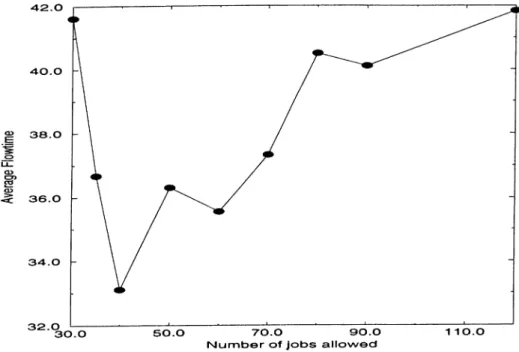
Mean Flowtime versus number of jobs allowed for the three cases (Aggregate Loading (cont.) with SPT dispatching rule under high machine, transporter utilization, and loose due dates.) . . 35
Mean Flowtime versus number of jobs allowed (For Aggregate Loading (cont.) with SPT dispatching rule under high machine, transporter utilization, and loose due d a t e s ) ... 37
Mean Flowtime versus number of jobs allowed (For Aggregate Loading (cont.) with MOD dispatching rule under high machine, transporter utilization, and loose due d a t e s ) ... 37
Components of the flowtime (For Aggregate Loading (cont.) with SPT dispatching rule under high machine, transporter uti lization, and loose due dates) 40
Components of the flowtime (For Aggregate Loading (cont.) with MOD dispatching rule under high machine, transporter utilization, and loose due d a te s ) ... 41
Mean Flowtime versus number of jobs allowed (For Aggregate Loading (cont.) with SPT dispatching rule under low machine, transporter utilization, and loose due d a t e s ) ... 42
LIST OF FIGURES XI
4.7 Mean Flowtime versus number of jobs allowed (For Aggregate Loading (cont.) with MOD dispatching rule under low machine, transporter utilization, and loose due d a t e s ) ... 42
4.8 Mean Tardiness versus number of jobs allowed (For Aggregate Loading (cont.) with SPT dispatching rule under high machine, transporter utilization, and loose due d a t e s ) ... 43
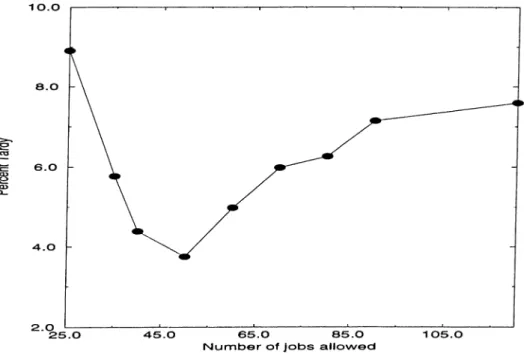
4.9 Percent Tardy versus number of jobs allowed (For Aggregate Loading (cont.) with SPT dispatching rule under high machine, transporter utilization, and loose due d a t e s ) ... 43
4.10 Mean Flowtime versus Interval Length (For Interval Release with SPT dispatching rule under high machine, transporter uti lization, and loose due dates) 45
4.11 Mean Flowtime versus Interval Length (For Interval Release with MOD dispatching rule under high machine, transporter utilization, and loose due d a te s ) ... 45
4.12 Mean Flowtime versus Interval Length (For Interval Release with SPT dispatching rule under low machine, transporter uti lization, and loose due dates) ... 46
4.13 Mean Flowtime versus Interval Length (For Interval Release with MOD dispatching rule under low machine, transporter uti lization, and loose due dates) 46
4.14 Mean Flowtime versus number of jobs allowed (For Aggregate Loading (per.) with SPT dispatching rule under high machine, transporter utilization, and loose due d a t e s ) ... 49
4.15 Mean Flowtime versus number of jobs allowed (For Aggregate Loading (per.) with MOD dispatching rule under high machine, transporter utilization, and loose due d a t e s ) ... 49
4.16 Mean Flowtime versus number of jobs allowed (For Aggregate Loading (per.) with SPT dispatching rule under low machine, transporter utilization, and loose due d a t e s ) ... 50
4.17 Mean Flowtime versus number of jobs allowed (For Aggregate Loading (per.) with MOD dispatching rule under low machine, transporter utilization, and loose due d a t e s ) ... 50
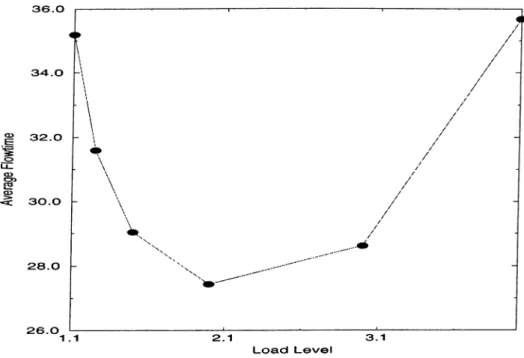
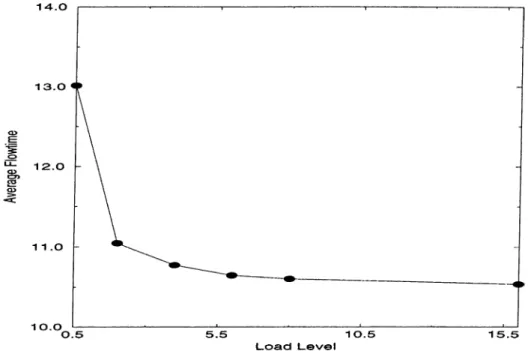
4.18 Mean Flowtime versus load level (For Workcenter Information Based Loading (cont.) with SPT dispatching rule under high machine, transporter utilization, and loose due d a te s ) ... 52
4.19 Mean Flowtime versus load level ( For Workcenter Information Based Loading (cont.) with MOD dispatching rule under high machine, transporter utilization, and loose due d a te s ) ... 52
4.20 Mean Flowtime versus load level (For Workcenter Information Based Loading (cont.) with SPT dispatching rule under low machine, transporter utilization, and loose due d a te s ) ... 53
4.21 Mean Flowtime versus load level ( For Workcenter Information Based Loading (cont.) with MOD dispatching rule under low machine, transporter utilization, and loose due d a te s ) ... 53
5.1 Mean Absolute Deviation versus WIP limit (For PRM with SPT dispatching rule under high machine, transporter utilization, and loose due dates) ... 67
5.2 Mean Absolute Deviation versus WIP limit (For PRM with SPT dispatching rule under low machine, transporter utilization, and loose due d a te s ) ... 68
5.3 Mean Flowtime versus Interval Length (For the modified PRM with SPT dispatching rule under high machine, transporter uti lization, and loose due dates) 71
LIST OF FIGURES xni
5.4 Mean Flowtime versus Interval Length (For the modified PRM with SPT dispatching rule under low machine, transporter uti lization, and loose due dates) 72
5.5 Mean Flowtime versus WIP limit (For the modified PRM with SPT dispatching rule under high machine, transporter utiliza tion, and loose due dates) 77
Introduction
In this thesis, we evaluate Order Review/Release (ORR) mechanisms under dynamic and stochastic environment. A new ORR method is also developed and compared with the existing ones. ORR is a component of the shop floor control system. It is the interface between the planning system and the shop floor. It simply controls the release of orders which have been released by the planning system to the shop floor by means of a backlog pool (Melnyk, Tan, Denzler and Fredendall [22]).
Major aim of ORR, which is a control process for the flow of orders to the shop floor, is achieving on time delivery. It determines the timing of the orders to be released. Melnyk and Ragatz [19] classified the activities of ORR into:
1. order preparation
2. review and evaluation of orders
3. load leveling
First step includes preparation of all information required for the job. In the second step the jobs that should be released are identified. Finally, the shop load is levelled. Third activity levels capacity utilization over time by smoothing out the peaks and valleys of load on workcenters.
ORR activities have mostly been ignored in past job shop research. In majority of these studies, arriving jobs are immediately released to the shop floor without considering any information about the job and the system status. In practice, however, jobs arriving at the shop are first collected in a pool and then released periodically according to some release criterion. These input control policies are used for the aim of reducing work in process (WIP), lead time and controling the congestion on the shop floor. Morton and Pentico [23] counts the following motives for not releasing raw materials to the shop floor until just before they are needed:
1. WIP on the floor incurs inventory charges at a higher rate than raw material.
2. There is limited space on the floor for WIP.
3. Obsolescence, damage and confusion cause high WIP to be expensive.
CHAPTER 1. INTRODUCTION 2
Although there are a number of studies in the literature that investigate the effectiveness of ORR mechanisms, researchers have found limited supports for the use of these input regulation policies. Indeed, the ORR research has the following paradox: Practitioners use ORR systems to improve shop floor performance. However, most of the simulation based studies have indicated that ORR mechanisms do not reduce overall lead times. These studies also showed that the most effective strategy for reducing mean tardiness and pro portion tardy is to release all jobs immediately to the shop floor [22]. That is, potential benefits of ORR mechanisms have not been realized in these studies.
We reexamine this problem in a capacitated system. We use a simulation model of a job shop in which early shipments are prohibited. Our job shop model also includes a material handling system and finite buffer capacities.
This study is the first investigation of ORR mechanisms in a capacitated system. Because we believe that benefits of ORR mechanisms can easily be seen in a capacitated system with the congestion modelled explicitly. A com prehensive evaluation of ORR mechanisms is carried out in the thesis. Eight
different ORR methods (four periodic and four continuous release mechanisms) are tested. A new ORR method is also proposed and compared with other poli cies.
First chapter is a brief introduction for the thesis. The subject is briefly explained. The objective and scope of the research is also outlined.
In Chapter 2, we present a review of the ORR literature. First we propose a classification framework and then summarize the existing studies according to this classification.
In Chapter 3, detailed information about the study is given. First, we explain the I'elease mechanisms tested. Then the properties of our simulation model and experimental conditions are discussed in detail.
In Chapter 4, we present our computational findings. Statistical tests are
also given to justify the conclusions.
In Chapter 5, we explain the proposed release mechanism. The proposed mechanism is also compared with the existing ones.
Finally in Chapter 6, we draw our overall conclusions and present further research directions. Simulation results, analysis of variance (ANOVA) tables and Duncan’s multiple range results are given in the Appendix.
C hapter 2
Literature R eview
In this chapter, we first prepare a classification framework. Then we briefly re view the previous ORR studies in the literature using this classification scheme. At the end of this chapter, we also present our observations from this literature review.
Our classification of order review/release (ORR) mechanisms is based on the observations made by Philipoom, Malhotra and Jensen [29]. In this study, the authors classified the literature into two major areas; Load-limited order release and release mechanisms that are based on calculated release times. In this study, however, we added some more details and propose the following classification scheme:
1. Mechanisms that don’t use any information about the shop status and the jobs to be released:
(a) Immediate Release (IMR): This mechanism releases jobs to the shop as soon as the jobs arrive at the system. Most of the previous job shop research, which ignored ORR function, implicitly used this release mechanism. This release mechanism is also used as a bench mark for comparisons in the literature. Although it is a naive rule, it has shown better performances than other ORR mechanisms in
some situations.
(b) Interval Release (IR): Jobs arriving at the shop are first collected in a pool and then released periodically. This seems to be more realistic mechanism because it reflects the situation where the jobs are kept for paperwork and released in batches at the beginning of day or shift.
2. Load limited order release: Jobs are released to the shop based upon the current workload in the shop. Due dates of the jobs are not considered. The mechanisms in this category can be further classified into:
(a) Aggregate Loading (AGG): Jobs are released according to the cur rent total load in the shop. The mechanism resembles a release valve that allows jobs to raise the existing shop load to a specified shop load level (Bobrowski and Park [5]). Total shop load can be mea sured in terms of total number of jobs in the shop or total amount of work in hours in the shop.
(b) Workcenter Information Based Loading (VVTBL): These mecha nisms require more detailed information than Aggregate Loading. Total workload in the process routing of the jobs is considered for the release decision.
3. Release mechanisms that are based on calculated release times: These rules attem pt to supply on time delivery. Release times are calculated by using expected flowtimes and job due dates. According to this approach the jobs are released to the shop at these release times regardless of the shop conditions. These mechanisms can also be classified into two:
(a) Infinite Loading (INF): The release time of the job is calculated using the following flow time estimation;
Ri = A - F. (2.1)
where, Ri = D, =
Release time of job i, Due date of job i,
CHAPTER 2. LITERATURE REVIEW
As can be noted, the shop capacity is not explicitly considered in this mechanism. However, finite loading explicitly considers the shop capacity.
(b) Finite Loading (FIN): This mechanism uses more detailed informa tion about the jobs and the shop status. Finite loading explicitly considers available shop capacity over time and tries to match the job’s machine requirements with capacity availability [5]. These mechanisms can also be classified into:
i. Forward Finite Loading (FFIN): It loads the operations of the job into available capacity for the appropriate workcenter by starting from the first operation. Release decision is based on the last operation load period and the due date. The job is released if the last operation load period is within a preset time window around the due date.
ii. Backward Finite Loading (BFIN): This mechanism attem pts to fit each operation into available capacity for the appropriate workcenter, by starting with the last operation of the job and working backward from the job’s due date. Release decision is based on the first operation load period and the current time. The job is released if the first operation load period is within a preset time window around the current time.
Vollmann et al. [38] discuss finite loading as an approach to shop- floor control. They grouped the approaches for filling a workcenter capacity into two;
• Vertical Loading: Workcenter capacity is filled job by job. A set of jobs is selected by the time of the loading to load next. • Horizontal Loading: Entire job is loaded for all of its operations,
then next job is considered. This approach is used in our study. 4. Release mechanisms that consider the workload level in the shop and the
level in the shop and and at the same time they supply on time delivery of the jobs.
A list of the existing studies in the literature based on our classification scheme is given in Table 2.1.
In the following paragraphs we will give a brief review of these studies using the terminology defined in the classification framework.
Melnyk and Ragatz [19] [20] identified four major components which influ ence the operation of ORR:
1. The order release pool 2. The shop floor
3. The planning system
4. The information system which links the above three components.
Relationships of the components is shown in Figure 2.1 [20].
The Planning ' ' ' ~ ' Y Order Release ~ The Shop
System Floor
Information Flow
Figure 2.1: Relationships of the components
The pool includes all the orders that were released by the planning system. But these orders have not been released to the shop yet. According to these authors [20], three specifications describe a pool management system. These are:
CHAPTER 2. LITERATURE REVIEW
Table 2.1; Classification of the literature
1. Group One:
• IMR: Melnyk and Ragatz (1989); Panwalkar et al. (1976);
Mahmoodi et al. (1991); Philipoom et al. (1993); Hendry and Wong (1994)
• IR: Panwalkar et al. (1976); Mahmoodi et al. (1991); Mel
nyk et al. (1994); Melnyk et al. (1991); Bobrowski and Park (1989); .Ahmed and Fisher (1992); Ragatz and Mabert (1988); Hansmann (1992)
2. Group Two:
• AGG: Melnyk and Ragatz (1989); Melnyk et al. (1994); Mel
nyk et al. (1991); Bobrowski and Park (1989); Ragatz and Mabert (1988); Hendry and Wong (1994)
• WIBL: Hendry and Kingsman (1991); Hendry and Wong
(1994); Irastorza and Deane (1974); Melnyk and Ra gatz (1989); Philipoom et al. (1993)
3. Group Three:
• INF: Mahmoodi et al. (1991); Philipoom et al. (1993); Bo
browski and Park (1989); Park and Bobrowski (1989); Ahmed and Fisher (1992); Ragatz and Mabert (1988)
• FIN:
- FFIN: Bobrowski (1989); Bobrowski and Park (1989); Park
and Bobrowski (1989); Ahmed and Fisher (1992)
- BFIN: Ragatz and Mabert (1988)
4. Group Four: Hansmann (1992); Wiendahl et al. (1992); Bechte (1988); Bechte (1994); Onur and Fabrycky (1987)
• Timing Convention: 1. Continuous 2. Bucketed (Periodic) • Triggering Mechanism: 1. Shop Based 2. Pool Based • Selection Rule: 1. Local 2. Global
Timing convention determines whether the system works in a continuous or periodic basis. In the continuous case, release decisions are made any time on the time axis. In the bucketed (periodic) case, however, these decisions can only be made at the beginning of each period. Triggering mechanism determines the condition for releasing the jobs to the shop. The authors classified the triggering mechanisms into: pool based and shop based triggering mechanisms. According to the pool based triggering mechanism the release decision for a job is made using the information about that job. In the shop based case, release time is based on the current condition of the shop floor. Selection rule is used to determine the jobs to be released. The selection rules are classified as local or global selection rules. Local selection rules use only the information about the jobs in the pool. But in global rules, information about the shop status is also considered.
The planning system identifies the orders that will be released to the order- release pool. The relationship between the planning system and ORR may offer an additional way to level the shop load (Melnyk and Ragatz [19]).
Melnyk and Ragatz [19] have offered a summary of the ORR literature. Their conclusion is that effective shop floor control can be achieved by con trolling the relea.se and ORR is often more important than dispatching for the
CHAPTER 2. LITERATURE REVIEW 10
users of succesfull shop floor control systems.
Melnyk and Ragatz [20] also conducted a simulation study to show the effects of ORR on the shop floor. Immediate release (IMR), an aggregate loading mechanism (AGGWNQ) and a release mechanism based on workstation loads (WCEDD) were compared. In AGGWNQ, release decision is made when the total uncompleted work in the shop falls to 180 hours. Whereas in WCEDD, release decision is made when the work in the queue at any workstation drops below 10 hours. The results indicated that AGGWNQ and WCEDD reduced both work in process (WIP) levels in the shop and the variability of the shop load. IMR showed better delivery performance than other rules. AGGWNQ and WCEDD yielded small mean flow time in the shop, but a high mean flow time in the system compared to IMR. This high mean flow time value is due to the increase in waiting times of jobs in the pool. In this study, the authors also examined the effects of a planning system which releases a constant amount of job in each period to the pool. The results showed that adding planning system improved delivery performance, but their previous conclusions did not change.
Accepting all the orders is a common assumption in the ORR literature. Philipoom and Fry [28] relaxed this assumption. The authors argued that when the congestion in the shop is high, it may be better to reject an order to allow the customer to seek another supplier, than to accept and deliver it to the customer late. They compared three acception/rejection rules by simulating a hypothetical job shop. The results of simulation experiments indicated that flow times improves as the percentage of work rejected increases. They also pointed out that shop load information should be used for the decision rather than randomly rejecting some percentage of the jobs. Their results showed that using work load information is better than random rejection in terms of mean flowtime and delivery performance. It is also observed in this study that using the information of work load at the work stations along the route of the job, rather than using the total shop load, is more effective.
mechanism. Elvers and Taube’s work [8] is among few studies that are not about ORR and use interval release (IR) for releasing jobs to the shop. In another study, Panwalkar, Smith and Dudek [25] also compared the perfor mance of immediate release with the interval release by simulating a job shop. Interval lengths were set to 16 and 80 hours. They found that more jobs were finished early by immediate release. Larger values of the interval length caused increases in mean and variance of WIP levels. They concluded that it is better to keep the interval length small.
Mahmoodi, Dooley and Starr [18] studied the order release problem in cel lular manufacturing environment. They expected that the use of order release iuechanisms for cellular manufacturing cell may be very effective because load ■ mbalance is a major disadvantage of cellular manufacturing. Immediate re lease, interval release and infinite loading were tested in the study. The authors used the following equation to calculate release times for infinite loading:
Ri = Di - T W K i - k * Qi (2.2)
.vhere,
T W K i = Total operation time (Total Work Content) of job i, Qi = Total number of jobs in queues on job Vs routing,
k = planning factor.
Te results of simulation experiments indicated that IMR and IR performed setter than infinite loading for the mean flowtime and tardiness performances. ÎMR was the best rule except, when the due dates were loose. The infinite load- ng performed best in terms of mean lateness. Both IR and infinite loading mproved the due date performance of non-due-date oriented heuristics com pared to the due date oriented heuristics. Poor performances of the infinite loading are due to holding the jobs in the pool for a long time before releasing.
An evaluation of five releasing mechanisms and four dispatching rules in a job shop environment was made by Ragatz and Mabert [-31]. The authors tested interval release (IR), two infinite loading methods (backward infinite loading (BIL) and modified infinite loading (MIL)), the backward finite loading (BEL) and an aggregate loading mechanism (MNJ). BIL calculates the release times
CHAPTER 2. LITERATURE REVIEW 1 2
using the following equation;
Ri = Di — k * rii
where,
Hi = number of operations of job i, k = planning factor.
And MIL calculates the release time as follows;
R i = D i — k i * H i — ¿ 2 Ç 1
where,
A'1,^2 = planning factors.
(2.3)
(2.4)
MNJ, which releases the jobs to the shop floor periodically, limits the number of jobs in the shop. They evaluated the release mechanisms in terms of their total cost criteria (including delivery and inventory costs) in addition to the traditional performance measures. MIL yielded the best performance in terms of total cost while IR was the worst of all. BIL, MIL, BFL and MNJ outper formed IR in terms of shop lead time, the level of congestion in the shop and mean absolute deviation from the due dates.
Another load oriented release mechanism (PBB) was proposed by I^hilipoom, Malhotra and Jensen [29]. This rule was similar to the one used in [28]. In PBB, the job is released to the shop if the current load at each machine along the job’s path plus the job’s processing time at that machine is below the PBB treshold. In calculations, the current machine load considers the work in its queue and the work contained in the jobs which will visit the machine. Performance of PBB was compared with infinite loading mechanism (MIL) and immediate release (IMR). MIL calculates the release times with the following equation;
Ri = Di - ki * T W K i - k2 * W i
where,
Wi = work content of jobs along job ¿’s route. kx.k'i = planning factors.
The authors tested the rules under tight due dates and high utilization cases. Their simulation results indicated that in terms of the total cost criterion, which includes inventory and delivery costs, MIL was the best ORR policy for the loose and medium due date tightness while PBB was the best under the tight due date conditions. Whereas IMR outperformed other policies for the mean flowtime in most of the experimental conditions.
In general, the previous experimental studies showed that order release mechanisms do not improve the flowtime measure. Kanet [14] attempted to explain this by refering to the load limited order release mechanisms. He showed that limiting the load in the shop has no effect on flowtime for the M /M /1 case. He also explained the increase in the flowtime for the multi machine case by the introduction of extra idle time into the system. Because these mechanisms require all the work, at each machine among the routing, to be less than a preset limit. So, even if a machine is out of work, it stays idle because of this requirement. This causes a decrease at the flowtime in the shop, but an increase at the flowtime in the system.
In most of the studies, the planning system component of ORR was ig nored. Melnyk, Ragatz and Fredendall [21] studied the combined effect of the load smoothing made by the planning system and ORR on the job shop performance. They used IR and an aggregate loading mechanism (MAX) for releasing the jobs. In MAX, jobs are released to the shop floor until the cur rent workload in the shop reaches a predetermined maximum load limit. It was shown that the smoothing of the load and the ORR mechanism have a com plementary effect on the system performance. While the smoothing improves the mean flowtime measure, the release mechanism improves the inventory re lated measures. Combination of smoothing and ORR gives shorter and more consistent lead times, lower and more stable WIP values, and better delivery performances. The authors also showed that the combination of smoothing and ORR improves the performance of simple dispatching rules.
CHAPTER 2. LITERATURE REVIEW 14
[22]. They showed that smoothing the load and the reduction of variance in the processing times reduce the variance of the system. Load smoothing was achieved by keeping the weekly workloads between the 20th and 80th per centiles of the unsmoothed weekly workload distribution. Variance reduction in processing times was achieved by a change in the distribution of processing times. IR and MAX were used as in [21] for order releasing. Controlling the variances improved the effectiveness of ORR. The authors also observed that an increase in flowtime due to the MAX rule can be avoided by the controlling the variance. Also the variance control reduces the need for complex dispatching rules.
Ahmed and Fisher [1] investigated the effects of due date assignment, re lease and dispatching mechanisms interactions in a job shop with a simulation model. Their results showed the existence of a three-way interaction between the due date, release and dispatching mechanisms. Interaction between shop utilization and ORR policies was also found. Four release mechanisms were tested. These were IR, BIL, MIL and FFIN. BIL used Equation 2.3 for release time calculation and MIL was based on the Equation 2.4 for release date calcu lation. In the experiments, IR performed better than others for the flow time criterion, while BIL was best for the mean absolute deviation.
Mixed integer programming approach for the release decision were used by Irastorza and Deane [13], Onur and Fabrycky [24]. In these studies, solu tion modules were interfaced with their simulation models of a dynamic job shop. Irastorza and Deane’s algorithm [13] attempts to balance workloads among workstations. Constraints derived from the workload assignment at each workstation are included. New jobs to be released is selected by the algo rithm at the beginning of each day. Different balance measures were derived in the study. They used a bounded variable model instead of the mixed integer version in the simulation to save computer time. This means that they used a linear programming model. At the controlled shop, significant improvements were achieved in the balance measures. The algorithm also reduced the total work in the shop and the work performed for jobs in the shop values compared to the uncontrolled shop.
Onur and Fabrycky [24] proposed a combined input/output control system (DIOCS). The algorithm determines, periodically (once a week), the jobs to be released and the capacities of the workstations. It attempts to minimize the sum of underutilization, overtime, second shift, end of period workload, work in process and tardiness costs. The constraint which defines the relationship between the workload and the planned capacity is derived for each workstation. The algorithm was compared with an aggregate loading algorithm (FLCS). The results indicated that DIOCS outperformed FLCS in terms of mean tardiness, mean variance of tardiness, mean flowtime, mean variance of flow time, average WIP and total cost. FLCS was only better for the shop utilization measure.
Bobrowski and Park [5] investigated the effects of order release mechanisms on the performance of a dual constrained job shop in which early shipment is forbidden. They simulated a labor and machine limited job shop. Four release mechanisms were compared; interval release (IR), forward finite loading (FFIN), an aggregate loading mechanism (Maximum Shop Load, MSL), and an infinite loading mechanism (BIL). BIL uses Equation 2.5 for calculating the release times of the jobs. MSL releases jobs until all jobs are released or the shop load has reached a preset maximum shop load. Total cost measure, which includes inventory holding, late penalty and worker transfer costs, is used in the study. As in the case of a job shop which is not labor constrained, IR is outperformed by other release rules in terms of total cost criteria. FFIN and BIL yielded the best performance in terms of the total cost. Shop performance was kept constant, independent of due date tightness, by BIL and FFIN release mechanisms. FFIN and BIL were also better in terms of mean lateness. But IR and MSL produced better results for tardiness and proportion tardy measures.
A dual costrained job shop case was studied by Park and Bobrowski [26]. They considered three levels of labor flexibility. The degree of labor flexibility was represented as a combination of labor assignment rules and degree of worker cross-training. The release mechanisms, FFIN and BIL which were used in the study [5], were also included in the study. The results indicated that FFIN and BIL show almost the same performance under all combinations of labor flexibility and due date tightness levels. The authors used total cost criterion
CHAPTER 2. LITERATURE REVIEW 16
that includes inventory holding, late penalty and worker transfer costs.
For a shop environment where machine flexibility is available, an exchange heuristic was proposed by Bobrowski [6]. This heuristic is used after the For ward Finite Loading (FFIN) mechanism in the study. FFIN is a single pass sequential loading process. The exchange heuristic is used to improve the rout ing and loading of jobs prior to release to the shop. The heuristic is based on changing the order of jobs, which will be released, in the loading process. A total cost measure, which includes estimates of work in process and tardiness penalties, is used to evaluate the loading alternatives. Two types of shop flex ibility was included in the study; in the first one, every primary machine was coupled with an alternate machine (ALTMAC) and in the second one, pri mary sequence of machines was replaced by a different sequence (ALTSEQ). The simulation results indicated that the heuristic does only show a significant improvement in the total cost for the ALTSEQ case.
Hendry and Kingsman [10] presented a load-oriented release mechanism that aims to control the shop floor throughput times. It is shown that if the released backlogs (RBLs) of all workstations are maintained between the preset limits, then it is possible to control the flow times in the shop. RBL of a workstation is the number of days to produce the jobs which are currently being processed on the shop floor. The mechanism allows capacity adjustments if necessary. The jobs are ranked in the pool according to their latest release dates. This is the latest date on which a job can be released to meet its promised delivery date. Then, the jobs which maintain the RBLs between their limits are released. When a job is released the RBL of the workstations along the route of the job is increased. It is argued that the releasing mechanism may reduce shop congestion and decrease work in process levels and the cost.
Hendry and Wong [11] coded a simplified version of the releasing rule de veloped by Hendry and Kingsman [10]. This load oriented release mecha nism (JSSWC) was compared by the release mechanisms IMR, AGGWNQ, and WCEDD by a simulation study. AGGWNQ and WCEDD were proposed in [20] by Melnyk and Ragatz. As compared to the AGGWNQ and WCEDD
mechanisms, JSSWC allows capacity adjustments. Four different versions of JSSWC were evaluated in the study. IMR gives the best results in terms of proportion tardy and mean flow time measures. JSSWC outperforms AGG- WNQ and WCEDD in terms of delivery performance and workload measures. But it is slightly worse than WCEDD under the workload balance. Workload balance is determined by the mean of the standard deviations of queue lengths. The study showed that the capacity adjustment improves the mean tardiness measure.
Bechte [3] developed a load oriented manufacturing control mechanism for job shops. The mechanism establishes realistic order due dates and performs midterm capacity planning at the order entry stage. At the order release stage, short-term capacity planning is done. Load oriented order release forms the nucleus of this mechanism. It tries to keep actual lead times on a planned level to supply on time delivery. This periodic release mechanism is formed in two steps:
1. Establish urgent orders.
2. Release workable orders.
Release dates of the jobs in the pool were calculated to identify urgent jobs. This is achieved by scheduling the orders backwards with reliable operation lead times. Jobs which have release dates in a preset time window are called urgent. Urgent jobs are ranked according to their release dates and released as long as the load limits of all workstations involved are not exceeded. The second step of the procedure has to be repeated after the capacity adjustment if the capacities can be changed. They implemented their control system in a plastic leaves factory. The mechanism reduced lead times and inventories. Lead times correspond to the times which the jobs spend in the shop. Lead times were kept on planned levels. Delivery delay was reduced and a high workcenter utilization was guaranteed. In [4], Bechte describes the principles of the load oriented manufacturing control and its implementation in a pump manufacturing company. Satisfactory results were obtained. The total lead
CHAPTER 2. LITERATURE REVIEW 18
time from order entry to delivery was reduced from 14 weeks to 9 weeks.
In another study Wiendahl, Glassner and Peterman [39] described a load oriented manufacturing control system and its industrial applications. The load oriented order release mechanism releases the jobs in the pool to the shop until a certain inventory level at the bottlenecks is reached. Urgent orders are determined according to their calculated release dates. Jobs which have release dates located in a preset time window are called urgent. Two applications of load oriented manufacturing control system were given in the study: BORA-X and KPSF. These systems decreased work in process levels and reduced order lead times.
Hansmann [9] proposed another load oriented order release mechanism. The mechanism first determines the urgent jobs, which have release dates within a previously defined time horizon. Using the database of MRP II, bottleneck machines are identified. Different load limits are determined for bottleneck and non-bottleneck machines by using an optimization procedure. Expected capacity requirements are calculated for each job using a probabilistic state ment. As the last step, the jobs whose expected capacity requirements do not exceed the load limits of the work stations are released in the sequence of their release dates. The mechanism was compared with IR. The results showed that it outperforms IR in terms of their combined objective function and mean flow- time in the shop. The combined objective function is the sum of a multiple of mean flow time in the shop and a multiple of mean tardiness.
From the literature review we can make the following observations:
1. ORR mechanisms reduces WIP levels in the shop and the variability of the shop load.
2. ORR mechanisms improve the due date performance of non-due-date oriented heuristics compared to the due date oriented heuristics.
3. The most effective strategy for reducing mean flowtime, mean tardiness and proportion tardy values is to releaise the jobs immediately.
4. Combination of load smoothing made by the planning system and ORR gives shorter lead times and lower work in process levels.
5. Due date oriented release rules (e.g., FIN, INF) perform better for mean lateness and mean absolute deviation measures.
6. Load oriented release (e.g., AGG, WIBL) rules perform better than due date oriented release rules for mean tardiness and proportion tardy mea sures.
7. In all the simulation models used for ORR, material handling system and finite buffer capacities are not considered. For that reason these models were not quite capable of modeling the congestion in the system. This can be the reason why researchers have found limited supports for the effectiveness of ORR mechanisms in the literature.
8. The forbidden early shipment is a prevalent characteristic of real systems. But this characteristic has not been included in most of the studies.
In the light of the above observations we reexamine the problem in a dy namic job shop in which early shipments are forbidden. Furthermore our model includes material handling system and finite buffer capacities. This helps us to capture the congestion in the system. Detailed information about our sim ulation model and propsed study is given in the following chapters.
Chapter 3
E xperim ental C onditions
In this chapter, we first explain the release mechanisms tested in the experi ments. This is followed by system considerations and the simulation model. Finally, we discuss the experimental conditions.
3.1
R elease M echanism s
In this study, we investigate the effects of ORR mechanisms using a simula tion model of a dynamic job shop in which early shipments are prohibited. The following eight releasing mechanisms are tested. In each of the following mechanisms, jobs in the pool are ranked according to first in first out (FIFO) rule.
1. Immediate Release (IMR): Jobs are released to the shop as soon as they arrive into the system.
2. Interval Release (IR): Jobs, which arrived, are accumulated for a pre specified time interval. They are released periodically in a batch. In our study, period lengths are chosen as 2 and 8 hours.
3. Aggregate Loading; Two versions of this release mechanism are tested;
(a) Continuous Aggregate Loading (CAGG): Sabuncuoglu and Hom- mertzheim [32] used this rule to avoid excessive congestion and traf fic on the shop floor. This mechanism attempts to limit the number of jobs in the shop. A newly arrived job is released if the number of jobs in the shop is less than a prespecified value. Else the job waits in the pool. And whenever a job is finished, a job from the pool is released to the shop. In our study, performance of the shop is evaluated for different values of the number of jobs allowed to the shop.
(b) Periodic Aggregate Loading (PAGG): This mechanism was used in the study made by Ragatz and Mabert [31] (The Maximum Number of Jobs (MNJ) mechanism). With this rule, arriving jobs are col lected in a pool and the release decision is made at the beginning of each day (by 8 hour intervals). Jobs are released to the shop floor, one at a time, until either all jobs are released or the number of jobs in the shop has reached to a prespecified value. The performance of the shop is also evaluated for different values of the number of jobs allowed into the system.
4. Workcenter Information Based Loading (WIBL): This release mechanism is similar to the one proposed by Melnyk and Ragatz [20] (Workcenter workload trigger, earliest due date selection (WCEDD)).
This release mechanism uses the workload information of the worksta tions and information about the jobs in the pool. In our study, workload of a workstation is taken as the sum of the processing times of the jobs waiting at the workstation to be processed plus the sum of processing times of the jobs waiting at the output queues of other workstations to be transported to the workstation and sum of the processing times of the jobs which are, currently, being transported to the workstation. A newly arrived job is released to the shop if the workload of the workstation, at which the first operation of the job will be processed, is less than a presepecified load level. Otherwise the job is placed into the pool. When ever the total workload of a workstation decreases under a preset load
CHAPTER 3. EXPERIMENTAL CONDITIONS 2 2
level, a job which has its first operation at the underloaded workstation is selected among the jobs in the pool. Jobs are released until there are no jobs which have their first operations at the underloaded workstation or the total workload of the underloaded workstation increases above the preset load level. Performance of the shop is evaluated for different load levels in our study.
5. Infinite Loading: Two versions of this release mechanism are considered in our study;
(a) Continuous Infinite Loading (CINF): This mechanism is based on a release date calculation. When a job arrives to the system, release date of the job is calculated using the following equation;
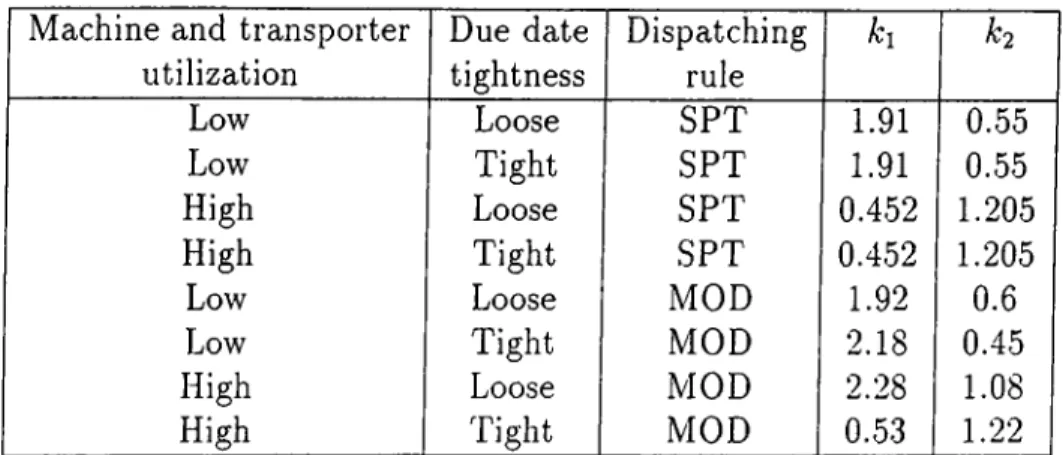
where, Ri Di Tli Q i k u h Ri = Di — ki * n, — ¿’2 * Qi
Release time of job i. Due date of job i,
number of operations in job i,
the number of jobs on job i’s routing, planning factors.
(3.1)
Above equation was also used for release date calculation by Ragatz and Mabert [31] (Modified Infinite Loading (MIL)). In our study, Qi includes the jobs in input queues at machines on job i’s routing, the jobs in output queues of other machines waiting to be transported to a machine on job i’s routing and the jobs which are currently being transported to a machine on job i’s routing.
If the release date calculated is before the current time, the job is released, immediately, to the shop. Else the job waits in the pool until its release date.
Mahmoodi et al. [18] tested a similar release mechanism with a different equation for release date calculation.
(b) Periodic Infinite Loading (PINF): This release mechanism uses the equation 3.1 for calculating the release date. This is called as Mod ified Infinite Loading by Ragatz and Mabert [31]. Jobs which arrive into the system, are directly placed into the pool. Release decision is made at the beginning of 8 hour periods. If the release date of the job is before the current time or before the beginning of the next 8 hour period, the job is released immediately. Otherwise, the job is returned to the pool and its release date is recalculated at the beginning of the next 8 hour period.
Bobrowski and Park [5] tested a similar release mechanism with a different equation for release date calculation.
6. Forward Finite Loading (FFIN): This release mechanism was proposed by Bobrowski and Park [5]. Detailed information about the job and the shop is used in this mechanism. A current-workload profile for each workstation in the shop is maintained by employing a planning horizon that is broken into time buckets (loading periods). The workload profile indicates the amount of work released for the workcenter for each time bucket in the planning horizon.
This mechanism loads the operations of the job into available capacity for the appropriate workstation by starting from the first operation. If there is no adequate capacity at the time bucket considered, then next time bucket in the planning horizon is evaluated for loading the operation. Flow time of a job is forecasted by using the processing time of each operation;
flowtime = k * processing time (3-2) where,
¿^planning factor, {k > 1).
Completion time of the job is estimated by the load period of the last operation. The job is released to the shop if due date of the job is less than the last operation load period. Otherwise, the job is returned to the pool and the release decision about the job is made at the beginning of the next 8 hour interval which is the length of a loading period.
CHAPTER 3. EXPERIMENTAL CONDITIONS •24
For keeping the load profile of each workstation upto date, we update the profile whenever an operation of a job is finished. We delete the processing time of the finished operation from the corresponding time bucket in the load profile. Then following operations of the same job are reloaded by using equation 3.2.
3.2
S y stem C on sid eration s and Sim ulation
M od el
A hypothetical factory was used in our simulation study. The model was written in the SIM AN simulation language [27] [35]. We also wrote some parts of the code in the C language [16] to implement the release mechanisms. C subroutines were linked with SIMAN in UNIX environment.
The assumptions, which are generally done in classic job shop scheduling studies, are given in [2]. We made the following assumptions in our study:
1. Jobs consist of strictly ordered operation sequences.
2. A given operation can be performed by only one type of machine.
3. There is only one machine of each type in the shop.
4. Processing times as well as due dates are known at the time of arrival. 5. There are no setup times.
6. Once an operation is begun on a machine, it cannot be interrupted.
7. An operation may not begin until its predecessors are completed.
8. Each machine can process only one operation at a time. 9. Each machine is continuously available for production.
Table 3.1: Vehicle travel distance between stations in the layout,distance units Station No. 1 2 3 4 5 6 7 8 1 0 80 85 75 130 95 40 125 2 0 35 95 80 145 70 135 3 0 60 45 110 105 100 4 0 55 50 115 80 5 0 85 150 55 6 0 135 30 7 0 165 8 0
Layout of the factory is given in Figure 3.1. The layout is bi-directional. Distances between the workstations is in Table 3.1. Some characteristics of the simulation model are identical to those used by Melnyk and Ragatz [20]. The model has the following characteristics;
Number of workstations Order routings
Operations per job Interarrival distribution Service time distribution
Random, no return visit to a workstation. Uniform[l,6]
Exponential
Erlang(mean=1.0 h)
8 ^
Figure 3.1: Layout of the Shop
CHAPTER 3. EXPERIMENTAL CONDITIONS 26
calculate the due date is the same as the one which Melnyk and Ragatz [20] used;
Di = ATi + k * T W K i (3.3)
where,
Di = Due date of job i, ATi = Arrival time of job i,
T W K i = Total operation time for job
k = A constant which determines due date tightness.
Evaluation of various due date assignment rules is given in [30] by Ragatz and Mabert.
Tsubone et al. [37] presented interactive due date management system for job shops. This system allows the user to accept or reject the job which is negotiated and to adjust the production capacity. They applied the system to a real production environment. The system decreased the variance in the flowtime and the number of jobs which missed their due dates. It provided a quick and accurate estimate of the flowtime for the job.
In our simulation model, we assumed that early shipment of completed jobs is forbidden. Kanet and Christy [15] simulated a job shop with the same assumption and compared two lead time estimation rules. They showed that TWK method is the best and provides lower mean tardiness and lower mean inventory values.
Every workstation involves one machine in our simulation model. We as sumed that each machine has one input and one output queue which has finite capacities. After some pilot simulation runs, we set input queue capacity to three and output queue capacity to one. Every workstation has also one buffer area with infinite capacity, representing a common deparmental storage area.
Described structure of the workstations helps us for modeling the congestion and for preventing deadlocks in the shop. Deadlock is a complete seizure of the job flow throughout the shop. Problem of deadlocking occurs during the operation of flexible manufacturing systems. Wysk et al. [40] presents some