SEIZURE DETECTION USING LEAST EEG CHANNELS BY
DEEP CONVOLUTIONAL NEURAL NETWORK
Mustafa Talha Avcu
12#, Zhuo Zhang
2∗, Derrick Wei Shih Chan
3 1Electrical & Electronics Engineering, Bilkent University, Turkey 2Neural & Biomedical Engineering, Institute for Infocomm Research, Singapore 3Dept of Paediatrics, Neurology Service, KK Women’s and Children’s Hospital, SingaporeABSTRACT
This work aims to develop an end-to-end solution for seizure onset detection. We design the SeizNet, a Convo-lutional Neural Network for seizure detection. To compare SeizNet with traditional machine learning approach, a base-line classifier is implemented using spectrum band power features with Support Vector Machines (BPsvm). We explore the possibility to use the least number of channels for ac-curate seizure detection by evaluating SeizNet and BPsvm approaches using all channels and two channels settings re-spectively. EEG Data is acquired from 29 pediatric patients admitted to KK Woman’s and Children’s Hospital who were diagnosed as typical absence seizures. We conduct leave-one-out cross validation for all subjects. Using full channel data, BPsvm yields a sensitivity of 86.6% and 0.84 false alarm (per hour) while SeizNet yields overall sensitivity of 95.8 % with 0.17 false alarm. More interestingly, two channels seizNet outperforms full channel BPsvm with a sensitivity of 93.3% and 0.58 false alarm. We further investigate interpretability of SeizNet by decoding the filters learned along convolutional layers. Seizure-like characteristics can be clearly observed in the filters from third and forth convolutional layers.
1. INTRODUCTION
Monitoring brain activity through EEG is critical for epilepsy diagnosis. To capture seizure events that may occur sparsely, neurologists have to visually scan vast amount of EEG data. The process is extremely time consuming and may be subjec-tive due to inter observer variance. Computer aided seizure detection approach would serve as valuable clinical tool for the scrutiny of EEG data in an objective and much more effi-cient manner.
Traditional machine learning approaches for seizure de-tection usually composite three stages: data pre-processing to eliminate artifacts, followed by feature extraction and decision-making. A number of features have been identified *Corresponding author. #The work was carried out under SIPGA schol-arship from Agency for Science, Technology and Research (A*STAR), Sin-gapore.
to describe the behavior of seizures, including those based on time-domain, frequency-domain, time-frequency analysis, wavelet features and chaotic features such as entropy etc. A pioneer work was presented in [1], which created subject-specific seizure onset detection model using hand-crafted features extracted from the raw EEG data followed by clas-sification. The subject-specific model reaches a sensitivity of 96% and false alarm rate of 0.08 per hour on CHB-MIT dataset by using SVM over a combination of spectral, spatial and temporal features.
The extracted features are believed to contain discrimi-native information for systems to differentiate seizure from non-seizure states. Feature space are highly compact as com-pare to raw EEG data space which is critical when computing power is limited. Furthermore, the features may bring inter-pretability for a machine learning system. However, there are limitations for such seizure detection methods. Firstly, ex-tracting features from raw data may induce information loss. Secondly, the standard power band analysis splitting the spec-trum bands (delta 0-4Hz, theta 4-8Hz etc.) could not take into consideration individual variance of spectrum distributions. Finally, hand crafted feature extraction brings extra computa-tional complexity for real-time applications.
Deep learning (DL) solves such problems by represen-tation learning which enables computer to learn high level features from raw data without human interference. Recent advances in DL such as batch normalization [2], dropout [3] and various new network structures have largely prompted the applications for DL in real world problems and some have achieved near human-like performance. Various DL ap-proaches have been proposed for seizure detection. Hugle et. al.[4] proposed a Convolutional neural network (CNN) de-signed for implantable microcontroller by using only 4 elec-trodes selected a priori by expert. Ullah and colleagues [5] de-veloped a pyramid CNN, and a typical 13-layer CNN model is created in [6], both using Bonn University database [7] which has only 3.27 hours of EEG data. The latter deep CNN structure has about 100k parameters, however neither dropout nor batch normalization is used to regularize the deep CNN. As a result, they could not reach the state-of-art performance
achieved by machine learning approaches using hand crafted features.
In this work, we aim to develop an end-to-end solution for seizure onset detection. A CNN structure called seizNet is carefully designed to enable an efficient and effective repre-sentative learning for seizure onset detection, equipped with dropout and batch normalization to prevent overfitting for a more generalized solution. We explore the possibility to use least number of channels for accurate detection across sub-jects. Finally, we attempt to interpret the model by discov-ering signatures hidden in the filters from different convolu-tional layers.
2. METHOD 2.1. Baseline method – BPsvm
We develop a SVM-based classifier using hand crafted trum band power features, called BPsvm. Frequency spec-trum components within the 0-25 Hz band is considered, as suggested by [8]. In this study, we preserve the 5-second epoch for analysis across different approaches. To obtain fea-tures in higher resolution, we split the 5-second epoch into 5 1-second windows for spectrum transformation and band power feature extraction. In Shoeb’s work [1], 8 bands from 0.5-24 Hz are chosen. As our window size is 1 second, the lowest frequency we can analyze is 1 Hz, therefore sub-bands are defined as [1-3, 3-6, 6-9, 9-12, 12-15, 15-18, 18-21, 21-24] Hz. Spectrum band power feature in the sub-band sig-nals on every 1-second are calculated and then concatenated into one instance for every 5-second epoch. Afterwards, SVM classifier is trained based on extracted features by using radial basis function (RBF) kernel.
2.2. Deep learning method – SeizNet
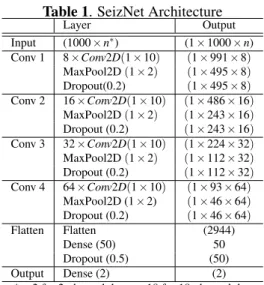
We develop a deep CNN network named SeizNet for end-to-end seizure detection solution. Comparing to [6], SeizNet contains additional dropout layers [3] and batch normaliza-tion [2] after every convolunormaliza-tion layer. Such layers are de-signed to avoid model overfitting. Unlike the typical usage of dropout which is only after fully connected layer, we used dropout in various parts of the model as it is indeed sug-gested by the inventors of dropout [3]. The number of filter at each convolution layer is multiplied by two every time like VGGNet [9]. It enables SeizNet to have less number of fil-ters at low levels in which filfil-ters learn basic shapes, while to have more filters at the higher levels where filters are capable of grasping sophisticated patterns. As an activation function ReLU is used and other hyper-parameters of the model such as number of filters and filter sizes at each layer as well as number of unit in the fully connected layer are cross-validated over a broad range. Detailed architecture of SeizNet can be found in table 1. The total number of parameters for
SeizNet-2chn and SeizNet-18chn are 200, 592 and 201, 872 respec-tively, both include 240 non-trainable parameters.
Table 1. SeizNet Architecture
Layer Output Input (1000 × n∗) (1 × 1000 × n) Conv 1 8 ×Conv2D(1 × 10) (1 × 991 × 8) MaxPool2D (1 × 2) (1 × 495 × 8) Dropout(0.2) (1 × 495 × 8) Conv 2 16 ×Conv2D(1 × 10) (1 × 486 × 16) MaxPool2D (1 × 2) (1 × 243 × 16) Dropout (0.2) (1 × 243 × 16) Conv 3 32 ×Conv2D(1 × 10) (1 × 224 × 32) MaxPool2D (1 × 2) (1 × 112 × 32) Dropout (0.2) (1 × 112 × 32) Conv 4 64 ×Conv2D(1 × 10) (1 × 93 × 64) MaxPool2D (1 × 2) (1 × 46 × 64) Dropout (0.2) (1 × 46 × 64) Flatten Flatten (2944) Dense (50) 50 Dropout (0.5) (50) Output Dense (2) (2)
*n=2 for 2-channel data, n=18 for 18-channel data
We conduct leave-one-subject-out cross validation to evaluate our model. For training, we use Adam [10] opti-mizer with a learning rate of 4.1e − 3, binary cross entropy loss function and batch size of 128. We explored early-stopping [11] approach by randomly selecting 20% of train-ing data as our validation set. However, it is observed that SeizNet does not overfit due to the effect of aggressive reg-ularization, namely dropout and batch normalization applied after every convolution layer. Therefore, 100 iterations have been decided to execute without any validation split. It also enables us to take advantage of all the data which possibly affects the performance since deep learning approaches for BCI problems are often deprived of big datasets.
2.3. Filter Decoding for SeizNet interpretation
CNNs extract spatial features hierarchically in a modular way throughout convolution layers, the filters decompose the in-put space to set a mapping between abstract features and la-bels. Decoding such filters help us discern what decomposed components are, thereby how CNNs work. One technique to fathom the characterization of hidden units is visualizing sample inputs that maximize the selected units. A pioneer method, Activation Maximization (AM) proposed by Erhan in 2009 [12] has turned this technique into an optimization problem yielding artificial inputs that maximally activate any chosen hidden unit/units by gradient ascent rather than select-ing from the data set which is shown to be problematic and inadequate in the sense of leading a conclusion. Furthermore, its consistency has been shown with different initializations producing mostly same salient features at the input [12].
To date, AM has been widely used to decode abstract spa-tial filters and to make qualitative interpretations of CNNs. It was first applied by [13] to the AlexNet [14], known as first
modern CNN architecture as well as to the others such as VG-GNet [9], GoogleNet [15] etc.
3. EXPERIMENT AND RESULT 3.1. Seizure EEG data and Pre-processing
Data used in this study is from KK Women’s and Children’s Hospital, Singapore. IRB was acquired from the hospital re-view board. EEG data of 29 pediatric patients diagnosed with typical absence seizures are included in this study. The data are extracted from Nikon Kohden EEG-1200K and EEG-9100K recording systems (reading setting: Cal Voltage=50µV , HFF=70Hz, LFF=0.53Hz, Sensitivity=7 − 10µV /mm, sampling rate=200 or 500Hz). The length of patients’ EEG recordings range from 25 to 66 minutes. In total the data contains 1037.6 minutes of EEG recording with 24.95 minutes seizure data distributed among 120 seizure onsets. EEG data is down-sampled to 200 Hz across all sub-jects. Data from all channels for each subject is z-normalized. Window size of 5 second is chosen and preserved for all the methods in order to obtain a conclusive comparison based on performance metrics. A common problem in CNN networks for seizure detection is that datasets are often imbalanced meaning interictal phases outnumber the ictal phases by a wide margin and it has been shown that imbalanced datasets lead to statistically significant performance drop in CNN ar-chitectures [16]. To overcome this issue, a data augmentation method during pre-preprocessing is preferred rather than un-dersampling or oversampling. To increase the number of ictal phases, sliding is applied with different overlapping propor-tions according to existence or absence of seizure. While shifting with 5 seconds (no overlapping) is implemented to create interictal class, 0.075 second shifting is used for ictal class to create balanced input for the SeizNet. For BPsvm, however, no such technique is applied since SVM is shown to be robust against imbalanced datasets [17].
3.2. Experiment Settings and Performance Metrics We compared result of four experimental settings including 18-channel SVM, 18-channel CNN, channel SVM and 2-channel CNN respectively. Performance of the seizure detec-tion algorithms are assessed with sensitivity and false alarm rate by the community [18] and often extended with latency in order to make more comprehensive analysis across detector algorithms. The definitions are described as follows:
Sensitivity(%): Proportion of seizures correctly detected False alarm rate(fp/h): Number of false positive seizures per hour Latency(second): Delay between electrographic onset and detection While BPsvm yields determinate results, seizNet models produce different result in every round, due to random initial-ization. To evaluate the result objectively, ten tests have been carried out for both seizNet-2-chn and seizNet-18-chn mod-els, and most frequent result which statistically corresponds
to the mode of sensitivity and false alarm is chosen as a final result for each subject.
3.3. Results
Results obtained from different experimental settings can be found in Table 2. In both BPsvm and seizNet, models using 18-chn reduce false alarms with a boost in sensitivity com-pare to the 2-chn models. But to our surprise, SeizNet-2-chn model despite using much less number of channels, outper-forms BPsvm-18-chn model for all performance metrics mea-sured.
Table 2. Comparison of Performance Metrics
Model BPsvm SeizNet Channel used 2-chn 18-chn 2-chn 18-chn Seizure detected 104/120 108/120 112/120 115/120 Sensitivity (%) 86.6% 90% 93.3% 95.8% False alarms 33 14 10 3 FAR∗(fp/h) 1.91 0.81 0.58 0.17 Mean Latency(sec) 4.42 3.75 3.26 3.80 *FAR–false alarm rate
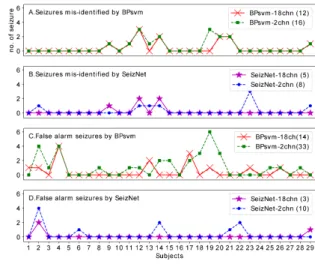
Detailed schematic illustrating number of missed seizures and false alarms for each subject can be found in Fig 1. It is observed that for subject 2 and subject 23, BPsvm-2chn could identify all the seizures while not triggering more false alarm than seizNet-2chn which could not find all the seizures for the mentioned subjects.
Fig. 1. Mis-identified and false alarm seizures across subjects 3.4. Filters in SeizNet
To understand what representation features are learned in seizNet, we use Activation Maximization method explained thoroughly in Section 2.3. It enables us to visualize the low level and high level features that help to reveal the feature hierarchy throughout convolution layers of SeizNet. In this work, AM is implemented with keras-vis library [19]. Un-like the baseline method in which activation maximization
loss is based on only model weights, the library provides two kind of regularization terms, namely LP norm and total variation added to the loss in order to enforce natural image prior. Default values are preserved for the weights of these regularization terms. Only input range is changed according to our pre-processing, and it is set to (-10,10). Finally, seed is initialized with random values.
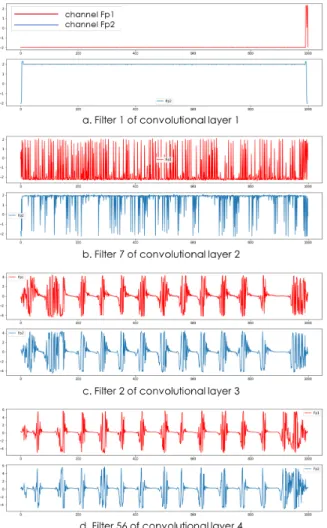
Fig. 2. Filters from 4 convolutional layers
In image classification problems, filters at the first convo-lutional layer usually encode the direction and color, in other words channels. Hierarchically moving along the CNN, more and more complex features are found at the higher layers that are indeed combination of features at the lower levels [12].
In SeizNet, the first layer filters present very basic shapes as shown in Fig 2.a. While interpreted as color encoding from the perspective of image analysis, for SeizNet the filters can be thought to encode EEG channel information, due to the fact that there are filters that have high and constant value for the channel 1 and low and constant value for the channel 2 and vice versa. Another possible interpretation could come from EEG montage perspective where bi-polar signal repre-sents the difference of two electrodes, since the filters indeed subtract the channels one another.
Fig. 3. Examples of seizure waveforms (3 seconds) In the second convolution layer, various kind of filters have been found but nothing meaningful to us has been ob-served. However, from the third convolution layer onwards we observe substantial characteristics of seizures, therefore our hypothesis for the second layer is that it serves as the middle man to bring basic information in the lower layers into complex like-seizure signals in the higher layers
Characteristics of the seizures are observed at the third convolution layer and become clearer at the last convolution layer. It can be inferred that SeizNet has learned the fact that absence seizures create periodic and 3 Hz signals. Nonethe-less, clearly SeizNet focuses on spike-and-wave happening three times in one second and try to capture it rather than cap-turing a whole shape of a seizure. One possible reason behind is that seizure patterns often vary from subject to subject as can be seen from the Fig 3, therefore it is reasonable for fil-ters of a generalized model to learn the common and salient characteristics of seizures.
4. DISCUSSION AND CONCLUSION
It has been observed from the overall results that SeizNet is better than BPsvm in terms of sensitivity and false alarm. It shows that CNN models are more suitable for generalized models unlike the SVM which is indeed often implemented in subject-specific models. Nevertheless, as observed in Fig 1, frequency domain features can be more discriminative than the features extracted from time-domain for some subjects. This is also consistent with the fact that even EEG experts are to check the spectrogram in some cases in order to finalize their decision. An interesting discovery in this study is that SeizNet model trained by only 2 channels is able to outper-form traditional approach trained with full scalp EEG data.
End-to-end approach is more favorable for developing real time seizure detection systems as it eliminates feature extraction, which can be a burden for real time signal pro-cessing. A solution using data merely from 2 channels makes the approach even more adoptable for light-weight, home based seizure monitoring system.
5. REFERENCES
[1] Ali Hossam Shoeb, Application of machine learning to epileptic seizure onset detection and treatment, Ph.D. thesis, Massachusetts Institute of Technology, 2009. [2] Sergey Ioffe and Christian Szegedy, “Batch
nor-malization: Accelerating deep network training by reducing internal covariate shift,” arXiv preprint arXiv:1502.03167, 2015.
[3] Nitish Srivastava, Geoffrey Hinton, Alex Krizhevsky, Ilya Sutskever, and Ruslan Salakhutdinov, “Dropout: a simple way to prevent neural networks from overfit-ting,” The Journal of Machine Learning Research, vol. 15, no. 1, pp. 1929–1958, 2014.
[4] Maria H¨ugle, Simon Heller, Manuel Watter, Manuel Blum, Farrokh Manzouri, Matthias D¨umpelmann, An-dreas Schulze-Bonhage, Peter Woias, and Joschka Boedecker, “Early seizure detection with an energy-efficient convolutional neural network on an implantable microcontroller,” arXiv preprint arXiv:1806.04549, 2018.
[5] Ihsan Ullah, Muhammad Hussain, Hatim Aboalsamh, et al., “An automated system for epilepsy detection us-ing eeg brain signals based on deep learnus-ing approach,” Expert Systems with Applications, vol. 107, pp. 61–71, 2018.
[6] U Rajendra Acharya, Shu Lih Oh, Yuki Hagiwara, Jen Hong Tan, and Hojjat Adeli, “Deep convolutional neural network for the automated detection and diagno-sis of seizure using eeg signals,” Computers in biology and medicine, vol. 100, pp. 270–278, 2018.
[7] Ralph G Andrzejak, Klaus Lehnertz, Florian Mormann, Christoph Rieke, Peter David, and Christian E El-ger, “Indications of nonlinear deterministic and finite-dimensional structures in time series of brain electri-cal activity: Dependence on recording region and brain state,” Physical Review E, vol. 64, no. 6, pp. 061907, 2001.
[8] J Gotman, JR Ives, and P Gloor, “Frequency content of eeg and emg at seizure onset: possibility of removal of emg artefact by digital filtering,” Clinical Neurophysi-ology, vol. 52, no. 6, pp. 626–639, 1981.
[9] Karen Simonyan and Andrew Zisserman, “Very deep convolutional networks for large-scale image recogni-tion,” arXiv preprint arXiv:1409.1556, 2014.
[10] Diederik P Kingma and Jimmy Ba, “Adam: A method for stochastic optimization,” arXiv preprint arXiv:1412.6980, 2014.
[11] Yuan Yao, Lorenzo Rosasco, and Andrea Caponnetto, “On early stopping in gradient descent learning,” Con-structive Approximation, vol. 26, no. 2, pp. 289–315, 2007.
[12] Dumitru Erhan, Yoshua Bengio, Aaron Courville, and Pascal Vincent, “Visualizing higher-layer features of a deep network,” University of Montreal, vol. 1341, no. 3, pp. 1, 2009.
[13] Karen Simonyan, Andrea Vedaldi, and Andrew Zisser-man, “Deep inside convolutional networks: Visualising image classification models and saliency maps,” arXiv preprint arXiv:1312.6034, 2013.
[14] Alex Krizhevsky, Ilya Sutskever, and Geoffrey E Hin-ton, “Imagenet classification with deep convolutional neural networks,” in Advances in neural information processing systems, 2012, pp. 1097–1105.
[15] Christian Szegedy, Wei Liu, Yangqing Jia, Pierre Ser-manet, Scott Reed, Dragomir Anguelov, Dumitru Erhan, Vincent Vanhoucke, and Andrew Rabinovich, “Going deeper with convolutions,” in Proceedings of the IEEE conference on computer vision and pattern recognition, 2015, pp. 1–9.
[16] Mateusz Buda, Atsuto Maki, and Maciej A Mazurowski, “A systematic study of the class imbalance problem in convolutional neural networks,” Neural Networks, vol. 106, pp. 249–259, 2018.
[17] Rehan Akbani, Stephen Kwek, and Nathalie Japkow-icz, “Applying support vector machines to imbalanced datasets,” in European conference on machine learning. Springer, 2004, pp. 39–50.
[18] Alexandros T Tzallas, Markos G Tsipouras, Dimitrios G Tsalikakis, Evaggelos C Karvounis, Loukas Astrakas, Spiros Konitsiotis, and Margaret Tzaphlidou, “Au-tomated epileptic seizure detection methods: a re-view study,” in Epilepsy-histological, electroencephalo-graphic and psychological aspects. InTech, 2012. [19] Raghavendra Kotikalapudi and contributors,
“keras-vis,” https://github.com/raghakot/ keras-vis, 2017.