SPORMETRE, 2017, 15 (4), 191-196
EFFECT OF SERIAL CAFFEINE MOUTH RINSE ON
WINGATE ANAEROBIC PERFORMANCE
Raci KARAYİĞİT
1, Burak Çağlar YAŞLI
1, Hakan KARABIYIK
1,
Mitat KOZ
1, Gülfem ERSÖZ
11Ankara University Faculty of Sport Sciences, Ankara
Geliş Tarihi: 14.06.2016 Kabul Tarihi: 12.07.2017
Abstract: Caffeine has been shown to increase aerobic and anaerobic performance especially in elite level athletes. Recently, caffeine
mouth rinsing without ingestion has had same ergogenic potential with ingestion in some performance parameters. The purpose of this study was to investigate serial rinsing of caffeine during the warm-up period before wingate anaerobic test (Want) performance. Ten physically active male completed the following 10-s mouth rinsing protocols; a-) %2 w/v caffeine solution (Caf) b-) water (Pla) c-) no rinse as a control (Con) with a randomised, double-blind, crossover and counterbalanced research design. Serial mouth rinse protocol was implemented (8x25 ml solutions at s intervals during 5 minutes warm up). Following to last rinse, participants were asked to cycle 30-s maximal 30-sprint on a cycle ergometer. Peak and Mean power output were calculated via cycle ergometer 30-software, al30-so at re30-st and immediately after Want, heart rate (HR) and rating of perceived exertion (Rpe) were assessed. In comparison with Pla and Con, Caf trial had no significant effect on peak (p>0.05) and mean (p>0.05) power output, there were also no significant effects on heart rate and ratings of perceived exertion (p>0.05).
Key Words: Serial mouth rinsing, mouthwash, ergogenic aids, supplementation.
INTRODUCTION
Caffeine (1,3,7 Trimethylxanthine) is one of the most widely used ergogenic aids by elite athletes to increase sports performance in the world. With its removal of the World Anti-Doping Agency’s list of controlled substance in 2004, there have been so many research conducted related to caffeine’s ergogenic potential on various performance parameters as aerobic endurance, sprinting performance, muscular strength (Glaister et al., 2012). Most of this studies have reported improved performance following caffeine ingestion especially during endurance type activities. Potential ergogenic mechanisms of caffeine on sports performance as follows; enhancement of fat oxidation that has been thought to spare muscle glycogen stores for later use, muscle pain dampening with hypoalgesic effect via peripheral and central adenosine A1 and A2 receptor blockage and lastly direct effect on
muscle tissue such as increased calcium release from sarcoplasmic reticulum and enhancement of sodium-potassium ATPaz activity (Burke, 2008). It is known that caffeine absorption is very fast (between 15-120 minutes) and caffeine quickly exerts its effect on various tissues. Further, absorption of caffeine in the oral cavity is more rapid and has greater ergogenic response when compared to capsule form (Kamimori et al., 2002). Moreover, very low doses (1.5 mg/kg) of caffeine ingestion with cola has been shown to increase cycling performance unrelated to plasma caffeine concentration (Cox et al., 2002). In another study, chewing of caffeinated gum in the oral cavity for 5 minutes just before the beginning of time-trial test has been shown to improve endurance performance (Ryan et al., 2013). This studies led researches to investigate seperate mechanisms of caffeine rather than peripheric because it clearly appeared that method of caffeine intake
(especially with exposure to oral cavity as in the intake with beverage and gum form) effected its ergogenic response. Recently, studies that investigate caffeine mouth rinse without ingestion have shown that 5 or 10 seconds caffeine mouth rinse with 25 mililiter water can improve sprint and endurance performance via receptors found in the mouth that directly effect on brain tissue responsible for motor control and motivation (Beaven et al., 2013). In Beaven’s study, it has been reported that %1.2 caffeine solution improved peak and mean power output of the first of five or six seconds sprint via supraspinal mechanisms in the absence of central fatigue. Additionally, caffeine mouth rinse may increase brain activity within the dorsolateral prefrontal cortex and orbitofrontal cortex responsible for topdown attention control that may increase reaction time and neural drive to the motor unites during match or training (De pauw et al., 2015). Rinsing strategy can be a good alternative to ingestion of caffeine in some instance. Some athletes are unresponsive to different doses of caffeine ingestion due to the genetic reasons and they may benefit from rinsing with the exclude of metabolism. Also caffeine ingestion is not recommended to young athletes due to the side effects and side effects on health (Burke et al., 2015). Further, caffeine mouth rinsing can have superior effects on performance especially in the fasted and low muscle glycogen state (Kasper et al., 2015). It is also important to note that athletes often prefer to perform morning training sessions in fasted state without having breakfast and may have not enough time to wait to appearance of caffeine into circulation. In the literature, effect of caffeine mouth rinsing on anerobic performance is scarce and to our knowledge this is the first study that investigate the effects of serial caffeine mouth rinsing in the oral cavity without swallow on anaerobic power. We hypothesized that serial caffeine mouth rinsing during the warm-up period would significantly increase peak and mean power output compared with a placebo and control condition.
MATERIALS AND METHOD Ten physically active healthy males volunteered for the study (mean(±SD) age: 20,50 (1,58) years, height: 182,50 (8,04) m, body mass (BM): 76,55 (5,38) kg). Participants were physically active and regularly engaged in various recreational activites
such as rugby, soccer, basketball 8-10 hours in 3-5 days in a week. The study was approved by Ankara University Clinical Research Ethics Committee (no: 07-365-17) and conducted in accordance with the Declaration of Helsinki. All participants were fully informed of the possible risks of the study and the right to refuse to participate in the study before giving written consent.
Participants were deceived about the true aims of the study and were informed that the aim of this study was to examine the effect of caffeine mouth rinsing on heart rate and ratings of perceived exertion after an 30-seconds wingate anerobic test (Want) protocol. The participants attended 4 sessions seperated by 3-5 days within a 14-day period at a testing laboratory in a double-blind, randomized, counterbalanced and crossover research design. The first session was familiarization to improve the reliability of Want test on a cycle ergometer (Monark Ergomedic 894E, Monark Exercise, AB, Varberg, Sweden) and became accustomed to 6-20 Borg rating of percevied exertion scale (RPE), also participants’ height and body mass were measured. The saddle and handle bars were adjusted to each participant’s accordance and remained consistent for each condition. To mimic all procedures in the experimental conditions, water was used as a mouth rinse in the familiarization session. Other 3 sessions were treatments during which participants rinsed 1-) 25 ml of %2 caffeine (500 mg) solution (Caf; Aromsa, Turkey) 2-) 25 ml of water (PLA) 3) no rinse as a control (CON). Solutions were rinsed for 10 seconds in the mouth immediately before beginning and at 60 seconds intervals during the 5 minutes warm up session (6 times in total). To make solutions taste matched, both solutions contained same amount of sodium saccharin. Participants were asked to abstain from caffeine ingestion and vigorous exercise for a minumum of 24 hours before the each condition. To maintain total caloric intake and muscle glycogen level equal between experimental conditions, participants were asked to record their eating patterns with their time and size 24 hours before the familiarization session and repeat this diet before each condition. Participants were reminded to replicate diet and not to do physical activity via mobile phone or e-mail every 4-5 hours within the day prior to 24 hours each experimental condition. Additionally, verbal
confirmation of compliance to these procedures was provided in the morning prior to beginning of the test protocol.
Experimental conditions began between 8-10 am. in the fasted state after 10 hour night-fasting. Upon arrival the laboratory, prior to Want test, in the resting state, heart rate (HR) (Polar Team 2, Finland) and Ratings of perceived exertion (Rpe) were measured. Following 500 ml water intake to prevent dehydration, participants began 5-minutes warm up at 60 Watt 60 rpm on cycle ergometer. Immediately before beginning and at 60 seconds intervals during the 5 minutes warm up sessions participants rinsed the solutions 10 seconds in the mouth and expectorating back into a plastic cup. Immediately after rinsing of the last solution, par-ticipants asked to cycle maximally till the end of 30-seconds sprint and upon reaching 150 rpm, 0.075 g/kg resistance was automatically added to flywheel and 30 seconds sprint began (Özkan et al., 2010). On completion of the Want test, partici-pants’ Rpe and Hr were assessed and cycled at 60 watt 60 rpm to active recovery. Vigorous verbal encouragement was provided during sprint. Peak and mean power output were calculated with software (Monark Anaerobic Test Version 3.3.0.0).
All data were analyzed using the IBM SPSS statistics for Windows, version 20.0 (IBM Corp., Armonk, NY, USA). To assess the distribution of all data Shapiro-Wilk test was used. Peak and mean power output were analyzed by one-way repeated measures ANOVA. Rpe, heart rate datas were anaylzed using two-way ANOVA for repeated measures. Sphericity
was anaylzed by Mauchly’s test of sphericity followed by the Greenhouse-Geisser adjustment where required. If any differences were identified, pairwise comparisons with Bonferroni correction were applied. Significance level was set at p < 0.05. Effect sizes were calculated using partial eta squared (n2) for peak and mean power were defined as trivial, small, moderate or large (Cohen, 1992).
RESULTS
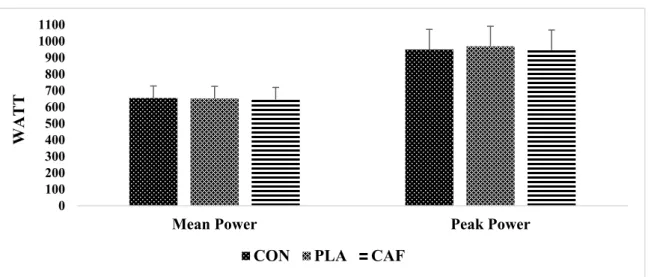
There was no significant effect of serial caffeine mouth rinse on mean power (P=0,523, n2=0,070) and peak power (P=0,126, n2=0,206) indicating that rinsing of caffeine in the mouth did not improve in sprint power output through 30 seconds maximal sprint test (Figure 1).
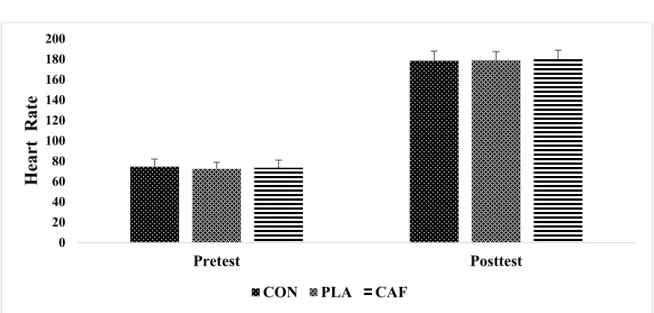
Heart rate values are shown in Figure 2. There were no significant main effect for condition in he-art rate (P=0.696). However, there were main ef-fects of time (P=0.001). Posttest values in all con-ditions significantly increased compared with pre-test. Additionally, condition x time interaction was not detected (P=0.644).
Ratings of perceived exertion values are shown in Figure 3. There was no significant main effect for condition in ratings of perceived exertion (P=0.190). However, there were main effects of time (P=0.001). Posttest values in all conditions significantly increased compared with pretest. Ad-ditionally, condition x time interaction was not de-tected (P=0.164).
Figure 1. Mean and peak power for each experimental condition 0 100 200 300 400 500 600 700 800 900 1000 1100
Mean Power Peak Power
WATT
Figure 2. Pre and post test values of heart rate for each experimental condition
Figure 3. Pre and post test values of ratings of perceived exertion for each experimental condition
DISCUSSION AND CONCLUSION
The aim of the current research was to investigate the effects of serial caffeine mouth rinsing on 30 seconds sprint power output. Contrary to our hy-pothesis, main findings from this study suggest that Caf mouth rinse did not significantly improve anerobic power in comparison to Pla and Con trial. Additionally, heart rate and ratings of perceived exertion values did not change significantly between condition.
Previously, Beaven et al. reported that rinsing the mouth with a %1.2 caffeine solution significantly
increased first sprint performance in the 5x6 se-conds repeated sprint test protocol in a cycle ergo-meter when compared to placebo. Further, perfor-mance benefits from rinsing of the caffeine solu-tion during the high intensity activities generally attribute to stimulation of the receptors found in the mouth that are responsible for detecting caloric content and taste, in turn, directly activating brain regions that increase neural drive to the motor uni-tes thus improving sprint power output with the increase of motor unite recruitment (Beaven., 2013). This raises the possibility that much more caffeine solution may be rinsed in the mouth thus stimulate more receptors to gain greater central
0 20 40 60 80 100 120 140 160 180 200 Pretest Posttest
Heart
Rate
CON PLA CAF
0 2 4 6 8 10 12 14 16 18 20 Pretest Posttest Ratings of Perceived Exertion
response during high intensity sprint activities. In the current study, during the 5 minutes warm-up sessions, with the expectation that increase in mo-tor unite recruitment during maximal sprints, taste receptors responsive to bitter anhydrous caffeine found in the mouth repeatedly stimulated 60 se-conds interludes via 500 mg of caffeine. But hy-pothesized performance benefits were not obtai-ned. Intraclass Correlation Coefficients (ICC) were calculated 0.98 both peak and mean power. It means that test-retest reliability was achieved and that finding no significant performance impro-vement with caffeine mouth rinsing may be related to else factors. Our study design was not without limitations. Although the diet 24 hours before each trial was asked to replicate by participants, it was analyzed with nutrients analyze programme. Parti-cipants’ total energy intake may vary before trials and may influence the Caf mouth rinse trial perfor-mance response. Langfort et al. had showed that decrements in peak and mean power output of win-gate test performance with three days of %5 car-bohydrate (cho) diet compared to %50 cho diet (Langfort et al., 1997). Furthermore, the partici-pants were asked to rest and not to perform any physical activities twenty four hours before the tests, yet their physical activities were not fol-lowed by pedometer or accelerometer. Partici-pants’ physical activity levels may have been changed before the each test day and affected the performance accordingly. In addition, it has been known that rinsing water in the mouth impacts per-formance negatively, affecting the breathing and causing nauseation (Gam et al., 2013). In this study, because the tests were conducted early in the morning on an empty stomach (07:00-08:00), and due to the bitter taste of caffeine, the partici-pants might have had nauseation and thus their answers of performance might have affected ac-cordingly. Participants’ values of nausea may be measured, in the future researches.
There are also researches conducted which have parallel results with ours (Clarke et al., 2015; Tho-mas et al., 2014). Clarke et al. studied out in their research that caffeine mouth rinsing did not imp-rove the muscular strenght and muscular endurance performance. However, the strength training pasts of the above mentioned participants are not so much and that might have effected those results. In our research, however; the participants have gone through familiarisation before tests and they are ac-customed to the high-intensity sprint activities in
bicycle ergometer. Furthermore, the caffeine dose (300 mg) used in Clarke et. al was lower than ours and their participants went through the test after rinsing in the mouth for once. The sprint perfor-mance did not increase significantly in our study, despite higher caffeine dose and repeated rinsing protocol. Similarly, the mouth rinsing of caffeine did not change the ratings of perceived exertion and heart rate values significantly and this situation was considered to be resulted from the high values du-ring the already high activities and named as “cei-ling effect” (Clarke et al., 2015). The fact that there has been no effect of rinsing caffeine in the mouth on rpe and hr values is parallel with our study. In another study, it has been researched the effect of caffeine mouth rinsing in very low doses on time-trial performance and reported that it has not sig-nificantly increased the performance (Doering et al., 2014). The reason for not detecting any perfor-mance increase in the mentioned research might be the usage of caffeine in very low doses (35 mg). It has been known that caffeine in higher doses are needed for sensitive taste receptors situated in the oral cavity to stimulate the area in brain in charge of motor control. It has been improved by Kizzi et al. that caffeine mouth rinsing increased the perfor-mance. He reported that it increased significantly the mean and peak power, in the 5x6 seconds sprint protocol in low muscle glycogen level, by lowering the muscle pain and used 500 mg caffeine in the research. The same dose of caffeine with ours has been used, yet it has had some differences consid-ering the physiological stress. It has been observed that with an evolutionary perspective, the sensitiv-ity of receptors in oral cavsensitiv-ity has rose according to the high stress physiological conditions and perfor-mance answer for caffeine has increased, and thus it explains the non-responsive performance in nor-mal muscle glycogen level (Ali et al., 2017). In ad-dition, the torque factor during the 30 seconds max-imal sprints was 0.75 N.m/kg in our research. It has been asserted in the research conducted by Glaister et. al, that the peak power increase with caffeine in-take has been directly proportionate to the magni-tude of applied resistance. He stated that in anaero-bic sprint protocols conducted with low torque fac-tors, the effects of caffeine intake on neural drive has not increased the anaerobic performance since the maximal pedaling speed, which were restricted by motor control mechanisms, was reached, yet in anaerobic sprint tests, in which high torque factors are applied, the maximal pedaling speed were not reached and it could show the effect of caffeine on
neural drive (Glaister et al., 2015). Glaister et al has stated that in 1.2 N.m/kg torque factor, it increased the power output of caffeine. In this research, the reason for the caffeine mouth rinsing not to in-crease the 30 seconds sprint performance might be the usage of low torque factor.
As a result, the caffeine mouth rinsing repeatedly has not increased significantly the anaerobic power and effected the heart beat and the per-ceived degree of difficulty. In future researches, its effects of long-lasting aerobic endurance perfor-mance on the elite athletes and the effects of caf-feine mouth rinsing in different doses on perfor-mance might be researched.
REFERENCES
1. Glaiester M, Stephen D et al. (2012): Caffeine and Sprinting Performance: Dose Responses And Efficacy. Journal of Strength and Conditioning Research, 26:1001-1005.
2. Burke LM. (2008): Caffeine and sports performance. Appl Physiol Nutr Metab, 33:1319-1334.
3. Kamimori et al. (2002): The rate of absorption and relative bioavailability of caffeine administered in chewing gum versus capsules to normal healthy volunteers. Int. J. Pharm, 234:159-167.
4. Cox et al. (2002): Effect of different protocols of caffeine intake on metabolism and endurance performance. Journal of Applied Physiology, 93:990-999.
5. Ryan et al. (2013): Caffeine gum and cycling performance: a timing study. Journal of Strength and Conditioning Research, 27:259-264.
6. Beaven et al. (2013): Effects of caffeine and carbohydrate mouth rinses on repeated sprint performance. Appl Physiol Nutr Metab, 38:633-637.
7. De Pauw K, Roeland B, Knaepen K, Polfliet M, Stiens J, Meeusen R. (2015): Effects of caffeine and maltodextrin mouth rinsing on P300, brain imaging, and cognitive performance. J Appl Physiol, 118:776-782.
8. Burke LM et al. (2015): The governor has a sweet tooth – mouth sensing of nutrients to enhance sports performance. European Journal of Sport Science. 15:29-40.
9. Kasper AM et al. (2016): Carbohydrate mouth rinse and caffeine imroves high-intensity interval running capacity when carbohydrate restricted.
10. Doering TM et al. (2014): The effect of a caffeinated mouth-rinse on endurance cycling time-trial performance. International journal of sport nutrition and exercise metabolism, 24:90-97.
11. Özkan A, Köklü Y, Ersöz G (2010): Wingate anaerobic power test. International Journal of Human Sciences, 7:207-224.
12. Cohen J (1992): A power primer. Psychol. Bull, 112:155-159.
13. Langfort J et al. (1997): The effect of a low-carbohydrate diet on performance, hormonal and metabolic responses to a 30-s bout of supramaximal exercise. European Journal of applied Physiology and occupational Physiology, 76:128-133.
14. Gam S et al. (2013): Opposition of carbohydrate in a mouth-rinse solution to the detrimental effect of mouth rinsing during cycling time trials. Int J Sport Nutr Metab. 23,48-56.
15. Ali et al. (2017): Effect of mouth rinsing and ingestion of carbohydrate solution on mood and perceptual responses during exercise. Journal of the International Society of Sport Nutrition, 14(4):1-10. 16. Kizzi J et al. (2016): Influence of a caffeine mouth rinse on sprint cycling following glycogen depletion. European journal of sport science, 16(8):1087
17. Glaister M, Muniz-Pumares D, et al. (2015): Caffe-ine supplementation and peak anaerobic power out-put. European Journal of Sport Science, 15(5), 400-406.