Green Settlement Planning and Design: The First National
and Institutional Certification Attempt for Turkey
Yeşil Yerleşme Planlaması ve Tasarımı: Türkiye’nin İlk Ulusal ve Kurumsal
Sertifikasyon Girişimi
Geliş tarihi: 26.12.2018 Kabul tarihi: 28.03.2019 Online yayımlanma tarihi: 06.04.2019
İletişim: Melis Oğuz. e-posta: [email protected]
Planlama 2019;29(1):1-9 doi: 10.14744/planlama.2018. 27146
RESEARCH REVIEW / ARAŞTIRMA ÖZETİ
Özlem Özçevik,1 Melis Oğuz,2 Ayşe Akbulut3
1Department of City and Regional Planning, Istanbul Technical University, Faculty of Architecture,Istanbul 2Department of Industrial Design Beykent University, Faculty of Engineering and Architecture, Istanbul 3Department of City and Regional Planning, Niğde Ömer Halisdemir University, Faculty of Architecture, Nigde
ABSTRACT
The concept of sustainability should be significantly integrated into practice as well as into contemporary urbanism principles as inno-vative technological approaches for designing the future cities of 21st century. A green certification can be accepted as an essential tool to provide the location-specific, measurable, monitorable, updatable components and parameters of sustainability. The aim of the study is to discuss the preparation of analysis and synthesis of green building and settlement certification that is carried out with the Ministry of Environment and Urbanism and to share the results of the significant experience which is dealing with global objectives at the national and local scale. This first experience will be evaluated under the indicators of land use, ecology and disaster management topics related to their contribution in sustainable ur-ban development with a notion of providing social and economic sustainability of urban livelihoods. Alongside the evaluation this paper will provide a comparison of this national intervention with other widely used and world-known international green certifica-tions. Having elaborated international green certificates to build the infrastructure for a national certificate on urban scale, the ma-jor land use decisions for the sustainable settlements prove to pro-vide integrity between the green scales building and settlement. Thus, the researchers decided to emphasize the major subjects of ecological assets and land evaluation, sustainable site selection and energy efficient planning, sustainable urban development and land use, environmental management and infrastructure planning, disaster mitigation in conjunction with socio-cultural quality and socio-economic welfare to insure sustainability measures in Turk-ish settlements. The decisions on the parameters also help other components of sustainability to relate among whole dynamics of the city. Therefore, the suggestions for a national green certificate in this study are expected to contribute to the adoption of realistic and practical steps necessary to achieve sustainability goals.
ÖZ
Sürdürülebilirlik kavramı, 21. yüzyılın kentlerinin tasarımında ye-nilikçi teknolojiler ile birlikte hem pratiğe hem de güncel plan-lama prensiplerine entegre edilmelidir. Yeşil sertifika sistemleri ile sürdürülebilirlik için konum odaklı, ölçülebilir, izlenebilir, güncellenebilir gösterge ve bileşen setleri sağlanabilir. Bu çalışma, Çevre ve Şehircilik Bakanlığı ile yürütülmüş olan yeşil bina ve yeşil yerleşme sertifikasyonu için yapılan analiz ve sentez aşamalarını derlemekte ve küresel sürdürülebilirlik hedeflerini hem ulusal hem de yerel ölçekte çözümlemeye çalışan deney-imsel sürecin sonuçlarını derlemektedir. Bu ilk ulusal girişim için yapılan arazi kullanımı, ekoloji ve afet yönetimi göstergeleri kentsel yerleşimlerin sosyal ve ekonomik sürdürülebilirliklerine sağladıkları katkı üzerinden değerlendirilecektir. Bu çalışma, aynı zamanda, yaygın kullanılan uluslararası yeşil sertifika sistem-lerinin karşılaştırmasını da yapmaktadır. Ulusal bir kılavuz hazır-lama hedefiyle incelenen uluslararası yeşil sertifika sistemlerinin de gösterdiği üzere, sürdürülebilir yerleşmelerin ön koşutu bina ve yerleşme ölçeğinde verilen sürdürülebilirlik kararlarının bir-birlerini pekiştirici nitelikte olması gerekmektedir. Bu sebeple, araştırmacılar ekoloji, sürdürülebilir arazi seçimi, enerji verimli planlama, sürdürülebilir kentsel gelişme ve arazi kullanımı, çevre yönetimi ve altyapı planlaması ile afet zarar azaltma politikalarını sosyo-kültürel kalite ve sosyo-ekonomik refahı artırma nosyon-ları ile bağdaştırarak Türkiye yerleşmeleri için sürdürülebilirlik kıstaslarını belirlemeye çalışmışlardır. Bu çalışmanın ulusal yeşil sertifikasyon önerisinin sürdürülebilirlik hedeflerini gerçek-leştirmede gerçekçi ve pratik adımların geliştirilmesine katkıda bulunabileceği öngörülmektedir.
Anahtar sözcükler: Sürdürülebilirlik; sürdürülebilir kentsel yerleşme; Türki-ye; yeşil yerleşme sertifikasyonu.
Keywords: Green settlement certification; sustainability; sustainable urban development; Turkey.
Introduction
The idea of sustainable development became a world-wide concern during the 1970s, while the first ever official docu-ment Bruntland Report only dates back to 1987. Since then, the ideal of “sustainable city” has turned into a “compulsory target” due to the unregulated consumption of natural re-sources. Many studies predict that 2030 will be the year in which the first major impacts will be seen, and 2050 will be the year of accelerating natural resource shortages (Steffen et al., 2015).
The inability to achieve sustainable development has pre-pared a ground for transnational struggle over global climate change, disaster planning, etc. Turkey first took part in a joint action with sanctions related to environmental protection in 1971 with RAMSAR Convention, aiming to protect wetlands (Union of Turkish Bar Associations, 2014). Over the years, Turkey has continued to be involved in many other agree-ments that serve sustainable development. Turkey became a party to one of the climate sensitive international initiatives firstly with United Nations Framework Convention on Cli-mate Change at Rio Earth Summit in 1992 and continued to do so with Kyoto Protocol, which went in effect officially in 2005. Unfortunately, the could not be met through these agreements and conventions, the general objectives of which are a common understanding and programmed constructive steps for human-originated greenhouse gas emissions to be shared by countries. However, the search for solutions still continues as the impacts of global climate change has become more evident than ever.
Effective since January 2016, United Nations Sustainable Development Goals for 2030 to increase welfare while pre-serving the planet have been a milestone for global joint ef-forts against this change (United Nations Sustainable Goals, 2016). These goals have been an invitation to devote eco-nomic growth from climate change, poverty and inequality. Signed in April 2016, the Paris Treaty entered into force after reaching a sufficient majority by November 2016. To combat climate change, Turkey, as one of the parties, has made a com-mitment for the reduction of poisonous gas emissions cre-ating greenhouse effect. According to Greenhouse Emission Statistics published by Turkey Statistical Institute in 2017, the main cause of the emissions are energy demand (fossil fuels), agricultural activities (fossil fuel use by agricultural machinery, agrochemicals, agricultural waste assessments), and industrial activities (TurkStat, 1990-2015). Particularly, energy use and thus buildings with more than 30% of greenhouse gas emis-sions remain to be outstanding problems for Turkey. Businesses with clean technology approach, alternative re-newable energy sources and green buildings are necessary for
reducing emissions (Wamsler, Brink & Rivera, 2013). How-ever, while a number of governments put various targets and legislations in place to reduce greenhouse gas emissions, they are experiencing difficulties in this rapidly emerging legal and business area. In most cases, “green policies” followed by the public and private sectors are neither integrating nor meeting on a common infrastructure.
Green building and settlement certificates are among the most important components of long-term energy efficiency-oriented cooperation policies of the European Union. Green certificates contribute to long-term sustainability goals, both with their ecological and economic efficiency effects (Ringel, 2006). It is a disadvantage that academic research and publi-cations on green settlement certificates are in short supply (Sharifi & Murayama, 2014). However, even if they are limited in numbers, an analysis of empirical research results will help eliminate any future mistakes in the developing of a new cer-tificate of such.
Development of a national green settlement certification for sustainable settlements in Turkey is of outmost importance. In order to achieve sustainability goals, to implement high-scale approaches, to contribute to national economic devel-opment, and to protect local values, integrated green building and settlement certification is an important tool.
Green Settlement Certification as a New
Sustainability Agenda
Failure in the conversion from theory to practice of the work on sustainable cities is one of the major problems for Turkey. By individual or institutional efforts, it has not been possible to achieve an effective outcome about the com-mitments undertaken by agreements that Turkey has been a party of. Studies on various approaches such as ecological city, resilient city, green city, smart city, energy efficient city, eco-tech city, etc. could not be implemented due to lack of financial investments or of cultural, administrative and academic requisites.
In 1988, World Green Building Council (WGBC) was es-tablished to promote studies on ecological architecture and sustainable buildings in order to speed up such efforts on a global scale. Founded in 2007, Green Building Association in Turkey (ÇEDBİK) is the first initiative supported by WGBC. Green buildings can be described as constructions that are sensitive to sustainable ecosystems, are produced from natu-ral and non-waste materials, use renewable energy resources, are assessed within life cycle starting from land selection, are designed in accordance with social and environmental respon-sibilities, are suited to climate and local conditions and
con-sume minimum energy possible (Kibert, 2013). The first green building applications emerged as a result of engineering and software technologies working together on building scale. The effort to define a framework for “European Sustainable Cities” includes common parameters and sustainability crite-ria on settlement scale. These parameters are based on urban development as well as urban renewal, which may correspond to residential, commercial, health or educational facilities on the building scale, whether existing or new.
Green certificates or guides are initiatives that promote co-operation for the improvement of construction and urban planning sectors in terms of environmental sustainability. What makes green certificates applicable and valuable is that they have a bottom-up approach rather than top-down (Hamedani & Huber, 2012). They intend to increase service and product quality by promoting green competitiveness and introducing new parameters and values about sustainability in the market. All over the world, many green building and green settlement certifications as well as their implementations are already in use as tools for ecological and environmental policies. How-ever, two extensively used certificates, LEED and BREEAM may document green building and green settlement perfor-mances more accurately than many others.
Canalizing towards green buildings corresponds to increasing either the life quality or the social responsibility for construc-tion companies. However, the building scale, can only offer a segment of sustainable development in terms of efficiency. Therefore, many certifications now integrate the urban scale into existing certificate systems through taking settlements and neighborhoods into consideration.
In the context of Turkey, as international certificates can-not address local problems, they cancan-not become prevalent. Examining the constructions in Turkey, there are only 191 buildings with LEED certificate and 35 with BREEAM certifi-cate (LEED Official Web Page, 2018), (BREEAM Official Web Page, 2018). As a matter of fact, Ministry of Environment and Urbanization in Turkey has given priority to “National Green Certification” project to ensure its vision of distinctive and quality sustainable development with the support of accessi-ble recording and auditing systems.
General Characteristics of International
Certification and Turkey’s Former Initiatives
As of today, there are more than 30 local certification sys-tems used in different countries. BREEAM (Building Re-search Establishment Environmental Assessment Method), LEED (Leadership in Energy and Environmental Design),
CASBEE (Comprehensive Assessment System for Building Environmental Efficiency), DGNB (Deutsche Gesellschaft für Nachhaltiges Bauen-German Sustainable Building Council), GREENSTAR, HQE (Haute Qualité Environnementale-High Quality Environmental Standard) can be listed as the most commonly used certification systems. Turkey’s first attempt for a local certification system have been ÇEDBİK Residential Certificate and ISO 14000 Systems, both of which could not be institutionalized.
BREEAM originates from UK and is developed in 1990. Some of the main categories of this certification system are land use, energy use, water use, construction materials, user health and welfare, transportation (location), pollution, ecological man-agement. LEED originates from USA and it is developed in 1998. Some of the main categories of this certification system are spatial sustainability, water efficiency, energy, atmosphere, materials and resources, indoor quality, innovation and design process. CASBEE originates from Japan and is developed in 2001. Some of the main categories of this certification are en-ergy consumption, materials and resources, air pollution, wind damage, use of sunlight, light pollution, acoustic and thermal comfort, lighting, indoor air quality, service opportunities, durability, safeness, flexibility and adaptation. DGNB originates from Germany and is developed in 2007. Some of the main cat-egories of this certification system are environmental quality, economic quality, socio-cultural and functional quality, techni-cal quality, process quality, and location quality. GREENSTAR originates from Australia and is developed in 2003. Some of the main categories of this certification system are management, transportation, emissions, water, waste, materials, indoor quality, land use, ecology, and innovation. HQE originates from France and is developed in 1996. Some of the main categories of this certification system are land, components, energy, working space, water, waste, management, hydrothermal com-fort, acoustic comcom-fort, visual comcom-fort, smell comcom-fort, spatial quality, air quality, and water quality.
Internationally and commonly used certifications mentioned thus far has not prevailed in Turkey due to their evaluation parameters, applications, appraisal, and processes of moni-toring, innovation, research and development. In this man-ner, accredited ISO 14000 Standards and ÇEDBİK Residential Certification are examined as national attempts.
IS0 14000 Environmental Management System fundamentally originates from Geneva and has been accredited to Turkey. Be-ing used since 1996, ISO 14000 is a management model based on reduction of natural resource use, analysis of risks, and minimization of damages inflicted on earth, water and air. ISO 14000 offers a system standard than product standards, thus it is involved in how something is produced rather than what is produced. ISO 14000 is founded on constant monitoring and
improvement of environmental performance. It stipulates the following of conditions defined by law and legislations about environmental factors and makes monitoring and certification in concordance with these law and legislations.
Turkey’s first green building-settlement certification is ÇEDBİK Residential Certification Guide, which had a pilot application in 2016. The main categories of this certification are integrated green project management, land use, water use, energy use, health and comfort, use of materials and resources, management, maintenance, and innovation. For such a certification to function, the central government has to provide necessary infrastructure as well as financial and administrative subsidies for sectoral initiatives for the cer-tification to be prevalent. Moreover, a sustainable manage-ment of the certification system is also necessary. Green collar employment, planning of vocational services, inno-vative projection of technological necessities, cooperating with academia as well as provision of essential infrastructure for monitoring and auditing are basic factors for certifica-tion systems to funccertifica-tion well. Otherwise, all attempts re-main as initial efforts.
Evaluation of Global Compliance and Local
Motivation for the National Green Settlement
Certification
Seventeen sustainable development goals have been men-tioned in the report “Transforming Our World: The 2030 Agenda for Sustainable Development” published by UN. The report touches on subjects such as sustainable production and consumption, fair resource allocation, increasing life qual-ity and social justice with the aim of making “cities and human settlements inclusive, safe, resilient and sustainable” (United Nations Sustainable Goals, 2016). Within the report it is of-ten stated that many of social problems in urban life stem from lack of sustainable planning of cities.
Major problems of 21st century are energy related including economic crisis. Matters such as consumption of natural re-sources, use of fossil fuel, and global climate change take place in the development agenda of Turkey (Özçevik et al., 2018). In both economic and social terms energy efficiency is of cap-ital importance regarding its acquisition, consumption, and conservation. Concordantly, Turkey imports 70% of its en-ergy (TurkStat, 2017); thus it can be easily argues that Turkey is dependent on external sources for energy acquisition. Scrutinizing the share of energy consumption causing the en-ergy dependency, it is clear that 35% of Turkey’s total enen-ergy consumption and 40% of Turkey’s electricity consumption occurs in buildings, and that energy conservation cannot be maintained mainly in residential buildings (TurkStat, 2016; The Ministry of Energy and Natural Resources, 2018).
The call from the Ministry of Environment and Urbanism has been a concrete step for Turkey to reach the goals of sustain-able development as set by the UN. Adaptations based on 2030 agenda has been set as national targets. Furthermore, with the aim of designing sustainable settlements Turkey’s first national green building and green settlement certification has been prepared as a response to this call.
Besides shared decision making and solution provision, there are other national motivations exhilarating this certification process. Firstly, considering the climate, geography, culture and economic structure of Turkey, there has been a need to modify the international prevailing certificates. For Turkey the market covering certification processes for green build-ings and green settlements are completely new (Erten et al., 2012). Another important national motivation is the urban renewal acts in Turkey. The movement started with the Law number 6303 on the Regeneration of Areas under Disaster Risk effective since 2012. The aim of this law and movement is taking precautions against disasters, specifically against earthquake (Official Journal, 2017).
Disaster management requires an environment constructed with disaster resistant infra- and superstructure. Although the aim was to create a resilient environment with the trans-formation process, this attempt was a parcel-based building renewal, the sustainable goals could not be met. As social and economic targets could not be put clearly, institutional and organizational solutions could not last. Green building and green settlement certification plays a vital role in reconstruc-tion processes since construcreconstruc-tions are actively progressing depending on urban renewal legislations. Reaching interna-tional sustainability goals, increasing life quality, creating new employment in national economy, supporting local economy with the use of local materials and with energy efficiency are new doors to open with the key of national green building and green settlement certification system.
The Preparation of National Green Settlement
Certification
The wide-ranging study as a first national and institutional in-tervention for preparing a green building and settlement certi-fication started on 26.02.2016 based on the protocol between Istanbul Technical University and the Ministry of Environment and Urbanism, Directorate of Vocational Services, to be com-pleted on 04.12.2017. On 23.12.2017, the legislation published on an official gazette was a step towards foundation of the legal basis of the certification process (Özçevik et al., 2018). This two year-long process of preparation of a national green building and green settlement certification was led by Istan-bul Technical University with 32 experts from six different
universities. Eleven scientific study groups carried out this preparation transparent process in cooperation with author-ities from the ministry. All preparation, decision-making and implementation processes have been carried out with the understanding of co-production with face-to-face meetings and/or participation opportunities via communication tech-nologies.
Initiated by the Ministry of Environment and Urbanism, this certification system has been approached in a holistic way with particular attention on connections between different scales of planning. On the settlement level, regional and immediate vicinity profiling, sustainable land use, ecology, and disaster management, transportation and mobility, settlement and neighborhood design, social and economic sustainability have been listed as sub-modules; whereas on building level inte-grated design, management and construction, indoor quality, construction material and life cycle, energy consumption and efficiency, water and waste management and innovation were the sub-modules of the certification. All these 11 modules are significant steps in taking action against climate change in the context of Turkey.
All modules of green settlement certification system are of capital importance in terms of urban planning. This study fo-cuses on two of these modules, namely “Land Use, Ecology, and Disaster Management” (LUE) and “Social and Economic Sustainability” (SES). LUE deals with subtopics such as eco-logical assets and land valuation, sustainable area selection and energy efficient planning, sustainable urban development and land use, environmental management and infrastructure planning and disaster management. SES on the other hand deals with social and economic welfare, as well as socio-cul-tural quality.
Assessment of International Certifications
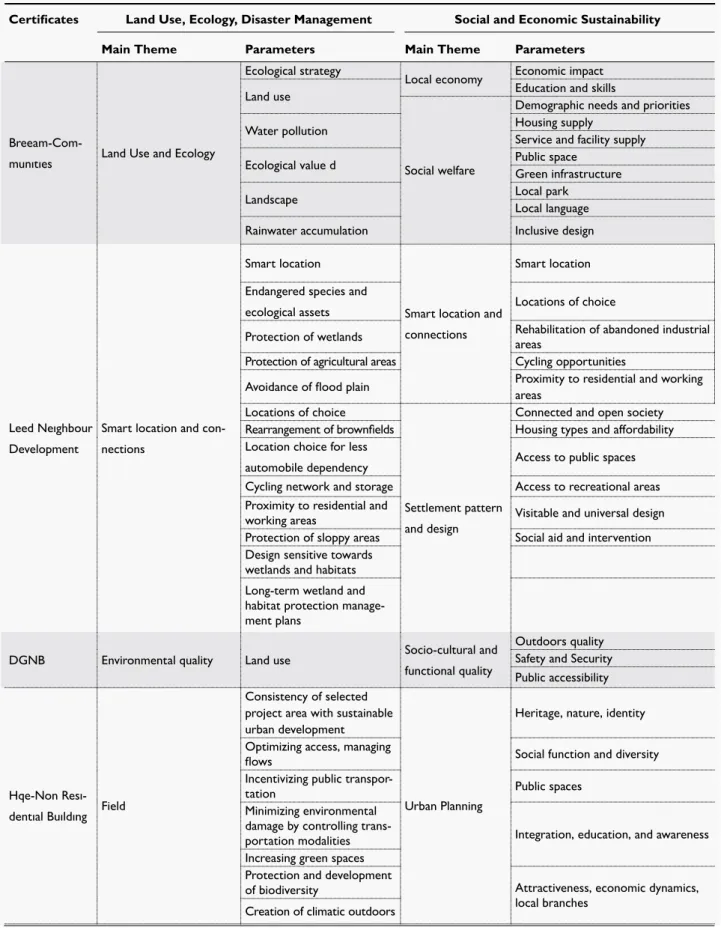
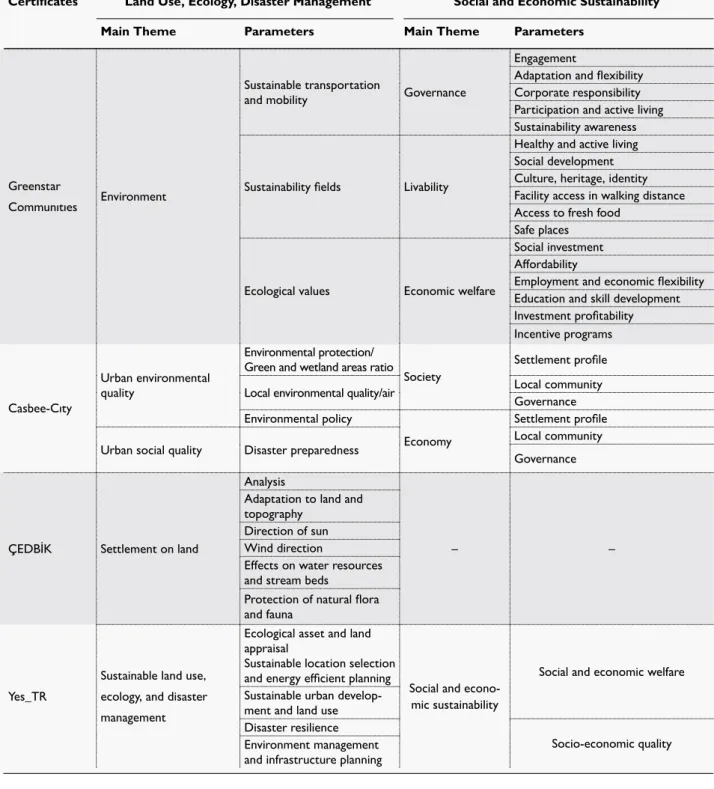
The first step of the national green certification system prepa-ration was the analysis of existing international green certifi-cation systems. As mentioned in previous sections, the most prevalent certifications, namely BREEAM, LEED, DGNB, GREENSTAR, CASBEE, and ÇEDBİK Residential Certificate has been examined in this regard for LUE and SES modules (Table 1). For the analysis of LUE and SES, two parameters are important: their evaluation methods and national barriers they have faced, if there are any.
Formation Process of the National Certification
Having analyzed parameters of international certification sys-tems, following steps have been taken for the formation of the national certification system.
• Formation of the technical manual of the national certi-fication
• Formation of the training guide of the national certification
• Formation of exams for national certification evaluators • Design of national certification logo and certificates • Preparation of the infrastructure for national green big
data management
The certification is divided into two groups: Green Building and Green Settlement. As mentioned above Green Settlement Certification consists of modules on (1) Regional and Imme-diate Vicinity Profiling, (2) Sustainable Land Use, Ecology, and Disaster Management (LUE), (3) Transportation and Mobility, (4) Settlement and Neighborhood Design, (5) Social and Eco-nomic Sustainability (SES). Below, parameters of two modules, LUE and SES, will be clarified. However, it is important to note that these parameters and modules are part of a holistic Green Settlement Certification and fully function together. Sub-cate-gories of LUE and SES are briefly explained below:
a. LUE I - Ecological asset and land appraisal
This main theme is based on primary criteria for sustainable urban environment. It requires that the upper scale and sub-scale plans are established based on the notion of natural en-vironmental protection. It draws attention to the relationship between built environment and the natural landscape. Thus, settlements are certified based on the following reports: (i) upper scale natural, historical and cultural environmental pro-tection decisions report; (ii) ecological asset inventory report (iii) protection and development of biodiversity report
b. LUE II -Sustainable location selection and energy efficient planning
One of the most important components of sustainable devel-opment is the reduction of ecological footprints. This means that productive areas (forests, agricultural land, lakes, rivers, etc.) should be kept distant from urban structure and to con-vert towards compact settlements. Energy efficient planning approach presumes maximization of benefit from energy re-sources. Under this theme, following requirements need to be met: (i) suitability of settlement and evaluation; (ii) sustain-able land analysis and evaluation; (iii) use of renewsustain-able energy; (iv) site selection according to insolation and wind.
c. LUE III -Sustainable urban development and land use
The aim of this category is to direct urban growth towards green settlement by correct land use selection. Urban brown fields are incentivized to be selected to inhibit urban sprawl and ensure compact urban development. Rehabilitation, re-newal and regeneration on urban areas in which legal and administrative incentives already exist are encouraged to apply for this certificate. Criteria for this theme has been determined as follows: (i) selection of urban brown fields for development; (ii) renewal and sanitization old building stock; (iii) selection of sites already declared as renewal/rehabilita-tion areas; (iv) selecrenewal/rehabilita-tion of socially/physically/economically deteriorated areas; (v) increase in open and green area.
Table 1. Green Settlement Certifications and LUE/SES Parameters
Certificates Land Use, Ecology, Disaster Management Social and Economic Sustainability
Main Theme Parameters Main Theme Parameters
Breeam-Com-munıtıes Land Use and Ecology
Ecological strategy
Local economy Economic impact
Land use Education and skills
Social welfare
Demographic needs and priorities Water pollution Housing supply
Service and facility supply Ecological value d Public spaceGreen infrastructure
Landscape Local park
Local language Rainwater accumulation Inclusive design
Leed Neıghbour Development
Smart location and con-nections
Smart location
Smart location and connections
Smart location Endangered species and
ecological assets Locations of choice
Protection of wetlands Rehabilitation of abandoned industrial areas Protection of agricultural areas Cycling opportunities
Avoidance of flood plain Proximity to residential and working areas Locations of choice
Settlement pattern and design
Connected and open society Rearrangement of brownfields Housing types and affordability Location choice for less
automobile dependency Access to public spaces Cycling network and storage Access to recreational areas Proximity to residential and
working areas Visitable and universal design Protection of sloppy areas Social aid and intervention Design sensitive towards
wetlands and habitats Long-term wetland and habitat protection manage-ment plans
DGNB Environmental quality Land use Socio-cultural and functional quality
Outdoors quality Safety and Security Public accessibility
Hqe-Non Resı-dentıal Buıldıng Field
Consistency of selected project area with sustainable urban development
Urban Planning
Heritage, nature, identity Optimizing access, managing
flows Social function and diversity Incentivizing public
transpor-tation Public spaces
Minimizing environmental damage by controlling
trans-portation modalities Integration, education, and awareness Increasing green spaces
Protection and development
of biodiversity Attractiveness, economic dynamics, local branches
d. LUE IV - Disaster resilience
Definition of disaster history, analysis of risks, establishment of disaster management plans are of outmost importance for resilience against urban disasters. It is also very crucial to take precautions for protection and intervention during disasters and avoidance from their destructive effects. Therefore,
settle-ments applying for a certificate should declare (i) a disaster risk report and a settlement plan regarding disaster management; (ii) a plan for assembly areas and of necessary equipment.
e. LUE V - Environment management and infrastructure planning
Water management is not only important on building scale,
Greenstar
Communıtıes Environment
Sustainable transportation
and mobility Governance
Engagement
Adaptation and flexibility Corporate responsibility Participation and active living Sustainability awareness
Sustainability fields Livability
Healthy and active living Social development Culture, heritage, identity Facility access in walking distance Access to fresh food
Safe places
Ecological values Economic welfare
Social investment Affordability
Employment and economic flexibility Education and skill development Investment profitability Incentive programs Casbee-Cıty Urban environmental quality Environmental protection/ Green and wetland areas ratio
Society
Settlement profile Local environmental quality/air Local communityGovernance Environmental policy
Economy
Settlement profile Urban social quality Disaster preparedness Local community
Governance
ÇEDBİK Settlement on land
Analysis
– –
Adaptation to land and topography
Direction of sun Wind direction
Effects on water resources and stream beds
Protection of natural flora and fauna
Yes_TR
Sustainable land use, ecology, and disaster management
Ecological asset and land appraisal
Sustainable location selection and energy efficient planning
Social and econo-mic sustainability
Social and economic welfare Sustainable urban
develop-ment and land use Disaster resilience
Socio-economic quality Environment management
and infrastructure planning
Table 1. CONT.
Certificates Land Use, Ecology, Disaster Management Social and Economic Sustainability
but also on urban scale. Saving of clean water, refinement and reuse of waste water are significant for sustainable urban environment management. Urban waste collection and reuse methods are valuable for sustainable consumption habits. Thus, settlements should have (i) a system for rainwater col-lection; (ii) waste water management and reuse of refined water; (iii) waste collection and reuse).
f. SES I – Social and Economic Development
The aim of the certification is to improve social inclusion, to provide efficient and sufficient services for various demo-graphic groups, to allow social actualization and to reach a social welfare level with high social acceptability in an existing or a developing area. To ensure and incentivize this, the cer-tification grades settlements in regard to (i) adaptability to demographic needs and priorities; (ii) accessibility of public services; (iii) increase in vocational education and skills; (iv) supporting social development; (v) increase in employment opportunities; (vi) increase in investment profitability; (vii) increase in land values; and (viii) use of incentive programs.
g. SES II - Socio-cultural quality
A green settlement should advocate understanding between different cultures, preserving traditional and cultural iden-tities; it should include organization of social and touristic events, as well as necessary strategies for increasing the life quality of local inhabitants to urban plans and design deci-sions. The measures to grade this in a settlement are (i) the increase in local mobility, (ii) improvement in healthy and ac-tive living; (iii) increase in efforts to support local production and use of local products.
For sustainable urban development it is possible to generate many more indicators. These indicators of the Green Certifi-cate and all its modules are based on an initial analysis of its global examples. While creating the certification it has been considered that the indicators can be updated and serve as a first guide and draft to be worked on further. Turkey has seven geographical sub-regions and four different climate ty-pologies which hold many cultural and ethnic groups. There-fore, researchers having generated the Green Certificate Turkey strongly believe that this certification is adaptable for other countries and their settlements.
Conclusion
To achieve sustainable development, countries need to act with shared wisdom acceding to treaties and following sanc-tions. A concrete step from Turkey has been nationalization and institutionalization of green building and certification sys-tem, which has been a research and development project in nature and was prepared in cooperation with academia, ad-ministration and private sector. In this paper, only two of the
modules of the whole certification system, LUE and SES have been examined in detail.
For Turkey this concrete step is expected to contribute to the national economy with its multiplier effect and provide a physical transformation of individual buildings or settlements. Hence, it can be claimed that the outcoming certification is directed towards economic, social and physical welfare. From the perspective of urban planning, with this certifica-tion, specifically the two modules examined in this paper, the researchers hope to ensure sustainable land use, energy efficient planning, bottom-up transformation of unplanned building stock, performance of a planned disaster manage-ment, development of resilient physical and social systems. The confidence of the researchers lies within a future, when local communities embrace the criteria of green certification and thus even without legal procedures sustainable urban de-velopment will be supported in an internalized way.
Acknowledgements
General outputs of the project “A Basic Assessment Guide for Sustainable Green Building-Sustainable Settlement Cer-tification and Preparation of National Data Management Plan for National Green Building Information System Soft-ware Development” are used for this study. This project is collaborated between Istanbul Technical University and Min-istry of Environment and Urbanization of Turkey. As the au-thors of this paper and as members of the project team, we would like to thank Murat Bayram, Murat Kantemir, Namık Sandıkçı, Samet Yılancı, Ömer Eroğlu, Esra Tombak, Yıldız Agaya, Çağlar Özdemir, the experts of Directorate General of Vocational Services of the Ministry for their dedication and valuable contributions.
KAYNAKLAR
BREEAM Official Web Page, Numbers of Project By Countries. (2018). https://tools.breeam.com/projects/explore/map.jsp?sectionid=0&pro-jectType=&rating=&certNo=&buildingName=&client=&developer =&certBody=&assessor=&addressPostcode=&countryId=7&partid =10023&Submit=Search.
Erten D., Henderson K., Kobas B. (2009). A Review of International Green Building Certification Methods: A Roadmap for a Certification System in Turkey. Fifth International Conference on Construction in the 21st Century (CITC-V). Act. No.6306 of Turkish Law, 2012. http://www. resmigazete.gov.tr/eskiler/2016/10/ 20161027-2.htm.
Hamedani A.Z. & Huber F. (2012). A Comperative Study of DGNB, LEED and BREEAM Certificate Systems in Urban Sustainability. The Sustain-able City VII. (Vol I, pp.121-132).
Kibert C.J. (2013). Sustainable Construction: Green Building Design and De-livery (Third Edition). Wiley and Sons: New Jersey.
LEED Official Web Page. Numbers of Project by Countries. (2018). https:// www.usgbc.org/articles/usgbc-announces-international-ranking-top-10-countries-leed.
Official Journal (o.j). (2017, 23 December). No: 30279. http://www. resmigazete.gov.tr/ eskiler/ 2017/12/20171223-3.htm.
Ozcevik O., Oguz M., Akbulut A. (2018). Urban Transformation and Green Certification Systems in Combating Climate Change. İ.T.Ü Foundation Journal. (Vol 80, pp.34-39).
Ringel M. (2006). Fostering the Use of Renewable Energies in the European Union: the Race between Feed-in Tariffs and Green Certificates. Renew-able Energy. (Vol 31, Issue 1, pp. 1-17).
Sharifi A. & Murayama A. (2014). Neighbourhood Sustainability Assess-ment in Action: Cross-evaluation of Three AssessAssess-ment Systems and Their Cases from the US, the UK, and Japan. Building and Environment. (Vol 72, pp. 243-258).
Steffen, W., Richardson, K., Rockström, J., Cornell, S.E., Fetzer, I., E.M. Ben-nett, Biggs, R., S.R. Carpenter, De Vries, W., De Wit, C.A., Folke, C., Gerten, D., Heinke, J., Mace, G.M., Persson, L.M., Veerabhadran, R., Reyers B. & Sörlin S. (2015). Planetary Boundaries: Guiding Human Development on A Changing Planet. Science (Vol 347 (6223), pp.736-748).
The Ministry of Energy and Natural Resources. (2018). National Energy Ef-ficiency Action Plan 2017-2023.
http://www.yegm.gov.tr/document/20180102M1_2018.pdf. TurkStat. (2016). Energy Statistics. http://www.tuik.gov.tr/Start.do. TurkStat. (2017). Foreign Trade Statistics. http://www.tuik.gov.tr/Start.do. TurkStat. Greenhouse Emission Statistics 1990-2015. http://www.tuik.gov.
tr/Start.do.
Union of Turkish Bar Associations. (2014). International Natural Pro-tection Agreements. http://www.cmo.org.tr/resimler/ekler/ 0a964846d55e228_ek.pdf.
United Nations Sustainable Goals 2016 Report. https://sustainabledevelop-ment.un.org/ content/ documents/ 21252030%20Agenda %20for%20 Sustainable%20 Development %20web.pdf.
Wamsler C., Brink E., Rivera C. (2013). Planning for Climate Change in Ur-ban Areas: From Theory to Practice. Journal of Cleaner Production (Vol 50 (1), pp.68-81).