THE INSTITUTE OF SOCIAL SCIENCES
Mehmet Galip ZORBA
AN EVALUATION OF ANATOLIAN HIGH SCHOOLS’ 9th
GRADE EFL CURRICULUM AND COURSE MATERIALS THROUGH THE PRINCIPLES OF THE COMMON EUROPEAN FRAMEWORK OF REFERENCE FOR LANGUAGES
Foreign Language Teaching Department
MA Thesis
THE INSTITUTE OF SOCIAL SCIENCES
Mehmet Galip ZORBA
AN EVALUATION OF ANATOLIAN HIGH SCHOOLS’ 9th
GRADE EFL CURRICULUM AND COURSE MATERIALS THROUGH THE PRINCIPLES OF THE COMMON EUROPEAN FRAMEWORK OF REFERENCE FOR LANGUAGES
Supervisor
Assoc. Prof. Dr. Arda ARIKAN
Foreign Language Teaching Department
MA Thesis
LIST OF TABLES………..……….…iv LIST OF FIGURES……….………....vi LIST OF ABBREVIATION………..….vii ABSTRACT……….viii ÖZET……….………..…....x ACKNOWLEDGMENTS………xii CHAPTER I INTRODUCTION 1.1 Background of the Study..……….…………..2
1.2 Problem of the Study…………...……….……...…3
1.3 Purpose of the Study……….………..4
1.4 Research Questions……….………5 1.5 Limitations……….……….………5 1.6 Definitions of Terms………...6 CHAPTER II REVIEW OF LITERATURE 2.1 The Council of Europe, the European Union and Turkey……….8
2.1.1 Language Education Policies in Europe………..9
2.2 The Common European Framework of References for Languages……….12
2.2.1 Historical Background………...12
2.2.2 Need for the CEFR………14
2.2.3 What is the CEFR? ………....15
2.2.4 The Common Reference Levels (CRL)……….……18
2.2.5 Features of ‘Can do’ Descriptors……….……..23
2.2.6 The A2 (Waystage) Level ………...………...……….……..25
2.3.2 The Coursebooks Used by the MONE………..………32
2.4 Curriculum and Evaluation………...………..33
2.4.1 Types of Curriculum Evaluation…...……….36
2.5 Coursebook Evaluation………...38
2.6 Related Studies on Curriculum and Coursebook Evaluation………..42
2.6.1 National Studies……….42 2.6.2 International Studies………..46 CHAPTER III RESEARCH METHODOLOGY 3.1 Introduction………...51 3.2 Research Method………..………...51
3.3 The Instrument and Data Analysis……..………..52
CHAPTER IV RESULTS AND DISCUSSION 4.1 The Principles of the CEFR………...……….…………..………...54
4.2 Evaluation of Anatolian High Schools’ EFL Curriculum………...60
4.3 Evaluation of New Bridge to Success for Grade 9………….………...87
CHAPTER V CONCLUSION 5.1 Conclusion………..……..95
CHAPTER VI IMPLICATIONS AND SUGGESTIONS 6.1 Implications for Practice………..…99
APPENDICES ………..…114 Appendix 1………..………….114 Appendix 2………...116 Appendix 3………...129 Appendix 4………...130 Appendix 5 ……….……….131 CURRICULUM VITEA………...………..………..132
LIST OF TABLES
Table 2.1 Education Programmes of the CoE………..…....11
Table 2.2 The Features of the CEFR and Their Explanations …...18
Table 2.3 Common Reference Levels………...19
Table 2.4 Common Reference Levels Global Scale………...…..20
Table 2.5 Common Reference Levels Self-assessment Grid………...………...….21
Table 2.6 A2 Level Global Scale……….…………26
Table 2.7 A2 Self-assessment Grid…………...………...………27
Table 2.8 A2-CRL Qualitative Aspects of Spoken Language……….………27
Table 2.9 Foreign Language Learning Principles……….…...29
Table 2.10 The Learning Field: Listening………30
Table 2.11 The Learning Field: Speaking.………..….30
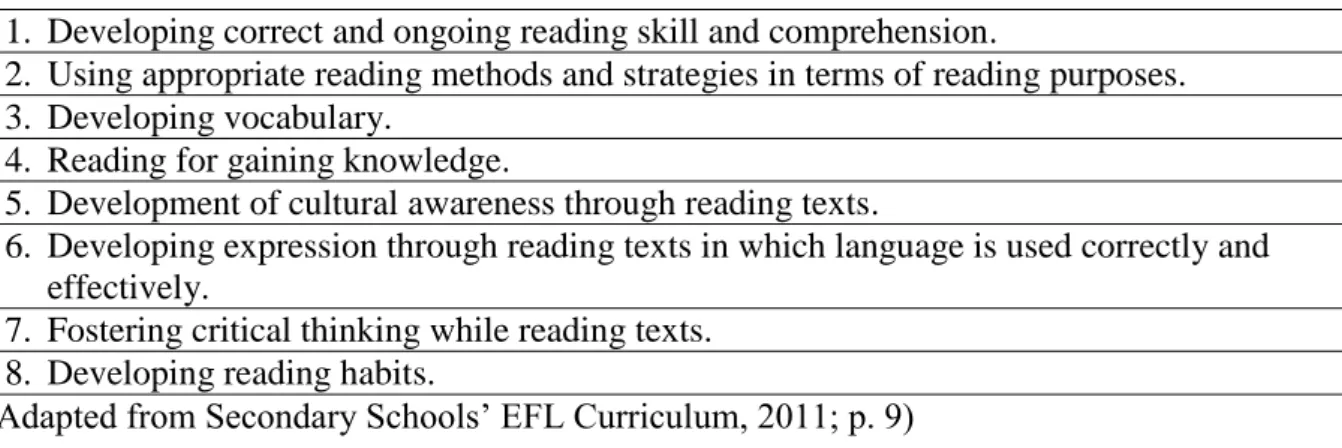
Table 2.12 The Learning Field: Reading ……..………..31
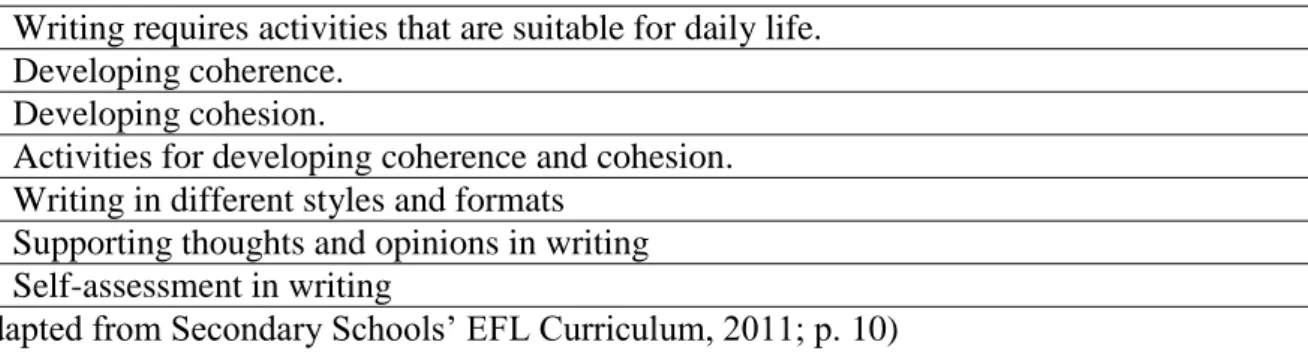
Table 2.13 The Learning Field: Writing………. ………..…..32
Table 4.1 Principles of the CEFR………...……….54
Table 4.2 The A2 Level Principles of the CEFR in the Listening Skill………….…………..58
Table 4.3 The A2 Level Principles of the CEFR in the Reading Skill ………..…….58
Table 4.4 The A2 Level Principles of the CEFR in the Spoken Interaction Skill …………..59
Table 4.5 The A2 Level Principles of the CEFR in the Spoken Production Skill ……...59
Table 4.6 The A2 Level Principles of the CEFR in the Writing Skill …...….60
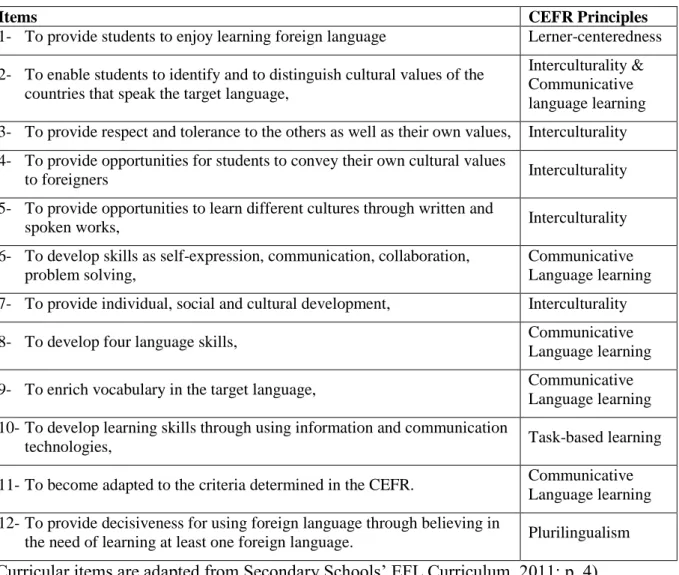
Table 4.7 General Aims of the Curriculum………..……61
Table 4.8 The Scope of the Curriculum………...63
Table 4.9 The Principles of Foreign Language Teaching………...….64
Table 4.10 Setting-up Classroom Environment in Foreign Language Learning……….65
Table 4.11 The Role of Students……….………….………...…66
Table 4.12 General Features of the Curriculum……….………..………68
Table 4.13 Learning-Teaching Process……….………...……...…71
Table 4.14 Assessment……….………73
Table 4.15 The Assessment of Language Elements………...………..74
Table 4.16 The Gains in the Listening Skill..………...………75
Table 4.17 The Gains in the Spoken Interaction Skill.………77
Table 4.18 The Gains in the Spoken Production Skill..………..………….79
Table 4.20 The Gains in the Writing Skill.………..83
Table 4.21 The Overall Results for the Gains………..86
Table 4.22 Distribution of Activities by Skills……….…87
Table 4.23 A2 Listening………...88
Table 4.24 A2 Spoken Interaction………89
Table 4.25 A2 Spoken Production……….………..90
Table 4.26 A2 Reading……….91
Table 4.27 A2 Writing………..92
LIST OF FIGURES
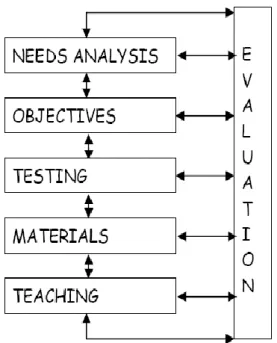
Figure 1.1 Study’s Framework………...……….…..….4 Figure 2.1 Language Division of the Council of Europe …...……….…...…..10 Figure 2.2 Features of the CEFR………...17 Figure 2.3 Brown’s Systematic Approach Designing and Maintaining Language
LIST OF ABBREVIATIONS
CEFR: The Common European Framework of Reference for Languages CoE: Council of Europe
CRL: Common Reference Levels
DIALANG: Diagnostic Language Testing ECML: European Centre for Modern Languages EFL: English as a Foreign Language
EHEA: European Higher Education Area ELP: European Language Portfolio ELT: English Language Teaching EU: European Union
ABSTRACT
The CEFR has been one of the most debated issues in foreign language teaching in the last decade. It aims to standardize language teaching, learning and assessment across Europe through setting some principles. Therefore, some scholars have been praising the CEFR whereas some harshly criticize it. Nevertheless, The MONE has decided to revise EFL curricula and course materials in accordance with the principles of the CEFR. The current curriculum, prepared in 2011, states that communicative approach and the criteria determined in the CEFR were adopted during the development of the curriculum. Besides, in Turkey’s case, EFL curricula are only maintained with and highly dependent on coursebooks. Therefore, both EFL curricula and the related course materials are worth being evaluated in terms of the principles of the CEFR in order to identify coherence of both documents with the CEFR. In this sense, the aim of this study is to evaluate Anatolian High Schools’ 9th grade EFL curriculum and the related coursebook titled New Bridge to Success for Grade 9, through the principles of the CEFR.
In parallel to the aim of the study, answers are sought to the following research questions that guided the study;
1. What are the principles of the CEFR?
2. To what extent does Anatolian High Schools’ 9th grade EFL curriculum meet the principles of the CEFR?
3. To what extent do the Anatolian High Schools’ 9th grade EFL course materials meet the principles of the CEFR?
As for the method of the study, document analysis method is employed to seek answers to the research questions set. The CEFR, Anatolian High Schools’ 9th grade EFL curriculum, and the related coursebook titled as New Bridge to Success for Grade 9 are the documents analyzed in this study. In order to determine the principles of the CEFR according to which the curriculum and the coursebook examined, the CEFR was exposed to multiple readings by the researcher. As a result of this process, the principles of the CEFR were determined. During the analysis of the curriculum these determined principles of the CEFR are sought. Then, the gains of the curriculum for the five language skills were analyzed through a checklist adopted from the
A2 level descriptors of the ELP. In this process, the coursebook was first analyzed in terms of the tasks and their distributions among the five skills were determined. Then, they were analyzed in order to identify whether these tasks were suitable for the A2 level or not. Lastly, the coursebook is analyzed again so as to identify the principles of the CEFR.
As a result, nine principles of the CEFR were defined. These defined principles of the CEFR are sought in Anatolian High Schools’ curriculum, and the following results are reached;
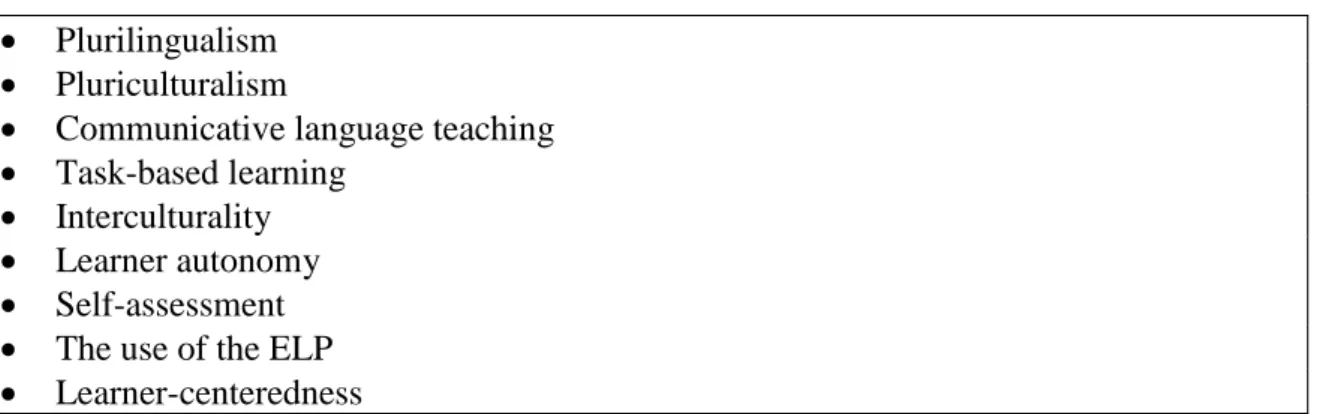
1. In general, the curriculum embraces 7 out of 9 principles of the CEFR which are communicative language teaching, task-based learning, autonomy, learner-centeredness, self-assessment, interculturality and pluriculturalism whereas plurilingualism and the ELP are overlooked in the curriculum. However, these 7 principles are not harmonized equally. Communicative language teaching, task-based learning, learner-autonomy, learner-centeredness are prioritized whereas self-assessment, interculturality and pluriculturalism remain in the background.
2. The analysis of the gains for the five language skills shows that there is an unequal distribution in the gains for the five skills. Besides, the results show that 38.29% of the gains are appropriate to the A2 level descriptors.
3. The general analysis of the coursebook shows that there is an unequal distribution among tasks. In this sense, the coursebook mainly focuses on teaching grammar rules and vocabulary rather than teaching the five language skills since 30.5% of the tasks in the coursebook are related to grammar rules and vocabulary.
4. The detailed analysis of the tasks shows that the coursebook titled as New Bridge to Success for Grade 9 are not appropriate to the A2 level since 168 out of 792 (21.21%) tasks match with the A2 level descriptors.
5. Lastly, the analysis of the coursebook in terms of the principles of the CEFR shows that the coursebook does not involve any tasks related to plurilingualism. Besides, it does not support the use of the ELP. It provides a limited number of activities related to interculturality and pluriculturalism.
ÖZET
Avrupa Dilleri Öğretimi Ortak Çerçeve Programı (ADÖÇEP) son yıllarda yabancı dil öğretiminde oldukça tartışılan bir kavramdır. Bazı uzmanlar tarafından oldukça benimsenirken bazı tarafından da sert bir şekilde eleştirilere maruz kalmaktadır. Temel olarak Avrupa’daki dil öğrenime, öğretime ve değerlendirmesini bir takım prensipler ile belirli bir standarta sokmayı hedeflemektedir. Milli Eğitim Bakanlığı’nda İngilizce öğretim programını ADÖÇEP’e göre yenilenmesine karar vermiş ve mevcut program 2011 yılında uygulanmaya başlamıştır. Buna bağlın olarak okullarda okutulan İngilizce ders kitapları da programa uygunluklarının sağlanması için yenilenmiştir. Buna ek olarak, Türkiye’de İngilizce öğretiminin ders kitaplarıyla sürdürülebilmesi ve İngilizce derslerinin sadece ders kitaplarına bağımlı bir halde işlenmesi, hem mevcut İngilizce öğretim programının hem de İngilizce ders kitaplarının ADÖÇEP’e göre değerlendirilmesini gerekli kılmaktadır.
Bu çalışmanın amacı da mevcut İngilizce öğretim programını ve Anadolu Liseleri 9. Sınıflarında okutulan New Bridge to Success for Grade 9 isimli ders kitabını ADÖÇEP’in prensiplerine göre incelemek ve hem mevcut programın hem de ders kitabının ADÖÇEP’in öngördüğü prensiplerle ne kadar uyumlu olduğunu görmektir.
Çalışmanın amacına uygun olarak, aşağıdaki araştırma sorularına yanıt aranmıştır. 1. ADÖÇEP’n prensipleri nelerdir?
2. Anadolu Liseleri 9. Sınıf İngilizce dersi öğretim programı, ADÖÇEP’in prensipleriyle ne kadar uyumludur?
3. Anadolu Liseleri 9. Sınıf İngilizce ders kitabı (New Bridge to Success for Grade 9), ADÖÇEP’in prensipleriyle ne kadar uyumludur?
Araştırma doküman incelemesi ilkelerine göre yapılmıştır ve elde edilen veriler içerik analizi yöntemiyle değerlendirilmiştir.
İngilizce öğretim programı ve ders kitabının incelenmesinin ardından aşağıdaki sonuçlara ulaşılmıştır.
1. Mevcut İngilizce dersi öğretim programı, ADÖÇEP’in belirlenen dokuz prensibinden yedi tanesini kapsamaktadır. Ancak mevcut program bu yedi prensibi eşit bir şekilde karşılamamaktadır. Mevcut program bu yedi prensipten bazılarını ön
plana çıkarırken, bazılarını arka planda bırakmıştır, bazılarını da programa hiçbir şekilde dahil etmemiştir.
2. Mevcut İngilizce dersi öğretim programının kazanımlarının incelenmesi ve analiz edilmesi sonucunda, beş dil becerisindeki (dinleme, yazma, okuma, karşılıklı konuşma ve sözlü anlatım) kazanım sayılarında dengesiz bir dağılım saptanmıştır. Programda toplam 235 kazanıma yer verilmiştir. Ancak bu 235 kazanımın sadece 90 tanesi (% 38.29) A2 seviyesinin betimleyicilerine uygundur.
3. Anadolu Liseleri 9. sınıflarında okutulan ders kitabının genel incelemesi sonucunda, söz konusu ders kitabında yer alan etkinliklerde dil becerilerine göre dengesiz bir dağılım saptanmıştır. Ders kitabının %30’luk kısmının dilbilgisi ve kelime öğrenimine yönelik etkinliklerden oluştuğu görülmüştür. Ayrıca sözlü anlatım ve yazma becerisine yönelik etkinliklerin sayısı bu becerilerin öğretilmesini için tatmin edici sayıda değildir. Bu açıdan bakıldığında, söz konusu ders kitabının mevcut İngilizce dersi öğretim programıyla ve ADÖÇEP’le uyumlu olduğunu söylemek oldukça zordur.
4. Söz konusu ders kitabının detaylı incelemesi sonucunda ise ders kitabında yer alan toplam 792 etkinliğin sadece 168 tanesinin (% 21.21) A2 seviyesine uygun olduğu belirlenmiştir.
5. Söz konusu ders kitabı ADÖÇEP’in prensipleri açısından incelendiğinde de, belirlenen prensiplerin bazılarının ders kitabı tarafından göz ardı edildiği görülmüştür.
Bu sonuçlar ışığında Milli Eğitim Bakanlığı’na mevcut İngilizce dersi öğretim programının ve incelenen ders kitabının geliştirilmesine yönelik önerilerde bulunulmuştur.
ACKNOWLEDGEMENT
I started my MA thesis under the guidance of my advisor Assoc. Prof. Dr. İsmail Hakkı MİRİCİ without whom this thesis would not be realized.
I would like to express my deepest gratitude to my thesis supervisor Assoc. Prof. Dr. Arda ARIKAN, for his invaluable support and patience throughout the study. His academic guidance and daily encouragement enabled me to continue my studies. I feel honored to be one of his privileged students.
I would also like to specifically thank Asst. Prof. Dr. Hatice Sezgi SARAÇ for her valuable contributions to my study.
In addition, I wish to express my deepest thanks to my fiancé Hatice AKIN for her warm support and patience.
Last but not least, my sincere thanks to my parents, Erdal and Aynur ZORBA, for their patience and understanding. I also owe thanks to my sister Merve ZORBA.
CHAPTER I
INTRODUCTION
This chapter gives some background information on the study, titled “An Evaluation of Anatolian High Schools’ 9th
Grade EFL Curriculum and Course Materials through Principles of the Common European Framework of Reference for Languages” (hereafter CEFR), and presents the problem and the analysis of the study. After giving the purpose of the study, it also presents the research questions. Through the end of the chapter the limitations that affected the study and definition of terms are also presented and discussed in detail.
Although English is not the most widely spoken native language in the world, it has, undoubtedly, become a lingua franca and became the most popular foreign language (Seidlhofer, 2005). Therefore, English started to be learnt by many people all round the world. As a result of this, as Acar (2009) states, “English has taken various forms reflecting the linguistic and cultural backgrounds of the speakers” (p. 12). Furthermore, Acar (2009) explains that English is not only learned as a foreign language to communicate with native speakers but is used more and more as an international language among both native and non-native speakers (p.12). The fact that many people has learnt English brought forth the term English as a foreign language (hereafter EFL). Different language teaching approaches and methods developed in years, and they more or less affected EFL in years. Communicative language teaching is one of the methods that affected EFL. The method aims to teach the target language by making communicative competence the goal of language teaching and by acknowledging the interdependence of language and communication (Larsen-Freeman, 2010). Communicative language teaching was well embraced by the Council of Europe for projects aiming to develop conceptual and planning instruments to assist teachers and course planner to analyze learners’ needs and learning objectives (van Ek and Trim, 1990). As a result of this project, in 1975, van Ek and Trim published their books named as the Threshold Level, which provides a set of specifications for first-level communicative language syllabi and have had a strong influence on the design of communicative language programs and coursebooks in Europe (Richards & Rodgers, 2006). The well acceptance of the book paved way to the Waystage Level in 1990 and the Vantage Level in 2000. In 2001, these three publications were incorporated in and constitute The Common European Framework of References for Languages (CEFR). The CEFR is mainly based on communicative language teaching which aims at standardization in language teaching, learning and assessment by targeting the
improvement of communicative and intercultural competencies, and that of learner autonomy (Karababa & Saraç-Süzer, 2010). The CEFR has been used for developing language tests, certificate programs, curricula and coursebooks since 2001 (Mansilla & others, 2007).
The Ministry of Turkish National Education (hereafter MONE) has been working on the adaptation of the CEFR in foreign language education in Turkey. The Secondary Schools’ EFL curriculum published in 2011 is stated to have adopted the criteria determined in the CEFR. Students’ learning gains as stated in the curriculum are based on both the CEFR and the principles of the communicative language teaching.
This study aims to reach results about both the current EFL curriculum and the coursebook used in Anatolian High Schools’ 9th
grade. It is expected that the detailed analysis of the curriculum and the course materials will provide data on the reflection of the CEFR in the curriculum and the course materials.
In this study, the researcher tries to present a descriptive, not prescriptive, study on evaluation Anatolian High Schools’ EFL curriculum and the related coursebook in terms of the principles of the CEFR. This study includes six chapters and the detailed information about each chapter is given as follows.
In this chapter the components of the research such as the background of the study, problem of the study, purpose of the study, research questions and limitations are presented. In the second chapter, a detailed literature review on the CEFR, Anatolian High Schools’ EFL curriculum and procedures related to coursebook evaluation are presented. In the third chapter, the method of the study is explained in a detailed way. In the fourth chapter, the curriculum and the coursebook are analyzed through focusing on the principles of the CEFR and the A2 level descriptors, and the results are discussed. In the fifth chapter, the summary of the study and the overall evaluation of the results are shared. In the last chapter, practical and theoretical implications of the study are presented.
1.1 Background of the Study
In foreign language teaching, it has been widely recognised that speaking, reading, writing and listening are indispensable skills that learners need so as to communicate in a foreign language in a culturally and socially appropriate way. In other words, the main aim of
language learning is to communicate with other people in one way or another. CEFR, which was developed by the Council of Europe, came to fore and has been on the agenda in the realm of language teaching for the last decade although it has its origin in over 40 years of work on modern languages. What has made it so popular in the last decade is the changes in the methods of teaching, the nature of the materials used, the description of what is to be learnt and the originality of the assessment of learning. The CEFR is intended to standardize language learning across Europe by providing:
“a common basis for the elaboration of language syllabuses, curriculum guidelines, examinations, textbooks, etc. across Europe. It describes in a comprehensive way what learners have to learn to do in order to use a language for communication and what knowledge and skills they have to develop so as to be able to act effectively” (Council of Europe, 2001, p. 1).
The CEFR’s main function is to assist learners, teachers, course designers, examining bodies and educational administrators to co-ordinate their effort. As it includes self-assessment checklists, it enables teachers and students to see their progress. In the light of these innovations, the MONE has decided to revise Turkey’s EFL curricula and course materials in accordance with the principles of the CEFR. The Board of Education has made some fundamental adjustments in both EFL curricula and the course materials. Hence, the aim of this study is to evaluate the revised version of the Anatolian High Schools’ 9th grade EFL curriculum and the course materials in relation to the principles of the CEFR and to discuss to what extent the curriculum and the course materials meet the principles of the CEFR.
1.2. Problem of the Study
Learning a foreign language has been a necessity for the last two decades in the world that has been globalizing rapidly. As globalization affects not only foreign relations but also education and educational policies, communicating in at least one foreign language effectively has become essential. As the most commonly used language in the world, English is the most dominant foreign language in our education system. Demirel (2003) states that foreign language education in Turkey is based on teaching English as a foreign language. This is also because English is the dominant language in almost all communicative channels such as television, the Internet, and mass media. Since 2004, the MONE has been revising our education system. In this process, it was announced that the drawbacks and obsolete part of the foreign language education curricula and the course materials would also be revised. The Board of Education declared that “the CEFR is a valuable source to be used for the
development of foreign language curriculum, and the new program will be based on the CEFR” (Karaçalı, 2004). In this sense, the Board of Education decided to initiate the application and dissemination of the CEFR.
Despite all the promising development about the revision of the EFL curricula according to the principles of the CEFR, the consistence of the EFL curricula and the course materials related with the CEFR is not at an expected level (Tosun, 2007; Doğan 2007). Besides the program, teachers also have difficulty with the course materials in terms of content and availability. Ezici (2008) states that the coursebook titled as New Bridge to Success - which was declared to be prepared in accordance with the CEFR - is not an effective coursebooks series in terms of the selection and organization of the content. In addition, she states that many English teachers are not satisfied with the New Bridge to Success series.
To sum up, it can be stated that the MONE has had great challenges in adapting and revising the EFL curricula and related course materials according to the principles of the CEFR although such efforts must be studied scientifically to improve the quality of education.
1.3. Purpose of the Study
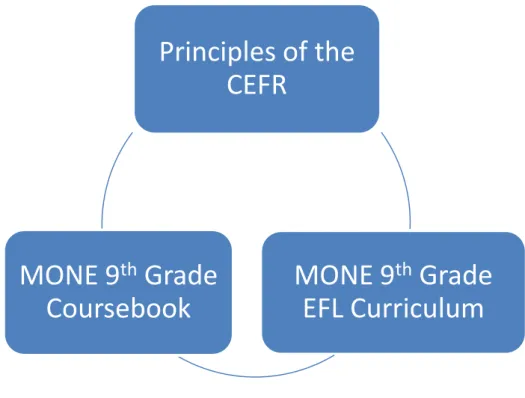
In the light of the information mentioned above, the main purpose of this study is to evaluate the Anatolian High Schools’ 9th
grade EFL curriculum and the course materials in relation to the CEFR (see Figure 1). The study aims at examining the principles of the CEFR in detail and to discuss to what extent Anatolian High Schools 9th grade EFL curriculum and the course materials match with the principles of the CEFR.
Figure 1.1 The Study’s Framework
On the other hand, it is believed that the results of the study would be useful for revising and improving both the EFL curriculum and the related course materials. In this way, it is aimed that the CEFR will be understood better and teachers as well as learners will be able to use it effectively in the language teaching/learning process.
1.4. Research Questions
Parallel to the aims of the study, the following research questions are expected to be answered:
1- What are the principles of the CEFR?
2- To what extent does Anatolian High Schools’ 9th grade EFL curriculum meet the principles of the CEFR?
3- To what extent do Anatolian High Schools’ 9th grade EFL course materials meet the principles of the CEFR?
1.5. Limitations
The study has some contextual limitations. The study is limited to the evaluation of Anatolian High School’s 9th
grade EFL curriculum within the frame of the CEFR. Therefore,
Principles of the
CEFR
MONE 9
thGrade
EFL Curriculum
MONE 9
thGrade
Coursebook
some items observed in the curriculum may be regarded as unsuitable in relation the CEFR although they might be methodologically and theoretically correct. Furthermore, some sections of the curriculum are not included in the study as they do not serve to the aims of the study.
The gains stated in the curriculum are only analyzed through the A2 level descriptors since they refer to the five language skills stated in the CEFR. Lastly, only one coursebook that 9th grade students study is analyzed as a course material. Therefore, the findings about the coursebook analyzed cannot be attributed to all of the coursebooks studied in Anatolian High Schools.
1.6 Definitions of Terms
Action-oriented approach: the view of language pedagogy that focuses on various tasks that represent life-like situations.
Can-do statements: The descriptors that inform language users what he or she can do in a certain skill.
Common reference levels (CRL): The levels of proficiency required by existing standards, tests and examinations in order to facilitate comparisons between different systems of qualifications. There are six levels defined by the CoE: A1, B1, B1, B2, C1, and C2 (Council of Europe, 2001; p. 21).
Communicative language competences: These are competences which empower a person to act using specifically linguistic means (Council of Europe, 2001; p. 9).
Communicative language teaching: It aims to construct of communicative competence together with language functions and argued that learners are expected to be able use. Drawing the attention to the nature of styles and nonverbal communication, it encourages teachers to teach actual communication, not merely structures out of context (MEB, 2006; p. 18).
Global scale: Language proficiency assessment statements that focus merely on overall proficiency.
Language activity: It involves the exercise of one’s communicative language competence in a specific domain in processing (receptively and/or productively) one or more texts in order to carry out a task (Council of Europe, 2001; p. 10).
Plurilingualism: Plurilingualism is the ability of an individual to speak more than two languages. However, it is different that multilingualism in which each language is considered in isolation. Plurilingualism emphasized that the languages used should interrelate and interact with one another as a whole in the learner’s brain (Ekşi, 2008).
Task:A task is defined as any purposeful action considered by an individual as necessary in order to achieve a given result in the context of a problem to be solved, an obligation to fulfill or an objective to be achieved. This definition would cover a wide range of actions such as moving a wardrobe, writing a book, obtaining certain conditions in the negotiation of a contract, playing a game of cards, ordering a meal in a restaurant, translating a foreign language text or preparing a class newspaper through group work (Council of Europe, 2001; p. 9).
CHAPTER II
REVIEW OF LITERATURE
In Chapter II, the review of literature on key aspects of the study is shared. First, the Council of Europe (hereafter CoE), the European Union (hereafter EU) and Turkey’s relationship is briefly explored. Then, language education policies in Europe are explained followed some general information about the CoE and the EU is stated. After that, the CEFR, its historical background and its principles are shared in conjunction with those education policies in Europe. What follows is detailed information about Anatolian High Schools’ and the 9th grade EFL curriculum. The related literature on curriculum and coursebook evaluation and the key aspects of them are presented.
2.1. The Council of Europe, the European Union and Turkey
World War II led to unprecedented economic and social devastation and also human suffering in Europe, which resulted in disintegration and polarization among the European countries. Besides, it caused the new political necessities and challenges in Europe as well. One of the most significant necessities in the aftermath of World War II was the reconciliation among the Europeans, yet the polarization resulted from World War II among European states was the biggest challenge (Prettenthaler-Ziegerhofer, 2010).
The idea of integration of Europe came to fore in the beginning of the 50s. The term of “United States of Europe” was first publicly stated by Winston Churchill in his famous speech in 1946 in Zurich (Winkler, 2010). After tough negotiations and intense consultations, the idea was embraced, and on 5 May 1949 the CoE was founded in Strasbourg with the participation of ten founding states: Belgium, Denmark, France, Ireland, Italy, Luxembourg, the Netherlands, Norway, Sweden and the United Kingdom (Prettenthaler-Ziegerhofer, 2010). Turkey participated in the CoE on 9 August 1949, nevertheless it obtained the founding member state status and has continuously taken part in the work of the CoE so far (Demirel, 2003).
Today, the EU is an economic and political partnership including 27 European countries. The objectives of the EU are based on providing permanent peace in Europe. In that sense, the CoE and the EU share similarities since both aim to provide permanent peace (Gülcan, 2005). One of the significant objectives of the EU is to coordinate of the member states in
developing common policies in industry, energy, agriculture, transportation, custom, environment, science, technology and education (Gülcan, 2005; Serbest, 2005). After education, the EU’s education policies can be defined as the policies and decisions shaped by the CoE and the European Commission (EC) so as to promote collaboration and harmonization in education (Terzi, 2005).
Today, Turkey is still one of the full membership candidate states which maintains the EU’s accession negations process. Turkey, however, needs to make political, socio-economic, legal and educational reforms (Gülcan, 2005; Tuzcu 2006). Thus, Turkey has been applying and integrating the policies developed in many fields and also started to take part in policy developing processes in these fields. In terms of education policies, Turkey has started to take part in such education programmes as Socrates, Comenius, Grundvig and Leonardo Da Vinci, all of which are the products of the EU Education and Youth Programmes. Turkey was entitled to benefit from the EU Education and Youth Programmes after the Helsinki Summit. Moreover, since 2001, Turkey has been the full member of the Bologna Process, which aims at restructuring European Higher Education Area (EHEA). EHEA was launched in 2010, and “intends to ensure more comparable, compatible and coherent systems of higher education in Europe” (EHEA, n.d.).
2.1.1. Language Education Policies in Europe
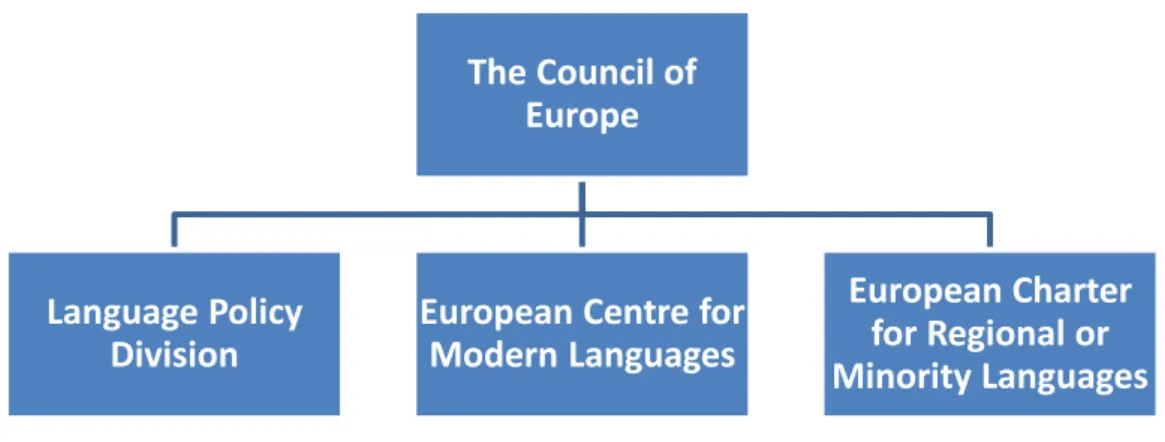
As it is known, the EU consists of various nations embodying different cultures and languages. Different cultures and languages mean having different barriers in front of mutual understanding. However, the main objective of the EU is to integrate all these cultures and languages in harmony. Hence, common language education policies were accepted as a priority in promoting mutual understanding while respecting the differences so as to remove these barriers. In order to avoid the obstacles stemming from lack of communication, the CoE founded three official institutions on language policy. These are The Language Policy Division, The European Centre for Modern Languages (hereafter ECML) and The European Charter for Regional or Minority Languages.
Figure 2.1 Language Divisions of the Council of Europe
The Language Policy Division aims to execute intergovernmental programmes about language education while attaching great importance to activities and tools to support policy development. The Division’s programmes and policies are complemented by the ECML and the European Charter for Regional or Minority Languages (Council of Europe). The ECML, based in Austria, works in collaboration with the Language Policy Division for improvement in the teaching and learning of the languages and supports member states in bringing language education policies and practices together (ECML). The European Charter for Regional or Minority Languages is a reflection of the prompting and protecting cultural heritage policy of the CoE based on the idea that languages are indispensable aspects of cultures (Kozhemyakov, 2008). In that sense, the charter aims to encourage the use of minority or regional languages in public and private life (Kozhemyakov, 2008).
The CoE language education policies, generally, aim to promote; plurilingualism,
linguistic diversity, mutual understanding, democratic citizenship,
social cohesion (Boldizsar, 2003)
The first step in language education in Europe started with the Lingua Programme which was developed by the CoE in 1976. The programme has four objectives;
providing the European youths to learn at least two foreign languages spoken in the CoE member states,
The Council of Europe
Language Policy Division
European Centre for Modern Languages
European Charter for Regional or Minority Languages
encouraging using new methods to learn new foreign languages,
disseminating daily use of the European languages in each level of education, raising awareness of community, language and culture (Tok & Arıbaş, 2008).
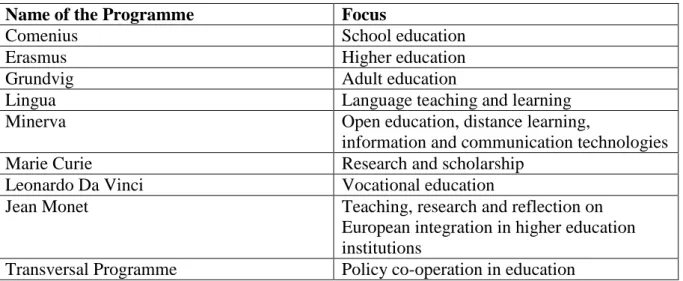
The EU focuses on education programmes all of which either include or centre around language education. Some of the objectives of the education programmes of the EU concentrate on the importance of language education (Tok & Arıbaş, 2008). The CoE has contributed to the development of many education programmes all of which either includes or focuses on language teaching and learning. The educational programmes of the CoE are given in Table 1.
Table 2.1 Education Programmes of the CoE
Name of the Programme Focus
Comenius School education
Erasmus Higher education
Grundvig Adult education
Lingua Language teaching and learning
Minerva Open education, distance learning,
information and communication technologies
Marie Curie Research and scholarship
Leonardo Da Vinci Vocational education
Jean Monet Teaching, research and reflection on
European integration in higher education institutions
Transversal Programme Policy co-operation in education
The Erasmus Programme constitutes the higher education part of the Socrates Programme. In terms language education, one of the main objectives of the Erasmus Programme is to develop intercultural understanding and integrity via teaching different languages spoken in Europe (Gülcan, 2005; Serbest, 2005). Moreover, one of the activities of the Erasmus Programme is the intensive language preparation course (IP) which takes between 3-8 weeks with an aim of teaching the language of the university in one of the EU member states where the exchange students will take education for a term or a year (Serbest, 2005; Turan 2005). The other activity is curriculum development (CD) which includes the development of special language modules as well as dissemination of them. The Comenius Programme, on the other hand, focuses on all levels of schools from pre-school to high school. One of the objectives of the Comenius Programme is to encourage language learning, innovative ICT-based services
and better teaching practices and techniques. In this sense, the programme particularly focuses on language learning and motivation for learning (Serbest, 2005). The EU gives importance to all of these programmes since they play a vital role in the integration of diverse cultures and languages under the same roof.
2.2. The Common European Framework of References for Languages
In language teaching, speaking, reading, writing and listening have been accepted to be indispensable aspects that learners need to develop so as to communicate in a foreign language (Harmer, 2001; Larsen-Freeman, 2008). Hence, communicative language teaching has gained significance since it places emphasis on developing all four skills while focusing on communication in the target language. The CEFR, which was developed by the CoE, has its origin in over 40 years of work on modern languages in various projects of the CoE (Heyworth, 2006). What has made it so popular in the last decade is the changes in methods of teaching, the nature of the materials used, the description of what is to be learnt and the assessment style used in evaluating the learning outcomes (Byram & others, 2002). The CEFR is the product of a long-term scientific research and thus, the need and historical background of it are required to be explained so as to comprehend the rationale of the CEFR. The CEFR is intended to overcome the barriers to communication among professionals working in the field of modern languages (Council of Europe, 2001).
2.2.1. Historical Background
1970s witnessed the appearance of communicative approach, which is regarded as a major breakthrough in language teaching. This approach prioritizes that language learners must be able to communicate in the foreign language (Savignon, 2002; Littlewood 2002). Learning languages for communicative purposes resulted in two essential concerns: analysing the learners’ communicative needs and describing the language they must learn in order to fulfil those needs (Little, 2006). Therefore, communicative approach supported the view that a certain level of proficiency had to be attained in order to ensure that learners use the language in real-life communication. The first step of the CEFR was taken in 1971, which concurred with the appearance of communicative approach.
The rich heritage of cultural and linguistic diversity of Europe is valuable whereas it is also one of the biggest challenges for mutual understanding and communication (Council of
Europe, 2001). Therefore, one of the major priority areas of the CoE is the encouragement of teaching and learning of the European languages. In the pursuit of setting standards that meet the objectives of the Lingua Programme, the CoE initiated various projects. These projects resulted in a series of different syllabi at different language proficiency levels (Heyworth, 2006; Morrow, 2004). The series started with The Threshold Level which was first published in 1975. The Threshold Level aims to determine the minimum amount of language that learners need to know so as to use the target language communicatively (van Ek & Trim, 1990). It involves such simple speech acts as introducing, leave-taking, persuading, apologizing. It also includes such specific notions for communication as daily life, travel, personal identification, education and shopping (van Ek & Trim, 1990). However, the Threshold Level is concerned only with oral communication (Little, 2006). Although this level focuses on what learners should be able to in their target language, it does not explain comprehensively how well they should be able to do it (Little, 2006).
By the middle of the 80s, the Threshold Level had already shown that it helped to upgrade syllabi for secondary schools (Council of Europe, 2002). The success of the Level paved the way to the Waystage (1991) and the Vantage Level (1997) both of which present similar speech acts and notions. Furthermore, all of these documents follow the principles of communicative language learning, action-oriented approach and learner-centeredness all of which provide the basis of the CEFR (Kohonen, 2003; Heyworth, 2006). These three documents provided labels for three of the CEFR’s common reference levels (CRL); A2 Waystage, B1 Threshold, and B2 Vantage defined in the CEFR. The Swiss National Science Research Council held a symposium on “Transparency and Coherence in Language Learning; Objectives, Assessment and Certification” in Rüschlikon, Switzerland in 1991. During the symposium, the CRL descriptors, which describe the competences of these levels by “can-do” statements, were established, and another three levels were added to the CRL after the validation process of the descriptors (North, 1995).
These new CRL are A1 Breakthrough, C1 Effective Operational Proficiency, C2 Mastery. In the middle of 1990s, the CoE initiated a project which aimed at unifying all these levels under one coherent Framework (Council of Europe, 2002a). The following two main aims were the focus points during the development process of the CEFR:
1. “to encourage practitioners of all kinds in the language field, including language learners themselves, to reflect on such questions as:
a. what do we actually do when we speak (or write) to each other?
b. what enables us to act in this way?
c. how much of this do we need to learn when we try to use a new language?
d. how do we set our objectives and mark our progress along the path from total ignorance to effective mastery?
e. how does language learning take place?
f. what can we do to help ourselves and other people to learn a language better? 2. to make it easier for practitioners to tell each other and their clientèle what they wish
to help learners to achieve, and how they attempt to do so.” (Council of Europe, 2002a, p.3)
In 1996, the initial version of the CEFR was published followed by the second revised version in 1998. Finally, after extensive feedback and comprehensive discussions, the last version of the CEFR was published in 2001 (Council of Europe, 2002a: Morrow, 2004; Heyworth, 2006).
2.2.2. Need for the CEFR
The need for the CEFR was directly related with and based on the language education policies of the CoE. The CoE aims at establishing coherence and transparency in teaching of modern languages in the EU member countries. As mentioned before, the CoE language education policies aim to promote plurilingualism, linguistic diversity, mutual understanding, democratic citizenship, social cohesion (Boldizsar, 2003). Moreover, the objectives of the education programmes demand greater mobility, more effective international communication, better access to information and more intensive personal interaction. In order to meet these demands and achieve these objectives, language education should be designed on a life-long basis in all levels of education systems, from pre-school to adult education (Boldizsar, 2003). However, it is obvious that there was a need for setting some standards and criteria in language teaching, learning and assessment. The need for developing such a framework was stated in the Intergovernmental Symposium held in Rüschlikon, Switzerland November 1991, (Council of Europe, 2001). According to the Symposium;
1. A further intensification of language learning and teaching in member countries is necessary in the interests of greater mobility, more effective international communication combined with respect for identity and cultural diversity, better access
to information, more intensive personal interaction, improved working relations and a deeper mutual understanding.
2. To achieve these aims, language learning is necessarily a life-long task to be promoted and facilitated throughout educational systems, from pre-school through to adult education.
3. It is desirable to develop a Common European Framework of reference for language learning at all levels, in order to:
promote and facilitate co-operation among educational institutions in different countries;
provide a sound basis for the mutual recognition of language qualifications;
assist learners, teachers, course designers, examining bodies and educational administrators to situate and co-ordinate their efforts (Council of Europe, 2001: 5-6).
2.2.3. What is the CEFR?
The CoE defines the CEFR as follows:
“The Common European Framework provides a common basis for the elaboration of language syllabuses, curriculum guidelines, examinations, textbooks, etc. across Europe. It describes in a comprehensive way what language learners have to learn to do in order to use a language for communication and what knowledge and skills they have to develop so as to be able to act effectively. The description also covers the cultural context in which language is set. The Framework also defines levels of proficiency which allow learners’ progress to be measured at each stage of learning and on a life-long basis” (Council of Europe, 2001: p.1).
In other words, Little (2006) argues that the CEFR is offered as a basis for sustained international co-operation in the development of language education policy, the construction of language curricula, the implementation of language learning and teaching, and the assessment of language learning outcomes (p. 169). According to Moreno (2003), it is a document designed to set standards of language teaching and learning.
The CEFR is believed to enhance the transparency of courses, syllabuses and qualifications by the common basis (Council of Europe, 2001). In short, the CEFR is used for:
The planning language learning programmes in terms of their assumptions, objectives and content.
The planning of language certification in terms of the content syllabus of examinations
and assessment criteria.
The planning of self-directed learning in terms of raising the learners’ awareness of their present state of knowledge, self-setting of feasible and worthwhile objectives, selection of materials and self-assessment (Council of Europe, 2001: p.6)
The overall aims of the CEFR are stated as follows;
to make language learning courses, syllabuses and qualifications more transparent, to establish well-defined objective criteria for describing language proficiency,
to aid reciprocal recognition of qualifications thereby facilitating European mobility (Council of Europe, 2001, p. 1).
Similarly, the CEFR aims to promote:
the deepening of mutual understanding and respect among citizens in Europe; the protection and promotion of linguistic and cultural diversity
the development of learner responsibility and learner autonomy;
the promotion of life-long language and inter-cultural learning aiming for competent plurilingual and self-confident European Citizens;
the clear and transparent description of competences and qualifications to facilitate mobility and personal growth (Council of Europe 2001: p 5).
In order to meet such needs, fulfil all functions and achieve its objectives, the CEFR needs to have some particular features. Therefore, it seeks to be comprehensive in specifying ‘as full a range of language knowledge, skills and use as possible’; transparent so that ‘information must be clearly formulated and explicit, available and readily comprehensible to users’, and coherent so that ‘the description is free from internal contradictions’ (Little, 2006). Moreover, the CEFR states that in terms of educational systems there should be a harmony among their components by means of:
the identification of needs; the determination of objectives; the definition of content;
the selection or creation of material;
the teaching and learning methods employed;
evaluation, testing and assessment (Council of Europe, 2001: p. 7).
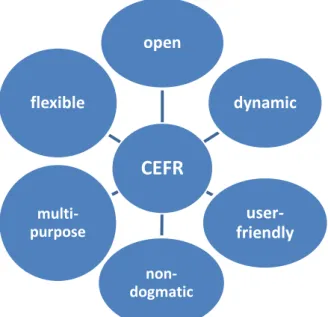
In addition to these, there are other features shown in Figure 2.1 that the CEFR must have so that it can be applied to particular situations.
Figure 2.2 Features of the CEFR (Adapted from Council of Europe, 2001; p.9-10)
It is obviously stated that the CEFR should be multi-purpose, flexible, open, dynamic, user-friendly and non-dogmatic (Council of Europe, 2001; p.7-8). These features and their explanations are given in Table 2.2.
CEFR
open dynamic user-friendly non-dogmatic multi-purpose flexibleTable 2.2 The Features of the CEFR and Their Explanations.
Features Explanation
multi-purpose and flexible
The CEFR should be capable of being used in different ways and adaptable for use in different circumstances according to user needs.
open and dynamic The CEFR should be capable of further development by its users as they discover the inevitable gaps and deficiencies.
user-friendly The CEFR should be understandable and usable by those for whom it is addressed.
non-dogmatic The CEFR should welcome all approaches and viewpoints instead of insisting upon the current tendencies.
(Adapted from Council of Europe, 2002b.)
The approach adopted in the development of the CEFR is an action-oriented approach. The action-oriented approach views users and learners of a language primarily as ‘social agents’ who have tasks to accomplish in a given set of circumstances, in a specific environment, and with a particular field of action (Council of Europe, 2001, p.9). In other words, the action-oriented approach means that tasks are related to texts in a way to allow the language user to utilize his/her language and general competences while making use of strategies in language use and learning, if necessary (Morrow, 2004). The key elements in this approach are communicative language competences (linguistic, sociolinguistic and pragmatic), language activities (production, reception, interaction and mediation) domains (public, occupational, educational and vocational), tasks and strategies since these key aspects play a vital role in the development of skills which are essential in language learning. The action-oriented approach sees language as an aspect of a total communicative event, in which the participants exchange information and achieve mutual understanding by all means open to them (Council of Europe, 2002b). Therefore, knowledge is not seen as an end in itself. Instead, it is the necessary basis for action, and it provides also necessary to build up linguistic competences necessary for communication (Council of Europe, 2001; 2002a; 2002b).
2.2.4 The Common Reference Levels (CRL)
The CEFR (2001) states that it also provides the definitions of proficiency levels allowing learners’ progress to be measured at each stage of learning. The CEFR brought forward some well-defined objective criteria for describing language proficiency, which is required by existing standards, tests and examinations in order to facilitate comparisons between different systems of qualifications (Council of Europe, 2001).
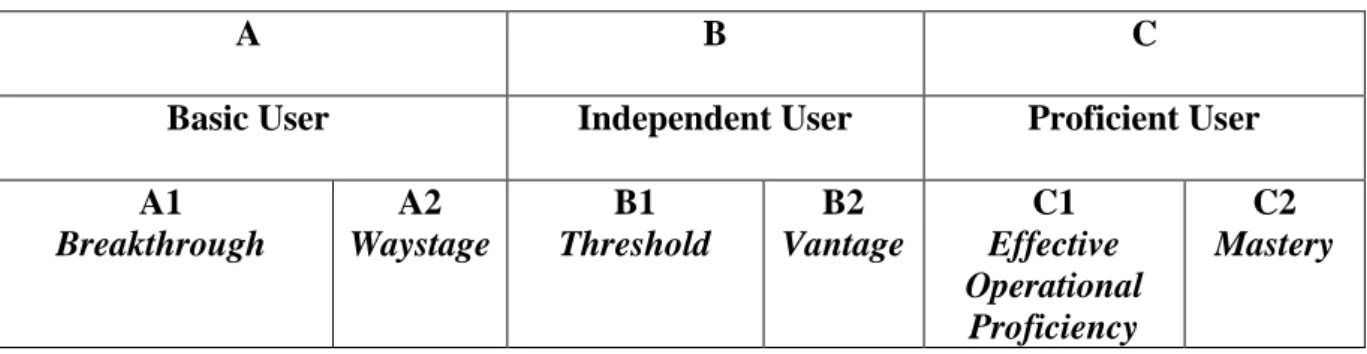
Under three main branches (A for Basic Users, B for Independent Users and C for Proficient Users), the CRL provides a set of six defined criterion levels (A1, A2, B1, B2, C1, and C2). These common standards are intended to help the course providers and examinations relate their products to a common reference system (Council of Europe, 2003: p.15).
Table 2.3 Common Reference Levels
A B C
Basic User Independent User Proficient User
A1 Breakthrough A2 Waystage B1 Threshold B2 Vantage C1 Effective Operational Proficiency C2 Mastery
(Adopted from the Council of Europe, 2001: p. 23)
The global scale of the CEFR is designed to summarise the set of proposed CRL in single holistic paragraphs (see Table. 2.4). Self-assessment grid, on the other hand, is more specific than the global scale. It consists of descriptors which show what a learner can do in the five language skills at certain levels (see Table 2.5).
Table 2.4.Common Reference Levels: Global Scale (Council of Europe, 2001: p 24)
Proficient User
C2 Can understand with ease virtually everything heard or read. Can summarise information from different spoken and written sources, reconstructing arguments and accounts in a coherent presentation. Can express him/herself spontaneously, very fluently and precisely, differentiating finer shades of meaning even in complex situations.
C1 Can understand a wide range of demanding, longer texts, and recognise implicit meaning. Can express him herself fluently and spontaneously without much obvious searching for expressions. Can use language flexibly and effectively for social, academic and professional purposes. Can produce clear, well-structured, detailed text on complex subjects, showing controlled use of organisational patterns, connectors and cohesive devices.
Independent User
B2 Can understand the main ideas of complex text on both concrete and abstract topics, including technical discussions in his/her field of specialisation. Can interact with a degree of fluency and spontaneity that makes regular interaction with native speakers quite possible without strain for either party. Can produce clear, detailed text on a wide range of subjects and explain a viewpoint on a topical issue giving the advantages and disadvantage of various options.
B1
Can understand the main points of clear standard input on familiar matters regularly encountered in work, school, leisure, etc. Can deal with most situations likely to arise whilst travelling in an area where the language is spoken. Can produce simple connected text on topics which are familiar or of personal interest. Can describe experiences and events, dreams, hopes and ambitions and briefly give reasons and explanations for opinions and plans.
Basic User
A2
Can understand sentences and frequently used expressions related to areas of most immediate relevance (e.g. very basic personal and family information, shopping, local geography, employment). Can communicate in simple and routine tasks requiring a simple and direct exchange of information on familiar and routine matters. Can describe in simple terms aspects of his/her background, immediate environment and matters in areas of immediate need.
A1
Can understand and use familiar everyday expressions and very basic phrases aimed at the satisfaction of needs of a concrete type. Can introduce him/herself and others and can ask and answer questions about personal details such as where he/she lives, people he/she knows and things he/she has. Can interact in a simple way provided the other person talks slowly and clearly and is prepared to help.
Table 2.5 Common Reference Levels: Self-assessment Grid (Council of Europe, 2001: p. 26-27)
A1 A2 B1
Understa
nd
ing
Listening I can recognise familiar words and very basic phrases
concerning myself, my family and immediate concrete surroundings when people speak slowly and clearly.
I can understand phrases and the highest frequency vocabulary related to areas of most immediate personal relevance (e.g. very basic personal and family
information, shopping, local area, employment). I can catch the main point in short, clear, simple messages and
announcements.
I can understand the main points of clear standard speech on familiar matters regularly encountered in work, school, leisure, etc. I can understand the main point of many radio or TV programmes on current affairs or topics of personal or professional interest when the delivery is relatively slow and clear. Reading I can understand familiar
names, words and very simple sentences, for example on notices and posters or in catalogues.
I can read very short, simple texts. I can find specific, predictable information in simple everyday material such as advertisements,
prospectuses, menus and timetables and I can understand short simple personal letters.
I can understand texts that consist mainly of high frequency everyday or job- related language. I can understand the description of events, feelings and wishes in personal letters. Sp ea kin g Spoken
Interaction I can interact in a simple way provided the other person is prepared to repeat or rephrase things at a slower rate of speech and help me formulate what I’m trying to say. I can ask and answer simple questions in areas of immediate need or on very familiar topics.
I can communicate in simple and routine tasks requiring a simple and direct exchange of information on familiar topics and activities. I can handle very short social exchanges, even though I can’t usually understand enough to keep the conversation going myself.
I can deal with most situations likely to arise whilst travelling in an area where the language is spoken. I can enter unprepared into conversation on topics that are familiar, of personal interest or pertinent to everyday life (e.g. family, hobbies, work, travel and current events).
Spoken
Production I can use simple phrases and sentences to describe where I live and people I know.
I can use a series of phrases and sentences to describe in simple terms my family and other people, living conditions, my educational
background and my present or most recent job.
I can connect phrases in a simple way in order to describe
experiences and events, my dreams, hopes and ambitions. I can briefly give reasons and explanations for opinions and plans. I can narrate a story or relate the plot of a book or film and describe my reactions.
Writ
ing
Writing I can write a short, simple postcard, for example sending holiday greetings. I can fill in forms with personal details, for example entering my name, nationality and address on a hotel registration form.
I can write short, simple notes and messages relating to matters in areas of immediate need. I can write a very simple personal letter, for example thanking someone for something.
I can write simple connected text on topics which are familiar or of personal interest. I can write personal letters describing experiences and impressions.
B2 C1 C2
Understa
nd
ing
Listening I can understand extended
speech and lectures and follow even complex lines of
argument provided the topic is reasonably familiar. I can understand most TV news and current affairs programmes. I can understand the majority of films in standard dialect.
I can understand extended speech even when it is not clearly structured and when relationships are only implied and not signalled explicitly. I can understand television programmes and films without too much effort.
I have no difficulty in
understanding any kind of spoken language, whether live or
broadcast, even when delivered at fast native speed, provided I have some time to get familiar with the accent.
Reading I can read articles and reports
concerned with contemporary problems in which the writers adopt particular attitudes or viewpoints. I can understand contemporary literary prose.
I can understand long and complex factual and literary texts, appreciating
distinctions of style. I can understand specialised articles and longer technical instructions, even when they do not relate to my field.
I can read with ease virtually all forms of the written language, including abstract, structurally or linguistically complex texts such as manuals, specialised articles and literary works.
Sp
ea
kin
g
Spoken
Interaction I can interact with a degree of fluency and spontaneity
that makes regular interaction with native speakers quite possible. I can take an active part in discussion in familiar contexts, accounting for and sustaining my views.
I can express myself fluently and spontaneously without much obvious searching for expressions. I can use language flexibly and effectively for social and professional purposes. I can formulate ideas and
opinions with precision and relate my contribution skilfully to those of other speakers.
I can take part effortlessly in any conversation or discussion and have a good familiarity with idiomatic expressions and colloquialisms. I can express myself fluently and convey finer shades of meaning precisely. If I do have a problem I can backtrack and restructure around the difficulty so smoothly that other people are hardly aware of it.
Spoken
Production I can present clear, detailed descriptions on a wide range
of subjects related to my field of interest. I can explain a viewpoint on a topical issue giving the advantages and disadvantages of various options.
I can present clear, detailed descriptions of complex subjects integrating sub-themes, developing particular points and rounding off with an appropriate conclusion.
I can present a clear, smoothly flowing description or argument in a style appropriate to the context and with an effective logical structure which helps the recipient to notice and
remember significance points.
Writ
ing
Writing I can write clear, detailed
text on a wide range of subjects related to my interests. I can write an essay or report, passing on information or giving reasons in support of or against a particular point of view. I can write letters highlighting the personal significance of events and experiences.
I can express myself in clear, well- structured text, expressing points of view at some length. I can write about complex subjects in a letter, an essay or a report, underlining what I consider to be the salient issues. I can select style appropriate to the reader in mind.
I can write clear, smoothly flowing text in an appropriate style. I can write complex letters, reports or articles which present a case with an effective logical structure which helps the recipient to notice and
remember significance points. I can write summaries and reviews of professional or literary works.
The global scale and the self-assessment grid were formulated using the most typical and stable descriptors; these level descriptions are drawn from a bank of "illustrative descriptors" developed and validated for the CEFR using a rigorous methodology in the Swiss research project (Council of Europe, 2003). It is also argued that "the formulations have been mathematically scaled to the levels by analyzing the way in which they have been interpreted in the assessment of large numbers of learners" (Council of Europe, 2001: p.25).
2.2.5. Features of ‘Can do’ Descriptors
North (1995) explains the development phase of the descriptors as follows; first the content of existing scales was analysed in relation to categories of description used in the framework. Then, in an intuitive phase, this material were edited, new descriptors were formulated and the set discussed by experts during the intuitive phase. Then, a variety of qualitative methods were used to check that teachers could relate to the descriptive categories selected and that descriptors actually described the categories they were intended to describe. Lastly, by means of quantitative methods the best descriptors were scaled (Council of Europe, 2007; p.5).
North (1995) states that in the development process of these scales description and measurement issues were the fundamental problems. Therefore, as for descriptive issues;
The scales need to be context-free so as to accommodate generalizable results from different specific context. That is to say, they should not be prepared only for specific contexts and learners. In contrast, they need to be context-relevant as well, which is intended to mean that descriptors should be relevant and transferable for each and every context (North, 1995; Council of Europe, 2001).
On the other hand, the second challenge is that the descriptors also need to be based on theories of language competence. In other words, the descriptors need to be theoretically grounded. Furthermore, they need to be user-friendly, which means they also need to be accessible to practitioners as well as encouraging them to think more about the meaning of competence in their context (North, 1995; Council of Europe, 2001).