Ef
ficient community identification and maintenance at multiple
resolutions on distributed datastores
☆
Hidayet Aksu
a,⁎
, Mustafa Canim
b, Yuan-Chi Chang
b, Ibrahim Korpeoglu
a, Özgür Ulusoy
aa
Department of Computer Engineering, Bilkent University, Ankara, Turkey bIBM T.J. Watson Research Center, Yorktown Heights, NY, USA
a r t i c l e i n f o
a b s t r a c t
Article history:
Received 16 September 2014 Received in revised form 6 May 2015 Accepted 2 June 2015
Available online 16 June 2015
The topic of network community identification at multiple resolutions is of great interest in practice to learn high cohesive subnetworks about different subjects in a network. For instance, one might examine the interconnections among web pages, blogs and social content to identify pockets of influencers on subjects like ‘Big Data’, ‘smart phone’ or ‘global warming’. With dynamic changes to its graph representation and content, the incremental
maintenance of a community poses significant challenges in computation. Moreover, the
intensity of community engagement can be distinguished at multiple levels, resulting in a multi-resolution community representation that has to be maintained over time. In this
paper, wefirst formalize this problem using the core metric projected at multiple
k-values, so that multiple community resolutions are represented with multiple k-core graphs. Recognizing that large graphs and their even larger attributed content cannot be stored and managed by a single server, we then propose distributed algorithms to construct and maintain a multi-k-core graph, implemented on the scalable Big Data platform Apache HBase. Our experimental evaluation results demonstrate orders of magnitude speedup by maintaining multi-k-core incrementally over complete reconstruction. Our algorithms thus enable practitioners to create and maintain communities at multiple resolutions on multiple subjects in rich network content simultaneously.
© 2015 Elsevier B.V. All rights reserved.
Keywords:
Mining methods and algorithms Distributed databases Community identification Big Data analytics k-Core HBase
1. Introduction
Multi-resolution community identification and evolution in a complex network have applications spanning multiple disci-plines ranging from social science to physics. In recent years, the rise of very large, rich content networks re-ignited interests to the problem at the multi-k-core scale that poses computation challenges to early work with algorithm complexity greater than O(n). A further distinction from the decade-old graph problem formulation is that multi-attributed content associated with vertices and edges must be included in creating, managing, interpreting and maintaining results. Thus the problem of community analysis is a hybrid of content and graph analysis on various subjects of interest. The problem is made even more complex with the observation that interactions with a community happen not just at one but also at multiple levels of intensity, which reflects in reality active to passive participants in a group. This results in multiple levels of resolution in
☆ A preliminary version[1]of this paper was presented at the IEEE 2nd International Congress on Big Data, 2013 (BigData 2013). ⁎ Corresponding author.
E-mail addresses:[email protected](H. Aksu),[email protected](M. Canim),[email protected](Y.-C. Chang),[email protected](I. Korpeoglu), [email protected](Ö. Ulusoy).
http://dx.doi.org/10.1016/j.datak.2015.06.001 0169-023X/© 2015 Elsevier B.V. All rights reserved.
Contents lists available atScienceDirect
Data & Knowledge Engineering
community identification. To make the solution practical, it is thus necessary to identify and maintain communities at multiple resolutions.
In this paper, we propose a set of algorithms built on the k-core metric to identify and maintain a content-projected commu-nity at multiple resolutions on an open-source Big Data platform, Apache HBase. We formulate the commucommu-nity identification problem byfirst projecting a subgraph by content topic of the social network interaction, such as a microblog or message, and then locating the“dense” areas in the subgraph which represent higher inter-vertex connectivity (or interactions in the case of a social network) at multiple resolutions. In the literature, there is a long list of subgraph density measures that may be suited in different application contexts. Examples include cliques, quasi-cliques[2], k-core, and k-edge-connectivity[3]. Among these graph density measures, k-core stands out as the least computationally expensive one that still gives reasonable results. An O(n) algorithm is known to compute k-core decomposition in a graph with n edges[4], where other measures have complexity growing super-linear or NP-hard.
The set of our proposed algorithms identify k-core subgraphs at multiple,fixed k values and maintain the identified subgraphs incrementally over dynamic changes. These distributed algorithms run on a multi-server cluster with shared nothing partitioned graph data, managed by Apache HBase. The size of the social network graph and the rich content is only limited by storage space and not by main memory. Furthermore, identified communities at multiresolution are also retained and updated as changes come in. Our algorithms thus enable practitioners to monitor changes in communities on different topics and resolutions in rich social network content simultaneously, which main-memory based algorithms cannot achieve.
Previously, we studied the identification and maintenance of k-core subgraphs at a fixed k value[5]. We also proposed algorithms to perform batch operations for maintenance purposes. The proposed approaches are quite effective when a constant k value is used. On the other hand, when subgraphs at multiple resolutions are needed, one has to run separate instances of the algorithms for each k value. In order to cope with this limitation, we made significant design changes in these algorithms to efficiently handle k-core subgraphs at multiple, fixed k values. The new study proposes integrated algorithms for k-core construction, maintenance and the bulk processing of update operations. As we demonstrate in the experiments section, the new algorithms yield orders of magnitude speed up compared to the base case k-core construction. Note that, we study how k-core can be computed efficiently in distributed datastores such as Google BigTable, MegaStore, and Apache HBase which are widely used by web companies. In other words, we target the k-core computation problem in a specific context, and we acknowledge that k-core computation in specific setups, i.e. in-memory or topology-only centralized ones, might outperform multi-purpose general distributed datastores or distributed parallel databases which are designed to address high availability, fault-tolerance, scalability, and load balancing issues.
Our main contributions in this paper can be summarized as follows:
• We defined multiresolution community identification in a network as a multi-k-core problem and developed a distributed construc-tion algorithm that exploits parallelism on a Big Data platform.
• In order to keep the materialized multiresolution representation up to date with incremental updates, we developed a distributed maintenance algorithm that also exploits parallelism.
• We further improved the maintenance algorithm with batch window refresh for practical applications with heavy updates. Batch update maintenance allows more expensive graph traversal steps to be aggregated for computational efficiency.
• We presented a robust implementation of our algorithms on top of Apache HBase, a horizontally scaling distributed storage platform through its coprocessor computing framework[6].
The remainder of the paper is organized as follows. Wefirst provide a motivating example inSection 2, then we review prior work on community identification and k-core algorithms inSection 3.Section 4describes our distributed multi-k-core construction algorithms in nave implementation and pruning techniques.Section 5details our incremental maintenance algorithms for edge insertions and deletions. Experimental results are reported and discussed inSection 7. Finally,Section 8 concludes the paper and discusses future work.
2. Motivating example
Consider the following scenario as an example of why the distributed multi-k-core construction and maintenance algorithms we propose are needed in real life problems. Suppose that a data analytics company provides keyword based analytics services to its customers based on the retweet graph of Twitter data. The customers subscribe to the service by providing certain keywords along with the queries and the company provides a response whenever they want to get the results. To keep up with the growing size of the data and to manage the query load on the system, the graph is horizontally partitioned and stored on distributed computing nodes by the company. Moreover, to effectively respond to the computation load, the results of user queries are materialized and updated as the retweet graph changes. Depending on customer needs, both instant updates as well as batch updates are reflected to the maintained results.
The aforementioned scenario is quite realistic currently. As the popularity of social media sites increases, the demand for performing analytics on these large graphs grows dramatically. In the last few years, many web companies, such as“Followerwonk” [7],“SocialPing”[8], and“SimplyMeasured”[9], emerged to help customers make better marketing decisions based on the content of social media tools such as Twitter and Google+. These web companies have to deal with very large graphs to perform analytics. To
keep up with the scale, storage and maintenance of these datasets efficiently, companies are compelled to use distributed data archi-tectures. Hence, previously used analytics, i.e., community identification algorithms, need to be redesigned to work in such new data man-agement environments. We believe that the distributed algorithms presented in this paper can be leveraged on these large graph datasets to perform better analytics.
3. Related work
A wide range of applications from social science to physics need to identify communities in complex networks that share certain characteristics at various scales and resolutions[10–12]. Challenges remain, however, in addressing both the intensity and dynamicity of communities on a large scale. We thus focus on metrics and algorithms whose complexity is no greater than O(n). The notion of k-core isfirst introduced in[13]for measuring group cohesion in social networks. Subsequently, Batagelj and Zaversnik (BZ) proposed a linear time algorithm to compute k-core[4]. The BZ algorithmfirst sorts the vertices into the increasing order of degrees and starts deleting the vertices with degrees less than k. At each iteration, it needs to sort the vertices list to keep it ordered. Due to the high number of random accesses to the graph, the algorithm can only run efficiently when the entire graph can fit into the main memory of a single machine. Recently, k-core is preferred as a key metric of measuring social interaction strength in many other studies[14–17].
On the other hand, to deal with the scalability concerns when data gets big, graph algorithms were implemented on the MapReduce framework[18]and its open source implementation Apache Hadoop[19–21]. By formulating common graph algorithms as iterations of matrix-vector multiplications, coupled with compression,[22] and [23]demonstrated significant speedup and storage savings, although such a formulation would prevent the inclusion of metadata and content as part of the analysis. The iterative nature of graph algorithms soon prompted many to realize that static data is needlessly shuffled between MapReduce tasks[24,21,25]. Pregel[26]thus proposed a new parallel graph programming framework following the bulk synchronous parallel (BSP) model and message passing constructs. In Pregel, vertices are assigned to distributed machines and only messages about their states are passed back and forth. In our work, we achieved the same objective through coproces-sors. Pregel did not elaborate, however, about how to manage temporary data, if it is large, with a main memory implementation nor did it state if updates are allowed in its partitioned graph. Furthermore, by introducing a new framework, compatibility with MapReduce-based analytics is lost.
Our work learned from the strength and limitation of these algorithms and platforms to make progress in the areas of distrib-uted big graph data processing and incremental multi-resolution maintenance. We implemented, tested, and analyzed our algorithms on the open-source Hadoop HBase Big Data processing framework. Therefore, before going into the details of our proposed algorithms, readers are encouraged to read the preliminary version of our paper[1]or some other reference about HBase to become familiar with the Hadoop Big Data programming framework where our distributed k-core algorithms are implemented.
4. Distributed multi-k-core construction
In this section, wefirst describe a nave distributed algorithm that constructs a k-core subgraph, then we propose a novel algorithm to compute a k-core graph for multiple k values simultaneously.Table 1summarizes the notations used in our pseudocode.
4.1. Base algorithm
The base algorithm is an adaptation of the BZ algorithm to distributed processing for afixed k value. As described inAlgorithms 1 and 2, the server side algorithm executes in parallel as HBase Coprocessors to scan partitioned graph data in the local regions
Table 1
Notations used in algorithms.
G Dynamic graph partitioned into regions stored in multiple server nodes
Gk k-Core materialized view graph of G
Gki Subgraph of Gkholding k-core for core value ki
k1… n Target core values in ascending order
Ri i'th region of graph stored on and processed by node i
Ni i'th node storing region i
(X, Y)← RCf(Ri, S) Remote call to function f on region i takes parameter S and returns values X, Y to client
{u, v} Graph edge from vertex u to vertex v
Ri(GA) Region of graph GAprocessed by node Ni
TA(CX, CY) Lookup table A with column CXand CY
dðuÞ; dGkiðuÞ Degree of vertex u in G and Gki
and delete those vertices with degrees less than k. The client side program monitors the parallel execution and issues iterations until the k-core is found. To compute the k-core graph for multiple k each k value separately.
Algorithm 1. Base k-core construction— client side.
Algorithm 2. Base k-core construction— node Niside.
4.2. Multi-k-core construction
Our proposed algorithm computes k-core subgraphs for a list of distinct k values. As stated in the notation, k values are ordered and kiis the i'th k value, e.g. k1… 3= {15, 20, 30}. In the degenerate case, k0¼ 0; Gk0¼ G. The algorithm starts with computing a k-core graph for k1and progressively moves up the index by reusing a previously found k-core subgraph.
The algorithms are described inAlgorithms 3 and 4for the client and server side, respectively. Itfirst computes a k-core graph for k1
using the Base algorithm. Next, the client invokes distributed parallel processing Compute Core at the server side to compute core values for vertices with a degree greater than or equal to kiand less than ki + 1. On the server side, it checks a vertex's degree count
and decrements its neighbors' if their degree counts are greater than ki + 1. Iterations continue until all the parallel execution reported
vertices in Gkiþ1have been identified.
5. Incremental multi-k-core maintenance 5.1. Edge insertion
With graph G = {V, E} and its materialized multi-k-core subgraph Gk¼ ∪i¼1 ::nGkiwhere Gki¼ fVki; Ekig, we give the following edge insertion theorem.
Theorem 1. Given a graph G = {V, E} and its k-core subgraph Gk¼ ∪i¼1 ::nGki, and an edge {u, v} is inserted to G, • If both u; v ∈ Vkn, then Gknstays the same.
• If u or v or both ∈ Vkiand i is maximal, i.e.∄ðj; kÞjj N i; k N i; u ∈ Vkjand v∈ Vkk, then the subgraph consisting of vertices in fwjw ∈ Vki; dGkiðwÞ ≥ kiþ1; qncGkiðwÞ ≥ kiþ1g, where every vertex is reachable from u or v, may need to be updated to include additional vertices into Gkiþ1.
The intuition behind the theorem is that an edge insertion can at most increase the core number by one. And edge inserted into the highest k-core Gkndoes not change the subgraph. However, an edge inserted into vertices in Gkimay push some vertices to Gkiþ1but not further up in the hierarchy.Fig. 1depicts this scenario, where a new edge and its update is always sandwiched between two rings of the k-core graph. Bounding by the two rings implies that our maintenance algorithm can exploit this property to minimize traversal.
To prove the theorem, wefirst prove the following lemma, a preliminary version of which is presented in[5].
Lemma 1. If vertex q is included in the kn-core after the edge {u, v} is inserted, then there exists at least one path originating from either u or
v connecting to q on which all vertices also have a core number greater than or equal to knafter the insertion of the new edge.
Algorithm 4. Multi k-core construction— node Niside.
Fig. 1. Upon an edge {u, v} insertion where u or v resides in ki-core Gki,first tightly bounded Gcandidategraph is discovered exploiting maintained auxiliary information,
Proof. Since q was not in Vknand is in ~Vknafter the edge insertion, its core number must have been increased from kn− 1to kn. The increase of q's core number is due to one or more of its neighboring vertices whose core numbers also increased to kn. The same logic
applies to those neighbors and leads one or more connected paths to the vertices u or v, where the graph topology is changed. Using the above lemma, we now prove the edge insertion theorem by contradiction.
Proof. Case 1. If u; v ∈ Vkn, the new edge {u, v} is inserted into Eknand there is no change to Vkn.
Case 2. We prove by contradiction that a vertex q in Gki, where i is maximal, cannot be in the ki + 1-core, unless q∈ fwjw ∈ Vki; DGðwÞ≥kiþ1; N
kiþ1
G ðwÞ≥kiþ1g where all the vertices in the set are reachable by either u or v. Suppose q is in the ki-core
but q∉ fwjw ∈ V; DGðwÞ≥kiþ1; NkGiþ1ðwÞ≥kiþ1g where all the vertices in the set are reachable by either u or v. The above lemma states
that there exists at least one path originating from either u or v connecting to q on which all vertices also have a core number greater than or equal to ki + 1. By definition of k-core, the vertices on the path must have DG≥ ki + 1and N
kiþ1
G ≥kiþ1. Therefore, the vertices on
the path to q and including q must also have DG≥ ki + 1and NkGiþ1≥kiþ1. Therefore, q must be in the subgraph expanded from u and v.
Algorithms 5, 6 and 7present the algorithms in detail. Several auxiliary counts are maintained for all vertices,∀ v ∈ V, its degree dGkiðvÞ and its qualifying neighbor count qncGkiðvÞ for each maintained ki. For each insert, the algorithmfirst looks for the maximal
subgraph Gkiin which u or v is found. If any suchGkigraph is found for iN 0, a new edge is inserted and auxiliary information is updated. When i is equal to n, which means both vertices are in the inner most core graph, no update is required so the algorithm terminates. If the qnc value for either vertex is no less than the next target ki + 1value, then there is a possibility that Gkiþ1will be updated because of the new edge. In this case, the algorithm searches the graph and marks a tightly bounded subgraph of vertices which needs to be updated. Find Candidate Graph subroutine inAlgorithm 6traverses the Gkisubgraph and returns the Gcandidatesubgraph which covers the set of candidate edges that may be part of the ki + 1-core. The edges whose vertex w satisfy the condition d(w)≥ ki + 1
and qnckiþ1ðwÞ≥kiþ1are considered as candidate edges for Gkiþ1. Partial KCore inAlgorithm 7then processes the Gcandidatesubgraph
and returns the graph qualified for ki + 1core into Gqualified.
5.2. Edge deletion
We begin with the following edge deletion theorem, which mirrors the edge insertion theorem.
Theorem 2. Given a graph G = {V, E} and its k-core subgraph Gk¼ ∪i¼1 ::nGki, and an edge {u, v} is deleted from G, • If fu; vg∉ Eki, then Gkidoes not change.
• If fu; vg∈ Ekiand i is maximal, then the subgraph consisting of vertices infwjw ∈ Vkig, where every vertex is reachable from u or v, may need to be updated to maintain edge deletion from Gki.
The intuition behind this theorem is that an edge deletion can at most decrease the core number by one and thus an edge deleted from Gkimay push some vertices from Gkito Gki−1but not further down in the hierarchy. Again, our algorithm exploits the property to minimize traversal.
Algorithm 8implements the theorem on the server side. Edge deletion logic is similar to the edge insertion case. Upon receiving an edge deletion, itfirst finds out in which k-core graph this edge resides, say Gki. If it does not reside in any k-core, then the algorithm terminates. Otherwise, the Update Coreness Cascaded algorithm inAlgorithm 9starts with the vertex withdGkiless than ki, and moves it
to the lower k-core graph Gki−1. Then it recursively traverses the neighbors whose degrees in Gkiare now below ki. The algorithm accelerates k-core re-computing by knowing, at each iteration, which vertices have changed their degrees. For the majority of cases where an edge deletion impacts a small fraction of vertices in the k-core, we have found this improved algorithm to be very effective.
Algorithm 7. Partial KCore. Algorithm 6. Find candidate graph.
6. Batch multi-k-core maintenance
In an update-heavy workload, k-core does not need to be kept in lock steps with data updates and thus presents the opportunity to periodically maintain k-core in batch windows. Accumulating data updates and refreshing k-core in a batch bundles up expensive graph traversals and thus speeds up maintenance time, compared to maintaining each update incrementally.
In such a batch maintenance scenario, edge insertion and deletion incurs immediate updates to the auxiliary information, degree and QNC, while updates to the k-core subgraph are deferred. The system maintains a list of updates andflushes them based on update count or clocked window. InAlgorithm 10, when the list isflushed, updates that cancel each other out are first removed from the list. Edge deletions, which typically incur a shorter graph traversal, are then treated next followed by edge insertions, which may include longer traversals. Regardless of the processing order, the net effect is the same.
Algorithm 11presents the batch edge deletions in more detail. Edges in the deletion list deleteList are grouped and sent to the respective region's node, where each remote call returns a list of cascaded deletion requests. The client then regroups the requests. Algorithm 9. Update coreness cascaded.
Algorithm 10. Batch process— client side.
Algorithm 12describes the node side of edge deletions. The algorithmfirst receives the list deleteList, the list of edges to be deleted, and the list downgradeList, the list of vertices to be updated into one lower k values in the maintained k-core list k1… n. For each edge
{u, v} in the deleteList the edge is deletedfirst. To do that, all the outgoing edges of u are deleted and the incoming edges are returned to the client as cascaded delete. We do not delete incoming edges in this remote call since those edges do not necessarily reside in the rent region (edges are stored according to source vertex). If the degree of u becomes smaller than the k value of the core in which it cur-rently resides, this vertex should be downgraded. Such vertices are added to the downgradeList. Each vertex in the downgradeList is moved from its current core value, let's say ki, to one lower core value ki− 1. When the vertex becomes lower than the minimum maintained k
value, it is deleted from the materialized view and any cascaded delete is added to the cascadedDeletes list. After each core change, if any direct neighbor also needs to be updated, it is added to the cascadedDowngrades list to be processed in the next iteration.
Algorithm 13presents batched edge insertion maintenance in detail. In essence, the independently launched graph traversal in each incremental maintenance is now aggregated into a single parallel graph traversal launched simultaneously from all the new edges. The algorithmfirst takes the list of edges insertList, and traverses them in parallel. All candidate edges discovered Algorithm 12. Handle delete— node Niside.
during BFS traversals are kept in the client side in sets called Gcandidate1…nfor posttraversal computation. Firstly, the client groups all vertices in the insertList according to their regions. A BFS operation is performed for each region by calling the qualifyingListi← RCPruned MultiTraversal(Ri, bucketi, k1… n) remote call function. Each node handles the BFS iterations over
its associated region and then returns the selected edge list to the client. The list insertList is cleared after all remote calls are made. An edge {u, v} returned from the remote call is skipped if it already exists in the set Gcandidate1…n, which means it has already been traversed previously. When the new edge {u, v} is not connected to the next inner k-core subgraph, v is inserted into the list insertList to be traversed in the next iteration.
Once the parallel traversal is done, the candidate lists Gcandidate1…nwill be processed by the Partial KCore algorithm to compute each maintained k-core over the traversed graph.
The Pruned MultiTraversal algorithm described inAlgorithm 6runs on the node side and performs a single BFS iteration for the vertices in the insertList list. It selects the edges to the vertices with a QNC value greater than the next maintained core value.
7. Performance evaluation
We ran experiments to demonstrate the performance of our proposed multi-k-core construction algorithm and the performance of our proposed k-core maintenance algorithms on dynamic graphs. We show that recomputing the k-core subgraphs is much costlier than incrementally maintaining them in dynamic graphs where the edges are inserted and deleted.
7.1. System setup and datasets
Graph data is stored in HBase and the algorithms are implemented as HBase Coprocessors where distributed parallelism is applicable.Table 2shows how notations in algorithms are interpreted in HBase implementation. Our cluster consists of one master server and 13 slave servers, each of which is an Intel CPU based blade running Linux connected by a 10-gigabit Ethernet. We use a vanilla HBase environment running Hadoop 1.0.3 and HBase 0.94 with data nodes and region servers co-located on the slave servers. We configured HBase with a maximum 16 GB Java heap space and Hadoop with a 16 GB heap to avoid long garbage collection in the Java virtual machine. The HDFS (Hadoop File System) replication factor is set at the default three replicas. There was no significant interference from other workloads on the cluster during the experiments.
The datasets we used in the experiments were made available by Mislove et al.[27]and the Stanford Network Analysis Project[28]. We appreciate their generous offer to make the data openly available for research. For details, please see the references and we only briefly recap the key characteristics of the data inTable 3.
7.2. Experiments
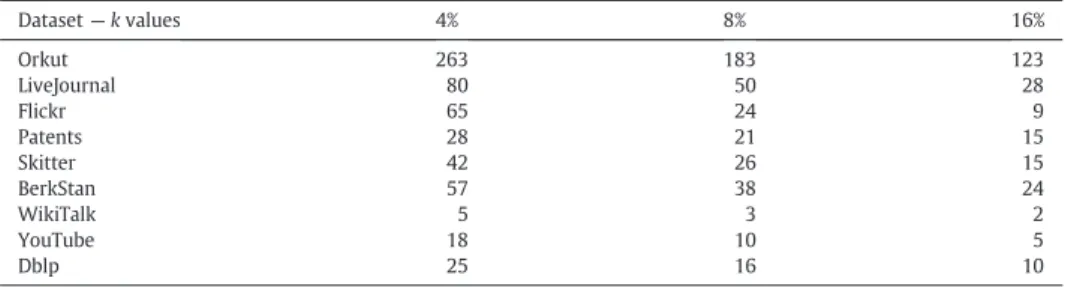
We use multiple k values to represent a community at multiple resolutions. For each social network dataset, we select three distinct k values so that 4, 8 and 16% of the vertices in that dataset have a degree of at least k. The higher the k value, the stronger or more tightly knit the communities are. Conversely, the lower the k value, the weaker or more loosely connected the communities Algorithm 14. Pruned MultiTraversal— node Niside.
Table 2
Mapping of graph notations inTable 1to implementation in HBase.
G HBase table holding graph edges partitioned into regions over multiple region servers
Gk HBase table holding k-core graph edges
Ri i'th region processed by coprocessor Ni
Ni i'th coprocessor running on region i
(X, Y)← RCf(Ri, S) Coprocessor function f on region i takes parameter S and returns values X, Y to client
Ri(GA) Region of GAprocessed by coprocessor Ni
are.Table 4lists the chosen k values. Wefirst run the Base k-core construction algorithm to measure the baseline k-core construction time for each dataset and k value. Then we run the Multi-k-core construction algorithm, which is described inAlgorithms 3 and 4, for each dataset with all the chosen k values at once to measure the k-core construction for multiple k values.Fig. 2shows the construction times for both algorithms. The speedup achieved by Multi-k-core construction algorithm is upper bounded by the number of distinct values which is 3 in this case. For larger datasets we observe that the algorithm achieved a higher speedup due to the redundant computation saved.
To evaluate the performance of the maintenanceAlgorithms 5 and 6, wefirst construct and materialize a k-core graph for selected multiple k values and under the three scenarios explained below we measure the average maintenance times.
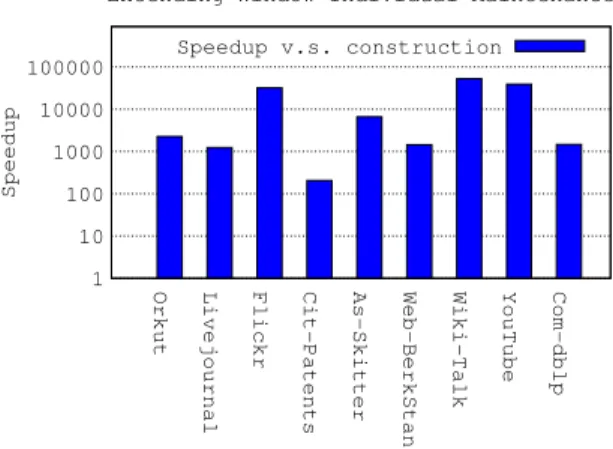
1. In the Extending window scenario, a constant number of edges are continuously inserted into the original graph. We randomly choose 1000 vertices from the graph and exclude a random edge of each vertex at the beginning. Later we construct the k-core subgraph. Once the system is ready for changes we insert the excluded edges into the graph one by one while we maintain the k-core subgraph.
Table 3
Key characteristics of datasets in the experiments.
Name Vertex Count Bidirectional Edge Count Ref
Orkut 3.1 M 234 M [27] LiveJournal 5.2 M 144 M [27] Flickr 1.8 M 44 M [27] Patents 3.8 M 33 M [28] Skitter 1.7 M 22.2 M [28] BerkStan 685 K 13.2 M [28] YouTube 1.1 M 9.8 M [27] WikiTalk 2.4 M 9.3 M [28] Dblp 317 K 2.10 M [28] Table 4
k values used in the experiments and the ratio of vertices with degree at least k in the corresponding graphs.
Dataset— k values 4% 8% 16% Orkut 263 183 123 LiveJournal 80 50 28 Flickr 65 24 9 Patents 28 21 15 Skitter 42 26 15 BerkStan 57 38 24 WikiTalk 5 3 2 YouTube 18 10 5 Dblp 25 16 10
Fig. 2. k-Core construction times for base and multi k-core construction algorithms are shown for each dataset with three chosen k values. Relative speedup achievement of multialgorithm over Base algorithm is provided above each bar.
2 In the Shrinking window scenario, a constant number of edges are continuously deleted from the original graph. Wefirst construct the k-core subgraph. Later, we randomly choose 1000 vertices from the graph to delete them one by one while we maintain the k-core subgraph.
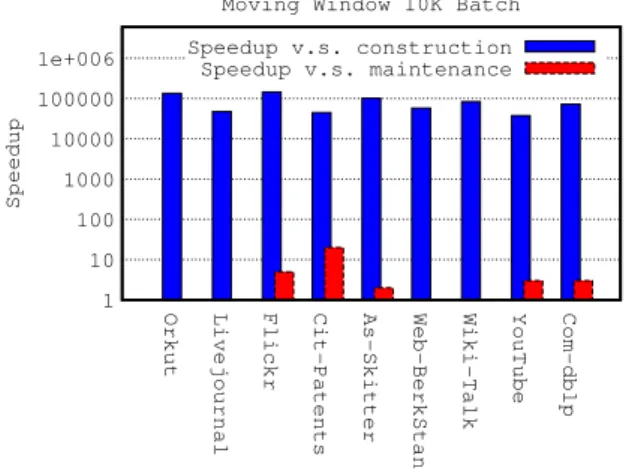
3 In the Moving window (Mix) scenario, a constant number of edges are both inserted and deleted continuously. We choose 1000 random vertices from the graph and exclude a random edge of each vertex at the beginning. We use them for insertion. Next we construct the k-core subgraph. Once the system is ready for changes we keep inserting these edges while deleting a random edge from the original graph. So, each insertion is followed by a random deletion from the graph. By doing so we insert 1000 edges into the graph and delete 1000 edges from the graph while maintaining the k-core subgraph.
We repeated these three scenarios with each dataset and measured their execution times.Figs. 3–5plot the speedup through our incremental maintenance algorithms over recomputing k-core from scratch, for 9 different datasets. The y-axis shows the speedup in log-scale. For the extending, shrinking, and moving window scenarios and each dataset, thefigures give the speedup of the incremen-tal update approach with respect to from-scratch construction using the multi-k-core construction algorithm. As thefigures show, three tofive orders of magnitude speedup can be expected for the edge insertion workload. We observe different speedup values for different datasets. When compared withTable 3 and Table 4, there is no direct relation between the k values, dataset size and achieved speedup. The different datasets we used are from different networks, i.e., Com-dblp is a collaboration network, Orkut is a friendship network, and Flickr is an image sharing network. Their internal connection structure causes different maintenance costs. For instance homogenous and dense edge distribution would cause longer traversals inAlgorithm 14Pruned MultiTraversal, while het-erogeneous and sparse edge distribution would result in shorter traversals. Thus, the internal edge distribution structure, which is dif-ferent in each network, causes difdif-ferent maintenance speedups. Similar speedup factors are also observed for mixed edge insertions and deletions with a one-to-one ratio. A higher speedup of more thanfive orders of magnitude was achieved for the edge deletion only workload.
Fig. 3. k-Core maintenance algorithm speedup over construction algorithms for extending window scenario.
7.3. Batch maintenance experiments
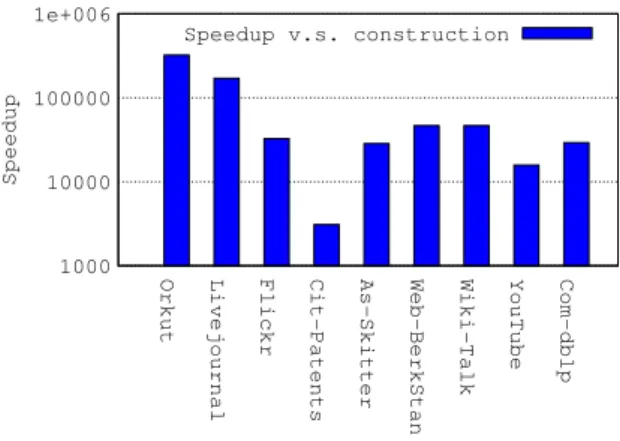
In order to investigate the speedup provided by our batch update approach for maintaining the multi-k-core subgraph, we ran ex-periments on different datasets. To measure the performance improvement of the batch processing approach compared to individual updates and full reconstruction, we set up experiments for each dataset and for each update scenario described inSection 7. For each experiment, we used a 10 K batch size.Figs. 6–8show batch processing speedup versus individual processing in k-core individual
Fig. 5. k-Core maintenance algorithm speedup over construction algorithms for moving window scenario.
Fig. 6. 10 K sized batch maintenance speedups for extending window scenario.
maintenance and reconstruction for three different update scenarios and 9 different datasets. The speedup is shown in the y-axis in the log-scale. Eachfigure illustrates the batch maintenance speedup versus both individual maintenance and reconstruction.
For the Extending window scenario, inFig. 6we get a greater performance improvement of four tofive orders of magnitude speed-up when compared with the reconstruction case. We get speed-up to 2 orders of magnitude speedspeed-up compared to individual maintenance. When compared withFig. 3, wefigured out that the batch window extending approach provides a more stable speedup ratio for different datasets. For instance, the Cit-Patent dataset shows the largest speedup in the batch maintenance case compared to individ-ual maintenance, while it provides the smallest speedup in the individindivid-ual maintenance case. In total, its speedup is close to the average speedup of other datasets. For the shrinking window scenario, the batch processing approach does not provide significant speedup, as the deletion cost in individual processing is already minimal, i.e., close to the auxiliary maintenance cost plus the base HBase update times. The moving window case provides speedups in between the extending and shrinking window cases, which is as expected considering that it is a mixture of insertion and deletion operations. The experiment results show that batch processing provides stable speedup for all scenarios and datasets with different sizes and topologies.
8. Conclusions
To the best of our knowledge this paper is thefirst to propose a horizontally scaling solution on the Big Data platform for multi-resolution social network community identification and maintenance. By using k-core as the measure of community intensity, we proposed multi-k-core construction and incremental maintenance algorithms and ran experiments to demonstrate orders of magnitude speedup with the aggressive pruning and fairly low maintenance overhead in the majority of graph updates at relatively high k-valued cores. We further extended algorithms to handle batch maintenance of a window of updates, which provides larger and more stable speedup for multi-k-core maintenance.
For the simplicity of the presentation, we left out the metadata and content associated with graph vertices and edges. In practice, a k-core subgraph is often associated with application context and semantic meaning. Our efficient maintenance algorithms now enable many practical applications to keep many k-core materialized views up-to-date and ready for user exploration.
We provided a distributed implementation of the algorithms on top of Apache HBase, leveraging its horizontal scaling, range-based data partitioning, and the newly introduced coprocessor framework. Our implementation took full advantage of the distributed, parallel processing of the HBase Coprocessors. Building the graph data store and processing on HBase also benefits from the robustness of the platform and its future improvements.
Acknowledgments
This research was sponsored by DARPA under agreements no. W911NF-11-C-0200 and W911NF-12-C-0028. We thank TUBITAK (The Scientific and Technological Research Council of Turkey) for supporting this work in part with project 113E274. The authors would like to thank the anonymous reviewers for their helpful comments.
References
[1] H. Aksu, M. Canim, Y.-C. Chang, I. Korpeoglu, O. Ulusoy, Multi-resolution social network community identification and maintenance on big data platform, Big Data (BigData Congress), 2013 IEEE International Congress on 2013, pp. 102–109, http://dx.doi.org/10.1109/BigData.Congress.2013.23 (doi:10.1109/ BigData.Congress.2013.23).
[2] Z. Zeng, J. Wang, L. Zhou, G. Karypis, http://doi.acm.org/10.1145/1242524.1242530Out-of-core coherent closed quasi-clique mining from large dense graph databases, ACM Trans. Database Syst. 32 (2). http://dx.doi.org/10.1145/1242524.1242530 doi:10.1145/1242524.1242530. URL http://doi.acm.org/10.1145/ 1242524.1242530
[3] R. Zhou, C. Liu, J.X. Yu, W. Liang, B. Chen, J. Li, Finding maximal k-edge-connected subgraphs from a large graph, Proceedings of the 15th International Conference on Extending Database Technology, EDBT'12, ACM, New York, NY, USA 2012, pp. 480–491,http://dx.doi.org/10.1145/2247596.2247652(http://dx.doi.org/ 10.1145/2247596.2247652 doi:10.1145/2247596.2247652. URL http://doi.acm.org/10.1145/2247596.2247652).
[4] V. Batagelj, M. Zaversnik, An o(m) algorithm for cores decomposition of networks, CoRR cs.DS/0310049
[5] H. AKSU, M. Canim, Y. Chang, I. Korpeoglu, O. Ulusoy, Distributed k-core view materialization and maintenance for large dynamic graphs, IEEE Trans. Knowl. Data Eng. (99) (2014) 1,http://dx.doi.org/10.1109/TKDE.2013.2297918(doi:10.1109/TKDE.2013.2297918.).
[6] hbase.apache.org. [7] followerwonk.com. [8] socialping.com. [9] simplymeasured.com.
[10] A. Lancichinetti, S. Fortunato, Community detection algorithms: a comparative analysis, Phys. Rev. E. 80 (5) (2009) 056117.
[11] L. Danon, A. Daz-Guilera, J. Duch, A. Arenas, Comparing community structure identification, J. Stat. Mech: Theory Exp. 2005 (09) (2005) (P09008).
[12] C. Tantipathananandh, T. Berger-Wolf, D. Kempe, A framework for community identification in dynamic social networks, Proceedings of the 13th ACM SIGKDD International Conference on Knowledge Discovery and Data Mining, KDD'07, ACM, New York, NY, USA 2007, pp. 717–726,http://dx.doi.org/10.1145/1281192. 1281269(http://dx.doi.org/10.1145/1281192.1281269 doi:10.1145/1281192.1281269. URL http://doi.acm.org/10.1145/1281192.1281269).
[13] S.B. Seidman, Net work structure and minimum degreehttp://www.sciencedirect.com/science/article/pii/037887338390028X Soc. Networks 5 (3) (1983) 269–287,http://dx.doi.org/10.1016/0378-8733(83)90028-X(doi:10.1016/0378-8733(83)90028-X. URL http://www.sciencedirect.com/science/article/pii/ 037887 338390028X.).
[14] X. Shi, M. Bonner, L. Adamic, A.C. Gilbert, The very small world of the well-connected, SIGWEB Newsl. (Winter) 4 (10) (2009) 1–4,http://dx.doi.org/10.1145/ 1457507.1457511http://dx.doi.org/10/1145/1457507.1457511 doi:10/1145/1457507.1457511. URL http://doi.acm.org/10/1145/1457507.1457511. [15] F.D. Malliaros, M. Vazirgiannis, To stay or not to stay: modeling engagement dynamics in social graphs, Proceedings of the 22nd ACM International Conference on
Conference on Information & Knowledge Management, CIKM'13, ACM, New York, NY, USA 2013, pp. 469–478,http://dx.doi.org/10.1145/2505515.2505561 http://dx.doi.org/10.1145/2505515.2505561 doi:10.1145/2505515.2505561. URL http://doi.acm.org/10.1145/2505515.2505561.
[16] D. Garcia, P. Mavrodiev, F. Schweitzer, Social resilience in online communities: the autopsy of Friendster, Proceedings of the First ACM Conference on Online Social Networks, COSN'13, ACM, New York, NY, USA 2013, pp. 39–50, http://dx.doi.org/10.1145/2512938.2512946 (http://dx.doi.org/10.1145/ 2512938.2512946 doi:10.1145/2512938.2512946. URL http://doi.acm.org/10.1145/2512938.2512946).
[17] W. Cui, Y. Xiao, H. Wang, W. Wang, Local search of communities in large graphs, Proceedings of the 2014 ACM SIGMOD International Conference on Management of Data, SIGMOD'14, ACM, New York, NY, USA 2014, pp. 991–1002,http://dx.doi.org/10.1145/2588555.2612179(http://dx.doi.org/10.1145/2588555.2612179 doi:10.1145/2588555.2612179. URL http://doi.acm.org/10.1145/2588555.2612179).
[18] J. Dean, S. Ghemawat, Mapreduce: simplified data processing on large clusters, Commun. ACM 51 (1) (2008) 107–113,http://dx.doi.org/10.1145/1327452. 1327492http://dx.doi.org/10.1145/1327452.1327492 doi:10.1145/1327452.1327492. URL http://doi.acm.org/10.1145/1327452.1327492.
[19] hadoop.apache.org.
[20] J. Cohen, Graph twiddling in a mapreduce world, Comput. Sci. Eng. 11 (4) (2009) 29–41,http://dx.doi.org/10.1109/MCSE.2009.120.
[21] J. Lin, M. Schatz, Design patterns for efficient graph algorithms in mapreduce, Proceedings of the Eighth Workshop on Mining and Learning with Graphs, MLG'10, ACM, New York, NY, USA 2010, pp. 78–85, http://dx.doi.org/10.1145/1830252.1830263(http://dx.doi.org/10.1145/1830252.1830263 doi:10.1145/ 1830252.1830263. URL http://doi.acm.org/10.1145/1830252.1830263).
[22] U. Kang, C.E. Tsourakakis, C. Faloutsos, Pegasus: mining peta-scale graphs, Knowl. Inf. Syst. 27 (2) (2011) 303–325,http://dx.doi.org/10.1007/s10115-010-0305-0 (http://dx.doi.org/10.1007/s10115-010-0305-0 doi:10.1007/s10115-010-0305-0. URL http://dx.doi.org/10.1007/s10115-010-0305-0).
[23] U. Kang, H. Tong, J. Sun, C.-Y. Lin, C. Faloutsos, Gbase: a scalable and general graph management system, Proceedings of the 17th ACM SIGKDD International Conference on Knowledge Discovery and Data Mining, KDD'11, ACM, New York, NY, USA 2011, pp. 1091–1099,http://dx.doi.org/10.1145/2020408.2020580 (http://dx.doi.org/10.1145/2020408.2020580 doi:10.1145/2020408.2020580. URL http://doi.acm.org/10.1145/2020408.2020580).
[24] Y. Bu, B. Howe, M. Balazinska, M.D. Ernst, Haloop: efficient iterative data processing on large clustershttp://dl.acm.org/citation.cfm?id=1920841.1920881 Proc. VLDB Endow 3 (1-2) (2010) 285–296 (URL http://dl.acm.org/citation.cfm?id=1920841.1920881).
[25] J. Huang, D. J. Abadi, K. Ren, Scalable sparql querying of large rdf graphs, Proc. VLDB Endow. 4 (11).
[26] G. Malewicz, M.H. Austern, A.J. Bik, J.C. Dehnert, I. Horn, N. Leiser, G. Czajkowski, Pregel: a system for large-scale graph processing, Proceedings of the 2010 International Conference on Management of Data, SIGMOD'10, ACM, New York, NY, USA 2010, pp. 135–146,http://dx.doi.org/10.1145/1807167.1807184 (http://dx.doi.org/10.1145/1807167.1807184 doi:10.1145/1807167.1807184. URL http://doi.acm.org/10.1145/1807167.1807184).
[27]A. Mislove, M. Marcon, K.P. Gummadi, P. Druschel, B. Bhattacharjee, Measurement and analysis of online social networks, Proceedings of the 5th ACM/Usenix Internet Measurement Conference (IMC'07), San Diego, CA, 2007.