ORIGINAL ARTICLE
Association of hypermobility and ingrown nails
Fatma Gulru Erdogan&Abdurrahman Tufan&Munevver Guven&Berna Goker&Aysel Gurler
Received: 19 September 2011 / Revised: 20 May 2012 / Accepted: 21 May 2012 / Published online: 2 June 2012 # Clinical Rheumatology 2012
Abstract Ingrown nail (onychocryptosis) is a common con-dition with severe pain and various associated morbidities. Although some underlying factors are identified, its etiology remains largely unknown. Generalized joint hypermobility (GJH) is a common entity with clinical features that might prone affected individuals to ingrown nails. Herein, we inves-tigated the incidence of GJH in patients with ingrown nails to determine possible association between hypermobility and ingrown nail formation. Patients 16–50 years of age who were undergoing treatment for ingrown nails at the dermatology clinic were consecutively enrolled into the study. Patients with known rheumatic diseases or orthopedic foot disorders were excluded. All patients were in a pain-free period at the time of examination. The control group was comprised of age- and sex-matched healthy subjects without a history of ingrown nail. Assessment of GJH was made according to Beighton criteria. Local hypermobility was evaluated by measurement of range of motion using a goniometer. Thirty-nine patients (male/female, 17/22, mean age 31.9± 11.3 years) and 32 healthy subjects (male/female 12/20, mean age 31.7 ± 10.4 years) were included. Patients with ingrown toe nails were more likely to have GJH compared to healthy subjects (35.9 vs. 9.4 %, p00.009). Toes with ingrown nails had significantly smaller maximum dorsiflexion angles (p< 0.001) compared to toes of healthy subjects. Ingrown nail
formation may be associated with GJH. However, when ex-amined locally, there is a limited range of motion in the affected toe rather than hypermobility, which could be due to the degenerative process facilitated by the hypermobility. Keywords Hallux rigidus . Hypermobility . Ingrown nail . Onychocryptosis
Introduction
Ingrown nail (onychocryptosis) is a common condition with severe pain and various associated morbidities. Well-defined risk factors for this disorder are ill-fitting shoes, faulty nail trimming, hyperhidrosis, poor foot hygiene, and genetic background. Repetitive or inadvertent trauma has also been postulated as a causative factor [1–4]. Therefore, etiology of ingrown nails seems to be multifactorial, and interaction between all listed factors might be possible.
Excessive range of motion or hypermobility of a joint usually gives symptoms as muscle or joint pain. However, joint laxity could also stay unnoticed in many affected individuals or might be associated with various conditions that have not yet been defined [5–7]. Recently, an associa-tion between generalized joint laxity and modificaassocia-tion of plantar forces has been described in female soccer players aged 11–21 years [8]. Joint hypermobility increases medial midfoot pressure and loading during walk through changing the foot biomechanics and affecting gait [8]. Ingrown nails are mostly detected on the first toes, where first metatarso-phalangeal joints bear the highest pressure [1]. Besides, orthopedic foot problems, like pes planus, are common in hypermobility patients [5].
Generalized joint hypermobility (GJH) is a major com-ponent of joint hypermobility syndrome (JHS) which have F. G. Erdogan
:
M. Guven:
A. GurlerDepartment of Dermatology, Ufuk University, Ankara, Turkey
A. Tufan (*)
:
B. GokerDepartment of Internal Medicine, Division of Rheumatology, Gazi University,
06500, Besevler, Ankara, Turkey e-mail: [email protected] Clin Rheumatol (2012) 31:1319–1322 DOI 10.1007/s10067-012-2014-4
some extra features that may prone affected individuals to ingrown nail formation, such as fragile and thin skin, auto-nomic and proprioceptive sensory neuronal dysfunction resulting in hyperhidrosis and vulnerability to recurrent trauma [9].
Beighton criteria has been used for more than 30 years for the assessment of GJH; however, it has been criticized for including only certain joints and lacking of associated symptoms or conditions in scoring. Brighton criteria are recently introduced for the assessment of JHS and include related symptoms and other extra-articular findings of hy-permobility with a sensitivity and specificity of 93 % [5,9,
10].
The aim of this study was to investigate whether joint hypermobility might be associated with ingrown nails, as well as to investigate the hypothesis that local hypermobility as the neutral and maximum passive dorsiflexion toe angles might play a role on the occurrence of this condition.
Materials and methods
Patients 16–50 years of age who were under treatment for ingrown nails at the dermatology clinic were consecutively enrolled into the study. Patients with known rheumatic dis-eases or orthopedic foot or lower extremity problems were excluded. They were all treated prior to the study and were in a pain-free condition at the time of the examination. The control group was comprised of age- and sex-matched healthy subjects without history of ingrown nails. Assess-ment of GJH was made according to Beighton criteria [10]. A total Beighton score≥4 out of 9 was considered as GJH. Local mobility was evaluated by measuring angles of the affected toes using a goniometer, primarily the first meta-tarsophalangeal joints. Measured angles were neutral angle of the first toe with respect to plantar line and maximal passive dorsiflexion. Angles were measured bilaterally while the patient was lying supine at neutral position.
Assessment of GJH (Beighton items) was performed by two rheumatologists (AT & BG), and all angle measure-ments were done by a single rheumatologist (AT). Fifteen patients (30 toes) were reevaluated for the inter- and intra-observer agreements for the assessment of Beighton items and intra-observer reliability of toe angle measurements. Local ethics committee approved the study and written informed consent was obtained from all participants and parents of those younger than 18 years of age.
Intra- and inter-observer agreements for the assessment of Beighton items were given as kappa coefficients. Intra-class correlation (ICC) coefficients were calculated for the intra-observer reliability of toe angle measurements. Numer-ical and categorNumer-ical variables of groups were compared by the Student’st and chi-square tests, respectively. For the
comparison of Beighton scores of groups, the Mann–Whitney U test was used. A p value of ≤0.05 was considered significant in all analyzes.
Results
The study group was comprised of 39 patients (male/female, 17/22, mean age 31.9±11.3 years) and 32 healthy subjects (male/female 12/20, mean age 31.7±10.4 years). Ingrown nail was bilateral in 20, unilateral in 19 patients. There was no difference between patient and control groups for their forefoot shape (Greek, Egyptian, or square types) preferred shoe style, foot hygiene, nail trimming frequency, and pat-tern. Grade of ingrown nails was similar among the patients with or without GJH.
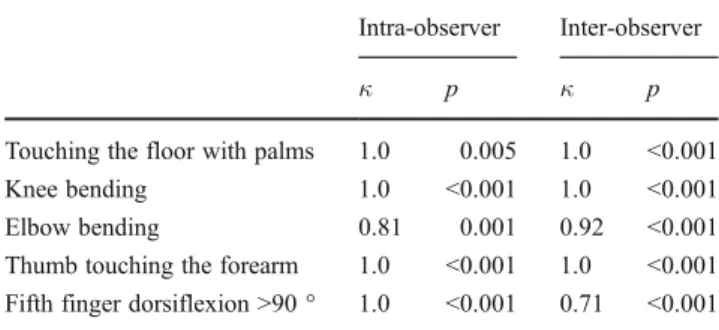
Intra- and inter-observer reliability was evaluated for each Beighton item and the lowest Kappa value was 0.71 (p<0.001) for any item (Table1). The intra-observer agree-ment for angle measureagree-ments was excellent (ICC 0.98, 95 % Confidence interval 0.95–0.99).
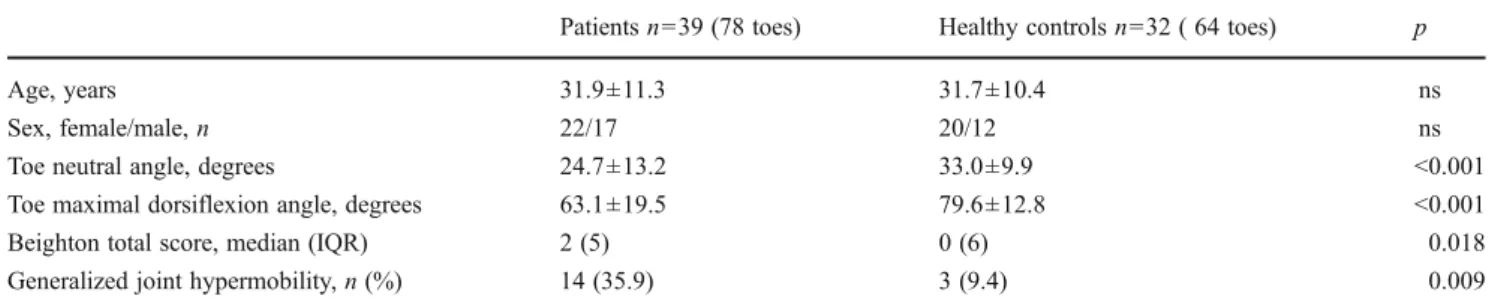
Patients with ingrown toe nails had a significantly higher median Beighton score compared to healthy subjects (2 vs 0,p00.018); they were also more likely to have a GJH (35.9 vs 9.4 %, p00.009; Table 2). Interestingly, the only case who had five toes affected had severe GJH with a Beighton score of nine points.
Patients with ingrown nails had significantly smaller neu-tral, as well as maximum toe dorsiflexion angles compared to healthy subjects (24.7±13.2 vs 33.0±9.9 °,p<0.001 and 63.1 ±19.5 vs 79.6±12.8 °,p<0.001, respectively). However, af-fected and unafaf-fected toes of the patients with ingrown toe nails had similar angles (Table3).
Discussion
Ingrown nail is a common condition with two peak ages (namely, in adolescents and in middle aged to elderly), sug-gesting different underlying etiological factors [2, 3]. Al-though several factors have been identified as predisposing
Table 1 Intra- and inter-observer agreement for Beighton items Intra-observer Inter-observer
κ p κ p
Touching the floor with palms 1.0 0.005 1.0 <0.001 Knee bending 1.0 <0.001 1.0 <0.001 Elbow bending 0.81 0.001 0.92 <0.001 Thumb touching the forearm 1.0 <0.001 1.0 <0.001 Fifth finger dorsiflexion >90 ° 1.0 <0.001 0.71 <0.001
individuals to ingrown nails (such as foot anatomy and nail structure), there is also a personal tendency [2, 11, 12]. Patients with ingrown nails often have a positive family history [2]. Similarly, joint hypermobility has also been shown to be familial and displays newly defined associations with many other conditions, such as uterine and rectal prolapse [5]. The results of the study suggest that ingrown toe nails are more common in patients with GJH and are associated with more limited dorsiflexion angle of the great toe. This might appear to be conflicting. However, many studies in the literature reported a limited range of motion in patients with a past history of joint hypermobility [13]. GJH predisposes joints to repetitive trauma and may lead to early degenera-tive changes and premature osteoarthritis; therefore, may limit joint mobility and cause rigid state earlier than healthy individuals [9].
Limited dorsiflexion of the first toe is defined as hallux limitus, which in time turns to hallux rigidus. Hallux limitus/ rigidus in young patients is reported to be usually due to trauma, either acute or chronic, which may not be radiolog-ically recognized earlier; however, it may result in second-ary degenerative changes in time [14]. Moreover, change in the first metatarsophalangeal joint flexibility is associated with a variance in hallucal peak pressure and loading and therefore might also predispose an individual to ingrown nail formation [15–17]. Supporting this association, hallux limitus/rigidus has previously been shown to be associated with first toe hypermobility and an increased peak plantar pressure under the hallux which should rather be located under the first metatarsal head [16]. Besides, weakening of the muscles in and around the foot usually results in over-pronation. Pregnancy and obesity, two other risk factors for
ingrown nails, are also risk factors for hallux limitus/rigidus formation, as they lead to increased pronation [3,18]. Other groups who are subject to extreme pronation are dancers and sports people in whom ingrown nail formation is also common.
GJH is the fundamental part of JHS. However, JHS have other clinical characteristics in which various organs like skin, nerves, and vessels are involved [5]. Fragility and thinning of the skin, autonomic nervous system dysfunction leading to hyperhidrosis and impaired proprioception may all contribute to the development of ingrown nail formation in JHS [3,5]. One of the limitations of our study is that we were not able to evaluate skin and nerve functions in our patients.
Joint hypermobility is shown to be more common in children and less common in the elderly; therefore, patients with GJH may have joint laxity at a younger age and may present with complications related to it, such as degenera-tive changes and hallux rigidus formation, later in the life [9]. Various degenerative arthritic conditions occur after the age of 50 and this might impair accurate assessment of the joint hypermobility. Therefore, we did not include the patients over the age of 50 in this study. Inclusion of this particular age group might strengthen the possible associa-tion shown in our study. Another weakness of the study is that it is cross-sectional. Although the number of patients was enough to demonstrate the association between ingrown nails and GJH, prospective studies are needed to investigate if hypermobility is also associated with recurrence of in-grown nails.
The results of this study support the hypothesis that in-grown nail formation may be associated with generalized joint Table 2 Localized and generalized joint hypermobility among patients and healthy subjects
Patientsn039 (78 toes) Healthy controlsn032 ( 64 toes) p
Age, years 31.9±11.3 31.7±10.4 ns
Sex, female/male,n 22/17 20/12 ns
Toe neutral angle, degrees 24.7±13.2 33.0±9.9 <0.001
Toe maximal dorsiflexion angle, degrees 63.1±19.5 79.6±12.8 <0.001
Beighton total score, median (IQR) 2 (5) 0 (6) 0.018
Generalized joint hypermobility,n (%) 14 (35.9) 3 (9.4) 0.009
All data are expressed as mean±standard deviation (SD) unless indicated ns nonsignificant, IQR interquartile range
Table 3 Neutral and maximal dorsiflexion angles of affected and unaffected toes of the patients with ingrown toe nails All values are expressed as mean ±SD
ns nonsignificant
Affected toes (n060) Unaffected toes (n018) p Ipsilateral neutral angle, degrees 25.5±13.3 22.2±12.8 ns Ipsilateral dorsiflexion angle, degrees 62.9±19.4 63.5±20.6 ns Contralateral neutral angle, degrees 23.1±13.7 25.3±13.1 ns Contralateral maximal dorsiflexion angle, degrees 62.8±17.6 63.9±25.5 ns
hypermobility. However, when examined locally, there is a limited range of motion in the effected toe, which could be due to the degenerative process facilitated by the hypermobility.
Disclosures None.
References
1. Heidelbaugh JJ, Lee H (2009) Management of the ingrown toenail. Am Fam Physician 79(4):303–308
2. Langford DT, Burke C, Robertson K (1989) Risk factors in ony-chocryptosis. Br J Surg 76(1):45–48
3. Ikard RW (1998) Onychocryptosis. J Am Coll Surg 187(1):96–102 4. Johnstone MW (1962) "Ingrown" nails and other toenail problems—
surgical treatment. Calif Med 97:222–226
5. Simpson MR (2006) Benign joint hypermobility syndrome: eval-uation, diagnosis, and management. J Am Osteopath Assoc 106 (9):531–536
6. Simmonds JV, Keer RJ (2007) Hypermobility and the hypermobility syndrome. Man Ther 12(4):298–309. doi:10.1016/j.math.2007.05.001
7. Ross J, Grahame R (2011) Joint hypermobility syndrome. BMJ 342:c7167
8. Foss KD, Ford KR, Myer GD, Hewett TE (2009) Generalized joint laxity associated with increased medial foot loading in female athletes. J Athl Train 44(4):356–362. doi: 10.4085/1062-6050-44.4.356
9. Bird HA (2007) Joint hypermobility. Musculoskelet Care 5(1):4– 19. doi:10.1002/msc.91
10. Grahame R, Bird HA, Child A (2000) The revised (Brighton 1998) criteria for the diagnosis of benign joint hypermobility syndrome (BJHS). J Rheumatol 27(7):1777–1779
11. Kosaka M, Kusuhara H, Mochizuki Y, Mori H, Isogai N (2010) Morphologic study of normal, ingrown, and pincer nails. Dermatol Surg 36(1):31–38. doi:10.1111/j.1524-4725.2009.01361.x
12. Ozdil B, Eray IC (2009) New method alternative to surgery for ingrown nail: angle correction technique. Dermatol Surg 35 (6):990–992. doi:10.1111/j.1524-4725.2009.01169.x
13. Simmonds JV, Keer RJ (2008) Hypermobility and the bility syndrome, part 2: assessment and management of hypermo-bility syndrome: illustrated via case studies. Man Ther 13(2):e1– e11. doi:10.1016/j.math.2007.11.001
14. Shurnas PS (2009) Hallux rigidus: etiology, biomechanics, and nonoperative treatment. Foot Ankle Clin 14(1):1–8. doi:10.1016/ j.fcl.2008.11.001
15. Van Gheluwe B, Dananberg HJ, Hagman F, Vanstaen K (2006) Effects of hallux limitus on plantar foot pressure and foot kine-matics during walking. J Am Podiatr Med Assoc 96(5):428–436 16. Darwish FM, Haddad W, Ammari F, Aoudat Z (2008) Association
of abnormal foot angles and onychocryptosis. Foot (Edinb) 18 (4):198–201. doi:10.1016/j.foot.2008.05.004
17. Zammit GV, Menz HB, Munteanu SE, Landorf KB (2008) Plantar pressure distribution in older people with osteoarthritis of the first metatarsophalangeal joint (hallux limitus/rigidus). J Orthop Res 26 (12):1665–1669. doi:10.1002/jor.20700
18. Manral DB (2004) Hallux rigidus: a case report of successful chiropractic management and review of the literature. J Chiropr Med 3(1):6–11. doi:10.1016/S0899-3467(07)60060-3