DESIGN CONSIDERATIONS
IN MULTIPURPOSE SPACE OF
PRESCHOOL EDUCATIONAL ENVIRONMENTS
A THESIS
SUBMITTED TO THE DEPARTMENT OF INTERIOR ARCHITECTURE A N D
ENVIRONM ENTAL DESIGN
A N D INSTITU TE OF FINE ARTS OF BlLKENT U NIVE RSITY IN P A R T IA L FULFILLMENT OF THE REQUIREMENTS
FOR THE DEGREE OF MASTER OF FINE ARTS
El^in O zyu rt
June, 1994
^70
MA
. η
ОЪ
I certify that I have read this thesis and in my opinion it is fully adequate, in scope and in quality, as a thesis for the degree of Master of Fine Arts.
/fi
.
---/ --- —
Assist. Prof. Dr. Halime D0mirkan (Principal Advisor)
I i
I certify that I have read this thesis and in my opinion it is fully adequate, in scope and in quality, as a thesis for the degree of Master o f Fine Arts.
Prof. Dr. Mustafa Pultar
I certify that I have read this thesis and in my opinion it is fully adequate, in scope and in quality, as a thesis for the degree of Master of Fine Arts.
v \ \
Assist. Prof. Mehmet Asatekin
Approved by the Institute of Fine Arts.
ABSTRACT
DESIGN CONSIDERATIONS IN MULTIPURPOSE SPACE OF PRESCHOOL EDUCATIONAL ENVIRONMENTS
Elçin Özyurt M. F. A. in
Interior Architecture and Environmental Design Supervisor: Assist. Prof. Dr. Halime Demirkan
June, 1994
Design requirements of preschool educational environments that support all aspects o f child development are examined in this study. In order to determine the design criteria for preschool educational environments, the characteristics and the properties of early childhood are investigated. Additionally, educational philosophy and psychological influences of environment which affect the physical organization are stated. Within this framework, design considerations o f preschool educational environments are discussed under the issues of activity places, alternative organizations, and items of furniture which build up the environment. Finally, general design criteria which are necessary for a comfortable education environment are pointed out.
Keywords: Preschool Educational Environments, Ergonomics, Space
ÖZET
O K U L ö n c e s i ç o k A M A Ç LI E Ğ t lîM O R TA M LA R IN D A
TASARIM KRİTERLERİ
Elçin Özyurt
Iç Mimarlık ve Çevre Tasarımı Bölümü
Yüksek Lisans
T ez Yöneticisi; Yrd. Doç. Dr. Halime Demİrkan
Haziran, 1994
Bu çalışmada okul öncesi eğitim ortamlarının, çocuk gelişimini destekleyen
tasanm şartları tüm yönleri ile incelenmiştir. Okul öncesi ortamları için gerekli
tasarım kriterlerini belirleyebilmek amacıyla erken çocukluk dönemi özellikleri
araştırılmıştır. Ayrıca, mekan planlamasını etkileyen eğitim felsefesi ve çevrenin
çocuk üzerindeki psikolojik etkileri de belirtilmiştir. Bu yapı içerisinde, okul
öncesi eğitim ortamlarının tasarım şartları; etkinlik alanları, plan seçenekleri,
ve ortamı oluşturan mobilya birimleri başlıkları altında incelemiştir. Son olarak,
uygun bir eğitim ortamı için gerekli genel tasarım kriterleri belirlenmiştir.
A nahtar sözcükler: Okul Öncesi Eğitim Ortamlan, Ergonomi, Alan Planlama,
Tasarım Kriterleri, Mobilya.
ACKNOWLEDGEMENTS
Doing a master thesis is one of the few enjoyful studies I have ever done. Foremost, I would like to thank Assist. Prof. Dr. Halime Demirkan for her endless patience, support, and sensitiveness which show me the way I should be on. I appreciate Ms. Demirkan for her guidance without which this thesis wouldn’t have been completed.
Secondly, I would like to appreciate Akin Genceli, my sister, for her endless patience in helping me when I have been in trouble. I would also like to thank Özyurt’s who have always been confident with my successes.
Finally, I would like to thank Dr. Feyzan Beler and Yaprak Sağdıç, who have given me critics and help for this study which let it worthy.
TABLE OF CONTENTS P a g e Signature Page_________________________________________________________________ ii Abstract________________________________________________________________________iii Özet____________________________________________________________________________ iv Acknowledgements_____________________________________________________________ v Table of Contents_______________________________________________________________ v i List of Tables___________________________________________________________________ ix List of Figures__________________________________________________________________ x 1. INTRODUCTION 1 1.1. Problem____________________________________________________________ 1 1.2. Object and Methodology______________________________________________1 1.3. Structure of Thesis_________________________________________________ 4
2. CHILDREN AND ENVIRONMENT 7
2.1. Characteristics and Properties of Potential Age Group_____________ 8 2.1.1. Physical and Motor Development in Early Childhood_______ 9 2.1.2. Cognitive Development in Early Childhood_______________ 10 2.1.3. Social Development in Early Childhood___________________ 16 2.1.4. Emotional Development in Early Childhood_______________ 17 2.1.5. Linguistic Development in Early Childhood_______________ 19 2.2. Perceptual and Evaluative Approach of Preschool
3. CHILDREN AND PRESCHOOL EDUCATION
23
3.1. Need and Purpose of Preschool Education________________________24
3.2. Multipurpose Space and Learning in Preschool Education_______ 25 3.2.1. Role of Interest Centers in Development of Preschool
C hildren________________________________________________________ 26 3.2.2. Aspects of Activity in Learning____________________________ 29
3.2.2.1. Play________________________________________________ 30 3.2.2.2. Discovery__________________________________________ 41 3.3. Major Philosophies in Preschool Education______________________ 42 3.3.1. Behavioristic Learning Theory Approach__________________43 3.3.2. Piagetian Cognitive-Developmental Approach_____________ 45 3.3.3. Developmental-Interaction Approach_____________________ 47
4. PSYCHOLOGICAL ASPECTS OF PRESCHOOL EDUCATIONAL
ENVIRONMENTS 52
4.1. Psychological and Behavioral Influences of Environment on
\ Preschool Children______________________________________________ 52 4.1.1. Personal Space____________________________________________ 53 4.1.2. P r iv a c y __________________________________________________ 57 4.1.3. T erritoria lity______________________________________________ 64 4.1.4. Crowding__________________________________________________ 66 4.2. Researches Conducted on Psychology and Space Characteristics of
Preschool Educational Environments______________________________69
5. PHYSICAL ASPECTS OF PRESCHOOL EDUCATIONAL ENVIRONMENTS 73
5.1. Activities and Learning Areas in Multipurpose Space---74 5.1.1. Activity Places with High Physical Mobility and Noise_______74 5.1.1.1. Music and Physical Exercise A rea____________________ 75 5.1.1.2. Dramatic Play A rea _________________________________ 76 5.1.1.3. Block A rea_________________________________________ 81 5.1.1.4. Art and Craft A rea__________________________________ 89 5.1.2. Audiovisual Interaction Activity Place______________________ 91 5.1.3. Noiseless Activity Places___________________________________ 94
5.3.3.1. R eading and Listening C o r n e r______________________ 94 5.3.3.2. Manipulative T o y A rea ______________________________% 5.1.4. Other Areas Related with Multipurpose Space______________ % 5.2. Items of Furniture______________________________________________ 101 5.2.1. Work Surfaces____________________________________________ 102 5.2.2. Sitting Units______________________________________________ 102 5.2.3. Storage and Display Units_________________________________ 103 5.2.4. Partitions_________________________________________________109 5.2.5. Platform s_________________________________________________109 5.3. Organization of Multipurpose Space_____________________________ 115 5.3.1. Structured Space Plan ____________________________________ 117 5.3.2. Open Space Plan__________________________________________ 118 5.3.3. Modified Open Plan_______________________________________ 119
6. GENERAL CRITERIA FOR THE DESIGN OF A MULTIPURPOSE SPACE 123
6.1. Basic Requirements_____________________________________________ 123 6.2. Health and Safety Requirement__________________________________ 125 6.3. Maintenance____________________________________________________ 128 6.4. Environmental Requirements___________________________________ 129 6.5. Ergonomic Considerations_______________________________________ 131 7. CONCLUSION REFERENCES SELECTED BIBLIOGRAPHY APPENDIX 138 143 148
P a g e Table 2.1. Piaget’s Stages of Cognitive Development___________________ 9 Table 2.2. Milestones of Motor Development During Early
Childhood______________________________________________ 11 Table 2.3. Conservation Tasks Investigated by Piaget_________________ 15 Table 2.4. Stages in the Development of Self Awareness______________ 16 Table 3.1. Some Good Toys and Play Materials for Young
Children___________________________________________________ 36 Table 3.2. Stage Theories of Play: Piaget, Smilansky & Parten_________ 39 Table 5.1. Suggested Equipment for Block Building__________________ 83 Table 5.2. A Summary of Space Requirements________________________ 99 Table 5.3. Representative Partitioning Systems for Enclosed Space
_____________________________________________________ 110
Table 5.4. Furnishings in the Flexible P la n _________________________ 113
P a g e Figure 5.1. Various Shapes of Unit Blocks and Two Sample
Constructions___________________________________________ 82 Figure 5.2. Preschool Hollow Blocks and Associated Equipment
________________________________________________________ 86
Figure 5.3. A View from Block Corner_______________________________ 87 Figure 5.4. Children Playing with Block_____________________________ 88 Figure 5.5. Storages on Wheel, Work Surfaces, Platforms____________ 105 Figure 5.6. Sitting Units, Shelves, and Other Furnishings___________ 106 Figure 5.7. Partitions, and Some Storage Units______________________ 107 Figure 5.8. U-shaped Work Area Formed with Combination of
Various Storage Units__________________________________ 108 Figure 5.9. Three Types of Toy Storage Cabinets in
Combinations___________________________________________ 108 Figure 5.10.Platform s______________________________________________ 112 Figure 5.11. Various Organizations of Multipurpose Space in
Different Architectural Patterns________________________121 Figure 5.12.Comparison of Organizations of Multipurpose
Space in Usage_________________________________________ 122 Figure 6.1. Two Scales Prevalent throughout Playroom of the
Stanford Day Care Center_______________________________ 133 Figure 6.2. Average Dimensions of 3 Year-olds______________________ 135 Figure 6.3. Average Dimensions of 6 Year-olds______________________ 136
1. INTRODUCTION
1.1. Problem
Recognition of the importance of early years in the life of a child is not new. From the works o f Comenius (1592-1670), Rousseau (1712-1778), Pestalozzi (1746-1827), and Froebel (1782-1852) modern early childhood education evolved. After the World War II., social works to improve the welfare of family gave rise the idea of enhancing young children’s development through social organizations. Advances in science, especially in the pediatrics, mental health, education, psychology, and rapid industrialization have appeared as general reasons of public concern being focused in the healthy growth and development in early childhood (Christianson, Rogers & Ludlum, 1961) Besides, the source of drastic increase in the number of preschool educational settings depends on employment of mothers because of economic reasons (Scarr & Weinberg, 1986). As early childhood education have become an almost universal experience, there is a need to think the concepts and environmental conditions which provide the early childhood education most beneficial for all aspects of child development.
1.2. Object and M ethodology o f the Study
inhabit is less than adults. Actually, children may be very active users of facilities, and often the facilities they use the most are little used or unused by adults. Sometimes children’s usages are in conflict with those of adults; more often they are simply separate. The conflict between these two groups comes from the differences in dimensions that are critical for environmental design such as physical size, cognitive development, social competency, personal mobility, autonomy, and control. Preschool educational environments are places in which children are the main active, users. Therefore, the decisions about the design o f these environments should be made by the consideration of young children entity as the primary user while still regarding the existence of adults. The aim of this study is to point out the main design principles which are consistent with the need and expectations of young children in preschool educational environments.
Firstly, characteristics and properties of children should be examined in order to be familiar with the attitudes and expectations of the potential age group. Depending on this; physical and motor, cognitive, social, emotional, and linguistic development of children should be studied. Perceptual and evaluative approach of children to built environment should be pointed.
Determining the role of preschool education in a child’s life as a new environment is the second step. All concepts related with preschool educational environments such as multipurpose space, and interest centers are discussed. While doing this, the aspects of learning are stated as play and discovery. Play has been categorized differently by various authorities.
These categories should be investigated in order to point out the necessity of activities determined in a preschool educational environment. Another point which should be discussed is that the major philosophies in preschool education and their reflectance to the built environment.
Thirdly, psychological and behavioral influences o f environment on preschool children should be examined while supporting the issues with researches conducted on psychology and space characteristics o f preschool educational environments. Discussing psychological aspects of preschool educational environments is compulsory. Because, it’s a known fact that psychology and social behavior of preschool children are affected by physical character of the environment.
Fourthly, under the scope of all information above, major activity places, items o f furniture which constitute these activity places, and the alternatives of organization in a preschool educational environment are investigated.
As a final step, general criteria for the design of a preschool environment should be explained so that the requirements of a comfortable and appealing indoor environment for the education of preschool children are clarified.
All these researches are done in order to determine the alternative requirements of a healthy preschool educational environment which contribute to the development of children positively.
1.3. Structure of the Thesis
There are five main chapters which examine the problem and give information in various aspects excluding the introduction and conclusion chapters. The first chapter is an introduction to the thesis and the seventh chapter is the conclusion part.
In the second chapter, characteristics and properties of the potential age group are discussed from physical and motor, cognitive, social, emotional, and linguistic development points of view. Perceptual and evaluative differences of preschoolers in comparison with adults are discussed in the second part of the chapter.
In the first part of the third chapter, the need and purpose of preschool education are stated. At this respect, preschool educational settings have two functions: to educate and to socialize the children. In the second part, multipurpose space and learning in preschool education are discussed. Multipurpose space refers to the environment where various activities related with education take place and the children be cared. Five particular themes; environmental, creative, educational, emotional, and social development are discussed to emphasize the role of multipurpose space in learning. The aspects of learning are discussed as play and discovery. The meaning and value of play is stated, and the varieties of play are examined from three authorities’ point of view. Discovery and its relation with play are also discussed as a learning method. In the third part of the chapter, philosophies in preschool education and their influence on the organization of multipurpose space are examined. These philosophies are
Behavioristic Learning Th eory Approach, Piagetian Cognitive Developmental Approach, and Developmental Interaction Approach.
The concern of the fourth chapter is to analyze the psychological aspects of preschool educational environments and to make inferences on physical dimensions. In the first part of the chapter, psychological and behavioral properties o f the environment and their effects on physical dimensions are pointed out in detail. Psychological and behavioral properties of environment are reflected in the concepts o f personal space, privacy, territoriality, and crowding. In the second part, how social behavior of children is affected by the certain arrangements of multipurpose space is discussed. The advises pertained from researches to shape the behavior of young children is stated.
The fifth chapter o f the thesis refers to the physical aspects of preschool educational environments. The activities and play areas are grouped according to their mobility and noise level. Activity places with high physical mobility are composed of music and physical exercise area, dramatic play area, block area, and art and craft area. In audiovisual interaction activity place, the usage of computers by children, and exposition of video and slides are stated. With the requirements of this activity center, the appropriate placement of this place in a multipurpose space is also discussed. The activity centers where basically a noiseless environment is required and personal activity is dominant rather than group participation are grouped under noiseless activity places. Reading and listening corner, and manipulative toy area constitute this category. Other areas which support or control the function of multipurpose space
are tutoring booth, storage space, and observation space. In the second part of the chapter, the main items of furniture are presented as work surfaces, sitting units, storage and display units, partitions, and platforms. When discussing them, the main purpose is to point out the characteristics of furniture that best serve for the needs of activity centers, and create flexible environments. In the last part o f the chapter, organization of multipurpose spaces which refer to structured, open, and modified open plan are discussed with respect to architectural alternatives.
In the sixth chapter, general criteria for the design of a multipurpose space are classified as basic requirements, health and safety requirements, m aintenance, en viron m en tal requ irem en ts, and ergon om ic considerations.
2, CHILDREN AND ENVIRONMENT
The understanding and prediction of children's spatial perceptions and behavior have been profoundly investigated by the researchers. Piaget's investigations of children's spatial understanding (Piaget
&
Inhelder, 1967) have strongly influenced what is believed about children's environmental context (Ziegler&
Andrews, 1987).As Piaget (1963) stated, a s s im ila tio n and acco m m od ation are the two basic functions used by young children to perceive and learn the environment. According to Piaget, in case the experience, perception, or information fits to previously structured knowledge of one's mind, that experience, perception, or information is accepted-it is assimilated. If it does not fit, the mind may change the previous knowledge to the new one which is able to accept -or accommodate- the information or experience. Accommodation occurs when a previously learned response fails to work in a new situation. When the balance occurs between these two functions, the development of intellect takes place. Therefore, the relation of a young child with environment is a process of assessment and construction (Craig,
1989).
The concern of this chapter is to examine the approach of young children to environment. The question of 'how does a young child perceive and understand his environment?' is aimed to be answered. In order to
understand the children's evaluation of environment, it seems necessary to investigate the characteristics and properties of the potential age group. Under this title; physical and motor, cognitive, social, emotional, and linguistic development of the preschool children will be stated. Perceptual and evaluative differences of preschoolers in comparison with adults will be discussed in the second part.
2.1. Characteristics and Properties of Potential Age Group
While children grow up, their needs and expectations change according to their physical and psychological development. Children have different pleasures, performance and properties in every developmental period. Therefore, it is important to consider the characteristics of children in different age groups when making inferences about the quality and property of their environment.
The researchers studying development of children , generally divide the childhood period into four groups (Clarke-Steward & Friedman, 1987; Fogel
&
Melson, 1988; Craig, 1989); infancy, early childhood/young child (preschool period), middle childhood, adolescence. These stages which are shown in Table 2.1. are Piaget's stages of cognitive development. According to Piaget's theory, children are ready to adapt and to learn the world by birth. They don't have to be taught deliberately to walk or that objects have to obey certain physical laws and people have to obey moral rules. In his opinion, children build up knowledge as they mentally organize information from the environment.Children actively participate in their own development. They manipulate and explore their world, guided by mental structures or mental representations of how things work (Clarke-Steward & Friedman, 1987).
Stage
Sensorimotor Birth to two years P r e o p e r a t io n a l 2 t(îtrf7 years
C on crete O p era tio n a l 7 to 11 years
Form al O p e ra tio n a l Over 11 year
A c tiv itie s and A c h ie v e m e n ts
Infants discover aspects of the world through their sensory impressions, motor activities, and coordination of the two.
Child can not yet think by operations, by manipulating and transforming information in basic and logical ways. They can think in images, symbols and form mental representations of objects and events.
Children can understand logical principles that apply to concrete, external objects.
Adolescents and adults can think abstractly. Their thinking is no longer constrained by the given o f the immediate situation but can work in probabilities and possibilities.
Table 2.1. Piaget's Stages of Cognitive Development.
(From CLARKE-STEWARD, A., & ERIEDMAN, S. Child Development: Infancy Trough Adolescence. New York: John Wiley and Sons, 1987. p. 19)
In order to give more detailed information about the properties of early childhood, the characteristics of physical and motor, cognitive, social, emotional, and linguistic development of this period will be examined in detail under the following subtitles.
2.1.1. Physical and Motor Development in Early Childhood
During the preschool years, substantial changes in size, shape, and body proportions are occurring. However, compared to the dramatic transformations of the first two years, the growth rate has slowed down.
Children grow twice as fast in the period from about 1 to 3 years as they do from the period about 3 to 6 years. Differences in heights of children tend to remain moderately stable during the preschool years. Although boys and girls develop at approximately the same rate, girls tend to be slightly shorter and lighter than boys.
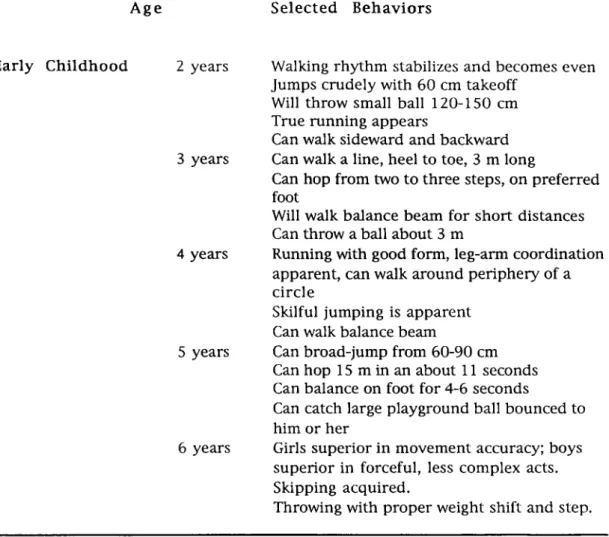
Motor coordination in young children develops along with muscular strength and speed. This refers to the skills involved in coordinating physical movements. Through active play, young children learn to channel strength and the speed into smooth, accurate movements. Children of this period are curious, energetic and eager and they love to climb, run, and jump. This vitality in the movements provide the children to master the ability to regulate their behavior. These gains in self-regulation in movement are part of a general trend toward greater self- control in all areas of development. The major milestones of motor development from age two to age six are summarized in Table 2.2.
2.1.2. Cognitive Development In Early Childhood
Thinking typical of early childhood is a blend of impressions, intuition, and partial logic. Piaget describes this period as the stage of preoperational thought. By "preoperational," he meant "before the ability to perform logical mental operations" (Fogel & Melson, 1988: 243).
Children in the period of early childhood gain the symbolic representation which means the ability to represent people, places, and ideas as symbols.
A g e S elected B eh aviors
Early C h ildhood 2 years Walking rhythm stabilizes and becomes even Jumps crudely with 60 cm takeoff
Will throw small ball 120-150 cm True running appears
Can walk sideward and backward 3 years Can walk a line, heel to toe, 3 m long
Can hop from two to three steps, on preferred foot
Will walk balance beam for short distances Can throw a ball about 3 m
4 years Running with good form, leg-arm coordination apparent, can walk around periphery of a circle
Skilful jumping is apparent Can walk balance beam
5 years Can broad-jump from 60-90 cm
Can hop 15 m in an about 11 seconds Can balance on foot for 4-6 seconds
Can catch large playground ball bounced to him or her
6 years Girls superior in movement accuracy; boys superior in forceful, less complex acts. Skipping acquired.
Throwing with proper weight shift and step.
Table 2.2. Milestones of Motor Development During Early Childhood (From CRATTY, BRYANT J., Perceptual and Motor Development in Infants and
Children, 1979. p. 222)
A symbol bears some resemblance to the thing signified. For example, a road sign with a curved line symbolizes the fact that the road ahead is curved. In contrast, a sign, such as the word cat, is arbitrary and has no resemblance to its referent. During the preoperational period, both symbols and signs are evident in many aspects of children's behavior. Imitating the adult roles, using the objects resembling the real thing, entertaining mental images o f absent people, places, and things are the results of symbolic thought.
On the other hand, preoperational thinking has the deficiencies in many ways (Fogel & Melson, 1988):
Egocentrism is the inability to understand the world except from one's
own point of view. When a three-year-old children picks out a toy truck for Daddy's birthday shows the inability to consider the preferences of his father because of the limitations of thinking.
Centration means centering or concentrating on only one aspect o f a
situation. According to Piaget, preschoolers cannot asses the multiple elements and the relations among them. As a result o f this approach, egocentric thinking and other mistakes in preoperational thinking come out.
Cause-and-Effect Reasoning involves preschoolers centration on only
one aspect of a situation at a time, which they have frequently in trouble grasping how one event causes another. For example, when watching a television program interrupted by commercials, preschool children have difficulty linking events shown before and after the breaks.
In case the preschool children identify cause-and-effect sequences, they use transductive reasoning which leads the preschool children to incorrect interpretations. Through transductive reasoning, young children link two specific events that occur close together. For example, supposing that it rained in the first day of nursery school, a preschool might interpret this to mean that school started because it rained.
understanding causality, refer to the belief that every event must have a specifiable cause and that nothing happens by chance. Thus, preschoolers ask endless questions beginning with “Why?” to the adults.
Anim ism can be described as "preschoolers' tendency to explain the
behavior of natural phenomena, inanimate objects, or mechanical devices as though they were alive" (Fogel
&
Melson, 1988: 247). For example, a preschooler thinks that moon is hiding when it is behind a cloud and a room is lonely when it is empty.A rtificialism , which is related with animism, is "the belief that
everything that exists has been created by humans or divine plan" (Fogel & Melson, 1988: 247). Thus, according to Piaget (1967), preschoolers believe that "Mountains grow because stones have been manufactured and then planted; and lakes have been hollowed out" (Fogel & Melson, 1988: 247).
Because o f the preoperational thinking, preschoolers have re a so n in g
problem s. They make inferences and logical deductions poorly. Classifying problems also appear in the period of early childhood.
Centration makes it difficult for preoperational children to understand that people and objects can be classified in more than one way. For example, it’s difficult for a preoperational child to consider a collie as a dog, a mammal, and an animal in a hierarchy o f subordinate and superordinate categories.
Children in the preoperational stage also tend to group objects together differently than do older children. If preoperational children are given a
variety of objects of different sizes and colors, and asked to classify them, preschoolers are likely to use inconsistent and shifting categories. Instead of consistently using specific dimensions or color to group the objects, they put some objects together since they are near each other, or “because one can make a man out of them”. This approach is an example of syn cretic
re a s o n in g that refer to “idiosyncratically connecting unrelated ideas or
elements into a whole” (Fogel & Melson, 1988; 247).
Sériation refers to the ordering of items from largest to smallest or
smallest to largest. When sticks of differing lengths are given to four and five year old children and asked to arrange them from smallest to largest in a row, they are unable to complete the task successfully. Children of ages five and six, on the other hand, can do the task with a considerable effort and frequent errors.
Conservation is defined by Piaget as understanding the invariance of
certain properties, such as number, length, surface, and quantity in spite of apparent changes in objects. Piaget argued that because of centration, preoperational thinkers have difficulty grasping the conservation of liquid, volume, length, mass, and number (Table 2.3.).
Another problem preschoolers have with conservation is understanding the reversibility of operations. Thus, a preoperational child is likely to think that the amount of liquid poured from a container to another in different dimensions, and then back, would not be the same amount.
preschoolers are more able to be distracted than older children. They also tend to perceive objects globally rather than in terms of specific dimensions. Another characteristic of preschoolers is that they don’t use specific strategies to scan or remember objects, and they are less aware of what memory or problem-solving techniques should be used in different situations.
Task Procedure
Acquired
Conservation
Two identical balls of clay are presented. Child admits
of substance
they have equal amounts.
The shape of one ball is changed. The child is asked
whether the two balls still contain the same amount of clay.
Conservation
Two parallel sticks are shown to the child who admits they
of length
are equally long.
One of the sticks is moved. The child is asked if the sticks
are still the same length.
Conservation
Two rows, each containing the same number of beads, are
of number
placed in one-two-one correspondence.
The spaces in the beads in one of the rows are changed. The
child is asked whether each row still has the same number
of beads.
Conservation
Two identical beakers are filled to the same level with
of liquids
liquid. The child sees that they contain the same amount.
The liquid from one beaker is poured into a differently
shaped beaker (so that the water level changes). The child
is asked if the beakers still contain the same amount of
liquids.
Conservation
Two glasses of water with equal balls of clay inside them
of volume
are shown to the child.
One of the balls is changed in shape. The child is asked if
each piece of clay still displaces the same volume of water.
Conservation
The same number of small squares are placed in the upper
of area
left comer on two identical sheets of cardboard. The child
sees that the same amount of space remaining on each sheet.
On one sheet, the squares are scattered. The child is asked
if the same amount of space remains on each sheet.
Age
6-7
years
6-7
years
6-7
years
6-7
years
9-10
years
9-10
years
Table 2.3. Conservation Tasks Investigated by Piaget
(From FOGEL A., & MELSON G. F. Child Development: Individual, Family, and Society. New York: West Publishing Company, 1988. p. 249)
2.1.3. Social Development In Early Childhood
When preschool children enter the environment of early childhood education, they experience new social relationships other than that of parents. These new relationships help develop the prosocial behavior in children which refers to being fully human such as helping, sharing, giving to those in need, and cooperating. Children behave more prosocial, when they feel that they are expected to be so and to understand how to help or share effectively.
In preschool educational environments, children influence each other in many ways. They support each other in various situations and behave as a team to solve the problems they face with. These peer relations promote the feeling o f socializing and help children understand social concepts and rules which is a process called internalization.
As a result of social interaction, preschool children develop the self- awareness which is different from that of older children (Table 2.4.).
L e v e l A ge in Y e a r s 0 Birth-3 1 3-7 2 7-12 3 10-15 4 15+ Description
No difference between perspective o f self and other. Knows others feel differently but no understanding that they observe how self feels.
Appreciates that others know how self could be feeling.
Observes self as actor ( “ 1” ) and as object ( “ me” ) simultaneously.
Aware of unconscious processes in self and others. Tab le 2.4. Stages in the Development o f Self Awareness
(From FOGEL A. & MELSON G. F. Child Development: Individual, Family, and Society. New York: West Publishing Company, 1988. p. 274)
Preschoolers begin to realize that their actions evoke reactions in others, and they become more self-aware and behave in ways that anticipate the responses of others. They discover how they are similar to and different from the others. As a result of this discovery, they understand the sex and age differences among the people. Gradually, they realize that gender is a stable and consistent property of human.
2.1.4. Emotional Development in Early Childhood
When preschool children begin to interact with other persons, events, or ideas, they begin to live emotional experiences. The expression of specific emotions, such as fear, anger, distress, and enjoyment appear to change in preschool years.
Preschool children begin to use both distress and enjoyment as social signals, since they occur primarily in interaction with others. In general, preschoolers cry less and laugh more frequently than younger children.
Since young children have difficulties in understanding that transformations in appearance do not change identity, they can become alarmed when the appearance of the people around, or of their own suddenly alters. Thus, young children are frightened when seeing the familiar people with a haircut or with masks. The distinction between fear and anxiety is that the fear has a specific source whereas anxiety has a more vague or generalized source. A sudden change in parental expectations, or a move to a new neighborhood can become the source of anxiety.
As a reaction against the feeling of anxiety, young children develop the strategies called defense mechanisms. At the age of 5 or 6, many children have learned to hide their feelings with defense mechanism.
The following list summarizes the most common defense mechanisms learned by children:
Withdrawal. A common defence mechanism in which the young child
physically runs away from or, mentally withdraws from, unpleasant situations.
Identification. This mechanism refers to the process of incorporating
into oneself to values, attitudes, and beliefs of others. For example, children adopt the attitudes of powerful figures, like parents, to reduce the anxiety that children feel about their own relative helplessness.
P ro jection. Young children use this defence mechanism to attribute his
or her own undesirable thoughts or actions to someone else.
Displacem ent. A defence mechanism in which a less threatening person
or object is substituted for the actual source of anger or anxiety.
Denial. The refusal to admit that an anxiety-producing situation exists or
that an anxiety-producing event happened.
R epression. An extreme form of denial in which the individual completely
Regression. C op in g w ith a a n x ie ty -p ro d u c in g situ ation b y r e v e rtin g to an earlier, m ore im m atu re b e h a v io r such as b e g in n in g to tum b-sucking.
Reaction formation. This occurs when children have thoughts or desires
that make them anxious and cause them to react against such thoughts by behaving in a contradictory way.
Rationalization. Young children explain unacceptable thoughts or
behavior by inventing a socially acceptable reason for them (Craig, 1989).
Preschool children begin to feel self-worth or self-esteem through the realization of their characteristics. They represent individual differences in their emotional lives and the way to respond to the events.
The development of self-control is another property acquired by children in this period. Physical and verbal aggression increase from early childhood, but over the preschool years, most children learn the ways of resolving conflicts with others. Self-control help children to control the aggression, and eventually becomes a way to adapt to the environment (Fogel & Melson, 1988).
2.1.5. Linguistic Development in Early Childhood
A dramatic increase is observed in average vocabulary during the preschool years, from under 400 words at age two to over 2500 at age six. Children understand many more words at each age (receptive vocabulary),
though they cannot use all o f them effectively in conversation
hear around them, even though they may not know the meaning of them. The grammatical development in the language is also evident in this period. Children begin to use the grammatical rules stage by stage in the nature of an approximation to adult usage. Gradually, children learn to use language as a social instrument in communication (Fogel & Melson, 1988).
2.2. Perceptual and Evaluative Approach of Preschool Children to Built Environment
A child’s physical environment is formed by few basic spaces: home, surroundings of home such as playground, street, shop, and preschool environment. The child, as the youngest member of the society, develops in this environment. A child’s physical environment, which is mostly created by adults with adult understanding, is the world of small objects within a world o f bigger objects. Broad imagination capability of the child uses every object as a raw material to recreate his own world whether the environment has been well-prepared or half-prepared by adults (Tungel, 1981).
Observations show that children use the built environment in an amazingly different manner than adults. "Young children, so imaginative in their own spheres of actions, may look matter-of-factly on places than to adults are haunted by memories" (Tuan, 1977: 33). Children may perceive their environment realistically as a necessity or experience, but their use of environment may depend on their unlimited imagination. For example, a child may use an environment just like a play material as the designer never planned. Environments for children, to live in, learn in, and play
in should give opportunities for children to make their own decisions. Otherwise, children find out ways against the limitations with their imagination. Children are often able to adapt themselves to the existing environment and change the environment according to their desires.
Children and adults differ as regards the critical entities for environmental design including not only physical dimensions but also cognitive development, social competency, personal mobility, autonomy, and control. Thus, actions of children are different from those of adults within and upon the built environment. Secondly, reactions of children are different from those of adults. Thirdly, certain environments are designed explicitly for children's activities or for children as users. Because of the reasons stated above, the quality of children's interactions with the world around them should be assessed according the characteristics of children (Ziegler & Andrews, 1987).
When the design of an environment requires the consideration o f the data related to children, the problem becomes even more complex. If the potential users of an environment are different groups of people such as children and adults, design solutions should satisfy the needs o f both groups. It is obvious that children have special psychological and physical needs and these needs may not always be identical to those of adults. Moreover, it is a difficult design process to develop an environment precisely answers the expectations of both age group together.
According to environmental researchers, physical environment influence the development o f children. Thus, in order to create an effective
environment, the needs of the children have to be considered in any setting. The young child has a right to develop and to grow according to his inner dictates; he needs to play, to socialize with other children and adults, and to explore the world around him. Thus, the child should be considered as an active learner, the physical environment as a living learning environment, and the child's life as a development cycle. If designer is aiming at physical congruence between the child and the physical environment, information has to be obtained about his spatial requirements, and this information has to be usable in the design process (Pollowy, 1974).
3. CHILDREN AND PRESCHOOL EDUCATION
Early years in the life of a child has great importance, since the development is very rapid. In this period of life, being in a developmentally supportive environment and being cared by the able persons provide a healthy progress in the overall development of children.
In this chapter, the need and purpose o f preschool education will be explained in the first part. In the second part, the meaning of a multipurpose space and its general contributions to the development of children will be stated. Five particular themes; environmental, creative, educational, emotional, and social development will be discussed to emphasize the role of a multipurpose space in learning. The aspects o f activity in learning will be examined under the titles of play, and discovery. After the meaning and values of play are stated, three authorities’ point of views on the varieties of play will be examined. The criteria that should be taken into consideration for a high quality of play in child development will be summarized considering time, change, challenge, and suitability. Discovery is defined as another aspect of learning and its relation with play is determined. In the third part of the chapter, major philosophies in preschool education and their appearance in physical dimension o f educational environments will be discussed in order to clarify the consistency between the philosophy and the design of the multipurpose
space.
3.1. Need and Purpose of Preschool Education
The advancement of pediatrics, mental health, education, psychology, and growing public concern in welfare o f family and children have caused a gradual development in the preschool education. Moreover, the employment of mothers because of the economic problems has necessitated that preschool children be cared by other social organizations. Day care centers and nursery schools are included in these social organizations. Day care centers are institutional settings in which preschool children are cared for when their mothers are working or otherwise unavailable. Nursery schools, on the other hand, are preschool settings which prepare children for school, usually with periods of group activities and shorter hours than day care. The aim of kindergartens is to prepare 5-6 years of children to first grade education (Clarke-Steward & Friedman, 1987).
Early childhood education programs have often been justified because they meet the developmental needs of children. Generally, preschool education has two functions: The first one is to socialize the young children. Preschool educational environments are the places where children meet new social interactions. Through the activities such as eating, sleeping, and playing together, children begin to learn how to live with other people. They also realize their liberty through the conditions of preschool environment.
team work, sharing, helping each other, and respecting the others’ liberty and rights, children experience the feeling o f socialization. Besides, teachers and caregivers are healthy models for young children who learn through imitation. The young child's development is largely a function of the interaction between the basic maturational patterns and encounters with the environment. The second function of the preschool education is to educate the young children. The activities that children are involved in preschool education help them elaborate certain skills and abilities rather than teach new things. Thus, early childhood educational environments, by creating a favorable circumstances, support the child's development and influence its direction (Frazier, 1968).
3.2. Multipurpose Space and Learning in Preschool Education
The appropriate environment for preschool children will nurture growth in all areas of development, such as physical, emotional, social, and intellectual. Concrete, manipulative materials arranged in interest centers will motivate the children to engage with activities, while creating the optimal learning environment for young children. Preschoolers are naturally curious and eager to explore their environment (Moore
&
Moore, 1979). The learning center approach to teaching creates a total learning environment which supports the development of each child as an individual (Ward, 1991). Children need space to learn through their own actions such as building, sorting, experimenting, counting, and pretending (Hohmann, Banet & Weikart, 1979). An environment o f this nature lets children make choices and act on them. Early experiences appear to be a key influence in determining children's abilities for further learning(Ward, 1991).
In this part, the role of interest centers in child development will be examined. Besides, two aspects of activity in learning; play and discovery will be discussed.
3.2.1. Role of Interest Centers in Development of Preschool C h ild ren
Multipurpose space in preschool educational settings refers to the environment where various activities related with education take place, and children are cared. Activity or interest centers are the places that are arranged with creative materials for exploration and play. Multipurpose space is a dynamic environment where activity centers are permanently ready to serve for children. In this respect, a total multifunctionality takes place in multipurpose space, while children are involved in different corners concurrently. The dynamism of multipurpose space also comes from the changing the physical aspects o f activity centers through the combinations among them. For example, a combination of a dramatic play area and a block area changes the usage o f these areas into a new appearance.
In relation to interest centers, five particular themes - environmental, creative, educational, emotional, and social development - are developed to emphasize the role o f multipurpose space in learning.
the broad goals of a program, and to meet children's need for activities, decision making and interaction. Children receive information from this environment and use it in their intellectual development. This information has the properties of life enhancement, providing a range of choices and experiences, and stimulating and challenging. By the implications of this information, children learn many things about texture, color, sound, aesthetics, etc. These beneficial implications are required to be developed by a series o f well-defined, interrelated areas, in multipurpose space (Ward,
1991).
Creative Development: Creativity greatly contributes to children's sense
of self-worth and individuality and increases the probability of unique contributions that they may ultimately make the society. An environment including materials that encourage self-expression and pretend play and strategies enhance the growth of original thought (Hendrick, 1990; Ward,
1991).
Creativity in young children can be stimulated by the alternative uses of materials. Through the interaction between loose materials and children, creative development in multipurpose space can occur. Nicholson (1971) stated that the number and kinds of variables in any environment determine the degree of inventiveness and creativity, and the possibility of discovery. This reality is one o f the many important criteria to be considered in designing preschool educational environments.
Educational Development: Children learn to make meaning from their
questioning, information gathering, interacting, organizing data, and generalizing. These actions are supported by preschool educational environments where children meet with others. This environment help to foster the ability to reason and to put the results of this reasoning to later applications. This development provides the strong foundation for continued success in learning (Frazier, 1968; Hendrick, 1990).
During the preschool years, play with other children and conversation with adults help children to develop conversational and other language skills. Therefore, the environment in where the language communication is available with peers and adults foster the language skills (Fogel & Melson, 1988).
Emotional Development: Preschool education provides opportunities
for young children to develop their sense of autonomy and initiative in a setting that is consistent, trustful, and warm. Through the preschool educational environment, the emotional stability of young children which contributes to sense of well-being and self-confidence is emphasized. Emotionally healthy children are not excessively withdrawn or aggressive. They consume their energy to develop their total being. As a result, this development is carried to a society in which individuals avoid themselves to create worries and insecurities (Hendrick, 1990; Hendrick, 1975).
Social Development: Children in the period of early childhood begin to
attain new social learnings. These attainments are successfully supported by the preschool environments. Preschool educational environments are places where children have the opportunity to meet and interact with
other people. Feelings of rivalry and competition begin to develop and appear to be intense level between the ages of four and six. This interaction develops the feeling of need for social involvement. Children gain skills that help them get along easily and happily with others, the more likely they are to enjoy life and to feel successful (Hendrick, 1990).
Preschool educational environments foster the prosocial behaviors like helping, sharing, giving to those in need, and cooperating. Young children also learn to respect to the rights of others. This development becomes one of the first step for a positive personality (Fogel & Melson, 1988).
After examining contributions of preschool educational environment in development of young children, the activity in the multipurpose space and its way of appearance will be discussed under the following topic.
3.2.2. Aspects of Activity In Learning
Children learn best by doing, and find interest and enjoyment in activity. Efficient learning depends on well chosen and well managed activities. The features that identify a good activity and distinguish it from a poor one are that
-it is well within the competence of the age and ability of the children using it
- it does not attract attention to itself at the expense of what is being learned
- it is enjoyable for those taking part
- it can sustain the interest of pupils involved for as long as it takes them to succeed in what they are learning
- it allows ample freedom for the child to express himself
too serious or disturbing
-it helps the child to gain a firmer grasp of what is learned by leading to a deeper understanding. Activity can be used in three main ways:
- to develop a skill such as reading, drawing, singing, etc.
- to discover new knowledge through investigation, experiments, exploring, etc.
- to apply knowledge learned to useful ends such as the care of animals, farming, modelling, etc (Farrant, 1988: 133).
Movement and freedom to move are very desirable in any situation where activity is to be used. This has significant implications for the kind of furniture used in preschool environments, its arrangement, and even the design of schools themselves.
Activity methods require a higher standard of competence from the teacher because the forecast of extraordinary events in the multipurpose space is difficult. Therefore, teacher must be ready to make adaptations to changing situations. Learning that comprise active pupil participation is a cooperative effort.
3.2.2,1. Play
Play serves as an opportunity for experimentation in the process of learning. In playing, children combine the bits of skills into new wholes and find out what works and how it works (Clarke-Steward & Friedman,
1987).
In the United Nations Declaration of the Child’s Right to Play, which was broadcast in 1959, Principle 7 states:
The child shall have full opportunity for play and recreation which shall be directed to the same purpose of education; society and public authorities shall endeavor to promote the enjoyment of that right.
In the Malta Declaration of the Child’s Right to Play (1979), which was formulated by the International Association for the Child’s Right to Play (IPA), it was declared as part of the International Year of the Child that;
Play, along with the basic needs of nutrition, health, shelter and education, is vital for the development of the potential of all the children.
As mentioned by Hendrick (1990), Johnson & Ershler (1982) offered a definition of play for preschool teachers that has a particular merit: "Play may be defined as that is intrinsically motivated, freely chosen, process- oriented, and pleasurable" (137). This definitionallows us to determine the set o f standards in play activity in multipurpose space. These standards and their interpretations are given by Hendrick (1990) as:
- Play is intrinsically motivated.
(interpretation) Will children choose to become involved in the curriculum I have planned because the activities are inherently satisfying or because they will be rewarded by the teacher? -Play is freely chosen.
(interpretation) Does this play allow children to choose freely what they wish to do for at least a portion of the time they are at school?
- Play is process-oriented.
(interpretation) Will children find satisfaction while doing the activity and not just in the end result?
- Play is pleasurable.
(interpretation) Will the children have fun while they are participating in the activity? (18)
play, they feel deeply satisfied by knowing what one’s body can do. For extrovert children, play works as an energy expenditure process that help them feel more comfortable through the usage of excessive amount of energy (Hendrick, 1990).
Curing Value of Play: Children’s desires are immediate, intense, and
personal. Inevitably, their desires are prevented numerous times from satisfying them. Though the amount of anger and aggression vary from child to child, all children experience the feeling of aggression in case they are prohibited to reach their desires. Depending on this, children need to redirect their aggressive feelings into channels that harm neither themselves nor others. Play serves as a decharging tool for children to relieve anger harmlessly (Hendrick, 1990).
As Hendrick (1990) quoted from Elkind (1983):
Play is, first and foremost, an individual’s way of dealing with the stress of life. By transforming reality play makes unmanageable situations manageable at the same time that it provides socially acceptable outlets for stress... Children need to play for the same reason adults do- to enable them to go on with the difficult task of adapting to an ever more complex and bewildering society (29).
Fogel and Melson (1988) state that according to psychoanalytic point of view, young children have the opportunity to act out conflicts and fears in a safe environment, while they are playing. In this way, children can express aggressive impulses without fear of punishment. Another point, emphasized by psychoanalytic theory, is that the pretended themes of fantasy play let the young child satisfy unrealized desires and overcome
frustrations.
When children play, they are more completely themselves than any other time. Thus, play leaves children free to express ideas, and feelings that they cannot utter.
Social Value of Play: Certain characteristics of play distinguish it
from other kinds of behavior. The real world is imitated in the safety of a secure surrounding. Play sometimes encourages competition between individuals or groups against each other and sometimes supports cooperation in between them. This cooperation leads children to new relationships that foster social knowledge. According to cognitive theorists, social play prompts awareness of the feeling of others that decreases egocentrism. Besides, it provides opportunities for creativity, emphaty and prosocial behavior. As a natural consequence of play, the concepts of self-confidence, self-reliance, and independence are developed in children. Consequently, play provides the most appropriate training ground to develop the social consciousness through the interaction among children (Hendrick, 1990).
Education Value of Play: Play is interpreted in many preschool
educational programs as free activity. In periods of free activity, children are allowed to choose one of a number of different kinds of activity such as drawing, modelling, craftwork or certain kinds of play with other children. The value of free activity is that it allows children to choose the activity they like best. Children also acquire a scope to experiment with the knowledge and skills (Farrant, 1988).
Ethical Value of Play: Sociodramatic play is a way of rehearsal of real
life in a safe environment. When children imitate various roles, they learn what is right and what is wrong in the society. As a result of this, children learn ethical principles and develop the moral identity (Hendrick, 1990).
Principles for Encouraging Play: When teachers understand and
accept the value of play in learning, they make a commitment to it subtly convey this message to children. In this atmosphere of acceptance and approval, children are involved in play eagerly (Hendrick, 1990).
In addition to commitment, there are some more obvious and general principles which are used to encourage the play. One such principle is that planning enough time for play to be generated is essential (Hendrick, 1990). It takes time for children to develop their play ideas fully. Another principle is that equipment must be stored in readily accessible areas. Postponing the play request of children may remove the desire for play.
One o f the most important encouragements for playing is to provide plentiful materials. Having enough equipment to go around promotes comfortable and harmonious play. Thus, it is wise to provide at least two of whatever the items that are very popular.
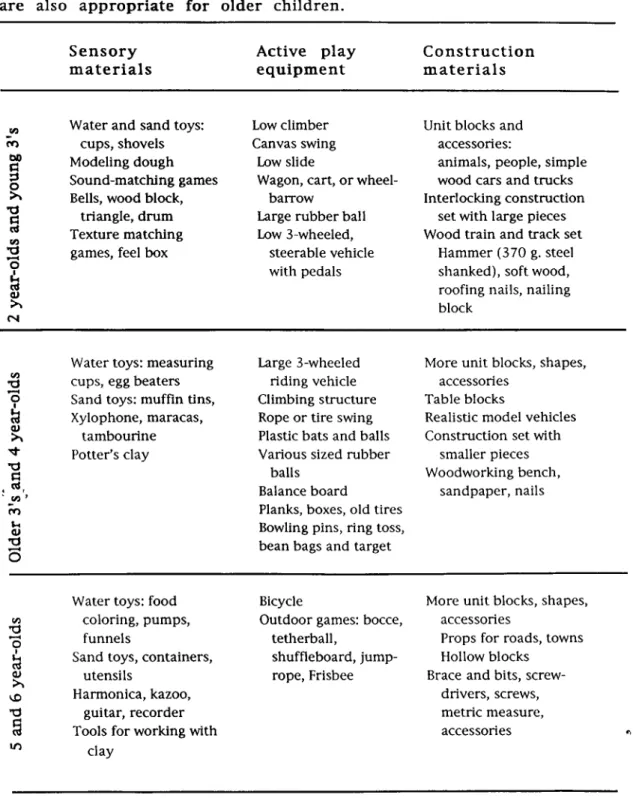
Materials and equipment should also be age appropriate so that children love to use them in their play. Unless the materials are age appropriate, playing with them does not contribute to the development of children. Thus, the selection o f toys and play materials must be done carefully in
order to provide the highest benefit in playing. Table 3.1. offers many suggestions for the kinds of appropriate materials and equipment.
Wherever play takes place, teachers should be aware o f it and seek to continue and extend it. Although the dramatic play area and block corner are the most popular play areas, play can occur anywhere: at the manipulative table as children play zoo with small models and cubical counting blocks, or in a wagon which is transformed into an ambulance. Thus, an accomplished teacher tries to extend the boundaries o f play, encourages imagination so that children can obtain the maximum benefit from the experience. However, role of the teacher should be the supporter, not the creator. It is also important to allow some space between teachers and children so that the youngsters do not feel suffocated by too much close attention (Hendrick, 1990).