Full Terms & Conditions of access and use can be found at
http://www.tandfonline.com/action/journalInformation?journalCode=uiie21
ISSN: 0740-817X (Print) 1545-8830 (Online) Journal homepage: http://www.tandfonline.com/loi/uiie20
Analysis of maintenance policies for M machines
with deteriorating performance
EMRE BERK & KAMRAN MOINZADEH
To cite this article: EMRE BERK & KAMRAN MOINZADEH (2000) Analysis of maintenance policies for M machines with deteriorating performance, Iie Transactions, 32:5, 433-444, DOI: 10.1080/07408170008963919
To link to this article: https://doi.org/10.1080/07408170008963919
Published online: 31 May 2007.
Submit your article to this journal
Article views: 62
IIE Transactions (2000) 32,
433-444Analysis of maintenance policies for M machines with
deterlorating performance
EMRE BERK' and KAMRAN MOINZADEH~.*
1
Faculty of Business Administration, Bilkent University, Ankara, Turkey E-mail: [email protected]
2 ~ c h o o l of Business, Universily of Washington, Seattle, W A 98195, USA E-mail: [email protected]
Received October 1998 and accepted June 1999
In this paper, we consider the maintenance scheduling of a group of M identical machines, the performance of which deteriorates with usage. Examples of such situations are frequently found in the heavy machine tooling, petro-chemical and semi-conductor industries among others. Assuming a limited maintenance resource and that the maintenance times are i.i.d., we propose a dynamic maintenance policy which utilities the information about the number of operating machines and their ages. We analyze the system for the special cases of constant and exponentially distributed maintenance times. We investigate the impact of maintenance time variability on system performance and evaluate the performance of various maintenance policies within the proposed policy class when the expected profit rate is maximized.
1. Introduction
In this paper, we consider the maintenance scheduling of a group of M identical machines the performance of which deteriorates over time. That is, we assume that the performance of each machine measured by the quality of its output, is inversely related to the operation time since the last maintenance. This general setup may be found in a variety of environments such as the heavy machine tooling. ( e g , metal cutting), petro-chemical, semi-con- ductor industries (e.g., various stages of wafer fabrication as in etching and deposition).
Maintenance models for deteriorating systems have been widely investigated in the past three decades. Comprehensive reviews of the literature can be found in
the surveys by McCall [I], Pierskalla and Voelker [2],
Valdez-Flores and Feldman 131, and Cho and Parlar [4]. In order to highlight the contribution of this paper, we classify and discuss the previous work in two broad cat- egories: (i) failure models versus strict deterioration models; and (ii) single versus multiple machine environ- ments.
In general, failure models treat the deterioration of a machine as a stochastic progression through a finite set of states from a new or renovated state to an inoperative or failed state. Early studies which have focused on a single
*Corresponding author
0740-81 7X @ 2000 "IIE"
machine are due to Barlow and Proschan
[S]
and Cox [6],Kolesar [7], Derman
[8]
and Kao [9] who showed that the optimal policy that minimizes the discounted or time average costs is of the control limit type. Under a control limit rule, the machine is maintained or replaced a t failure or at a certain age, whichever comes first. For the ex- tensions of these basic results and various constructs of the single machine setting with random failure, we refer the reader to the surveys in McCall [ l ] and Valdez-Flores and Feldman [3].When dealing with a group of machines that are sub- ject to random failures, the preventive maintenance problem becomes more complex due to possible eco- nomic or stochastic dependencies among the machines. Economic dependence implies that there are economies of scale in repair or replacement. Stochastic dependence may occur in two ways: (i) the failure rate of a machine may be affected by the failure of another machine; and, (ii) in environments with limited maintenance resources, the existence of a queue of machines a t the maintenance facility may result in maintenance delays. In the presence of either type of dependence, a control limit rule on the repair or replacement of one machine is not necessarily optimal anymore.
In order to exploit the economic dependence in a mul- tiple machine environment, the so-called opportunistic maintenance policies have been proposed in the literature. The models using such policies focus primarily on the effect of economies of scale and invariably assume instantaneous
replacement. Under the opportunistic replacement policy, the maintenance decision is made at the instances of ma- chine failure. In such cases, either a group or all of the machines are replaced. The former replacement policy is called group replacement and the latter is known as
block replacement. Of the two types of stochastic depen- dence, failure rate dependence among the machines has received very little attention in the literature (see Ozekici [I 01 for a discussion and review of preventive maintenance in the presence of interdependent machine failure). As for the stochastic dependence due to limited repair resources, the vast existing literature on failure models falls into the category of machine interference and employs queueing methodology to calculate the optimal repair rates (in terms of number of servers, allocation of units to non-identical servers, establishing priorities, etc.) and the optimal number of machines and spares. For an extensive review of these models, we refer the reader to the excellent surveys by Pierskalla and Voelker [2], and Cho and Parlar [4].
An equally important maintenance scheduling problem that requires attention arises in situations where the machines are, with usage, subject to performance deteri- oration but not to failure. In the single machine setting, it follows from Kolesar [7] that the machine is repaired or replaced when its deterioration (or, its deterioration measured as the age of the machine) exceeds a certain level. Other works which deal with the maintenance of a single machine subject to strict deterioration include Barlow and Preschan [5], Derman [ I 11, Jorgensen et a l .
[12], Gibra [I 31, Drezner and Wesolowsky [14], Jeang and Yang [I51 and Zhou et a l . [16]. In a multiple machine setting, however, the optimal maintenance policy class is an open question. One may conjecture that it would be a function of the deterioration status of all machines in the system. The only study in which the maintenance decision is based on the status of all the machines in the group is by Sivazlian and Mahoney [17]. Thus, their model is unique in that the state of the system is represented by the respective deterioration of each machine within the group. However, the simultaneous assumptions of block replacement and that replacements are instantaneous render the model inappropriate for production environ- ments where repair resources are limited and repair times are consequently non-zero. Other work on machine groups subject to strict performance deterioration also suffer from the same simplifying assumptions (e.g., Brosh
et a l . [18], Berg and Epstein [19] and Love et a l . [20]. In fact, the observation in McCall [I] is still valid: "The only maintenance models that have dealt successfully with queueing are those in which the equipment is replaced at failure. [.
.
.],Nan-trivial maintenance policies have never been considered within a queueing environment. Mathe- matical analysis of these problems constitutes an impor- tant area for further research."ln this paper, we consider a multiple' machine envi- ronment in which identical machines are subject to per-
formance deterioration but not to random failure and the maintenance is done by a maintenance facility or crew that has limited resources. Assuming that machines are monitored continuously, we develop a model under a general class of "dynamic" maintenance policies which utilizes the information about the number of machines in operation and their ages. A number of studies have ap- peared on dynamic maintenance policies (e-g., van der duyn Schouten and Vanneste [21,22], Gurler and Kaya [23]. However, these works have assumed instantaneous replacements. Recently, Noh et al. [24] have considered a class of age-replacement policies for the setting with two machines subject to failure and one repair person. The proposed control limit is such that a machine is taken out of service for replacement either when it has failed or as soon as it reaches a critical age when both machines are operating; that is, the control limit is operational only when the repair facility is idle. T o the best of our knowledge, ours is the first work which studies a general class of age-based maintenance policies in the multiple machine environment subject to strict performance dete- rioration in the presence of limited maintenance re- sources.
T o motivate our model, we cite a specific example dealing with the maintenance scheduling of the plasma etching machines in the semi-conductor fabrication pro- cess. Plasma etching is used at various points in the mi-, crocircuit fabrication process. The term etching is used to describe all the techniques by which the material can be either uniformly removed from the wafer as in surface polishing, or locally removed as in the delineation of a pattern for microcircuit. In plasma etching, the material to be removed undergoes conversion to a volatile state by chemical reaction with one or more energetic species which are produced in a gas discharge (see Ghandi [25] ! for more details). As the wafers are etched in the etching chamber of the machine, etch byproducts referred to as polymers are gradually deposited in the chamber walls. With the change in the environment (e.g., temperature of the chamber), the polymer will start to flake off creating particle problems which result in the deterioration of the process yield (e.g., the fraction of good dies in a wafer). This problem necessitates the periodic cleaning and maintenance of the etching chamber which is usually performed by a single maintenance crew. The restoration is almost perfect; therefore, one can reasonably assume that the machine is put into service (taken on line) in excellent condition. Round the clock production is a common industry practice and, hence, all online etching machines can be assumed to be in continuous operation. At any point in time, any of the on-line machines can be taken off line for maintenance. The operating cost of a machine associated with performance increases due to deterioration, therefore, it is desirable to employ intelli- gent maintenance policies which avoid operating ma- chines in a highly deteriorated condition.
Maintenance policies for
M
machinesThe remainder of the paper is organized as follows: in Section 2 we present the model, state the underlying as- sumptions and propose the general control policy class. In Sections 3 and 4, for deterministic and random mainte- nance times, respectively, we derive the steady state be- havior and obtain expressions for the operating characteristics of the system. In Section 5, we provide the optimal policy within the proposed class and discuss a number of 'simple and intuitive' alternative maintenance policies. We investigate the effectiveness of such policies vis a vis the optimal policy via a numerical experiment and provide sensitivity results. In Section 6, we develop an ex- tension of the model herein with state-dependent random maintenance times; and, finally, in Section 7, we summa- rize our model and provide suggestions for future work.
2. The model and assumptions
Consider a group of M identical machines the perfor- mance of which, measured by the quality of the output of a machine (e.g., the fraction of good dies), deteriorates with the operating time since the last maintenance. We shall interchangeably refer to the operating time elapsed since the last maintenance of the machine as the age of the machine. The operating machines are run continu- ously and are subject only to performance deterioration. That is, no random failures occur. Any of the on line machines can be taken off line for maintenance at any point in time. We assume that maintenance is performed by a single maintenance crew, although we shall remove this assumption in Section 6, and, that the maintenance times are identically and independently distributed. In general, the maintenance time of a machine would de- pend on the wear on the machine and, therefore, be a function of the age of the machine; however, age-depen- dent maintenance times render the analytical treatment of the problem complex. Therefore, for analytical tract- ability, we assume that maintenance time of a machine is independent of the age at which it is taken off line and has a mean of 1/p. Upon maintenance, the machine is re- stored to perfect condition. Each machine produces out- put at a constant rate I) and the output yield (e.g., the
expected fraction of good dies produced in a wafer per unit time) of a machine with an age of x is 8(x), where dd (x) /ax
5
0.Define the state of the system as x,(t) = {xl(t),
. . .
,x,(t)}, here n is the number of machines in operation at time t and xi(t) denotes the time elapsed prior to t since the i-th operational machine has undergone maintenance (i.e., the age of the i-th operational machine at time t). Note that 05
xl5
xz5
.
.
.
5
x,, for 05
n<
M. Let pn(trx1,.. .
,
x,) andP,,
denote, respectively, the probabil- ity density of the system being in state x, at time t, and the probability distribution of n operational machines at steady state.The form of the optimal maintenance policy in this general setup is an open question and depends on the operational objective(s) of the firm; however, one may conjecture that it would involve the number of machines that are undergoing maintenance and the ages of the all the machines that are operational. We propose the fol- lowing general "dynamic" maintenance policy class which captures the essence of the above conjecture by consider- ing both the number and the age of machines in operation: POLICY. When there are n machines in operation (M-n in the maintenance queue), a machine is taken
08
line for maintenance f i t s age is greater than or equal to a main- tenance trigger time, T,.Note that T = {TI,.
. .
,
T M ) is the decision vector. It is practical to assume that the maintenance trigger times are a non-increasing function of the number of on-line ma- chines; that is TI>
Tz3
+..
>
TM. In other words, withmore machines in operation, the age dependent mainte- nance decisions are made at least as early as when there are fewer machines on-line. Clearly, 0
5
x1 ( t )5
. . .
5
x,(t)5
T, for 15
n5
M. Since the system is moni- tored continuously, the maintenance decisions apply only to the oldest operational machine.The measures that describe the performance of a system under consideration will depend on the specifics of the firm's operational objectives. For example, in the semi- conductor fabrication, process efficiency is a critical factor of performance in wafer production, given the commod- ity (high volume, low cost) nature of computer chips. The expected throughput (e.g., the number of good dies that are produced per time unit), E [ P ] , and the expected number of operational machines (e.g.,, the average ma- chine utilization), E[N], have a direct impact on the cost of production and, hence, are commonly used as efficiency measures in practice. The expected yield of the process (e.g., the fraction of good dies that are produced per time unit) is also monitored as a benchmark efficiency measure. Expected cost per unit time has been the traditional measure of the steady state behaviour of a maintenance policy. This is appropriate when the value of the system output does not vary with the age of the system. How- ever, when the output performance of a machine deteri- orates over time, one needs to consider an expected profit per unit time since the trade off is now between the in- curred costs of maintenance and idleness (the latter in the form of foregone revenue) and those of output deterio- ration (in the form of scrap).
We consider the following cost/revenue structure: each unit produced by a machine incurs a cost of c (regardless of whether the unit produced is good or defective), and each good unit produced brings in a revenue of r. With- out loss of generality, we assume that defective units are scrapped at no additional charge. Furthermore, every time a machine is taken off line for maintenance, a fixed
maintenance cost, K is incurred. Here, we are assuming
that the maintenance cost is independent of the age of the machine. This assumption is reasonable in situations where the maintenance often involves the replacement of modules and parts. the expected profit per unit time, n(T) is, then given by:
n(T) = r E [ P ] - c$E[N] - K E [ R ] , ( I ) where E [ R ] is the expected number of maintenances un-
dertaken per unit time.
In the next two sections, we analyze two special cases of the. general setup described above: one with deter- ministic (constant) maintenance times and the other with random (exponential) maintenance times.
3. The case with deterministic maintenance times In this section, we analyze the case when maintenance times are constant. Such deterministic maintenance times may be observed when maintenance procedures are highly routine and involve perhaps replacement of a whole unit or module.
Consider a group of M machines to be operated under a given maintenance policy T =
{Z, . . .
,
T M ) of the pro- posed class. Without loss of generality, assume that the machines are initially all new. For any given policy T, the behavior of the system will depend on the value of TM. Specifically:-(i) If T; c (M - I)/p, since
F
2 T2 2. . .
2 TM, then there exist a j<
M such that (j - l ) / p5
Tj<
j l p . Letj
be the smallest value of j ( j ~ -<
M) such that (j- l ) / . .p
5
T,
<
j / p for E { T I , ..
.TM-1): suppose thatI;=
r and note that z<
(M - 1)/p. One can easily see that the system reaches steady state after exactly-one maintenance of all the machines. At steady state, there are either3
or - 1) machines on line (the remainder being in the queue for maintenance), the ages of the operational machines are exactly I / p apart and, the system renews itself every M / p time units. Within each renewal cycle, defined as the in- stances at which a tagged machine is taken on line, there are exactly M maintenances and when a machine is taken off line, it has operated for exactly 7 time units. Let Ndenote the number of on-line machines at steady state and
P,(I
5
n5
M) be the probability distribution o f N . Using renewal theory, we getotherwise.
(ii) T i TM 2 (M - l)/p, then let TM = z, and note that that 7 2 ( M
-
1)lp. In such cases, the system also reachessteady state after exactly one maintenance of all the machines. At steady state, there are either M or (M - I)
machines on line, the ages of the operational machines are exactly 1/p apart and, the system renews itself every
(z
+
1 / p ) time units. Within each renewal cycle, there are exactly M maintenances and when a machine is taken off line, it has operated for exactly 7 time units, as before.Therefore, we have
0 - I. otherwise.
Note that the above steady-state probability distribution holds irrespective of the queue discipline (FCFS, random etc.) employed at the maintenance facility except for preemptive service. To see that this is so, first consider
TM
<
(M - I)/p. At steady state, there are (M- j +
1) or (M -j )
machines at the maintenance facility; that is, the maintenance facility is always busy. (Recall thatj
<
M.) As long as preemption is not allowed during maintenance, it does not matter how a machine is chosen from the queue for maintenance and there will be a machine joining the running group every (1/p) time units. Therefore Equation (2) holds for all service routines except the primitive ones. For TM2 (M
- 1)/p, there is at most one machine undergoing maintenance and no queue at all times; therefore, the service routine is not an issue in this case.For a given policy T = { T I , .
. .
,
T M ) , the expected number of operating machinesttime will be:p7 otherwise.
Furthermore, the expected throughput rate can be de- rived by dividing the expected total output of the system in a cycle by the expected cycle time which yields:
"'"
=[
*lp:
J
B(x)dr otherwise.Similarly, it can shown that the expected number of machines maintainedltime can be written as:
, .
otherwise.
Using (4) through (6), the expected profit per unit time is given as:
if 7 2 (M- l)/p,
(
~ $ pj
e(r)dx - c$pr -Kp
otherwise,Maintenance policies for
M
machines
where r is as defined before. Note that the steady state behaviour of the system above is determined solely by r
and the policy reduces to a single parameter policy. That is, all policies with
TM
<
(M - 1)/p and those withTM
>
(M-
1)/p result in the same steady state behavior, respectively. Therefore, it suffices to specify r to achieve a particular operational objective when maintenance times are deterministic.4. The case with random maintenance times .
In this section, we consider the case when maintenance times are random. Following the customary assumption in machine-interference problems for analytical tract- ability, we specifically assume that maintenance times are exponentially distributed with a mean of 1/p. Our ap- proach in the sequel is similar to the one employed by Cox [26], Gnedenko and Kovalenko [27], Schmidt and Nahmias [28], and Moinzadeh [29]; we shall derive the steady state distribution of xn(t) which will then be em- ployed to obtain the operating characteristics of the sys- tem for a given maintenance policy. Let p n ( t , x l , . .
.
,xn) denote the probability density of the system being in state xn 'at time t. The system of partial differential equations and their boundary conditions which describe the state of the system are found as follows.Case ](a). 1
5
n<
M, xl>
0 and xn<
Tn+1. Let h>
0 be a small number. ThenThis case corresponds to the instance when there is at least one machine undergoing maintenance at time t
+
h and no machine has been put into service in the time interval (t, t + h). The first order probability of the oc- currence of this event is 1 - ph. The state x, can then be reached at time t+
h either if there were n machines running at time t, or there were n+
1 machines running at time t and the oldest machine was taken off line for maintenance after having reached the age of Tn+1 during the interval (t, t+
h). All other transitions have proba- bility o(h). Note that xl>
0 prohibits the possibility of a machine finishing maintenance during the time interval (1, t+
h); hence, a transition is not possible from a state with n - 1 machines running.By adding and subtracting successive terms and using the Mean Value Theorem, we have
p,(t f h,xl
+
h , .. .
,xn+
h)= ( l - ~ h ) p n ( t , x l , . . . ,xn)
+
[ p , ( t , x l+
h , . ..
,x,+
h)where 0
5
E5
h. Rearranging terms and dividing by h, we getIf we assume that a steady state distribution exists, letting h -r 0 and then t + co, we obtain
Note that we have dropped the time argument in notation at steady state for the sake of brevity and pn(xl,.
. .
,xn) denotes the steady state probability density of x,(t).Case I ( b ) . 1
5
n<
M,xl>
0 and Tn+] < x n<
Tn. This case is similar to the one above except that, since Tn+,5
x,<
T,, transitions from states with (n+
1) op- erating machines in the interval ( t , t+
h) are now allowed. Hence,Using similar operations, at steady state, we obtain
Case 2. n = M , x l
>
0 and XM<
TM. ThenThis follows since all machines are operational at t , and x1
>
0 implies that no machine has finished mainte- nance and xy<
TM implies that no machine has been taken off line for maintenance during (t, t+
h). Hence, machines age uniformly over time. At steady state, we obtainCase
3, n = 0. In this case, all machines are off-line and at the maintenance queue. This state can be reached only if there are no operational machines at t and no mainte- nance is completed in (1, t+
h) or there is one machine operational at t and its age reaches8
during (I, t+
h) and is, therefore, taken off line for maintenance. Hence,Once again, a t steady state we have
Next we consider the boundary conditions for the above system of partial differential equations. The boundary conditions are found by considering the discontinuities in the motion of the state of the system caused by the completion of a maintenance and the introduction of a new machine (i.e. the instances at which the age of the youngest machine is equal to zero). We derive the boundary conditions a t steady state as follows. (For a detailed discussion on the derivation of the boundary conditions, 'see Schmidt and Nahmias'
[8])
(i) For 1
5
n<
M and xn-i<
T,,
there are (M - n) machines in the maintenance queue. The completion of a maintenance introduces a new machine to join the group of machines in operation. Transitions to state (O,xl,.. .
,X,,-,) occur if(a) there are (n - 1) machines in operation and a maintenance is completed, or
(b) there are n machines operating and the age of the oldest machine has exceeded Tn+, when a maintenance is completed. In such situations, the arrival of the new machine will bring the state of the system to (n+ 1) ma- chines, resulting in the oldest machine being taken off line leaving n machines in operation.
These transitions occur in an infinitesimal time. To obtain the boundary condition, we consider the system immediately before and after a maintenance completion. Define:
We note that Qn(t, 0,x2,.
. .
,x,) represents the probability mass in the neighbourhood of the boundary (t,0,x2,.
. .
,X").By the mean value theorem, for some 0
1
ci5
h ( i = 1 , .
. .
,
n), we haveFurthermore,
where (x
v
y) = m a x ( x , ~ ) . TheRHS
of (20) represents the probability flow over (t, t+
h) for the boundary neigh- bourhood about (0, x2,.. .
) xn) as explained above. By using Taylor's Theorem, together with the Mean Value Theorem, Qn(t f h, 0,x2,.. .
,xn) can also be written asQn(t f h, O)x2,..
.
,xn)= hnpn(tI~1,x2
+
~ 2 ,- .
.
,Xn+
En)+
o(hn). (21) Equating (20) and (21), dividing by h", taking the limith 4 0 and then t oo, we get, at steady state
(ii) When n = M, the boundary condition is similar to (i) except that transitions from states with M machines to themselves are not allowed, since there are no machines undergoing maintenance in such cases. Therefore, the second term of the RHS of (22) will not be present and we have,
It can be verified that a solution to the above system of partial differential equations and their boundary condi- tions is:
where co is the normalizing constant obtained by inte- grating the densities to unity and can be written as:
Maintenance policies for
M
machines439
with f (-, pt) being the probability mass of the Poisson distribution with mean pt, and
F b ,
pt) =Cry
f ( i , p t ) .The probability distribution of the number of on-line machines at steady state, P,, can be found by integrating the probability density over the appropriate n-dimen- sional space:
Note that the steady state distribution derived in Equa- tions (8)-(25) holds irrespective of the queue discipline employed at the maintenance facility. In this case, the queue discipline may even be preemptive due to the memoryless property of the exponential assumption. From the above distribution, we obtain
Furthermore, as shown in the Appendix,
The expected number of maintenances undertaken per time, E[R], is given by
The expected profit per unit time can be obtained by substituting these expressions in (I). In the next section, we present results on the effect of maintenance time variability and the performance of various maintenance policies within the general policy class when the objective is expected profit maximization.
5. Optimization and numerical results
In this section, we examine the behaviour of the system under the optimal proposed policy with respect to certain system parameters. Furthermore, we examine the per-
formance of a number of simple but intuitively appealing maintenance policies constructed as special cases within the general policy class.
We start by describing the policies considered.
(i) The first policy refers to the optima1 policy within the proposed general class which maximizes the expected profit per unit time, and we refer to it as P1. It will constitute our benchmark in the comparison of other poIicies. In the following proposition, we characterize the optimal-policy parameter for P1 for both cases when maintenance times are constant and exponential.
Proposition I
(a) When maintenance times are constant, n(T) is concave in z and; i f 8 ( ( M - 1)/p)
<
c l r , then opti- mal policy parameter z* which maximizes ll(T) will be the solution to O(z) = clr; otherwise, 7' will be thesolution to:
0
(b) when maintenance times are exponenzially distrib- uted, n ( T ) is (separately) concave in T, for i =
1 ,
.
.
. ,
M - 1 and is maximized when = z for i = 1 , .. .
,
M - 1 where z solves O(T) = c / r , and T ilies in the region [O,z].
Proof. Follows from standard optimization results and that 0 ( x ) is decreasing in x .
We are unable to show the concavity of n(T) with respect' to
TM
when the maintenance times are exponential; therefore, to find TG a univariate numerical search was conducted.(ii) One special class of maintenance policies that we consider is the single parameter policies. Such policies assign a single (identical) age for all machines to trigger preventive maintenance and, thus, ignore the number of operational machines when making decisions as to which machine(s) should be maintained. They are attractive because the maintenance decision for a particular ma- chine is made independent of the status of the other machines, and, thus, there is less of a need in practice for coordination and supervision among the operators of the machines. We consider two single parameter policies which we describe below:
(a) In the first single parameter policy, the maintenance age for all machines is determined within the proposed general policy class by setting them equal. That is, under this policy, the profit maximization problem is solved subject to the condition that all T ( i = 1,.
. .
,
M) are equal. We shall refer to this policy as P2. Note that P2 is an optimal policy within the proposed class when main- tenance times are deterministic since it solves for the same unique T* as P 1.(b) In the second single parameter policy considered, the identical maintenance age for all machines is based on the single machine environment that ignores possible queueing delays encountered for maintenance. Under this policy, the maintenance age of the machines is found by maximizing the expected profit rate for a single machine which requires an average maintenance time of (lip). We refer to this policy as P3. This policy is important in two respects: first, it is often used in practice and has been the focus of many of the previous work as mentioned above. Secondly, its performance vis a vis the proposed policy PI illustrates the importance of the queueing delays in a multiple machine environment and enables us to identify the conditions under which ignoring the queueing effects in the analysis may be appropriate. When maintenance times are deterministic, employing P3 forces the policy parameter z to be set equal to 5. Clearly, we would expect P3 to be inferior to P2 in general.
(iii) Finally, we consider a simple maintenance policy which takes the oldest machine off line as soon as a maintenance is finished. We refer to this policy as P4. Under P4, there are always (M - 1) operational ma- chines; therefore, the maintenance crew is always busy. The advantages of this policy lies in its simplicity since it does not require keeping records of the operational ages of the machines. Note that, P4 is also a special case of the proposed general policy class: when maintenance times are exponentially distributed, 7;: + oo (i = 1 , .
. .
,
M - I ) andTM
= 0. And, when maintenance times are constant,T = (M
-
])/paIn our numerical study, we assumed that the expected deterioration in the output of a machine as a function of operation time follows an exponential form; that is,
O(x) = a exp(-bx). We set a = 1 and considered a group of four machines (M = 4). We also fixed the maintenance rate ( p = 1) and varied the deterioration rate, b, between 0. I and 1. It can easily be shown that the cost parameters in (1) can be normalized by $r. Let c' = c l r and
K'
= K / $ r denote the normalized unit production and maintenance costs. This way, one needs to consider onlyc' and K' as the cost parameters in the problem. In our experiment, we varied
K'
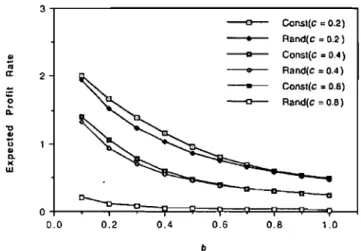
between 0 and 0.5 and c' be- tween 0 and 1. We examined the behavior of the system under both constant exponentially distributed mainte- nance times. The optimization problem for the random maintenance case under all policies was solved numeri- cally. We used increments of 0.01 to determine the opti- mal policy parameters when a search was needed. In all of our test cases, we observed unimodality,Figure 1 illustrates the impact on expected profit rate under PI of the deterioration rate, b, and the normalized unit production cost, c' for both deterministic and ran- dom maintenance cases. As expected, increasing b and c'
results in a lower profit rate. Very low deterioration rates results in larger maintenance trigger times and therefore queuing delays at the maintenance facility are minimal.
Fig. I. The behavior of expected profit rate versus b. (M = 4,
p = l , a = l , a n d K f = O ) .
Very high deterioration rates, on the other hand, result in smaller trigger times causing big queuing delays. There- fore, we see that the effect of maintenance time variability becomes negligible for very small and very large values of 6, and it remains small for moderate values of deteri- oration rates, as well. The maximum difference in ex- pected profit rates with constant and exponential maintenance times is observed to be around 20% for the parameter set considered. The effect of maintenance time randomness increases as the fixed maintenance cost, K, gets bigger, and it decreases as the unit production cost, C , increases.
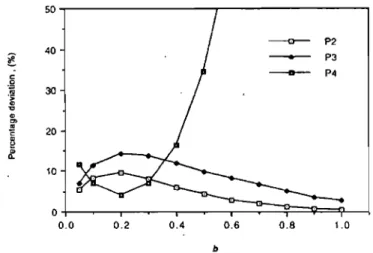
Next, we discuss the performance of the special policies P2, P3 and P4 when compared to P1. Since the obser- vations hold for both deterministic and random mainte- nance times, we only provide the results for the case of exponentially distributed maintenance times. We present our findings in terms of the percentage deviation in the expected profit per unit time under each policy (P2, P3 and P4) as compared to the profit rate obtained by the optimal policy within the general class, P1, defined as:
Expected profit rate under P1
% deviation =
Expected profit rate under
P1
- Expected profit rate under P,(i = 2 , 3 , 4 )Expected profit rate under P1
]
.
100. In Fig. 2, the performance of each policy is depicted as c'varies. This illustrates the trade off between the incurred maintenance costs due to maintenance and production costs due to the deteriorated performance of the machines under each policy.
First, we note that P2 dominates P3 in all cases, as expected. We also observe that, in general, there exist three distinct regions in which single parameter policies (P2 and P3) and P4 alternately dominate one another. When the unit production cost is small relative to the unit revenue, P2 and P3 perform better than P4. For
Maintenance policies for
M
machinesFig. 2. The behavior of percentage deviation in average profit rate versus c'. ( M = 4, p = 1, a = 1, b =0.1, and K t = 0.25). small unit production costs, P4 takes machines off line sooner (faster) than necessary and thereby incurs un- necessary maintenance costs. Policies P2 and P3, on the other hand, allow for some possible wait if the oldest machine has not deteriorated much when the mainte- nance on the off line machine is over. As the unit pro- duction cost increases, it becomes more attractive to take the machines off line sooner and incur some additional maintenance costs which compensate for the lost reve- nues due to deteriorated performance. Hence, in this region P4 dominates P2 and P3 since the former is more reactive. However, when the unit production cost exceeds a certain level, single parameter policies (P2 and P3) become more responsive than P4.
When the unit maintenance cost gets smaller, all else being equal, the region in which single parameter policies dominate P4 disappears. That is, for small unit mainte- nance costs, taking the oldest machine offline as soon as a maintenance is finished is the better policy except for high unit production costs. For large unit maintenance costs, we notice that the middle region also disappears; that is, when the unit maintenance cost increases, P2 and P3 are superior to P4 regardless of the unit production cost.
Next, we consider the effect of the deterioration rate, b, on the performance of the maintenance policies. The typical behavior of the policies as a function of the de- terioration rate is shown in Fig. 3.
In Fig. 3, we also notice the existence of three regions in which policies alternately dominate one another. F6r reliable systems (small deterioration rates), P2 and P3 perform better than P4. This is again due to the fact that P4 is unnecessarily reactive taking machines off line too soon. As the system becomes less reliable (as the deteri- oration gets larger), P4 becomes more profitable since its reactiveness matches the deterioration in the performance of the machines. That is, the additional costs of mainte- nance compensate for the increasing production costs due t o low output performance. However, beyond a certain
Fig. 3. The behavior of percentage deviation in average profit rate versus deterioration rate, b. (A4 = 4, p = 1 , a = 1, C' = 0.3,
and K' = 0.25).
value of the deterioration rate, P4 loses its attractiveness as it becomes under-reactive. In this case, single para- meter policies (P2 and P3) start performing better since they do not allow for highly deteriorated machines to operate even when there is a queue for maintenance.
6. The case with state-dependent random maintenance times
An interesting generalization of our model is the case when the maintenance time is exponential, but the mean restoration rate depends on the number of operational machines (the state of the system). Such a case occurs when, for instance, the maintenance is performed by multiple teams (crews) with identical mean maintenance .rates or the crew(s) adjusts the mean maintenance rate according to the number of off-line machines waiting for maintenance. The dynamics of the system with such state dependent service is similar to that obtained in Section 4 with the exception that,' now, the restoration rate is a function of the number of operational machines.
Let p,, be the machine restoration rate when there are n
machines in operation. For example, if there are s iden- tical maintenance crews present and the mean mainte- nance rate is p, then p,, = min[s, (M - n)]p. (Note that
pM = 0.) Rewriting the integro-differential equations with the appropriate restoration rate, one can show that the steady state density is now given by
where
As before, co is the normalizing factor and is found by integrating the densities to unity. The operating charac- teristics of the system with state dependent service can then be computed in a similar fashion as in Section 4.
7.
SummaryIn this paper, we considered a group of M identical ma- chines, the performance of which deteriorates with usage. We proposed a "dynamic" maintenance policy class which utilizes the information about the number of op- erating machines and the performance status of the ma- chines. We developed expressions for the operating characteristics of the system and optimization results for the cases when maintenance times are deterministic and exponentially distributed. We investigated the effect of maintenance time randomness and compared the per- formance of maintenance policies within the proposed policy class on the average profit rate.
Possible extensions to this research include the case where the maintenance times follow a general distribution and, possibly, are a function of the age of the machine taken off line, and the case where there are random fail- urcs of the machines due to part breakdowns in addition to the gradual performance deterioration considered in our model. Also maintenance facility design decisions such as having one faster crew or more crews with slow maintenance rates under various cost structures consti- tute an interesting research area (e.g. van der duyn Schouten and Wartehhorst [21,22]). The authors intend to pursue the analysis of the model with state-dependent maintenance times in this problem setting in the future.
Acknowledgements
The authors wish to thank the DE, Izak Dueynas and the anonymous referee for their valuable comments and Mr. A . Harriri of Lam Research Co., Fremont, CA for sug- gesting the problem. Funding for the second author was provided through a research grant from the Program for Engineering and Manufacturing Management (PEMM), University of Washington, Seattle, WA and the Bur- lington Northern Foundation.
References
111 McCall, J.J. (1965) Maintenance policies for stochastically failing
- - . .
equipment: a survey. Management Science, 11, 493-524.
Pierskalla, W.P. and Voelker, J.A. (1976) A survey of mainte- nance models: the control and surveillance of deteriorating sys- tems. Naval Research Logistics Quarterly, 23, 353-388.
Valdez-Flores, C. and Feldman, R.M. (1989) A survey of pre- ventive maintenance models for stochadcally deteriorating single unit systems. Naval Research Logistics, 36, 419-446.
Cho, D.1. and Parlar, M. (1991) A survey of maintenance models for multi-unit systems. European Journals of Operational Re-
search, 51, 1-23.
Barlow, R.E. and Proschan, F. (1963) Mathematical Theory of
Reliability, Wiley, New York, NY.
Cox, D.R. (1962) Renewal Theory, Methuen, London.
Kolesar, P. (1966) Minimum cost replacement under Markovian deterioration. Management Science, 12, 694-706.
Derman, C. (1970) Finite State Markovian Decirion Processes,
Academic Press, New York, NY.
Kao, E. (1973) Optimal replacement rules. Operations Research, 21, 1231-1249.
Ozekici, S. (1989) Optimal periodic replacement of multicom- ponent reliability systems. Operations Research, 36, 542-552. Derman, C. (1963) On optimal replacement rules when changes of state are Markovian, in Mathemarical Optimizarion Techniques Bellman, R. (ed), University of California Press, Berkeley, CA. Jorgensen, D., McCall, J. and Radner, R. (1967) Opfimal Re-
placement Policies, Rand McNally, Chicago, IL.
Gibra, T.N. (1967) Optimal control processes subject to a linear trend. The Journal of industrial Engineering, 18, 35-41.
Drezner, 2. and Wesolowsky, G.O. (1989) Optimal control of a linear trend process with quadratic loss. IIE Tramactiom, 21, 66-72.
Jeang, A. and Yang, K. (1992) Optimal tool replacement with non-decreasing tool wear. international Journal of Production
Research, 30, 299-3 14.
Zhou, C., Chandra, J. and Wysk, R. (1990) Optimal cutting tool
replacement based on tool wear status. Inrernational Journal of
Production Research, 28, 1357-1 367.
Sivazlian, B.D. and Mahoney, J.F. (1978) Group replacement of a multi-component system which is subject to deterioration only.
Advances in Applied Probability, 10, 867-885.
Brosh, I., Shlifer, E. and Zeira, Y. (1975) Optimal maintenance policy for a fleet of vehicles. Management Science, 22, 401-410. Berg, M. and Epstein, B. (1979) A note on a modified block re- placement policy for units with increasing marginal running costs.
Naval Research Logistics Quarterly, 23, 15-24.
Love, C.E., Rodger, A. and Blazenko, G. (1982) Repair limit policies for vehicle replacement. INFOR, 20, 226-236.
van der duyn Schouten, F.A. and Vanneste, S.G. (1993) Two
simple control policies for a multiwmponent mainlenance system.
Operations Research, 41, 1 125-1 136.
van der duyn Schouten, F.A. and Wartenhorst, P. (1993) A two- machine repair model with variable repair rate. Naval Research
Logistics, 40, 495-523.
Curler, U. and Kaya, A. (1998) A policy for the maintenance of a
multistate multicomponent series system, Technical Report IEOR- 9812, Department ofIndustria1 Engineering, Bilkent University.
Noh, J., Kang, S. and Feldman, R.M. (1992) A control policy for
replacement involving two machines and one repairman. Euro-
pean Journal of Operational Research, 56, 413-422.
Ghandi, S. (1983) VLSI Fabrication Principles. Wiley, New York,
NY. .
Cox, D.R. (1955) The analysis of non-Markovian stochastic processes by the inclusion of supplementary variables. Proceedings
of the Cambridge Society, 51, 433-441.
Gnedenko, B. and Kovalenko, I.N. (1968) Infroduction to
Queueing Theory, Israel Program for Scientific Translations,
Maintenance policies for
M
machines[28] Schmidt, C.P. and Nahmias, S. (1985) (S-1,s) policies for per- T"+I x, ishable inventory. Management Science, 31, 719-728.
[29] Moinzadeh, K. (1989) Operating characteristics of the (S-1,s) $ c o t
/ /
7
B(xi)P"exp(-~i~)dxinventory system with partial backorders and constant resupply i= 1 x.=o x,=O
xn-1=x.-2
times. Managemen1 Science, 35, 472477.
-
Appendix
(pi)i-l [p(x, -X1)]n-i-' i= 1 x,=T.+I xi=O (i- l)! (n-i- I)!
.
Derivation of Equation (27) T.
First, we note that the expected throughput of the system x exp(-p.)dr.dr.+$co
1
~ ( x ) , u q e x ~ ( - p x ) & (n - I ) .can be written as: X=T"+I
Now for 1
5
n5
M - 1 we have:J
FG+I
Changing the order of integration of the first term in the RHS of the above expression and noting that:
we get:
Substituting (25) in the first term in the RHS of (Al), we get:
Z + I
(P)'-' [ ~ ( ~ n + '
exp(-pTn+l)&
i= 1 x=o (n - i)!
For n = M, using the same approach, we get:
r=O
Combining (A2) and (A4) and summing for n = 1, Also, in a similar fashion we can write the second term in
.
..
,
M - I together with (AS), after some algebraic ma- theR H S
of (Al) as: nipulation, (27) is derived.Biographies
Emre Berk is an Assistant Professor a t the School of Business, Bilkent University, Turkey. Dr. Berk received his B.Sc. in Mechanical Engi- neering at Bogazici University, Turkey and his M.Sc. in Mechanical Engineering at Washington State University. He received his M.B.A. and Ph.D, in Operations Management a t the University of Washing- ton. His research interests include supply chain management and sto- chastic models in health care applications. He is a member of INFORMS.
Kamran Moinzadeh is the Burligton Northern/Burlington Resources Professor of Manufacturing Management, Professor of Management Science and the co-director of the Program in Engmeering and
Manufacturing Management (PEMM) a t the University of Washing- ton. He received his B.A. in Computer Science from the University of California, San Diego, his M.S. in Operations Research and Ph.D. in Industrial Engineering from Stanford University. Dr. Moinzadeh's publications have appeared in Management Science, Operations
Research, Naval Research Logistics, EJOR and IIE Transactions.
His research interests include Production/Operations management, Inventory management, Multi-echelon distribution systems, Supply Chain management and Quality management. Dr. Moinzadeh is a member of INFORMS and IIE. He is currently the department edi- tor of IIE Transactions, and is the Associate Editor for Operalions
Research and Management Science. Dr. Moinzadeh has been a
consultant to Microsoft Corp., Starbucks Coffee Inc. and Boeing