“CURRENCY, CARRY ME, EVERYONE IS HELD HOSTAGE:
”AN ANALYSIS OF
POST-2008 RECESSIONARY FILMS
The Graduate School of Economics and Social Sciences
of
İhsan Doğramacı Bilkent University
by
UMUT MERT GÜRSES
In Partial Fulfillment of the Requirements for the Degree of
MASTER OF ARTS
in
Media and Visual Studies
THE DEPARTMENT OF COMMUNICATION AND DESIGN
İHSAN DOĞRAMACI BİLKENT UNIVERSITY
ANKARA
June 2018
I hereby declare that all information in this document has been obtained and
presented in accordance with academic rules and ethical conduct. I also declare that, as required by these rules and conduct, I have fully cited and referenced all materials and results that are not original to this work.
UMUT MERT GÜRSES
ABSTRACT
“CURRENCY, CARRY ME, EVERYONE IS HELD HOSTAGE:
”1AN ANALYSIS OF
POST-2008 RECESSIONARY FILMS
Umut Mert Gürses
MA in Communication and Design Supervisor: Assist. Prof. Dr. Ahmet Gürata
June 2018
As the impact of The Great Recession of 2008 has been felt severely by millions of people, “why” and “how” of the crisis became the topic of debate in almost every field. Number of films revolving around the crisis, whether explicitly focusing on The Great Recession or taking the scene designated by the crisis as a background for similar stories about white-collar workers, have been made. The argument of this thesis is that, these narratives focusing on the crisis is a new cycle of films revealing a capitalist realist attitude, and can be named as “recessionary films.” Under three main headings -ideology, structural columns, and crime/justice dichotomy- I analyze the narratives to explore their common thematic elements.
Keywords: Capitalist Realism, Corporations, Financial Crisis, Recessionary Films, White-Collar Criminality.
ÖZET
“TEDAVÜL, TAŞI BENİ, HERKES ESİR DÜŞMÜŞ:
”12008 SONRASI RESESYONEL FİLMLERE DAİR BİR ANALİZ
Umut Mert Gürses
İletişim ve Tasarım Bölümü Yüksek Lisans Programı Tez Danışmanı: Dr. Öğr. Üyesi Ahmet Gürata
Haziran 2018
2008 Büyük Resesyonu’nun etkisi milyonlarca insan tarafından ciddi biçimde hissedildikçe, krize dair “nasıl” ve “neden” soruları birçok farklı alanda baş tartışma konularından biri haline geldi. Bu süreçte kriz üzerine, doğrudan Büyük Resesyon’a odaklanan veya kriz ile belirlenmiş olan zamanı kendisine arka plan olarak alan ve beyaz yakalı çalışanları konu edinen birçok film yapıldı. Bu tez ise, söz konusu filmlerin “resesyonel filmler” olarak nitelendirilebilecek ve kapitalist realist yaklaşımla belirlenen yeni bir film furyası oluşturduğunu öne sürüyor. Ortak tematik özelliklerini belirlemek adına üç ana başlık altında –ideoloji, yapısal kolonlar, ve suç/adalet ikilemi- bu filmler anlatı yönünden inceleniyor.
Anahtar Kelimeler: Beyaz Yaka Suçları, Finansal Kriz, Kapitalist Realism, Resesyonel Filmler, Şirketler.
ACKNOWLEDGMENTS
I would like to express my gratitude to my advisor Ahmet Gürata for guiding me through in this study. He has introduced to me theories and studies that enabled me to develop the topic I wanted to study, but most importantly he has showed patience throughout this process while encouraging me.
Also I am grateful to Colleen Kennedy-Karpat for her support with thought-provoking seminars. Thanks to the chance she gave me to be a guest lecturer, in addition to her fruitful advices, I am more eager to pursue further academic study. Also, I would like to thank Özlem Savaş and Ersan Ocak for their invaluable contribution through their joyful courses.
TABLE OF CONTENTS
ABSTRACT ……….iv ÖZET………v ACKNOWLEDGMENTS………..vi TABLE OF CONTENTS………vii LIST OF FIGURES……….viii 1. INTRODUCTION 1.1. Introduction……….11.2. Structure of the Thesis……….6
1.3. Recessionary Films, Or What Has Changed After 2008?...8
1.4. Two Perspectives from Two Films on One Wall Street……….11
2. POLITICAL AND ECONOMIC BACKGROUND OF CAPITALIST REALISM……….16
2.1. Capitalism of Capitalist Realism………16
2.2. Realism of Capitalist Realism………...21
3. IDEOLOGY: “The End” Or “An End?”………..28
3.1. Navigating with a Capitalist Realist Approach in Recessionary Films….29 3.2. “Reflexive Impotence” or When You are Among “The Losers”…………..33
3.3. Wall Street vs. Main Street………..37
3.4. Limitations of Narratives………44
4. STRUCTURAL COLUMNS: Representing Corporations……….50
4.1. “What” and “who” of a corporation………51
4.2. Temporal Agents of Permanent Powers………..58
4.3. Products of Capitalism………..64
4.4. Conflicted Financial Performativity………..67
5. CRIME/JUSTICE: Depicting White Collar Criminality (“Is that a good thing?”)….76 5.1. Whitewashing White-collar Crimes………..77
5.2. Societal Crimes and Norms……….84
5.3. Financial Difficulties, Material Gains, and Conflictual Messages………….90
LIST OF FIGURES
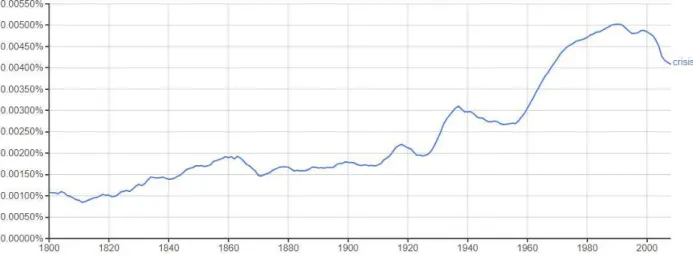
Figure 1. Showing the usage of the word “crisis,” in books published in English. Google Books Ngram Viewer.
CHAPTER 1
INTRODUCTION
1. Introduction
As an avid filmgoer, I have noticed around 2010 that whenever there is a film on
journalism and/or finance world I have started to get excited as if I was going to find my brand new favorite film. Especially the ones tackling the issues of corruption and other similar topics revealing inherent power dynamics were more appealing since we now live in a world where everything seems more transparent while there is a consensual infringement of our most basic rights, showcased by the very existence and the operations of social media firms. Just as the fact that existence of more platforms to raise a voice does not guarantee variety of opinions, but contributes to transformation of opinions into truth(s) where many has to agree with one of the oppositional camps without raising a concern over any part of the whole that camp is comprised of; I have observed that the issues of corruption and asymmetric power dynamics also became topics of interest without a care for intricate politics behind them on conventional and alternative media platforms. As the impact of 2008 crisis was grave on millions of
individuals around the world, there were opposing views on the reasons behind it ranging from scapegoating financiers and/or politicians to whitewashing them of every seemingly ill-intentioned conduct on the verge of either side of the law. Thus, I thought that stories had (and still have) potential to provide an insight into how the world find itself in that state through impartially depicting individuals and institutions that have a part in this, but with a care for experiences of individuals that are either side of this catastrophe, meaning both for those who have not felt the effect of the crisis that much (and those who contributed to the conditions that made the crisis possible) and those who have. Furthermore, since anti-establishment sentiments were raised during election years in most of the countries starting from late 2015 (Geiselberger, 2017), I thought films tackling the issue of 2008 crisis might reveal the early sparks of these movements in the forms of depicted grievances. With these thoughts, I have started to study on these films that I found entertaining the first time I saw them as a member of the ordinary audience.
As I have watched the films over and over again, I begin to notice that not only they take the crisis and the conditions created by it as a background for their stories, they employ certain tropes as if constituting a new cycle of films. Even the narratives vary in degree of being critical of the financial performativity that made a crisis of this scale possible, the way they perceive and portray the relations of production, and everyday life in relation to that, without an alternative, meaning how our lives are constructed not to work to live, but to live to work, are very similar. To categorize these similarities more
systematically; every film since 2008 telling a story sets in finance world, or in the other peripheral sectors of 2008 crisis, focus on three headings with a very similar tones: ideology, structural columns, and crime/justice dichotomy. Ideology refers to the way narratives hint at possible political destinations in the aftermath of the crisis, and provides philosophic support for other headings. Structural columns address to the platforms the system operates through, and the mechanisms of ideology permeating through population. Crime and justice dichotomy, on the other hand, is the point where these two headings are connected to the zeitgeist following the 2008 crisis, meaning both how narratives discuss the issues seemingly made the system debatable among masses, and how their own outlook on these issues became relevant. Thus, along these lines, I intent to analyze post-2008 cycle of films revolving around economic crisis and corporations, and name them as “recessionary films,” taking the cue for the name from a study on how video games deal with the issues arising from The Great Recession (Perez-Latorre, Navarro-Remesal, Maza, & Sanchez-Serradilla, 2017).
Uttering the words of a Marvel film is an appropriate way to start a discussion regarding the state of cinema or how we can interpret their popularity as a demonstration of the masses’ encapsulation by populism and/or anti-establishment ideas. Aside from that, when such a movie comes out, the most common news pieces are about their post-credit scenes, either for the purpose of tipping moviegoers to not leave the theater immediately when credits start to roll, or for pointing out how funny it is or the fact that it indicates a sequel. The Other Guys (McKay, 2010), a comedy film co-written and
directed by Adam McKay, however, took this element of marketing and included
informative animations regarding 2008 crisis with Rage Against the Machine’s Bob Dylan cover, Maggie’s Farm, playing on the background. Although plot involves a somewhat awkward storyline dealing with white collar criminality in reference to 2008 crisis, this is an unexpected move for an action/comedy buddy-movie, which obviously set out to entertain masses. Yet, it also shows how the repercussions of 2008 crisis was
omnipresent, infiltrating to cultural space to a degree to be part of a popular comedy film’s plot two years after it has happened.
The Other Guys, however, is only an example showing how discussion revolving around
financial crisis and its affects are widespread. Aside from that, a cycle of films that can be named as “recessionary films” has started to emerge within the American cinema.
The common aspect of these films, which is the reason for designating a specific name for them, is how their story either directly deals with 2008 crisis aiming to explain what has happened or portray financiers and other white-collar employees with the emergent outlook of 2008 crisis, but without explicitly referencing it. Given the fact that 2008 crisis constitute the paramount segment of the narratives, through depicting the course before the crisis or the aftermath of it, such films present a great opportunity to discuss the ways our economic system regulates our lives, and how the system itself is
perceived today. In other words, they portray how late-capitalism operates and how we can see it does so within differing levels of our lives from work to entertainment, or even to our psychological understanding of our environment. In this sense, I will employ
narrative analysis to explore designated dramas primarily dealing with 2008 crisis or its fictional counterpart –99 Homes (Bahrani, 2014), Arbitrage (Jarecki, 2012), Margin Call (Chandor, 2011), The Big Short (McKay, 2015), The Company Men (Wells, 2010), and The Wolf of Wall Street (Scorsese, 2013)- to see what they signal in terms of our
perception of capitalism and possible alternatives to it, or that of social classes, jobs we are working, and corresponding ethics.
As this is a crisis, named The Great Recession as a reference to earlier structural crises of capitalism (Robinson, 2018), affected millions of people around the globe, the way cinema handles its reflections or attempting to explain what has been happening while trying to understand it reveals a great insight for us to interpret. However, keeping in mind that 2008 crisis is still debated within economics scene, I should make clear that, in no way I intent to explain 2008 financial crisis in length, or give a definitive account of it. What I will do is capturing the interpretation made by films that feature plots
revolving around the Great Recession, and how they depict the people who were affected by it, or which type of characters they portray. Whether or not one’s political inclinations are towards arguing that crises are corrective mechanisms of the market, it is clear that such occurrences, accompanied by other developments such as the ones in technological sphere, have affects beyond economics as we can differentiate the times as pre- and post-2008. In this sense, whether there is a rupture in storytelling in terms of depiction of the corporations, white- and blue-collar workers, and the way social and
political background is formed in narratives gain significance to understand the age we live in.
1.1. Structure of the Thesis
The second chapter will serve as a ground for discussing the background both of crisis and the films as I will tackle the concept of capitalist realism to explain in which sense of it I will be employing the concept. This will be in two parts as I will firstly give a basic account of 2008 crisis, addressing which version of capitalism the term points out, and then tackle the issue of what realism refers to in the coined term. Following this, I will investigate the common thematic elements found in the film list given above to see both the reactions to the crisis, and the reflections of it. Third chapter will be comprised of identifying the ideology, meaning how the films are reflection of capitalist realism in detail. One of the recurring issues films are dealing with, Wall Street vs. Main Street, and how the narratives present this as part of their supposed critique or not in order to frame the lack of alternative for capitalism will be discussed to see how films face a challenge in depicting an economic crisis. The fourth chapter will be dealing with how corporations are represented on screen alongside with the discussion of financial
performativity, as corporations constitute the structural columns the system is based on through administrating the relations within the market. The fifth chapter will be the ground for investigation to see how films realize the white-collar criminality in their relaying of the crisis since the recession has started with fraudulent operations of banks’
selling overpriced financial products. Then, I will make concluding remarks to address the ongoing theme of recessionary films, which is presenting capitalism as “the reality.”
Films are selected among those produced after 2008, having a narrative that involves the explicit impact of 2008 either by depicting events leading up to crisis and/or
aftermath of it, or by focusing on characters that are vital to understanding the unfolded events and cultural response to them. The films such as Margin Call and The Big Short, primarily dealing with 2008 crisis, is a natural part of the study. Since Arbitrage and The Wolf of Wall Street focus on characters who are guilty of white-collar crimes, their perspectives on the subject are imperative to understand how in post-2008 films white-collar criminality is reflected. Since The Company Men and 99 Homes, on the other hand, deals with characters who have been directly affected by the 2008 crisis, they present a case for how the crisis is perceived. There are other films that fit into
description of recessionary films such as The Wizard of Lies (Levinson, 2017), focusing on Bernie Madoff scandal, or Waffle Street (Nelms & Nelms, 2015), which is based on the memoir of a financier who was laid-off, but they are not included within this study because the former is a television film, which has different set of standards, and the latter is a relatively low-budget film with a didactic tone which makes one to consider it has other priorities than storytelling. Wall Street: Money Never Sleeps (Stone, 2010), on the other hand, is not included because it is a sequel to Wall Street (Stone, 1987) and I believe it is best to analyze it as a part of a double feature with the first film of Oliver
Stone’s on the subject in order to see the contrast between pre- and post-2008 films from a perspective of the same director.
1.2. Recessionary Films, Or What Has Changed After 2008?
The etymological origin of the words “crisis” and “crime” (Berardi, 2015: 75) is a Greek word “krisis,” which means “judgement, selection, separation.” Close relation of both words points out how they mark a time of discrepancy where differing realities collide with each other in request for an assessment. The determining factor of this
intersection can be regarded with a search in Google Books’ Ngram Viewer (Figure 1.), which shows that there is a steady increase in the word crisis’ usage since 1960s. This might be seen in a light related with debate within political economy whether there is an ongoing crisis since 1970s or every time there was a recession it was a separate occurrence. However, regardless of what that debate suggests, it should be
investigated whether 2008 crisis has changed anything in terms of narratives.
Figure 1. Showing the usage of the word “crisis,” in books published in English. Google Books Ngram Viewer
Investigating a cycle of “anti-corporatist” films in the ‘90s, Lopate (2000) asks relevant questions to post-2008 recessionary films. Understanding how corporations are legal entity, how they act, or even, the behavioral pattern of individuals working for them within that circle are problems visual narratives still struggle to resolve. Despite the fact that they resemble each other in narrative quandary they face within such inquiries, there is an apparent change in categorizing the films. First of all, apart from Wall Street and Boiler
Room (Younger, 2000), it is hard to find a film dealing with financial world in pre-2008
period, meaning there is no recessionary film in today’s sense. Even if a film includes a plot regarding financial sector, it does so without caring for its intricate nature. What a narrative present regarding this front mainly is a salesman relying mostly on his marketing skills, and imitators aspiring to be “that guy.” Still, what they do is presented as having a similar nature to playing lottery since there is no tangible product. In this sense, distinction the films make regarding Wall Street vs. Main Street is obvious, which can also be seen in post-2008 recessionary films even though it is comparably more implicit. On the other hand, what we have witnessed in post-2008 world is abundance of recessionary films, or films dealing with stories revolving around the finance world. Besides films in question in this study, there are number of films. Think, for instance, the adaptation of 1974 novel Cogan’s Trade as a metaphorical reflection of 2008 crisis with a title Killing Them Softly (Dominik, 2012). The crisis is not only taken as a background for updating the novel to then-current state of the world, but it is used to form a stage for playing out a gangster story allegorically. Or let’s take, Waffle Street,
which I have mentioned above, a film that has not gained popular and critical
recognition. It is based on a memoir of James Adams, a former financier, who happens to “find his calling,” when he was laid-off from his job during 2008 crisis and started working in a diner as a server. Intriguing aspect of this contrast between two cycles is that these recent films are hardly labelled as being “anti-corporatist.” It is not that they position themselves specifically to be that way, rather, they dominantly deal with repercussions of financial capitalism while referring to common experience of living in a post-2008 world, which makes them recessionary films before anti-corporatist films. Furthermore, these films are fictional interpretations of real events that have taken place recently and still in memory for their audience unlike earlier cycles, even though within which most are “based on true stories,” meaning that the recent examples attempt to capture the zeitgeist, or common feeling after a disaster.
Another difference to see between two cycles is that, earlier narratives are mostly about outlier firms that are distinct from the ordinary operations of the corporations under capitalism, which is a topic I will be dealing in next chapters, and deviant individuals who manage them. In this sense, rather than having a grander outlook, they tend to focus on discrete events. To illustrate, let’s take any of the films: Erin Brockovich (Soderbergh, 2000), The Insider (Mann, 1999), A Civil Action (Zaillian, 1998)… All these films are based on true stories, however, other than The Insider, none has a claim of their depiction is representative of the whole system rather than separate events. This might be
representations of the totality of the system. Take 99 Homes, for instance: it does not only tell a story of a real estate broker preying upon hapless victims of a crisis, it
presents a case concerning the reactions towards a crisis and poses a question of ethics, and its relevance in conditions such as these. In this sense, it challenges our
understanding of and positioning regarding a political-economic system although it does not involve in discussion of the political principles or the ideals. However, rather than taking films with different variables not only in terms of period but also of creative mind behind them, a comparison between Oliver Stone’s two films on Wall Street with a little more than a decade between them, at least as a way of introduction, can be fruitful to briefly see the impact of 2008 crisis.
1.3. Two Perspectives From Two Films On One Wall Street
“Greed is good” was the motto of Gordon Gekko in Wall Street, Oliver Stone’s masterpiece on deceitful ways a financier works. Given the fact that its writers and the director has not changed, it is not surprising to see in 23 years after the first film, the second one still holds the same position regarding white-collar criminality, even though it seems more forgiving this time. However, the first thing to notice is that, although there still are hidden agendas of the firms and their CEOs which set to deceit others for the purpose of more and more profit, the world, alongside with the finance scene, is more chaotic now. This is where forgiving attitude of the film shows itself: while narrative is still based on condemning those who act on greed, it also suggests that if you do not want to deal with such a world you should just turn your face away because
there are worse kind of acts than you have witnessed. Such a big-little fish narrative suggests, keeping in mind that the second film is produced two years after 2008 crisis, that deceitful operations are not disjunctive occurrences, but the way market works. Throughout the film, all the characters we are introduced within the finance sector are corrupt in one way or another. However, the fact that the film attempts to give Gordon Gekko a relatable human side through the relationship with his daughter and make him say that his financial performativity is not actually about money but the game itself while not casting him in a negative light as it was the case in the first film, can be taken as indicators for the film condoning such a behavior unlike before. In this sense, Wall Street: Money Never Sleeps attempts to make a case for greed, claiming that it is not inherent to the finance sector but to the times. Susan Sarandon’s character is the obvious vehicle for narrative to suggest that as her source of income is to buy and sell houses with loans, meaning with the money she does not have. This is also what The Wolf of Wall Street was suggesting with the glamourous lifestyle it depicts and the way it compels the audience to continue to watch and to want more of everything on screen. However, as it was the case for latter, since it was criticized to be portraying a fraud without casting a negative light on his wrongdoings, it is also the case here: now should we think Gekko is a good guy after all because he seems to care about his daughter? Thus, the case can be made arguing that it is not easy for any film to make the audience think they might also be part of the problem even though Wall Street: Money Never Sleeps fails in that attempt miserably.
Another point to note regarding the two Wall Street films of Stone’s is the depiction of the way system is formed. In both, we follow a relatively young character, who can be said to be ambitious without the means to back that, acting on his greed, trying to make more money than he needs, but end up getting swindled at last. In a way, this suggests how the system is fixed for current and big players while it also feeds itself on the back of those who also want more but can only see the shining opportunities market present through the lives of those who already have them. On the other hand, it signals the difference between pre- and post-2008 films in treating their characters either to be deviant or to be “normal,” in relation to the values and ordinary behavior pattern of the times. In this sense, the way Gekko manages to defraud another aspiring financier is telling of the way post-2008 films treat their characters: this might be how the whole sector operates; however, this is not to blame on the principles of the system but on corrupted individuals. After all, in the sequel, we know without a doubt that Gekko is someone who manipulates his way into anything he wants, but still we expect he might behave differently this time and would honor his word. In this sense, it is not that white-collar criminality is seen as victimless crime, but we accept that victims are also in for themselves in these operations, which seems as a justification for the criminals’ performativity.
Taking these differences as representative of the broader change within the way narratives are formed is possible. Differences, however, are not only financial-wise. Earlier films treat the corporate they portray as dull villains, which does not have any
potency, while characterizing protagonists as purely good individuals. Thus, they tend to have narratives resembling fairy-tales. On the other hand, recent films do not have a single dimensional approach to its characters whether they symbolize the perils of corporate power or its victims. In this sense, they do not focus solely on Gordon Gekkos and slogans like “greed is good,” but realize that Bud Foxes make Gekkos and such slogans possible. If Fox were to be happy with what he has got, it would not be possible for Gekko to ruin his and his father’s lives. In this sense, seeing Bud Fox as another rich financier in the sequel is imperative because we have not witnessed the treatment of Fox in that light in the original film. Only after 2008, in the sequel, narrative realizes Bud Fox is a variation on Gekko.
To illustrate this difference of approach in characters’ portrayals in pre- and post-2008 films, let’s take Boiler Room and The Wolf of Wall Street: both films depict seemingly glamorous lives of financiers, but the former one ends with protagonist informing on his colleagues and putting blame on the outlier firm he works for, which is not even located on Wall Street. The latter, on the other hand, after depicting every hyperbolic behavior and its consequences, ends with an epilogue as Jordon Belfort giving a conference after he was released from prison to a group of audience who are very happy to take advice from someone who has been convicted of fraud. Thus, it is fair to say that post-2008 films realize that the problem does not stem from some outlier firm or an individual, but from society that is latent with greed. In this sense, these films do not portray some corporate villain not because they admire those too much to put under such a light, on
the contrary, they demonstrate corporate power and its sources as societal values and beliefs. However, this is an assessment that arises in comparison, meaning they do so relatively to the earlier cycles of films.
CHAPTER 2
POLITICAL AND ECONOMIC BACKGROUND OF CAPITALIST REALISM
As it can be seen in Reading Capitalist Realism (2013), the term “capitalist realism” connotes various meanings and even opposing ones. Since the comments are made on observations of the state of the world, both politically and socially, the way background of the concept is defined, and interpreted, make it possible how it frames an outlook. Thus, in following two subheadings, I will discuss constituent parts of the concept by firstly giving a brief account of 2008 crisis and then by tackling the issue of realism.
2.1. Capitalism of Capitalist Realism
Within the duration of 10 years after the 2008 crisis, there are many developments that can be analyzed in relation with the crisis itself starting from Occupy Wall Street movement to the rise of right-wing populism. As such examples show, the reaction to the crisis is based on the ideas varying from isolationist economics to open border politics. In this sense, beyond economic terms, the widespread impact of the crisis and the ostensible need for a new understanding of economy politics can be observed. Yet,
since capitalism inherently develops through systemic crises, there is a need to have an evaluation of the crisis in economics term.
Kotz (2009: 305-6) argue that financial and real sector crisis of 2008, which started as the value of mortgage related securities’ sudden collapse, should be treated as a systemic crisis signaling the end of neoliberal form of capitalism. Between the years of 2000 and 2007, “profits growing faster than wages” (p. 311) contributed greatly to creation of surplus value; yet, since the model fell short on creating aggregate demand due to high pressure on real wages and restrained state spending, surplus value could not be realized, meaning long expansion spans required to preserve the neoliberal capitalist model
became problematic. Then, growing of the economy could only be possible through loans, meaning if “some groups spending more than their income.” However, Kotz (2009) states, “a system in which wages are repressed so severely that economic expansion is possible only through growing household debt cannot continue indefinitely.” (p. 314) Thus, such process results in what we know as the 2008 crisis. However, the real problem arises after that since the neoliberal form of capitalism requires asset bubbles to grow just as it required a housing bubble as explained above. Yet, as the system was not able to contain the deflation of this one, as Kotz (2009) argues, this is a systemic crisis indicating an end for neoliberal form of capitalism. Since such conditions stem from deregulation of the economy, in which financial sector creates a void characterized by lack of state monitoring of banks’ activities, it allows financiers to act on their pursuit of corporate gain in the short run even if it will bring
harm on the whole economy in the future. As such, 2008 crisis might be interpreted as the crisis of global financialization due to empirical evidence proving that the theories providing ground for neoliberal outlook has failed (Crotty, 2009; Toarna & Cojanu, 2015). Crotty (2009: 564) explains since 1980, “accelerated deregulation accompanied by rapid financial innovation stimulated powerful financial booms that always ended in crises.” Then government interventions, in the forms of bailouts, made it possible for the model to continue as it is, meaning it has made the occurrence of new growths possible; yet, these have also ended with crisis and required bailouts again. So, Crotty (2009: 564) suggests that “Over time, financial markets grew ever larger relative to the nonfinancial economy, important financial products became more complex, opaque and illiquid, and system-wide leverage exploded.”
Apparent pattern of crisis after crisis in this summary shows that not only the risk contained within the financial operations grew bigger, but also that 2008 crisis was not something entirely surprising. From high incentives to financiers for high risks they are taking, without being held responsible if those risks prove to be harmful, to the
questionable relationships between them and rating agencies, the conditions emerging in this void are obvious (Crotty, 2009; Toarna & Cojanu, 2015). Issue of negligence on the part of the states, as identified and explained by Toarna and Cojanu (2015: 390-391), is enough to show that ever encompassing acceptance of neoliberal principles, since any country taking a measure against possible future crisis would risk losing profitable investments from such financial firms.
As financial innovation provides a ground for new profitable products in an ever-expanding field of finance, there comes a point where these “products are so complex that they are inherently non-transparent,” states Crotty (2009: 566). As such,
bafflement with regard to what the product is exactly and how it works causes the issue of rightly evaluating their price. Leaving aside the intricate problem it causes for economics, what is interesting here is the acceptance of how hard it is to comprehend a financial product itself, let alone the transactions revolving around it. As the method of how risk is contained within the financial system, among those who best understand it, or how it is dispersed, to those who are least able to understand it (Wolf, 2009), determines the emergence of possible crisis and/or its impact. Thus, it is imperative to understand how financial innovation operates.
From Michael Moore’s Capitalism: A Love Story (2009) to Adam McKay’s The Big Short, also the films aimed at explaining the inner working of the financial system often explicitly states how hard it is to understand the basic operations of the financial capitalism as even the terms themselves are baffling. Both concludes that is because “they do not want you to understand it,” as films explicitly express. Aside from the externalization of the self from collaboration with the criticized system by the “us vs. them” discourse, such arguments are intriguing in the sense that how public becomes aware of these developments and then form opinions on them. Apart from the news media, existence of such films and their explicit aim of relaying and interpreting the
events for the public turn the event into something more complex than a basic explicandum. Even within the films, media coverage plays a big part in narration techniques either for revealing information or for forming the aesthetic reality for the narrative, which refers to how much public needs an intermediary to understand these events. In this sense, fictional films, which primarily concerned with cinematic aesthetic in order to entertain the audience, that revolves around 2008 crisis are imperative in
analyzing today’s cultural outlook as they have not only had an impact on public understanding, but they themselves also have been affected by public’s understanding.
Furthermore, as I have argued that this should be treated as a systemic crisis, cultural artefacts produced within the past ten years following 2008 capture the void left by neoliberal economics, which might reveal probable pursuit of possible alternatives. Recessionary films, i.e. films dealing with 2008 crisis or those primarily concerned with financial crisis’ impact, in this sense, present a great platform for a debate regarding late-capitalism and possible destinations following 2008. Furthermore, as Toarna and Cojanu (2015) states that including the aspect of human behavior within economy modeling without relying on facile understanding of it is imperative for forming a new outlook after crisis. As an individual investor’s transactions based on developments within the market have potential to bring harm to the system as a whole and considering how many other investors are evaluating the same data regarding the market, which would also account for Toarna and Cojanu’s (2015: 388) diagnosis of “herding behavior,” it is clear that the discussion regarding the crisis should not be
exclusive to economics and the aspect of human behavior should be taken into account. In this sense recessionary films provide an opportunity as their depiction of characters operating in the financial world is reciprocal in the sense that they are both reflective of their real-world counterparts and also reinforce the perception of them in one way or another.
2.2. Realism of Capitalist Realism
Commenting on Jameson’s argument stating that “it seems to be easier for us today to imagine the thoroughgoing deterioration of the earth and of nature than the
breakdown of late capitalism,” Dienst (2013: 250) asserts that “in its most current sense, then, ‘capitalist realism’ is no longer a literary category or a genre, but an
attitude and disposition so pervasive that we could hardly expect to locate it— let alone to dispel it— through the critical analysis of a few key examples.” As such an attitude is pervasive to a degree not to be noticed initially, then how it could be depicted within the narratives ranging from films to video games to books? Or more precisely, how it could not be depicted?
A quick look to post-apocalyptic fictions would show that what they depict is the end of the world where there is no imaginable alternative to capitalism. Be it critically-acclaimed video games like The Last of Us or Fallout franchise, or be it popular
apocalypse movies such as George Miller’s Mad Max franchise, The Book of Eli (Hughes & Hughes, 2010) or I Am Legend (Lawrence, 2007); what we cannot escape in these
escapist entertainment artifacts is a still standing state, which is stripped down to being provider of basic security services, and a seemingly irreplaceable political-economic system, which is capitalism, while the rest of the world does not resemble a bit what we know of it. In this sense, they are as realistic as a post-apocalyptic narrative can be: capitalism is a naturally fitting political-economic system for human species even if nature is nothing like we experienced it anymore. For there is no alternative to political-economic system that is being put forward or debated in the present, narrative’s tie to the world as we know it can be established through such depiction. Moreover, the way “poverty, famine and war presented as an inevitable part of reality,” as Fisher (2009: 16) suggests, we accept these narratives as realistic, just as we accept such sufferings to be inherent part of our experience.
Margin Call, in this respect, can be praised to be a realistic account of 2008 crisis, as it was
done by many business-related media organizations (Weisenthal, 2011) (Krauthammer, 2011). As the film does not favor any character over other to be identified while it simply portrays the events before the firm’s decision that leads to fictional counterpart of 2008 crisis, it “understands” the financial world and its characters. So, we think to ourselves, “this is what must be like working on the Wall Street; it is not that bad, these are ‘normal’ individuals just trying to do what is right for someone in their position.” Thus, this comes as realistic since there is no naïve, wishful tone to it, meaning, it does simply portray how to navigate within such a world without any idealist word is uttered. Dienst’s (2013: 251) quotation of Georgia O’Keeffe, “there
is nothing less real than realism,” in this sense, coincides with Fisher’s (2009: 17-20) discussion of “the Real and reality” through Alenka Zupancic’s “reality principle,” which simply suggests that “any reality presenting itself to be natural is actually ideologically meditated,” as in “unrepresentable X, a traumatic void that can only be glimpsed in the fractures and inconsistencies in the field of apparent reality,” (Fisher, 2009: 18) which might also explain the satiric references to socialist realism in the earlier use of the term capitalist realism. By the same token, what is identified as realism in such narratives also refers to the discussion of sterility, not only in the sense that there is no alternative to the portrayed version of the world, but also in the sense that there is no perspective transforming encounters.
In Margin Call, for instance, we rarely see blue-collar workers, and that is when they are doing their job at the background: sweeping the floors. When the main characters, white-collar workers, are in the same elevator with a cleaner, there is no acknowledgement of the other’s existence on the both sides. Not that there should be one, but such a depiction, and the way it is perceived as “realistic,” reveals the underlying logic in common understanding. The closest film depicting a blue-collar worker is 99 Homes, as one of the protagonist is a working class young man although his lack of class consciousness is never stressed since he aspires to be like real-estate broker he starts to work for. In this sense, even though the character comes from a blue-collar background, his story becomes narratable only when he works in a white-collar job. As Farocki (2002) states “The first camera in the history of cinema was pointed at a factory,
but a century later it can be said that film is hardly drawn to the factory and is even repelled by it.” Dienst (2013: 252) quotes Alexander Kluge saying that:
The root of a realistic attitude, its motivation, is opposition to the misery present in real circumstances; it is, therefore, an Anti-realism of motivation, a denial of the pure reality-principle, an anti-realistic attitude, which alone enables one to look realistically and attentively
Thus, compared to a French film, The Measure of a Man (2015), made by Stephane Brize, shows that how these films in question fall short on providing a “realist” fiction following the inherent principle of the realist attitude itself. The protagonist in The Measure of a Man, who desperately looks for a job to provide for his family, leaves his hard-won job at the supermarket without informing anyone there due to the treatment employees experience. As such, he refuses to comply with perils of the system with a belief in possibility of another sort of life unlike it is depicted in recessionary films, which are claiming that every disadvantageous condition and situation capitalism brings about are simply part of reality that cannot be fight against.
However, there is a crucial mistake in reading the fiction as the actuality, however realistic attitude it might attests. As Clune (2013: 197-198) argues against Fisher’s reading of William Gibson’s cyberpunk novel Neuromancer to be representation of the real, suggesting that it should be seen as a science-fiction novel, as it claims to be, rather than taking it as an accurate representation of our experience, readings of the
narratives such as the ones above might be misleading in revealing the true potential of them. For the accuracy of “the ruthless critique everything that exists,” Dienst (2013:
251) suggests while taking the phrase from Marx, “our grasp of the capitalist system must exceed the reach of our own lived experience.” In this sense, even though their positions regarding Fisher’s conceptualization differs, both Clune and Dienst agree that fictional works present a potential to understand capitalist realism that is not bounded by our lived experience. Clune (2013: 202-203), for instance, argues how it would be problematic to take Offred’s lines from The Handmaiden’s Tale as evidence of the novel’s or Margaret Atwood’s approach to the concepts like freedom, equality, or time since the context such words are uttered are immensely different from our own experience. Thus, such “imaginary capitalisms,” actually, reveal new ways to understand “actually existing capitalism” that we might be blind to. By this way,
“realism” of the films might be compelling enough to draw parallels to the world as we know it, however, one should be careful and attentive to details not to take the realist attitude as the evidence of films’ position concerning the events just because of our awareness of presenting “a reality” is actually ideological. In other words, there are layers in these creations’ understanding of the world as it is exemplified by the comments on The Handmaid’s Tale.
The distinction made by Dienst (2013: 251) as “the privileges of philosophy” and “the haecceities of narratives” is imperative in this sense; while the former refer to “fidelity to reality,” the latter stems from “commitment to history.” In other words, he calls for “critical interventions,” not to correct the problems present in the actuality, but to look for “what goes unrecognized and unrealized” within it. Thus, individuality of the films
should be recognized to see what these narratives aim to tell, so what they leave out of the picture they present as reality becomes imperative since they reveal with which sensibilities these realities are formed by the narratives. By this way, expecting
recessionary films to relay what has happened in 2008 would be giving the corporations that have took part in the emergence of the crisis a voice unless the ethical discussion of their operations becomes the centerpiece of the narratives and the depiction of their world, in which ethics and legality have potential to collide with each other. There are tones that films can assume, of course, like the absurdity in terms of setting and
dialogue reminiscent of David Cronenberg’s Cosmopolis (2012), which takes place within a limousine trip of a young businessman in a seemingly dystopian world, but then they risk of losing popular interest for a serious subject they take on.
Without going any further on the potentials how films can tackle the crisis gracefully, it should be noted here that even though capitalist realism put forward by Mark Fisher embodies an anti-capitalistic ethos, there is not a consensus on the concept, as the following discussions such as Reading Capitalist Realism (2013) shows, neither regarding its relevance within differing fields, whether it is a tone to a narrative or an outlook it can adapt, nor its position concerning if it is anti- or pro-capitalistic. What is certain is that it refers to the fact that “capitalism seamlessly occupies the horizons of the thinkable.” (Fisher, 2009: 8) As such, “haecceities of narratives,” as Dienst puts it, provides a ground for investigation to see how recessionary films’ aim to reveal or relay a part of crisis approach to the constrained thinkable, and to see if they attempt to
reach to the unthinkable by making what is lost between the layers –what the films depict and what they do not- as their focal point.
CHAPTER 3
IDEOLOGY: “THE END” OR “AN END?”
"There are three ways to make a living in this business: be first, be smarter, or cheat,” says John Tuld, played by Jeremy Irons, the head of the fictional investment bank in Margin Call, just before they decide to sell all their subprime mortgages that will have domino effect on the whole economy and bring it into collapse. In many ways, this quote exemplifies not only the outlook such thriving business people have, but also the way capitalist realism operates. As the board discusses possible actions they may take to prevent possible bankruptcy, as risk assessment branch’s projection shows they are not going to be able to contain the risks they are holding, Tuld suggests what the projection puts forward means “the music is going to stop,” rather than “it is slowing down,” meaning an end for the then-current capitalist model. Yet, following the debate concerning their financial position, the strategy he puts forward (selling all their assets before their worth collapses) is still within the mechanics of the model that he argues about to end. What this attitude proves is “it is easier to imagine the end of the world than it is to imagine the end of capitalism,” the quote Mark Fisher (2009: p. 2) attributes to Slavoj Zizek and Fredric Jameson.
Since Mark Fisher’s definition of “capitalist realism” is broader and more overarching than others in terms of the fields it can be applicable to, in this chapter, I will firstly explain how he conceptualizes the term, and then explore how it can be applied to the films in question. Given the inherent competitive value of capitalism is put forward by the narratives and argued that there will always be “winners and losers,” how one fits into either category and whether their feeling of powerlessness plays a part in this become relevant discussions in following subheadings. Then, I will investigate how narratives approach differing classes of people, or whether they portray blue-collar workers at all in relation with common comparison narratives employ, which is Wall Street vs. Main Street. Lastly, the way films depict the zeitgeist of 2008 crisis and if they are successful at visualizing it will constitute another point of discussion.
3.1. Navigating with a Capitalist Realist Approach in Recessionary Films In clarifying his use of capitalist realism, Mark Fisher takes Children of Men, Alfonso Cuaron’s 2006 film, as a quintessential late-capitalist film. He argues that the disastrous crisis environment depicted in the film is not something has happened in the past or something that will in the future; “rather it is being lived through.” (Fisher, 2009: 2) This signals a resemblance with the world we are living in now; the dystopic reality within it is an exacerbation of today’s world instead of being based on hard science fiction ideas. Just as we are living through times that are designated with on-going, never ending wars, be that “war on terror,” or proxy wars still being fought in the Middle East, the
social and political crisis is being normalized. Thus, he says, taking the fact that there is still a state, albeit as only within its security functions in the film, as also there are co-existence of “internment camps and franchise coffee bars,” (p. 2) it is not based on some fantasy outside of our current situation. Indeed, it resembles how refugee camps exists alongside of franchise stores today, seemingly without any encounter of one another. In this sense, Fisher (2009: 3-4) argues, the sterility within the narrative, since the film depicts a world where a virus swept away childbearing, symbolizes how the new cannot be born as an alternative to capitalism, which makes possible the claim arguing that capitalism is the only viable system. Taking from T.S. Eliot, Fisher (2009: 3-6) relays how the new is born as a response to the old, and the latter reconfigures itself in response to the former, which prevents the exhaustion of the culture itself. However, late-capitalism “subsumes and consumes all of previous history: one effect of its 'system of equivalence' which can assign all cultural objects, whether they are religious
iconography, pornography, or Das Kapital, a monetary value.” (p. 6) The striking point here lies in the quotation Fisher (2009: 4) takes from The Communist Manifesto: “It has resolved personal worth into exchange value, and in place of the numberless
indefeasible chartered freedoms, has set up that single, unconscionable freedom.”
The Company Men, begins by showing a montage of morning routine of three characters,
who will all be laid-off in coming days. Among them, the main character, Bobby Walker, played by Ben Affleck, is the one who is laid-off first, indicating that narrative will revolve mainly around his struggle in this economic climate. Although the
main characters are white-collar employees who have achieved somewhat upward mobility through the material gains, later we see they are not the only ones affected by downsizing since the outplacement agency, where Bobby Walker is sent to, is full of laid-off employees from various firms. Despite their differing financial situation, what all former employees have in common is that their existential struggle while trying to find a new job to preserve the standards they have been living in. In this sense, what Marx and Engels stated in the above quotation gains significance: their personal worth is not determined by their social relations but by their financial gains, regardless of the quantitative differences. The joy in their lives does not stem from their families, or how their loved-ones support them emotionally, but from the jobs they have, where their exchange value is realized. In this sense, there is no alternative for them other than to find a job that pays enough, meaning they have failed in preserving their life conditions; not the employers, the firms, or the economic system in total. Therefore, they attempt to improve their skills, or to obtain new ones to help them find a new job while the consultant in the outplacement agency try to relieve them psychologically by making them repeat the lines: “I will win. Why? Because I have Faith! Courage! Enthusiasm!” In every repetition their voices are needed to be raised even higher, as if it is a metaphor for their need to enhance their abilities after every failed attempt in finding a job since they are responsible for their shortcomings to provide themselves and for their families. “(…) Be first, be smarter, or cheat,” the quote from Margin Call, in this sense,
materializes beyond the sphere of corporations, as a general rule for operating within capitalism. As the former employees try to figure out what has gone wrong in resulting
their lay-off eventually turn to themselves for an answer, even if the first reaction is anger towards the employers. They do not realize the economic mechanics that caused them their jobs, if anything, they think it is something ordinary since there are
thousands of people discharged, meaning they did something wrong to be placed among these groups since employees have always been laid-off when there is a
recession. After the board decide to lay-off another wave of employees, in Margin Call, Tuld says to Sam Rogers, played by Kevin Spacey, the head of trading, it is not
reasonable to have guilty conscience all of a sudden for “putting people out of business today,” because it is not something new; it is just another cycle:
(…) It's not wrong. And it's certainly no different today than it’s ever been. 1637, 1797, 1819, 37, 57, 84, 1901, 07, 29, 1937, 1974, 1987. (…) It's all just the same thing over and over; we can't help ourselves. And you and I can't control it, or stop it, or even slow it. Or even ever-so-slightly alter it. We just react. And there have always been and there always will be the same percentage of winners and losers. Happy foxes and sad sacks. Fat cats and starving dogs in this world. Yeah, there may be more of us today than there's ever been. But the percentages-they stay exactly the same.
Such a tirade might be categorized under various labels beginning from cynical; yet, what it perfectly sums up is the line both employers and the employees fall into under
capitalism: there is no alternative. Thus, what a laid-off employee should do is to
separate himself/herself from “the losers” by reacting in the right way to the situation they are in.
This theme can also be observed in The Big Short, a film set out to explain the 2008 financial crisis. As the narrative develops through three focal branches, which all
revolves around characters who foresee the incoming crisis and attempt to make use of it financially even if they feel uneasy about it. As the film follows characters rightly predicting the downfall, it does not give an answer to the question of “why” the crisis has happened, but “how” it happened. It might not be the responsibility of a fictional film to provide right explanations for a multi-layered catastrophe; yet, keeping in mind the film’s aim to describe the 2008 crisis (Belloni, 2015; Gross, 2015; VanDerWerff, 2016), it seems subversive that the logic of the narrative is formed on the basis that being aware of the incoming downfall and reacting to it sensibly to take an advantage of it. Moreover, as the film gives information in ending credits about what the characters, who are based on real people, are doing in then-present, it indicates that Michael Burry, played by Christian Bale, who single handedly analyzes subprime mortgages before shorting them as a way of investment, is interested only in one commodity: water. Therefore, it presents the cyclical reconfiguration process of capitalism through crises by suggesting that there will be another crisis ahead, but despite this, it argues, capitalism still is the only viable system. Likewise, 99 Homes, a film narrates how a working-class young boy becomes a protégé for a real estate broker who foreclosed his family home, shows how reacting in right way places one among “the winners” and sustains the system as it is.
3.2. “Reflexive Impotence” or When You are Among “The Losers” “Reflexive impotence,” as Mark Fisher (2009: 21) puts it, is another aspect of this outlook regarding capitalism’s solid grip on reality, barring any alternative rivaling itself.
While comparing the seemingly indifferent reactions of British youth with the French against the conditions they are in, Fisher (2009) argues that this attitude does not stem from apathy or cynicism, but from assuming that they have no power whatsoever to change the way things are. Even the comparison reveals the relative difference between the French and the English youth in terms of feeling powerless, it can said to be a
widespread feeling for any ordinary citizen under capitalism. It is understandable, in this sense, Peter Sullivan, played by Zachary Quinto, in Margin Call, tells his friend “look at these people, wandering around with absolutely no idea what's about to happen,” while driving through the city on the eve of the crisis. As someone who knows what his role is and plays it almost perfectly to analyze the risks the company faces, he knows that something should be done and people should react to what is going on, but they are not able to because they are not aware of the crisis yet. Considering alongside with the way film depicts blue-collar workers as decorative pieces in scenes such as the cleaning lady in between the arguing colleagues in an elevator, or the parking lot attendant who brings the car to the financier, this outlook lays to the ground how those who are affected most by the crisis are perceived as oblivious. Even though these people are not affected right away as they are not actively taking part in the stock market, treating the loss of white-collar employees’ investment as graver than how the market’s crash will spread through every strata and affect livelihoods of others seems ill-judged. Moreover, since blue-collar workers do not have a voice within the narrative, we do not know if indeed they are unconcerned about the way things are or not, but we are presented with reassurance as John Tuld enumerates previous crises and tells Sam Rogers that
nothing is different, so why should he concerned with the fact that they are bringing the economy into collapse and leaving thousands out of job. Having emphasized the uneasy nature of the decision the firm is going to make, and framing “other people” as being unconcerned while not giving them a voice, and also suggesting that this crisis is just like any other as if it is something ordinary to have these cycles of crises is subversive not only in presenting a case for 2008 crisis, but also in putting blame on those who are less fortunate. In other words, film takes everyone as market players who have to react to it and considers those who do not as complicit in adverse outcomes of it barring any doubt in the way market is operating.
99 Homes, on the other hand, suggests that it is not that easy to put blame on anyone while realizing the reflexive impotence of ordinary people. As those who are evicted from their homes turn the motel they are staying into homes assuming that they cannot successfully challenge these decisions, narrative hints at both the facts that these
people have bought houses they cannot possibly pay for through loans and that they are not given the same tolerance when they struggle to pay back the loans they have taken to buy those houses. Still, the film never addresses the issues arising from the banking system when implicitly dealing with the notion of loans. Rather, it depicts scenes where homeowners attempt to fight foreclosure decisions at hearings, which is, in a way, passing the ball into legal system’s court and freeing the banks from their responsibility in the process. Therefore, while narrative argues that these people should not be blamed for purchasing houses by big loans, it does perceive the homeowners as
impotent since they do not seek an alternative and accept everything the way they are when the court decides against them. In this sense, even there are imperative nuances the way narratives handle the issue, reflexive impotence of the people is another common element that is depicted within recessionary films.
Lacking depiction of blue-collar workers and portraying the feel of powerlessness of people as a fact is not coincidence. As Fisher (2009: 33) argues that the conditions capitalist realism arises in late-capitalism is shaped by post-Fordist principles, it is imperative to realize how this pushes blue-collar workers to behind the curtain as the stage of production is different now. In all of the films that are in question here, not only we watch white-collar workers struggle to get by, but we also see the flexible working conditions as opposed to “rigidity” of Fordism, as Fisher puts it. Outplacement agency in The Company Men exemplifies increasingly accepted temporality of having a job and flexibility of working conditions. Former employers arrange an agency for those who are laid-off to go to every day for months to find another job, which in itself shows the conditions post-Fordism entails. In The Wolf of Wall Street, Margin Call, 99 Homes, Arbitrage, The Big Short, The Company Men, there are not stable working hours. Even when being a “flexible” employee is not the case, we realize how work and social life are intertwined, and “capital follows you when you dream” (Fisher, 2009: 34) by depicted aspirations of the characters.
The fact that these films are made, whether they are based on real stories or not, and depict these financier characters and their friends who have similar socio-economic standing as if they constitute the whole world demonstrate how everything is about the capital and nothing else. In this sense, if you cannot take an action against what you face because of your feeling of powerlessness, then you place yourself among “the losers” since you cannot react rightly as the successful market players do, thus; your story might not be worth narrating. Think, for instance, how in Arbitrage, we are not watching the story from an angle of a seemingly successful hedge fund manager’s daughter realizing how her father’s success was actually a fraud; rather narrative focus on the fraud himself by making the audience identify with him. Moreover, when the daughter’s subplot plays out, we see how impotent she is while confronting his father, who does not accept responsibility for his wrongful financial conducts, arguing that it was not his intention to commit financial fraud, that it was only a mistake, as the daughter, played by Brit Marling, condones his actions, even if those actions will also incriminate her. Then, as the film ends with the daughter giving an award to his father in a ceremony that is arranged solely for that purpose, it is clear that they get away with a white-collar crime. Therefore, what is imperative is how one reacts in finance world, as examples show, because there is nothing tangible to pay attention to other than how one navigates among derivatives and other virtual products.
“You're one of the luckiest guys in the world, Sam. You could’ve been digging ditches all these years,” says John Tuld to Sam Rogers in Margin Call, which Rogers replies with following: “That's true. And if I had, at least there'd be some holes in the ground to show for it.” This is a running theme of all recessionary films that are mentioned in this study. There is always a problem concerning lack of a tangible product in financial line of work despite they earn high amounts of money, which might suggest that exchange value of their personal worth does not do the trick for them: there is something missing, something to show for.
Wall Street is mainly based on this concept, with explicit references to Wall Street vs. Main Street, claiming that the problem with Wall Street is that their inability to produce something tangible, which would be of use to everyone. Boiler Room, follows a
protagonist who desperately tries to make his father proud while his father expects him to have a lawful, honest paying job. The protagonist in The Company Men is mocked by his brother-in-law, who is a carpenter, for “driving high-paying American jobs to Asia.” In 99 Homes, real estate broker aspires to build a housing project of his own despite he earns enough to afford not only many estates but also different families of his own to live there. Arbitrage never disclose in detail what its protagonist, a hedge fund
manager, does in work life as if to suggest he does not produce anything. The Big Short is a film solely claiming how Main Street was destroyed by Wall Street. Last but not the least, The Wolf of Wall Street explores how a product that does not exist can be sold by a talented salesman, who produces nothing of worth for the world.
Capitalist Realist attitude, here, becomes more apparent, as even when these films attempt to criticize an economic model due to its repercussions, they take a position of another model of capitalism. Furthermore, what is more intriguing to see, narratives hardly include a blue-collar worker, or someone who bears the tangible fruits of her/his labor. It is as if, across the globe these events take place, white-collar workers are the only ones the crisis is affecting. Even when we see a blue-collar worker, they are treated within the narrative as if a projection on a green screen: a background picture to give the feeling of a depth for what really matters in the story, i.e. white-collar workers. In Wall Street, for instance, Bud Fox’s blue-collar father and their family background are only there to serve the bigger plot, which is showcasing the perils of a greedy financier. In other words, unlike Gordon Gekko, they are not three-dimensional characters who are explored within the narrative. In this sense, The Company Men, employs the same gimmicks as the protagonist goes from working in a high office on a nice building to be an apprentice to his carpenter relative, where carpentry is there just to serve as a learning field for him to go to his new job with his old boss. Moreover, both films cast famous old stars in these roles, Martin Sheen as a worker of an airline company and Kevin Costner as a carpenter, respectively, to heighten the presence of these characters without having them involved in the narrative. When audience sees an old star as a father of Bud Fox, who is starred by Martin Sheen’s real-life son Charlie Sheen, this generates an attention on the part of the audience, so these one-dimensional small characters serve their purposes to create a contrast between Wall Street vs. Main
Street. It is the same for seeing Kevin Costner, a big-name actor, in a relatively small role.
The question arises, then, if these films claim that financial capitalism lacks tangible products which can be of use to everybody, then why blue-collar workers, who are producing outputs that improves everyone’s lives due to their concrete effect on daily life, are not represented in meaningful ways? Take, for example, The Measure of a Man, a French film exploring a laid-off worker’s struggle to get on with his life and provide for his family. We witness how many layers he has to go through to have a job, where middle agencies are established either for the purpose of training skills required for a job, or simply for finding a job, resembling the outplacement agency in The Company Men. However, unlike it is the case in The Measure of a Man, which explores these agencies critically, in The Company Men, the slogan “I will win, because I have Faith! Courage! Enthusiasm!” becomes a subject of a cathartic moment. Thus, it can be argued that, while the former demonstrates how capitalist realist logic works and how we are trapped by it, the latter is supportive of that logic. There is, of course, differences of experience and perception regarding the economic crisis between the two countries, yet; one difference might be the telling aspect: while both films revolve around a laid-off individual looking for a job in the climate of 2008 crisis, the French film focuses on a blue-collar worker. In this sense, its perception of the events changes gravely since a white-collar worker does not have the same experience of an economic crisis with a blue-collar one. Considering these are intentional choices on the part of storytellers, the