ABSTRACT
Inspired by positive organizational scholarship, this study focuses on two important concepts of positive organizational behavior: empowerment and gratitude. The effects of servant leadership style—with its ever-increasing popularity—were investigated based on these two concepts, under the assumption that having been affected by servant leadership, gratitude and empowerment will enhance the innovative capacity of the individuals on whom it is tested. The assumption is that this change, in turn, will have a positive effect on the overall performance of the organization. During our field survey, 527 white-collar workers from Turkey’s Marmara region contributed to the study. Our results suggest that servant leadership has a positive effect on the perceptions of empowerment and gratitude felt by followers, and that these feelings in turn affect innovativeness and organizational performance. We thus contribute to the related literature by displaying the positive effects of innovativeness on organizational performance by supporting the view that when firms are more innovative they tend to perform better..
Keywords: Servant leadership, gratitude, innovativeness ÖZ
Bu çalışmada, pozitif örgüt okulundan esinlenilerek, iki önemli pozitif örgütsel davranış kavramı olan, güçlendirme ve şükran duyguları üzerine odaklandık. Bu araştırmada, popülerliği her geçen gün artan hizmetkar liderlik tarzının, yukarıda bahsi geçen iki kavram üzerindeki etkisi araştırılmış ve hizmetkar liderlik tarzından etkilenerek, şükran duygusu ve güçlendirmenin bireylerin yaratıcılık kapasitelerini arttıracağı öngörüsü test edilmiştir. Ve bu durumun da örgütün genel performansını pozitif yönde etkileyeceği öngörülmüştür. Saha araştırmamızda, Türkiye'de, Marmara Bölgesinde çalışan 527 beyaz yakalı çalışan araştırmaya katkıda bulunmuştur. Çalışmanın sonucunda, 1Assist. Prof., Istanbul Medipol University,
Medipol Business School, Business Management, Istanbul, Turkey
2Prof. Dr., Yıldız Technical University, Faculty
of Economics and Administrative Sciences, Management, Istanbul, Turkey
3Res. Assist., Yıldız Technical University,
Faculty of Economics and Administrative Sciences, Management, Istanbul, Turkey
Corresponding author:
Elif BAYKAL,
Istanbul Medipol University, Medipol Business School, Business Management, Istanbul, Turkey
E-mail: [email protected] Received: 12.02.2018 Accepted: 11.04.2018
Citation: Baykal, E., Zehir, C., & Kole, M.
(2018). Effects of servant leadership on gratitude, empowerment, innovativeness and performance: Turkey example. Journal of
Economy Culture and Society, 57, 29-52.
https://doi.org/10.26650/JECS390903
Effects of Servant Leadership on Gratitude,
Empowerment, Innovativeness and
Performance: Turkey Example
Hizmetkar Liderliğin Şükran Duygusu, Güçlendirme,
Yenilikçilik ve Performans Üzerine Etkisi: Türkiye Örneği
Elif BAYKAL1 , Cemal ZEHİR2 , Mahmut KÖLE3
Journal of Economy Culture and Society
Araştırma Makalesi / Research Article ISSN: 2602-2656 / E-ISSN: 2645-8772
EXTENDED ABSTRACT
This study of positive organizational behavior, rooted in positive psychology, focuses on understanding the effects of servant leadership style on certain positive organizational outcomes, such as gratitude, empowerment and innovativeness. Moreover, it is assumed that positive relationships emerging from these traits will have a significant effect on performance. According to the positive organizational behavior approach, there should be a balance between positivity and negativity. It is believed that when individuals are in a positive mood they have an inner potential to develop their positive psychological strengths. In this context, an empowering leadership style may be imperative to help people develop and attain their ultimate goals.
According to the positive organizational behavior mindset, perceived organizational support stemming from leadership style encourages innovative behavior. In the related literature, innovation researchers assume that when organizations create ideal working conditions with the right kind of leadership, managerial methods and organizational culture, employees will realize their own potential and generate new knowledge easily. When leaders encourage their subordinates, the latter feel sufficiently empowered to engage in innovative activities, resulting in a fruitful atmosphere of innovativeness. Servant leadership makes followers feel more empowered, which contributes to higher levels of self-confidence, satisfaction, and encouragement to try out new working methods and create new products. This style is regarded as an important determinant of innovative behavior and performance due to the fact that servant leaders prepare the necessary environment for followers’ growth and development, and they ensure trust, further motivating followers by encouraging participation in challenging situations at work. A servant leader’s focused attitude, altruistic behavior, and tendency to give priority to their followers, affects the perceptions of the latter. By being exposed to servant leadership, followers feel encouraged and will thus be more effective in taking on initiatives in their jobs, creating a feeling of security in making their own decisions. Followers realize that they are free to make their own decisions and know that they hizmetkâr liderliğin, takipçilerin hissettiği güçlendirme ve şükran duyguları üzerinde olumlu etkileri olduğu ve bu duyguların yenilikçiliği ve örgütsel performansı etkilediği kanıtlanmıştır. Sonuçlar, yenilikçiliğin örgütsel performans üzerindeki olumlu etkilerini göstererek ilgili literatüre katkıda bulunmuş ve firmaların daha yenilikçi olduklarında daha yüksek performans seviyeleri gösterme eğilimininde olduklarını desteklemiştir.
are responsible for their behavior. The encouragement to cultivate innovative behavior allows followers to be potential innovators.
Another important concept discussed in this study is gratitude, which is experienced by followers in positive work environments. Conceptually, gratitude is described as a general disposition to respond with grateful emotions and give positive reactions to the benevolent attitudes and actions of others. It nurtures social relationships and increases the probability of returning favors. In this study it is assumed that under such empowering leadership, followers will feel a sense of gratitude towards their leaders and organizations and will thus repay them with a positive attitude by working harder and engaging in higher levels of innovative activities, leading to greater organizational performance.
The research model of this study hypothesizes that a path analysis exists in which servant leadership affects gratitude and empowerment and that this, in turn, affects innovative and organizational performance. Research is applied to the production and service sectors using 645 usable surveys. The results obtained show that servant leadership has a positive effect on empowerment and the gratitude felt by followers, which then affect innovativeness and organizational performance.
INTRODUCTION
According to positive psychologists human nature is inherently predisposed to experience bad and negative emotions more strongly than good and positive ones. Due to this way of reasoning, as stated by Cameron et al. (2003), organizational studies mostly focus on negative organizational behavior concepts such as uncertainty management, chaos theory, disorganization theory and loosely coupled systems. By the same token, positive organizational scholarship has emerged with the aim of countering this negativity in organizational studies and it focuses on the dynamics leading to the development of human strength. It produces resilience and restoration, fosters vitality, and cultivates high levels of performance (Cameron, Dutton, Quinn, & Wrzesniewski, 2003).
Leadership is also an important topic widely studied by positive organizational scholarship researchers as a necessary component in the creation of positive organizations. According to these researchers positive forms of leadership involve an entrepreneurial and positively focused framework of leaders (Youssef & Luthans, 2012). Those leaders have the ability to build trust between leaders and employees in an organization (Mishra & Mishra, 2012), and as a result they contribute to positive perceptions of justice among organization members. They are empowering, supporting and caring leaders that contribute to a positive organizational climate.
POSITIVE ORGANIZATIONAL SCHOLARSHIP AS AN UMBRELLA
CONCEPT
Positive organizational scholarship is a comprehensive term that includes previous studies and acts as an organizing frame for related research on positive organizational themes (Fredrickson & Losada, 2005). There are some common concepts that most positive organizational scholars agree on, the first of which being virtuousness. According to Cameron, virtuousness has deliberately been omitted from classic organizational theory since it is regarded as a quality pertaining to human beings rather than organizations. In fact, in organisations virtuousness plays an important role in encouraging the development of moral characteristics, such as human strength,
self-control, and resilience. It represents what is acceptable, good, important, right, and worthy of cultivation and results in social betterment. It produces benefit to others in the organization regardless of anticipation of reciprocity or reward (Cameron et al., 2003). From the employees point of view, virtuous organizations enable and support virtuous activities on the part of their members (Cameron, Bright, & Caza, 2004). The second important fact that positive organizational scholars agree on is the escalating effect of positive emotions, especially those of pride, gratitude, love and contentment which have the potential to transform and increase optimal individual and organizational functioning (Cameron et al., 2004). Frederickson (2001) argues that positive emotions—such as joy and interest - perform a “broaden-and-build” function by facilitating learning both from new ideas and past knowledge and by causing the creation of new skills and knowledge. According to Frederickson experiencing positive emotions may increase new knowledge creation.
NEW KNOWLEDGE CREATION AND INNOVATION
Scholars of new knowledge creation assume that when organizations create the right conditions—such as clear goals, ample resources, timely coaching—individuals will realize their own potential and generate new knowledge easily (Amabile, Conti, Coon, Lazenby, & Herron, 1996; Hackman, 1992). Positive psychologist Fredrickson (2001) claims that positive emotions cause a “broaden-and-build” effect by triggering learning from both new ideas and past knowledge and this results in creation of new knowledge. Astonishingly, the process of creating new knowledge also engenders positive emotions. This starts an interactive upward spiral between positive emotions and new knowledge creation and, over time, results in high levels of individual and organizational functioning (Cameron et al., 2003). Moreover, positive emotions have the ability to heighten attention and cognition, thus enabling flexible and creative thinking (Frederickson & Joiner, 2002). In the extant literature we can see examples of this relationship. For example, Alice Isen of Cornell University and her colleagues’ experiment, which took two decades, showed that people experiencing positive feelings think differently from those experiencing negative feelings. Experiments showed that when people feel good, they think more creatively, integratively, and flexibly, and they become more open to new information (Frederickson, 2003).
New knowledge creation and innovation also require some preliminary attitudes towards followers. For example, empowerment is an important antecedent of innovativeness. When leaders help and support their followers to feel confident in doing or creating something new, it provides a more congruent atmosphere for followers to engage in innovative activities.
EMPOWERMENT
Employee empowerment is an essential element in change management and in the ability of an organization to adjust internal and external factors. Empowerment increases and nurtures individual vitality, the capacity to grow and develop (Cameron, 2003). Employees who experience empowerment learn the model of empowerment and in turn use that model to continue generating resources as a means to find ways to address the challenges of their work. According to Conger and Kanungo (1988) empowered individuals experience higher levels of self-efficacy and they believe in their abilities to succeed. Empowerment requires the development of belief in one’s abilities (Gardner, 2010) and it is about distribution and generation of power. Empowerment is also transformative in nature creating the mechanisms that alter and build relationships that share and create power. And it is not a zero sum game. It is one of the significant points that encourage positive organizational scholarship researchers to talk about leadership.
SERVANT LEADERSHIP
Servant leadership is an important leadership style that stands in contrast to self-interest in human behavior. In fact when Greenleaf first developed the phrase 'servant leadership' in 1977, related concepts regarding servant leadership had already been in practice since biblical times. In Greenleaf’s view, the servant-leader is first of all a servant, having the innate feeling of serving other people. He differs sharply from a leader who is a leader first and foremost, for whom it will be a secondary choice to serve his followers (Greenleaf, 1977, p. 13). The action and behaviour of servant leaders often amount to more than simply their willingness to serve others. Being in service to other people mostly results from leaders’ spiritual insights and modesty (Graham, 1991). Unlike other kinds of leadership styles servant leaders are not obssessed with hierarchy.
According to Greenleaf servant leaders facilitate the necessary climate for growth, development and trust that motivates followers to reciprocate by demonstrating high levels of performance (Greenleaf, 1998). Servant leaders are good at supporting their followers in finding their purpose and inspiring them toward it. Moreover, according to positive organizational scholarship, they are good and reliable problem solvers. They are competent at taking input and carefully weighting options, and they are good at understanding what is happening around them. That is to say, they have high levels of awareness, and they are good communicators (Page & Wong, 2000). Characteristic of servant leadership is its authenticity. Such leaders know themselves and are true to themselves, being able to lead authentically with integrity, accountability and consistency. Moreover, they build relationships with their followers based on low levels of power distance. They are understanding, trustworthy and caring towards other parties.
To sum up, servant leaders engage with others as equal partners in the organization. This is described as a covenant-based relationship, which can be explained as an intensely personal and friendly bond nourished by shared values, reciprocal trust, and intimate mutual concern. The strength of the ties binding all members under servant leadership results in a relationship which cannot easily be broken (DePree, 1989). Furthermore, it can be expected that this strong bond between the leader and his follower will result in positive feelings, in particluar that of sympathy, towards each other, and the followers will feel gratitude towards their emphatic, empowering and flourishing leader.
GRATITUDE
One of the most important emotions experienced in positive atmospheres is the feeling of gratitude. McCullough, Emmons, and Tsang (2002) defined gratitude as an affective trait - a general disposition to recognize and respond with grateful emotions to the benevolent actions of other people. A sense of gratitude may help people appreciate the positive sides of the moment and experience freedom from the regrets of the past and the anxieties of the future, due to the fact that it involves wanting what one has rather than having what one wants.
Several theorists insist that gratitude nurtures social relationships through its encouragement of reciprocal and prosocial behavior between parties (Emmons & McCullough, 2004). Gratitude contributes to the probability of repayment of a favor and assisting an unrelated third party in the future (Bartlett & DeSteno, 2006). Moreover, McCullough et. al. (2002) suggest that gratitude causes not only the appreciation of one’s counterpart demonstrated in responsive behaviour, but also makes one feel grateful towards other people and towards life resulting in more positive actions compared to people who experience feelings of gratitude less often. Gratitude also increases social connections and results in higher levels of information, allowing people to maintain a better life (Chang, Lin, & Chen, 2012). As people lead their life in a more sophisticated way they feel happier and behave more positively. Similarly it is expected that individuals experiencing gratitude and behaving benevolantly towards other people increase their social bonds, and this extended social capital helps them to better adapt to differences in life and combat difficulties.
EFFECTS OF SERVANT LEADERSHIP IN ORGANIZATIONS
The Relationship Between Servant Leadership and Performance
Servant leaders bring the discipline necessary to set goals in guiding their followers towards organizational goals. According to Page and Wong (2000) servant leaders bring clarity, focus, discipline, and realism to goal setting. Extant literature on servant leadership shows that when employees are directed by servant leaders they become more prone to working efficiently (Organ, 1988). The concern shown by the servant leader to his followers is reciprocated by a similar kind of concern on the part of employees towards their leaders and results in an improved performance in their job (Winston, 2003). In organizations in which servant leadership dominates, shared vision inevitably leads to teamwork. In the servant led organization, teams work in coherence and prefer collaboration over competition (Laub, 2003). Martin and Cullen (2006) insist that group processes such as positive perceptions about goals and duties and high quality interpersonal relationships contribute to the creation of a positive atmosphere among organization members. As Martin and Cullen suggest, in a caring organizational
climate, it is more probable that organizatonal units and members act more efficiently and more coherently, thus contributing to better organizational results.
Borrowing from research on the effects of servant leadership on team level performance, this study suggests that servant leadership has the potential to trigger a reciprocal exchange relationship through which leaders support followers by emphasizing their strengths thus contributing to their growth and development (Ehrhart, 2004; Walumbwa et al., 2010), and this is reciprocated by higher collective peformance (Hu & Liden, 2011; Liden, Wayne, Zhao, & Henderson, 2008; Peterson, Galvin, & Lange, 2012). Moreover, the spiritual climate (Liden et al., 2008) created by servant leadership results in high levels of collaboration and encourages stronger commitment to the collective’s success (Peterson et al., 2012). Furthermore, despite the scarcity of studies on the relationship between servant leadership and organizational performance, there are some studies that deal with issue on team and organization level. For example, Peterson et al. (2012) examined the issue in USA, conducting research on 126 CEO’s from technology industries and found a positive relationship between servant leadership and company performance. To give other example, interviews conducted by Melchar and Bosco (2010) on 59 mid-level service managers of three high-performing automobile dealerships showed that servant leadership is an important growth factor of companies through the promotion of a culture that increases net profit. In addition, servant leadership increases net income through customer loyalty. Similarly, Liden Wayne, Liao, and Meuser (2014) tried to examine servant leadership’s effects on unit performance by testing their model on a restaurant chain, and their findings showed that the serving culture of the restaurant chain enhanced both the restaurant performance and employee job performance. Moreover, servant leadership also has positive relationships with creativity and the ability of employees to focus on customers, while being negatively related to turnover intentions.
Effects of Servant Leadership on Empowerment and Gratitude
As Hale and Fields (2007) suggest, servant leadership can be described as a leader’s tendency to empower and support his followers by giving priority to their betterment rather than glorifying his own role and position. According to Laub (1999) and Parolini (2005) organizations led by servant leadership often create a healthy atmosphere that
can maximize its outputs both in the areas of leadership and workforce. In contrast to other leadership styles, servant leadership nurtures an empowering and democratic organizational climate. A servant leader’s genuine love, empowerment and concern for his followers’ welfare, often results in incidents of unspecified willingness on the part of the followers to take on tasks that are beyond the call of duty. Being supported by their leaders, followers experience a more sophisticated reciprocal relationship with their leaders (Liden et al., 2008; Winston, 2003).
Social exchange theory (Blau, 1964) and the norm of reciprocity (Gouldner, 1960) are good sources for our discussion. The basic presumption of social exchange theory is the fact that interpersonal relationships comtribute to higher levels of rewards, mutual trust and attraction in these relationships (Blau, 1964). Succesful social exchange generates “feelings of personal obligation, gratitude, and trust on an ongoing basis” (Blau, 1964, p. 94). Thus, it can be expected that when leaders empower and support their followers this will probably create a grateful mood on the part of the followers. Leader - member exchange theory also makes it is easier to understand the role of gratitude in the relationship between servant leaders and followers. As in the case of servant leadership, leader member exchange relationship is positively related to objective and subjective performance, supervisiory satisfaction, overall satisfaction about the organization, organizational commitment, role clarity, job satisfaction, intentions to stay, empowerment, and justice perceptions (Gerstner & Day, 1997).
RESEARCH MODEL AND HYPOTHESIS
The intention in this study was to examine positive deviances, especially positive outcomes of a positive atmosphere nourished by servant leaders as well as the subsequent gratitude and engagement stemming from a servant leadership oriented work atmosphere. Servant leaders’ claim of being a role model for other people also results in high level of performance. Riechmann (1992) emphasizes the significance of modeling by explaining the importance of excellent leaders in a high-involvement and high-impact team acting as a role model for followers due to their success in attaining high standards. That is to say, in successful teams, team leaders empower followers and increase collaborative performance. Servant leaders are good at
understanding the motivational needs of followers. Related literature shows that servant leadership also has a significant impact on team effectiveness. For example, Irving (2005) was one of the researchers who examined the relationship between servant leadership and team effectiveness. In his study in 2005, in an international nonprofit organization in ABD, he found an important relationship between servant leadership at the individual level and team effectiveness (Irving, 2005).
In our study, we hypothesized a path analysis in which servant leadership affects gratitude and empowerment which in turn affect innovation performance, leading to the latter affecting organizational performance. Servant leaders have the capacity to create this succesful exchange relationship due to their tendency to give priority to their followers by building caring relationships, by behaving ethically, and by interacting openly, fairly, and honestly. Servant leaders’ genuine effort to understand and support other members in the organization, and their emphasis on building long-term relationships with their followers, results in establishing a team of grateful followers (Liden et al., 2008). As stated previously, gratitude triggers recognition of a favor and repayment of that act. Hence in this study the relationship between servant leadership and feelings of gratitude in an organization will be examined. Thus, the first hypothesis is:
H1: There is a meaningful relationship between servant leadership in an organization and gratitude felt by followers.
Empowerment is also an important concept we have taken into consideration in our model. Caring for each person in the team is the core issue in a servant leader’s desire to empower them (Greenleaf, 1998). Empowered followers often have greater faith in their ability to undertake a certain task and exert greater effort in perpetuating the perception of self sufficient employee role. In the extant literature it is seen that servant leadership is also related to job satisfaction. A servant leader’s intimate relationships, his genuine love, his concern for the personal development and welfare of his followers, contribute to the development of unspecified obligations on the part of employees and make them feel empowered (Ehrhart, 2004). In order to see these relationships, the effect of servant leadership on perceived empowerment is examined in this study. So the second hypothesis is:
H2: There is a meaningful relationship between servant leadership in an organization and empowerment felt by employees.
As in the case of positive organizational atmospheres, it is proposed that organizations led by servant leaders will probably have the tendency to be more innovative and creative. According to positive organizational scholarship researchers, positive psychology is very effective on new knowledge creation and innovation in the organizational context. The relationship between positive emotions and new knowledge creation can generate some kind of an upward spiral, namely a self-reinforcing process, similar to the one described by Fredrickson and Joiner (2002), in which positive emotions lead to more broad-minded coping, and broad-minded coping in turn increases positive emotions leading to more receptiveness and openness, resulting in high levels of individual and organizational function (Cameron, 2003). In keeping with the extant literature, the relationship between innovation and gratitude will be examined in this study. Thus the third hypothesis is:
H3: There is a meaningful relationship between gratitude in an organization and the tendency to innovate.
Servants leaders tendency to share their vision with their followers contributes to higher levels of teamwork. On this point, Riechmann (1992) emphasizes the importance of role modeling. According to him, excellent leaders act as a role model in meeting high standards, and in working hard to reach organizational goals. In effective teams, leaders empower others and contribute to collaborative efforts, and this leads to more creative solutions compared to the case under an individualistic leader. Moreover, empowerment, namely, enabling and encouraging people (Conger, Kanungo, & Menon, 2000) is one of the main tenants of servant leadership and encourages a proactivity and self-confidence among followers contributing to innovativiness and creativeness. Thus, in this study the relationship between empowerment and tendency to inovate will be examined. So the fourth hypothesis is:
H4: There is a meaningful relationship between empowerment in an organization and the tendency to innovate.
Lastly, we assumed that organizations that encourage innovation and that are succesful in new idea creation will be more succesful and will show higher levels of performance compared to their rivals. According to Vazquez et al. (2001) openness to innovation can be understood as the improved level of new ideas adopted or implemented by organizations that makes them more effective in reacting to environmental changes and in developing new capabilities that lead to competitive advantage resulting in superior performance. Particularly in dynamic markets, innovation makes it possible for the company to deal with the turbulence of the external environment thus contributing to long-term success in business (Baker & Sinkula, 2002). In the extant literature, it is seen that innovative companies tend to respond to challenges faster and find new products and market opportunities more easily and more quickly compared to non innovative companies (Brown & Eisenhardt, 1995; Miles, Snow, Meyer, & Coleman, 1978). Extant literature gives enough evidence regarding the postive relationship between innovation and performance (Thornhill, 2006; Weerawardenaa & Mort, 2006). Thus the sixth hypothesis is:
H5: There is a meaningful relationship between opennes to innovation in an organization and organizational performance.
In keeping with our hypothesis we can schematize our model as follows.
Servant Leadership Innovation Empowerment Gratitude Organizational Performance
RESEARCH METHOD
Research MethodologySimple random sampling method was used in order to collect our survey data. Surveys designed for the field study were used with the help of face to face data collecting method. 200 companies from production and service sectors in the Marmara region registered at the Istanbul chamber of commerce and with personnel numbers of
higher than 250 were selected. We first contacted these companies via email or field visits and got permission to conduct our research. After getting permission, 5 surveys per company were requested. In case some companies or participants did not respond to the survey we chose 30 more companies and we had to contact 13 of them in order to attain our goals. Most of the participants completed the surveys during our visits, but some of them sent the surveys back by post.
Regarding statistical analysis, exploratory factor analysis and confirmatory factor analysis were conducted and validity and reliability values were investigated. In addition, the research model and hypotheses were tested using the Structural Equation Modelling technique.
Measurement Instrument and Sample
Responses to the survey questionnaire were assessed on a five-point Likert Scale (1 - strongly disagree to 5 - strongly agree). Regarding the questions about servant leadership, Şahin and Özata’s servant leadership scale was used based on the original scales of Dennis and Winston (2003) and Dennis and Bocernea (2006). In keeping with Şahin and Özata’s method, fourteen questions from Dennis and Winston’s Scale (2003) were used, namely four questions for service dimension, seven for empowerment dimension and three for vision dimension. In addition, three questions for love, three for empowerment, three for vision, two for altruism and three for trust were borrowed from from Dennis and Bocernea’s scale. Moreover, in order to measure gratitude, six questions from the Gratitude Questionnaire (McCullough et al., 2002) were used. Innovation dimension was measured using Zhou and George Creativity Scale (2001), and for qualitative and quantitative performance ten questions from Kirkman and Rosen (1999), Rahman and Bullock (2004) were borrowed.
In the present study, the researchers focused on two sectors: production and service. Simple random sampling method was used in order to collect our survey data. Face to face surveys were conducted with interviewees. 200 companies were contacted and five surveys per company were requested, with data collection being limited to only white collar employees in order to ensure homegenity. The number of individuals who agreed to take part in the study amounted to 750. Of these 645 surveys were
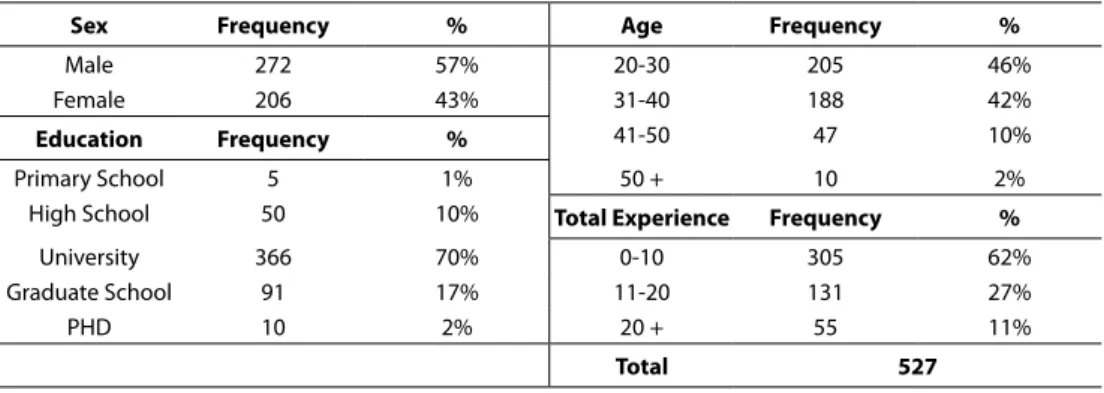
returned, 527 of them having been completed. In the sample 57% of the participants were male and about half of these were between the ages of 20-30. Most of the participants were university graduates and about two thirds of them had less than ten years of work experience. Details regarding descriptive statistics can be seen in Table 1. Descriptive Statistics.
Table 1. Descriptive Statistics
Sex Frequency % Age Frequency %
Male 272 57% 20-30 205 46%
Female 206 43% 31-40 188 42%
Education Frequency % 41-50 47 10%
Primary School 5 1% 50 + 10 2%
High School 50 10% Total Experience Frequency %
University 366 70% 0-10 305 62%
Graduate School 91 17% 11-20 131 27%
PHD 10 2% 20 + 55 11%
Total 527
Reliability and Validity of the Constructs
In this study, Principal Component Analysis was applied with promax rotation and EFA was performed in order to see whether the observed variables were loaded together adequately. Kaiser-Meyer-Olkin (KMO) and Bartlett sphericity tests were applied to test data adequacy necessary for factor analysis. The results showed the KMO value to be 0.952, namely above the desired level of 0.50, and the Bartlett test results were significant being at a level of 0.001. Moreover, diagonal values in anti-image correlation matrix were examined and proved to be above 0.5, all above the necessary value. Thus, it can be seen that our sample data were suitable for factor analysis. The results of factor analyses are shown in Table 2.
Table 2. Factor Analyses and Scale Reliability and Validity Values
Construct Items Faktor Loadings Validity ValuesReliability and EFA CFA Service SL_Service_2 0.866 0.698 Cronbach α: 0.829 SL_Service_3 0.468 0.723 SCR: 0.830 SL_Service_5 0.635 0.777 AVE: 0.550 SL_Service_6 0.576 0.765
Vision SL_Vision_2 0.698 0.715 Cronbach α: 0.880 SL_Vision_4 0.665 0.799 SCR: 0.881 SL_Vision_5 0.643 0.800 AVE: 0.597 SL_Vision_6 0.903 0.771 SL_Vision_7 0.789 0.775 Love SL_Love_2 0.911 0.878 Cronbach α: 0.900 SL_Love_3 0.563 0.820 SCR: 0.904 SL_Love_4 0.997 0.842 AVE: 0.701 SL_Love_5 0.564 0.808 Gratitude Gratitude_1 0.778 0.823 Cronbach α; 0,844 Gratitude_2 0.816 0.847 SCR: 0.837 Gratitude_3 0.780 0.652 AVE: 0.566 Gratitude_4 0.698 0.666 Empowerment SL_Empowerment_1 0.704 0.750 Cronbach α: 0.875 SL_Empowerment_2 0.860 0.771 SCR: 0.876 SL_Empowerment_3 0.836 0.732 AVE: 0.586 SL_Empowerment_4 0.538 0.775 SL_Empowerment_5 0.909 0.799 Innovativeness Innovativeness_1 0.843 0.683 Cronbach α: 0.925 Innovativeness_2 0.913 0.747 SCR: 0.923 Innovativeness_3 0.861 0.753 AVE: 0.602 Innovativeness_4 0.874 0.804 Innovativeness_5 0.863 0.870 Innovativeness_6 0.591 0.695 Innovativeness_7 0.711 0.830 Innovativeness_9 0.659 0.806 Firm Performance Firm_Performance_1 0.782 0.710 Cronbach α: 0.780 Firm_Performance_2 0.794 0.699 SCR: 0.799 Firm_Performance_3 0.840 0.785 AVE: 0.500 Firm_Performance_4 0.681 0.625 Notes
(i) Principal Component Analysis with Promax Rotation (ii) KMO =0.952, Bartlett Test; p<0.001 (iii) Total Variance Explained (%); 68.752
(iv) All CFA trait is statistically significant with the lowest t value being 11,751 at p < 0.001 X2/df = 1.982, GFI=0.903, TLI=0.951, CFI=0.956, PNFI=0.819, RMSEA=0.043
AVE and SCR values of the research factors are also placed on Table 2. According to Table 2, reliability and validity of factors are at the desired levels. Furthermore, correlation values of factor structures were also examined and found to be at the desired level as seen in Table 2. Since there are no dependency relationships between subdimensions of servant leadership, high correlation levels between these subdimensions do not create multicollinearity.
Table 2. Correlations Construct 1 2 3 4 5 6 7 1. Firm Performance 1 2. Innovativeness 0.257 1 3. Empowerment 0.220 0.604 1 4. Vision 0.174 0.611 0.794 1 5. Love 0.153 0.517 0.772 0.830 1 6. Gratitude 0.190 0.697 0.475 0.551 0.469 1 7. Service 0.191 0.526 0.788 0.830 0.839 0.576 1
All correlation values are meaningful in p<0.001 level Test of the Research Model
Structural equation modeling (SEM) was used to test the hypotheses due its suitability for examining causality relationships conveniently (Hox & Bechger 1998). Model fit indexes were found to be X2/df=1.989, GFI=0.900, TLI=0.950, CFI=0.955, PNFI=0.838, RMSEA=0.045, so it can be claimed that fit values are at acceptable levels (Hu & Bentler, 1999; Schumacker & Lomax, 2012).
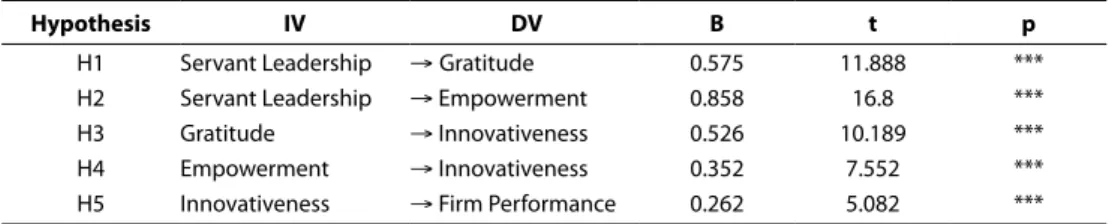
After the analysis it was seen that the path leading to gratitude from servant leadership is statistically significant (ß; 0.58, p<0.001). The path from servant leadership to empowerment is also statistically significant (ß; 0.86, p<0.001). These findings prove that the assumptions in H1 and H2 hypothesis are supported. Moreover, according to SEM results the path leading to innovativeness from gratitude (ß; 0.53, p<0.001) and the path leading to innovativeness from empowerment (ß; 0.35, p<0.001) are also statistically significant. Additionally, the path from innovativeness to firm performance is also statistically significant (ß; 0.35, p<0.001). Thus, it is seen that all our H3, H4 and H5 hypotheses are supported in this study.
Table 3. Structural Model and Related Hypothesis
Hypothesis IV DV B t p
H1 Servant Leadership → Gratitude 0.575 11.888 ***
H2 Servant Leadership → Empowerment 0.858 16.8 ***
H3 Gratitude → Innovativeness 0.526 10.189 ***
H4 Empowerment → Innovativeness 0.352 7.552 ***
H5 Innovativeness → Firm Performance 0.262 5.082 ***
Model Fit
Servant
Leadership Innovativeness PerformanceFirm Gratitude
Empowerment
***; Significant Effect with p<0.001 H1; B; 0.58***
H2; B; 0.86***
H3; B; 0.53***
H5; B; 0.26***
H4; B; 0.35***
FINDINGS AND DISCUSSIONS
This paper represents an important empirical examination of the relationship between servant leadership, innovativeness and organizational performance. In trying to understand how servant leaders influence followers’ feelings of gratitude, perceptions regarding empowerment, and the effects of these perceptions on innovativeness and organizational performance, the path analysis of the study is quite explanatory. In the extant literature, although limited in number, there are empirical studies explaining the positive effects of servant leadership on organizational outputs relationship in keeping with the findings of this study. For example: Irving (2005) tested the relationship between team effectiveness and servant leadership and he found a positive relationship between servant leadership and team effectiveness. Peterson et al. (2012) also found a positive relationship between servant leadership behaviour and firm performance. Indeed, this study provides empirical evidence that servant leadership has positive effects on empowerment and gratitude felt by followers and that these feelings in turn affect innovativeness and organizational performance. Our findings are parallel with the extant literature on empowerment. According to previous literature, empowering employees and supporting their success contributes to an exchange relationship and results in a higher level of motivation and performance (Hu & Liden, 2011; Liden et al., 2008). One of the main assumptions regarding empowerment is the fact that it supports organizations in releasing the motivation, initiative, flexibility, involvement, implicit knowledge, and commitment required for responding to increasingly competitive conditions (Wall, Cordery, & Clegg, 2002). Thus, it creates a
suitable atmosphere for innovativeness. Moreover, according to extant literature, grateful thinking contributes to positive life experiences and situations, ensuring the necessary atmosphere for bringing out the maximum level of satisfaction and enjoyment from current situations (Sheldon & Lyubomirsky, 2006), with the result that grateful people can find easy and convenient ways to create something new. Gratitude, namely the ability to appreciate one’s life circumstances, can also be an adaptive strategy through which one reinterprets difficult cases and adversities (Fredrickson, Tugade, Waugh, & Larkin, 2003) leading to involvement in innovative activities. In line with the extant literature, our findings show that both empowerment and gratitude result in high levels of innovativeness. Feeling grateful towards organizational policies and leadership style makes employees feel comfortable and creates a tendency to return gratitude felt towards them by engaging in innovative activities and by demonstrating satisfactory performance.
The results of this study contribute to the related literature by showing the positive effects of innovativeness on organizational performance, supporting the view that when firms are more innovative they tend to show higher levels of performance due to their success in innovativeness and to their proactive, agile and flexible structures and management styles. In this study the focus was not on the differences between different types of innovation tendencies. Innovativeness as a general inclination of the organization to create something new- either an idea or a new product- and openness of the organization to new ideas and interpretations was taken into consideration. The study revealed that servant leadership style is an important and positive way of leadership that is conceptually and empirically related to innovativeness and organizational performance in at least two ways: namely, by creating grateful employees that are involved in innovative activities, and by empowering employees and making them feel confident and eager to use innovation thus contributing to higher levels of performance and organizational success.
LIMITATIONS
Data related to the empirical research of this study were collected in a limited geographical region. In the field study, companies mainly in the Marmara region and specifically companies in Istanbul and the surrounding provinces were contacted.
The density of service and production companies in this region and the ease of getting in touch with these companies directed the focus of the field study to this specific geographical area. Thus the representativeness of the data is limited to the nature of the companies in the above mentioned location. Moreover, the study intentionally focuses on white collar workers within a certain work culture, due to the fact that white collar workers doing office work are often accustomed to a hierarchical order and bureaucratic work culture and can answer questions regarding leadership without experiencing problems. But in order to limit the scope of companies and for greater ease in conducting the research, production and service sectors were choosen. Data from the production sector was deliberately restricted to answers from administrative units, on the basis that their working habits and perceptions regarding leadership and innovation were likely to be akin to the answers from the service sector. Without doubt, it would have been more meaningful if a wider scope of sectors had been reached and a more representative data on Turkish companies had been obtained.
FURTHER RESEARCH
In this study, the relationship between servant leadership, gratitude, innovation and performance was examined in service and production sectors. In the service sector, innovativeness may not always be followed by an increase in high performance or it may take longer than expected, thus the contribution of innovativeness to high performance should be examined over a long period of time. That is why, a longitudinal study design to study these relationships will be more helpful. In this way a healthier model can be employed in order to explain the effects of servant leadership on innovation and performance especially in the service sector. Moreover, a more inclusive research design regarding the number of sectors and limits of geography will increase the representativeness of the study. In addition, individual performance items besides organizational performance could be included into the study and an individual level explanation could be obtained.
References
Amabile, T. M., Conti, R., Coon, H., Lazenby, J., & Herron, M. (1996). Assessing the work environment for creativity. Academy of Management Journal, 39(5), 1154–1184. https://doi.org/10.2307/256995
Baker, W. E., & Sinkula, J. M. (2002). Market orientation, learning orientation and product innovation: Delving into the organization’s black box. Journal of Market-Focused Management, 5(1), 5–23. Bartlett, M. Y., & DeSteno, D. (2006). Gratitude and prosocial behavior: Helping when it costs you.
Psychological Science, 17(4), 319–325.
Blau, P. M. (1964). Exchange and power in social life. New Jersey, NJ: John Wiley & Sons.
Brown, S. L., & Eisenhardt, K. M. (1995). Product development: Past research, present findings, and future directions. Academy of Management Review, 20(2), 343–378.
Cameron, K. S. (2003). Organizational virtuousness and performance. In K. S. Cameron, J. E. Dutton & R. E. Quinn (Eds.), Positive organizational scholarship: Foundations of a new discipline (pp. 48–65). San Francisco, CA: Berrett-Koehler Publishers Inc.
Cameron, K. S., Bright, D., & Caza, A. (2004). Exploring the relationships between organizational virtuousness and performance. American Behavioral Scientist, 47(6), 766–790.
Cameron, K. S., Dutton, J. E., Quinn, R. E., & Wrzesniewski, A. (2003). Developing a discipline of positive organizational scholarship. In K. Cameron & J. Dutton (Eds.), Positive organizational scholarship:
Foundations of a new discipline (pp. 361–370). San Francisco, CA: Berrett-Koehler Publishers.
Chang, Y. P., Lin, Y. C., & Chen, L. H. (2012). Pay it forward: Gratitude in social networks. Journal of Happiness Studies, 13(5), 761-781.
Conger, J. A., & Kanungo, R. N. (1988). The empowerment process: Integrating theory and practice.
Academy of Management Review, 13(3), 471–482.
Conger, J. A., Kanungo, R. N., & Menon, S. T. (2000). Charismatic leadership and follower effects.
Journal of Organizational Behavior, 21(7), 747–767.
Dennis, R., & Bocarnea, M. (2006). Development of the servant leadership assessment instrument.
Leadership and Organization Development Journal, 26(7–8), 600–615.
Dennis, R., & Winston, B. E. (2003). A factor analysis of Page and Wong’s servant leadership instrument.
Leadership & Organization Development Journal, 24(8), 455–459.
DePree, M. (1989). Leadership is an art. New York, NY: Bantam Doubleday Dell Publishing Group. Ehrhart, M. G. (2004). Leadership and procedural justice climate as antecedents of unit-level
organizational citizenship behavior. Personnel Psychology, 57(1), 61–94.
Emmons, R. A., & McCullough, M. E. (Eds.). (2004). The psychology of gratitude. New York, NY: Oxford University Press.
Fredrickson, B. L. (2001). The role of positive emotions in positive psychology: The broaden-and-build theory of positive emotions. American Psychologist, 56(3), 218–226.
Fredrickson, B. L. (2003). The value of positive emotions. American Scientist, 91(4), 330–335. https:// doi.org/10.1146/annurev.psych.55.090902.141913Fredrickson, B. L., & Joiner, T. E. Jr. (2002). Positive emotions trigger upward spirals toward emotional well-being. Psychological Science, 13(2), 172–175.
Fredrickson, B. L., & Losada, M. F. (2005). Positive affect and the complex dynamics of human flourishing. American psychologist, 60(7), 678.
Fredrickson, B. L., Tugade, M. M., Waugh, C. E., & Larkin, G. (2003). What good are positive emotions in crises? A prospective study of resilience and emotions following the terrorist attacks on the United States on September 11th, 2001. Journal of Personality and Social Psychology, 84, 365– 376. http://dx.doi.org/10.1037/0022-3514.84.2.365
Gardner, H. (Ed.). (2010). Responsibility at work: How leading professionals act (or don’t act) responsibly. New Jersey, NJ: John Wiley & Sons.
Gerstner, C. R., & Day, D. V. (1997). Meta-Analytic review of leader–member exchange theory: Correlates and construct issues. Journal of Applied Psychology, 82(6), 827–844. http://dx.doi. org/10.1037/0021-9010.82.6.827
Gouldner, A. W. (1960). The norm of reciprocity: A preliminary statement. American Sociological
Review, 25(2), 161–178.
Graham, J. W. (1991). Servant-leadership in organizations: Inspirational and moral. The Leadership
Quarterly, 2(2), 105–119.
Greenleaf, R. K. (1977). Servant leadership. New York, NY: Paulist Press.
Greenleaf, R. K. (1998). The power of servant-leadership. San Francisco, CA: Berrett-Koehler.
Hackman, J. R. (1992). Group influences on individuals in organizations. Sunnyvale, CA: Consulting Psychologists Press.
Hale, J. R., & Fields, D. L. (2007). Exploring servant leadership across cultures: A study of followers in Ghana and the USA. Leadership, 3(4), 397–417. https://doi.org/10.1177/1742715007082964 Hox, J. J., & Bechger, T. M. (1998). An introduction to structural equation modeling. Family Science
Review, 11, 354–373. https://doi.org/10.1016/S0191-491X(98)00006-6
Hu, J., & Liden, R. C. (2011). Antecedents of team potency and team effectiveness: an examination of goal and process clarity and servant leadership. Journal of Applied Psychology, 96(4), 851–862. http://dx.doi.org/10.1037/a0022465
Hu, L. T., & Bentler, P. M. (1999). Cutoff criteria for fit indexes in covariance structure analysis: Conventional criteria versus new alternatives. Structural Equation Modeling: A Multidisciplinary
Journal, 6(1), 1–55.
Irving, J. A. (2005). Servant leadership and the effectiveness of teams (Doctoral dissertation, Regent University) Retrieved from http://people.bethel.edu/~irvjus/PDF/Irving,Justin-RegentUniversity_ final.pdf
Kirkman, B. L., & Rosen, B. (1999). Beyond self-management: Antecedents and consequences of team empowerment. Academy of Management Journal, 42(1), 58–74. https://doi.org/10.2307/256874 Laub, J. (2003). From paternalism to the servant organization: Expanding the Organizational
Leadership Assessment (OLA) model. Proceedings of the Servant Leadership Research Roundtable, August, 1–20.
Laub, J. A. (1999). Assessing the servant organization (Doctoral dissertation, Florida Atlantic University) Retrieved from http://olagroup.com/Images/mmDocument/Laub%20Dissertation%20 Complete%2099.pdf
Liden, R. C., Wayne, S. J., Liao, C., & Meuser, J. D. (2014). Servant leadership and serving culture: Influence on individual and unit performance. Academy of Management Journal, 57(5), 1434– 1452.
Liden, R. C., Wayne, S. J., Zhao, H., & Henderson, D. (2008). Servant leadership: Development of a multidimensionaleasure and multi-level assessment. The Leadership Quarterly, 19, 161–177. https://doi.org/10.1016/j.leaqua.2008.01.006
Martin, K. D., & Cullen, J. B. (2006). Continuities and extensions of ethical climate theory: A meta-analytic review. Journal of Business Ethics, 69(2), 175–194.
McCullough, M. E., Emmons, R. A., & Tsang, J. A. (2002). The grateful disposition: A conceptual and empirical topography. Journal of Personality and Social Psychology, 82(1), 112–127.
Melchar, D. E., & Bosco, S. M. (2010). Achieving high organization performance through servant leadership. The Journal of Business Inquiry, 9(1), 74–88.
Miles, R. E., Snow, C. C., Meyer, A. D., & Coleman, H. J. (1978). Organizational strategy, structure, and process. Academy of Management Review, 3(3), 546–562.
Mishra, A. K., & Mishra, K. E. (2012), Positive organizational scholarship and trust in leaders. In: K. S. Cameron & G. M. Spreitzer (Eds.), The Oxford handbook of positive organizational scholarship (pp. 449–461). New York, NY: Oxford University Press.
Organ, D. W. (1988). A restatement of the satisfaction-performance hypothesis. Journal of
Management, 14(4), 547-557.
Page, D., & Wong, T. P. (2000). A conceptual framework for measuring servant leadership. In S. Adjibolosoo (Ed.), The human factor in shaping the course of history and development (pp. 69– 110). Boston, MA: University Press of America.
Parolini, J. L. (2005). Investigating the relationships among emotional intelligence, servant leadership behaviors and servant leadership culture. Proceedings of the 2005 Servant Leadership
Research Roundtable, August, 1–21.
Peterson, S. J., Galvin, B. M., & Lange, D. (2012). CEO servant leadership: Exploring executive characteristics and firm performance. Personnel Psychology, 65(3), 565–596.
Rahman, S. U., & Bullock, P. (2004). Soft TQM, hard TQM, and organisational performance relationships: An empirical investigation. Omega, 33(1), 73–83.
Riechmann, D. (1992). High-involvement, high-performance teams in higher education: The impact of leadership. In K. E. Clark, M. B. Clark, & D. P. Campbell (Eds.), Impact of leadership (pp. 257–268). Greensboro, NC: Center for Creative Leadership.
Schumacker, R. E., & Lomax, R. G. (2012). A beginner’s guide to structural equation modeling. London, UK: Routledge.
Sheldon, K. M., & Lyubomirsky, S. (2006). How to increase and sustain positive emotion: The effects of expressing gratitude and visualizing best possible selves. The Journal of Positive Psychology, 1(2), 73–82. http://dx.doi.org/10.1080/17439760500510676
Thornhill, S. (2006). Knowledge, innovation and firm performance in high-and low-technology regimes. Journal of Business Venturing, 21(5), 687–703. https://doi.org/10.1016/j. jbusvent.2005.06.001
Vázquez, R., Santos, M. L., & Alvarez, L. I. (2001). Market orientation, innovation and competitive strategies in industrial firms. Journal of Strategic Marketing, 9(1), 69-90.
Wall, T. D., Cordery, J. L., & Clegg, C. W. (2002). Empowerment, performance, and operational uncertainty: A theoretical integration. Applied Psychology, 51(1), 146–169. https://doi. org/10.1111/1464-0597.00083
Walumbwa, F. O., Hartnell, C. A., & Oke, A. (2010). Servant leadership, procedural justice climate, service climate, employee attitudes, and organizational citizenship behavior: a cross-level investigation. Journal of Applied Psychology, 95(3), 517.
Weerawardena, J., & Mort, G. S. (2006). Investigating social entrepreneurship: A multidimensional model. Journal of World Business, 41(1), 21–35. https://doi.org/10.1016/j.jwb.2005.09.001 Winston, B. (2003). Extending Patterson’s servant leadership model. Retrieved from https://www.
regent.edu/acad/global/publications/sl_proceedings/2003/winston_extending_patterson.pdf Youssef, C. M., Luthans, F. (2012), Psychological capital. Meaning, ndings and future directions. In K.
S. Cameron & G. M. Spreitzer (Eds.), The Oxford handbook of positive organizational scholarship (pp. 17–27) New York, NY: Oxford University Press.
Zhou, J., & George, J. M. (2001). When job dissatisfaction leads to creativity: Encouraging the expression of voice. Academy of Management Journal, 44(4), 682–696. https://doi. org/10.2307/3069410