T.C.
GAZİ UNIVERSITY
INSTITUTE OF EDUCATIONAL SCIENCES
DEPARTMENT OF ENGLISH LANGUAGE TEACHING
PERSONALIZATION OF FOREIGN LANGUAGE LEARNING
IN CONSTRUCTIVISM: A POSTMODERN PERSPECTIVE
MA THESIS
By
Burcu ARSLANER
ANKARA
Haziran – 2009
GAZİ UNIVERSITY
INSTITUTE OF EDUCATIONAL SCIENCES
DEPARTMENT OF ENGLISH LANGUAGE TEACHING
PERSONALIZATION OF FOREIGN LANGUAGE LEARNING IN
CONSTRUCTIVISM: A POSTMODERN PERSPECTIVE
MA THESIS
By
Burcu ARSLANER
SUPERVISOR
Assist. Prof.Dr. İskender Hakkı SARIGÖZ
adlı çalışma jürimiz tarafından İNGİLİZ DİLİ EĞİTİMİ Anabilim Dalında DOKTORA /YÜKSEK LİSANS TEZİ olarak kabul edilmiştir.
(İmza)
Başkan:... Doç. Dr. Arif SARIÇOBAN
(İmza)
Üye:...
Yrd. Doç. Dr. İskender Hakkı SARIGÖZ
(İmza)
Üye:... Yrd. Doç. Dr. Cemal ÇAKIR
First of all, I would like to express my sincere appreciation to Assist. Prof. Dr. İskender Hakkı SARIGÖZ for his guidance and continual support throughout the preparation of this study.
I also owe special thanks to the instructors Betül Canıdar and Vecihe Keçecioğlu who encouraged me during the studies of this thesis for their friendships and to my dear students who facilitated the data collection procedure for their participation and priceless understanding.
Last but not the least, my deepest gratitude goes to my family, especially to my mother Ayşe ARSLANER and father Mustafa ARSLANER, who were always there when I needed and granted me every support during my long periods of study, and also I, especially, would like to thank my sister Demet ARSLANER for her love and care.
In short, it is a debt for me to extend my appreciation to everybody without whom this study would have been incomplete.
OLUŞTURMACI BAĞLAMDA
YABANCI DİL ÖĞRENİMİNİN KİŞİSELLEŞTİRİLMESİ: POSTMODERN BİR YAKLAŞIM
Arslaner, Burcu
Yüksek Lisans, İngiliz Dili Eğitimi ABD
Tez Danışmanı: Yrd. Doç. Dr. İskender Hakkı SARIGÖZ Nisan, 2009
Bu araştırmada oluşturmacılık kuramı ışığında kişiselleştirilmiş ders programının Eskişehir Osmangazi Üniversitesi Yabancı Diller Bölümü öğrencilerinin başarı düzeylerine etkisi ölçülmüştür. Dolayısıyla araştırmanın amacı geliştirilen başarı testi ile oluşturmacı bir uygulama olan kişiselleştirmenin etkisini incelemek ve bu uygulamanın İngilizce eğitiminde uygulanabilirliğini ortaya koymaktır. Çalışmada aynı zamanda öğrencilerin normal öğretim veya ikinci öğretim bölümlerinde okuyor olmaları ile mezun oldukları okulun başarılarına olan etkisi de incelenmiştir.
Araştırma evreni 2008–2009 eğitim öğretim yılı ikinci döneminde Eskişehir Osmangazi Üniversitesi Yabancı Diller Bölümü öğrencilerinden 44 öğrenci ile oluşturulmuştur.
Bu araştırma deney ve kontrol grubu üzerinde uygulanmış ve ön-test ve son-test kontrol gruplu desen kullanılmıştır. Uygulama 6 hafta sürmüştür. Bu süreçte deney grubuna (n=22) oluşturmacı metotlarla hazırlanmış kişiselleştirilmiş dersler sunulurken kontrol grubu (n=22) geleneksel metotlarla çalışmıştır. Her iki gruba da öğrendikleri konulara yönelik 40 soruluk çoktan seçmeli bir test uygulanmıştır. Test sonuçları istatistikî ve sözel olarak sunulup yorumlanmıştır.
Araştırmanın sonucunda, İngilizce öğretiminde oluşturmacı bir uygulama olan kişiselleştirmenin öğrenci başarısını artırdığı yönde olumlu olarak etkilediği ve araştırmaya katılan öğrencilerin normal öğretim veya ikinci öğretim olmaları başarı düzeylerinde farklılık yaratırken; mezun oldukları okulun öğrencilerin başarı düzeyini etkilemediği gözlemlenmiştir.
Arslaner, Burcu
MA, English Language Teaching Department Supervisor: Assist. Prof. Dr. İskender Hakkı SARIGÖZ
April, 2009
In this thesis, the effect of personalized course activities under the light of constructivism on the success level of students studying at Eskişehir Osmangazi University Foreign Languages Department has been assessed. Thus, the main purpose of this research is to examine the effect of the constructivist instruction, personalization on the success levels of students with an achievement test and to display the employability of this instruction within Foreign Language Learning. In the research also students’ department types: day or evening classes and high school types have been examined in relation to their success.
The research population has been composed of 44 students studying at Eskişehir Osmangazi University Foreign Languages Department in the second term of 2008-2009 education years.
This research has been implemented on experimental and control groups besides pre-test and post-test control group pattern has been used. The practice process continued approximately for 6 weeks. Within this process, while the experimental group (n=22) was instructed by constructivist personalized methods, the control group (n=22) was instructed by traditional methods. Both groups were administered a 40-question multiple choice test directed to the subject matters they learnt. The findings are interpreted statistically and verbally.
As a result of the research, it is seen that the constructivist personalized instruction in Foreign Language Learning has a positive effect by increasing the students’ success. It is also proved that students’ department types: day or evening classes can create a difference in their academic achievements; however their high school types do not have a significant effect on the success levels of the students.
To my family in deep gratitude for their parenting…
Knowledge is only perception
SOCRATES
1.1. Background to the Study………...………..1
1.2. Problem………..………...……….…3
1.3. Aim of the Study.………...…..…………..5
1.4. Importance of the Study………...………..………6
1.5. Assumptions and Research Questions………...………7
1.6. Limitations ……….………...………….………...9
1.7. Definitions of Terms…..………...………….9
CHAPTER 2: REVIEW OF LITERATURE……….………12
2.1. What is Modernism?………...……….12
2.2. What is Postmodernism?……….………...……..16
2.2.1. How Does it Differ from Modernism?...22
2.2.2. Postmodernism and Reality……….…….27
2.2.3. Postmodernism and Education………..………29
2.3. Historical Background of Constructivism………...35
2.4. Postmodern Roots of Constructivism………:::………..…….39
2.5. Constructivist Language Learning………..……….43
2.5.1. Learning and Instruction in Constructivism………..48
2.5.2. Assessment in Constructivism………….. ………..……….51
2.6. Personalization of Language Learning in Constructivism………...53
CHAPTER 3: METHODOLOGY AND DATA COLLECTION...……….56
3.1. The Design of the Study………..………56
3.2. Subjects and Settings………...………57
3.3. Data Collection ……….….……...62
3.3.1. Personal Information Form...62
3.3.2. Subject Matter………...62 vi
CHAPTER 4: FINDINGS AND INTERPRETATION OF THE DATA……..…70
4.1. Findings and Interpretation of the First Problem………...70
4.2. Findings and Interpretation of the Second Problem……….71
4.3. Findings and Interpretation of the Third Problem………...………72
4.4. Findings and Interpretation of the Forth Problem………74
4.5. Findings and Interpretation of the Fifth Problem……….75
4.6. Findings and Interpretation of the Sixth Problem………76
4.7. Findings and Interpretation of the Seventh Problem………...77
4.8. Findings and Interpretation of the Eighth Problem………..78
CHAPTER 5: CONCLUSIONS AND IMPLICATIONS FOR TEACHING...80
5.1. Conclusion………..……….80
5.2. How to Construct a Constructivist Classroom……….83
5.3. Role of the Student………..……….84
5.4. Role of the Teacher………..86
REFERENCE LIST ………..…………...91
APPENDICES ……….………..………...96
Appendix 1. Questions on Unit 7: “Look to the Future“………...97
Appendix 2. Questions on Unit 8: “The World of Work”...100
Appendix 3. Questions on Unit 9: “Love and Trust“...103
Appendix 4. Questions on Unit 10: “The Media“...106
Appendix 5. Personal Information Form...109
Appendix 6. Essays Studied During the Application Weeks………...110
Appendix 7. Achievement Test………....111 vii
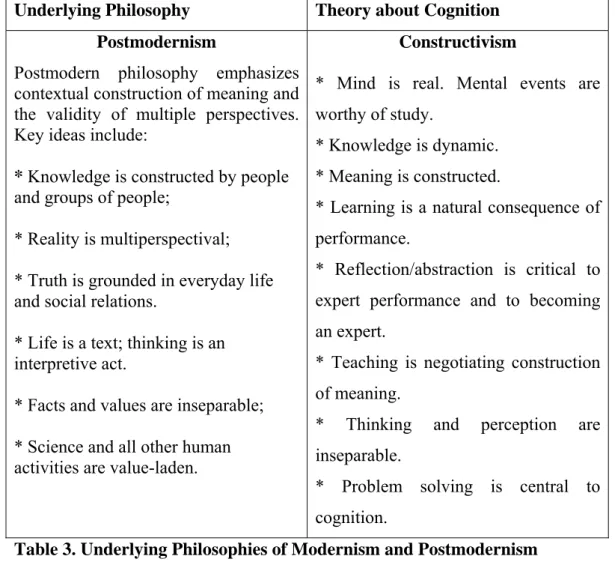
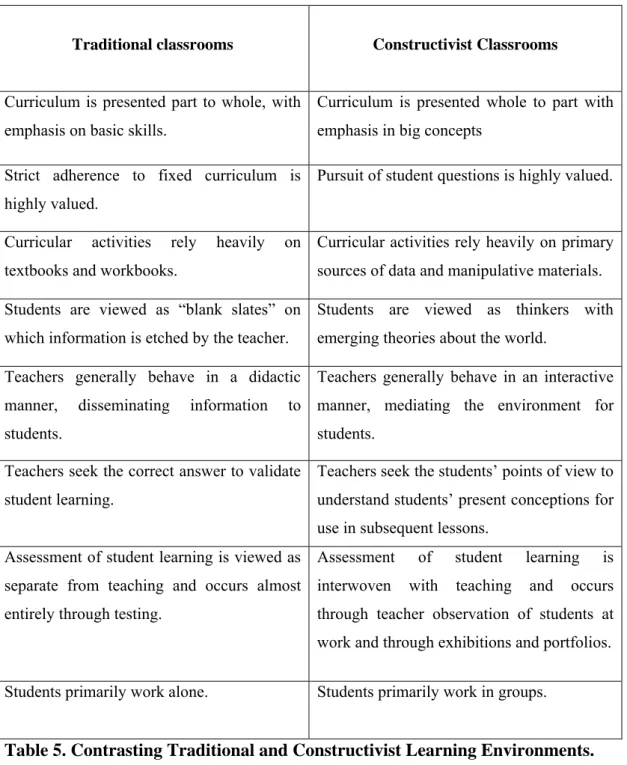
Table 1. Contrast of Modern and Postmodern Thinking………..…. 25 Table 2. Contrasting Modern and Postmodern Educational Concepts….…………..33 Table 3. Underlying Philosophies of Modernism and Postmodernism………….….43 Table 4. How Our Views of Knowledge Influence Our Views of Instruction...……44 Table 5. Contrasting Traditional and Constructivist Learning Environments……...54 Table 6. The Results of the Comparison of the Groups Regarding the Success
Averages in the Last Midterm (the second midterm) by means of the t-test Included in SPSS………..57 Table 7. The Results of the Comparison of the Groups Regarding the Success
Averages in Pre-test by means of the t-test Included in SPSS……….58 Table 8. The Number and Percentage of Participants in Control Group in terms of
Their High School Types……….…59 Table 9. The Number and Percentage of Participants in Experimental Group in terms
of Their High School Types……….59 Table 10. The Number and Percentage of Participants in Control Group in terms of
Their Department Types: Evening or Day Classes………60 Table 11. The Number and Percentage of Participants in Experimental Group in
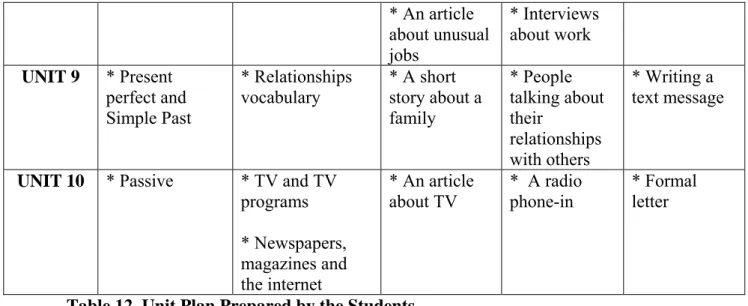
terms of Their Department Types: Evening or Day Classes………..61 Table 12. Unit Plan Prepared by the Students………62 Table 13. Constructivist Learning Design………..65 Table 14. The Results of the Comparison of the Groups Regarding the Success
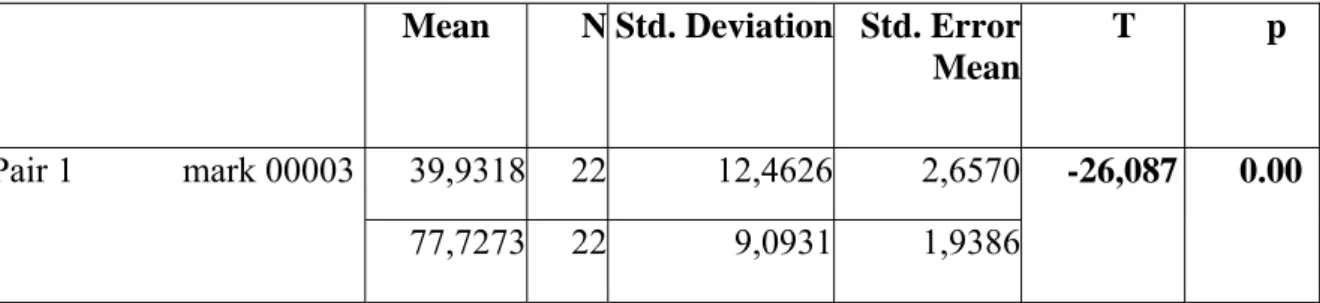
Averages in Pre-test by means of the t-test Included in SPSS…………...70 Table 15. The Results of the Comparison of the Pre-test and Post-test Results of the
Control Group………....72 Table 16. The Results of the Comparison of the Pre-test and Post-test Results of the
Experimental Group………...73 Table 17. The Results of the Comparison of the Post-tests Results of the
Experimental and Control Group………...………74
Table 20. The Results of the Comparison of the Post-tests Results of the Control Group in terms of Their Class Types………..77 Table 21. The Results of the Comparison of the Post-tests Results of the
Experimental Group in terms of Their Class Types………..79
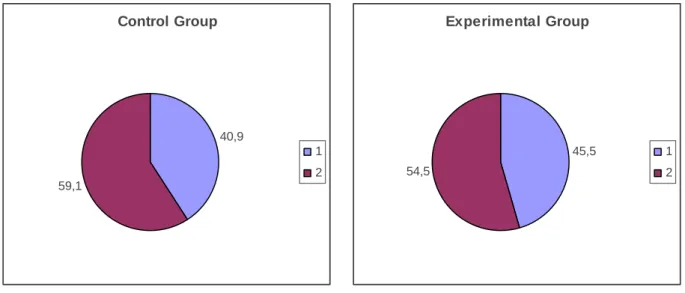
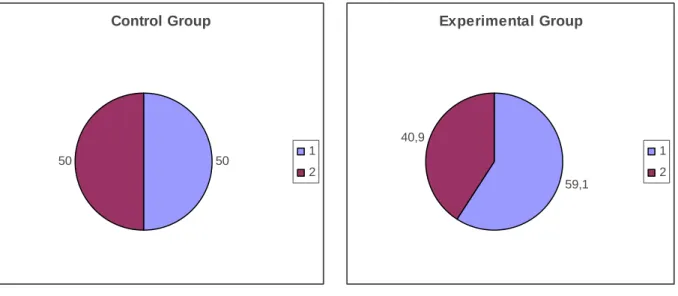
Figure 1: The High School Type of the Participants in the Control and
Experimental Groups………..…60 Figure 2: The Department Type of the Participants in the Control and
Experimental Groups………..61
CHAPTER I
INTRODUCTION
1.1. Background to the study
For the past a few decades the world has undergone many changes. New experiences and different technologies have enabled us to broaden our viewpoints and consider everything from a different perspective. In this age of changes it is not possible that education can stay as it is. Contrary to the previous understandings of education like in industrialization period which promised the idea of bringing up children who are obedient, disciplined, specialized and self-sacrificing, the information age and society, especially new technologies and science have presented new learning environments which are based on multiplicity of perspectives and where people can realize themselves by studying with others in collaboration. For these reasons it is unavoidable that education, especially foreign language learning and teaching gets its own shares, is reinterpreted and finds new meanings.
Language has been such a significant tool in a world where limits are being cleared away and where communication is gaining more and more importance. The keystone of this frame is people who can interact with others, effect and be affected by them. Within this social interaction process, such people use their experiences in the construction of new ones and thus it facilitates activating both the learning and teaching processes. Novak (1998) summarizes this idea as below:
“ Meaningful learning underlies the constructive integration of thinking, feeling, and acting that occurs in human learning and in new knowledge construction…Human constructivism is… both for the way in which humans learn their usable knowledge and also
for the way in which they construct new knowledge. The nature and process of meaningful learning underlies both human learning and knowledge creation.” (Novak, 1998:79-80)
Furthermore, in order to increase the efficiency of these processes, to provide people opportunities to realize themselves and direct them to creative and critical thinking, they need learning environments where they can express themselves freely, that is, without hesitation. Besides, foreign language learning, different from other areas offers people more possibilities to develop a better understanding of who they are and compare and contrast themselves with others. In that sense, foreign language learning has been an important tool owing to the fact that it supports multi-perspectives, respect for universality and free idea in a global world in which personal relations have been complex and become dense. Thus, the key point of postmodern education philosophy, which centers upon students, is the variety of ideas, emphasize on the multi-perspectives and the rejection of exclusion of the reality from the self. Meaning cannot exist independently in a world open to people’s perceptions due to the fact that reality is a construction of human beings based upon their experiences.
To be more precise, meaning is a construction of the person. While this idea leads to the repudiation of objective reality, it also supports the idea that people’s own experiences shape their construction of knowledge. Within these construction processes students are the active participants of the course, expressing their ideas freely, working in collaboration, reflecting and developing a better understanding of the subject matter. Therefore, constructivist learning environments should include the personalization of the learning process in order to awake their minds, take them into the lesson easily, and enable them to realize themselves, understand themselves and others so that they can question and construct new ideas and reflect on their own experiences.
In a foreign language class, it is a necessity to create such a lively atmosphere that makes students creative and their minds active. As a matter of fact, constructivist classrooms should be environments where students’ active
participation to the course becomes a natural process, meaning is constructed in their minds considering the dynamic nature of the knowledge and therefore, students are seen as the important for the decision of the process and personalization is placed at the center of the activities presented.
Postmodern constructivist philosophy which gives support to variety of perspectives, hands-on experience, trying to understand the other, considering participation as a significant point, the importance of cultural basis to make sense of texts, the development of the self concurrent with the development of the ideas, has been considered as an important instruction that enriches learning, teaching and assessing systems.
1.2. Problem
Today’s fast changing world gives way to question, re-interpret things we have already had and reshape the concepts in our minds. In such an era it is also inevitable not to reconsider the idea of education due to the fact that it helps people to order their minds, perspectives and lives. Therefore, the new technologies and improvements in science make people closer to each other by clearing the limits away. In that sense, foreign languages gain a great significance owing to the fact that it lessens the distances, enables people to communicate with each other, provide them with different perspectives, makes us realize that there is not only one truth and people should not only tolerate but also celebrate the multiplicity of ideas, perspectives and cultures.
However, there has also been a lot of discussion and writing in the education profession over the last few decades about the nature of foreign language learning and teaching. This mainly stems from the experiences that foreign language students even after a couple of years of instruction cannot use the language properly and produce it actively and without hesitation. One reason for this is that teaching has generally been connected to managing a class, making students understand and receive the necessary input and assessing this input by applying some quizzes and
exams. On the other hand, learning has been connected to be ready for the course, listening to the teacher and understanding the given input, doing the necessary homework and getting ready for the exam to have a higher education. Yet, it has been understood that within this framework learning can neither be realized nor become permanent. And when it comes to the foreign languages where production is important, it for the most part, results in failure.
If knowing is a process of construction of the meaning rather than memorizing or receiving a particular knowledge, teachers should revise and re-think about the methods, techniques they use and tasks they present to the class. It means what is to be considered is that the purpose of education is not transmitting a body of knowledge to students’ minds, making them memorize the ready-made input and/or validated truths. Instead, it should involve students in the knowledge production process, analyzing, questioning, deriving meaning, comparing/contrasting and interpreting to construct a variety of knowledges appear from different locations.
Thus, the problem is if constructivist methods affect the success of students in FL classrooms and how teachers can prepare their students to become good learners and interpreters of learning, what teachers should do to involve their students into the process, how they can make them internalize the knowledge by connecting it with the prior experiences. Constructivism, at this point, offers that there is no fixed knowledge for everyone to be injected to the students or no fixed way to make them receive the target knowledge owing to the fact that the goal of education is not giving a product but being involved into the process where the students can interpret the world, ask questions and draw conclusions in the lights of their experiences. Hanley summarizes what constructivism tells us as below:
“Focusing on a more educational description of constructivism, meaning is intimately connected with experience. Students come into a classroom with their own experiences and a cognitive structure based on those experiences. These preconceived structures are valid, invalid or incomplete. The learner will reformulate his/her existing structures only if new information or experiences are connected to knowledge already in
memory. Inferences, elaborations and relationships between old perceptions and new ideas must be personally drawn by the student in order for the new idea to become an integrated, useful part of his/her memory. Memorized facts or information that has not been connected with the learner's prior experiences will be quickly forgotten. In short, the learner must actively construct new information onto his/her existing mental framework for meaningful learning to occur” (Hanley, 1994).
The obvious conclusion is that foreign language learning and teaching has been under the reign of traditional methods in which teachers are considered as a information-giver and students as receivers. The problem if we can convert our learning environment to a place where students collaborate, share ideas, construct their own meaning, question, interpret and a place where teachers can personalize the course and involve them into the knowledge construction or meaning making processes.
1.3. Aim of the study
The purpose of this study is to investigate to what extent a constructivist classroom, which emphasizes upon the individual differences and critical thinking by applying personalized tasks, can provide a more effective and permanent foreign language learning. It is in such a postmodern era, which gives importance to the process of knowledge construction rather than the product, creating a more efficient learning environment based on multiplicity by personalization of the process, thus enabling permanent learning by featuring the person has been a must for teachers. In this respect, this study also attempts to find out how constructivist classrooms can be constructed and what the teacher’s role is.
This study aims at providing student-centered tasks by which students construct the knowledge actively and determine the processes they will be involved in. Within this framework the following questions are going to be answered:
* How does postmodernism effect foreign language learning?
* How can personalization be related to constructivism?
* How do constructivist personalized activities make a difference in comparison with traditional methods?
* How can postmodernism, constructivism and foreign language learning be related among each other?
1.4. Importance of the study
Nowadays, in this information society, the qualities of people have become different from the traditional ones. It is expected from people of this information society to be creative, tolerable, initiative and productive. However, while on one hand school curriculums are too strict and limited to achieve these goals, on the other hand teachers’ own approaches towards language teaching and learning are too narrow.
For this reason, it is important to not only broaden teachers’ points of view towards teaching and learning processes, but also learning environments and applied tasks should be converted into meaning construction processes shaped by students’ own experiences within their own mental frameworks.
Active learning environments created by constructivist personalized tasks give individuals opportunities to express their ideas in a free atmosphere and present them by interpreting under the lights of their own experiences and background knowledge. So, their sense of responsibility is going to be improved and they are going to become aware of their ability to make decisions and, in the end, they are going to realize themselves. This is why personalization and in general constructivism are of great importance.
Equally important point is that constructivist studies have generally been carried out in the fields of math, science and mostly in primary school teaching. For this reason, it is hoped that this study aiming at presenting examples of efficient and permanent learning environment with supportive, fun, free atmosphere in foreign language teaching will provide a comprehensive data concerning the constructivist classrooms in a foreign languages department in a university.
Finally it is expected that this study is going to help teachers who want to bring a different perspective to their instruction, tasks and learning environment they try to create.
1.5. Assumptions and Research Questions
The major research questions observed in this study are:
1. Does the implementation of personalized constructivist activities affect the success of FL classes?
1.1. Is there a meaningful difference in academic success of experimental and control groups in terms of pre-test?
1.2. Is there a meaningful difference in academic success of students in control group between pre-test and post-test?
1.3. Is there a meaningful difference in academic success of students in experimental group between pre-test and post-test?
1.4. Is there a meaningful difference in academic success of experimental and control groups in terms of post-test?
1.5. Is there a meaningful difference in academic success of students in control group participated in the study in their pre and post- test results in terms of their high schools?
1.6. Is there a meaningful difference in academic success of students in experimental group participated in the study in their pre and post- test results in terms of their high schools?
1.7. Is there a meaningful difference in academic success of students in control group participated in the study in their pre and post- test results in terms of their class types: formal and evening classes?
1.8. Is there a meaningful difference in academic success of students in experimental group participated in the study in their pre and post- test results in terms of their class types: formal and evening classes?
Regarding the main goal of this study the assumptions are the followings:
1. Foreign language classrooms have generally been considered as places where traditional methods are applied to transform the necessary knowledge to students’ minds.
2. Constructivist approach from a postmodern perspective has an important effect in the personalization of foreign language learning.
3. Personalized tasks prepared under the lights of constructivism can attract students’ attention better and facilitate students’ involvement into the process.
4. Success in foreign language classrooms can be increased and made permanent and more effective by using tasks which are
shaped by constructivist approach and postmodern perspective that supports autonomy of the individuals and enables them construct their own knowledge by their own awareness in comparison with the traditional ones.
5. Students’ high school types do not affect their academic success before or after applying constructivist methods.
6. Students’ studying in a formal or evening class does not affect their success before or after applying constructivist methods.
1.6. Limitations
The data for this study were collected at Eskişehir Osmangazi University. Despite the fact that there are a lot of classes at Eskişehir Osmangazi University Foreign Languages Department, just two of them including 44 students were observed for this study. This study is also limited with traditional activities applied to control group and constructivist activities applied to the experimental group.
1.7. Definitions of Terms
In this part of the study the concepts that are mostly used through the work are going to be defined.
Postmodernism can be defined as a term that repudiates certain, objective knowledge and grand theories stemming from the absolute truths. It is a philosophy which is grounded on multiple perspectives, therefore, pluralism in cultures and ideas. Although it is an elusive term which is difficult to define, it can be interpreted as a philosophy stemming from rejection of single-mindedness and universality, challenges static predetermined identities and any kind of meta-narratives trying to
explain the world. “It is a skepticism that results from the discrepancy between modernity’s ideals and promises about grand narratives, and the actuality of the oppression and destruction which characterizes the contemporary world” (Usher, R. I. Bryant and R. Johnston., 1997:6).
Along the same line, in education, postmodernism asserts the idea that the learning environments must be student-centered, based upon the multiple perspectives of individuals, have a flexible curriculum, activate students’ collaboration within the classroom where they can have the opportunity to experience their own meaning making process.
Constructivism is a theory about knowledge and learning. It deals with what knowing is and how people construct knowledge in their minds. Constructivism suggests that there is not external truths independent from people, instead, meaning is constructed in people’s mind interpreted by their past experiences and knowledges. Therefore, constructivism supports creative, inquiry-based and personalized tasks with cooperative learning, reflective and creative thinking.
In constructivism knowledge is internalized not by giving reaction to the environment passively but by being involved into the meaning making process as a self-regulating individual. It is a theory which puts students at the center of the course by giving them the right to make decision for the flow of the course. They participate in the course actively by collaborating, asking questions, criticizing, drawing conclusions and making their own meaning. On the other hand, constructivists support the idea that teachers are the ones who define students’ profiles and interests to prepare suitable tasks accordingly, the ones who activate their minds and making them ready for the process of interpreting and constructing knowledge. To sum up, constructivism is simply based on the idea that “in our interactions with the world, we actively construct our experience and understanding in accord with the categories, concepts and previous experiences that we bring to the situation” (Jardine, 2006: 34).
Constructivism is also a postmodern thought in education owing to the fact that both reject objectivist externally constructed knowledge and a single truth. Besides, both celebrate the multiplicity of ideas and welcome different cultures, perspectives and attitudes.
Personalization, as the term implies, is the process in which students personalities play the central role in many respects. Owing to the fact that in the postmodern education “fixed reference points and solid groundings becoming increasingly detached and shaky…it becomes pleasurable in opening up possibilities for constituting identities” (Usher, R. I. Bryant and R. Johnston.,1997:5), thus, it is of great importance to be aware that each student has a unique world and if they can discover themselves, education would be more meaningful and effective. At first, in a constructivist learning environment personalization means students’ being decision makers for the whole process. Then tasks are personalized by the teacher to attract their attention, to facilitate the involvement process and to help them find some things to relate with their experiences in their lives. Personalization has a crucial role in respect of providing them with opportunities to become aware of their own skills, mental schemata, engage them into the course actively by helping them get things to identify themselves with.
CHAPTER II
REVIEW OF LITERATURE
2.1. What is Modernism?
The word modern brings the one which is different from the old into mind and includes the dynamics of change per se. And “modernity” is used to distinguish the contemporary and signifies the things belonging to the contemporary time. Sarup defines the term modernity as the progressive economic and administrative rationalization and differentiation of the social world (Sarup, 1993).
Modernism was grounded in the beliefs of the Enlightenment which dates back to the eighteenth century. Thus, it clarifies the change and differentiation in art, science, culture and the social structure of society. This modern project, built upon the Enlightenment, “which saw the beginning of a process of modernization, of socio-economic and cultural change and disruption” (Usher, R. I. Bryant and R. Johnston.,1997:2), presupposes an understanding of capitalism, urbanization, secularism, industrial revolution, human identity, human rights, scientific knowledge and etc.
Right from the emergence of the Enlightenment, old forms of government has been cast off and new social experiments have just began and many established truths have been called into question; as a result, reason has been discovered.
“The discourses and practices of modernity are characterized by an emphasis on progress and a faith in rationality and science as the means of its realization” (Usher, R. I. Bryant and R. Johnston.,1997:6). The West, within this period, dismissed the old traditions and headed towards rebuilding the world via “reason”.
The proponents of modernism have been motivated by this modern spirit and led to make ambitious claims for the power of human reason. Scientists have maintained that reason plays an essential role which makes it probable for people to develop an understanding of nature and regimes that confirm rights and liberties of humanity.
The human mind is seen as the apex of evolution owing to its capacity to think, interpret and discover which lead us towards the perfect society. They began to reinterpret government, education, art, and the social structure of the society at that period according to the tenets of reason. Putting human mind into the center in place of traditional beliefs, regimes and King, the West supported people’s intellectual abilities to compose a new social framework for his attempt.
Under the light of scientific knowledge and reason, The West, beginning from the eighteenth century has experienced a great change and agricultural society has been transformed into industrial one. The society after this transformation has been called modern and it is known that many great changes have been meant when this term is used. In this respect, various revolutions in many fields such as science, politics, culture have shown up, whose changes are effective from agriculture to industry, from ancient to modern. In terms of science, the modern spirit has been considered as the driving force behind the scientific thought that the universe can construct and arrange itself as a machine on its own and “modernity is characterized by a search for an underlying and unifying truth and certainty” (Usher, R. I. Bryant and R. Johnston.,1997:10). Thus, under the sovereignty of this positivist paradigm, the modern science has substituted itself in place of religion. These developments have brought about the birth of modern science and it has rejected all kinds of knowledge that cannot be discovered and proven by methods and techniques of modern science.
Enlightenment project which has shaped the ideals of modern era has become a hope for humanity by creating a utopian world. What is more, it has charged an important mission to the modern science to realize these ambitions. And, in the end, transformed into the technology, scientific knowledge has created industrial revolution which changed the destiny of humanity.
Among the modern social projects, education has also its own share and the schools have been institutionalized. They are organized as a factory that mass-produces. By the same token, “education is interpreted as a means of enabling pre-existing coherent and authentic self to be uncovered” (Usher, R. I. Bryant and R. Johnston.,1997:10).
Modernism including many great changes also supports the idea of universality. Owing to the fact that the West has a dominant power over the other civilizations, it is supported by some modernists that all the values and institutions of the West should spread through the world.
In the final analysis, it is clear that the modern age coinciding with the consolidation and global expansion of industrial capitalism, supports order, authority and hierarchy as the basic rules of institutions, rationalization in the fields of economy, society, and government; it also supports globalization, humanism and domination of nature by using technology under the light of science and scientific knowledge.
All these universal claims have been accepted for a long time due to the fact that they are the common expectations of humanity. However, when these values have functioned for the benefit of only the West, they have been questioned and people have begun to hesitate about the validity of all these ideas and skepticism towards all these principles and ideals have shown up. And, evidently, postmodern challenges rest upon these hesitations and skepticism.
When all the projects that address to humanity such as progress, development, democracy, human rights and the dominance of scientific knowledge crashed, postmodern criticism finds its own way to realize and appreciate itself. And in the long run modernism has been one of the most important reference points to make clear all the principles and basis of postmodernism contrary to the idea that they are against each other.
Thus it is clear that in order to understand the premises of postmodernism, the principles of modernism should be revised. Jane Flax (1990:41) makes a good summary about these ideas as above:
1. There is a stable, coherent, knowable self. This self is conscious, rational, autonomous, and universal--no physical conditions or differences substantially affect how this self operates.
2. This self knows itself and the world through reason, or rationality, posited as the highest form of mental functioning, and the only objective form.
3. The mode of knowing produced by the objective rational self is "science," which can provide universal truths about the world, regardless of the individual status of the knower.
4. The knowledge produced by science is "truth," and is eternal.
5. The knowledge/truth produced by science (by the rational objective knowing self) will always lead toward progress and perfection. All human institutions and practices can be analyzed by science (reason/objectivity) and improved.
6. Reason is the ultimate judge of what is true, and therefore of what is right, and what is good (what is legal and what is ethical). Freedom consists of obedience to the laws that conform to the knowledge discovered by reason.
7. In a world governed by reason, the true will always be the same as the good and the right (and the beautiful); there can be no conflict between what is true and what is right (etc.).
8. Science thus stands as the paradigm for any and all socially useful forms of knowledge. Science is neutral and objective; scientists, those who produce scientific
knowledge through their unbiased rational capacities, must be free to follow the laws of reason, and not be motivated by other concerns (such as money or power).
9. Language, or the mode of expression used in producing and disseminating knowledge, must be rational also. To be rational, language must be transparent; it must function only to represent the real/perceivable world which the rational mind observes. There must be a firm and objective connection between the objects of perception and the words used to name them (between signifier and signified).
2.2. What is Postmodernism?
The term postmodernism in terms of its meaning and implications has hardly gained consensus as a social condition. It causes a great many confusion owing to the fact that there are miscellaneous definitions of the term in respect to distinct areas, academic disciplines, and cultural practices such as literature, music, art, education, architecture, media, politics and etc.
Right from the emergence of the term in the late 1950s, it has kept its popularity and as the term evolves, it is regarded as both vague and vogue. It is a vague and an “exasperating term” (Bertens, 1995:3) because postmodernism “has meant different things to different people at different conceptual levels” (Bertens, 1995:10) which actually brings us to the idea that it has been used to tell different things at different times and basis. It is also in vogue because it is not just a philosophical term, but rather, a widespread term whose definitions are formulated from various theoretical and disciplinary standpoints. As Bertens states it has developed in the course of the last three decades and has drawn more and more disciplines into its orbit (Bertens, 1995:18).
Though “no single definition of postmodernism has gone contested and has been widely accepted” (Bertens, 1995:12), postmodernism, for an initial characterization of its basic premises, may be summarized as a skepticism toward
long-cherished concepts and models of thought, an unwillingness ‘to accept taken-for granted components of our reality and the “official” accounts of how they came to be the way they are’ (Dean, 1994:4).
Since the historian Arnold Toynbee first used the term in 1950s, the concept of postmodernism has expanded its range and dominion. In 1960s the term was used in the writing of a group of French intellectuals, especially Jean-Francois Lyotard, Michel Foucault, Jacques Lacan, and Jacques Derrida who rejected the firmly established and fixed social structures. However, postmodernism, which rejects standardization and integration, revolts against the people who try to state the meaning of the term precisely. Evidently, there are miscellaneous definitions of the term which means that different people have used the term in terms of politics, psychology, economy, philosophy, art and etc. meaning different things.
Arnold Toynbee considers this term including the distinctive events of his ages such as great wars, revolutions and chaos. This chaos means a cultural chaos. On the contrary, modern ages characterize the period dominated by determination, progress and rationalization. For Toynbee, in the postmodern era ethics of Enlightenment are destroyed and people have stepped into a chaotic time. The postmodern era is described as a catastrophe and ruin in terms of the values of modern ages and Enlightenment movement. According to this, the term postmodernism is used by Toynbee to describe a negativeness and breakdown (Şaylan, 1999: 31).
Lyotard believes that rationalism, Marxism, and positive science are all taboos of modernism and describes them as metanarratives and thinks that postmodernism is a kind of disbelief in them. He not only has a doubt at modernism but also sees postmodernism as an initiation to destroy reality basing upon this doubt. Lyotard severely criticizes the positivist scientific knowledge. He separates knowledge in two categories: scientific knowledge and narrative knowledge. For him, scientific knowledge ignores what it cannot explain, therefore; repudiates
subjectivity and finds a way of legitimatization. And, accordingly defines postmodernism as the return of subjectivity.
Sociologist Jean Baudrillard argues that people live in a world of images which are only simulations. He suggests that many cannot understand this concept that “we have now moved into an epoch…where truth is entirely a product of consensus values, and where science itself is just the name we attach to certain modes of explanation” (Norris, 1990:169).
Hassan uses the term to mean an artistic tendency and interpret it as an artistic avant-garde. Yet, as it is known, the term avant-garde shows up within the boundaries of modern understanding of art. However, Hassan bases postmodernism on the instant and uncertain principles of art and places avant-garde in a postmodern framework that ignores artistic styles and aesthetic standards (Şaylan, 1999:54). Postmodern artists view postmodernism as a stage at which the prejudices, assumptions and constraints of modernism are abandoned and profusion of pop and mass culture, irony and contradictions are embraced. From this perspective postmodernism is a kind of combination of forms and genres, de and re-contextualization of styles in all kinds of art.
Another important figure Gitlin who is an American sociologist, political writer and novelist offers a different perspective on postmodernism by considering it from an artistic point of view. For him, postmodernism self-consciously splices genres, attitudes, styles. It relishes the blurring or juxtaposition of forms, stances, moods, cultural levels…It pulls the rug out from under itself, displaying an acute self-consciousness about the work’s constructed nature. It takes pleasure in the play of surfaces, and derides the search for depth as mere nostalgia (Gitlin, 1989:52).
Though Sarup lays stress on the ambiguity between whether postmodernism is a continuation of modernism or a break from it, he asserts the idea that postmodernism refers to the incipient or actual dissolution of those social forms
associated with modernism. For Sarup, postmodernity, as a term, emphasizes the various forms of personal and social identities in today’s world ( Sarup, 1993:185).
Habermas agrees with many respectable proponents of postmodernism and, besides; by and large, he considers postmodernism as a new interpretation of the conservative ideology that tries to invalidate the values and theories that liberates people. For him, the French thinkers of the 1970s, such as Derrida and Foucault, represent a specific repudiation of Enlightenment ‘modernity’ that supports the possibility of progress and the faith in reason. They attacked, in his view, the ideals of reason, clarity, truth and progress, and as they were thereby detached from the quest for justice, he identified them as ‘young conservatives’ (Barry, 1995:85-86).
It is clear that many philosophers and theorists all diversely gather around this territory and each takes different stances on postmodern claims, which means that there is no point in thinking that a common thesis or form of assertion can be extracted which may piece their unlike views together.
As for Peters postmodernism and postmodernity are catch-all concepts, allegedly signaling an epochal break not only with the so-called modern era but also with various traditionally “modern” ways of viewing the world (Peters, 1995:22). In that sense it is the renunciation of the doctrine of the sovereignty of reason, linear course, the belief in the rationality and therefore the perfectibility of man, the concept of reality, and the idea that there is and one right way to do things and that man can create a better world. According to postmodernism, reality is a phenomenon that is socially constructed and there is always multiplicity in our lives. Due to the fact that postmodernism struggles against all kinds of totalizations, postmodernists doubt the systems of thought that attempt to explain the world, which Lyotard describes as the ‘incredulity toward metanarratives’ (Lyotard, 1986:xxiv). Namely, grand stories like Marxism and Liberalism which make sense of the world according to a dominating truth are all resisted.
While it declares the end of grand theories that explain the true morality, history, politics, the human nature and many other universal terms, within this term there is also the celebrity of different styles, tolerance of diversity and ambiguity, support for change and novelty, and stress on the plurality of perspectives and multiple truth. An important aspect of postmodernism is its assertion that meta-narratives, which are also called as super-narratives and which purport to explain and reassure are really illusions, fostered in order to smother difference, opposition, and plurality. What Lytoard calls as ‘the incredulity of metanarratives’ is explained by Barry as below:
“Grand narratives of progress and human perfectibility, then, are no longer tenable, and the best we can hope for is a series of ‘mininarratives’, which are provisional, contingent, temporary, and relative and which provide a basis for the actions of specific groups in particular local circumstances. Postmodernity thus ‘deconstructs’ the basic aim of the Enlightenment, that is ‘the idea of a unitary end of history and of a subject, and directs people to content themselves with mininaratives about small parts of their experience and make no claim for their universality and validity for all.” (Barry, 1995:86-87)
Postmodernists believe that the history has come to its end and the world is a disjoined phenomenon where all conflicts and strains are individual and/or regional. However, while on one hand individuality is discussed in postmodernism, on the other hand they argue that self is a construction of its own cultures values and principles. As Beck states that self cannot exist without being affected by its encircling world:
“For that reason, it has rightly questioned the idea of a universal, unchanging, unified self or “subject” which has full knowledge of and control over what it thinks, says, and does. It has shown that the self is strongly influenced by its surrounding culture, changes with that culture, and is fragmented like that culture. To a degree, it is not we who think, speak, and act but the culture which thinks, speaks, and acts through us”(Beck, 5).
After all struggles to explain what postmodernism is, the obvious conclusion can be that it is an intellectual trend that includes many quite distinct philosophical theories; therefore, cannot be considered as a particular theoretical position itself. This variety of overlapping and conflicting definitions highlights one of the main paradoxes of postmodern thought – that it rejects the label of an explanatory system - but is unavoidably subject to various systematizations and schemas of interpretation and description, many of which are common and cohesive for both postmodernists and skeptics of postmodernism alike (Long, 2004:1). However, in order to develop a basic understanding of what it is or at least what it connotes, it may be useful to state what themes it is likely to revolve around and summarize some characteristics of postmodernism upon which are mostly discussed agreed:
* It celebrates the plurality of perspectives and multiple truths.
* It does not trust Grand theories of science, politics, and etc…that try to explain and make sense of the world. It is a kind of a denial of natures, essences, and any other universals which place a grounded and steady meaning on things. Because absolute truth is something unattainable, no doctrines can be trusted.
* There is no universal reality. Reality is something socially constructed. It can change according to context or cultural conditions. What we call as reality is just the representations of it. Therefore any kind of truth that is or will be accepted as universal is actually unattainable.
* Postmodernists believe that the Notion of truth is a contrived illusion, misused by people and special interest groups to gain power over others.
* Truth and errors are synonymous- facts, postmodernists claim, are too limiting to determine anything. Changing erratically, what is fact today can be false tomorrow.
* Self-conceptualization and rationalization- traditional logic and objectivity are spurned by postmodernists. Preferring to rely on opinions rather than embrace facts, postmodernists spurn the scientific method.
* Traditional authority is false and corrupt- Postmodernists speak out against the constraints of religious morals and secular authority. They wage intellectual revolution to voice their concerns about traditional establishment.
* Disillusionment with modernism- postmodernists rue the unfulfilled promises of science, technology and government.
* Morality is personal - Believing ethics to be relative, postmodernists subject morality to personal opinion. They define morality as each person’s private code of ethics without the need to follow traditional values and rules.
* Globalization – Many postmodernists claim that national boundaries are a hindrance to human communication. Nationalism, they believe, causes wars. Therefore, postmodernists often propose internationalism and uniting separate countries.
(Retrieved from http://www.allaboutphilosophy.org/characteristics-of-postmodernism-faq.htm, December 5, 2008.)
2.2.1. How Does Postmodernism Differ from Modernism?
As postmodern studies began to expand, there occurred a better understanding of the necessity of making a differentiation between modernism and postmodernism. Along the same lines, in order to make sense of the postmodern condition, one should examine what modernism is and what it is not and in what senses it affects postmodernism. In Connor’s words, in order to understand and participate in the postmodernist break, it was necessary to undergo a kind of apprenticeship in modernism (Connor, 2004: 9).
Modernism is generally understood as the condition in which society must legitimate itself by its own self-generated principles, without appeal to external verities, deities, authorities, or traditions (McGowan,1991:3). When looked at a broader perspective on the question of modernism, it is easy to realize that the roots of it lie much deeper in history than the middle of the 19th century.
However it is accepted that the idea of modernism can be said to have emerged in the Renaissance Period and it takes its roots from the concepts of humanism and secularism, which have put man at the very center of the world as the one who is responsible for his own and the measure of all things.
Humanism has been the focal point of modernism as it makes humans the focal point of the world and whatever has been going around it. He can learn, create experiences and live them, master the nature of the universe and can be the reason of what he has lived, that is he can shape his own way and therefore the world.
The starting point of modernism, The Age of Enlightenment headed for the humanity to move themselves away from myths and superstitions and the sovereignty of the nature on them. By the help of reason, human mind succeeded to realize his own potential and set himself free from the restraints of ignorance, thus it would be a pertinent remark to call modernism as a new world opened up ahead of humanity.
The transition from the traditional to the modern was marked by scientific, political, cultural and industrial movements at the end of the nineteenth and beginning of the twentieth century. And this idea of humanism promoted scientific knowledge which is objective enough to guide the human mind to find the truths of the world and of himself and reshape all. It actually gave way to question and reinterpret every aspect of existence. Therefore modernist movement led humanity to progressive and practical ways.
In essence, the idea of modernism claimed that new realities of the industrialized and mechanized world were at hand and everlasting. Therefore, what people had to do was to make the necessary changes in their point of views to welcome modernism which gave them the freedom to enlighten themselves to uncover things in their lives and most importantly what they need to do with such a freedom was to use the freedom to use their minds. At this point postmodernism is interpreted as a response to modernism as Wilson states:
“However, 'Postmodernism', as the term implies, is largely a response to modernity. Whereas modernity trusted science to lead us down the road of progress, postmodernism questioned whether science alone could really get us there. Whereas modernity happily created inventions and technologies to improve our lives, postmodernism took a second look and wondered whether our lives were really better for all the gadgets and toys. Postmodernism looked at the culmination of modernity in the 20th century-the results of forces such as nationalism, totalitarianism, technocracy, consumerism, and modern warfare-and said, we can see the efficiency warfare-and the improvements, but we can also see the dehumanizing, mechanizing effects in our lives“(Wilson, 1996:3).
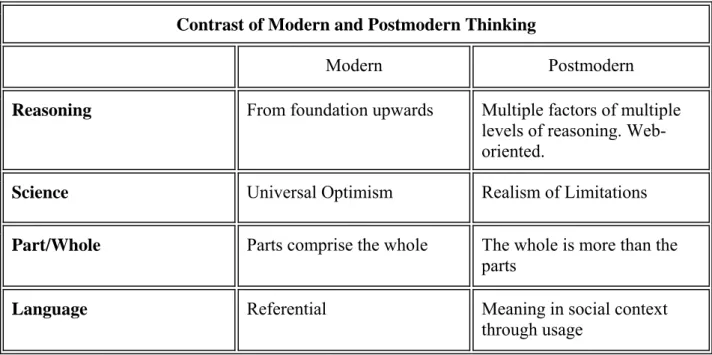
As it is stated above postmodernism rejects the objective knowledge as a thoroughly trustful guide for people and it questions anything having a certain description, border or value in our lives. Though the interpretations may naturally differ from one to another, the underlying ideas of modernism and postmodernism can be roughly summarized as below:
Contrast of Modern and Postmodern Thinking
Modern Postmodern
Reasoning From foundation upwards Multiple factors of multiple levels of reasoning. Web-oriented.
Science Universal Optimism Realism of Limitations
Part/Whole Parts comprise the whole The whole is more than the parts
Language Referential Meaning in social context
through usage
Table 1. Contrast of Modern and Postmodern Thinking excerpted from http://private.fuller.edu/~clameter/phd/postmodern.html, October 6, 2008
Postmodernism is generally understood as a philosophy which stands against modernism; however, it seeks for ways to improve its premises and established concepts. Although it seems to have rejected science, postmodernism actually refuses the scientific approach that has been taken through years as such that shapes our worldview. It indeed offers a new identity for scientific, cultural and religious establishments. While on one hand modernism deals with the results and the product, postmodernism is limitless focusing on the process.
Postmodernists, in essence, criticize concepts and erase distinctions with which modernists are comfortable. Connor emphasizes the points modernism makes to make a distinction between the two as below:
“The modern constitution arises out of the sense of the sharp separation of nature and culture, and out of the forms of knowledge they produced and are addressed by. Nature produces science, the knowledge of how things are in themselves. Culture produces the social sciences and the discourse of morality, politics, psychology, etc. Modernity is characterized by the belief that there is no relation between these two kinds of object or
between this two kinds of knowledge; indeed, by the requirement that they should be kept rigorously distinct” (Connor, 2004:7).
Postmodernists define modernism as a philosophy that fundamentally focuses on its support on objective knowledge which takes its roots from objective reality that is accepted as occurring to different people in the same way. Modernists claim that there is an obtainable knowledge by the self owing to the fact that reason can acquire this objective knowledge whose reliability and validity are and can be proven. Furthermore, this knowledge is a product of the human mind produced by the reason of the mind. However, postmodernists reject the idea that there are truths obtainable by the mind. Truths are only stories created in the mind of individuals changing according to their backgrounds, experiences and as a result their mental schemas. The thing that can be more important to be considered may be their claim that even these schemas are shaped by the established values of a certain culture or they are pleasing a particular society. Thus each society’s meaning making values and processes are different than others. In that sense it is not possible for them to talk about any kind of objective knowledge, because language cannot represent what we call as reality, the world is not accessible to us through the use of this transparent language and therefore knowledge arises out of our direct experience of reality…(Bertens, 1995).
While postmodernism rejects truths valid for the majority, by the same token, it also denies grand narratives that try to make sense of the world. Instead postmodernists believe that there are mini-narratives accepted by a particular society owing to the fact that they are localized, situational and impermanent having no relation with universality or such totalizations.
Another aspect that makes modernism and postmodernism different is their idea of language. Postmodernism claims that language is a self-explanatory system which means it is actually transparent. It has been accepted as a truth for years in terms of linguistics that the relationship between the signifier and the signified is clear which means that signifiers always aim at the signifieds. Nevertheless, because
postmodernism repulses a steady, grounded reality, it also comes into conflict with the relationship between the signifier and the signified. That is, the signified is out of question which means that there is only the signifier to be mentioned. Bertens (1995:6) states “language constitutes rather than reflects”. This leads us to the concept of knowledge owing to the fact that it is also interpreted in different ways from the points of the two terms. In postmodernism it is believed that knowledge is created, stored and interpreted differently than modernists do. In such modernist societies knowledge is associated with objective reality, that is, science. While postmodernists believe in narrations which are localized and institutionalized, modernists refuse it by claiming that narration is unreasonable and rudimentary and that “knowledge is always distorted by language, the historical circumstances and the specific environment” (Bertens 1995:6). Similarly, modernism promotes the idea that ‘knowledge is for its own sake’, that is, one can gain the necessary knowledge and can change his/her point of view, way of life and so educate him/herself. On the contrary, postmodernism puts emphasis to the function of it. People have education in order not to gain the necessary knowledge but to use them where necessary. Thus, postmodernism deals with the abilities one has through knowledge and how s/he uses it.
As a final thought modernism and postmodernism can be differentiated from each other in several points, however, it should be kept in mind that postmodernism is not totally an opposite term to modernism but it is the continuation of it, which tries to improve the things that modernism presents by enlarging their borders.
2.2.2. Postmodernism and Reality
At the very centre of postmodernism there is skepticism about the existence of external reality. It is not acceptable for postmodernists that there can be truths welcomed by many people, contrarily; there one can mention about only socially constructed truths. If this is the case, then postmodernism naturally questions West’s essential philosophies which include taken-for-granted concepts in the framework of culture, morality and science. Due to the fact that all realities are socially and
culturally constructed there cannot be permanent, fixed truths but only assumption of them.
Postmodern philosophers and historians inquire cultural identities and the representation of history in terms of reality and they think that history does not reflect what really happened, on the contrary, they see history as a narrative of what happened. Many postmodernist historians assert that people can access history only in narrative form. There arises the difference between fact and fiction. Postmodernists erase the difference between the two. They think that there cannot be a necessary connection between words and things, subject and object, signifier and signified. For this reason, all the discourses claimed to be explaining truth, such as history, has no greater connection to its referent than fiction. Thus, they claim that history and fictional narratives only substitute for reality. Barry states that:
“…what is usually known as ‘the loss of the real’, that is, a loss of the distinction between real and imagined, reality and illusion, surface and depth. Within postmodernism, the distinction between what is real and what is simulated collapses: everything is a model or an image, all is surface without depth....” (Barry, 1995:89)
As it is supported above what postmodernists claim is that people invent stories to make sense of the world and explain what has been going around them. For them, it is clear that they are just the representations of reality rather than realities themselves. It is even more complicated that these representations differ according to the culture they were born in. Thus, owing to the fact that belief systems and narratives may vary and people define their own, realities may be various in numbers and styles, too. For postmodernists, reality is obviously situational that may change according to cultural conditions and characteristics. Furthermore, it also shows differences according to the voices and communities which are defined by their experiences and their histories. Marshall states that:
“Postmodernism is about history. But not the kind of ‘History’ that tells us think we can know the past. History is in the postmodern moment becomes histories and questions. It
asks: Whose history gets told? In whose name? For what purpose? Postmodernism is about histories not told, retold, untold. History as it never was. Histories forgotten, hidden, invisible, considered unimportant, changed, eradicated. It is about the refusal to see history as linear, as leading straight up to today in some recognizable pattern-all set for us to make sense of. It is about chance. It is about power. It is about information. And more information. And more. And. And that’s just al little bit about what postmodernism is” (Marshall, 1992:4).
It is claimed by postmodernists that people can never leave their cultural luggage that has been shaped beginning from the time they were born. People are all what they have in their minds. What postmodernist points out eventually is that the way we perceive anything in the world and the world itself is influenced by our upbringings, experiences and the culture we were born in. The possible conclusion then is the impossibility of being objective about anything and the rejection of totalitarian, rationalist modernist approaches which hold objective and exact knowledges to be true.
2.2.3. Postmodernism and Education
Education may be simply described as the way we understand not only our relations and ourselves but also the way we experience and change the world. What is more it has been always regarded as “a key role in the forming and shaping of subjectivity and identity so that subjects become fully autonomous and capable of exercising their individual and intentional agency, bringing out the inherent potential to become self-motivated and self-directing” (Usher and Edwards, 2006:24-25).
Upon considering the modernist and postmodernist views on education, one can conclude that these ideas belong to the modernist doctrines. Owing to the fact that according to modernism education verifies and concerns the ideals of enlightenment, reason, and individuality, it makes human beings free to decide and therefore people can shape their way of life, thoughts, attitudes and their own course
However, it should be noted that education does not only deal with the reason, the free-will and the individuality of humans, but also power, dominance and their being organized and institutionalized. To put it in another way, the goal of education is to give a shape to the direction of peoples’ lives. Yet, it is not a one-way process but rather depends on a mutual interaction. It means that while it forms our way of lives, it is also affected by itself and the powers it creates. The important thing here is that although people are seen as the ones that can shape their own way of thinking they are managed by the powers in a society. These powers are so neutralized that people can never feel their existence and mostly reject that their mental operations are under the control of some things, what postmodernists call as socially constructed values and powers in a culture. Anything we see as ours may be only a kind of perception for postmodernists, even our interpretations, thoughts, decisions. Therefore, education is a tool that shapes us and makes us what we are supposed to be by seeming as our own choice although education, itself, is also shaped by other powers neutralized in our daily lives.
A different standpoint may be the one which sees education as something clearing the otherness away and creating sameness in a way. According to Usher and Edwards education is:
“…a manifestation of violence insofar as it attempts to reduce difference, contingency, provisionality and play to one in the same. Education is a site where meanings are reduced to a single, determinate meaning, where otherness is brought under the control of reason and difference is reduced to sameness.” (Usher and Edwards, 2006:139)
Such a concept putting objectivity, neutrality and scientific production into question and the education which places people into a same order, puts the very possibility of knowing and individual interpretation deeply into question. However, as Beck states:
“It would be just an exaggeration, to maintain that because the self is limited, conditioned, and contingent in this way it has no significance, identity, or capacities. Individuals may be no more important than cultures, but neither are they less so. Individuals
are just as unified and characterizable as communities, and they have considerable (though not unlimited) capacity for self-knowledge, self-expression, and self-regulation. There is no basis for emphasizing culture or community to the neglect of individuals.” (Beck, 5)
What should be considered is that, though it seems a little ambiguous and changing and though it puts emphasis on possibilities rather than facts and certainties, postmodern education gives way to individuality in the interpretation of texts which shows various needs and experiences. Authenticity must be put at the very center of the class because we no longer seek for the truths and/or certain knowledges. The idea is to participate into and contribute to the knowledge-making process. Considering that mental schemas, therefore interpretations and aims may change from one to another, students are supposed to be a part of the creation of the information. In the end there occur the individual stories and personal products which let students make the most of what they have in their minds and realize themselves. In that sense Usher and Edward emphasize experiences student have in education by saying that “Experience is most often accorded importance as the ‘authentic’ representation and voice of the individual. Experiential learning has been constructed as a progressive and emancipatory movement within education” (Usher and Edwards, 2006:187).
This leads to the idea that education cannot be kept under universally acceptable objectives pre-determined by powerful institutions. Contrarily, the objectives of education and accordingly its processes should be more various. It should free itself from repressive and strict voices which should replace itself by accepting, unprejudiced and progressive voices to make learners encourage to experience their ‘self’. Peters emphasizes this progressive voice as below:
“And knowledge will not be exteriorized with respect to the “knower” and the status of learner and the teacher is transformed into a commodity relationship of “supplier” and “user”: Knowledge is not and shouldn’t be produced in order to be sold, and be consumed in order to be valorized in a new production” (Peters, 1995:28).