Selçuk J. Appl. Math. Selçuk Journal of Vol. 9. No.1. pp. 31-47 , 2008 Applied Mathematics
An integrated approach for fuzzy set based part—machine cell forma-tion
Yakup Kara1, Turan Paksoy1, Ching-Ter Chang2
1Selçuk University, Department of Industrial Engineering, Campus 42031, Konya,
Turkey
e-mail: tpaksoy@ yahoo.com
2National Changhua University of Education, Department of Information
Manage-ment, Changhua, Taiwan, ROC Received : January 14, 2008
Abstract. The nature of cell formation is imprecise and uncertain which is fuzzy rather than crisp and/or random. The binary part—machine incidence matrix fails in reflecting the real world conditions such as design features, part demands, machine capacities and routing data. Using the non-binary part-machine incidence matrix, the relationships between parts and part-machines can be represented by fuzzy membership values based on the alternative process plans and machine capacity limitations. This paper presents an integrated approach for fuzzy set based part—machine cell formation. The proposed approach em-ploys a fuzzy binary integer model and is capable of determining process plans of parts and fuzzy membership values in the non-binary incidence matrix consider-ing part demands and machine capacities. The proposed approach is illustrated and tested on a numerical example. Results show that the proposed approach is valid and capable of reflecting real world conditions.
Key words: Fuzzy set theory; Binary fuzzy goal programming; Alternative process plans; Cell formation; Cellular manufacturing.
1. Introduction
Cellular Manufacturing (CM) is one of the most innovative manufacturing par-adigms where the entire manufacturing system is decomposed into several sub-systems which are called as manufacturing cells. CM has been seen as an effi-cient environment for the efforts to improve flexibility and efficiency. Increasing flexibility and efficiency are achieved by transforming batch-type production to line-type production. In CM, parts with similar processing requirements are grouped into part families and processed by corresponding machine cells to
achieve the potential benefits of these similarities. Some benefits of CM include simplified material flows, faster throughput, reduced setup times, reduced in-ventory, better control of the shop floor and increased quality (Chu, 1997). The first step in CM applications is the formation of part families and machine cells. This step is called as Cell Formation (CF) in the literature. CF problem has received a great deal of attention and many procedures have been developed to solve this problem. Chu (1989) classified these procedures into six categories: a) array-based methods; b) hierarchical methods; c) non-hierarchical methods; d) mathematical programming formulations; e) graph-theoretic approaches; and f) other heuristic methods. Detailed survey and analysis of these procedures can be found in the review papers of Singh (1993), Selim et al. (1998), Sarker (1999), Yin and Yasuda (2006) and Balakrishnan and Cheng (2007).
Most CF procedures use the binary part-machine incidence matrix which rep-resents the operational relationships between parts and machines, consists of 0 and 1 values, where = 1 means that part i is processed on machine
and = 0 otherwise. However, the binary part-machine incidence matrix fails
in reflecting the real world conditions such as design features, part demands, machine capacities and routing data. In real world applications, alternative process plans, part demands, machine capacities and other factors can influence the structure of CF problem. These factors make the nature of CF problem imprecise and uncertain which is fuzzy rather than crisp and/or random. Fuzzy set based approaches are appropriate to handle imprecise and uncertain envi-ronments. According to Xu and Wang (1989) and Chu and Hayya (1991) the relationships between parts and part families and machines and machine cells do often not satisfy the binary classification logic. In order to overcome this issue, fuzzy logic can be applied to CF problem. There are several studies that adopted the fuzziness to CF problems.
Xu and Wang (1989) used fuzziness to define the relationships between parts and part families and machines and machine cells. They formed part families and machine cells based on the design features of parts and employed the fuzzy c-means algorithm to solve the CF problem. A simplified version of the Xu and Wang (1989)’s approach was presented by Chu and Hayya (1991) who used the binary part-machine incidence matrix to represent the production routing data. Based on the Chu and Hayya (1991)’s approach, fuzzy c-means algorithm was modified by several researchers including Gindy et al. (1995), Masnata and Settineri (1997), Susanto et al. (1999), Josien and Liao (2000), Lozano et al. (2002) and Li et al. (2007).
The above methodologies employing the fuzzy c-means algorithm use the bi-nary part-machine incidence matrix. However, in practice, a part shape can be processed by alternative machines with different levels of efficiency and process-ing times which can be specified by the degree of appropriateness for alternative machines. On the other hand, a part can be routed through the same ma-chine for different operations. The specification of alternative mama-chines for an operation can be useful in choosing other machines in case of lack of capacity and breakdowns. The non-binary part-machine incidence matrix based on the fuzzy set theory can be used to represent the relationships between parts and
machines. The relationships can be expressed by membership values, which are the degree of appropriateness that a part will visit the corresponding machine (Leem and Chen, 1996).
To the best knowledge of authors, there are two studies that use the non-binary incidence matrix based on the fuzzy set theory. Zhang and Wang (1992) used non-binary part-machine incidence matrix to represent the relationships be-tween parts and machines with fuzzy membership values. They applied the non-binary incidence matrix to single linkage and rank order clustering algo-rithms. Leem and Chen (1996) proposed a similarity coefficient based fuzzy clustering algorithm which uses non-binary incidence matrix and routing data. These two studies focus on forming cells with the objective of minimizing the sum of exceptional values under the assumption of the non-binary incidence matrix of the problem is known. However, determination of fuzzy membership values in the non-binary incidence matrix is a crucial issue before solving CF problem. There is no study dealing the construction of non-binary incidence matrix before solving CF problem.
The main goal of this study is to develop an integrated approach for fuzzy set based part—machine cell formation that determines the process plans of parts considering part demands and machine capacities, calculates the degree of ap-propriateness between parts and machines, constructs the non-binary incidence matrix and finally solves the CF problem. The proposed approach consists of five steps and in the second step; it uses the Binary Fuzzy Goal Programming (BFGP) methodology developed by Chang (2007) to determine the fuzzy mem-bership values. To determine the process plans of parts and fuzzy memmem-bership values under the restriction of part demands and limited machine capacities, a binary integer formulation is developed and solved using the Chang (2007)’s BFGP approach.
The remainder of the paper is organized as follows: Fuzzy set theory and Chang (2007)’s BFGP approach are introduced in Section 2. The proposed integrated approach is presented in Section 3. An illustrative example is solved in Section 4. Consideration of fuzzy machine capacity constraints in the proposed BFGP model is introduced in Section 5. Concluding remarks are given in Section 6. 2. Fuzzy Set Theory and Binary Fuzzy Goal Programming
2.1. Fuzzy set theory
In classical set theory, the characteristic function of a crisp set assigns a value in binary terms to each element in the universal set according to a crisp condition – an element either belongs or does not belong to the set. On the contrary, fuzzy set theory generalizes this function and permits the gradual assessment of the membership of elements in relation to a set; assigns values to the elements of the universal set fall within a specified range, this is determined by the help of a membership function. Larger values denote higher degrees of set membership (Klir and Yuan, 1995).
Fuzzy sets are an extension of classical set theory since, for a certain universe, each membership function () maps all elements to either 1 or 0, as in the classical notion. Specifically, a fuzzy set ( ˜) on a classical set is defined as follows (Ross, 1995):
˜
= { ( ())| ∈ }
Fuzzy set theory has been successfully applied to a vide variety of fields such as manufacturing, computer systems, robotics, electronics, transportation systems, consumer products, and many other industrial control systems. This study presents a new application of fuzzy set theory in manufacturing.
2.2. Chang (2007)’s BFGP approach
The concept of Goal Programming (GP) was developed by Charnes and Cooper (1961). A general GP model for the aspiration level set of the goals ( = 1,
2, . . . , ) can be formulated as the following achievement function: (GP) Minimize P =1 ¡ + + −¢ Subject to () − = + − −, = 1 2 ∈ (F is a feasible set), + − ≥ 0, = 1 2 ,
where += max (0 () − )and −= max (0 − ())are referred to as
deviational variables. + is the positive deviation from the target of goal ; − is the negative deviation from the target of goal (Ignizio, 1982; Winston, 1993).
Fuzzy Goal Programming (FGP) involves applying the fuzzy set theory to GP and allows decision makers to define “naturally” goal values for his/her decision making problems such as “somewhat larger than”, “substantially lesser than” or “around” the value goal . The FGP can be expressed as follows (Narasimhan,
1980): (FGP)
A solution set is obtained for FGP that let be the aspiration level of th
objective,
()& (or(). ), = 1 2
Subject to ∈ , ( is a feasible set)
where()& (.) indicates the th fuzzy goal approximately greater than or
equal to (approximately less than or equal to) the aspiration level . Then,
using Zimmermann (1978), the FGP can be formulated as follows: Maximize
Subject to − (() ≤ 0, = 1 2 )
∈ (F is a feasible set)
where is an additional continuous variable; (())is a membership function
(()) = ⎧ ⎨ ⎩ 1 if () ≥ ()− − if ≤ () ≤ for ()& 0 if ≤ (()) = ⎧ ⎨ ⎩ 1 if () ≤ −() − if ≤ () ≤ for (). 0 if () ≥
where and are, respectively, lower and upper limits for the th goal.
In the pioneering paper, Chang (2007) proposed a method for BFGP. The math-ematical formulation of the BFGP is given below:
() : The function of resource constraints for the th goal = 1 2
: Binary decision variable for the th goal ( = 1 2 ); its behavior
(i.e., 0 or 1) is bounded by ();
(BFGP)
() & (or() . ) = 1 2
Subject to ∈ , ( is a feasible set)
∈ () = 1 2
Chang (2007) proposed the following model to solve the above BFGP problem: Minimize −, = 1 2 Subject to ()− + − − + = 1, = 1 2 for ()& , − ()+ − − + = 1 = 1 2 for (). , ∈ (F is a feasible set) ∈ () = 1 2 where =−1 , = , = −1 and =
In the BFGP model given above, the negative deviational variables − vary between 0 and 1 and indicate the level of achievement of the goals. If the under deviational variable − equals to 1, it indicates the zero achievement of the membership value of the goal. If − is 0 then it indicates the full achievement of the membership value of the goal.
3. The Proposed Approach
The proposed approach is capable of constructing the non-binary part — machine incidence matrix while determining the parts’ process plans under crisp or fuzzy capacity limitations. The proposed approach integrates the real world aspects of CF problem and consists of the following steps:
Step 0 Read data of the production system that will be switched to CM system. These data include parts, operations, alternative machines, operation times, machine capacities and part demand rates.
Step 1 Apply the production data to the BFGP model presented below. Solve the BFGP model of the problem using Chang (2007)’s approach to obtain the degree of appropriateness (fuzzy membership values) between parts and ma-chines.
Step 2 Construct the non-binary incidence matrix including fuzzy membership values.
Step 3 Solve the CF problem using any suitable algorithm that is able to use non-binary data to determine the machine cells.
Step 4 Assign each part to a machine cell which gives the largest sum of member-ship values for the corresponding part (maximum utilization rule). Calculate the performance measures (number of exceptional values (NEV) and sum of exceptional values (SEV)).
To obtain the degree of appropriateness (fuzzy membership values) between parts and machines in Step 1, the following BFGP model is developed:
The BFGP Model
Giventhe following data; set of parts set of operations set of machines
completion time of operation of part on machine
annual capacity of machine
annual demand of part
setofoperationsofpart
set of machines that can process operation of part
set of operations of part that can be processed on machine
find;
1, if operation of part is allocated to machine ; 0, otherwise
− under achievement of the goal + over achievement of the goal which; Minimize = P ∈ P ∈ − subject to: X ∈ X ∈ ≤ ∀ ∈ X ∈ X ∈ = 1 ∀ ∈ ∀ ∈
X
∈
. 0 ∀ ∈ ∀ ∈
The first constraint of the above model assures that the sum of processing times of operations allocated to a machine can not exceed the capacity of this machine. The second constraint assures that each operation is assigned to at least and at most to one machine.
The last fuzzy constraint is defuzzified using the Chang (2007)’s linearization method as follows: − X ∈ + −− + = 1 ∀ ∈ ∀ ∈
The above defuzzified constraint determines the operations allocated to a ma-chine and calculates the degree of appropriateness (membership values) between parts and machines according to the assignments. In this constraint, we would like to make all − be 0, some of which are met and some not because these fuzzy goals are subject to the first two constraints. Hence, a fuzzy goal can be fully achieved, level achieved or not achieved completely that is some − values will be 0, some of which will be between 0 and 1, and some of which will be 1. Aiming at the minimization of the sum of −values in the objective function makes such allocations that maximize the number of operation times of part that can be processed on a machine. The right hand side value defines the aspiration level of the goal ( = 0). Upper limit of the goal () is the sum
of operation times that can be processed on the corresponding machine related to the constraint.
For instance, suppose there are three different operations of Part A and these operations can be processed on three alternative machines. Machine 1 can process operation 1, 2 and 3 of Part A with the operation times of 5, 4 and 6 minutes respectively. Machine 2 can process operations 1 and 3 of Part A with the operation times of 4 and 5 minutes respectively. Machine 3 can process operations 1 of part A with the operation time of 6 minutes. Fuzzy constraints for Part A can be expressed as follows:
Fuzzy equations for Part A:
5111+ 4121+ 6131. 0 (fuzzy constraint for machine 1)
4112+ 5132. 0 (fuzzy constraint for machine 2)
6113. 0 (fuzzy constraint for machine3)
These fuzzy equations are defuzzified using Chang (2007)’s linearization method. For example, fuzzy equation for machine 1 is defuzzified as follows:
−151(5111+ 4121+ 6131) + −11− +11= 0
−033111− 027121− 04131+ −11− +11= 0
−033111−027121−04131+−11− +
11= 0 (defuzzified constraint for machine 1)
−044112−056132+−12−+12= 0 (defuzzified constraint for machine 2)
−113+−13− +
13= 0 (defuzzified constraint for machine 3)
If all operations of Part A that can be operated on machine 1 are allocated to machine 1 then the negative deviational variable −11 will be 1. If no operation is assigned then −11 will be 0. The value of −11 is depended on the amount of work allocated to the machine 1. Minimizing the sum of −11+ −12+ −13forces model to assign as much as operations of Part A to the minimum number of machines. For this example, the minimum value of the sum of −11+ −12+ −13is 1. This value is obtained when all operations of Part A are allocated to machine 1. Thus, no operation of Part A will be allocated to machines 2 and 3 and both −12 and −13 will be 0.
4. Illustrative Example
In this section, in order to demonstrate the validity and effectiveness of the proposed approach, an illustrative example is presented. Suppose there are 9 different parts which have a total of 12 different operations that can be processed on some of 7 alternative machines. The annual demands of parts are supposed as follows: 1=2,000, 2=3,000, 3=5,000, 4=2,000, 5=4,000, 6=3,000,
7=5,000, 8=1,000 and 9=6,000 units/year.
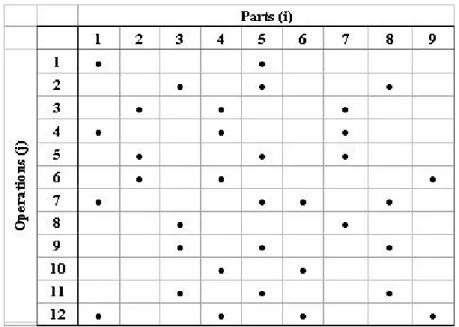
The part-operation relationship matrix shows the operations of parts and is assumed as given in Figure1 below:
The operations of parts can be processed on different machines with different levels of processing times. The operations of parts and their processing times (minutes) on alternative machines are given in Appendix. Annual capacities of machines are assumed to be equal and 96 000 minutes/year.
Solution:
The step-by-step solution of the example problem is given below: Step 0 Read the above production data.
Step 1 Apply the above example to the proposed BFGP formulation given in Section 3 and solve the model.
The example problem is solved using LINDO (Schrage, 2002) and the objective function value is found as 13.19. In the optimal solution, allocations of opera-tions (where=1) obtained and the Annual Work Loads (AWL) of machines
based on the allocations are given in Figure 2.
Figure 2. Operations of parts allocated to machines
Figure 2 shows the process plans of parts. According to Figure 2, for example, part 1 will be processed on machine 1 for operations 4, 7, and 12; and will be processed machine 3 for its operation 1.
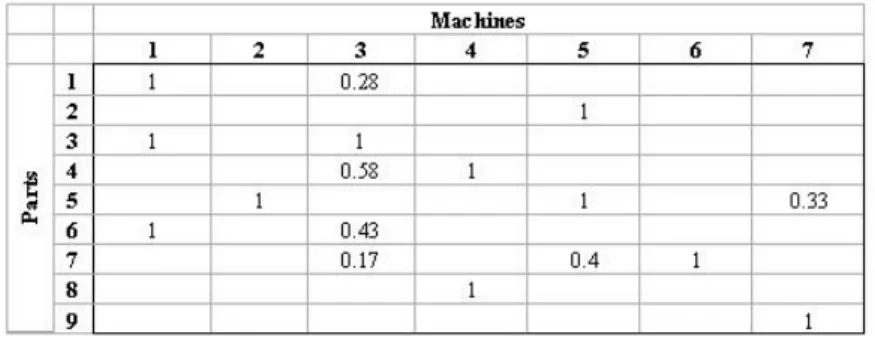
In the optimal solution, the negative deviational variables (part-machine appro-priateness values) are found as follows: −11 =1, −13 = 0.28, −25 =1, −31 = 1, −33 =1, −43 =0.58, −44 =1, −52 =1, −55 =1, −57 =0.33, −61 =1, −63 =0.43, −73 =0.17 −75=0.4, −76=1, −84=1, −97 =1, and all the others are 0.
As mentioned above, part 1 will be processed on machine 1 and machine 3. According to the part-machine membership values obtained for part 1, it belongs to the machine cell to which machine 1 is assigned, with the membership value 1. On the other hand, it belongs to the machine cell to which machine 3 is assigned,
with the membership value 0.28. Therefore, it can be said that assigning part 1 and machine 1 to the same cell is preferred more than that of machine 3. Step 2 Construct the non-binary incidence matrix. Using the membership values obtained in the previous step, the non-binary part-machine incidence matrix is constructed as shown in Figure 3.
Figure 3. The non-binary incidence matrix
Step 3 Solve the CF problem using any suitable algorithm to determine the machine cells. We employed the Fuzzy ART neural network algorithm of Suresh and Kaparthi (1994) to solve the CF problem. The Fuzzy ART neural network approach yielded two machine cells. The machines 1, 3 and 4 are assigned to cell 1 while the others are assigned to cell 2.
Step 4 Assign each part to a machine cell which gives the largest sum of mem-bership values for the corresponding part. After assigning parts to the cells with maximum utilization rule, the arranged incidence matrix is as given in Figure 4:
The number of exceptional values (NEV) and the sum of exceptional values (SEV) are the measures of grouping efficiency in non-binary CF problems (Leem and Chen, 1996). For this example, the NEV value is 1 and the SEV value is 0.17. These measures show that the grouping efficiency is satisfying.
5. Considering Fuzziness in Machine Capacities
When using the proposed approach, we may not obtain feasible solutions due to the lack of machine capacity for some machines. However, in practice, to tackle this problem, we can consider machine capacities as fuzzy parameters (goals) and modify the capacity constraint of the proposed BFGP model as follows: With the following additional notation;
lower limit for the capacity of machine
upper limit for the capacity of machine
The fuzzy capacity constraint will be; X ∈ X ∈ ≤ ∼ ∀ ∈
The fuzzy capacity constraint is defuzzified using the Chang (2007)’s lineariza-tion method as follows:
− X ∈ X ∈ + − − + = 1 ∀ ∈
Then objective function of the model becomes as follows: Minimize = P
∈
P
∈
−+ −
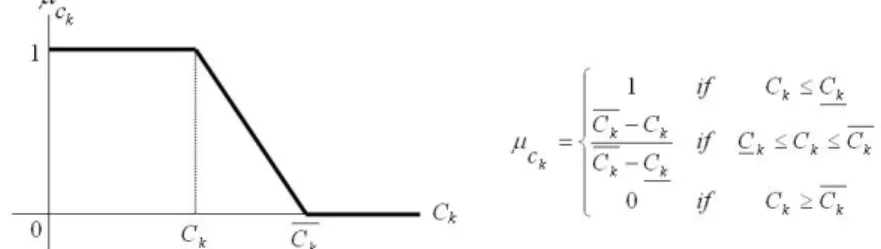
The membership function of machine capacity is depicted in Figure 5.
Figure 5. The membership function of machine capacity
For the example presented in the previous section, the following set of part de-mands requires using over capacities. 1=3,000, 2=7,000, 3=5,000, 4=6,000,
The lower limit of the annual machine capacities () is assumed 96,000 minutes/year
and that of upper limit () is assumed 140,000 minutes/year. Then, the
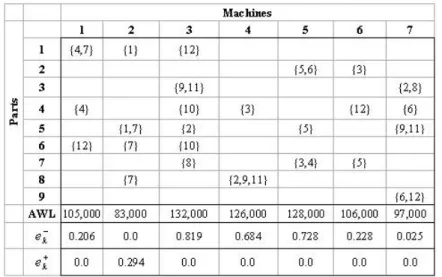
exam-ple problem with fuzzy capacities is solved using LINDO (Schrage, 2002) and the objective function value is found as 17.90. In the optimal solution, operation allocations (where=1) obtained, the AWL values of machines based on the
allocations and the values of deviational variables are given in Figure 6.
Figure 6. Operations of parts allocated to machines with fuzzy capacities
As shown in Figure 6, except from machine 2, the workloads of machines exceed the lower limit of capacity (96,000). The fuzzy goal for the capacity of machine 2 is fully achieved, so the value of −2 is 0. This means that the satisfaction level of this goal is 1 (full achievement). On the other hand, the fuzzy goals for other machines are partially achieved or not achieved completely. For example, the utilization of machine 3 capacity is 132,000 minutes that exceeds the lower limit by 36,000 minutes hence the satisfaction level is 0.181 (which is calculated as 1 —−3).
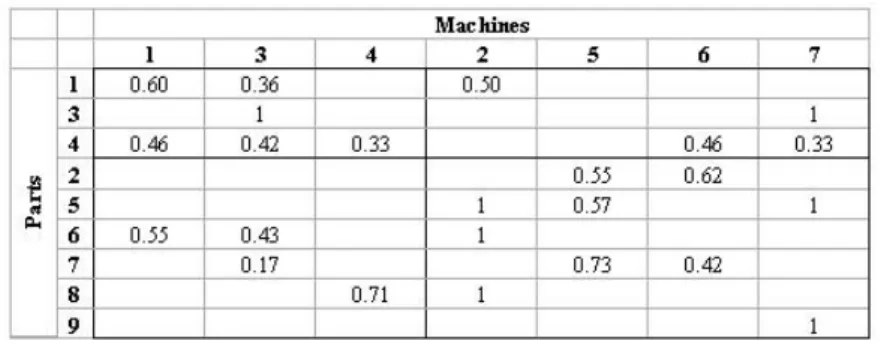
In the optimal solution, the negative deviational variables are found as follows: −11= 060 −12= 050 −13= 036 25− = 055 −26= 062 −33= 1 −37= 1 −41= 046 −43= 042 −44= 033 −46= 046 −47= 033 −52= 1
−55= 057 −57= 1 −61= 055 62− = 1 −63= 043 −73= 017 −75= 073 −76= 042 −82= 1 −84= 071 −97= 1and all the others are 0.
Using the same machine cell assignments in the previous solution, parts can be assigned to the machine cells according to the maximum utilization rule and the arranged non-binary matrix is obtained as given in Figure 7.
Figure 7. The arranged non-binary incidence matrix with fuzzy capacities
The performance measures of this solution is calculated as NEV = 8 and SEV = 4.15. If the initial non-binary part-machine incidence matrix is resolved using the Fuzzy ART neural network and new machine cell assignments are obtained, the grouping performance will probably be improved. When compared the results of crisp capacities and fuzzy capacities, it can be seen that more negative deviational variables took value in fuzzy capacity condition.
6. Conclusions
The cell formation problem is generally can be considered as fuzzy rather than crisp and/or random. Most approaches developed for this problem use the binary part—machine incidence matrix which fails in reflecting the problem spe-cific conditions such as design features, part demands, machine capacities and routing data. Although the non-binary part-machine incidence matrix is more successful in reflecting the cell formation problem, it is rarely used in the liter-ature.
In this paper, we investigate the cell formation problem with non-binary part-machine matrix by considering alternative process plans and part-machine capacities under fuzzy environment. A binary fuzzy goal programming is demonstrated and a four steped algorithm is developed to obtain a solution for this type of fuzzy environment. In order to show the ability of the proposed approach, an illustrative example is tried to solve by taking into acoount alternative process plans. Results show that the proposed approach is valid and capable of reflecting real world conditions. The extension of the proposed approach using stochastic demand rates can be considered as further research.
References
1. Balakrishnan, J., Cheng, C. H., 2007, Multi-period planning and uncertainty is-sues in cellular manufacturing: A review and future directions, European Journal of Operational Research, Volume 177, Issue 1, 281-309.
2. Chang, C. T., 2007, Binary fuzzy goal programming, European Journal of Opera-tional Research, 180 (1), 29-37.
3. Charnes, A., Cooper, W.W., 1961, Management Model and Industrial Application of Linear Programming, vol. 1, Wiley, New York.
4. Chu, C.H., 1989, Clustering analysis in manufacturing cellular formation. OMEGA, 17, 289—295.
5. Chu, C.H., 1997, An improved neural network for manufacturing cell formation. Decision Support Syst., 20, 279—295.
6. Chu, C.H., Hayya, J.C., 1991, A Fuzzy Clustering Approach to Manufacturing Cell Formation, International Journal of Production Research, Vol. 29, No. 7, p. 1475-1487.
7. Gindy, N.N.Z., Ratchev, T.M., Case, K., 1995, Component Grouping for Group Technology Applications - a Fuzzy Clustering Approach with Validity Measure, Inter-national Journal of Production Research, Vol. 33, No. 9, p. 2493-2509.
8. Ignizio, J.P., 1982, Linear Programming in Single-Multiple Objective Systems, Prentice-Hall, Inc., New Jersey, 374-389.
9. Josien, K., Liao, T.W., 2000, Integrated use of fuzzy c-means and fuzzy KNN for GT part family and machine cell formation. Int. J. Prod. Res., 38(15), 3513—3536. 10. Klir, G. J., Yuan, B., 1995, Fuzzy Sets and Fuzzy Logic: Theory and Applications, Prentice Hall, New Jersey.
11. Leem, C.W., Chen, J.J.G., 1996, Fuzzy-set-based machine-cell formation in cellular manufacturing, J. Intel. Manuf., 7, 355—364.
12. Li, J., Chu, C. H., Wang, Y., Yan, W., 2007, An improved fuzzy clustering method for cellular manufacturing, International Journal of Production Research, 45, 5, 1049-1062.
13. Lozano, S., Dobado, D., Larraneta, J., Onieva, L., 2002, Modified fuzzy C-means algorithm for cellular manufacturing, Fuzzy Sets and Systems, 126, 23-32.
14. Masnata, A., Settineri, L., 1997, An application of fuzzy clustering to cellular manufacturing, Int. J. Production Research, 35(4), 1077—1094.
15. Narasimhan, R., 1980, Goal programming in a fuzzy environment, Decision Sci-ences, 11, 325-338.
16. Ross, T. J., 1995, Fuzzy Logic with Engineering Applications, International Edi-tion, McGraw-Hill, Inc., New York.
17. Sarker, B. R., 1999, Grouping efficiency measures in cellular manufacturing: a survey and critical review, International Journal of Production Research, Volume 37, Number 2.
18. Schrage, L., 2002, LINGO Release 8.0, LINGO System Inc.
19. Selim, H. M., Askin, R. G., Vakharia, A. J., 1998, Cell formation in group tech-nology: Review, evaluation and directions for future research, Computers & Industrial Engineering, Volume 34, Issue 1, 3-20.
20. Singh, N, 1993, Design of cellular manufacturing systems: An invited review, European Journal of Operational Research, Volume 69, Issue 3, 284-291.
21. Suresh N.C., Kaparthi, S., 1994, Performance of Fuzzy ART neural network for group technology cell formation, International Journal of Production Research, 32(7), 1693-1713.
22. Susanto, S., Kennedy, R.D., Price, J.W.H., 1999, A new fuzzy-c-means and as-signment technique-based cell formation algorithm to perform part-type clusters and machine type clusters separately, Prod. Plan. & Cont., 10(4), 375—388.
23. Winston, W.L., 1993, Operations Research- Applications and Algorithms, 3Ed., Duxbury Press, 775-783.
24. Xu, H.P., Wang, H.P., 1989, Part family formation for GT application based on fuzzy mathematics. Int. J. Production Research, 27(9), 1637—1651.
25 Yin, Y., Yasuda, K., 2006, Similarity coefficient methods applied to the cell for-mation problem: A taxonomy and review, International Journal of Production Eco-nomics, Volume 101, Issue 2, 329-352.
26. Zhang, C., Wang, H.P., 1992, Concurrent formation of part families and machine cell based on the fuzzy set theory. J. Manuf. Syst., 11(1), 61—67.
27. Zimmermann, H. J., 1978, Fuzzy programming and linear programming with several objective functions, Fuzzy Sets and Systems, 1, 45-55.
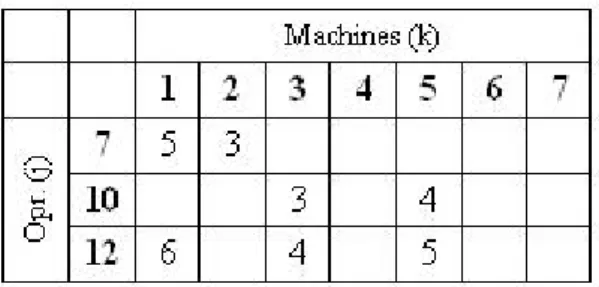
Appendix. Operation data for the illustrative example
Table A1. Operation data for part 1 (=1)
Table A3. Operation Data for Part 3 (=3)
Table A4. Operation Data for Part 4 (=4)
Table A6. Operation Data for Part 6 (=6)
Table A7. Operation Data for Part 7 (=7)
Table A8. Operation Data for Part 8 (=8)