HOW THE ENERGY MARKETS STEER ECO-POLITICAL RELATIONS BETWEEN THE STATES? AN ANALYSIS FOR TURKISH-RUSSIAN
TENSION IN THE CONTEXT OF ENERGY MARKETS.
VEDAT ATEŞ 115674012
ISTANBUL BILGI UNIVERSITY
GRADUATE SCHOOL OF SOCIAL SCIENCE
DEPARTMENT OF INTERNATIONAL POLITICAL ECONOMY
In Partial Fulfillment of the Requirement for the Degree Master of Arts
International Political Economy
Academic Advisor: Mehmet Ali Tuğtan 2017
iv
Acknowledgement
I would like to thank to my great supervisor Assistant Prof. Mehmet Ali Tuğtan and Cem Deniz Kut for their valuable contributions, comments and supports. I would also like to thank the members of thesis jury; Professor Mitat Çelikpala, and Assoc. Prof. Emre Erdoğan for their valuable contribution and recommendation.
I would like to thank Tarık Yurtoğlu & H. Çiler Keskin for tolerating me at work during this study.
Thanks also to my parents Gülperi Ateş, Yaşar Ateş and my sister Pınar Ateş for their love and trust.
v To my wife
vi
Table Of Contents
1. INTRODUCTION ... 1
1.1. Objective & Limits of Thesis ... 6
1.2. Methodology of Thesis ... 8
1.3. Organization of the Thesis ... 8
2. CHAPTER 1: THEORETICAL FRAMEWORK ... 10
2.1. Main Arguments of Neo - Institutional Liberalism... 13
2.1.1. Cooperation ... 14
2.1.1.1. Definition of Cooperation ... 14
2.1.1.2. Conditions of Cooperation ... 18
2.1.1.3. Pay Off Structure: Mutuality of Interest ... 18
2.1.1.4. Shadow of the Future ... 20
2.1.1.5. Number of Actors: Sanctioning Problem ... 21
2.1.2. Interdependence in World Politics ... 23
2.1.2.1. Definition of Interdependence ... 24
2.2. Complex Interdependence Theory ... 25
2.2.1. Main Characteristics of Complex Interdependence. ... 27
2.2.1.1. Multiple Channels ... 27
2.2.1.2. Absence of Hierarchy among Multiple Issues ... 28
2.2.1.3. Minor Role of Military Force ... 29
2.2.2. Sensitivity and Vulnerability Concepts ... 30
2.2.3. Political Process of Complex Interdependence ... 31
2.2.3.1. Goals of Actors ... 31
2.2.3.2. Agenda Formation ... 32
2.2.3.3. Transnational and Transgovernmental Relations ... 33
2.2.3.4. Roles of International Organizations ... 33
3. CHAPTER 2: ECO-POLITICAL OVERVIEW OF TURKEY AND THE RUSSIAN FEDERATION ... 36
3.1. Economic Outlook of Russian Federation and Turkey (1999-2017) ... 37
vii
3.1.1. Economic Outlook of Turkey ... 44
3.2. Foreign Policy Strategies of Turkey & Russian Federation ... 47
3.2.1. Turkish Foreign Policy ... 48
3.2.2. Russian Foreign Policy ... 52
3.3. Turkish - Russian Political Relations ... 54
3.3.1. Russo-Georgia War and Position of Turkey ... 55
3.3.2. Ukrainian Crisis, Crimea Annexation and Position of Turkey ... 56
3.3.3. Western Sanctions to Russian Federation and Position of Turkey ... 58
4. CHAPTER 3: CASE STUDY, AS AN ECONOMICAL ISSUE, HOW DO NATURAL GAS AND OIL TRADE STEER ECO-POLITICAL RELATIONS BETWEEN TURKEY & RUSSIAN FEDERATION? ... 61
4.1. Political Process of Turkish - Russian Interdependence ... 62
4.1.1. Syrian Civil War and State’s Positions. ... 63
4.1.2. Warplane Crisis & Formation of Agenda ... 65
4.1.3. Minor Role of Military Power in Turkish – Russian Relations ... 69
4.1.4. Russian Sanctions Against to Turkey ... 70
4.1.5. Interdependence Analysis for Turkish - Russian Relations ... 71
4.2.Turkish - Russian Economic Relations in Terms of Vulnerability and Sensitivity 72 4.2.1.Turkish - Russian Interdependence in Terms of Natural Gas and Oil Trade ... 80
4.2.1.1. Oil Trade ... 80
4.2.2. Turkish Stream Project ... 81
4.2.3. The Effect of Natural Gas Trade in Turkish – Russian Relations ... 83
viii Figure list
Figure 1.Harmony Cooperation and Discord ... 17
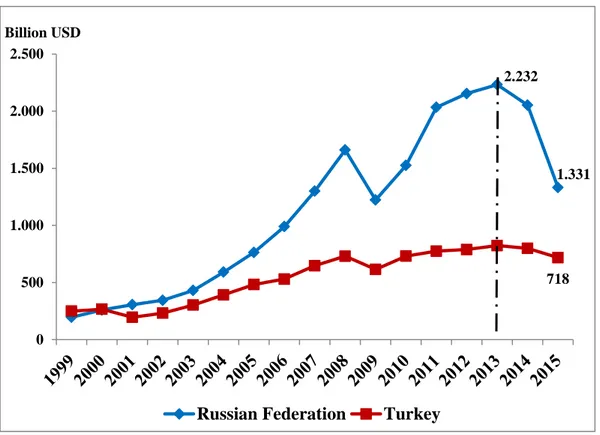
Figure 2. Trend Analysis for Turkey and Russian Federation by GDP (Current USD) ... 38
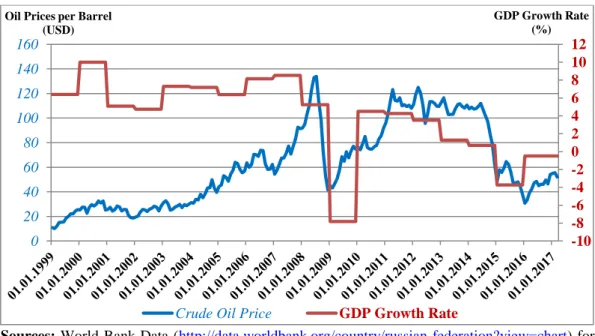
Figure 3. Russian Economy by Oil Prices & GDP Growth Rate ... 40
Figure 4. Russian Economy by National Currency and Inflation Rate ... 43
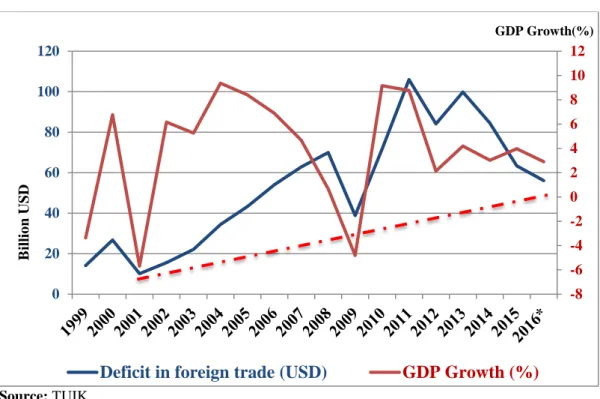
Figure 5. Deficit in Turkish Foreign Trade and GDP Growth of Turkey ... 45
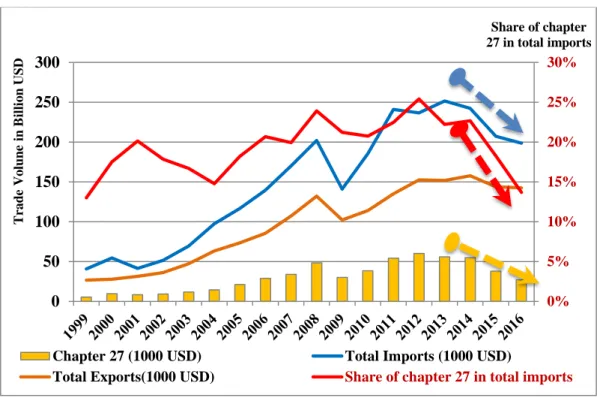
Figure 6. Effect of Energy Imports in Turkish Foreign Trade Deficit ... 46
Figure 7. Imports of Turkey by Country ... 72
Figure 8. Export of Turkey by Country ... 73
Figure 9. Turkish - Russian Bilateral Trade ... 74
Figure 10. Share of Turkey in Russian Foreign Trade ... 76
Figure 11.Turkish Tourism & Russian Visitors ... 78
Figure 12. Crude Oil Import of Turkey ... 80
Figure 13. Turkish Stream Pipeline Route ... 82
Figure 14. Natural Gas Import of Turkey ... 84
Figure 15. Russian Share in Turkish Natural Gas Consumption ... 86 Figure 16. Percentage Distribution of Natural Gas Sales by Gazprom in Country Basis . 88
ix ABSTRACT
This thesis aims to study the how the energy markets (natural gas and oil trade) steer eco-political relations between the states in the context of complex interdependence theory. In this respect, Turkish – Russian interdependence is chosen as case study since it contains both military security and economic issues. In order to figure out the influence of energy markets in this interdependence, natural gas and oil trade is analyzed by cooperation and conflict periods. In this regard, as a military security issue warplane crisis and Russian economic sanctions against to Turkey are explained in details to demonstrate how bilateral cooperation transformed into conflict. Although Turkish – Russian relations come to a state of conflict, cooperation was kept in natural gas and oil trade. At this point, this thesis asks why Russian economic sanctions against to Turkey missed out the natural gas and oil trade? And why Russian Federation didn’t weaponize natural gas while Turkey is asymmetrically dependent to Russian natural gas? And the last question, what is the role of natural gas and oil trade in Turkish – Russian relations after the warplane crisis?
In order to answer all these questions, this thesis analyzed how Russian economy became vulnerable after 2014. In addition to low oil prices, western sanction declared against to Russian Federation after the Ukrainian crisis in 2014 that negatively affected the Russian Federation in terms of economy and politics. Under these circumstances, Russian Federation deterred from any conflict with Turkey in terms of natural gas trade as Turkey is the second top importer of Russian natural gas.
Therefore, this thesis argues how natural gas trade –as an economic issue- provides a channel for actors to maintain cooperation in case of conflict. Additionally, this thesis demonstrated that Russian Federation is also dependent to Turkish natural gas demand as Turkey is dependent to Russian natural gas. By this way, this thesis proved that natural gas trade steers bilateral relations by generating complex interdependence between actors.
x ÖZET
Bu tez, enerji piyasalarının (doğalgaz ve petrol ticareti) devletler arası eko-politik ilişkilere nasıl yön verdiğini karşılıklı bağımlılık çerçevesinde incelemeyi amaçlamaktadır. Bu bağlamda, hem askeri güvenlik hem de enerji piyasaları anlamında ekonomik hususları içinde barındımasından dolayı, Türkiye – Rusya karşılıklı bağımlılık ilişkisi vaka çalışması olarak seçilmiştir. Enerji piyasalarının bu karşılıklı bağımlılığa olan etkisini anlayabilmek adına doğalgaz ve petrol ticareti, işbirliği ve kriz zamanlarını kapsayacak şekilde, analiz edilmiştir. Bu doğrultuda, savaş uçağı krizinin ve Rusya tarafından Türkiye’ye karşı ilan edilen ekonomik yaptırımların ikili işbirliğini nasıl bir krize dönüştürdüğü detaylıca açıklanmıştır. Türk – Rus ilişkileri kriz halini almasına rağmen doğalgaz ve petrol ticaretinde var olan işbirliği sürdürülmüştür. Bu tez, Rusya’nın ilan ettiği yaptırım kararlarının neden dolayı doğalgaz ve petrol ticaretini kapsamadığını sormaktadır. Ayrıca, Rus doğalgazına asimetrik bir şekilde bağımlı olan Türkiye’ye karşı Rusya neden doğalgazı silah olarak kullanmamıştır? Savaş uçağı krizi sonrasında doğalgaz ve petrol ticareti Türk – Rus ilişkilerinde nasıl bir rol oynamıştır?
Bu sorular kapsamında her iki devlet ekonomik ve politik olarak analiz edilmiştir. Bu kapsamda, 2013 yılından sonra düşük seyreden petrol fiyatlarının petrol ve doğalgaz ihracatına dayalı büyüyen Rus ekonomisini kırılgan hale getiriği, ayrıca 2014 yılındaki Ukrayna krizi sonrasında, batının Rusya’ya uygulamış olduğu yaptırımların Rusya’yı ekonomik ve politik anlamda zayıflattığı, bu şartlar altında Rusya’nın, Rus doğalgazının en büyük ikinci ithalatçısı olan Türkiye ile doğalgaz ticareti açısıdan oluşabilecek krizden kaçtığı bu tez tarafından ileri sürülmüştür. Dolayısıyla bu tez, ekonomik bir unsur olarak doğalgaz ticaretinin kriz halinde olan aktörlere aralarındaki işbirliğini koruma açısından nasıl bir kanal sağladığını, ayrıca, Türkiye’nin Rusya doğal gazına bağımlı olması kadar Rusya’nın da Türkiye’de bulunan enerji piyasasınına bağımlı olduğunu göstermiş ve doğalgaz ticaretinin aktörler arasında karşılıklı bağımlılık sağlamak suretiyle ilişkilere yön verdiğini kanıtlamıştır.
1 1. INTRODUCTION
Energy had a major role in international relations starting from 1970’s as it is a significant key factor for the sustainability of global markets because of its low elasticity. Today, countries are more sensitive to energy sources in in term of having productive and sustainable economy with low cost. Therefore, sustainable energy became more essential than in the past. Countries which have energy sources could use it as a source of negotiation or political weapon. For this reason, energy could be used as a gun in international arena. But on the other side, energy as an economic tie could attribute to cooperation between energy exporting and importing countries.
In this respect, energy supply and demand could help us to understand international relations in a world connected by multinational and transnational actors and channels. As the secretary –general of 13th World Energy Forum affirms that energy is one of the most significant issues in terms of connecting international actors and generates interdependence between states1 Therefore, considering energy as an economic issue would contribute a new dimension to interpretation of international relations.
Energy markets present a vast scientific study field. For this reason, this thesis will be limited in natural gas and oil trade. Furthermore, energy issues are generally studied by security perspective in international relations but this thesis considers natural gas and oil trade as an economic issue in the context of neo-institutionalist assumptions. In this sense, energy security issues such as routes of pipelines will not be considered in this study. Theoretical framework of this study will be based on neo – institutional liberalism’s arguments that promote this study to the economic side of energy markets.
1Aldo Flores Quiroga, “The Challenge of Energy Interdependence and the Global Energy Dialogue”, 13th International Energy Forum, 2012,.pp.8-9.
2
The reason why this thesis is focus on economic and political issues together is highly related to rising importance of economic issues in terms of international relations. Because twenty-first century is interpreted as a period of open, rule – based international system in the presence of emerging problems while economic and security interdependence is quietly rising. Moreover, following multilateral rules and being in cooperation with other states are vital for international relations while global economic system becomes more independent than in the past. As a result of interdependence, states seek for multilateral cooperation in economic issues. States may disagree on the process of cooperation but they try to avoid any breakdown in multilateral order.2 In this context, addressing the theoretical debates will make easier to understand the progress in interpretation of international relations since the 2nd World War.
In this regard, realist theories were widely accepted for interpretation of international relations after the 2nd World War up to 1970s when International Relations studies were dominated by realist theory and its arguments. Cuban Missile Crisis and Vietnam War made this dominance disappear. However realist theory and its arguments were consolidated after 1945 -when national interest concept were at its peak- events such as Cuban Missile Crisis (1962) changed the interpretation of “national interest” Cuban Missile Crisis was an important challenge to realist theory. Another major challenge to realist theory emerged after Vietnam War which could also be accepted as the second major challenge to realism since this war directed authors to reinterpret the balance of power notion in international relations. This war contained inequality as sides of the war were not equal in terms of economic and military power. Unexpected victory of Vietnam against to USA was an important milestone for realist assumptions as this war demonstrated how a weak armed state beat the stronger one.3 Furthermore, after 1970s, the World was not as in 1940s, since economic issues
2G. John Ikenberry, the Future of the Liberal World Order, Foreign Affairs, May/Jun2011, Vol. 90, Issue 3, p.5.
3Evren Çelik Wiltse, Editor; Evren Balta, Küresel Siyasete Giriş, Uluslararası İlişkilerde Kavramlar, Teoriler, Süreçler, “Liberalizm, İşbirliği, Kolektif Güvenlik ve Neoliberal Kurumsalcılık”, p.138.
3
and actors got more importance. Especially, the oil crisis starting after the 1973 OPEC (Organization of Petroleum Exporting Countries) oil embargo has been a major signal for the power of economic issues in international relations.
According to Ole R. Holsti realism is a heterogeneous school of thought which describes states are unitary actors guided by national interest and their actions are usually counter to foreign actors more than domestic ones. In realist view, the power rivalry between states leads to security dilemma because states want to have absolute power that leads the others in insecure situation. On the other side, Keohane and other neo-institutionalist liberals made a counter-argument to realist affirmation. Holsti underlines that the neo-institutionalist liberal models (Global-Society, Complex Independence and Liberal Institutionalism) criticize the notions like war/peace and nation-state of realists. Holsti emphasizes that these models shows how multiple actors are effective in international relations besides the states. Moreover, these models consist of economic issues such as trade, energy, health, immigration to explain international relations.4
In this regard, complex interdependence is one of the most significant affirmations of neo – institutional liberalism. According to Nye and Keohane, there are three main characteristic of complex interdependence; multiple channels, multiple issues and minor role of military issues. Especially, complex interdependence theory will be explained in details in order to realize how economic issues dominate political agenda. As a result of this transformation, transnational actors play a larger role than ever which demonstrates why non-state actors are key factors that should be considered in international studies.5 It should be well underlined that this thesis focuses on complex interdependence theory but international institutions and domestic politics are neglected as Turkish – Russian interdependence is considered by the wiev of sensitivity and vulnerability.
4
Ole R. Holsti, "Theories of international relations" Explaining the History of American Foreign Relations, Second Edition, January 1, 2004, pp.51-90.
5Robert O. Keohane and Joseph S. Nye, Power and Interdependence: World Politics in Transition Little Brown and Company, 1977, p.256.
4
Neo – institutional liberalism concentrates usually economic and political issues together while realist are tended to study military security issues and wars.6 The main argument of neoliberal institutionalism will be explained under the theoretical framework title but it could be affirmed that main arguments of neoliberal institutionalism are significant to realize the effect of energy markets on international relations.
Russett and Oneal claim that bilateral commerce may affect the political stake while economic actors influence political ones and relativity is important factor to understand the bilateral relation. Therefore, sides should be analyzed in comparative scale in a bilateral economic relation. Authors’ suggestion is likely smaller country will be more incentive to avoid any conflict case because of its weak (dependent) position:
“(…) We must calculate the value of trade relative to the size of a nation’s economy, usually as measured by its gross domestic product (GDP). Presumably, the smaller country will have more incentive to avoid the costs of conflict with the bigger country than vice versa.”7
In this regard, Turkish - Russian bilateral trade becomes the subject of this thesis as Turkey imported 55 % of her total natural gas consumption from Russian Federation in 2015. In this context, this thesis will analyze the Turkish dependency to Russian Federation in terms of natural gas trade. Natural gas trade between Turkey and Russian Federation is regulated by long-term contracts. Turkey and Russian Federation have signed an intergovernmental agreement in September 18, 1984 which was used as a base for long-term natural gas contract. The first delivery of Russian natural gas to Turkey was in June 1987 in the
6
Robert Jervis, Realism, Neoliberalism, and Cooperation: Understanding the Debate, International Security, Vol. 24, No. 1 (Summer, 1999), pp. 42-63.
7Bruce Russett, John R. Oneal, Triangulating Peace, “Democracy, Interdependence and International Organizations”, W.W. Norton & Company, 2001, pp. 125-155.
5
context of a long-term contract signed in February1986. This contract was for 25 years and the capacity was 6 billion m³ per year.8
In 1996, another long-term contract was signed for 8 billion m³ per year. After 2003, Russian natural gas was delivered to Turkey by the Blue Stream Pipeline. And the contractual basis for this trade was signed in December 15, 1997. The maximum capacity for this pipeline is 16 billion m³ per year. Turkey became dependent to Russian natural gas after the Blue Stream Project. At this point, It should be well emphasized that Turkish – Russian natural gas trade contains energy security issues such as the route of pipelines and the political effects in decision making process. In order to respect the limit of the thesis, I will not discuss the route of pipelines. In this regard, Blue Stream Project will not be discussed in details.
The literature on Turco-Russian relations focuses on the military security issues such as PKK problem, Chechen problem, Turkish straits and recently Syrian War. The Warplane crisis is one of these military security issues that appeared in November 2015 which assigns a different meaning to recent Turkish–Russian relations, since the Russian Federation announced a number of economic sanctions and restrictions against Turkey in response to a military crisis. These sanctions and restrictions constitute an example for the importance of economic issues in international relations. Moreover, Warplane crisis demonstrates strongly the intersection of politics and economics in international relations.
Russian Federation has an energy-based economy. For this reason, Russian Federation is quite sensitive to energy prices. One hand, low energy prices influence negatively Russian economy. On the other hand, Russian Federation could benefit from the advantages of possessing energy sources as a weapon for its foreign policy. According to Fiona Hill, high oil prices made Russian Federation a significant actor in global strategic and economic map thanks to its energy resources that substitute the Red Army in many diverse crises such as the
8
6
Ukraine crisis or the Georgian War.9 By the time, Turkey is dependent to Russian natural gas since her energy resources are not enough to balance energy supply and demand. According to Pamir, Turkey is deeply dependent on Russian Federation in terms of energy. Meanwhile, the tension between these countries has increased because of warplane crisis. Turkey could search for other energies from wind, water or sun. But these researches need huge exploratory that requires a big budget and developed infrastructure. Therefore, any move of Turkey for diversifying its energy resources could be named as long-term solution while Turkey is still depended to Russian Federation in short term.10
1.1. Objective & Limits of Thesis
Energy is one of the most vital subjects in this age that is a significant key factor in many cooperation and many conflicts. However energy issues became more apparent in international relations after 1970s, it was considered in terms of security issues through the international relations studies. But, energy is also part of trade, especially bilateral foreign trade which makes energy to be considered in economic dimension through the energy markets. Therefore, the aim of the study is to show the role of the energy markets in the international relations. this thesis tries to argue how the energy markets shape the bilateral relations. For this reason, the main research question of this thesis is “how the energy markets steer eco-political relations between the states?”
Reasearch question will be replied through Turkish - Russian relations in the context of energy markets. Turkey consumed 265.724,4 GWh and produced 261.783,3 GWh of electrical energy in 2015. The striking point appears when the breakdown of electricity production is analyzed as Turkey produces 99.218, 7
9
Fiona Hill, Energy Empire, Oil Gas and Russia’s Revival, The Foreign Policy Centre, September 2004.
10
7
GWh of electrical energy from the natural gas. It could be seen that natural gas is quite important for Turkish economic dynamics as natural gas means 38 % of total electricity production of Turkey. At this moment, this thesis drills down to natural gas trade.11
Turkey consumed 48 billion m³ natural gas in 2015 and could produce just 0,84 % of her total consumption in 2015. For this reason, Turkey imported nearly 99 % of her total natural gas consumption and the Russian Federation is the top natural gas exporter as Turkey imports 55 % of her gas consumption from this country. Analyzing all these numbers, this thesis put forward the importance of Russian Federation for Turkish energy markets. Moreover, this situation presents an asymmetry in Turkish - Russian interdependence that will be analyze in details by this study in order to understand how an energy issue affect international relations.12
Turkish – Russian relations is a vast study domain that should be well limited in the beginning of our thesis in order to increase the effectiveness of our case study. In this respect, Turkish – Russian relations will be analyzed in the context of interdependence theory. At this point, this thesis asks why Russian economic sanctions against to Turkey missed out the natural gas and oil trade? And why Russian Federation didn’t weaponize natural gas while Turkey is asymmetrically dependent to Russian natural gas? And the last question, what is the role of natural gas and oil trade in Turkish – Russian relations after the warplane crisis? In order to find appropriate answers to our research question and sub-questions in an effective way we will make a point of limiting the discussion domain related to our thesis arguments.
11
http://www.teias.gov.tr/FaaliyetRaporlari.aspx
12
8 1.2. Methodology of Thesis
In this thesis, the research question investigates economic issues in the basis of international relations. In order to explain the effect of energy markets in international relations energy will be considered as an economic issue by the help of neo-institutionalist concepts. Besides, the complex interdependence theory will help us to clarify our theoretical explanation. Especially, the delicate balance between cooperation and conflict will be studied through a case study.
To discover the effect of energy market in international relations our main method will be a case study of Turkish – Russian bilateral relations. Political and economic issues will be analyzed in terms of sensitivity and vulnerability dimensions that will help us understand the interdependence between these countries. Moreover, we will make trend analyze for Turkish - Russian bilateral trade by focusing on energy issues such as oil and natural gas trade to understand the role of energy issues in Turkish - Russian interdependence.
In this respect, the methodology of this thesis would contain two explanations as qualitative for political relations in terms of warplane crisis and quantitative for economic relations in terms of natural gas trade. In order to explain recent Turkish Russian political relations library sources, academic studies and newspapers will be used while Turkish Russian economic relation will be explained through the quantitative data based on reports and statistics, governmental data organizational researches .
1.3. Organization of the Thesis
This thesis is composed of three chapters in addition to introduction and conclusion parts. In the first chapter of the thesis, the theoretical framework will be explained by the definition of concepts such as cooperation, conflict or interdependence that belongs to neoliberal institutionalism. And in the following
9
part of the chapter the complex interdependence theory will be introduced through its main characteristics due to fact that the rising role of economic issues in international relations will be discussed to understand the recent developments that are related to our thesis argument. All of these explanations about the theoretical framework will provide us an academic path to analyze the effect of energy markets in international relations. Furthermore, this theoretical background would provide an academic basis to analyze Turkish - Russian bilateral relation in terms of political tension and energy trade.
In the second chapter of the thesis, Turkey and Russian Federation will be described through trend analysis. In addition to this, Turkey and Russian Federation will be introduced through their foreign policies and economic outlooks. All information given in this chapter will enable readers to understand economic and political positions of Turkey and Russian Federation by this way the interdependence exist between states could be analyzed in many dimensions in the case study.
In the third chapter of the thesis, a case study will be examined in terms of complex interdependence theory which aims to reveal the effect of energy markets in international relations. For this reason, Turkish - Russian bilateral relations will be studied in terms of economic partnership and recent political issues. In this regard, energy market issues such as Turkish Stream Project, natural gas and oil trade will be the studied through a trend analysis while warplane crisis will be discussed to reveal the political side of this bilateral relation. After this analysis, lecturers will be able to understand the interdependence degree between Turkey and Russian Federation in terms of bilateral trade especially in energy issues that would serve to reveal how energy issues steers Turkish - Russian bilateral relations.
10
2. CHAPTER 1: THEORETICAL FRAMEWORK
Neo - institutional liberalism is a school of thought in international relations studies developed after 1970’s which attributed economic and political way of thinking in terms of international relations. This school of thought contains counter arguments to neorealism’s assumptions. The debate of counter arguments put forward by both schools’ representatives named as neo-neo debate. This debate consists of some significant arguments that are mainly about absolute gain vs. relative gain, absence of hierarchy among issues vs. dominance of military security issues in setting of agenda. In order to explain effectively the theoretical framework of the thesis, I will not mention this debate in details. Instead, my strategy in this chapter will be explaining briefly the main arguments of neo - institutional liberalism in a clear order.
Neo - institutional liberalism has its proper arguments and concepts in order to understand and explain international relations such as cooperation, interdependence and complex interdependence. All of these concepts will be introduced in a descriptive way in this chapter. Before describing concepts and arguments of neo – institutionalist theory, a brief explanation would make it easy to understand the extent of neo-institutionalists’ assumptions.
In Twenty Years of Institutional Liberalism (2012), Robert O. Keohane emphasizes the importance of institutions:
“The world has now experienced what could be regarded as 20 years of Institutional Liberalism: the dominance of the view that cooperation in world politics can be enhanced through the construction and support of multilateral institutions based on liberal principles”13
Moreover, he continues his sentences by stressing the social purpose of Institutional Liberalism:
13Robert O. Keohane, 20 Years of Institutional Liberalism, Princeton University, International Relations, 2012, p. 125.
11
“The social purpose of Institutional Liberalism is to promote beneficial effects on human security, human welfare and human liberty as a result of a more peaceful, prosperous and free world.”14
Keohane makes a generalization over institutional liberals all around the world about their main arguments. According to Keohane, power might be used for interest of people and liberal values. But this usage of power should be restraint. Additionally, institutions are significant actors in order to establish cooperation because they serve for social purpose in terms of sustaining cooperation. Consequently, cooperation enhances the common interest for actors and institutions are supporters in this gain chain.15
In After Hegemony (1984), Keohane outlines the main assumptions of neo-institutional liberalism by explaining under what conditions cooperation might be formed. Keohane affirms that hegemony depends on certain kind of asymmetrical cooperation. According to him, theory of hegemonic stability is fatalism. And Keohane offers that the non-hegemonic cooperation is also possible.16 As it is known, the promise of neo - institutional liberalism was criticized by many authors as did Mearsheimer. In the article, the False Promise of International
Institutions, he affirms that institutions have minimal effect on state behavior and
on stability in a post-cold war world. Furthermore, he affirms:
“(…) Institutions are basically a reflection of the distribution of the power in the world. They are based on self-interested calculations of great power, and they have no independent effect on state behavior.”17
As it is declared by Mearsheimer, realists perceive the governments in the center of issues and neglects the role of nongovernmental issues. In this sense, realist
14Ibid., p.126.
15Ibid., p.127. 16
Robert O. Keohane, After Hegemony, Cooperation and Discord in the World Political Economy, Princeton, NJ: Princeton University Press, 1984, p.51.
17John J. Mearsheimer, "The False Promise of International Institutions", International Security, Vol. 19, No. 3, Winter 1994/95, p.7.
12
believes that institutions have minimal influence in state’s behavior which are not an important cause of the peace.
A responsive article was written by Robert O. Keohane and Lisa Martin in 1995 in order to reply Mearsheimer’s assumptions. In this article, authors stressed that the arguments alleged by Mearsheimer describe the fallacious logic of realism. According to Keohane and Martin, neo-institutional liberalism subsumes realism. Both authors claim that governments would invest to institutions when they will benefice the advantages of cooperation since transactions between states might be costly. In this context, institutions reduce these costs and facilitate the intergovernmental operations. In brief, institutions contribute to occurring and maintaining of cooperation between governments.18
Interdependence and Cooperation are two major concepts of neo-institutional liberalism. I will explain dependence and interdependence concepts in details. Especially, the “complex interdependence” theory will be considered in detail. in this sense, it would be better to ask if trade relation deters states from initiating the conflict?
As a response to these questions Solomon W. Polachek says that states are deterred from initiating conflict against their trading partners for fear of losing the welfare gains associated with trade.19 Polachek bases his view on microeconomic theory to illustrate the possibility of a relationship between international trade and conflict. Another author, Katherine Barbieri, investigates the effect of trade interdependence on the peace.
According to Katherine Barbieri, trade ties facilitate interstate peace: “Peace through trade is most likely to arise among dyads composed of mutually
18
Robert O. Keohane, Lisa L. Martin, The Promise of Institutionalist Theory, International Security, Vol. 20, No.1, Summer 1995, p.50
19Polachek, Solomon W., 1980. 'Conflict and Trade', Journal of Conflict Resolution, vol. 24, no. 1, March, pp. 57-78.
13 dependent trading partners.”20
She also underlines that extreme interdependence might be the reason for a potential conflict.
In “Hegemony and After”, Keohane claims that multilateral institutions have significant role to form cooperation. Therefore, policymakers invest in institutions. He explains the importance of multilateral institutions as below:
“Leadership is exercised most effectively by creating multilateral institutions that enable states to share responsibilities and burdens. Such institutions may not always succeed in their objectives or eliminate disagreements among their members, but they make cooperation easier and reduce the leader’s burdens which is why policymakers in Washington and many other capitals have invested so much effort for so many decades in creating and maintaining them.”21
2.1. Main Arguments of Neo - Institutional Liberalism
In this chapter, my intention is picking up two major concepts of neo - institutional liberalism which are “cooperation and complex interdependence”. I will firstly explain cooperation with its conditions. Secondly, I will define the concept of interdependence. By the way, “complex interdependence” theory will be explained through its main characteristics which are multiple actors and their goals, agenda formation, transnational and transgovernmental relations, minor role of military security issues.
20Katherine Barbieri, Economic Interdependence: A Path to Peace or a Source of Interstate Conflict?, Journal of Peace Research, Vol. 33, No. 1 (Feb., 1996), pp. 29-49.
14 2.1.1. Cooperation
Neo-institutional liberalism considers governmental and non-governmental actors in the context of cooperation and conflict to explain international relations. As Helen Milner indicates Cooperation among nations has become the focus of a wide range studies in the past decade.22
Duncal Snidal stressed out that realists’ tendency to cooperation is negative in compare with institutionalist scholars. Snidal underlines that realists, since Thucydides, believe that cooperation is difficult under anarchy as states are looking for their relative gains. But he also declares that realists couldn’t design a model of relative gains. For this reason, author offers a relative gains hypothesis and describes relative gains with two states in the context of game theories (prisoners’ dilemma, chicken, stag hunt). Snidal argues that relative gains have no effect in case number of actors increase.23
The common points among neo-institutionalist scholars could be grouped in two clusters. First cluster presents definitions of cooperation and the second cluster is made of the propositions that are focused on under what conditions cooperation could be possible. In the light of this clustering performed by neo-institutionalist scholars, I will firstly clarify what is cooperation and what is not. Secondly, I will investigate what are the conditions that affect cooperation.
2.1.1.1.Definition of Cooperation
Kenneth A. Oye defines that the international system is anarchic in which nations live. There is no authority that imposes limits on the pursuit of sovereign interests. This situation makes different outcomes emerge so that state’s relation marked by
22
Helen Milner, International Theories of Cooperation Among Nations, Strengths and Weaknesses, (Cambridge University Press, World Politics, Vol.44, No.3 Apr. 1992), pp.466-472.
23Duncan Snidal, Relative Gains and the Pattern of International Cooperation, The American Political Science Review, Vol. 85, No. 3 (Sep., 1991), p.701.
15
war, arm races, arm control, trade wars, financial panics but also rescues. In brief; the absence of centralized international authority precludes attainment of common goals.24 Oye affirms that international system is non-hierarchic where anarchy reigns. In this system, states may bind themselves in the absence of an international authority despite the absence of any ultimate international authority. According to Oye, in a mutual relation both sides of the cooperation may gain. And he implies that cooperation with two actors is better than having more actors. Because, the achievement probability of cooperation decrease while number of actors rises. He explains that different type of game theories such as prisoners’ dilemma, stag hunt, chicken. Author focus on how actor may alter their choices in order to gain and not to drop worst position. Finally, cooperation is always under the shadow of future because cooperation is consistency of iterated game.25
In his book, After Hegemony, Keohane defines us what is cooperation by separating cooperation from other concepts like harmony. He describes cooperation by distinguishing it from harmony. Because, Harmony refers to a situation in which policies of actors are already facilitate the attainment of other actors’ goals. It means, there is no need for an adjustment of policy made by sides. Harmony designs such a situation that cooperation is unnecessary. On the other hand, Keohane defines cooperation in the basis of policy adjustment. He claims that actors adjust their actions with respect to actual or anticipated preferences of others by the way that cooperation could occur.26 For this reason, the policy adjustment of actors is significant in the basis of cooperation.
Harmony and cooperation might be interpreted as synonyms. But in theoretical basis these two concepts are well defined. In a work, Robert Axelrod and Robert Keohane define us cooperation by distinguished it from harmony. According to these authors cooperation is not equivalent to harmony because, harmony
24Kenneth A. Oye, Explaining Cooperation under Anarchy: Hypotheses and Strategies, Cambridge University Press, World Politics, Vol.38, No.1, 1985, pp.1-24.
25Ibid.
26Robert O. Keohane, After Hegemony, Cooperation and Discord in the World Political Economy, Princeton, NJ: Princeton: University Press, 1984, p.51.
16
demonstrates a total identity of interest while cooperation contains also mixture of conflicting interests.27
Helen Milner also considers game theories as key instruments to explain cooperation concept. Her emphasis is on the key role of game theories and the conditions that orient actors to cooperate. She also defines cooperation in terms of policy adjustment. According to Milner cooperation becomes possible when actors adjust their behavior to the actual or anticipated preferences of each other through policy coordination28. She offers us new concept “policy coordination” that means implies that the policies of each state have been adjusted to reduce their negative consequences for the other states.
In order to realize the extent of cooperation, defining “what is cooperation” is important as well as defining “what is not cooperation”. As Milner underlines Cooperation is usually opposed to competition or conflict.29 According to Keohane, the difference between cooperation and conflict should also be distinguished. They specify that cooperation does not mean the absence of conflict. Besides, cooperation occurs when actors perceive that their policies are actually or potentially in conflict. Cooperation does not mean either the potential conflict. But, conflict is a trigger for cooperation. Actors will be disposed to cooperate when conflict exist.30 In order to understand the neo-institutionalist explanation of international relations, the concept of cooperation has a key role as it shows adjustment strategies of actor.
27Robert Axelrod and Robert Keohane, Achieving Cooperation under Anarchy: Strategies and Institutions, Cambridge University Press, World Politics, Vol.38, No.1, 1985, p.226.
28
Helen Milner, Op. Cit., p.466. 29Ibid., p.466.
30Robert O. Keohane, After Hegemony, Cooperation and Discord in the World Political Economy, (Princeton, NJ: Princeton :University Press, 1984), pp.53-54.
17 Figure 1.Harmony Cooperation and Discord
Source: Robert O. Keohane, After Hegemony, Cooperation and Discord in the World Political Economy, Princeton, NJ: Princeton: University Press, 1984, p.53.
Keohane and Axelrod underline that achieving cooperation is difficult in world politics. Cheating and deception are endemic. It is inevitable to touch game theories while explaining the concept of cooperation. However, any detailed explanation of game theories represents subject of another work, determinant factors of cooperation should be considered in brief. In other words, I will not explain in details the features of game theory, its varieties, application to cases or its working rules while describing the cooperation concept.
18 2.1.1.2.Conditions of Cooperation
According to Milner, there is a consensus about the definition of cooperation and about what kind of situations constitutes it. The disagreement point among scholars is about the cause of cooperation. In their work, Axelrod & Keohane claims that:
“Three situational dimensions affect the propensity of actors to cooperate: Mutuality of interest, the shadow of the future, and the number of actors.”31
These three dimensions are valuable to understand cooperation. Kenneth Oye asks two main questions about the cooperation. The first one is about what circumstances favor the emergence of cooperation under anarchy? And the second one is about what strategies can states adopt to foster the emergence of cooperation by altering the circumstances they confront?”32
Oye tries to find out answers to show what kind of circumstances contribute to form cooperation? What are the obstacles in front of cooperation and the actors’ counter strategies to these obstacles? In respect to these questions, this part, I will investigate under what kind of conditions cooperation is possible?
2.1.1.3. Pay Off Structure: Mutuality of Interest
Payoff structure is a key point for cooperation in terms of mutuality of interest and actors’ preferences. I could say that payoff structure affects the future strategies of actors because cooperation is consist of mutuality of interest. Axelrod and Keohane argue that payoff structure determines mutuality of interests and it is not based on objective factors as it is based on the perceptions of the actors in terms
31Robert Axelrod and Robert Keohane, Op. Cit., p.228.
32Kenneth Oye, Explaining Cooperation under Anarchy: Hypotheses and Strategies, Cambridge University Press, World Politics, Vol.38, No.1, 1985, p.2.
19
of their own interests. Perceptions of the actors define also the interest concept. The degree of mutuality could be understood through defining the perceptions and preferences of actors. Therefore, the process by which interests are perceived and preferences determined should be well examined.33
Actors in mutual relation have their own background, dynamics and goals. There is not an objective formula for payoff structure in a mutual relationship. Therefore, it is significant to understand the perceptions of actors in order to explain the features of cooperation. By the way, in order to understand mutuality of interest, desires of actors should also be considered for a cooperation analysis. According to Kenneth Oye, cooperation is a situation that actors desire. Actors who want to be in a beneficial position prefer to be coherent so that they act coherently to each other and bind themselves through the cooperation. This desirable gain needs to be fed by the efforts of actors for constructing and maintaining the cooperation. Another discussion point is the altering of the payoff structure. According to Oye, there are three main strategies, “unilateral, bilateral and multilateral” for altering the payoff structure. 34
Unilateral Strategy is put forward by Robert Jervis35. According to Jervis in a relation the powerful actor which relatively has more defensive and offensive weapons in compare with its counterparts would be cautious in cooperation. This prudence of the stronger actor would prevent any surprise deception. In reverse, this prudence would limit the gains from the cooperation.
Oye criticizes unilateral strategies in term of altering pay off structures. He affirms that unilateral strategies are not able to present altering options to actors. In contrary to unilateral strategies, bilateral strategies can be used to alter payoff structure as they combine dissimilar games. He affirms that multilateral strategies offer two options to actors for altering payoff structure:
33
Robert Axelrod and Robert Keohane, Op. Cit., p.229. 34Kenneth Oye, Op. Cit., p.6.
35Robert Jervis, Cooperation Under Security Dilemma, World Politics, Volume 30, Issue 2(Jan.,1978), p.167-214.
20
“First, norms generated by regimes may be internalized by states, and thereby alter payoff structure. Second, information generated by regimes may alter states' understanding of their interests.”36
In “The Evolution of Cooperation” Robert Axelrod gives us an example to make concrete the concept of interest in cooperation between actors: He says:
”A good example of the fundamental problem of cooperation is the case where two industrial nations have erected trade barriers to each other’s exports. Because of the mutual advantages of free trade, both countries would be better off if these barriers were eliminated. But if either country were to unilaterally eliminate its barriers, it would find itself facing terms of trade that hurt its own economy. In fact, whatever one country does, the other country is better off retaining its own trade barriers. Therefore, the problem is that each country has an incentive to retain trade barriers, leading to a worse outcome than would have been possible had both countries cooperated with each other.”37
This explanation of Axelrod through the trade barriers shows us that perception about the self-interest is a key determinant for actors who are in cooperation process. For this reason, mutuality of interest is a significant issue which contributes to cooperation.
2.1.1.4. Shadow of the Future
Cooperation has its own dynamics such as payoff structure and numerous actors. Time is also a significant determinant of cooperation. An accord, a deception or a stake between actors present a picture, but cooperation is a video that is made of these pictures in a long time horizon. An accord or a stake of the present time would shape the decision, actions of actors for the future. But, cooperators know
36Kenneth Oye, Op. Cit., p.11.
21
that cooperation consists of an iterated game that present events and cases promote the future. Axelrod and Keohane argue that in a game such as prisoners’ dilemma, concerns about the future would serve to form cooperation. Neo-institutionalists investigate the concept of cooperation through game theory. As I declared, the goal of this chapter is not explaining the game theories in detail. If the game is known by the cooperators as iterated; sides of the game will be avoided from to cause defection since other actors would retaliate tomorrow. In this sense, actors would be more faithful and honest to each other in order to keep cooperation. This case is directly in relation with the shadow of the future’s nature. Consequently, Axelrod and Keohane accept “shadow of the future” as an effective promoter of cooperation.38
Transparency is another vital factor for maintaining cooperation. Oye underlines that defining both defector and cooperation are the keys for establishing cooperation in international arena. For this reason, lack of transparency and ambiguous definitions might limit the states to recognize cooperation.39An important critic is made by Robert Powell to “iterated game” concept put forward by neo-institutionalists. Powell criticizes neo-institutionalists in terms of weak explanation for repeated game explanation. He affirms that the “iterated game explanation” made by neoliberals is weak because change in state level is neglected. Powell underlines that in a repeated game every period take after each other hence neo-institutionalists explanation for iterated game is problematical. 40
2.1.1.5. Number of Actors: Sanctioning Problem
The structure of relationship between actors in cooperation has also impact on the ability of cooperation. At this point, reciprocity appears as an effective strategy to
38Robert Axelrod and Robert Keohane, Op. Cit., p.232. 39
O. Kenneth Oye, Explaining Cooperation under Anarchy: Hypotheses and Strategies, Cambridge University Press, World Politics, Vol.38, No.1, 1985, p.16.
40Robert Powell, Absolute and Relative Gains in International Relations Theory, The American Political Science Review, Vol. 85, No. 4 (Dec., 1991), p.1310.
22
induce cooperation between actors. As Keohane and Axelrod mention that there are three conditions in an effective reciprocity. These conditions could be ordered as below:
1. Players can identify defectors.
2. They are able to focus retaliation on defectors.
3. They have sufficient long-run incentives to punish defectors.41
These conditions of reciprocity show us a new concept named “defector” in the context of cooperation process. It is strongly underlined in neo - institutional liberalism that, defectors should be limited and eliminated in the process to form and maintain cooperation. “Sanctioning” is a probable solution for cooperators in order to eliminate defectors. Hence, cooperators are faced with number of actor problem. In other words, it is hard to identify the defector in a relation participated by many actors.
In order to maintain cooperation, identifying and sanctioning the defectors are two indispensable actions. In this sense, intention of cooperators becomes the determinant factor for the future of the cooperation. Furthermore, information and transparency of the game would make easy to find and punish the defectors. Lastly, the confidence of states would be one of the most significant determinants for maintaining the cooperation. Therefore, states must be able to monitor their counterparts’ actions by assuring them that any betrayal action would be responded. Lastly, actors in cooperation should be encouraged to punish defectors otherwise, sanctioning problem would arise.42 As a result, Sanctioning problem is an important determinant for the maintenance of cooperation. Defectors put at risk the compatibility of actors’ policy in the way of cooperation. If defectors can’t be sanctioned, cooperators would lose confidence to each other and cooperation might be unachieved.
41Robert Axelrod and Robert Keohane, Op. Cit., pp.232-234. 42Ibid., p.236.
23
As I told in this thesis, cooperation is an important concept to understand neo-institutional liberalism. Another concept is interdependence and relatively “complex interdependence theory”. In the second part of this theoretical framework explanation, I will consider complex interdependence theory starting by the concept of interdependence.
2.1.2. Interdependence in World Politics
Neo-institutionalists such as Keohane and Nye underline that “national security” was a slogan performed by American political leaders during the Cold War era. According to authors, national security symbolism was largely product of the Cold War and its persuasiveness was increased by realist analysis. This way of thinking made the national security concept as the most important vague in international relations. But, events such as USA’s reaction to Vietnam imbroglio, misuse of national security concept by Nixon in Watergate affair increased the importance of national security concept.
National security had to share its position as the prime symbol in the internationalists’ lexicon with “interdependence.”43
Once, the concept of
interdependence got its importance in international relations, political leaders started to use interdependence rhetoric so that interdependence appeared as a mitigating factor for conflicting actors and interests. In this respect, I will firstly define the concept of interdependence through the neo-institutionalist perspective. After, complex interdependence theory will be explained and discussed through its main chracteristics.
It should also be underlined that interdependence and conflict concepts should be considered together as Edward D. Mansfield and Brian M. Pollins refer to the relation between interdependence and conflict. These authors research the effects
24
of economic interdependence on political conflicts and they precise that there are two meaning of economic interdependence:
“First, a group of countries is considered interdependent if economic conditions in one are contingent on those found in the others, for example, if inflation in France quickly places upward pressure on German prices. Second, countries are considered interdependent if it would be costly for them to rupture or forego their relationship (…)”44
Morevover, these authors emphasize that recent studies in international relations studies have demonstrated the influence of interdependence on political tensions. In this regard, the effect of economic interdependence on political issues will be discussed in this thesis through Turkish - Russian economic interdependence and the warplane crisis.
2.1.2.1.Definition of Interdependence
In their pioneer book “Power and Interdependence”, Keohane and Nye firstly define dependence as “a state of being determined or significantly affected by external forces.”45 And then, they describe the meaning of interdependence as below:
“Interdependence most simply defined, means mutual dependence. Interdependence in world politics refers to situations characterized by reciprocal effects among countries or among actors in different countries.”46
There are two major issues in this definition, Firstly, the strict sense of interdependence refers to the mutual dependence definition. Secondly, in a broad
44
Edward D. Mansfield and Brian M. Pollins, Economic Interdependence and International conflict, New Perspectives on an Enduring Debate, The University of Michigan Press, 2003, p.11. 45Robert O. Keohane and Joseph S. Nye, op.cit., p.7.
25
sense interdependence is defined as reciprocal effects among actors. Another author, Katherine Barbieri also defines interdependence by differentiating it from dependence: “Interdependence generally implies relations of mutual need and, by extension, mutual vulnerability between actors, while dependence denotes asymmetrical relations.”47
These simple definitions of dependence and interdependence designs us the difference between these close concepts. For instance, actors A and B are in a dependence relation, A is dependent to B means B determines the state of beings for A. And A is not free to move in case B is reluctant about A’s action. But, if there was an interdependence relation between A and B actors would be connected to each other. There will not be an unilateral determination by one actor about another one as interdependence presents mutual dependence. In other words, actions and reactions of actors would be reciprocal that is what Keohane and Nye defend.
It should also be underlined that an interdependence relation may be asymmetric. There might be advantageous and disadvantageous actors in a mutual dependence as interdependence hasn’t got objective international rules. At this point this thesis asks: “Who gets what in a mutual dependence?” If interdependence doesn’t imply a pure symmetry between actors, what kind of issues shape the asymmetry in interdependence? In order to find satisfying answers I will consider complex interdependence theory in many dimensions.
2.2. Complex Interdependence Theory
Complex interdependence theory was introduced by Keohane and Oye to international relations studies. In “Power and Interdependence”, Keohane and Oye present us an ideal type that they call “complex interdependence”. In relation
47Katherine Barbieri, Economic Interdependence: A Path to Peace or a Source of Interstate Conflict?, Journal of Peace Research, Vol. 33, No. 1, Feb. 1996, p. 33.
26
to this ideal type there is a great debate as international relations scholars call “neo-neo debate”. This debate might be subject of an entire work in details but I will not explain in details arguments and counter arguments put forward by the member of these two schools.
Keohane and Nye claim that realist assumptions are insufficient for explaining international relations. According to these neo-institutionalists authors, three assumptions are integral to the realist vision. Firstly, they claimed that realist authors consider states as coherent units and evaluate them as the dominant actors in world politics. Secondly, realism put forward the use of force as the most useful instrument in mechanism of world politics. According to realists, threatening force is the most effective means of power. Thirdly, realists assume a hierarchy of issues in world politics because they interpret the threatening force is useful instrument in world politics. And, the hierarchy of issues is determined by “high politics”. In other words, military security issues dominate the agenda in world politics. Therefore, economic and social affairs stay in the background for setting of the agenda.
Three assumptions of realist school are highly criticized by Nye and Keohane. This criticism has also an inspiring influence on both authors. They claim that neorealist assumptions give any importance to transnational actors. Moreover, in neorealist assumption, there is only the exercise of force or the threat of force. According to Nye and Keohane, these realist assumptions -given in three points- design an ideal type of world politics. In this realist ideal type there is a potential conflict among states. As a result of this perspective, use of force is possible in any time. Perceptions of states are based on military security principals and each state try to defend its borders, self-interests from potential threats. As a result of this perceptions and principals, political integration among states stay slow. Moreover, political integration between states is based on the self-interest of the most powerful states since these powerful states have the threatening force. In this realist ideal type, transnational actors are politically insignificant.
27
The realist assumptions put forward an ideal type in terms of dependence and cooperation as Keohane and Nye affirm. But my focus is on the ideal type of neo-institutionalists which is called “complex interdependence”. Therefore, complex interdependence theory will be studied through its main characteristics.
2.2.1. Main Characteristics of Complex Interdependence.
In their works, Keohane and Nye offer us an ideal type that named “complex interdependence” which has three main characteristics as authors explain in details. In this part of the theoretical explanations I will explain these three characteristics of complex interdependence.
2.2.1.1.Multiple Channels
The first characteristic of complex interdependence is multiple channels of interdependence relation. Keohane and Nye define multiple channels as below:
“Multiple channels connect societies, including: informal ties between governmental elites as well as formal foreign office arrangements; informal ties among nongovernmental elites (face-to-face and through telecommunications); and transnational organizations (Such as multinational banks or corporations). These channels can be summarized as interstate, transgovernmental, and transnational relations.48
Interaction of states has already existed before 1970s, but neo-institutional liberalism’s explanation made this interaction more visible. Moreover, these scholars put forward multinational firms and banks, or corporation as important actors besides the states. In this thesis, I considered two actors A and B while
28
explaining the dependence and interdependence. In this case, A and B were both states. But, this ideal type of Keohane and Nye, the affirmation of multiple channels pushes us to add new actors besides A and B. It means, in a complex interdependence situation, I have one side A, A1, A2 and the other side B, B1, B2. These new actors, (A1,B1) represent multinational firms, banks or corporations. These new actors have their own goals. For instance, a multinational company would take care of their own profits in interaction. Transnational actions of multinational firms and trade unions made national boundaries more transcended. Furthermore, transnational communication reinforced the tie effect of multinational firms and trade unions over governments. Because of reason, foreign economic policies touch more domestic economic activities. This is the inevitable result of multiple channels in international relations.49
2.2.1.2. Absence of Hierarchy among Multiple Issues
The second characteristic of complex interdependence is about unclear hierarchy of multiple issues in the agenda of states. Keohane and Nye refer to a description made in 1975 by Kissinger who describes the multiple issues of interdependence as cited below:
”Progress in dealing with our traditional agenda is no longer enough. A new and unprecedented kind of issue has emerged. The problems of energy, resources, environment, population, the uses of space and the seas, now rank with the questions of military security, ideology, and territorial rivalry which have traditionally made up the diplomatic agenda.”50
49Ibid., p.20.
50Henry A.Kissenger, A New Natioanal Partnership, “Department of State Bulletin, February 17, 1975, p.199.
29
As Kissenger explains, diplomatic agenda needs to be considered in a new way because new issues have emerged in international relation domain after 1970s. Keohane and Nye make their affirmation of “multiple issues” basing on Kissenger’s description. According to these authors, there are multiple issues in the agenda of international relations between actors. And this agenda is not ordered in a clear and consistent hierarchy. This absence of hierarchy among issues means that military security issues don’t dominate the agenda.51
Kissinger emphasizes that interdependence brought prosperity to actors in international arena but it may also cause problems and threats a decline for actors in case of actors couldn’t perceive common interests. In this sense, Kissenger claims that “interdependence requires a new level of political wisdom, a new standard of responsibility and a new vigor of diplomacy.”52
2.2.1.3. Minor Role of Military Force
The third main characteristic of complex interdependence based on the minor role of the military force which set off the distinction between realist and neo-institutionalist perspective. According to Keohane and Nye, if complex interdependence prevails among states, military force could not be used by governments towards equivalents.53
Relationship between countries gets intensity and mutual influence exists strongly than existed in the past. Consequently, military force losts its importance as an instrument of foreign policy. Moreover, usage of military force is costly and it presents uncertainty to international relations. Neo-institutionalists are not in intention to deny totally the role of military force. They underline how usage of military force is costly. In this respect, they claims that usage of military force by states causes uncertainty in international relations.
51Robert O. Keohane and Joseph S. Nye, op.cit., p.20. 52Henry A.Kissenger, Op. Cit. pp.199-200.