IEEE SIGNAL PROCESSING LETTERS, VOL. 1, NO. 9, SEPTEMBER 1994 131
DCT Coding of
Nonrectangularly Sampled Images
Emre Giinduzhan, A.
Enis Cetin,and
AAbstmct-Discrete cosine transform (DCT) coding is widely
used for compression of re.ctangularly sampled images. In this
letter, we address efficient
DCT
coding of "rectangularly sam- pled images. Tothis
eKect, we discuss an efecient method for the computation of the DCT on n o m c t a n p b sampling gridsusing the Smith-normal &"position. Sim- results are provided.
I. INTRODUCTION
N DIGITAL representation of multidimensional (M-D)
I
signals, various sampling structures can be used that are usually in the form of a lattice or a union of coset of a lattice [ 11. Rectangular sampling grids (orthogonal lattices)are the most commonly used lattice smcture. It is well known that the sampling efficiency of e depends on the region of support of the spectrum malog signal
[2]r [3]. In still images, a 2-D nonreckuguhr sampling grid may require. a smaller number of sampks'per unit area than a rectangular
grid.
In video, interlaced sampling grids (3-D nonrectangular@ids)
are widely used for reduced flickeringwithout increasing the transmission bandwidth.
Most algorithm currently used for processing and compres- sion of nonrectangularly sampled
signals
do not fully exploit the nature ofthe
sampling structureused.
The standard practice to compress nomtangularly sampled still images by JPEG- type schemes is to first interpolate the imageto
a rectangular grid, which usuallyhas
twiceas
many pixels. Altematively, n o m t a n g d a r l y sampledimages
can be treated as if they were sampledon
a
but this wouid cause artificial high fresueneies tothe DCT
reprewntation since horizontal and vertical lines in the image will be distorted.Thus, the latter choice usually results in a poorer compression efficiency. Likewise in video compression, the frame DCT option in MPEG-I1 assumes that the even and the odd fields were recorded at the same time instant on a rectangular grid, which may introduce artificial high-frequency components.
In this paper, we address DCT coding of images sampled on arbitrary lattices. To this effect, we discuss an efficient method for the computation of the DCT on nonrectangular sampling grids, which is similar to the computation of the M-
D DFI' in nonrectangular grids [2], [4]. The method is based on the Smith-normal decomposition, that is, diagonalizing the periodicity matrix of the M-D sequence. The original sequence
Manuscript received December 14, 1993; approved May 19, 1994. This work was suppotted by TUBh'AK and NATO (900012). The associate editor coordinating the review of this letter and approving it for publication was Prof. H. I. Trussell.
E. Giindlizhan and A. E. Cetin are with the Electrical and Electronics Engineering Department, Bilkent University, Bilkent, Ankara, Turkey.
A. M. T e m p is with the Electrical Engineering Department, University of Rochester, Rochester, NY, 14627, USA.
IEEE Log Number 9405349.
. . . . . . .
. . .
MuratTekalp
. . .. . .
. . . . . ~ -._. ..__ -.. . . . - - _ _. . .
. . . .. . .
I . . . . . .. . .
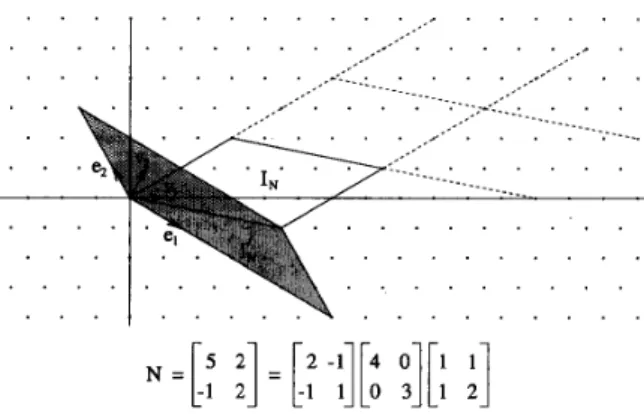
. . . . N = [ ; : ] = [ 2 - 1 ] r - 1 1 0 3 1 2'1
Fig. 1. Coordinate transformation in a hexagonal lattice.
is first transformed onto a new coordinate system, where it is rectangularly periodic. Rectangular M-D DCT of the trans- formed sequence is computed in the new coordinates, and the result is transformed back to the original coordinates. A short review of the notation and the Smith-normal decomposition is given in Section 11. In Section 111, an efficient method to compute the DCT and the inverse DCT in nonrectangular grids is described. Finally, in Section IV, simulation results are presented for quincunx sampling grids [5]-[ 101.
11. PRELIMINARIES
Let 2(n) be a periodic sequence, i.e.
Z(n
+
Nr) = 2(n) Vn,r E Z D (1) where the matrix N is a nonsingular integer matrix, and it is called the periodicity matrix. The number of samples in one period for a given periodicity matrix N is unique and given by IdetNI. The periodicity matrix N is not unique becauseN = NL represents the same periodicity if L is a unimodular
(IdetLI = 1) integer matrix [4].
dimensional Euclidean space. A lattice A in
RD
is the set of all linear combinations of v1...
V D with integer coefficients [4].Let v1
...
V D be linearly independent real vectors in aD-
A = {nlvl + n 2 ~ 2 + . . . + n D v D
I
ni E 2, i = 1,... ,D}.
(2)
The matrix V = [VI v2
. .
V D ] is called the sampling matrixof the lattice,A which is not unique. If E is any unimodular matrix, then V = VE is also a sampling matrix for the same lattice. However, IdetVl is unique for a given lattice, and it is called the sampling density [l].
Any nonsingular integer matrix N can be diagonalized by pre and postmultiplication by unimodular integer matrices E 1070-9908/94$04.00 0 1994 IEEE
IEEE SIGNAL PROCESSING LEITERS, VOL. 1, NO. 9, SEPTEMBER 1994 132
”
75-
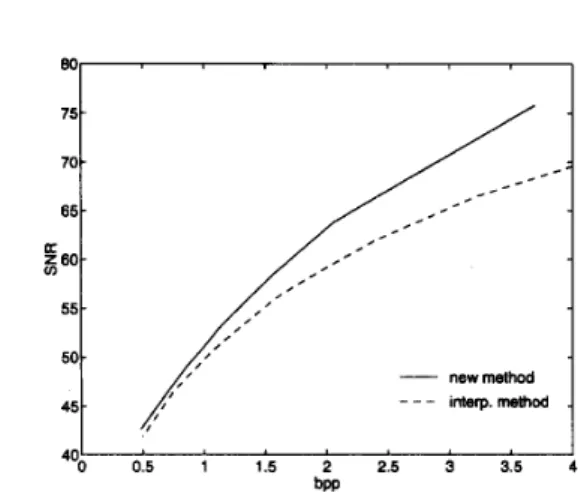
70 ~ 65 ~ u) %so- 55 - 50 - 45 -Fig. 2. Comparison of the two methods for the Barbara image TABLE I
COMPRESSION RESULTS FOR BARBARA IMAGE
Compression Ratio MSDE
1.74 2.17 3.88 3.46 2.06 b p p 1.32 b p p 63.85 55.45 51.17 46.39 5.09 4.70 6.07 7.05 5.61 6.43 7.18 8.12 9.44 7.96 9.30 11.46 16.22 11.69 TABLE II
COMPRESSION RESULTS FOR LENA IMAGE
II
I
Compression RatioI
MSDEI
SNR11
0-9 Fig. 3.
in a quincunx sampling grid (1.57 bpp, SNR = 58.53).
Original (a) and reconstructed (b) Barbara images of size (336 x 560)
II
3.09 bPPI
2.59I
1.70I
75.4911
55:
1
2.941
66.041
1.58 bpp1
1.17 bpp 3.69 62.08
0.96 bpp 8.35 4.19 59.87 used for transforming an arbitrary periodic sampling grid to
a rectangular grid.
0.82 bpp
0.73 bpp 11.00
0.62 bpp 12.82 55.32
0.51 bpp 15.61 53.20
nI. COMPUTATION OF DCT IN NONRECTANGULAR
GRIDS
The sequence will be first transformed to a new coordinate system where the periodicity matrix is diagonal. The DCT
will be computed in the rectangular coordinate system, and the result will be transformed back to the original coordinates. Let x(n) be a finite-extent M-D sequence with a support I N .
Let 5(n) denote its periodic extention with a periodicity matrix
N, which can always be decomposed as in (3). The sequence
Z(n) can be reordered using the coordinate transformation
n’ = E-ln. (4)
Let us denote the sequence in the new coordinates by 5’(n’).
It can be shown that Z‘(n‘) is periodic with A in the primed coordinates.
11
0.38 bppI
21.12I
7.48I
49.8011
and F, respectively, such that [4], [lo]
N = EAF (3)
where i) A is in Smith-normal form (or elementary divisor form), i.e, A is diagonal and A,, 1A221
. .
~ADDI(“I”
denotes“divides”), and ii) IdetEl = (detF( = 1. Such a decomposi- tion, which is called the Smith-normal decomposition, can be
GUNDOzhAN et al.: DCT CODING OF SAMPLED IMAGES 133
An example of the coordinate transformation is shown in Fig. 1 in a hexagonal sampling structure (for
D
= 2), whereVI and v2 are two basis vectors, and I N is the fundamental period for the periodicity matrix
N.
The basis vectors becomeel and e2 after the coordinate transformation, and I& is the fundamental period for the new periodicity matrix that is diagonal.
The algorithm to compute the DCT of a sequence s(n) can be summarized as follows:
i. Compute the transformation n‘ = E-ln, and find the ii. Compute the rectangular DCT of
x’
to obtainX’(k’).
iii. Compute the back transformation k = FTk’ to get X(k).
In order to compute the inverse DCT, the steps are reversed: i. Compute the transfomtion
k’
= (F-’)*k, and find ii. Compute the rectangular inverse DCT to get z‘(n‘).iii. Find x(n) using n =
En’.
If I N is the support of x(n), then I N should be mapped into the region
I:,
= [O,All) x [O,A22) for the DCT (orDFT) computation to be possible. Since DFT uses a periodicity m a k x of A, I N is always mapped into
Ih.
In the case of the DCT computation, the periodicity matrix is 2A, and due to this fact, it is not possible to mapI N
into I:, for all choices of the sampling and periodicity matrices. However, it can be shown that the DCT can be defined for all sampling lattices by properly choosing the (nonunique) sampling and the periodicity matrices for the given lattice.sequence in the new coordinates x’(n’).
XI(
k’)
.
IV. SIMULATION RESULTS
In our experiments, we have compared the proposed method with the method of interpolating to a denser grid and then using the standard JPEG algorithm. Images sampled on a quincunx lattice are first divided into 8x8 blocks. Then, the DCT of each block is computed using our new algorithm. The quantized transform domain coefficients are converted into a bit stream by using the JPEG entropy encoder. The compression results for the Barbara and Lena images are shown in Tables I and
II,
respectively. The original Barbara image and the compresseddecompressed Barbara image with a compression ratio of 5.09 are shown in Fig. 3.The same images are also coded by interpolating the quin- cunx grid to a denser rectangular grid (with twice as many samples). The standard JPEG algorithm is then applied. At the receiver, the incoming bit stream is decoded to get a rectangularly sampled image that is decimated back to the quincunx grid. The comparison of the compression results using the Barbara image is shown in Fig. 2. It can be seen that the new procedure proposed in this letter provides better results at all coding levels. For example, in the case of the Barbara image compressed to 1.57 bpp, the SNR of the compresseddecompressed image with the new method is
58.53, whereas interpolation to rectangular grid first yields the
SNR 55.83.
V. CONCLUSION
In this letter, the discrete cosine transform (DCT) is defined on nonrectangular sampling grids, and a DCT-based compres- sion scheme for nonrectangularly sampled images is presented. We note that the DCT can be defined for all lattices by the proper choice of the sampling and periodicity matrices.
REFERENCES
[I] E. Dubois, “The sampling and reconstruction of time-varying imagery with application in video systems,” Proc. IEEE, vol. 73, pp. 502-522, Apr. 1985.
[2] D. E. Dudgeon and R. M. Mersereau, Multidimensional Digital Signal Processing. Englewood Cliffs, NJ: Prentice-Hall, 1984.
[3] G. J. Tonge, “The sampling of television images,” Znt. Broadcasting Assoc. (IBA) Rep., 112/81.
[4] M. A. Rahgozar and J. P. Allebach, “A general theory of time-sequential sampling,” Signal Processing, Sept. 1992.
[5] A. E. Cetin, “A multiresolution nonrectangular wavelet representation for two-dimensional signals,” Signal Processing, vol. 32, no. 3, June 1993.
[6] R. Ansari and C. L. Lau, “Two-dimensional IIR filters for exact reconstruction in tree-structured sub-band decomposition,” Electron. Lett., vol. 23, pp. 633-634, June 1987.
[7] R. Ansari, A. E. Cetin, and S. Lee, “Subband coding of images using nonrectangular filter banks,” Pmc. SPIE Con$ Applications Image Processing XI (San Diego), Aug. 1988.
[8] J. Kovacevic and M. Vetterli, “Nonseparable multidimensional perfect reconstruction filter banks and wavelet for R”,” ZEEE Trans. Inform.
Theory, vol. 38, pp. 533-555, Mar. 1992.
[9] M. Barlaud et. al., “Pyramidal lattice vector quantization for multiscale image coding,” submitted to ZEEE Trans. on Image Processing. [lo] M. Pohst and H. Zassenhaus, Algorithmic Algebraic Number Theory.