Original Article / Orijinal Makale Orthopaedics / Ortopedi
Change in the impact of Turkish Orthopedics and
Traumatology on international scientific literature
Türk Ortopedi ve Travmatolojisinin uluslararası bilimsel literatüre
olan etkisindeki değişim
Abdullah DEMİRTAŞ1, Yılmaz TUTAK2, Tahir Mutlu DUYMUS3, İbrahim AZBOY4
Received: 31.03.2018 Accepted: 02.05.2018
1Department of Orthopaedics and Traumatology, Istanbul Medeniyet University, Medical Faculty, Istanbul, Turkey 2Department of Orthopaedics and Traumatology, Mardin State Hospital, Mardin, Turkey
3Department of Orthopedics and Traumatology, Private Respect Hospital, Istanbul, Turkey
4Department of Orthopaedics and Traumatology, Medipol University, Medical Faculty, Istanbul, Turkey
Yazışma adresi: Abdullah Demirtas, Department of Orthopaedics and Traumatology, Istanbul Medeniyet University, Medical Faculty, Istanbul, Turkey e-mail: [email protected]
INTRODUCTION
One of the indicators of the level of scientific
deve-lopment of a country is the impact on the relevant field of journals published in that country. The num-ber of citations is an important indicator used to
eva-ABSTRACT
The aim of our study is to investigate change in the impact of Turkish Orthopedics and Traumatology on the international sci-entific literature by examining the success of the Acta Orthopa-edica et Traumatologica Turcica (AOTT) journal. All clinical rese-arch articles published in the AOTT between 2006 and 2015 were included in the study. The number of citations and the factors (number of centers participating in the study, the origin of study (domestic-foreign), design, level of evidence, type and subtype of studies) that may affect the number of citations were evalua-ted. A total of 517 clinical research articles were evaluaevalua-ted. There has been an increase in the citation rate over the last five years (p=0.046). The majority of the articles were multi-center (54.9%) and domestic-origin (85.1%). In the last five years, there has been an increase foreign-origin articles (p=0.01). The majority of the articles was level 4 (76.2%) and designed retrospectively (95.9%). In the last five years, there has been an increase in the evidence levels of the articles and prospectively design studies (p=0.07, p=0.157, respectively). The majority of the articles were related to treatment of the diseases (74%). In the last five years, there has been an increase in the studies related to economic and decision analysis (p=0.055). Articles were mostly related to trauma (26.5%). In the last five years, there has been an increase in the number of articles related to arthroplasty, and a decrea-se in thodecrea-se associated with foot-ankle and pediatric orthopedics (p=0.022, p=0.036, p=0.007, respectively). As a result; it was seen that Turkish Orthopedics and Traumatology increased its influ-ence on the international scientific literature between the years 2011-2015.
Keywords: Turkish orthopedics and traumatology, literature, impact
ÖZ
Çalışmamızın amacı, Türk ortopedi ve travmatolojisinin ulusla-rarası bilimsel literatüre olan etkisindeki değişimi Acta Ortho-paedica et Traumatologica Turcica (AOTT) dergisinin başarısını inceleyerek araştırmaktır. 2006-2015 yılları arasında AOTT’de yayımlanmış tüm klinik araştırma makaleleri çalışmaya dahil edildi. Atıf sayısı ve atıf sayısını etkileyebilecek faktörler (çalışma-ya katılan merkezlerin sayısı, çalışmanın orjini (yurt içi-yurt dışı), dizaynı, kanıt seviyesi, çalışmaların tipi ve alt tipi) değerlendirildi. 517 klinik araştırma makalesi değerlendirildi. Atıf alma hızında son beş yılda artış görüldü (p=0,046). Makalalerin çoğunluğu çok merkezli (%54,9) ve yurt içi orjinli (%85,1) idi. Son beş yılda yurt dışı orjinli makale sayısında artış görüldü. Makalelerin çoğunluğu Level 4 (%76,2) ve retrospektif dizaynlıydı (%95,9). Son beş yılda makalelerin kanıt seviyelerinde ve prospektif dizaynlı çalışma sa-yısında artış görüldü (sırasıyla; p=0,07; p=0,157). Makalelerin ço-ğunluğu terapötik tipteydi (%74). Son beş yılda ekonomik ve ka-rar analizi çalışma tipinde artış görüldü (p=0,055). Makaleler, en sık travma ile ilişkiliydi (%26,5). Son beş yılda artroplasti ile ilişkili makale oranındaki artış, ayak-ayak bileği ve pediatrik ortopedi ile ilişkili makale oranında azalma görüldü (sırasıyla; p=0,022; p=0,036; p=0,007). Sonuç olarak, Türk ortopedi ve travmatolo-jisinin 2011-2015 yılları arasında uluslararası bilimsel literatür üzerindeki etkisini artırdığı görüldü.
Anahtar kelimeler: Türk ortopedi ve travmatolojisi, literatür, etki
luate the impact of a journal’s articles on the relevant field1. The number of citations and the parameters
associated with them are often used to evaluate the success of scientific journals. The number of citations can be affected by many factors2,3.
Turkish Orthopedics and Traumatology successfully represents our country in the international arena by publishing scientific articles with higher impact factors. Acta Orthopaedica et Traumatologica Turci-ca (AOTT) is one of leading mediTurci-cal journals in the field of Orthopedics and Traumatology in Turkey, which has been indexed4 in Science Citation
Index-Expanded (SCI-E) since 2008. Although there are very few studies in the literature evaluating the scientific success of AOTT5, there has been no study examining
the number of citations used as success criteria and the factors that could affect the number of citations. The aim of our study is to investigate the impact of the Turkish Orthopedics and Traumatology on the international scientific literature by examining the number of citations to the clinical research articles published in the AOTT between 2006 and 2015 and the characteristics of the factors (number of centers participating in the study, the origin of study (domes-tic or foreign), design, level of evidence, type and subtype of studies) that may affect the number of citations.
MATERIALS and METHODS
All articles published in the AOTT from January 2006 to December 2015 were evaluated. Clinical research articles were included in the study. The experimen-tal, biomechanical, cadaveric studies, case reports, letters to the editor, technical notes, questionnaire surveys, basic research studies and supplementum numbers were excluded.
In determining the number of center from which the articles were sent, the institutions where the authors worked were taken into account. According to this, the articles whose authors working in the same insti-tution were accepted as single-center whereas those
involve many authors working in different instituti-ons were accepted as multi-center studies.
In determining the origin of articles, the country of the first author was taken into consideration. Accor-ding to this, the articles were examined in two gro-ups as domestic and foreign-origin. Domestic articles were examined according to the geographic regions of Turkey where they came from in seven groups as follows: Marmara, Aegean, Mediterranean, Black Sea, Central Anatolia, Eastern Anatolia and Southe-astern Anatolia.
The number of citations to the articles (number of citations given in Google academic till 05.12.2016), the rate of citation (number of citations/time), study design of the articles, the changes in study types and subtypes were evaluated in two different periods co-vering 2006-2010 and 2011-2015.
The articles were examined in two groups as pros-pective and retrospros-pective in terms of the time pe-riods (past, future) they studied, and in five groups from 1 (highest evidence level) to 5 (lowest evidence level) in terms of their levels of evidence6. The
artic-les were examined in four groups in terms of their fields of study as therapeutic, diagnostic, prognostic and economic and decision analysis6,7.
The articles were examined in nine groups according to their region of interest as arthroplasty, foot-ankle, sports injuries, spine, tumor, pediatric orthopedics, trauma, hand and upper extremity and others. Artic-les related to hip fracture patients who underwent arthroplasty were included in the arthroplasty gro-up if no comparison was made with a patient grogro-up who underwent internal fixation in the same study. The articles related to spine trauma were included in the spine group, and in the pediatric orthopedics if it is related to pediatric trauma. The hand and up-per extremity group included articles related to hand trauma (traumas in the distal part of the radius and ulna), and the tumor group contained articles related to pathological fractures developing on the tumor base, and all other traumas except these were
inclu-ded in the trauma group. While articles related to the shoulder and elbow arthroscopy out of arthroscopic interventions at the upper extremity were included in sports surgery, the ones related to wrist arthros-copy were included in the hand and upper extremity group. Articles that couldn’t be included in any group were categorized in the miscellaneous group.
NCSS (Number Cruncher Statistical System) 2007 (Kaysville, Utah, USA) program was used for statisti-cal analysis. Mann-Whitney U test was used in the comparisons of two groups of quantitative variables with non-normal distribution. Pearson chi-square test, Fisher’s exact chi-square test and Yates’ Conti-nuity Correction were used for comparisons of quali-tative data. The significance was assessed at p<0.01 and p<0.05 levels.
RESULTS
Between 2006 and 2015, 517 clinical research articles have been published in AOTT. The majority of the ar-ticles were multi-center (54.9%) and domestic-origin (85.1%). Most of the national articles were from Mar-mara Region (53.2%) and the least were from Eastern Anatolia Region (1.1%). The detailed distribution of the characteristics regarding the years of publication, the number of centers participated in the study and whether the articles were domestic or foreign-origin have been shown in Table 1.
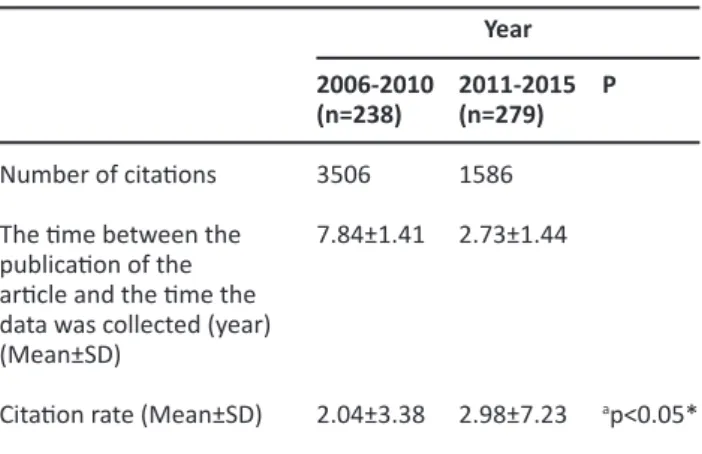
The average number of citations to the articles was 14.7 in the first five years and 5.6 in the last five years. It was seen that there had been a significant increase in citation rate within the last five years (2.98±7.23) compared to the first five years (2.04±3.38) (p<0.05). Table 2 shows the detailed distribution of the cha-racteristics related to the number of citations to the articles and the rate of citation by years.
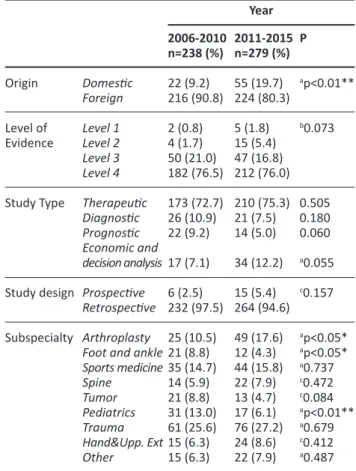
While the publication rate of domestic articles was distinctly high in both periods (90.8% and 80.3%, res-pectively), it was seen that there had been a signifi-cant increase in the publication rate of foreign artic-les (19.7%) in the last five years (p<0.05). In terms of
the level of evidence, while the rate of level 4 articles was distinctly high in both periods (76.5% and 76.0%, respectively), it was seen that there had been an inc-rease in the articles’ level of evidences in the last five years, but without any level of statistical significance (p=0.073). In terms of study design, although the cita-tion rate of retrospectively designed articles was high
Table 1. Characteristics of the articles in relation to publishing years, publication locations and centers between 2006-2015.
Year 2006 2007 2008 2009 2010 2011 2012 2013 2014 2015 Central Single-centered Multi-centered Place of publication Other countries National - Marmara region - Aegean region - Mediterranean region - Black Sea region - Central Anatolia region - Eastern Anatolia region - Southeastern Anatolia region
n 43 41 44 57 53 47 49 37 74 72 233 284 77 440 234 68 13 16 94 5 10 % 8.3 7.9 8.5 11.0 10.3 9.1 9.5 7.2 14.3 13.9 45.1 54.9 14.9 85.1 53.2 15.5 3.0 3.6 21.4 1.1 2.3
Table 2. Characteristics of the articles based on citation number and rate between 2006-2010 and 2011-2015.
Number of citations The time between the publication of the article and the time the data was collected (year) (Mean±SD)
Citation rate (Mean±SD) aMann Whitney U Test
2006-2010 (n=238) 3506 7.84±1.41 2.04±3.38 2011-2015 (n=279) 1586 2.73±1.44 2.98±7.23 P ap<0.05* Year
in both periods (97.5% and 94.6%, respectively), an increase in the rate of prospectively designed articles (5.4%) was observed in the last five years, but but without any level of statistical significance (p=0.157). Although increased number of articles appeared in the AOTT concerning the field of therapeutics in both periods (72.7% and 75.3%, respectively), an increase in the rate of economic and decision analysis type (12.2%) was observed in the last five-year period, but without any level of statistical significance (p=0.055) (Figure 1). Regarding the study subtype, although the citation rates of articles related to trauma were high in both periods (25.6%, 27.2% respectively), the increase in the number of articles related to arthrop-lasty (17.6%) (p<0.05, and the decrease in the rate of article related to foot-ankle and pediatric orthope-dics (4.3%, 6.1%, respectively) were at the significant level (p<0.05) in the last 5 years (Figure 2). The deta-iled distribution of the characteristics of the articles by years has been shown in Table 3.
DISCUSSION
Acta Orthopaedica et Traumatologica Turcica is one of leading journals in the field of Orthopedics and
Therapeutic Ra te (%) Study Type 80 70 60 50 40 30 20 10 0
Diagnostic Prognostic Economic
Arthroplasty Ra te (%) Subspecialty 30 25 20 15 10 5 0
Foot and ankle Sports medicine Spine Tumor
Pediatrics Trauma Hand&Upp. Ext Other
Figure 1. Distribution of article types by years.
Figure 2. Distribution of article subtypes by years.
Table 3. Distribution of the characteristics of articles according to years. Origin Level of Evidence Study Type Study design Subspecialty
aPearson chi-squared test, bFisher’s exact chi-square test, cYates’
Continuity Correction, **p<0.01, *p<0.05 2006-2010 n=238 (%) 22 (9.2) 216 (90.8) 2 (0.8) 4 (1.7) 50 (21.0) 182 (76.5) 173 (72.7) 26 (10.9) 22 (9.2) 17 (7.1) 6 (2.5) 232 (97.5) 25 (10.5) 21 (8.8) 35 (14.7) 14 (5.9) 21 (8.8) 31 (13.0) 61 (25.6) 15 (6.3) 15 (6.3) 2011-2015 n=279 (%) 55 (19.7) 224 (80.3) 5 (1.8) 15 (5.4) 47 (16.8) 212 (76.0) 210 (75.3) 21 (7.5) 14 (5.0) 34 (12.2) 15 (5.4) 264 (94.6) 49 (17.6) 12 (4.3) 44 (15.8) 22 (7.9) 13 (4.7) 17 (6.1) 76 (27.2) 24 (8.6) 22 (7.9) P ap<0.01** b0.073 0.505 0.180 0.060 a0.055 c0.157 ap<0.05* ap<0.05* a0.737 c0.472 c0.084 ap<0.01** a0.679 c0.412 a0.487 Year Domestic Foreign Level 1 Level 2 Level 3 Level 4 Therapeutic Diagnostic Prognostic Economic and decision analysis Prospective Retrospective Arthroplasty Foot and ankle Sports medicine Spine Tumor Pediatrics Trauma Hand&Upp. Ext Other Citation rate 3 2,5 2 1,5 1 0,5 0 2006-2010 2011-2015
Figure 3. The distribution of the characteristics of the articles by their citation rate over the years.
Traumatology in Turkey since its first publication in 1962 and it has gradually increased its success to international level since it started to be indexed in SCI-E in 20084.
In the evaluation of the performance of scientific jo-urnals, changes over the course of 10 years are often used8. In our study was investigated the impacts of
the Turkish Orthopedics and Traumatology on the international scientific literature by examining the number of citations to the clinical research articles published in the AOTT between 2006 and 2015 and the characteristics of the factors that may affect the number of citations. As a result of our study, it was seen that Turkish Orthopedics and Traumatology increased the impact on international scientific lite-rature in parallel with the success of AOTT over the years.
In our study, the changes in the scientific achieve-ment of AOTT was assessed by examining the number of citations to clinical research articles published in this journal between 2006 and 2015 and the factors that may affect the number of citations. This study has demonstrated that the citation rate of AOTT in last five years was high at a significant level, and the scientific quality level of the journal have increased over the years.
Increasing the sample size in scientific articles ma-kes it possible to reach the information that can be more generalized about the results of the study. One of the ways to increase the sample size is to increa-se the number of centers participating in the study. Since multi-center clinical studies provide suffici-ent number of differsuffici-ent participants in much shor-ter time, they are more effective than single-censhor-ter studies9. The majority of the articles in AOTT were
multi-center in which we set the number of centers according to the number of institutions of the aut-hors. We observed, however, that the majority of these studies were conducted from a single-center, even if their authors worked in different institutions, and therefore did not actually increase the number of samples. We believe that the AOTT may become a
journal that would have more frequently cited artic-les with higher scientific quality coming from larger scale multi-center studies.
The idea of the simplification of information transfer and sharing information around the world have inc-reased the accessibility and recognition of journals7.
Huh et al.3 noted that the participation of authors
from various countries and the publication of the journal in English would increase its circulation and number of citations. AOTT has been published both in Turkish and English since 20105. In our study,
alt-hough the citation rate of articles of domestic-origin was distinctly high in both periods, the significant inc-rease in foreign-origin articles in the last five years, indicates that the AOTT’s accessibility and recogniti-on have increased. We believe that the accessibility and the increased recognition of the AOTT will allow it to choose higher quality articles among many at the time of publication, which in the course of years will contribute to the journal’s higher scientific qua-lity with more cited articles.
Orthopedic surgeons are always interested in evi-dences and want to use them to make decisions de-pending on patients’ needs and conditions6. Articles
in journals of high scientific quality are good sources for orthopedic surgeons, providing them the eviden-ce they need. It has been reported in the literature that articles having higher level of evidence have been more cited10. Even if the articles having higher
level of evidence are more convincing in resolving cli-nical dilemmas, this can not always be achieved11. It
has been reported that level 3 and 4 studies still hold the majority in the orthopedics and traumatology literature6. However, Reich MS et al.7 indicated that
globally, Level 1, Level 2 and Level 3 studies are gra-dually being published more, while Level 4 studies are being published less and less. Similarly, Schesc-huk JP et al.12 have shown that the number of low
evidence-level studies in the orthopedic traumato-logy literature decreased in a significant level. In our study, the citation rates of level 4 articles were high in both periods in terms of level of evidence. Regarding the study design, the citation rates of retrospectively
designed articles were distinctly high. We think that level 4 and retrospective studies are more frequently preferred because they are easy to perform with lo-wer cost. In our study, although there was no signifi-cant difference, the increase in the level of evidence of the articles over the last five years and increase in the number of prospective studies were consistent with the literature7,12, which is promising in terms of
increasing the scientific quality of the journal. The classification of studies in a journal so as to cle-arly articulate the primary research topic facilitates the orientation of the reader to the area of interest. Easy access to an article about the subject that the reader is searching for, can lead to the beginning of the process that would increase the interest towards that journal and trigger the increase in its recogniti-on, and ultimately the number of citations and sci-entific quality of the articles. Reich MS et al.7,
eva-luated the articles published in the Journal of Bone and Joint Surgery (JBJS) between 1980 and 2010, and showed that 71.9% of the articles were based on therapeutic studies, while the number of studi-es related to the treatment, and prognosis has inc-reased in Asian and European-origin articles, while and in North American-origin jourals the number of economic and decision analysis type studies have increased over the years. In our study, regarding the study types, although the citation rate of therapeutic type articles was distinctly high in both periods, we observed an increase in the number of publication rate of economic and decision analysis studies in the last five-year period even though this was not at the significant level (Figure 1). The types of articles pub-lished in AOTT were similar to JBJS, which is a highly recognized journal in orthopedics and traumatology because of the high number of citations to its articles and high level of scientific quality.
The number of citations is related to the study subt-ypes published in a journal. Holzer LA et al.13
indica-ted that the articles published in JBJS were mostly in hip category, followed by knee and trauma, and the least frequently published articles were in the hand and wrist category. They also reported that the
hig-hest citation of all categories was made to the hip category. In our study, the most frequently published articles in AOTT were trauma related and the least frequently published articles were related to foot and ankle. Regarding the years, although the citation rates of articles related to trauma were high in both periods, an increase was observed in the number of articles related to arthroplasty, and the decrease in the number of articles related to foot-ankle and pe-diatric orthopedics over the last five years (Figure 2). Trauma is the most common diagnosis in orthope-dic surgeons’ daily practice, and detection of higher number of articles related to trauma is not surpri-sing. The indications of arthroplasty has increased in parallel to technologic improvements with better implant design, and it might be expected that the number of publications related with arthroplasty will increase over the years. Whereas the decline of the number of articles related to foot-ankle and pediatric orthopedics over the years might be due to the fact that there has been a decrease in diseases related to pediatric orthopedics such as pes equinovarus defor-mity, developmental hip dysplasia, polio, and early diagnosis and conservative methods have come to the front, and hence there are small number of ort-hopedic surgeons working on these diseases. The limitation of our study is that we have only eva-luated clinical research articles. Not including all pub-lications in the AOTT may underestimate the number of citations. However, the majority of publications in the AOTT are clinical research articles. We believe that the examination of clinical research articles will be sufficient to generalize the scientific level of the journal. However, new studies involving all studies published in AOTT can provide more accurate data regarding the scientific level of the journal.
As a result; this study has demonstrated that the majority of the articles published in AOTT are rela-ted to multi-center, domestic-origin, retrospective, therapeutic type and trauma-related studies having the evidence level of 4. However, over the years; prospective studies of foreign-origin, economic and decision-analysis type, having high level of evidence
and and arthroplasty related articles have been more frequently published in AOTT. Consequently the po-pularity of AOTT has gradually increased with articles having high citation rate, and high scientific quality. This success of the AOTT was significant in that it has demonstrated that Turkish Orthopedics and Trauma-tology increased the impact on international scienti-fic literature.
Declaration of Conflicting Interest: The authors have
not declared any conflict of interest.
Financial Disclosure: No financial support was
rece-ived.
REFERENCES
1. Baldwin K, Namdari S, Donegan D, Kovatch K, Ahn J, Mehta S. 100 most cited articles in fracture surgery. Am J Orthop (Belle Mead NJ). 2013 Dec;42(12):547-52.
2. Glänzel W. Bibliometrics as a research field: A course on the-ory and application of bibliometric indicators. COURSE HAN-DOUTS. 2003.
3. Huh S. Clinics in Orthopedic Surgery’s Evolution into an Inter-national Journal Based on Journal Metrics. Clin Orthop Surg. 2016 Jun;8(2):127-32.
https://doi.org/10.4055/cios.2016.8.2.127
4. Demirhan M. From The Editor. Acta Orthop Traumatol Turc. 2008;42:149-53.
5. Yalçınkaya M, Bagatur AE. Articles published in Acta
Ort-hopaedica et Traumatologica Turcica between 2003-2012: content, characteristics and publication trends. Acta Orthop Traumatol Turc. 2014;48(5):576-83.
https://doi.org/10.3944/AOTT.2014.14.0079
6. JG Wright. Editorial. Introducing Levels of Evidence to The Journal: JBJS - LWW Journals, 2003
7. Reich MS, Shaw J, Barrett I, Goldberg VM, Schnaser E. Level of evidence trends in the Journal of Bone and Joint Surgery, 1980-2010. Iowa Orthop J. 2014;34:197-203.
8. Rehn C, Kronman U. Bibliometric handbook for Karolinska Institutet. [Cited 2013 Sep 8]. Available from: http://ki.se/ content/1/c6/01/79/31/bibliometric_handbook karolinska_ instutet¬¬¬_v¬_1.05. pdf.
9. Sprague S, Matta JM, Bhandari M. Anterior Total Hip Artr-hroplasty Colloborative (ATHAC) İnvestigators, Dodgin D, Clarck CR, Kregor P, Bradley G, Little L. Multicenter collabo-ration in observational research: improving generalizability and efficiency. J Bone Joint Surg Am. 2009 May;91(Suppl 3):80-6.
https://doi.org/10.2106/JBJS.H.01623
10. Obremskey WT, Pappas N, Attallah-Wasif E, Tornetta P, 3rd, Bhandari M. Level of evidence in orthopaedic journals. J Bone Joint Surg Am. 2005;87(12):2632-8.
https://doi.org/10.2106/JBJS.E.00370
11. Hurwitz SR, Slawson D, Shaughnessy A. Orthopaedic infor-mation mastery: applying evidence-based inforinfor-mation tools to improve patient outcomes while saving orthopaedists’ time. J Bone Joint Surg Am. 2000;82:888-94.
https://doi.org/10.2106/00004623-200006000-00020 12. Scheschuk JP, Mostello AJ, Lombardi NJ, Maltenfort MG,
Fre-edman KB, Tjoumakaris FP. Levels of Evidence in Orthopaedic Trauma Literature. J Orthop Trauma. 2016 Jul;30(7):362-6. https://doi.org/10.1097/BOT.0000000000000557
13. Holzer LA, Holzer G. Analysis of scientific articles publis-hed in two general orthopaedic journals. Acta Ortop Bras. 2013;21(5):281-4.