Full Terms & Conditions of access and use can be found at
https://www.tandfonline.com/action/journalInformation?journalCode=ienz20
Journal of Enzyme Inhibition and Medicinal Chemistry
ISSN: 1475-6366 (Print) 1475-6374 (Online) Journal homepage: https://www.tandfonline.com/loi/ienz20
α
-Carbonic anhydrases are sulfatases with cyclic
diol monosulfate esters
Hüseyin Çavdar, Deniz Ekinci, Oktay Talaz, Nurullah Saraçoğlu, Murat
Şentürk & Claudiu T. Supuran
To cite this article: Hüseyin Çavdar, Deniz Ekinci, Oktay Talaz, Nurullah Saraçoğlu, Murat Şentürk & Claudiu T. Supuran (2012) α-Carbonic anhydrases are sulfatases with cyclic diol monosulfate esters, Journal of Enzyme Inhibition and Medicinal Chemistry, 27:1, 148-154, DOI: 10.3109/14756366.2011.629198
To link to this article: https://doi.org/10.3109/14756366.2011.629198
Published online: 03 Nov 2011.
Submit your article to this journal
Article views: 566
View related articles
Introduction
Mammals possess 16 different carbonic anhydrase (CA, EC 4.2.1.1) isoforms, which are involved in many crucial physiological processes connected with respiration and transport of CO2/HCO3−, pH and CO
2 homeostasis,
elec-trolyte secretion in a variety of tissues/organs, biosynthetic reactions, bone resorption, etc1–6. Some of the isozymes
are cytosolic (CA I, CA II, CA III, CA VII and CA XIII), two are mitochondrial (CA VA and CA VB), one is secreted (CA VI), and others are membrane-bound (CA IV, CA IX, CA XII and CA XIV)1–11. In a recent preliminary work from our
group, we investigated the interaction between natural phenolic compound, antioxidant phenolic compounds, hydroxy/metoxy organic compounds and salicylic acid derivatives with two cytosolic catalytically active isoforms (CA I and II) of the metalloenzyme CA1–8. Indeed, phenol 12
binds to CA in a diverse manner compared to the classical
inhibitors of the sulfonamides/sulfamates/sulfamides, which coordinate to the Zn2+ ion from the enzyme active
site by substituting the fourth, non-protein ligand, a water molecule or hydroxide ion12–15. Recently, Christianson’s
group then reported the X-ray crystal structure for the adduct of human carbonic anhydrase II (hCA II) with phe-nol12, showing indeed this inhibitor to bind to hCA II by
anchoring its OH moiety to the zinc-bound H2
O/hydrox-ide ion of the enzyme through a hydrogen bond as well as to the NH amide of Thr199, an amino acid conserved in all α-CAs and critically important for the catalytic cycle of these enzymes4–6,12–15. Furthermore, the phenyl moiety of
this inhibitor was found to lay in the hydrophobic part of the hCA II active site, where presumably CO2, the physi-ologic substrate of the CAs, binds in the precatalytic com-plex, explaining thus the behaviour of phenol as a unique CO2 competitive inhibitor1–3,13–16.
RESEARCH ARTICLE
α-Carbonic anhydrases are sulfatases with cyclic diol
monosulfate esters
Hüseyin Çavdar
1, Deniz Ekinci
2, Oktay Talaz
3, Nurullah Saraçoğlu
4, Murat Şentürk
5, and
Claudiu T. Supuran
61Department of Elementary Education, Dumlupınar University, Kütahya, Turkey, 2Department of Agricultural Biotechnology,
Ondokuz Mayıs University, Samsun, Turkey, 3Department of Chemistry, Karamanoğlu Mehmetbey University, Karaman,
Turkey, 4Department of Chemistry, Atatürk University, Erzurum, Turkey, 5Department of Chemistry, Ağrı İbrahim Çeçen
University, Ağrı, Turkey, and 6Dipartimento di Chimica, University of Florence, Sesto Fiorentino Firenz, Italy
Abstract
Carbonic anhydrases (CA) catalyze activated ester hydrolysis in addition to the hydration of CO2 to bicarbonate. They also show phosphatase activity with 4-nitrophenyl phosphate as substrate but not sulfatase with the corresponding sulfate. Here we prove that the enzyme is catalyzing the synthesis of cyclic diols from sulfate esters. 5-, 6- and 8-membered ring cyclic sulfates incorporating a neighboring secondary alcohol moiety were treated with CA II and yielded the corresponding cyclic diols. Inhibitory properties of obtained cyclic and original sulfate esters were then investigated on human carbonic anhydrase I (hCA I), hCA II, hCA IV and hCA VI (h = human isoform). KI-s of these compounds ranged between 32.7–423 μM against hCA I, 2.13–32.4 μM against hCA II, 13.7–234 μM against hCA IV and 76–278 μM against CA VI, respectively. The sulfatase activity of CA with such esters is amazing considering the fact that 4-nitrophenyl-sulfate is not a substrate of these enzymes.
Keywords: Cyclic diols, carbonic anhydrase, inhibition, antiglaucoma
Address for Correspondence: Dr. Murat Şentürk, Agri Ibrahim Cecen University, Agri 04100, Turkey. E-mail: [email protected] Dr. Claudiu T. Supuran, Dipartimento di Chimica, University of Florence, Rm. 188, Polo Scientifico, Laboratorio di Chimica Bioinorganica, Via della Lastruccia 3, Sesto Fiorentino Firenz, Italy. E-mail: [email protected]
(Received 22 September 2011; revised 30 September 2011; accepted 30 September 2011)
Journal of Enzyme Inhibition and Medicinal Chemistry, 2012; 27(1): 148–154 © 2012 Informa UK, Ltd.
ISSN 1475-6366 print/ISSN 1475-6374 online DOI: 10.3109/14756366.2011.629198
Journal of Enzyme Inhibition and Medicinal Chemistry
2012
27
1
148
154
22 September 2011 30 September 2011 30 September 20111475-6366
1475-6374
© 2012 Informa UK, Ltd.
10.3109/14756366.2011.629198
α-Carbonic anhydrases are sulfatases with monosulfate esters 149
© 2012 Informa UK, Ltd.
Inhibitory effects of different phenols, metoxyphenol derivatives, anions, metal ions and drugs have been inves-tigated up to now against many mammalian, fish, bacterial and fungal CAs12–20. CA II is the physiologically most
rel-evant isoenzyme. CA inhibitors (CAIs) are used for several applications, in particular for the treatment of glucoma, epilepsy, as diuretics etc. Other compounds, targeting iso-forms IX and XII, have applications as antitumor agents/ diagnostic tools1–11. Therefore, discovery of novel CAIs
targeting various isoenzymes has gained attention nowa-days1–10. Cyclic diols were developed treatments of type II
diabetes, Gaucher disease and also as an anti-HIV drug21–24.
In the current study, we aimed to synthesize cyclic diols 5, 7 and 9 using carbonic anhydrase enzyme and determine the inhibitory effects of cyclic diols and sulfate esters on four α-CA isozymes, hCA I, hCA II, hCA IV and hCA VI.
Results and discussion
Chemistry
It is known that carboxylate/phosphate esters are hydro-lyzed by α-CAs, although 4-nitrophenylsulfate was shown not to be a substrate for the cytosolic isoforms hCA I, II and XIII1–6. Recently, one of our groups reported kinetic study
on the hydrolysis of 4-nitrophenyl acetate 1 and phosphate in the presence of three cytosolic CA isozymes, hCA I, hCA II and hCA XIII1–6. In solution, these esters are hydrolyzed
by the nucleophilic attack of water (or hydroxide ions) to the central atom (carbonyl CO for acetate 1, phosphorus for phosphate) with formation of a transition state from which the 4-nitrophenoxide is released. Considering the fact that CAs contain the equivalent of a strong base (hydroxide ions, HO− coordinated to the zinc ion) at neutral pH, due to the
powerful activation of H2O by the zinc ion from the active site cavity and the hydrophobic environment of the protein, in principle, hydrolytic reactions 1–2 of Scheme 1 should have the same mechanism as the hydrolysis catalyzed
by bases in solution. In these studies, Innocenti et al.1,2
showed that the hydrolytic processes described by Eqs. 1–2 of Scheme 1, involve the active site Zn2+(OH)− functionality
of the enzyme, that is, the same one responsible of the CO2 hydration activity of α-CAs. Probably, compounds 4, 6 and 8 are hydrolysed by CA II in the same way in the current study. It is interesting to note here that the aliphatic, cyclic sulfates investigated here, unlike the aromatic activated one (ester 2) indeed act as substrates for CAs. The sulfatase activity of this enzyme has been in fact discovered earlier with a cyclic sulfate ester as substrate, by Kaiser and Lo3.
Furthermore, we report here an inhibition study of the four catalytically active human isoforms hCA I, II, IV and VI with compounds 4–11. They incorporate sulfate esters or cyclis diols in their molecules and scaffolds rep-resenting thus an interesting starting point for different chemotypes belonging to the CAIs. In fact, in an earlier
study25 we reported micromolar/submicromolar
inhibi-tors of the cytosolic isoforms hCA I and II with a library of organic nitrates.
CA purification, assay and inhibition
The purification of hCA isozymes was performed with a simple one step method by a Sepharose-4B-aniline-sulfanilamide affinity column9–11. Inhibitory effects of
com-pounds trans-(1R(S),6R(S))-6-Hydroxycyclohex-3-enyl
hydrogen sulfate (4), (1R,2R)-cyclohexane-1,2-diol (5), trans-(1R(S),8R(S),Z)-8-Hydroxycyclooct-4-enyl hydrogen sulfate (6), (2R,3R)-1,2,3,4-tetrahydronaphthalene-2,3-diol
(7),
tetrahydro-1,4-methanon-aphthalen-2(R(S))-yl sulfate (8),
9(R(S))-Hydroxy-1,2,3,4-tetrahydro-1,4-methanonaphthalen-2(R(S))-diol (9),
(1R(S),2R(S))-cyclohexane-1,2-diol (10) and trans-(2R(S),3R(S))-1,2,3,4-Tetrahydronaphthalene-2,3-diol (11) on these isoenzyme activities were tested under in vitro conditions; KI values were calculated from Lineweaver-Burk plots and are given in Table 125–29.
The CA isozymes play important roles in different tissues1–9,28–32. It is known that CA has been purified many
times from different organisms and the effects of various chemicals, pesticides, anions, metal ions and drugs have been investigated on its activity8–20,28–32. We report here a
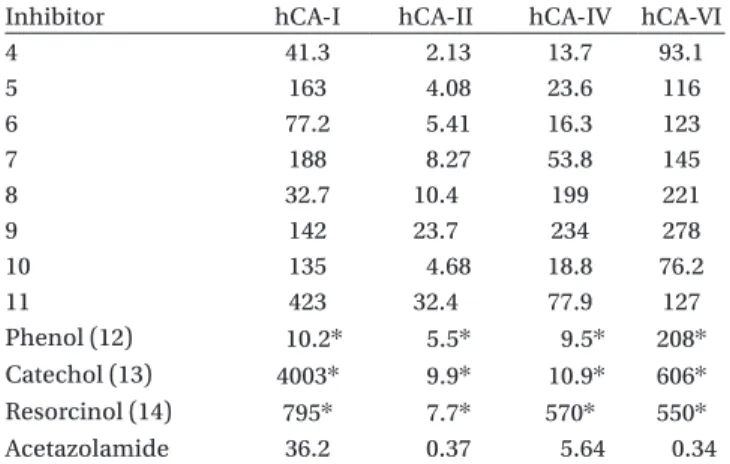
study on the inhibitory effects of organic sulfates, diols and some phenolic compounds on the CA esterase activ-ity of isoforms hCA I, II, IV and VI. Data of Table 1 show the following, regarding inhibition of hCA I, II, IV and VI with compounds 4–11 and with positive controls 12, 13, 14, Acetazolamide (AZA):
Against the slow cytosolic isozyme hCA I, compounds 1.
5, 7, 9–10 behave as weak, micromolar inhibitors,
with KI values the range of 135–188 μM. Compound
11 was an ineffective hCA I inhibitor (KI of 423 μM). A second group of derivative, including 4, 6 and 8, showed better inhibitory activity as compared to the previously mentioned compounds 5 and 7, with KI values of 32.7–77.2 μM, (Table 1). Compound 11 showed KI value of 423 μM, and various substutions Scheme 1. Reactions 1 and 2 catalyzed by α-carbonic anhydrases
(CAs). Whereas the 4-nitrophenyl acetate hydrolysis occurs easily, the corresponding sulfate 2 is not a substrate for CAs1–3.
patterns such as the introduction of the hydroxyl and sulfate- moieties lead to minor changes in activity, compounds 5, 7, 9–11 behaving as rather weak hCA I inhibitors (Figure 1). The same effect is observed when the inhibition constants are calculated (Table 1) by means of Lineweaver-Burk plots, these compounds showing KI-s in the range of 135–423 μM.
These compounds incorporate moieties leading to an acidification of the OH groups form the organic sulfates and cyclic diols scaffold (such as OSO3H or OH group in the 2-or 3-position in compound 4 and 5), as well as the bulkier scaffolds present in 6, 7 and espe-cially 8, 9, 11. These were among the best inhibitors in this series of organic sulfates and cyclic diols. Data of Table 1 also show that similarly to phenolic com-pounds9–15, most of the investigated organic sulfates (4,
6 and 8), act as competitive inhibitors with 4-NPA as substrate, i.e. they bind in the same regions of the active site cavity as the substrate. However, the binding site of 4-nitrophenylacetate (NPA) itself is unknown, but it is presumed to be in the same region as that of CO2, the physiological substrate of this enzyme12–15. Similarly
to salicylic acid derivatives and phenolic compounds investigated earlier by us, the investigated compounds
act as competitive inhibitors with 4-NPA as substrate, that is, they bind in same regions of the active site cav-ity as compared to the substrate.
A better inhibitory activity has been observed with 2.
compounds 4–6, 10 investigated here for the inhibi-tion of the rapid cytosolic isozyme hCA II (Table 1). Four derivatives, i.e. 7–9, 11 showed moderate hCA II inhibitory activity with KI-s in the range of 10.4–32.4 μM (Table 1), whereas the remaining four derivatives were quite effective hCA II inhibitors, with KI-s in the range of 2.13–5.41 μM (Table 1). Structure-activity relationship (SAR) is thus quite sharp for this small series of tetralin scaffold compounds (8, 9 and 11) are ineffective leads. The best hCA II inhibitor in this series of derivatives 4.
Compound 11, and some of its congeners such as 3.
compounds 8 and 9 are also weak inhibitors of CA IV,
with KI-s of 77.9–234 μM. However, again compound
7 is medium potency inhibitor (KI of 53.8 μM), and compounds 4–6 and 10 show a higher affinity for this isozyme, with inhibition constant in the range of 13.7–23.6 μM, AZA with KI of 5.64 μM (Table 1). Phenol 12 and some of its congeners such as 13 and 4.
14 are also weak inhibitors of the secreted isozyme hCA VI, with KI-s of 208–550 μM13. However, again
the compounds 8 and 9 are medium potency inhibi-tors (KI of 221–278 μM), and derivatives 4–7, 10 and 11 show higher affinity for this isozyme, with inhibi-tion constants in the range of 76.2–145 μM (Table 1). We hypothesize that CAs (which as we show above, 5.
possess esterase activity against several substrates), hydrolyses these organic sulfates leading to sulfu-ric acid and cyclic diols, as illustrated in Scheme 2. Previously, studies showed the hydrolysis reaction of 2-Hydroxy-5-nitro-α-toluenesuIfonic acid sultone (Scheme 3)1–3.
Table 1. KI values obtained from regression analysis graphs for hCA I, hCA II, hCA IV, and hCA VI in the presence of different inhibitors concentrations (μM).
Inhibitor hCA-I hCA-II hCA-IV hCA-VI
4 41.3 2.13 13.7 93.1 5 163 4.08 23.6 116 6 77.2 5.41 16.3 123 7 188 8.27 53.8 145 8 32.7 10.4 199 221 9 142 23.7 234 278 10 135 4.68 18.8 76.2 11 423 32.4 77.9 127 Phenol (12) 10.2* 5.5* 9.5* 208* Catechol (13) 4003* 9.9* 10.9* 606* Resorcinol (14) 795* 7.7* 570* 550* Acetazolamide 36.2 0.37 5.64 0.34
Mean from at least three determinations. Errors in the range of ±3% of the reported value (data not shown).
hCA, human carbonic anhydrase. *From reference 13.
Figure 1. Structure of compounds 10–14 and (AZA).
Scheme 2. The hydrolysis reaction of compound 4, 6 and 8 with carbonic anhydrase II (CA II) isoenzyme.
α-Carbonic anhydrases are sulfatases with monosulfate esters 151
© 2012 Informa UK, Ltd.
In recent studies, it was reported that phenols and natural phenolic compounds act as CAIs, and could rep-resent the starting point for a new class of inhibitors that may have advantages for patients with sulfonamide aller-gies (thioxolone acts as a prodrug)8–16.
Cyclic diols or cyclitols are receiving considerable attention as chemotherapeutic agents against diabetes, cancer, and viral infections26–29. Several multiple sulfated
compounds have been found in biologically active com-pounds and marine organisms28. For instance, sulfated
sterols have exhibited effects such as anti-HIV, antiviral activity, and inhibition of protein tyrosine kinases26–28.
Recent studies also showed that sulfo-containing sali-cylic acid derivatives have inhibitory effects on CA I and II isoenzymes9. However, it is critically important to
explore further classes of potent CAIs in order to detect compounds with a different inhibition profile as com-pared to the sulfonamides and their bioisosteres and to find novel applications for the inhibitors of these wide-spread enzymes, in particular tumor-related isoforms.
Conclusions
Cyclic diols 5, 7 and 9 were synthesized from sulfate esters 4, 6 and 8 using CA II isoenzyme. Cyclic diols and sulfate esters 4–11 affect the activity of CA isozymes due to the presence of the functional group (OH) in their cyclic ali-phatic scaffold. Our findings indicate thus another class of possible CAIs of interest, in addition to the well-known sulfonamides/sulfamates/sulfamides, although their mechanism of CA inhibition remains rather elusive at this moment. We have reported several inhibitors of both CA and other proteins so far30–44 and discovery of novel
inhibitors still requires further investigations. Indeed, some cyclic diols investigated here showed effective
CA I, II, IV and VI inhibitory activity, in the micromolar range, by the esterase assay method. These findings point out that substituted cyclic diols may be used as leads for generating more potent CAIs eventually targeting other isoforms which have not been assayed yet for their inter-actions with such agents.
Experimental
Chemicals
Sepharose 4B, protein assay reagents, p-nitrophenol, 4-nitrophenylacetate and chemicals for electrophoresis were purchased from Sigma-Aldrich Co. All other chemi-cals were of analytical grade and obtained from Merck.
Purification of CA isozymes from human blood by affinity chromatography
Fresh citrated human whole blood obtained from the Blood Center of the Research Hospital at Atatürk University. Cells were washed three times by centrifuga-tion at 1000xg at 4 ± 6°C, for 20 min in four volumes of 25 mM Na2HPO4 (pH 7,4) buffer. Supernatant and fluffy coat were removed. The erythrocytes were lysed in 10 vol-umes of 5 mM Na2HPO4 (pH 7.4) buffer, containing 1 mM EDTA. After 20 min, the haemolysate was centrifuged at 10,000g for 60 min. The particulate fraction was washed four times in the same buffer. The membranes were cen-trifuged down at 15,000g for 60 min. pH was adjusted to 8.3 with solid Tris. Sepharose-4B-aniline-sulfanilamide affinity column equilibrated with 25 mM Tris-HCl/0.1 M Na2SO4 (pH 8.3). The affinity gel was washed with 25 mM Tris-HCl/25 mM Na2PO4 (pH 8.3). Finally, human car-bonic anhydrase IV (hCA IV) isozyme was eluted with 25 mM Tris-HCl/0.5 M NaClO4 (pH 7.4)45,46. Fresh
non-citrated human whole blood obtained from the Blood Center of the Research Hospital at Atatürk University. The Scheme 3. The hydrolysis reaction of 2-Hydroxy-5-nitro-α-toluenesuIfonic acid sultone3 (3) and cyclic sulfate esters (4).
blood samples were centrifuged at 5000 rpm for 15 min and precipitant were removed. The serum was isolated. The pH was adjusted to 8.7 with solid Tris. Sepharose-4B-aniline-sulfanilamide affinity column equilibrated with 25 mM Tris-HCl/0.1 M Na2SO4 (pH 8.7). The affin-ity gel was washed with 25mM Tris-HCl/22mM Na2SO4 (pH 8.7). The hCA-VI isozyme was eluted with 0.25 M H2NSO3H/25 mM Na2HPO4 (pH 6.7). All procedures were performed at 4°C16,47.
Enzyme mediated synthesis of cyclic diols
The reactions were performed in the presence of hCA II in water at pH 7.5. A 10-fold excess of the starting sul-phate esters 4, 6, 8 was used to limit side reactions. Three reactions were performed with and without enzyme in a sodium phosphate solution at pH 7.4 (20 mM phosphate buffer). Stock solution in dimethyl sulfoxide of three sul-phate esters (10 mM) were added to three aqueous solu-tions in order to reach the final concentration of 0.08 mM. The clear mixture was incubated at 25°C for 5 min, for 4 and 6 and for 10 min, for 8. The sulphate esters yielded the corresponding diols in 100% yield in 5–10 min although 4 and 6 hydrolyzed without enzyme solution in approxi-mately 150 min whereas 8 was not hydrolyzed without the enzyme (Table 2). Prior to analyzing the products, the mixture was left for 2 h to be separated from CA by decan-tation. The thermal denaturation of the enzyme (2 min at 80°C) was also tested to ensure the release from casting site of some possible tightly bound ligands.
CA inhibition
CA activity was assayed by following the change in absorbance at 348 nm of 4-NPA to 4-nitrophenylate ion over a period of 3 min at 25°C using a spectropho-tometer (Shimadzu UV-VIS) according to the method described by Verpoorte et al.48 The enzymatic reaction,
in a total volume of 3.0 mL, contained 1.4 mL 0.05M Tris-SO4 buffer (pH 7.4), 1 mL, 3 mM NPA, 0.5 mL H2O and 0.1 mL enzyme solution. A reference measurement was obtained by preparing the same cuvette without enzyme solution. The inhibitory effects of compounds 4–11 were examined. All compounds were tested in triplicate at each concentration used. Different inhibitor concentra-tions were used. Control cuvette activity in the absence of inhibitor was taken as 100%. For each inhibitor an Activity%- [Inhibitor] graph was drawn. To determine KI values, three different inhibitor concentrations were tested. In these experiments, NPA was used as substrate at five different concentrations (0.15–0.75 mM). The
Lineweaver-Burk curves were drawn49.
Protein determination
Protein during the purification steps was determined spectrophotometrically at 595 nm according to the Bradford method, using bovine serum albumin as the standard50.
Sodium dodecyl sulfate (SDS) polyacrylamide gel electrophoresis
SDS polyacrylamide gel electrophoresis was performed after purification of the enzymes. It was carried out in 10% and 3% acrylamide for the running and the stacking gel, respectively, containing 0.1% SDS according to Laemmli51.
Synthesis of sulfate esters
Detailed synthetic procedures for the preparation of all derivatives can be found in: Ref 37.
Declaration of interest
This study was financed by Turkish Republic Prime Ministry State Planning Organization (DPT), (Project no: 2010K120440) for Murat Şentürk. Work from Supuran lab was financed by an FP 7 EU grant (Metoxia project).
References
1. Innocenti A, Scozzafava A, Parkkila S, Puccetti L, De Simone G, Supuran CT. Investigations of the esterase, phosphatase, and sulfatase activities of the cytosolic mammalian carbonic anhydrase isoforms I, II, and XIII with 4-nitrophenyl esters as substrates. Bioorg Med Chem Lett 2008;18:2267–2271.
2. Innocenti A, Supuran CT. Paraoxon, 4-nitrophenyl phosphate and acetate are substrates of α- but not of ß-, γ- and ζ-carbonic anhydrases. Bioorg Med Chem Lett 2010;20:6208–6212.
3. Kaiser ET, Lo KW. The carbonic anhydrase catalyzed hydrolysis of 2-hydroxy-5-nitro-α-toluenesuIfonic acid sultone. J Am Chem Soc 1969;91:4912–4918.
4. Supuran CT. Carbonic anhydrases: novel therapeutic applications for inhibitors and activators. Nat Rev Drug Discov 2008;7:168–181. 5. Supuran CT, Scozzafava A. Carbonic anhydrases as targets for
medicinal chemistry. Bioorg Med Chem 2007;15:4336–4350. 6. Sly WS, Hu PY. Human carbonic anhydrases and carbonic
anhydrase deficiencies. Annu Rev Biochem 1995;64:375–401. 7. Parkkila S, Parkkila AK. Carbonic anhydrase in the alimentary
tract. Roles of the different isozymes and salivary factors in the maintenance of optimal conditions in the gastrointestinal canal. Scand J Gastroenterol 1996;31:305–317.
8. Pastorekova S, Parkkila S, Pastorek J, Supuran CT. Carbonic anhydrases: current state of the art, therapeutic applications and future prospects. J Enzyme Inhib Med Chem 2004;19:199–229. 9. Bayram E, Senturk M, Kufrevioglu OI, Supuran CT. In vitro
inhibition of salicylic acid derivatives on human cytosolic carbonic anhydrase isozymes I and II. Bioorg Med Chem 2008;16:9101–9105.
Table 2. Time-% conversion rate with buffer or H2O medium (rt, 1 atm). Compound
Conversion rate
15 min 30 min 45 min 60 min 90 min 120 min 150 min 180 min
4 0.5% 7% 35% 53% 67% 93% 97% >99%
6 0 1% 11% 25% 34% 51% 73% 86%
α-Carbonic anhydrases are sulfatases with monosulfate esters 153
© 2012 Informa UK, Ltd.
10. Sentürk M, Gülçin I, Beydemir S, Küfrevioglu OI, Supuran CT. In Vitro Inhibition of Human Carbonic Anhydrase I and II Isozymes with Natural Phenolic Compounds. Chem Biol Drug Des 2011;77:494–499.
11. Alp C, Ekinci D, Gültekin MS, Sentürk M, Sahin E, Küfrevioglu OI. A novel and one-pot synthesis of new 1-tosyl pyrrol-2-one derivatives and analysis of carbonic anhydrase inhibitory potencies. Bioorg Med Chem 2010;18:4468–4474.
12. Nair SK, Ludwig PA, Christianson DW. Two-site binding of phenol in the active site of human carbonic anhydrase II: structural implications for substrate association. J Am Chem Soc 1994;116:3659–3660.
13. Innocenti A, Vullo D, Scozzafava A, Supuran CT. Carbonic anhydrase inhibitors: interactions of phenols with the 12 catalytically active mammalian isoforms (CA I-XIV). Bioorg Med Chem Lett 2008;18:1583–1587.
14. Durdagi S, Sentürk M, Ekinci D, Balaydin HT, Göksu S, Küfrevioglu ÖI, et al. Kinetic and docking studies of phenol-based inhibitors of carbonic anhydrase isoforms I, II, IX and XII evidence a new binding mode within the enzyme active site. Bioorg Med Chem 2011;19:1381–1389.
15. D’Ambrosio K, Vitale RM, Dogné JM, Masereel B, Innocenti A, Scozzafava A et al. Carbonic anhydrase inhibitors: bioreductive nitro-containing sulfonamides with selectivity for targeting the tumor associated isoforms IX and XII. J Med Chem 2008;51:3230–3237. 16. Ozturk Sarikaya SB, Topal F, Senturk M, Gulcin I, Supuran CT.
In vitro inhibition of α-carbonic anhydrase isozymes by some phenolic compounds. Bioorg Med Chem Lett 2011;21:4259–4262. 17. Hilvo M, Baranauskiene L, Salzano AM, Scaloni A, Matulis D,
Innocenti A et al. Biochemical characterization of CA IX, one of the most active carbonic anhydrase isozymes. J Biol Chem 2008;283:27799–27809.
18. Supuran CT, Scozzafava A, Casini A. Carbonic anhydrase inhibitors. Med Res Rev 2003;23:146–189.
19. Ceyhun SB, Sentürk M, Ekinci D, Erdogan O, Ciltas A, Kocaman EM. Deltamethrin attenuates antioxidant defense system and induces the expression of heat shock protein 70 in rainbow trout. Comp Biochem Physiol C Toxicol Pharmacol 2010;152:215–223. 20. Ceyhun SB, Senturk M, Yerlikaya E, Erdogan O, Kufrevioglu OI,
Ekinci D. In vitro and in vivo effects 321 of some pesticides on carbonic anhydrase enzyme from rainbow trout (Oncorhynchus 322 mykiss) gills. Pestic Biochem Physiol 2010;97:177–181. 21. Winchester BG. Iminosugars: from botanical curiosities to licensed
drugs. Tetrahedron 2009;20:645–651.
22. Scott LJ, Spencer CM. Miglitol: a review of its therapeutic potential in type 2 diabetes mellitus. Drugs 2000;59:521–549.
23. Yu Z, Sawkar AR, Whalen LJ, Wong CH, Kelly JW. Isofagomine- and 2,5-anhydro-2,5-imino-D-glucitol-based glucocerebrosidase pharmacological chaperones for Gaucher disease intervention. J Med Chem 2007;50:94–100.
24. Saracoglu N, Talaz O, Azizoglu A, Watson WH, Balci M. Synthesis and structure of cyclopropano-annelated homosesquinorbornene derivatives containing pyramidalized double bonds: evidence for the sterical effect of a cyclopropyl group on the degree of C=C double-bond pyramidalization. J Org Chem 2005;70:5403–5408. 25. Ekinci D, Cavdar H, Talaz O, Sentürk M, Supuran CT. NO-releasing
esters show carbonic anhydrase inhibitory action against human isoforms I and II. Bioorg Med Chem 2010;18:3559–3563.
26. Hughes AB, Rudge AJ. Deoxynojirimycin: synthesis and biological activity. Nat Prod Rep 1994;11:135–162.
27. Heightman TD, Vasella AT. Recent insights into inhibition, structure, and mechanism of configuration-retaining glycosidases. Angew Chem Int Ed 1999;38:750–770.
28. Kornprobst JM, Sallenave C, Barnathan G. Sulfated compounds from marine organisms. Comp Biochem Physiol B, Biochem Mol Biol 1998;119:1–51.
29. Cavdar H, Saracoglu N. Synthesis of new beta-hydroxy nitrate esters as potential glycomimetics or vasodilators. Eur J Org Chem 2008;4615–4621.
30. Senturk M, Ekinci D, Goksu S, Supuran CT. Effects of dopaminergic compounds on carbonic anhydrase isozymes I, II, and VI. J Enzyme Inhib Med Chem 2011;doi:10.3109/14756366.2011.591290. 31. Ekinci D, Ceyhun SB, Sentürk M, Erdem D, Küfrevioglu OI,
Supuran CT. Characterization and anions inhibition studies of an a-carbonic anhydrase from the teleost fish Dicentrarchus labrax. Bioorg Med Chem 2011;19:744–748.
32. Ekinci D, Ceyhun SB, Aksakal E, Erdogan O. IGF and GH mRNA levels are suppressed upon exposure to micromolar concentrations of cobalt and zinc in rainbow trout white muscle. Comp Biochem Physiol C Toxicol Pharmacol 2011;153:336–341.
33. Erdogan O, Ceyhun SB, Ekinci D, Aksakal E. Impact of deltamethrin exposure on mRNA expression levels of metallothionein A, B and cytochrome P450 1A in rainbow trout muscles. Gene 2011;484:13–17.
34. Ekinci D, Sentürk M, Beydemir S, Küfrevioglu OI, Supuran CT. An alternative purification method for human serum paraoxonase 1 and its interactions with sulfonamides. Chem Biol Drug Des 2010;76:552–558.
35. Aksakal E, Ceyhun SB, Erdogan O, Ekinci D. Acute and long-term genotoxicity of deltamethrin to insulin-like growth factors and growth hormone in rainbow trout. Comp Biochem Physiol C Toxicol Pharmacol 2010;152:451–455.
36. Ceyhun SB, Aksakal E, Ekinci D, Erdogan O, Beydemir S. Influence of cobalt and zinc exposure on mRNA expression profiles of metallothionein and cytocrome P450 in rainbow trout. Biol Trace Elem Res 2011;doi:10.1007/s12011-011–9068-z.
37. Cakmak R, Durdagi S, Ekinci D, Sentürk M, Topal G. Design, synthesis and biological evaluation of novel nitroaromatic compounds as potent glutathione reductase inhibitors. Bioorg Med Chem Lett 2011;21:5398–5402.
38. Aksakal E, Ekinci D, Erdogan O, Beydemir S, Alim Z, Ceyhun SB. Increasing stocking density causes inhibition of metabolic-antioxidant enzymes and elevates mRNA levels of heat shock protein 70 in rainbow trout. Livest Sci 2011;141:69–75.
39. Siktar E, Ekinci D, Siktar E, Beydemir S, Gülçin I, Günay M. Protective role of l-carnitine supplementation against exhaustive exercise induced oxidative stress in rats. Eur J Pharmacol 2011;668:407–413.
40. Balaydin HT, Durdagi S, Ekinci D, Senturk M, Goksu S, Menzek A. Inhibition of human carbonic anhydrase isozymes I, II and VI with a series of bisphenol, metoxy and bromophenol compounds. J Enzyme Inhib Med Chem 2011;doi:10.3109/14756366.2011.596836.
41. Ceyhun SB, Sentürk M, Yerlikaya E, Erdogan O, Küfrevioglu OI, Ekinci D. Purification and characterization of carbonic anhydrase from the teleost fish Dicentrarchus labrax (European seabass) liver and toxicological effects of metals on enzyme activity. Environ Toxicol Pharmacol 2011;32:69–74.
42. Senturk M, Ekinci D, Alici HA, Beydemir S. Paraoxonase-1, an organophosphate detoxifier and cardioprotective enzyme, is inhibited by anesthetics: an in vitro and in vivo insight. Pestic Biochem Physiol 2011;doi:10.1016/j.pestbp.2011.09.007.
43. Ekinci D, Beydemir S. Risk assessment of pesticides and fungicides for acid-base regulation and salt transport in rainbow trout tissues. Pestic Biochem Physiol 2010;97:66–70.
44. Ekinci D, Beydemir S. Purification of PON1 from human serum and assessment of enzyme kinetics against metal toxicity. Biol Trace Elem Res 2010;135:112–120.
45. Wistrand PJ, Carter ND, Conroy CW, Mahieu I. Carbonic anhydrase IV activity is localized on the exterior surface of human erythrocytes. Acta Physiol Scand 1999;165:211–218.
46. Whitney PL, Briggle TV. Membrane-associated carbonic anhydrase purified from bovine lung. J Biol Chem 1982;257:12056–12059. 47. Kivelä J, Parkkila S, Waheed A, Parkkila AK, Sly WS, Rajaniemi H.
Secretory carbonic anhydrase isoenzyme (CA VI) in human serum. Clin Chem 1997;43:2318–2322.
48. Verpoorte JA, Mehta S, Edsall JT. Esterase activities of human carbonic anhydrases B and C. J Biol Chem 1967;242: 4221–4229.
49. Lineweaver H, Burk D. The determination of enzyme dissocation constants. J Am Chem Soc 1934;56:658–666.
50. Bradford MM. A rapid and sensitive method for the quantitation of microgram quantities of protein utilizing the principle of protein-dye binding. Anal Biochem 1976;72:248–254.
51. Laemmli UK. Cleavage of structural proteins during the assembly of the head of bacteriophage T4. Nature 1970;227:680–685. 52. Cavdar H, Saracoglu N. Ring opening of epoxides with NaHSO4:
isolation of beta-hydroxy sulfate esters and an effective synthesis for trans-diols. Tetrahedron 2009;65:985–989.