Abstract.
Background/Aim: This study is the first to
evaluate the relationship of caspase-9 (CASP-9) gene
polymorphism with the risk for primary brain tumor
development. Materials and Methods: The study group
included 43 glioma and 27 meningioma patients and 76
healthy individuals. CASP-9 gene Ex5+32 G>A (rs1052576)
polymorphism was analyzed by real-time polymerase chain
reaction (RT-PCR). Results: Individuals with the CASP-9 GG
genotype had significantly decreased risk of developing a
glioma brain tumor (p=0.024). Additionally, the GA
genotype was significantly lower in patients with glioma
than the control group (p=0.019). A significantly decreased
risk of developing glioma was found in the A allele carrier
group (p=0.024). However, there was no statistically
significant relationship between CASP-9 polymorphism and
brain meningioma (p=0.493). Conclusion: CASP-9
(rs1052576) mutant A allele seems to be a protective factor
for glioma brain tumor. Future studies with a larger sample
size will clarify the possible roles of CASP-9 gene in the
etiology and progression of primary brain tumors.
Primary brain tumors are multifactorial diseases with poor
survival (1). The most common types of adult primary brain
tumors are gliomas and meningiomas (2). Gliomas account
for almost 80% of primary brain tumors and have poor
prognosis despite the use of multimodality treatments, total
surgical resections and adjuvant therapies. Gliomas are
locally invasive, rarely metastasizing tumors (3, 4).
Meningiomas are usually slow-growing benign tumors
arising from the meninges (5). Many environmental and
lifesytle factors, including smoking, diet, alcohol, exposure
to electromagnetic fields, ionizing radiation and several
occupations are thought to be associated with increased
primary brain tumors risk (6, 7). Researches in molecular
medicine have revealed that malignant behavior of primary
brain tumors are based on genetic and biochemical
abnormalities (8-10). The molecules/pathways identified in
these studies could be potential targets for therapeutics.
Abnormal cell growth and proliferation in cancer could be
the result of defects in apoptosis (11, 12). Caspases are cysteine
proteases which are responsible for diverse cellular functions
and apoptosis. There are two major apoptotic pathways known
as intrinsic and extrinsic pathways (13). 03-8 and -9 have been
proved to be the main caspases in those pathways (14). There
are two types of caspases: apoptotic caspases and inflammatory
caspases (caspase-1, -4, -5, and -11). Caspase-2, -8, -9, -10, and
-12 are known as initiators and caspase-3, -4, -7, and -12 as
effectors directly activating the downstream of the initiator
caspases, or indirectly activating due to a secondary messenger
mechanism, and cleaving certain cellular substrates to cause
demolition of the cells (12, 15).
Caspase-9 is a cysteine peptidase encoded by the CASP-9
gene located on chromosome 1p36.1 (16-18). Several
candidate and novel polymorphisms in the CASP-9 gene
have been recently reported in the databases (19).
Nevertheless, the functional effects of those polymorphisms
have not been clarified, and it has been assumed that some
of the variants can influence CASP-9 expression or activity,
thus modulating susceptibility to cancer.
4997
Correspondence to: Professor Turgay Isbir, Chairman, Department of Medical Biology, Faculty of Medicine, Yeditepe University, İnönü Cad. 26 Ağustos Yerleşkesi, 34755 Kayışdağı-Ataşehir, Istanbul- Turkey. Tel/Fax: +90 5332823726/+90 2165780000/1263, e-mail: [email protected], [email protected] Key Words: Caspase-9, glioma, meningioma, polymorphism.
A
NTICANCERR
ESEARCH 37: 4997-5000 (2017) doi:10.21873/anticanres.11912Role of Caspase-9 Gene Ex5+32 G>A (rs1052576)
Variant in Susceptibility to Primary Brain Tumors
SELCUK OZDOGAN
1, ALI KAFADAR
2, SEDA GULEC YILMAZ
3,
OZLEM TIMIRCI-KAHRAMAN
4, UZAY GORMUS
5and TURGAY ISBIR
61
Department of Neurosurgery, Dr. Lutfi Kirdar Kartal Training and Research Hospital, Istanbul, Turkey;
2Department of Neurosurgery, Cerrahpaşa Medical Faculty, Istanbul University, Istanbul, Turkey;
3
Department of Molecular Medicine, Institute of Health Sciences and
4Department of Molecular Medicine, Aziz Sancar Institute of Experimental Medicine,
Istanbul University, Istanbul, Turkey;
5
Department of Molecular Biology and Genetics, Faculty of Medicine, Istinye University, Istanbul, Turkey;
6Department of Medical Biology, Faculty of Medicine, Yeditepe University, Istanbul, Turkey
Therefore, in this study, we conducted a case-control study
in a Turkish population, and investigated the association
between CASP-9 Ex5+32 G>A (rs1052576) polymorphism
and development of primary brain tumors. To our
knowledge, this is the first analysis of the CASP-9 gene
variant in glioma and meningioma patients.
Materials and Methods
Study population. The hospital-based prospective case-control study included 70 primary brain tumors (43 glioma and 27 meningioma). All partipiciants were selected in the Neurosurgery Departments of Kartal Training and Research Hospital and Cerrahpasa University, Istanbul, Turkey. Pathological investigations of brain tumors were determined according to the World Health Organization Classification of Tumors (20). A total of 76 healthy subjects were selected for the control group. The clinical data of the patients were recorded and followed-up prospectively. Demographic characteristics of patients and controls were obtained from medical records of the subjects. Genetic analysis. After obtaining informed consent from all individulas, peripheral blood samples were collected into EDTA-tubes. DNA extraction was performed by iPrep Purification Instrument (Invitrogen, Life Technologies, Carlsbad, California, USA) by using 350μl of peripheral blood and Invitrogen iPrep PureLink gDNA blood isolation kit (Invitrogen, Life Technologies, Carlsbad, California, USA). Isolated DNA samples were measured with NanoDrop 2000 (Thermoscientific, Waltham, Massachusetts, USA), 1.7-1.9 optical density range were taken for genotyping and final concentrations of samples diluted to approximately 100 ng/μl. Genotyping for CASP9 gene rs1052576 polymorphism was performed by Applied Biosystems 7500 Fast Real- Time PCR instrument (Applied Biosystems, Foster City, CA, USA) by using TaqMan Genotyping Assay, TaqMan Genotyping Master Mix (TaqMan Reagents, Applied Biosystems, Foster City, CA, USA) and 100 ng of sample DNA. Reaction mixture and conditions were used as recommended by manifacturer. The reaction conditions were 10 min at 95˚C hold stage and 40 cycles of 15 sec at 92˚C denaturation and 60 sec at 60˚C annealing/extention. Allelic discrimination of samples by collecting and interpreting flourescent signals of hybridization probes by software of 7500 Fast Real- Time PCR instrument.
Statistical analysis. Statistical analysis were performed using SPSS Ver. 23 software (SPSS Inc, Chicago, IL, USA). The significant differences between groups were examined by Student’s t-test and demographic informations were compared by Chi square and Fisher’s exact tests. p<0.05 was denoted as statistically significant.
Results
The analysis included 43 glioma, 27 meningioma patients
and 76 controls. The mean age of the patients with glioma,
meningioma and healthy controls were 46.73±10.87,
52.00±11.61 and 51.44±17.61 years, respectively. No
significant differences were found between primary brain
tumor and control groups in terms of median age (p=0.124;
p=0.910). The frequency of gender was considerably
different for the patients and controls (51.4% male, 48.6%
female for patients; 76% male, 24% female for controls).
There were significant differences with regards to gender in
the study group (p=0.002).
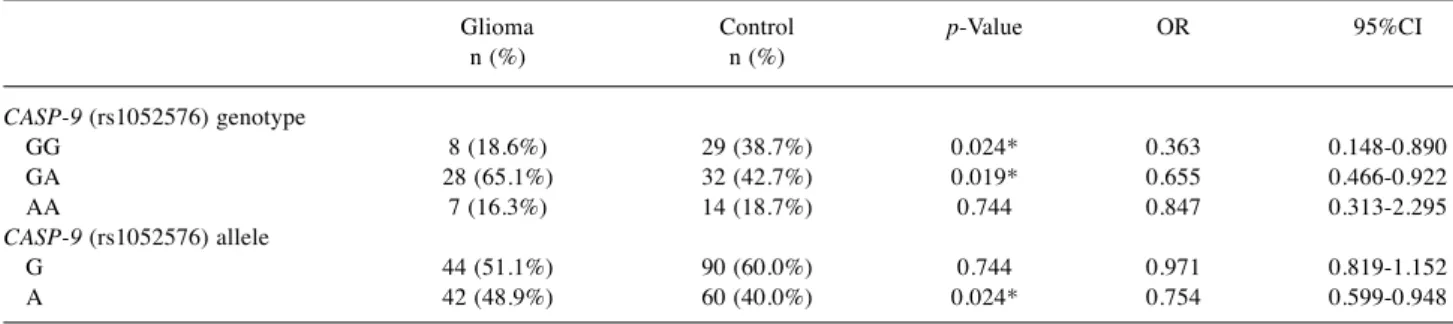
The allele and genotype frequencies for CASP-9 Ex5+32
G>A (rs1052576) polymorphism in patients with glioma and
controls are shown in Table I. CASP-9 Ex5+32 G>A genotype
frequencies between glioma patients and controls were
statistically significant (χ
2=6.305; p=0.043). As shown in
Table I, the frequency of the GG and GA genotype was
significantly higher in the control group than the glioma
patients (χ
2=6.305, p=0.024; OR=0.363, 95%CI=0.148-0.890
and χ
2=5.511; p=0.019; OR=0.655, 95%CI=0.466-0.922)
Although there was no significant difference in G allele
frequency between the study groups (χ
2=0.106; p=0.744), the
frequency of A allele was statistically significantly higher in
the glioma group (χ
2=5.511; p=0.024). Our results indicated
that carrying A allele decreased the glioma risk 0.7 fold
(OR=0.754, 95%CI=0.599-0.948).
The allele and genotype frequencies of CASP-9 Ex5+32
G>A (rs1052576) in patients with meningioma and controls are
given in Table II. GG, GA, and AA genotypes of the patients
with meningioma were 25.9%, 51.9% and 22.2%, respectively,
and the control subjects were 38.7%, 42.7%, and 18.7%,
respectively. The observed genotype frequencies of CASP-9
Ex5+32 G>A (rs1052576) in patients with meningioma and
control groups were in agreement with the Hardy-Weinberg
equilibrium (χ
2=1.412; p=0.493). In addition, there was no
significant difference in CASP-9 Ex5+32 G>A alleles between
the meningioma and control groups (p>0.05).
Discussion
Understanding the molecular mechanisms underlining
primary brain tumors assist to cover the gaps in
apprehending the pathogenesis of this tumor and potentially
provide better prognosis. Several studies have established
that some genetic variants affect the expression or the
activities of various enzymes and are therefore associated
with the cancer risk (21, 22).
Apoptosis is a physiological process regulating programmed
cell death (23). Defects in this mechanism can lead to abnormal
cell growth and proliferation in cancer development (24).
Caspase-9 is a member of the caspases (cysteine-aspartic
protease) family involved in the apoptotic process (25). Altough
some studies have investigated the association of CASP-9 gene
SNPs with cancer risk, results are not clear enough.
The CASP-9 (Ex5+32 G>A, rs1052576) polymorphism
encodes for a glutamine to arginine amino acid change at
codon 221 of the protein (26). The Q221R variant might
induce conformational changes in the molecule, and because
of that may have functional significance (27, 28). However
few studies have evaluated the association between this
polymorphism and cancer risk. Hosgood et al. examined the
A
NTICANCERR
ESEARCH 37: 4997-5000 (2017)association of CASP-9 Ex5+32 G>A polymorphism with
multiple myeloma. They found significantly higher
frequencies of AA and AG genotypes in the control group than
in patients with multiple myeloma (29). Similarly, Lan et al.
showed that CASP-9 rs1052576 polymorphism was
significantly associated with decreased risk for non-odgkin
lymphoma (30). Zhang et al. investigated 2733 neoplasmic
cases and 3352 healthy controls concerning CASP-9 Ex5+32
G>A polymorphism. They suggested that the rs1052576 A
allele might decrease the risk of cancer (31). Yan et al.
performed a meta-analysis of 1668 cancer cases and 2294
healthy controls. A allele of Ex5+32 G>A in the CASP-9 gene
was found to have protective factor for cancer risk in Chinese,
American and Asian populations, but not in the Caucasian
population (32). Conformably, in another meta-analysis, Xu et
al. showed that the A allele of rs1052576 might be a protective
factor for cancer, especially for Asians (33). Previous studies
ensured evidence that this SNP may play important roles in
the prognosis of cancer in various populations,however is
currently unknown for the Turkish population. Additionally,
to the best of our knowledge, no published study previously
investigated the association between this variant in CASP-9
gene and the risk of developing primary brain tumors.
Therefore, the present study is the first to evaluate the
relevance of CASP-9 Ex5+32 G>A functional
polymorphism in the risk of glioma and meningioma.
Similar to other studies, our results demonstrated that the
CASP-9 rs1052576 A allele was at a decreased risk for
glioma development, but no statistical significance for
interaction between CASP-9 gene variant and meningioma
was detected. Since genetic polymorphisms often show
ethnic differences, further functional studies are needed to
evaluate genotype and phenotype correlation in large
cohorts of various ethnicities.
Conflicts of Interest
The Authors declare that they have no financial disclosures or conflicts of interest.
References
1 Bondy ML, Scheurer ME, Malmer B, Barnholtz-Sloanet Jill, Davis FG, Il’yasova Dora, Kruchko C, McCarthy BJ, Rajaraman P, Schwartzbaum JA, Sadetzki S, Schlehofer B, Tihan T, Wiemels JL, Wrensch M and Buffler PA: Brain tumor epidemiology: consensus from the Brain Tumor Epidemiology Consortium. Cancer 113(Suppl 7): 1953-1968, 2008.
2 Fisher JL, Schwartzbaum JA, Wrensch M and Wiemels JL: Epidemiology of brain tumors. Neurol Clin 25(4): 867-890, 2007.
Ozdogan et al: Effects of Genetic Variations of Caspase-9 Gene Ex5+32 G>A (rs1052576) in Brain Tumors
4999 Table I. CASP-9 Ex5+32 G>A (rs1052576) genotype genotype and allelle frequencies in patients with glioma and the control group.
Glioma Control p-Value OR 95%CI n (%) n (%) CASP-9 (rs1052576) genotype GG 8 (18.6%) 29 (38.7%) 0.024* 0.363 0.148-0.890 GA 28 (65.1%) 32 (42.7%) 0.019* 0.655 0.466-0.922 AA 7 (16.3%) 14 (18.7%) 0.744 0.847 0.313-2.295 CASP-9 (rs1052576) allele G 44 (51.1%) 90 (60.0%) 0.744 0.971 0.819-1.152 A 42 (48.9%) 60 (40.0%) 0.024* 0.754 0.599-0.948 N: Number of individuals; OR: odds ratio; CI: confidence interval. *p-Values less than 0.05 denoted statistical significance.
Table II. CASP-9 Ex5+32 G>A (rs1052576) genotype and allelle frequencies in patients with meningioma and the control group.
Meningioma Control p-Value OR 95%CI n (%) n (%) CASP-9 (rs1052576) genotype GG 7 (25.9%) 29 (38.7%) 0.235 1.491 0.742-2.999 GA 14 (51.9%) 32 (42.7%) 0.411 0.823 0.526-1.288 AA 6 (22.2%) 14 (18.7%) 0.690 0.840 0.359-1.964 CASP-9 (rs1052576) allele G 28 (43.7%) 90 (60.0%) 0.690 0.803 0.274-2.359 A 36 (56.3%) 60 (40.0%) 0.235 1.801 0.677-4.791 n: Number of individuals; OR: odds ratio; CI: confidence interval. *p-Values less than 0.05 denoted statistical significance.
3 Goodenberger ML and Jenkins RB: Genetics of adult glioma. Cancer Genet 205: 613-621, 2012.
4 Louis DN, Ohgaki H, Wiestler OD, Cavenee WK, Burger PC, Jouvet A, Scheithauer BW and Kleihues P: The 2007 WHO classification of tumours of the central nervous system. Acta Neuropathol 114: 97-109, 2007.
5 Marosi C, Hassler M, Roessler K, Reni M, Santa M, Mazza E and Vecht C: Meningioma. Crit Rev Oncol Hematol 67(2): 153-171, 2008.
6 Goodenberger ML and Jenkins RB: Genetics of adult glioma. Cancer Genet 205: 613-621, 2012.
7 Ohgaki H and Kleihues P: Epidemiology and etiology of gliomas. Acta Neuropathol 109: 93-108, 2005.
8 Gu J, Liu Y, Kyritsis AP and Bondy ML: Molecular epidemiology of primary brain tumors. Neurotherapeutics 6(3): 427–435, 2009.
9 Wrensch M, Fisher JL, Schwartzbaum JA, Bondy M, Berger M and Aldape KD: The molecular epidemiology of gliomas in adults. Neurosurg Focus 19(5): E5, 2005.
10 Fischer U and Meese E: Glioblastoma multiforme: the role of DSB repair between genotype and phenotype. Oncogene 26(56): 7809-7815, 2007.
11 Raff M: Cell suicide for beginners. Nature 396: 119-122, 1998. 12 Hajra KM and Liu JR: Apoptosome dysfunction in human
cancer. Apoptosis 9(6): 691-704, 2004.
13 Hengartner MO: The biochemistry of apoptosis. Nature 407: 770-776, 2000.
14 Kumar S: Caspase function in programmed cell death. Cell Death Differ 14: 32-43, 2007.
15 Nicholson DW and Thornberry NA: Caspases: killer proteases. Trends Biochem Sci 22: 299-306, 1997.
16 Thornberry NA: The caspase family of cysteine proteases. Br Med Bull 53: 478-490, 1997.
17 Shiozaki EN, Chai J, Rigotti DJ, Riedl SJ, Li P, Srinivasula SM, Alnemri ES, Fairman R and Shi Y: Mechanism of XIAP-mediated inhibition of caspase-9. Mol Cell 11: 519-527, 2003. 18 Bian X, Giordano TD, Lin HJ, Solomon G, Castle VP and
Opipari Jr. AW: Chemotherapy-induced apoptosis of S-type neuroblastoma cells requires caspase-9 and is augmented by CD95/Fas stimulation. J Biol Chem 279: 4663-4669, 2004. 19 https://www.ncbi.nlm.nih.gov/pubmed/?term=caspase+9
+polymorphism
20 Kleihues P and Cavenee WB: In World Health Organization Classification of Tumors: Pathology and Genetics: Tumors of the nervous system. IARC Press: Lyon. 6-7, 2000.
21 Wang YX, Zhao L, Wang XY, Liu CM and Yu SG: Role of Caspase 8, Caspase 9 and Bcl-2 polymorphisms in papillary thyroid carcinoma risk in Han Chinese population. Med Oncol 29(4): 2445-2451, 2012.
22 Theodoropoulos GE, Gazouli M, Vaiopoulou A, Leandrou M, Nikouli S, Vassou E, Kouraklis G and Nikiteas N: Polymorphisms of caspase 8 and caspase 9 gene and colorectal cancer susceptibility and prognosis. Int J Colorectal Dis 26(9): 1113-1118, 2011.
23 Thompson CB: Apoptosis is the pathogenesis and treatment of disease. Science 267: 1456-1462, 1995.
24 Ter-Minassian M, Zhai R, Asomaning K, Li Su, Zhou W, Liu G, Heist RS, Lynch TJ , Wain JC, Lin X , DeVivo I and Christianiet DC: Apoptosis gene polymorphisms, age, smoking and the risk of non-small cell lung cancer. Carcinogenesis 29(11): 2147-2152, 2008.
25 Lee SY, Choi YY, Choi JE, Kim MJ, Kim JS, Jung DK, Kang HG, Jeon HS, Lee WK, Jin G, Cha SI, Kim CH, Jung TH and Park JY: Polymorphisms in the caspase genes and the risk of lung cancer. J Thorac Oncol 5(8): 1152-1158, 2010.
26 Hirano A, Nagai H, Harada H, Haga S, Kajiwara T and Emi M: Two novel single-nucleotide polymorphisms of the Caspase-9 (CASP9) gene in the Japanese population. Genes Immun 2: 117-118, 2001.
27 Kesarwani P, Mandal RK, Maheshwari R and Mittal RD: Influence of caspases 8 and 9 gene promoter polymorphism on prostate cancer susceptibility and early development of hormone refractory prostate cancer. BJU Int 107(3): 471-476, 2011. 28 Andreoli V, Trecroci F, La Russa A, Valentino P, Condino F, V
Latorre, R Nisticò, D Pirritano, Del Giudice F, Canino M, Cittadella R and Quattrone A: CASP-9: A susceptibility locus for multiple sclerosis in Italy. J Neuroimmunol 210: 100-103, 2009. 29 Hosgood HD 3rd, Baris D, Zhang Y, Zhu Y, Zheng T, Yeager M,
Welch R, Zahm S, Chanock S, Rothman N and Lan Q: Caspase polymorphisms and genetic susceptibility to multiple myeloma. Hematol Oncol 26(3): 148-151, 2008.
30 Lan Q, Zheng T, Chanock S, Zhang Y, Shen M, Wang SS, Berndt SI, Zahm SH, Holford TR, Leaderer B, Yeager M, Welch R, Hosgood D, Boyle P and Rothman N: Genetic variants in caspase genes and susceptibility to non-Hodgkin lymphoma. Carcinogenesis 28: 823-827, 2007.
31 Zhang ZY, Xuan Y, Jin XY, Tian X and Wu R: CASP-9 gene functional polymorphisms and cancer risk: a large-scale association study plus meta-analysis. Genet Mol Res 12(3): 3070-3078, 2013.
32 Yan S, Li YZ, Zhu XW, Liu CL, Wang P and Liu YL: Role of the CASP-9 Ex5+32 G>A polymorphism in susceptibility to cancer: A meta-analysis. Exp Ther Med 5(1): 175-180, 2013. 33 Xu W, Jiang S, Xu Y, Chen B, Li Y, Zong F, Zhao W and Wu J: A
meta-analysis of caspase 9 polymorphisms in promoter and exon sequence on cancer susceptibility. PLoS One 7(5): e37443, 2012.