Dumlupınar Üniversitesi Sosyal Bilimler Dergisi, 64, 38-52; 2020
38
WEBSITE PERFORMANCES OF COMMERCIAL BANKS IN TURKEY Mustafa ÖZDEMIR Gülçin BİLGİN TURNA2
Abstract
The purpose of this paper is to measure the performances of commercial banks’ websites in Turkey by using “Multi-Criteria Decision Making” (MCDM). The use of three MCDM methods (AHP, TOPSIS, VIKOR) consecutively constitutes the originality of this study. Based on the literature and expert opinions, 6 performance criteria (load time, page speed, markup, speed index, visitors, pageviews) and 5 website analysis tools were determined. First, the significance weights of the criteria were calculated with AHP (Analytical Hierarchy Process). Second, the data obtained in the 2-month period were analyzed by TOPSIS (Technique for Order Preference by Similarity to Ideal Solution) and VIKOR (Vise Kriterijumska Optimizacija I Kompromisno Resenje) methods. “Page speed” was found to be the most important criterion in performance of banks’ websites. Most successful banks in terms of website efficiency are Garanti BBVA, Isbank and QNB Finansbank according to TOPSIS whereas QNB Finansbank, Garanti BBVA and Halkbank according to VIKOR results. It is observed that banks with high deposits and number of branches and employees do not show the same success in website performance. The results are expected to shed light on managers who want to set policies and strategies for digital banking applications.
Keywords: Bank marketing, online banking, Turkish commercial banks, MCDM, TOPSIS, VIKOR JEL Codes: C69, M31
TÜRKİYE’DEKİ TİCARİ BANKALARIN WEB SİTESİ PERFORMANSLARI
Öz
Bu çalışmanın amacı, “Çok Kriterli Karar Verme” (ÇKKV) yöntemlerini kullanarak, Türkiye’deki ticari bankaların web sitesi performanslarını ölçmektir. Bu kapsamda üç ÇKKV yönteminin (AHP, TOPSIS, VIKOR) bir arada kullanılması, çalışmanın özgünlüğünü oluşturmaktadır. Literatüre ve uzmanların görüşlerine dayanarak, 6 performans kriteri (yükleme süresi, sayfa hızı, biçimlendirme, hız endeksi, ziyaretçiler, sayfa görünümleri) ve 5 web sitesi analiz aracı belirlenmiştir. Çalışmanın ilk aşamasında AHP (Analitik Hiyerarşi Süreci) yöntemi ile kriterlerin önem ağırlıkları hesaplanmıştır. İkinci aşamada, 2 aylık periyotta elde edilen verilerin TOPSIS (Technique for Order Preference by Similarity to Ideal Solution) ve VIKOR (Vise Kriterijumska Optimizacija I Kompromisno Resenje) yöntemleri ile analizi yapılmıştır. Bulgulara göre, “sayfa hızı” değişkeninin, banka web sitelerinin performans değerlendirmesinde en önemli kriter olduğu saptanmıştır. TOPSIS yönteminde Garanti BBVA, İş Bankası ve QNB Finansbank web sitesi performansında en başarılı Türk ticari bankaları olmuştur. VIKOR yöntemine göre ise QNB Finansbank, Garanti BBVA ve Halkbank en başarılı bankalardır. Mevduat hacmi büyük, şube ve çalışan sayısı yüksek olan bankaların, web sitesi performansında aynı başarıyı göstermedikleri gözlemlenmiştir. Elde edilen sonuçların, dijital bankacılık uygulamalarına yönelik politika ve strateji belirlemek isteyen yöneticilere ışık tutması beklenmektedir.
Anahtar kelimeler: Banka pazarlaması, Türk ticari bankaları, web site performansı, ÇKKV, TOPSIS, VIKOR JEL Kodları: C69, M31
Bu çalışma, 27-28 Nisan 2018 tarihinde Uluslararası EMI Girişimcilik ve Sosyal Bilimler Kongresi’de sunulan “Türkiye’deki Bankaların Web Sitelerinin Performanslarının Çok Kriterli Karar Verme (ÇKKV) Yöntemleri ile Değerlendirilmesi” başlıklı yayınlanmamış bildirinin genişletilmiş halidir.
Öğr. Gör. Artvin Çoruh Üniversitesi, Arhavi MYO, ORCID 0000-0002-6591-2858 Sorumlu Yazar (Corresponding Author): [email protected]
2 Dr. Öğr. Üyesi, Recep Tayyip Erdoğan Üniversitesi, İİBF, ORCID 0000-0003-1684-6548 Başvuru Tarihi (Received): 02.09.2019 Kabul Tarihi (Accepted): 27.03.2020
39 Introduction
Dramatic changes in the technological developments for online banking have influenced both consumers and banking sector. Many banks have realized that most of the services they offer in the physical environment are also applicable on their websites. Banks’ websites have become an integral part of their business processes allowing fast, convenient and traceable transactions. Website of a banking company is important to actualize its mission and vision and achieve superiority. Therefore, bank managers have to measure the level of customer satisfaction, position in the sector, determine whether the organization is succesful for both themselves and shareholders in order to outperform their competitors. Problematic areas need to be defined by real data and relevant improvements should be made on banks’ websites.
Customers conduct financial transactions via banks’ secure websites. Low operating costs, easier and faster transactions regardless of time and location (Chou & Chou, 2000; Jayawardhena & Foley, 2000) are some advantages of online banking. The quality of the website is vital when it comes to build “long-term relationships” with the stakeholders. MCDM is one of the methods that can be used in the determination and valuation of the characteristics of banks’ websites. MCDM is also a developing area in evaluating multiple dimensions of some problems (Shee & Wang, 2008; Turskis et al., 2009). Websites have been evaluated in some sectors by using MCDM; however, there have been a few studies in the literature for banks’ websites. This study’s contribution to the literature is that, three methods (AHP, TOPSIS and VIKOR) are used consecutively in order to obtain quantitative results for the performace of banks’ websites. There are many studies carried out by different methods to measure banks’ financial performances. “DEA: Data Development Analysis” was used by Bauer et al. (1998), Mercan et al. (2003), Isik (2003), Lin and Zhang (2009) to examine the impact of ownership on bank performance. Parkan and Wu (1999) compared DEA with “OCRA: Operational Competitiveness Rating Procedure” to measure banks’ capabilities. Kaya (2001) conducted a performance analysis of Turkish Banking Sector through a method called “CAMELS: capital adequacy, assets, management capability, earnings, liquidity, and sensitivity” rating system. Beccalli (2007) examined the relation between bank performances and the investments by investigating the data of 737 banks that operate within the EU (European Union) between years 1995–2000 where he measured banks performances by “financial rate, cost, profitability and productivity”. He found out that the relation between banks’ performances and the investments was lower than expected. Vivas et al. (2001) investigated the performances of banks in EU and the impacts of environmental factors on performance.
There are some factors that have been mentioned in many studies in website development. One of them is “relevance” which means that in order to meet the needs of different groups of visitors, different parts of the websites should be designed accordingly (Lee & Kozar, 2006; Tsai et al., 2010). “Service quality” refers to the website’s overall support. (Ahn et al., 2007; Chou & Cheng, 2012). “Reliability” focuses on website’s accuracy and dependability (Negash et al., 2003). “Assurance” involves the ability of the personnel’s knowledge and courtesy (Zhou et al., 2009). “Understandability” means clearness of the information (Chou & Cheng, 2012). “Richness” refers to the level of details given in terms of information content (Bilsel et al., 2006). “Empathy” means how a website provides individualized information (Cao et al., 2005). “Accessibility” evaluates not only information can be accessed efficiently, but also the ability of a website to be accessed by disabled users (Smith, 2001; Mohanty et al., 2007). “Navigability” measures the simplicity to navigate around the website and find relevant information (Miranda-Gonzalez & Banegil-Palacios, 2004; Tsai et al., 2010). “Response time” is also an important factor to increase system quality because online users are impatient and unwilling to wait (even for a few seconds) for a response (Lee & Kozar, 2006). Chou and Cheng (2012) claimed that the most important five criteria for website quality are “assurance, richness, understandability, reliability and relevance”.
40
There are some AHP-based studies (Lee et al., 1995; Frei & Harker, 1999; Suwignjo et al., 2000; Wang et al., 2004) on performance evaluations of credit evaluation analyses and the performance of production departments. Albayrak and Erensal (2005) analyzed both financial and non-financial performance criteria for the performance evaluation of Turkish banks using fuzzy AHP. Secme et al. (2009) also proposed a fuzzy MCDM to evaluate the performances in terms of several financial and non-financial indicators of the largest five commercial banks of Turkish Banking Sector by integrating fuzzy AHP and TOPSIS. The results revealed that both financial performance and non-financial performance should be taken into consideration in order to come up with meaningful results.
Customer satisfaction is a very important factor especially for service organizations (Cronin & Taylor, 1994; Spreng & MacKoy, 1996; Krishnan et al., 1999; Hussain et al., 2002; Wang et al., 2003) such as banks. In order to generate a positive customer value, effective evaluation of website quality is needed (Jayawardhena, 2004; Bauer et al., 2005; Lee & Chung, 2009; Kaya & Kahraman, 2011). For website evaluation, different techniques have also been employed such as
“PROMETHEE: preference ranking organization method for enrichment evaluation” (Bilsel et
al., 2006), Fuzzy VIKOR (Buyukozkan et al., 2007), Fuzzy AHP (Buyukozkan & Ruan, 2007) and Fuzzy TOPSIS (Law, 2007), “DEMATEL: decision-making trial and evaluation laboratory” (Tsai et al., 2010), and content analysis (Wan, 2002; Cai et al., 2004; Baloglu & Pekcan, 2006; Kasli & Avcikurt, 2008). Chou and Cheng (2012) found out that the top five criteria for website quality are “richness, understandability, assurance, relevance, and reliability”. Tsai et al. (2010) proposed a hybrid model for evaluating national park websites in Taiwan. In their study, they used DEMATEL to cope with the interdependencies between evaluation criteria. Next, they used ANP
(Analytic Network Process) to compute weights for each criterion. Finally, VIKOR was used to
rank the websites.
Aladwani (2001) considered potential customers’ and senior and IT managers’ persepctives to quantify to what degree an issue is important. At the time, 50 percent of the banks offered online banking services at the time; the rest had a system under development. “Bank’s reputation, customer privacy, Internet security and online banking regulations” were found out to be the most important future challenges of online banking adoption. Lee and Kozar (2006) applied AHP for the evaluation of travel websites. Different weights of each website quality factor were identified along with the priority of alternative websites. Buyukozkan et al. (2007) measured the performance of e-learning websites by investigating ten worldwide and eleven local websites according to seven criteria with Fuzzy VIKOR. Buyukozkan and Ruan (2007) ranked thirteen Turkish government websites according to 6 criteria by using Fuzzy AHP and Fuzzy TOPSIS. Kaya and Kahraman (2011) used an integrated fuzzy “AHP-ELECTRE: Elimination Et Choix Traduisant la Realité” approach for e-banking website quality assessment. Kasli and Avcikurt (2008), Baloglu and Pekcan (2006), and Cai et al. (2004) performed content analysis including a measurement variable of yes/no in order to analyze the websites of tourism departments at universities, tour operators and hotels.
This paper is organized as follows: literature review and online transactions and banking sector in Turkey are explained at first. After presenting the methodology of the research, AHP, TOPSIS and VIKOR results are given. Lastly, conclusions are given along with the suggestions for future studies.
1. Online Transactions and Banking in Turkey
Turkish banks operate within 25 countries. Number of cross border financial institutions is 145: there are 33 banks, 25 non-bank financial institutions, 77 branches and 10 representative offices (Banking Regulation and Supervision Agency, 2018: 2). The banking sector is one of the fastest growing sectors in Turkey. As of December 2017, banks employed 208.000 people. In Turkey,
41
there is one bank with an asset size of more than $100 billion, there are 4 banks with an asset size of between $80 billion and $100 billion, 2 banks with an asset size of between $40 billion and $80 billion, and 35 banks with an asset size below $10 billion (The Banks Association of Turkey, 2018: 16-17).
Internet banking started in the United States in 1996 (Sanli & Hobikoglu, 2015). In Turkey, Turkiye Is Bank also was the first and Garanti Bank was the second bank to introduce Internet banking services in 1997. Turkiye Is Bank was also the first bank in Turkey to introduce automated teller machines (ATMs) in 1987 and point of sale (POS) terminals in 1997 along with telephone banking and Internet banking (Polatoglu & Ekin, 2001). Since 2011, Turkish financial sector also has an aim to create “cashless society” until 2023. This idea arises from the technological improvements in payment systems such as contactless payment systems and digital wallets (Ozdemir, 2014).
In Turkey, payment environment is driven by a technologically-aware population. Internet penetration was more than 50% and smartphone penetration was almost 30% as of 2017. The e-commerce market in Turkey is growing with a market size of about $2,9 billion in 2015; 10,2 billion in 2016; 11,6 billion in 2018 (TUBISAD, 2018). Mobile payments realized to be 4 times higher by the end of the period from 2015-2019. Main driver of this growth is transferring money within Turkey. Shopping on international websites was about $1.5 billion in 2015. For online payments, Turkish people prefer credit cards to make installments over other payment methods, which is very different than other European countries. Turkish people can instantly shop free with the bonus they have earned by using their credit cards or save them up for their next free shopping. They can shop on installments, and continue to earn bonus while they enjoy the convenience of paying in installments. In Turkey, “synchronous” payment systems are also widely adopted which means transactions are completed with increased security and speed with a 24/7 availability. Therefore, Turkey became a highly attractive market for Internet banking (Thalhammer, 2017). In the world, mobile banking has grown three times faster than online commerce. Turkey was ranked the third in the world for online purchases made from a mobile device followed by China and United Arab Emirates. According to a 2015 Banco Bilbao Vizcaya Argentaria (BBVA) high percentage of youth leads to a healthy financial sector, a high percentage of mobile phone users and a large number of credit card transactions. Compared to other European countries, Turkey had the highest percentage of Internet users (65%) who use digital banking. 84% of the users have used their mobile device to make purchases in 2015 (Mendez, 2016).
Turkish banks are very quick to adopt digital technologies. Ziraat Bank has a network of unstaffed video kiosks (video teller machines) using video-conferencing to connect customers with agents. DenizBank became the first bank in the world in 2012 by letting the customers access their deposit and credit card accounts via Facebook. DenizBank lets prospects apply for a credit through its @DenizKredi account on Twitter. Isbank has developed IsPad which is an application offering functionality such as access to payments and retirement planning tools. Isbank uses biometric authentication on 2.400 ATMs and in Turkey, which let its customers withdraw cash by using their fingerprint image without the need for a card (Ensor, 2012).
2. Website Performances of Turkish Banks 2.1. Method
The performances of the Turkey’s first 10 commercial banks are analyzed in this study by using MCDM methods. These banks are selected for this study due to their deposit size declared by Turkish Banking Association. The weights of the evaluation criteria are determined with the AHP. The determined criteria weights are used in the TOPSIS and VIKOR methods of MCDM techniques to evaluate and compare banks’ website performances.
42
The MCDM methods VIKOR and TOPSIS are both representing “closeness to the ideal”. VIKOR presents the ranking index based on “closeness” to the ideal solution. On the contrary, TOPSIS method’s principle is that the chosen alternative should have the “shortest distance” from the ideal solution and the “farthest distance” from the “negative-ideal” solution. VIKOR uses linear normalization whereas TOPSIS uses vector normalization. The normalized value in VIKOR does not depend on the evaluation unit of a criterion function. However, the normalized values by vector normalization in TOPSIS method depend on the evaluation unit (Opricovic & Tzeng, 2004). 2.2 Preparation of Data
10 criteria were set for evaluating bank website performance. By taking experts’ opinions, the number of criteria has been reduced to 6. Experts are 5 people, consisting of 2 web designers, 2 computer engineers and 1 academic in the field of nanaging information systems, and they are independent of each other. The criteria and explanations are shown below:
Criteria Definition
Load Time (C1) It refers to the time required to display a web page. The low load time positively affects the performance of the page. Therefore, load time generates “cost”. The unit is the second(s).
Page Speed (C2) Google and Yahoo via the speed of the page given the speed. High score means high speed. Therefore, page speed generates “benefit”. The unit is a percentage (%). Markup (C3) It is utilized to assess and calculate the number of HTML errors, which exist on the website, such as coding errors (Vatansever and Akgul, 2018). The low number of markups affects page performance positively. Therefore, markup generates “benefit”. The unit is the quantity.
Speed Index (C4) It refers to the average viewing time of the visual parts of the page. Low value affects page performance positively (Google WebPagetest Documentation, 2018). Therefore, speed index generates “cost”. The unit is milliseconds.
Visitors (C5) It expresses how many different people visited the page. The higher the number, the better the performance of the page. Therefore, visitors generate “benefit”. The unit is the quantity.
Pageviews (C6) It expresses how many times the page is displayed. The higher the number, the better the performance of the page. Therefore, it is evaluated as a benefit criterion. The unit used is the quantity.
Five website analysis tools are shown below: Criteria Website Analysis Tools
Load Time (C1) https://tools.pingdom.com, www.webpagetest.org
Page Speed (C2) https://gtmetrix.com
Markup (C3) http://validator.w3.org
Speed Index (C4) www.webpagetest.org
Visitors (C5) http://website.informer.com
Pageviews (C6) http://website.informer.com
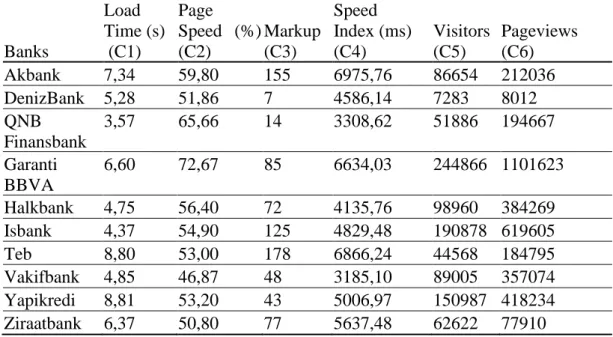
Benchmark values are obtained several times over the 60-day period in 2018 by using website analysis tools. The arithmetic average of the multiple data is obtained. The data is gathered on the same connection device at the same time of the day. The data set (decision matrix) is shown in Table 1.
43 Table 1: Decision Matrix
Banks Load Time (s) (C1) Page Speed (%) (C2) Markup (C3) Speed Index (ms) (C4) Visitors (C5) Pageviews (C6) Akbank 7,34 59,80 155 6975,76 86654 212036 DenizBank 5,28 51,86 7 4586,14 7283 8012 QNB Finansbank 3,57 65,66 14 3308,62 51886 194667 Garanti BBVA 6,60 72,67 85 6634,03 244866 1101623 Halkbank 4,75 56,40 72 4135,76 98960 384269 Isbank 4,37 54,90 125 4829,48 190878 619605 Teb 8,80 53,00 178 6866,24 44568 184795 Vakifbank 4,85 46,87 48 3185,10 89005 357074 Yapikredi 8,81 53,20 43 5006,97 150987 418234 Ziraatbank 6,37 50,80 77 5637,48 62622 77910
Best performances belong to QNB Finansbank in terms of load time; Garanti BBVA in terms of page speed, visitors and pageviews; DenizBank in terms of markup; and Vakifbank in terms of speed index.
2.3. Findings
2.3.1. The Calculation of the Weights of the Criteria bu Using the AHP
The weights of the criteria evaluated by the experts are calculated by Analytical Hierarchical Process (AHP) method as shown in Table 2. Super Decisions Program is used in the calculation process. The consistency indicator (CI) is 0,3 and is acceptable.
Table 2: Criteria Weights Load Time (s) (C1) Page Speed (%) (C2) Markup (C3) Speed Index (ms) (C4) Visitors (C5) Pageviews (C6) Ʃ w 0,267 0,299 0,089 0,133 0,056 0,154 1,000
Page speed is found to be the most important criterion.
2.3.2. Performance Evaluation with TOPSIS
Criteria weights are ranked according to bank website performances by TOPSIS after being calculated by AHP. In the first step, normalization of Table 1 decision matrix is performed by equation 1.
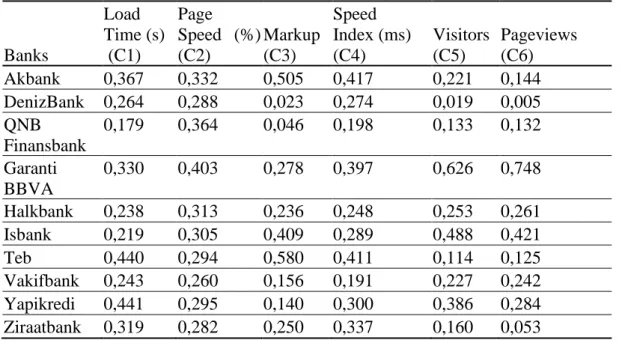
nij = xij /√∑𝑚𝑗=1𝑥𝑖𝑗2 j = 1, . . . ,m, i = 1. . . ,n. (1) Bigger values are better because page speed, visitor and page view criteria are beneficial. Smaller values are better because load time, mark up and speed index are cost-oriented (Vatansever & Akgul, 2018).
44 Table 3: Normalized Decision Matrix
Banks Load Time (s) (C1) Page Speed (%) (C2) Markup (C3) Speed Index (ms) (C4) Visitors (C5) Pageviews (C6) Akbank 0,367 0,332 0,505 0,417 0,221 0,144 DenizBank 0,264 0,288 0,023 0,274 0,019 0,005 QNB Finansbank 0,179 0,364 0,046 0,198 0,133 0,132 Garanti BBVA 0,330 0,403 0,278 0,397 0,626 0,748 Halkbank 0,238 0,313 0,236 0,248 0,253 0,261 Isbank 0,219 0,305 0,409 0,289 0,488 0,421 Teb 0,440 0,294 0,580 0,411 0,114 0,125 Vakifbank 0,243 0,260 0,156 0,191 0,227 0,242 Yapikredi 0,441 0,295 0,140 0,300 0,386 0,284 Ziraatbank 0,319 0,282 0,250 0,337 0,160 0,053
By using equation 1, values in the decision matrix were normalized as shown in Table 3. The objective is to provide homogeneity and reduce the values to 0-1 in order to use MCDM. Weighted decision matrix in Table 4 is constructed from the normalization decision matrix by using equation 2 with the criterial weights obtained from the AHP method.
vij = wi nij, j = 1, . . . ,m; i = 1, . . . ,m. (2)
Table 4: Weighted Decision Matrix
Banks Load Time (s) (C1) Page Speed (%) (C2) Markup (C3) Speed Index (ms) (C4) Visitors (C5) Pageviews (C6) Akbank 0,09812 0,09923 0,04493 0,05552 0,01240 0,02216 DenizBank 0,07058 0,08606 0,00203 0,03650 0,00104 0,00084 QNB Finansbank 0,04766 0,10895 0,00407 0,02633 0,00743 0,02035 Garanti BBVA 0,08820 0,12058 0,02471 0,05280 0,03505 0,11515 Halkbank 0,06354 0,09359 0,02105 0,03292 0,01416 0,04017 Isbank 0,05848 0,09110 0,03639 0,03844 0,02732 0,06476 Teb 0,11760 0,08795 0,05158 0,05465 0,00638 0,01932 Vakifbank 0,06488 0,07777 0,01389 0,02535 0,01274 0,03732 Yapikredi 0,11781 0,08828 0,01242 0,03985 0,02161 0,04372 Ziraatbank 0,08517 0,08430 0,02229 0,04487 0,00896 0,00814
By using equations 3 and 4, positive (A+) and negative (A-) ideal solution values are obtained for
each criterion as shown in Table 5.
A+ = {𝑣
1+, . . . , 𝑣𝑛+} = {(max
45
A+ = {𝑣1−, . . . , 𝑣𝑛−} = {(min
𝑗 𝑣𝑖𝑗|𝑖 ∈ 𝐼) , (max𝑗 𝑣𝑖𝑗|𝑖 ∈ 𝐽𝐼)}, (4)
Positive value shows the best performance whereas negative value shows the worst. Table 5: (A+) and (A-) values
Load Time (s) (C1) Page Speed (%) (C2) Markup (C3) Speed Index (ms) (C4) Visitors (C5) Pageviews (C6) A+ 0,04766 0,12058 0,00203 0,02535 0,03505 0,11515 A- 0,11781 0,07777 0,05158 0,05552 0,00104 0,00084
The distinction of each alternative from the positive ideal solution and the negative ideal solution is obtained by using equations 5 and 6. The ideal solution relative closeness of the alternatives is calculated by equation 7. 𝑆𝑗+ = {∑𝑛𝑖=1(𝑣𝑖𝑗 − 𝑣𝑖+) 2 } 12 , j = 1, . . . , m. (5) 𝑆𝑗− = {∑𝑖=1𝑛 (𝑣𝑖𝑗 − 𝑣𝑖−)2} 12 , j = 1, . . . , m. (6) 𝐶𝑗 = 𝑑𝑗 −/ (𝑑𝑗++ 𝑑𝑗−), j = 1, . . . , m. (7)
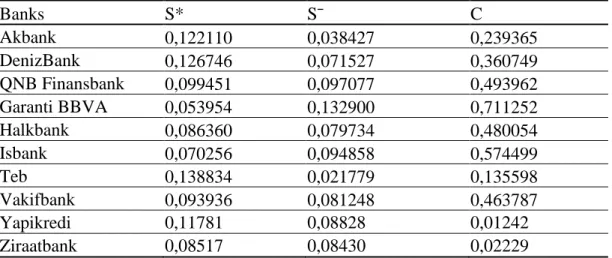
S* value is the distance from the positive ideal solution to the separation distance, S¯ value is the distance from the negative ideal solution to the separation distance and C value shows the ideal solution relative closeness. Alternative sorting has been done in decreasing order of C value. The highest C value indicates the best performing alternative (Garanti BBVA) for the TOPSIS method. Best performance belongs to Garanti BBVA as shown in Table 6.
Table 6: TOPSIS Results
Banks S* S¯ C Akbank 0,122110 0,038427 0,239365 DenizBank 0,126746 0,071527 0,360749 QNB Finansbank 0,099451 0,097077 0,493962 Garanti BBVA 0,053954 0,132900 0,711252 Halkbank 0,086360 0,079734 0,480054 Isbank 0,070256 0,094858 0,574499 Teb 0,138834 0,021779 0,135598 Vakifbank 0,093936 0,081248 0,463787 Yapikredi 0,11781 0,08828 0,01242 Ziraatbank 0,08517 0,08430 0,02229
2.3.3. Performance Evaluation with VIKOR
When the alternatives are evaluated by VIKOR, the best fi* and worst fi¯ values for each criterion are first determined from the decision matrix in Table 1. Equation 8 is used for the benefit criteria, and equation 9 is used for the cost criteria.
𝑓𝑖∗ = max
𝑗 𝑓𝑖𝑗, 𝑓𝑖
− = min
46
𝑓𝑖∗ = min
𝑗 𝑓𝑖𝑗, 𝑓𝑖
− = max
𝑗 𝑓𝑖𝑗, if the i-th function represents a cost; (9)
Table 7 shows the best (fi*) and the worst (fi¯) values for each criteria in the decision matrix. Table 7: fi* and fi¯ values
Load Time (s) (C1) Page Speed (%) (C2) Markup (C3) Speed Index (ms) (C4) Visitors (C5) Pageviews (C6) fi* 3,57 72,67 7 3185,10 244866 1101623 fi¯ 8,81 46,87 178 6975,76 7283 8012
The Sj and Rj values representing the mean and worst group scoring of each alternative are calculated by using equations 10 and 11. After finding the maximum and minimum Sj and Rj values, the Qj value of the alternatives is calculated by using equation 12.
Sj = ∑𝑛𝑖=1𝑤𝑖(𝑓𝑖∗ − 𝑓𝑖𝑗)/(𝑓𝑖∗ − 𝑓𝑖− ), (10) Rj = max 𝑖 [𝑤𝑖(𝑓𝑖 ∗ − 𝑓 𝑖𝑗)/(𝑓𝑖∗ − 𝑓𝑖− )], (11) Qj = 𝑣(𝑆𝑖 − 𝑆∗)/(𝑆− − 𝑆∗ ) + (1 − 𝑣) (𝑅𝑖− 𝑅∗)/(𝑅− − 𝑅∗ ), (12)
Consensus is determined for the application and v value of 0.5 was taken. Table 8: Sj, Rj and Qj values
Banks Sj Rj Qj v=0,5 Akbank 0,71376 0,19203 0,54815 DenizBank 0,58749 0,24111 0,59058 QNB Finansbank 0,26244 0,12772 0,00000 Garanti BBVA 0,31603 0,15428 0,12032 Halkbank 0,45188 0,18852 0,32876 İşbank 0,44709 0,20590 0,37568 Teb 0,88857 0,26618 0,90419 Vakifbank 0,52740 0,29900 0,71158 Yapikredi 0,69354 0,26700 0,75084 Ziraatbank 0,70570 0,25342 0,72090 DQ = 1 / (1-Alternative Quantity) (13)
In Table 8, Sj values show average groups scores, Rj values show the worst group scores for each bank. v=0,5 shows that group benefit and regret are equally considered. S, R and Q values are sorted increasingly. According to VIKOR method, lowest Qj means the best performance. For that two conditions must be valid: first condition (0,12032 − 0,00000 ≥ 1/9) is that when lowest Qj value (0,0000) is subtracted from the second lowest Qj value (0,12032), it must be equal or higher than DQ value (equation 13). Second condition is that the bank with the lowest Qj value (QNB Finansbank) must also have the lowest Sj and Rj values in Table 8. Both conditions are valid so QNB Finansbank has the best performance according to VIKOR results.
47 3. Conclusion
In this study, performance criteria for websites are determined and evaluated in light of mentioned criteria. Data is analyzed according to two different MCDM methods. The results of the analysis show that when TOPSIS is used, best website performance belong to Garanti BBVA, Isbank and QNB Finansbank, respectively (according to C values as shown in Table 6). When VIKOR is used, best website performance belongs to QNB Finansbank, Garanti BBVA and Halkbank, respectively (as shown in Table 8). Ranking results are close to each other despite two different methods and transactions. However, Ziraatbank, which is the first bank in terms of deposit sizes, could not show the same success in the website performance rankings. This might be because of the fact that Ziraatbank’s target customers are mainly farmers and retired people.
Ecer’s study (2014) aimed to find the best bank website in Turkey by using AHP method to determine the weights of the website evaluation criteria. He found that the websites of Garanti Bank, TEB and Ziraat Bank are the best whereas the websites of Anadolubank, Tekstil Bank and Turkish Bank are the worst in Turkey. Information quality (relevance and richness) and system quality (navigability and response time) were found to be the most important factors for website evaluation. According to the results of this paper, the AHP based on the expert opinion, the most important criterion for evaluating website performance is the page speed (0,299). Given the decision matrix of the data obtained, the Garanti BBVA has the best performance in page speed (72.67%), visitor and pageview. QNB Finansbank has the best performance in load time (3,57 seconds), DenizBank at markup (7 count) and Vakifbank at speed index (3185,10). “Time” is also the most important factor according to Pala and Kartal’s study (2010) where they measured the 196 online banking users’ attitudes towards Turkish banks. In Cetin and Cetin’s study (2010), Garanti BBVA has the highest rate among thirteen commercial banks in Turkey according to the financial ratios in 2008.
This study’s results are expected to shed light on decision makers in the banking sector in order to gain competitive advantage by website effectiveness. Bank management can benefit the findings of this study as a guide for the development of their website. Moreover, banks with high website performance can be used by other banks as a benchmark. Improved websites will allow customers to conduct faster, more convenient and efficient transactions in online banking.
Website performance structure is dynamic and variable. The speed of Internet connection and network density, which affect performance and cannot be controlled, constitute the constraints of this study. The study is also limited to a two-month period in 2018. For future studies, it is suggested to increase the number of criteria that are taken into consideration and to carry out different studies by obtaining the data in a longer time. It can also be compared with the results in this study using different methods. Furthermore, it can generate suprising results to compare the participation banks, which operate based on Islamic principles in Turkey with commercial banks in terms of their profit shares and interest rates (Gun, 2015) as well as their websites. Given the dynamic nature of Internet banking, it is possible to obtain different data in different time periods. This study can be repeated at regular intervals and the results obtained can be compared with the previous results. This study can also be applied for mobile banking in the future studies.
“A pneumonia of unknown cause detected in Wuhan, China was first reported to the WHO (World Health Organization) Country Office in China on 31 December 2019. The outbreak was declared a Public Health Emergency of International Concern on 30 January 2020. On 11 February 2020, WHO announced a name for the new coronavirus disease: COVID-19. Coronavirus disease (COVID-19) is an infectious disease caused by a new virus. It causes respiratory illness (like the flu) with symptoms such as a cough, fever, and in more severe cases, difficulty breathing. Coronavirus disease affects especially elderly and is highly contagious that spreads primarily
48
through contact with an infected person when they cough or sneeze. It also spreads when a person touches a surface or object that has the virus on it, then touches their eyes, nose, or mouth. People can protect themselves by washing their hands frequently, avoiding touching their face, and avoiding close contact (at least 1 meter) with people who are unwell”. Coronavirus disease (COVID-19) is a pandemic which means it has spread across worldwide. As of April 6th 2020, there are 1,3 million confirmed cases (the number of people diagnosed with the new coronavirus), 70 thousand deaths, and 270 thousand people who recover from it all around the world. In Turkey there are 27 thousand confirmed cases, 574 deaths and 1 thousand recovered people (WHO, April 6th 2020). What’s more, in Turkey people between 20 and 65 years of age are not allowed to go out and the rest are adviced to stay at home not to get infected. Banks are open between 12.00 and 17.00. As a result, the outbreak of “COVID-19” had led to an increase in using contactless payments and Internet banking. Therefore, bank managers need to be much more sensible about bank marketing via website efficiency.
References
Ahn, T., Ryu, S., & Han, I. (2007). The impact of web quality and playfulness on user acceptance of online retailing. Information & Management, 44(3), 263-275.
Aladwani, A. M. (2001). Online banking: A field study of drivers, development challenges, and expectations. International Journal of Information Management, 21(3), 213-225. https://doi.org/10.1016/S0268-4012(01)00011-1.
Albayrak, E., & Erensal, Y. C. (2005). A study bank selection decision in Turkey using the extended fuzzy AHP method. In 35th International Conference on Computers and Industrial Engineering, Istanbul, Turkey.
Baloglu, S., & Pekcan, Y. A. (2006). The website design and Internet site marketing practices of upscale and luxury hotels in Turkey. Tourism Management, 27(1), 171-176. https://doi.org/10.1016/j.tourman.2004.07.003
Banking Regulation and Supervision Agency (2018). Turkish Banking Sector. World Bank Group-Banque De France. Impact of Financial Reforms in Euro-Mediterranean Area. May 03-04. Bauer, H. H., Hammerschmidt, M., & Falk, T. (2005). Measuring the quality of e-banking portals.
International Journal of Bank Marketing, 23(2), 153-175.
https://doi.org/10.1108/02652320510584395.
Bauer, P. W., Berger, A. N., Ferrier, G. D. & Humphrey, D. B. (1998). Consistency conditions for regulatory analysis of financial institutions: A comparison of frontier efficiency methods.
Journal of Economic and Business, 50(2), 85-114.
Beccalli, A. (2007). Does IT investment improve bank performance? Evidence from Europe.
Journal of Banking & Finance, 31, 2205-2230.
Bilsel, R. U., Buyukozkan, G., & Ruan, D. (2006). A fuzzy preference-ranking model for a quality evaluation of hospital web sites. International Journal of Intelligent Systems. 21(11), 1181-1197. https://doi.org/10.1002/int.20177.
Buyukozkan, G., Ruan, D., & Feyzioglu, O. (2007). Evaluating e-learning web site quality in fuzzy
environment. International Journal of Intelligent Systems, 22(5), 567-586.
https://doi.org/10.1002/int.20214.
Buyukozkan, G., & Ruan, D. (2007). Evaluating government websites based on a fuzzy multiple criteria decision-making approach. International Journal of Uncertainty, Fuzziness and
49
Cao, M., Zhang, Q., & Seydel, J. (2005). B2C e-commerce web site quality: An empirical examination. Industrial Management & Data Systems, 105(5), 645-661.
Cai, L., Card, J. A., & Cole, S. T. (2004). Content delivery performance of world wide web sites of US tour operators focusing on destinations in China. Tourism Management, 25(2), 219-227.
Cetin, M. K., & Cetin, E. I. (2010). Multi-criteria analysis of banks’ performances. International
Journal of Economics and Finance Studies, 2(2), 73-78.
Chou, D.C., & Chou, A.Y. (2000). A guide to the Internet revolution in banking. Information
System Management, 17(2), 51-57.
https://doi.org/10.1201/1078/43191.17.2.20000301/31227.6.
Chou, W. C., & Cheng, Y. P. (2012). A hybrid fuzzy MCDM approach for evaluating website quality of professional accounting firms. Expert Systems with Applications, 39(3), 2783-2793. https://doi.org/10.1016/j.eswa.2011.08.138.
Cronin, J. J., & Taylor, S. A. (1994). SERVPERF versus SERVQUAL: Reconciling performance-based and perceptions-minus-expectations measurements of service quality. Journal of
Marketing, 58(1), 125-31.
Ecer, F. (2014). A hybrid banking websites quality evaluation model using AHP and COPRAS-G: A Turkey case. Technological and Economic Development of Economy, 20(4), 758-782. https://doi.org/10.3846/20294913.2014.915596.
Ensor, B. (2012). Digital banking innovation in Turkey. https://go.forrester. com/blogs/12-09-18-digital_banking_innovation_in_turkey/ Accessed 15 October 2018.
Frei, F. X., & Harker, P. T. (1999). Measuring aggregate process performance using AHP.
European Journal of Operational Research, 116, 436-442.
Google WebPagetest Documentation. (2018).
https://sites.google.com/a/web-pagetest.org/docs/using-webpagetest/metrics/speed-index/ Accessed 09 May 2018. Gun, M. (2015). Comparative analysis of profit shares and interest rates. Afro Eurasian Studies,
4(1), 62-82.
Hussain, M., Gunasekaran, A., & Islam, M. M. (2002). Implications of non-financial performance measures in Finnish banks. Managerial Auditing Journal, 17(8), 452-463.
Isik, I., Uysal, D., & Meleke, U. (2003). Post-entry performance of de novo banks in Turkey. In 10th Annual conference of the ERF.
Jayawardhena, C., & Foley, P. (2000). Changing in the banking sector- the case of Internet banking in the UK. Internet Research, 10(1), 19-30. https://doi.org/10.1108/10662240010312048. Jayawardhena, C. (2004). Measurement of service quality in Internet banking: The development
of an instrument. Journal of Marketing Management, 20(1-2), 185-207.
https://doi.org/10.1362/026725704773041177.
Kasli, M., & Avcikurt, C. (2008). An investigation to evaluate the websites of tourism departments of universities in Turkey. Journal of Hospitality, Leisure, Sport and Tourism Education, 7(2), 77-92. https://doi.org/10.3794/johlste.72.194.
Kaya, Y. T. (2001). CAMELS analysis in Turkish banking sector. BRSA MSPD working report 6.
50
Kaya, T., & Kahraman, C. (2011). A fuzzy approach to e-banking website quality assessment based on integrated AHP-ELECTRE method. Technological and Economic Development
of Economy, 17(2), 313-334. https://doi.org/10.3846/20294913.2011.583727.
Krishnan, M. V., Ramaswamy, M. M., & Damien, P. (1999). Customer satisfaction for financial services: The role of products, services, and information technology. Management Science,
45, 1194-1209.
Law, R. (2007). A fuzzy multiple criteria decision-making model for evaluating travel websites.
Asia Pacific Journal of Tourism Research, 12(2), 147-159.
https://doi.org/10.1080/10941660701243372.
Lee, H., Kwak, W., & Han, I. (1995). Developing a business performance evaluation system: An analytic hierarchical model. The Engineering Economist, 40, 343-357.
Lee, K. C., & Chung, N. (2009). Understanding factors affecting trust in and satisfaction with mobile banking in Korea: A modified DeLone and McLean’s model perspective.
Interacting with Computers, 21(5–6), 385-392.
https://doi.org/10.1016/j.intcom.2009.06.004.
Lee, Y., & Kozar, K. (2006). Investigating the effect of website quality on e-business success: An analytic hierarchy process (AHP) approach. Decision Support Systems, 42(3), 1383-1401. https://doi.org/10.1016/j.dss.2005.11.005.
Lin, X., & Zhang, Y. (2009). Bank ownership reform and bank performance in China. Journal of
Banking & Finance, 33(1), 20-29.
Mendez, F. (2016). Mobile banking in Turkey: The future of digital banking. https://www.bbva.com/en/mobile-banking-turkey-future-digital-banking/ Accessed 10 October 2018.
Mercan, M., Reisman, A., Yolalan, R., & Emel, A. B. (2003). The effect of scale and mode of ownership on the financial performance of Turkish banking sector: Result of a DEA-based analysis. Socio-Economic Planning Sciences, 37, 185-202.
Miranda-Gonzalez, F. J., & Banegil-Palacios, T. M. (2004). Quantitative evaluation of commercial web sites: an empirical study of Spanish firms. International Journal of Information
Management, 24(4), 313-328.
Mohanty, R. P., Seth, D., & Mukadam, S. (2007). Quality dimensions of e-commerce and their implications. Total Quality Management, 18(3), 219-247.
Negash, S., Ryan, T., & Igbaria, M. (2003). Quality and effectiveness in web-based customer support system. Information & Management, 40(8), 757-768.
Opricovic, S., & Tzeng, G. H. (2004). Compromise solution by MCDM methods: A comparative analysis of VIKOR and TOPSIS. European Journal of Operational Research, 156, 445-455. https://doi.org/10.1016/S0377-2217(03)00020-1.
Ozdemir, N. O. (2014). Adoption of mobile banking in Turkey. Master’s thesis, Republic of Turkey, Bahcesehir University, Istanbul.
Pala, E., & Kartal, B. (2010). Banka müşterilerinin internet bankacılığı ile ilgili tutumlarına yönelik bir pilot araştırma. Yönetim ve Ekonomi, 17(2), 43-61.
Parkan, C., & Wu, M. (1999). Measurement of the performance of an investment bank using the operational competitiveness rating procedure. Omega, 27, 210-217.
51
Polatoglu, V. N., & Ekin, S. (2001). An empirical investigation of the Turkish consumers’ acceptance of Internet banking services. International Journal of Bank Marketing, 19(4), 156-165. https://doi.org/10.1108/02652320110392527.
Sanli, B., & Hobikoglu, E. (2015). Development of Internet banking as the innovative distribution channel and Turkey example. Procedia - Social and Behavioral Sciences, 195, 343-352. https://doi.org/10.1016/j.sbspro.2015.06.362.
Secme, N. Y., Bayraktaroglu, A., & Kahraman, C. (2009). Fuzzy performance evaluation in Turkish Banking Sector using Analytic Hierarchy Process and TOPSIS. Expert Systems
with Applications, 11699-11709.
Shee, D. Y., & Wang, Y. S. (2008). Multi-criteria evaluation of the web-based e-learning system: A methodology based on learner satisfaction and its applications. Computers & Education,
50(3), 894-905. https://doi.org/10.1016/j.compedu.2006.09.005.
Smith, G. (2001). Applying evaluation criteria to New Zealand government websites.
International Journal of Information Management, 21(2), 137-149.
Spreng, R. A., & MacKoy, R. D. (1996). An empirical examination of a model of perceived service quality and satisfaction. Journal of Retailing, 72(2), 201-14.
Suwignjo, P., Bittici, U. S., & Carrie, A. S. (2000). Quantative models for performance measurement system (QMPMS). International Journal of Operation Production
Management, 64, 231-241.
Thalhammer, K. (2017). Key facts about payments industry in Turkey.
https://www.thepaypers.com/case-study/key-facts-about-payments-industry-in-turkey/767975 (15 October 2018).
The Banks Association of Turkey. (2018). Banks in Turkey 2017. June.
Tsai, W. H., Chou, W. C., & Lai, C. W. (2010). An effective evaluation model and improvement analysis for national parks websites: A case study of Taiwan. Tourism Management, 31(6), 936-952.
TUBISAD. (2018). E-commerce in Turkey 2017 market size. Informatics Industry Association, http://www.tubisad.org.tr/en/images/pdf/tubisad_2018_e-commerce_in_turkey_en.pdf Accessed 18 October 2018.
Turskis, Z., Zavadskas, E. K., & Peldschus, F. (2009). Multi-criteria optimization system for decision making in construction design and management. Inzinerine Ekonomika –
Engineering Economics, 1, 7-17.
Vatansever, K., & Akgul, Y. (2018). Performance evaluation of websites using entropy and grey relational analysis methods, the case of airline companies. Decision Science Letters, 7, 119-130. https://doi.org/10.5267/j.dsl.2017.6.005.
Vivas, A., Pastor, J., & Hasan, I. (2001). European bank performance beyond country borders: What really matter? Europeran Finance Review, 5, 141-165.
Wan, C. S. (2002). The web sites of international tourist hotels and tour wholesalers in Taiwan.
Tourism Management, 23(2), 155-160.
Wang, Y., Lo, H., & Hui, Y. V. (2003). The antecedents of service quality and product quality and their influences on bank reputation: Evidence from banking industry in China. Managing
52
Wang, G., Huang, S., & Dismukes, J. (2004). Product-driven supply chain selection using integrated multi-criteria decision-making methodology. International Journal of
Operations and Production Management, 91, 1-15.
WHO, World Health Organization. (2020). Coronavirus disease (COVID-19) pandemic. https://www.who.int/emergencies/diseases/novel-coronavirus-2019 Accessed 6 April 2020.
Zhou, T., Lu, Y., & Wang, B. (2009). The relative importance of website design quality and service quality in determining consumers’ online repurchase behavior. Information Systems
Management, 26(4), 327-337.
Website analysis tools: https://tools.pingdom.com https://www.webpagetest.org/ https://gtmetrix.com/
http://validator.w3.org http://website.informer.com