SPORMETRE, 2018, 16 (1), 107-118
ANALYSIS OF THE RELATION BETWEEN
ORGANIZATIONAL IDENTIFICATION LEVELS AND
ORGANIZATIONAL JUSTICE PERCEPTIONS OF
ACADEMICIANS
Pınar KARACAN DOĞAN
11 Gazi University, Sports Sciences Faculty, Ankara
Geliş Tarihi: 05.03.2018 Kabul Tarihi: 16.04.2018
Abstract: The purpose of the study was to examine the relationship between the organizational justice and organizational identification perceptions of the academicians in terms of some variables. The descriptive review model was used in the study as the method. As the data collection tool, the “Organizational Justice Perception Scale”, which was developed by Colquitt (2001) whose Turkish adaptation was performed by Özmen, Arnak and Özeri (2007), and the “Organizational Identification Scale”, which was developed by Mael and Ashforth (1992) whose Turkish adaptation was performed by Polat (2009), were used in the study. The study group consisted of 207 volunteering participants (152 male, 55 female) who worked at Sports Sciences Faculties of universities and who were selected according to the simple random sampling method The Multilinear Regression Analysis was used to examine the effect of organizational justice scores of the academicians who worked at Sports Sciences Faculties of universities on organizational identification levels. For the purpose of determining the difference between the organizational justice and organizational identification levels of the academicians according to gender and marital status, the Independent Samples t-test was applied; and the One-Way ANOVA test was applied to determine the difference according to service years and the department worked at. The significance level was determined as 0.05.
As a result, it was determined that there is a positive and significant relation between the procedural justice, distributional justice and interpersonal justice levels, which are among the sub-dimensions of organizational justice of academicians who worked at sport sciences faculties, and their organizational identification levels; the organizational identification levels of the participants were high; their organi-zational justice perceptions were above the medium level, and the service years, which is one of the demographical variables, increased, it had a positive effect on these levels.
Keywords: Organizational justice, Organizational identification
INTRODUCTION
Today’s organizational structures, which have the tendency of being transformed into more flexible ones with horizontal positioning property, having increased communication between employees, with employees being in control of the mecha-nisms and with intra-organizational network struc-tures, are gaining more importance. In such organ-izations, interpersonal communication and coordi-nation has gained importance and has even be-come a requirement. No doubt, the most important element in this new order is “knowledge”. For this
reason, the most important factor that may acquire, create, evaluate and use this knowledge is the
“hu-man factor” (Akyel, 2017). Organizations, which
consist of humans coming together to realize their certain goals, must use the human factor, which constitute one of the most important resources, in an efficient way in order to sustain their existence in today’s competitive world. In establishing the balance between the aims or the individual and the organizational aims, in reducing the employee turnover rate, and in ensuring the employee
effi-ciency, one of the most important factors is the or-ganizational identification levels of employees. As the identification levels of employees increase, it becomes easier for them to adopt the aims of the organization, and it is facilitated that they see themselves as identified with their organization, the sacrificing feelings increase, the membership of the organization may be continued in a volun-tary manner, and the roles may be realized in an efficient manner (Yazıcıoğlu & Topaloğlu, 2009). Major-scale changes or transformations experi-enced in the external conditions of organizations have increased the importance of the psychologi-cal relation between employees and organizations. In other words, all organizations expect that em-ployees love their work places, have the feeling of loyalty, and do not have the cease of employment intentions; i.e. they require that employees identify their organizations with their individual identities. Making organizational membership becomes an important part of the identities of employees en-suring that they feel proud when they are defining themselves as one of the members of the organiza-tion, have key roles in terms of acquiring long-term successes under the conditions that are now present (İşcan, 2006).
The individuals’, who constitute the organization, adopting the aims and values of the organization, integrating themselves with the organization and trying to bring more benefit in this term in the or-ganization, and considering some serious sacri-fices for these purposes, being identified with the organization, trying to bring more benefits for the company, feeling trust in their organizations and managers and colleagues; being present in a fair organizational structure, having a sense of belong-ing and loyalty for the organization cause that they become more efficient and productive (Candan, 2014).
One of the most important factors in ensuring the organizational identification is the beliefs of em-ployees in working in an environment that have justice. The organizational justice, which is one of the concepts that is the subject matter of the pre-sent study, and is also one of the fields on which intense studies are conducted in organizational psychology, human resources management, or-ganizational behavior fields, and it was accepted that this was an important field in realizing the functions of an organization (Greenberg, 1990a).
The organizational identification and organiza-tional justice concepts, which are among the im-portant factors in ensuring organizational effi-ciency and productivity, are among the topics that are emphasized with great importance by fields like organizational behavior and human resources management. Based on this point, analyzing the relation between the organizational justice percep-tions and organizational identification levels of academicians and examining this relation in terms of some variables constitute the main aim of the present study.
Organizational Identification
Organizational identification is defined as the per-ception of being unified with the organization in which the individuals define themselves in the scope of the organization to which they belong, the success or failure of the organization with which they integrate themselves and is said to be a special form of social identification (Mael & Ashfort, 1992). Organizational identification may also be defined as the harmonization of individuals with the targets of the organization they belong to (Ed-wards, 2005). Dutton et al. (1994) defined the identification as the overlapping point between the “cognitive bond between one’s individuality and the definition of his/her organization” and the “cognitive image” constructed by the organization and the identity of the member of the organization or a member’s using the same statements s/he uses to define himself/herself for defining his/her or-ganization. When organization members classify themselves in a social group (organization) that is different and centralist, and that has permanent qualities, organizational identification is strength-ened.
Lee (1971) dealt with organizational identification over three basic phenomena, belonging, loyalty and showing common characteristics. As a sense of belonging, identification refers to a phenome-non that comes from common targets that are shared with others in the organization. As loyalty and identification is discussed around the attitudes and behaviors that support the organization. These attitudes and behaviors include adopting and sup-porting organizational aims, being proud of the success of the organization, and defending the or-ganization to outsiders. Identification, as common characteristics, on the other hand, refers to the sim-ilarities between employees. These simsim-ilarities
may be demographic characteristics, attitudinal characteristics, educational level, experience, gen-der, race, age, success, job level, job type and some other similar aspects (Cited by İçkes & Yılmaz, 2017).
Another way of defining the organizational identi-fication is the Social Identiidenti-fication Theory (Mael & Ashforth, 1992). Social Identification Theory assumes that individuals acquire social identities and therefore individual identities through organi-zational membership. This viewpoint is based on two main assumptions. The first one claims that employees are motivated in order to strengthen their self-respect, and the other one claims that people use categories and comparisons to create their own environment and define a place for themselves in this environment. social identifica-tion theory-based identificaidentifica-tion, which explains organizational identification, is based on the feel-ing that the organizational belongfeel-ing and member-ship to the organization will strengthen the self-re-spect (Turunç & Çelik, 2010).
According to Hall et al. (1970), identification mainly consists of three elements. The main ele-ment of identification is that individual believes in organizational aims and values, and accept them. In this way, identification may be seen as the inte-gration process of organizational and individual aims. The second element of identification is that the individual does the activities that constitute his/her organizational role in a willing manner. For an individual who adopts the aims of the organiza-tion as if they were his/her own aims, working to realize them is a source of satisfaction. In other words, the levels of the satisfaction of the work done is proportional to the level of the organiza-tional identification level. The side of one’s per-sonality shows a great development after s/he joins the organization when compared with other sides. An individual who loves competitions is inclined to identify himself/herself with a job that may bring profit, an individual who has the need for bonding is inclined to identify himself/herself with an organization generally in the field of service sector. The third element of identification is that individuals must be willing to sustain their mem-bership to the organization. Although those who identify themselves with the organization find bet-ter conditions in bet-terms of salary, promotion and re-spectfulness, they may not leave their organiza-tions (Cited by Polat & Meydan, 2010).
The organizational identification level of an indi-vidual shows how much his/her self-identity is de-voted to the organization. If the organizational membership has gained a place in the self-identity of an employee, if it has gained an important posi-tion that is more important than the membership in other social groups, this individual has identified himself/herself with the organization at a high level (Karabey & İşcan, 2007). In previous studies, it was reported that identification caused positive outcomes in the attitudes and behaviors, and in this respect, it affected the motivation, job perfor-mance and satisfaction, individual decision-mak-ing and employee Interactional (Cheney, 1983; Scott et al., 1988).
Organizational Justice
Organizational justice is explained with the proce-dures used in distributing the acquisitions and in making decisions and with the rules and social norms that are required by the Interactional among individuals (Folger & Konovsky 1989; Greenberg, 1990b). Organizational justice may be defined as the positive perception of the decisions and prac-tices of the managers by employees. In other words, organizational justice is the way in which employees perceive how the salaries, rewards, fines and promotions in the organization are dis-tributed, how these decisions are taken, or how these decisions are told to employees (Ambrose & Schminke, 2009; Chernyak-Hai & Tziner, 2012; Cropanzano, et al., 2002).
The historical development of organizational jus-tice is based on the “Adams’ Equity Theory” of Adams (1963), and still keeps its importance in our present day. According to this theory, an individ-ual makes an accountancy of inputs and outputs in his/her job. In other words, this theory consists of the balance between the sacrifices of an individual made for his/her job (input) and the values s/he ac-quires as a result (output). The inputs are the things given by the individual to the organization (mas-tership, effort, training received, experience, etc.); the outcomes are the things given to the individual by the organization (reputation, salary, apprecia-tion, promotion in profession, etc.). In other words, the basis of the Equity Hypothesis of Ad-ams (1963) is the desires of the people for being treated in a fair manner. According to the hypoth-esis, equity means that the individual believes that s/he is treated in a fair manner compared with
other people in work place; inequity means that the individual believes that s/he is not treated in a fair manner when compared with other people in work place. In the Equity Theory of Adams, the individ-ual reaches satisfaction in case the input-output rate is balanced. The Equity Theory directed the attention of organizational scientists to conduct studies on justice concept (Mowday,1987). Justice perceptions in management field are exam-ined in four dimensions, which are Distributional Justice, Procedural Justice, Informational Justice and Interpersonal Justice. At first, the researchers intensified on “Distributive Justice” dimension, which included mostly the decision-making pro-cesses (Colquitt, 2001; Deutsch, 1975; Homans, 1961, Leventhal, 1976). As scientific studies on organizational justice increased, it was revealed that the distributive justice, which only involved the decision-making processes, were not adequate alone; and different researchers started to investi-gate new dimensions that included organizational justice (Alexander & Ruderman, 1987; Bies & Moag, 1986; Greenberg, 1987; Leventhal, 1980; Moorman, 1991). Although debates are still ongo-ing on the dimensions of organizational justice, the model which was proposed by Colquitt (2001) and which included 4 dimensions mentioned in his study in which he reported meta-analytic findings, was the most-preferred method in the literature. Distributional justice is related with the righteous-ness of the administrative decisions on the situa-tion of some acquisisitua-tions of employees like salary and promotion (Dailey & Kirk, 1992). In other words, the distributional justice seeks the answer to the question “Do employees perceive the salary, rewards and promotions they receive as being fair?”. Until recently, the distributional justice on the distributional of the acquisitions was consid-ered as the sole dimension of organizational justice perceptions (Cohen-Charash & Spector, 2001). In another definition, distributional justice was de-fined as “the equity evaluation of employees on the rewards given for their own inputs” of employees (Mueller et al., 1999). Distributional justice re-quires that individuals are behaved on a basis that is defined as ethical and objective. According to these principle, the individuals who are similar in terms of related aspects must be treated similarly; however, different individuals must be treated dif-ferently at a rate of their differences (Foley et al., 2002). Procedural Justice is defined as the justice perception on the methods and processes used in
determining the acquisitions (Cropanzano & Fol-ger, 1991). Konovsky (2000) stated that proce-dural justice is related with how distributional de-cisions are made, and with objective and subjec-tive situations. Bies and Moag (1986) pointed out to the importance of the quality of interpersonal behaviors when the proceedings are performed and called this “Interactional Justice”. In this re-spect, Greenberg (1993) claimed that Interactional
justice should be examined under two dimensions
which are interpersonal justice and informational justice. Interactional Justice includes some behav-iors like caring for employees, being respectful, and announcing a decision that is defined as a so-cial value to employees. Informational justice, on the other hand, may be defined as providing infor-mation on the realization of proceedings, distribu-tional of acquisitions, and explaining these to em-ployees (Colquitt et al., 2001). Colquitt (2001) de-fined interpersonal justice with the level of cour-tesy, value and respect shown by authorities (man-agers) who participate in the realization of acqui-sitions to employees.
METHOD
The Model of the Study
The study is a descriptive research designed as a relational survey method. The aim of this model is to determine the existence and level of the covari-ance among more than one variables (Karasar, 2005).
The Study Group
The study group consisted of a total of 207 volun-teering participants (152 male and 55 female) who were selected according to the “Simple Random Sampling Method” from among academicians who worked at Sports Sciences Faculties of differ-ent universities.
The Data Collection Tool
For the purpose of determining the data of the academicians who participated in the study ac-cording to their gender, marital status, service years, and their departments at their work places, a Personal Information Form was created. Before the other scales, the Personal Information Form was applied to the participants.
The “Organizational Justice Perception Scale”, which was developed by Colquitt (2001), and which was adopted into Turkish by Özmen, Arnak and Özeri (2007), was used as the data collection tool. The scale, which is designed according to the 5-Point Likert Type, consisted of 20 items and 4 sub-dimensions (Procedural Justice, Distributional Justice, Interpersonal Justice and Informational Justice). According to the reliability analysis con-ducted, the Cronbach Alpha value for Distribu-tional Justice Perception Dimension was .91; for Procedural Justice perception dimension .91; for Interactional Justice perception dimension .85; for Informational Justice sub-dimension .95.
Again, in the study, another measurement tool, the “Organizational Identification Scale”, which was developed by Mael and Ashforth (1992), and which was adopted into Turkish by Polat (2009), was used. As a result of the analyses, the reliability coefficient of the scale, which was leveled in the form of 5-Point Likert Style and which consisted of single dimension, was found to be .91.
The Analysis of the Data
In the present study, the Multilinear Regression Analysis was used to examine the effect of organ-izational justice scores of the academicians who worked at Sport Sciences Faculties of universities on their organizational identification levels. The Independent Samples t-test was used to determine the difference between the organizational justice
and organizational identification levels of the academicians according to gender and marital sta-tus; and the One-Way ANOVA test was used to determine the difference according to service years and the department worked. The significance level was determined to be 0.05.
FINDINGS
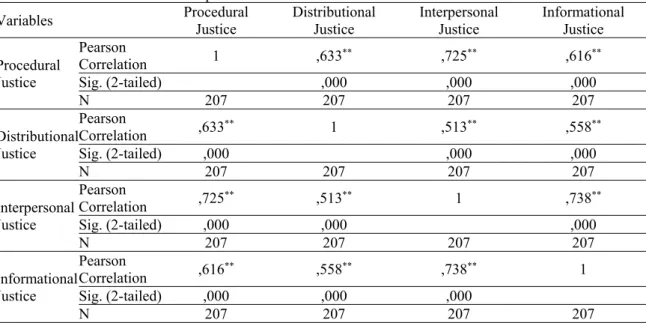
One of the most important assumptions in regres-sion analysis is the multicollinearity problem. The multicollinearity problem shows that there are high-level relations between independent varia-bles (r> 0.90) (Çokluk, Şekercioğlu & Büyüköztürk, 2010). Many methods were sug-gested to test the multicollinearity problem, which appears depending on high correlation between in-dependent variables. One of these methods is the examination of the correlation between the inde-pendent variables (Büyüköztürk, 2011; Çokluk et al., 2010). As a result of the correlation analysis which was performed to determine the level of the relation between independent variables it was de-termined that the highest relation level was 0.738. This finding may be stated as there is no multicol-linearity problem between the independent varia-bles.
According Table 2, a positive, medium-level and significant relation was determined between the Procedural Justice, Distributional Justice and In-terpersonal Justice sub-dimensions and Organiza-tional Identification levels (R= .514, R2= .264,
Table 1. Correlation Between Independent Variables
Variables Procedural Justice Distributional Justice Interpersonal Justice Informational Justice
Procedural Justice Pearson Correlation 1 ,633** ,725** ,616** Sig. (2-tailed) ,000 ,000 ,000 N 207 207 207 207 Distributional Justice Pearson Correlation ,633** 1 ,513** ,558** Sig. (2-tailed) ,000 ,000 ,000 N 207 207 207 207 Interpersonal Justice Pearson Correlation ,725** ,513** 1 ,738** Sig. (2-tailed) ,000 ,000 ,000 N 207 207 207 207 Informational Justice Pearson Correlation ,616** ,558** ,738** 1 Sig. (2-tailed) ,000 ,000 ,000 N 207 207 207 207
p<.000). In other words, as the scores of the acad-emicians who worked at universities in procedural justice, Distributional Justice, and Interpersonal Justice increase, so do the Organizational Identifi-cation scores.
According to the data obtained in the study, the Organizational Identification of the academicians is at a high level (X=3,8), and there are no
signif-icant differences in terms of the gender variable. It was also determined that the perceptions of the academicians in Organizational Justice sub-di-mensions (Procedural Justice: X=3,2;
Distribu-tional Justice: X=3,4; Interpersonal Justice:
X=3,5; Informational Justice: X=3,19) are above
medium level, and the personal justice dimension is more dominant. On the other hand, only the scores in Informational Justice sub-dimension dif-fered in favor of the female academicians accord-ing to the gender variable (t205: 2,366; p: 0,019).
When Table 4 is considered, it is seen that the Or-ganizational Identification, Procedural Justice, Distributional Justice, Interpersonal Justice and Informational Justice scores of the academicians do not differ according to marital status.
According to Table 5, it was determined that the Organizational Identification and Informational Justice sub-dimension scores of the academicians differ according to service years at their work places. According to the Organizational Identifica-tion sub-dimension of the academicians who had service years over 18 years and between 6 and 11 years, it was determined that there was a signifi-cant difference in favor of the academicians who had 18 years and over service years (F(3,203): 3,004;
p<0,05). Similarly, it was determined that there is a significant difference in favor of the academi-cians who had service years between 12-17, when those who had 6-11 service years and 6-11 were compared according to informational justice di-mension (F(3,203): 3,425; p<0,05).
In Table 6, it is seen that it was determined that the Organizational Identification, procedural justice, Distributional Justice, Interpersonal Justice and Informational Justice sub-dimension scores of the academicians did not differ according to the de-partment at which they worked.
Table 2. Regression Analysis for Organizational Identification Scale
B SH Beta t p Partial Part (Invariant) 11,158 1,452 7,683 ,000
Procedural Justice ,267 ,096 ,324 2,777 ,006 ,192 ,168 Distributional Justice ,289 ,118 ,193 2,454 ,015 ,170 ,148 Interpersonal Justice ,261 ,128 ,192 2,029 ,044 ,141 ,122 Informational Justice -,130 ,107 -,137 -1,219 ,224 -,085 -,074
Table 3. Independent Samples t-test Results Regarding Organizational Identification and Organizational
Jus-tice Scales According to Gender
Gender N Ss df t p Organizational Identification Male 152 22,80 5,354 205 ,010 ,992
Female 55 22,81 6,388
Procedural Justice Male 152 22,24 6,850 205 1,298 ,196 Female 55 23,63 6,731
Distributional Justice Male 152 13,47 3,633 205 ,858 ,392 Female 55 13,98 4,102
Interpersonal Justice Male 152 14,05 4,237 205 ,700 ,488 Female 55 14,50 3,881
Informational Justice Male 152 14,88 6,003 205 2,366 ,019 Female 55 17,07 5,466
Table 4. Independent Samples t-Test Results Regarding Organizational Identification and Organizational
Justice Scales According to Marital Status
Marital Status N Mean Ss df t p Organizational
Identification Married Single 168 39 22,87 22,53 5,690 5,433 205 ,335 ,738 Procedural
Jus-tice Married Single 168 39 22,41 23,46 7,077 5,646 205 ,860 ,391 Distributional
Justice Married Single 168 39 13,53 13,92 3,795 3,637 205 ,579 ,564 Interpersonal
Jus-tice Married Single 168 39 14,11 14,41 4,229 3,781 205 ,395 ,693 Informational
Justice Married Single 168 39 15,17 16,74 6,040 5,324 205 1,494 ,137
Table 5. One Way ANOVA Test Results Regarding Organizational Identification and Organizational Justice
Scales According to Working Year
Ss df Square F Mean p Significant Difference Organizational Identification Inter Group 277,739 3 92,580 30,817 3,004 ,031 18 years and over with
6-11 years In-Group 6255,913 203
Total 6533,652 206
Procedural Justice Inter Group 227,144 In-Group 9383,938 203 3 75,715 46,226 1,638 ,182 Total 9611,082 206 Distributional Justice Inter Group 100,756 3 33,585 13,855 2,424 ,067 In-Group 2812,548203 Total 2913,304206 Interpersonal Justice Inter Group 23,951 3 7,984 17,290 ,462 ,709 In-Group 3509,788203 Total 3533,739206 Informational Justice Inter Group 349,281 3 116,427
33,991 3,425 ,018 12-17 yıl ile 6-11 yıl In-Group 6900,265203
Total 7249,546206
Table 6. One way ANOVA Test Results Regarding Organizational Identification and Organizational Justice
Scales According to the Department in the Institution
Ss df Mean Square F Sig. Organizational Identification Inter Group In-Group 6251,978 197 213,545 3 71,182 31,736 2,243 ,085
Total 6465,522 200 Procedural Justice Inter Group 137,158 3 45,719 47,190 ,969 ,408 In-Group 9296,524 197 Total 9433,682 200 Distributional Justice Inter Group 27,238 3 9,079 13,888 ,654 ,581 In-Group 2736,026 197 Total 2763,264 200
Interpersonal Justice Inter Group In-Group 3421,851 197 20,517 3 17,370 6,839 ,394 ,758 Total 3442,368 200
Informational Justice Inter Group In-Group 6938,483 197 69,318 3 23,106 35,221 ,656 ,580 Total 7007,801 200
DISCUSSION AND RESULT
When the results of the regression analyses be-tween the scale which were used as a data collec-tion tool were considered (Table 2), it was deter-mined that there is a positive, medium-level and significant difference between the Organizational Identification levels and Procedural Justice, Distri-butional Justice and Interpersonal Justice sub-di-mension of the Organizational Justice Scale (R=.514, R2= .264, p<.000). In other words, it is
possible to claim that as the Procedural Justice, Distributional Justice and Interpersonal Justice sub-dimension scores of the academicians who worked at universities increase, so do the Organi-zational Identification scores. Greenberg (1990a) claimed that in the long run, justice was a basic re-quirement for the identification of employees with the organization and for the functioning of the or-ganization. Because justice perception shapes the thinking styles, feelings and the activities of indi-viduals (Özdemir, 2010). It is considered that Or-ganizational Justice perception strengthens the bond between the employees and their work places (Thompkins & Cheney, 1985). When employees evaluate the organization practices and the acqui-sitions they will have in a fair manner, they will think that their organization cares about them and behaves respectfully. This attitude, predisposition or behavior that appear in the employee will ensure that the employee bonds to the organization in an affective way, and identifies with it as a result of positive, volunteering and cooperative behaviors. The relevant literature points out that one of the most important organizational factors is the Or-ganizational Justice Perception (Cremer, 2005; Brewer & Kramer, 1986; Olkkonen & Lipponen, 2006). The findings of the present study support these findings. In addition, in similar studies, it was also concluded that there is a positive relation between Organizational Justice sub-dimension and Organizational Identification level, which is parallel to the findings of the present study (Turunç, 2011; Cheung & Law, 2008; Olkkonen & Lipponen, 2006; Çetinkaya & Çimenci, 2014). Ac-cording to Lipponen, Wisse and Perala (2001), as the procedural justice increases, the tendency also increases in employees to identify themselves with their organizations. When the results of the present study are analyzed, it is possible to claim that the inclinations of the employees increase when they believe that the procedures used during
organiza-tional processes, equity principles, and interper-sonal relations are fair. Employees, who think that interpersonal relations, practices, information sharing in the organization and the acquisitions they have are fair, believe that they are cared and respected for by their organizations. Feeling that one is respected and cared for in an organization increases the self-respect of him/her, and s/he will try to identify himself/herself with the organiza-tion to protect their self-respect and to identify themselves (Tyler & Blader, 2003). In this respect, it is possible that employees respond to the care and sensitivity of their organizations in treating employees in a fair way by caring for their organ-izations, defending it and seeing it as the part of their identities, in brief, by identifying themselves with their organizations.
According to the data obtained in the present study, it was determined that the organizational identification levels of the academicians were at a high level (X= 3,8). Academicians, who are the
most important value for universities, spend their efforts by using their knowledge, skills and atti-tudes for their organizations. In this respect, the existence of academicians who have high identifi-cation levels may increase the productivity of uni-versities. Because the performance criteria of academicians who work at universities like the number and quality of publications affect directly the world ranking of universities. The results of the study show that the participants experience the Or-ganizational Identification feeling at a very high level, they see themselves as a part of their organ-izations, and their scores in identification them-selves with their organizations are high. It is pos-sible to claim that these high scores stem from the fact that academicians see their work not only as a profession but also as a life style (Tolukan et al., 2016). In this respect, according to the study find-ings, the high identification levels of academicians with their organizations may stem from the fact that they trust their colleagues, they believe that they are in a fair organizations structure, they feel a sense of belonging and loyalty for their organi-zations, they establish affective bonds with their organizations by integrating their organization and profession with their personal values, they have high interpersonal communication levels, and they adopt and love their professions with the enlight-ening effect of science. The level of one’s identifi-cation of himself/herself with his/her organization reflects the bonding level of him/her with his/her
organization. The self-entity of an individual who has a strong identification with his/her organiza-tion integrate the discriminative, central and per-manent features felt for the organization with the discriminative, central and permanent features of one’s own. In this respect, if the identity of an em-ployee as a member of the organization attracts more attention than the other identities, and if an employee uses the concepts s/he uses to define the organization to define himself/herself, it is ac-cepted that this individual has identified him-self/herself with his/her organization in a strong level (Dutton et al., 1994).
According to the study results, it was determined that the Distributional Justice, Procedural Justice and Informational Justice perceptions of academi-cians are generally at a medium level, and inter-personal justice dimension is at a high level (4,4). According to Sarıkoyuncu and Ağca (2018), when employees working at an organization form their perception and attitudes towards their organiza-tion, they are affected by the Organizational Jus-tice applied by the organization at a great deal. The Organizational Justice applied to employees en-sures that organization members satisfy the psy-chological and social needs of organization mem-bers, they integrate with their organizations, adopt the aims of the organizations, their devotion to or-ganizations increases, in other words, they adopt their organizations, and therefore, it also ensures that employees work in a more efficient and pro-ductive way. In this context, the Organizational Justice perception level of academicians being de-termined as over medium level is a positive situa-tion for sport sciences faculties. Educators’ being successful and efficient is one of the most im-portant indicators in reaching success for educa-tional organizations. Because high Organizaeduca-tional Justice perceptions of employees about the prac-tices in educational faculties appear before us as factors effecting the productivity of organizations and employees (Aytaç, 2018). It was also deter-mined in the present study that the academicians were inclined more towards the Interpersonal Jus-tice dimension. The negative reaction of an em-ployee to a behavior that s/he sees to be improper is associated with Interpersonal Justice. In this re-spect, it is possible to claim that academicians’ level in considering the respect, sensitivity and caring in a behavior done to him/her is interpreted as an important criterion by the academicians in
Organizational Justice perception (Bies & Moag, 1986).
In the analysis made between the gender variable of the academicians and the sub-dimension of Or-ganizational Justice Scale, it was determined that female participants had higher average scores in all dimensions, and there is a significant difference in Informational Justice sub-dimension. Parallel to the study results, Çakar (2015) determined in his study that the expectations of female academicians were more than those of male academicians in all justice perceptions, and explained this situation as the gender being one of the factors that affect working conditions of employees in an organiza-tion. As the reason for similar identification levels of academicians according to the gender variable, we may show the fact that social gender roles as-sociated with males and females are not effective at universities, and in general, academicians are talked about as scientists. Parallel to the results of the present study, Başar (2011) conducted a study on teachers and reported that the identification lev-els did not vary at a significant level according to gender and marital status variables. In addition, Lovelace and Rosen (1996) stated that the results of the analyses of many studies in the literature conducted on the identification of individuals with their organizations and on the individual-organiza-tion agreement did not vary according to race and gender variables. However, Nartgün and Kalay (2014) conducted a study in educational field, and reported that the identification status of teachers with their organizations they work differed at a significant level in terms of the gender variable in favor of the male participants. The results of this study differ from the results of the present study of ours.
While no significant differences were detected in the analysis made in the sub-dimensions of Organ-izational Justice Scale about the marital status var-iable of the academicians, it was determined that the perception levels of married and female partic-ipants were similar. Different from the results of the present study, Akduman et al. (2015) examined the differences in Organizational Justice according to marital status. As a result of the analyses, it was determined that the Organizational Justice percep-tions of the single participants were higher than those of the married participants. The difference between the two studies might stem from the fact that academicians have different careers and titles in the society as professional perception and in
personal terms and the identities of academicians are over the social gender perception.
According to the data of the present study, it was determined that there were significant differences in the Organizational Identification sub-dimension according to the service years between those with 18 years and above service years and those with 6-11 years in favor of those with 18 years and above; and in the informational justice dimension, be-tween those with 12-17 years and 6-11 years in fa-vor of those with 12-17 service years. Mael and Ashforth (1992) reported that the seniority of em-ployees, the existence of role models in the organ-ization, and the opportunities provided by the or-ganization for its employees increased the identi-fication levels. The seniority and sense of belong-ing, which are among individual factors, affect the identification in a direct way (Cüce et al., 2013). In this respect, it is possible to claim that as for the professional characteristics of the academicians, the changes in the titles that come parallel to the service years, and as a result, increasing economic and social opportunities are consistent with the lit-erature. In his study, Korkut (1990) explained this situation as the elongation of the service years in the organization strengthening the identification of the employee with his/her organization.
When the study findings given in Table 6 are in-terpreted, it is seen that it was determined in the present study that the Organizational Identifica-tion, procedural justice, Distributive Justice, Inter-personal Justice and informational justice sub-di-mension scores of the academicians do not differ at a significant level according to the departments they work in their organizations. The lack of sig-nificant difference might stem from the value and position given to the academician in the society, the attraction of being an academician.
When we interpret the Organizational Identifica-tion concept by considering the groups in an or-ganization, we see that the most important focal point of the identification between the employees and their organizations occurs at the point when the employees identify themselves with their own careers and with their own professions (Başar, 2011). Similarly, Bamber and Iyer (2002) reported that identification with profession, identification with organization had a significant effect on Or-ganizational Identification, which supports the findings of the present study in this context.
As a result, in the present study it was concluded that there is a positive relation between the proce-dural justice, Distributional Justice and Interper-sonal Justice, which are sub-dimensions of Organ-izational Justice, and the OrganOrgan-izational Identifi-cation levels of the academicians working at sport sciences faculties; the Organizational Identifica-tion levels of the participants were at a high level; the Organizational Justice perceptions are above the medium level; and the increase of service years, which is one of the demographical varia-bles, has a positive impact on these levels.
REFERENCES
1. Adams JS (1963): Toward an understanding of in-equity. Journal of Abnormal and Social Psychology, 67, 422.
2. Akduman G, Hatipoğlu Z, Yüksekbilgili Z (2015): Medeni durumuna göre örgütsel adalet algısı. Ulus-lararası Akademik Yönetim Bilimleri Dergisi, 1(1), 1-13.
3. Akyel Y (2017): Yönetim bağlamında adalet ve gü-ven. Ankara: Pegem Akademi.
4. Alexander S, Ruderman M (1987): The role of pro-cedural and distributive justice in organizational be-havior. Social Justice Research, 1: 177-98. 5. Ambrose ML, Schminke M (2009): The role of
overall justice judgments in organizational justice research. Journal of Applied Psychology, 94, 491– 500.
6. Aytaç KY (2017): Investigating the working life quality and organizational commitment behaviors of academicians carrying on duties in faculties of sports science. European Journal of Education Studies, 3(11), 603-628.
7. Bamber EM, Iyer VM (2002): Big 5 auditors’ pro-fessional and organizational identification: Con-sistency or conflict? Auditing: A Journal of Practice & Theory, 21(2), 21-38.
8. Başar U (2011): Örgütsel adalet algısı, örgütsel öz-deşleşme ve iş tatmini arasındaki ilişkilere yönelik görgül bir araştırma. Yüksek Lisans Tezi. Kara Harp Okulu Savunma Bilimleri Enstitüsü, Ankara. 9. Biçkes DM, Yılmaz C (2017): Çalışanların örgütsel
güven algılamalarının özdeşleşme düzeyleri üzerin-deki etkisi: amprik bir çalışma. Kahramanmaraş Sütçü İmam Üniversitesi Sosyal Bilimler Der-gisi, 14(2), 301-322.
10. Bies RJ, Moag JF (1986): Interactional justice: Communication criteria of fairness. In R. J. Lewicki, B. H. Sheppard, & M. H. Bazerman (Eds.), Research on negotiations in organizations, 1, 43-55, Green-wich, CT: JAI Press.
11. Brewer MB, Kramer RM (1986): Choice behavior in social dilemmas: effects of social identity, group
size and decision framing. Journal of Personality and Social Psychology, 50, 543-549.
12. Büyüköztürk Ş (2011): Sosyal b l mler ç n ver ana-lizi el kitabı. Ankara: Pegem Akademi.
13. Candan H (2014): Çalışanların örgütsel adalet ve ör-gütsel güven algılamalarının örör-gütsel bağlılığa et-kisi: bir kamu kurumu üzerinde araştırma. Gazian-tep University Journal of Social Sciences, 13(4):889-917.
14. Cheney G (1983): On the various changing mean-ings of organization membership: A field study of organizational identification, Communication Mon-ographs, 50, 342-362.
15. Chernyak-Hai L, Tziner A (2012): Organizational citizenship behaviors (OCBS): Socio- psychological antecedents and consequences. International Re-view of Social Psychology, 25(3/4), 53–92. 16. Cheung MF, Law MC (2008). Relationships of
or-ganizational justice and oror-ganizational identifica-tion: The mediating effects of perceived organiza-tional support in Hong Kong. Asia Pacific Business Review, 14(2), 213-231.
17. Cohen-Charash Y, Spector PE (2001): The role of justice in organizations: A meta-analysis. Organiza-tional Behavior and Human Decision Processes, 86(2): 278-321.
18. Colquitt JA (2001): On the dimensionality of organ-izational justice: a construct validation of a measure. Journal of Applied Psychology, 86(3), 386-400. 19. Colquitt JA, Conlon DE, Wesson MJ, Porter CO, Ng
KY (2001): Justice at the millenium: A meta ana-lytic review of 25 years of organizational justice re-search. Journal of Applied Psychology, 86(3), 425- 445.
20. Cremer D (2005): Procedural and distributive jus-tice effects moderated by organizational identifica-tion. Journal of Managerial Psychology, 20(1), 4-13. 21. Cropanzano R, Folger R (1991): “Procedural justice
and worker motivation” in R. Steers & L. Porter (Ed.), Motivation and Work Behavior, New York: McGraw–Hill, 131–143.
22. Cropanzano R, Prehar CA, Chen PY (2002): Using social exchange theory to distinguish procedural from interactional justice. Group and Organization Management, 27, 324–351.
23. Cüce H, Güney S, Tayfur Ö (2013): Örgütsel adalet algılarının örgütsel özdeşleşme üzerindeki etkisini belirlemeye yönelik bir araştırma. Hacettepe Üni-versitesi İktisadi ve İdari Bilimler Fakültesi Dergisi, 31(1): 1-30.
24. Çakar ND (2015): Toplumsal cinsiyet temelinde ör-gütsel adalet algısı: etik iklimin rolü. KADEM Ka-dın Araştırmaları Dergisi, 1(2), 79-94.
25. Çetinkaya M, Çimenci S (2014): Örgütsel adalet al-gısının örgütsel vatandaşlık davranışı üzerindeki et-kisi ve örgütsel özdeşleşmenin aracılık rolü: Yapısal eşitlik modeli çalışması. Yönetim Bilimleri Dergisi, 12(23), 237-278.
26. Çokluk Ö, Şekerc oğlu G, Büyüköztürk Ş (2010): Sosyal bilimler için çok değişkenli istatistik: SPSS ve Lisrel uygulamaları. Ankara: Pegem Akademi. 27. Dailey RC, Kirk DJ (1992): Distributive and
proce-dural justice as antecedents of job dissatisfaction and intent to turnover. Human Relations, 45(3): 305- 317.
28. Deutsch M (1975): Equity, equality, and need: What determines which value will be used as the basis for distributive justice? Journal of Social Issues, 31, 137-149.
29. Dutton JE, Dukerich JM, Harquail CV (1994): Or-ganizational images and member identification. Ad-ministrative Science Quarterly, 39(2), 239-263. 30. Edwards MR (2005): Organizational identification:
A conceptual and operational review. International Journal of Management Reviews, 7(4), 207-230. 31. Foley S, Kıdder DL, Powell GN (2002): The
per-ceived glass ceiling and justice perceptions: An in-vestigation of hispanic law associates. Journal of Management, 28(4), 471-496.
32. Folger R, Konovsky MA (1989): Effects of proce-dural and distributive justice on reactions to pay raise decisions, Academic Management Journal, 32(1), 115– 30.
33. Greenberg J (1987): A taxonomy of organizational justice theories. Academy of Management Review, 1987, 9-22.
34. Greenberg J (1990a): Organizational justice: yester-day, toyester-day, and tomorrow. Journal of Management, 16, 399-432.
35. Greenberg J (1990b): Looking fair us being fair: Managing impressions of organizational justice. Re-search in Organizational Behavior, 12(1), 111-157. 36. Greenberg J (1993): “The social side of fairness: in-terpersonal and informational classes of organiza-tional justice” Cropanzano (eds.) Justice in the Workplace: Approaching Fairness in Human Re-source Management, Hillsale, NJ Lawrence Erl-baum Associates.
37. Homans GC (1961): Social behavior: Its elementary forms. London: Routledge and Kegan Paul. 38. İşcan ÖF (2006): Dönüştürücü/etkileşimci liderlik
algısı ve örgütsel özdeşleşme ilişkisinde bireysel farklılıkların rolü. Akdeniz İ.İ.B.F. Dergisi, 11(6), 160-177.
39. Karabey CN, İşcan ÖF (2007): Örgütsel özdeş-leşme, örgütsel imaj ve örgütsel vatandaşlık davra-nışı ilişkisi: bir uygulama. Atatürk Üniversitesi İkti-sadi ve İdari Bilimler Dergisi, 21(2), 231-241. 40. Karasar N (2005): Bilimsel araştırma yöntemi.
An-kara: Nobel Yayın & Dağıtım.
41. Konovsky, MA (2000): Understanding procedural justice and its ımpact on business organizations. Journal of Management, 26(3), 489-511.
42. Korkut H (1990): Üniversitelerde akademik olma-yan personelin iş doyumu ve örgütle özdeşleşmesi. Ankara: Yükseköğretim Kurulu Matbaası.
43. Leventhal GS (1976): The distribution of rewards and resources in groups and organizations. In L. Berkowitz & W. Walster (Eds.), Advances in exper-imental social psychology, 9, 91-131, New York: Academic Press.
44. Leventhal, GS (1980): What should be done with equity theory? New approaches to the study of fair-ness in social relationships. In K. Gergen, M. Green-berg, & R. Willis (Eds.), Social exchange: Advances in theory and research, 27-55, New York: Plenum Press.
45. Lipponen J, Wisse B, Perala J (2011): Perceived jus-tice and group identification: The moderating role of previous identification. Journal of personnel psy-chology, 10(1), 13.
46. Lovelace K, Rosen B (1996): Differences in achiev-ing person-organization fit among diverse groups of managers. Journal of Management, 22, 703-722. 47. Mael F, Ashforth BE (1992): Alumni and their alma
mater: A partial test of the reformulated model of organizational identification. Journal of Organiza-tional Behavior, 13(2), 103-123.
48. Moorman, RH (1991): Relationship between organ-izational justice and organorgan-izational citizenship be-haviors: Do fairness perceptions influence em-ployee citizenship? Journal of Applied Psychology, 76, 845-855.
49. Mowday RT (1987): Equity theory predictions of behavior in organizations, in Steers M.R. Porter, L.W. (Ed), Motivation and Work Behavior (4. Ed), New York: Mcgraw-Hill, 89-110.
50. Mueller CW, Iverson RD, Jo DG (1999): Justice evaluations in two cultural contexts: A comparison of the US and South Korea. Human Relations, 52, 869–893.
51. Nartgün ŞS, Kalay M (2014): Öğretmenlerin örgüt-sel destek, örgütörgüt-sel özdeşleşme ile örgütörgüt-sel sinizm düzeylerine ilişkin görüşleri, Turkish Studies, 2014; 9(2): 1361-1376.
52. Olkkonen ME, Lipponen J (2006): Relationships be-tween organizational justice, identification with or-ganization and work unit, and group-related out-comes. Organizational Behavior and Human Deci-sion Processes, 100(2), 202-215.
53. Özdemir A (2010): Örgütsel özdeşleşmenin algıla-nan örgütsel destek, cinsiyet ve kıdem değişkenle-rine göre incelenmesi. Türkiye Sosyal Araştırmalar Dergisi, 14(1), 237-250.
54. Özmen ÖN, Arbak Y, Özer Süral P (2007): Adalete verilen değerin adalet algıları üzerindeki etkisinin sorgulanmasına ilişkin bir araştırma. Ege Akademik Bakış, 7(1), 17-33.
55. Polat M (2009): Örgütsel özdeşleşmenin öncülleri ve ardılları üzerine bir saha araştırması, Yayınlan-mamış Doktora Tezi, Uludağ Üniversitesi, Bursa. 56. Polat M, Meydan CH (2010): Örgütsel
özdeşleşme-nin sinizm ve işten ayrılma niyeti ile ilişkisi üzerine bir araştırma. Savunma Bilimleri Dergisi, 9(1), 145-172.
57. Sarıkoyuncu EŞ, Ağca A (2018): Örgütsel adaletin muhasebecilerin iş memnuniyeti üzerine etkisi: Kü-tahya örneği. Muhasebe ve Finans Dergisi, 77, 27-44.
58. Scott C, Corman S, Cheney G (1988): Development of a structurational model of ıdentification in the or-ganization”, Communication Theory, 8(3), 298-336. 59. Tolukan E, Şahin MY, Koç M (2016): Cimnastik
antrenörlerinin örgütsel özdeşleşme düzeyleri ve iş-ten ayrılma niyeti ilişkisi, Turkish Studies, 11(8): 377-398.
60. Tompkins PK, Cheney G (1985): Communication and unobtrusive control in contemporary organiza-tions. Organizational communication: Traditional themes and new directions, 13, 179-210.
61. Turunç Ö (2011): Örgütsel adalet n çalışanların ör-gütsel özdeşleşme ve işten ayrılma niyetine etkisi: örgütsel özdeşleşmenin aracılık rolü. “İş, güç” En-düstrı̇ İl şk ler ve İnsan Kaynakları Derg s , 13(1), 143-166.
62. Turunç Ö, Çelik M (2010): Çalışanların algıladıkları örgütsel destek ve iş stresinin örgütsel özdeşleşme ve iş performansına etkisi. Yönetim ve Ekonomi: Celal Bayar Üniversitesi İktisadi ve İdari Bilimler Fakültesi Dergisi, 17(2), 183-206.
63. Tyler TR, Blader SL (2003): The group engagement model: procedural justice, social identity, and coop-erative behavior. Personality and Social Psychology Review, 7(4), 349-361.
64. Yazıcıoğlu İ, Topaloğlu IG (2009): Örgütsel adalet ve bağlılık ilişkisi: konaklama işletmelerinde bir uy-gulama. İşletme Araştırmaları Dergisi. 1(1): 3-16.