Abdominal wall endometriosis
in patients with a history
of cesarian section
Ann. Ital. Chir., 2018 89, 5: 425-430pii: S0003469X18028397
Pervenuto in Redazione Febbraio 2018. Accettato per la pubblicazıone Marzo 2018
Correspondence to: Meryem Hocaoglu MD., Dr. Erkin cad. Goztepe Training and Research Hospital, Kadıkoy, Istanbul, Turkey. 34700 (e-mail: [email protected])
Meryem Hocaoglu*, Abdulkadir Turgut**, Ozkan Ozdamar**, Ahmet Aslan***, Selin Demirer°,
Akın Usta°°, Esra Ekdeniz°°°, Ates Karateke**
*Department of Obstetrics and Gynecology, Goztepe Training and Research Hospital, Istanbul Medeniyet University, Istanbul Turkey **Department of Obstetrics and Gynecology, Faculty of Medicine, Istanbul Medeniyet University, Istanbul Turkey
***Department of Radiology, Faculty of Medicine, Istanbul Medeniyet University, Istanbul Turkey °Department of Histology and Embryology, Faculty of Medicine, Namık Kemal University, Tekirdag °°Department of Obstetrics and Gynecology, Faculty of Medicine, Balıkesir University, Balıkesir, Turkey °°°Division of Biostatistics, Faculty of Medicine, Marmara University, Istanbul Turkey
Abdominal wall endometriosis in patients with a history of cesarian section
OBJECTIVE: The aim of this study is to review the characteristics, intraoperative and radiological findings of abdominal
wall endometriosis (AWE).
METHODS: This retrospective observational cohort study was executed through analysis of the medical records of patients
who underwent excision of AWE between January 2000 and June 2017. All the diagnoses were confirmed pathologi-cally. Characteristics, intraoperative and radiological findings of patients with AWE were and analyzed.
RESULTS: Each of the 20 patients had a history of at least one prior cesarean section. The main presenting symptoms
were pain (70%). Ultrasonography and/or magnetic resonance imaging was performed in 95% and 45 % of the patients, respectively. One patient (5%) was investigated by 18 Fluorodeoxyglucose positron emission tomography - computed tomog-raphy. The preoperative radiological diagnosis was correcting in 55 % of the cases. The mean diameter of the masses was 4.7 ± 1.53 cm. Recurrence was found only in one patient during 36-month follow-up.
DISCUSSION: Meticulous anamnesis, accurate clinical examination and proper imaging studies, are important guides for
diagnosis.
CONCLUSION: AWE should be kept in mind when pain or mass is detected on the abdominal wall of women who have
cesarean section history.
KEY WORDS: Abdominal wall endometriosis, Cesarean section, Radiology, Scar endometriosis
monly found in the genital organs and pelvic peritoneum, although they may also be seen in the gastrointestinal sys-tem, greater omentum, surgical scars, round ligament, mesentery, and occasionally in the kidney, lung, skin, umbilicus and rectus abdominis muscle 3-6
Abdominal wall endometriosis (AWE) is defined as endometrial tissue superficial to the peritoneum and is associated with previous surgical procedures 7,8. These
lesions almost always lie in the territory of the previous surgical scars. Patients with AWE may initially apply to general physicians, surgeons or dermatologists instead of gynecologists because of atypical presentation patterns of the disease 9,10 and this is an eligible reason to keep
AWE on the agenda. The aim of the present study is to draw attention to scar endometriosis in the
abdomi-Introduction
Endometriosis is defined as ectopic implantation of endometrial tissue outside the uterine cavity and is an enigmatic disease affecting 10-15% of women of repro-ductive age 1,2. Extrauterine endometrial lesions are
com-READ-ONLY
COPY
PRINTING
nal wall. Moreover, it is anticipated that the detailed analysis of clinical features, intraoperative and radiolog-ical findings we put forth with this monocentric retro-spective study, will contribute to the existing literature about this rare clinical entity.
Materials and Methods
This retrospective observational cohort study was per-formed through analysis of the medical records of patients who underwent excision of AWE between January 2000 and June 2017 in Goztepe Training and Research Hospital of Istanbul Medeniyet University. Approval from the local ethics committee was obtained before the execution of this study. Twenty patients with the diagnosis of AWE were included. All the diagnoses were confirmed histopathologically. Endometriosis in the cicatrix is being visible in routinely hematoxylin and eosin stained slides. It appears as a presence of endome-trial stromal cell focusses usually with concomitant endometrial glands in deeper layers of the skin, subcu-taneous tissue, sometimes also among skeletal muscle fibers. The endometriosis focus is usually embedded in fibrosing (reactive fibrosis) surroundings 11. The
follow-ing data were collected and analyzed: patient age, surgi-cal antecedents, history of endometriosis, symptoms, duration of complaints, asymptomatic time interval, size, number and location of the masses, diagnostic imaging studies, initial diagnosis, recurrences, follow-up time and utilization of hormone therapy.
STATISTICAL ANALYSIS
Continuous variables are presented as the mean±SD (range) while non-continuous variables are presented as number (percentage). Statistical analyses were performed using R Statistical Software (www.r-project.org), a free software environment for statistical computing and graphics. P < 0.05 was considered statistically significant.
Results
Twenty patients with pathologically confirmed AWE were included in the study.
Mean patient age was 36.2 ±6.7 years (min: 23, max: 52 years). Each case had at least one prior cesarean sec-tion with Pfannenstiel incision, three of the patients had
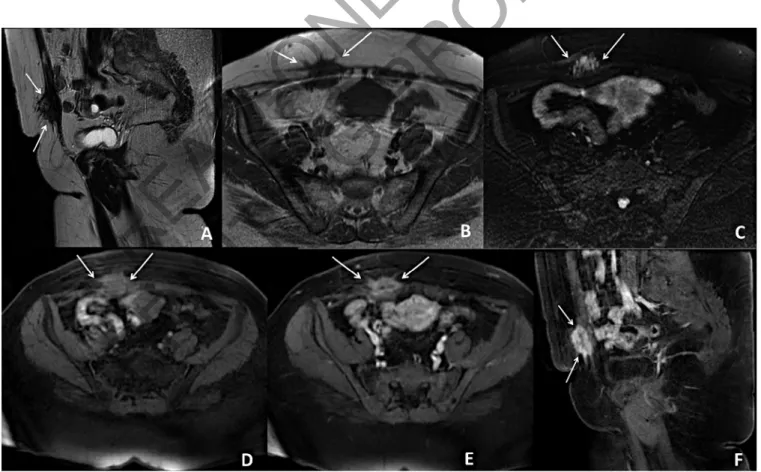
Fig. 1: 45-year-old-patient with cesarean section history 11 years ago. There is a 26x18x32 mm hypointense mass (arrows) above the right rectus abdominis muscle on the sagittal T2 weighted image (A). Mass has speculated margins and isointense on the axial T1 weighted image (arrows) (B). Mass is hyperintense on the axial fat saturated T2 weighted image, isointense on the axial non-enhanced fat saturated T1 weighted image, and markedly enhances after contrast admission on axial and sagittal fat saturated T1 images (arrows) (C, D, E, F).
READ-ONLY
COPY
PRINTING
undergone cesarean section twice and one of them thrice. The mean time interval between the most recent surgery and the onset of symptoms was 3.65 ± 3.05 years (range, 4 months to 11 years). The mean duration of symp-toms was 2.65 ± 3.25 years (range, 1 month to 11 years). Except for two patients who had endometriosis history, none of the patients received medical therapy until the time of excision of abdominal wall endometriomas. The main presenting symptoms were pain (70%, n=14/20), either cyclic (71%, n= 10/14) or noncyclic (29%, n= 4 /14); palpable abdominal mass (20%, n=4/20) and painful mass (10%, n=2/20). None of the patients had symptoms of pelvic endometriosis. Ultrasound was the only imaging study in 11 patients (55 %) and magnet-ic resonance imaging (MRI) was the only imaging study
in one patient (5 %). Seven patients (35 %) had both ultrasound and MRI (Fig. 1).
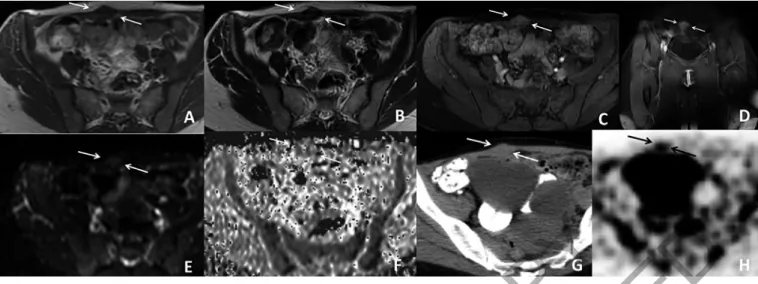
One patient (5 %) was investigated by ultrasound, MRI and 18 Fluorodeoxyglucose positron emission tomography - computed tomography (18-FDG PET-CT) (Fig. 2). Correlation between preoperative radiological imaging and final pathological diagnosis revealed that the preop-erative initial diagnosis was correcting in 55 % (n=11/20) of the cases. Remaining 9 patients had been initially diagnosed as desmoid tumor (35 %, n=7), suture gran-uloma (5 %, n=1) and fibroma (5 %, n=1).
Characteristics and symptoms of patients are summarized in Table I. The mean diameter of the masses was 4.7 ± 1.53 cm (range, 3– 8.5 cm). According to the macro-scopic observations during surgery, the exact locations of
Fig. 2: 35-year-old patient presented with complaints of abdominal pain. On T1 weighted image a 21x11x17 mm isointense mass is locat-ed at right rectus abdominis muscle (arrows) (A). Mass is hypointense on the T2 weightlocat-ed image and marklocat-edly enhances on contrast enhanced fat saturated axial and coronal T1 weighted image (arrows) (B, C, D). Mass is hyperintense on diffusion weighted images, and hypointense on ADC map compatible with restricted diffusion (arrows) (E, F). On 18- FDG-PET CT images, mass is isodense and shows mild FDG uptake (SUVmax=1.6) (arrows) (G, H).
TABLE I - Characteristics and symptoms of patients with abdominal wall endometriosis
N % Range Mean
Age (years) 23-52 36.2 ± 6.7
Previous operation and incision
One C/S † withPfannenstiel 16 80
Two C/S † withPfannenstiel 3 15
Three C/S †With Pfannenstiel 1 5
Asymptomatic time interval (years) 0.3-11 3.65 ± 3.05
Duration of symptoms (years) 0.08-11 2.65 ± 3.25
EndometriosisHistory Yes No 218 1090
Symptoms Palpable mass Painful mass Cyclic pain Noncyclic pain 42104 20105020
Diagnostic tests US ‡ MRI § PET/CT || 1991 95455
Radiological diagnosis Accurate Wrong 119 5545
† C/S, cesarean section; ‡ US, ultrasonography; §MRI, magnetic resonance imaging; ||PET/CT, positron emission
tomography-comput-ed tomography
READ-ONLY
COPY
PRINTING
the masses were subcutaneous fat layer (40%, n = 8/20), the fascia (20%, n = 4/20), and the muscular layer (40%, n = 8/20). The mass was located on the left side of the wound in 9 (45%) patients; on the right side in 9 (45%) patients; and in the middle in 2 (10%) patients. Clinical data of patients and results of the study parameters were shown in Table II. All patients were treated surgically, with wide excision polypropylene (Prolene; Ethicon, Edinburgh, United Kingdom) mesh was used in one patient. After the first surgery for abdominal endometrio-sis, none of the patients were treated by medical thera-py. Six patients were lost to follow-up. Regarding these 6 patients, the follow-up time after mass excision aver-aged 18 ± 15.38 months (range 2-37 months).
Recurrence was found only in one patient during 36-month follow-up who was treated by re- excision with safety margins.
Discussion
Abdominal wall endometriosis (AWE) is the functional endometrial gland transfer to the lower abdominal wall. Two main hypotheses are invoked to explain its cause. One suggests that multipotential mesenchymal cells undergo metaplasia under the proper circumstances, resulting in endometriosis; the other theory states that endometrial cells are transported to ectopic sites form an endometrioma 3,12,13. The most common site for
extrapelvic endometriosis is the Pfannenstiel scar with an incidence of 0.07%-0.47% and is known as cesarean scar endometriosis 7,14-16. Our findings are compatible with
the theory of iatrogenic cell transportation, since all the patients had a previous history of cesarean section pro-cedure. It’s a fact that some sporadic cases of scar endometriosis exists in women that did not previously have any type of surgery and it supports the coelomic metaplasia theory and suggests hematogenous spread and lymphatic dissemination as the possible explanations for its etiology 8,17. Scar endometriomas following cesarean
sections occur more frequently than the ones in epi-siotomy wounds that follow vaginal labors; in both cas-es decidual cells keep in touch with the surgical incision
11. It might be explained by lower level of immune
tol-erance of the mother that had cesarean section compared to the ones that had vaginal delivery at term 11,18-20. Hui
suggested that because low levels of estrogen is main-tained by lactation, breastfeeding can prevent the occur-rence of postpartum abdominal wall endometrioma to a certain extent 21. Zhang et al. found that postpartum
breastfeeding, breastfeeding duration and menstrual recovery time were independent from the incubation period 21. Accordingly, it has been suggested that local
abnormal expression of estrogen and progesterone recep-tors in abdominal wall endometrioma leads to high estro-gen producing levels in the ectopic endometrium 21-23.
In our study, the mean age of patients was 36.2 ± 6.7, which is like other studies 24, 25. The younger mean age
supports the observation that AWE affects young women of reproductive age 25. Pain caused by endometriosis is
classically described as cyclic pain but constant and non-cyclic pattern also have reported (26). In the present study 80% of the patients had cyclic abdominal pain and painful abdominal mass, consistent with those reported in the literature 4,8,21. Also, in our study, the
time from the most recent surgery to the onset of symp-toms was 3.6 years which was like other series 8,24,25,27.
Zhao et al. suggested that this latent period is positive-ly related to patient’s age at the onset of symptoms; as the more advanced the age of the patient, the longer the latency time 28. Time between the onset of
symp-toms and the definitive treatment with surgical excision was 2.65 ±3.25 years (range, 1 month to 11 years) which parallels the findings in the literature 10,25-27. Previous
studies have reported a delay in diagnosis ranging from 2.5 to 4.8 years 25. It might be explained that it is
clin-ically often misdiagnosed. AWE is often confused with other pathologic conditions such as suture granuloma, abscess, inguinal or incisional hernia, soft- tissue sarco-ma, desmoid tumor, liposarco-ma, metastatic tumor and seba-ceous cysts 3. Especially, when the patient’s symptoms
are not cyclical and the history of endometriosis is unknown clinical diagnosis could be impaired. AWE is largely a clinical diagnosis 24. The diagnosis requires an
accurate clinical examination combined with a detailed history. Palpation of the abdominal wall using superfi-cial and deep palpation method is recommended. Supplementary diagnostic modalities may be necessary to confirm and clarify the diagnosis and to plan optimal surgical treatment options 29. The typical ultrasound
finding is a hypoechoic nodule with speculated margins infiltrating the surrounding tissue 30. On color Doppler
TABLE II - Clinical data of patients and results of the study parameters
N % Range Mean
Mass diameter (cm) 3-8.5 4.7 ± 1.53
Depth of invasion Fat layer Fascia Muscle layer 848 402040 Location of mass Right side Left side Middle 992 454510
Repair of Defect Primary Prolene mesh 191 955
Follow-up(months) 2-37 18 ± 15.38
Postoperative recurrence Yes No 119 595
READ-ONLY
COPY
PRINTING
examination, a single avascular pedicle entering the mass at the periphery is one of the diagnostic features 31.
Endometriosis has no pathognomonic findings on com-puted tomography (CT), as appearances depend on the phase of the menstrual cycle, the proportions of stromal and glandular elements, the amount of bleeding, and the degree of surrounding inflammatory and fibrotic response. Owing to the relatively vascular nature of these lesions, enhancement often occurs on CT scans when intravenous contrast material is used 7,32. Preoperative
MRI is valuable in defining the extent of disease, thus enhancing accurate and total excision 33. The
hemor-rhagic signal is characterized by the presence of hypointense lesions with hyperintense foci on T1- and T2- weighted sequences and T1-weighted sequences with fat suppression; these correspond to the areas of hemo-siderin found in the endometriotic crypts 1,32. The study
by Zawin et al. revealed an MRI sensitivity of 71% and specificity of 82% for abdominal wall endometriosis and the authors suggested that MRI seems to be the best method for use in preoperative diagnosis 10,34. In our
study, abdominal wall endometrioma has no pathogno-monic findings on 18 FDG-PET CT. The mass is iso-dense and shows mild FDG uptake (SUVmax=1.6). According to a recent study, PET/CT is a good diag-nostic tool for malignant transformation of endometri-oma (MTOE) in cases where differentiation of MTOE from endometrioma was difficult despite the use of trans-vaginal ultrasound and MRI. An SUVmax cut-off >4.0 can exclude endometrioma, with 75 % sensitivity and 100 % specificity35. Fine needle aspiration is
inconclu-sive in up to 75% of the cases with theoretical concerns about further tissue inoculation with needle passage36.
Malignant transformation of abdominal wall endometri-oma is a rare complication (1%), but the existence of such cases should also be sought. 7,37,38. Medical
thera-py with danazol and gonadotropin-releasing hormone (GnRH) agonists produces only partial relief of symp-toms and usually recurrence occurs after cessation of the treatment 33. Surgical management offers the best chance
for both definitive diagnosis and treatment. Resection should be at least 0.5 to two cm distant from the lesion
21. As was required in one of our cases, fascial defect
may need closure with synthetic mesh if the underlying sheath is found to be involved. Local recurrence is like-ly after an inadequate surgical excision and in our series recurrence was found only in one patient. It is still con-troversial whether to use postoperative medication to reduce the recurrence risk. The study by Zhang and Liu revealed that postoperative medical treatment could improve the prognosis, reduce the recurrence 21. A
com-bination of surgical re-excision and postoperative adju-vant medical therapy is recommended for patients with recurrent AWE, especially for those with a history con-sistent with pelvic endometriosis 29. In addition to the
treatment strategies, there are prevention methods based on the implantation theory: Using a wound edge
pro-tector to separate the edges of the incision; careful flush-ing and irrigatflush-ing before closure; suturflush-ing the uterine incision without endometrium; using separate needles for uterine and abdominal closure; not using a sponge to clean the endometrial cavity following complete delivery of the placenta; removing a functional corpus luteum simultaneously with a hysterectomy; and extending the breastfeeding period to delay menstruation 29. The
cur-rent study has some limitations. Firstly, it is a retro-spective analysis. Retroretro-spective reviews are subject to information bias in the form of missing or illegible data and/or errors in data collection 24. Secondly, it involves
a small number of patients which can be attributed to the rarity of this condition.
Conclusion
The present study draws attention to AWE to facilitate early diagnosis in cases of pain or mass detected on the abdominal wall of women that have cesarean section his-tory. Besides being a rare entity, clinical importance of AWE is increasing in parallel with the increasing popu-larity of elective cesarean section procedures. In addition to clinical studies, AWE is open to further in-vivo and in-vitro investigations in order not only to enlighten its etiopathogenesis but also to find out alternative meth-ods of treatment and prevention.
Riassunto
Si tratta di uno studio retrospettivo osservazionale fina-lizzato a riconsiderare le caratteristiche, gli aspetti radio-logici ed intraoperatori della di endometriosi della pare-te addominale (AWE), sulla base delle carpare-telle cliniche di pazienti sottoposte ad exeresi chirurgica della lesione nel periodo compreso tra Gennaio 2000 e Giugno 2017. La diagnosi risulta confermata per tutte con l’anatomia patologica, e sono state analizzate i rilievi radiologici ed i reperti intraoperatori.
Ciascuna delle 20 pazienti della casistica presentava una storia di almeno un precedente taglio cesareo, ed il prin-cipale sintomo lamentato (70%) era il dolore. Lo studio diagnostico si è basato sugli ultrasuoni nel 95% dei casi e sulla RMN nel 45%. Una paziente (5%) è stata stu-diata con la PET mediante 18 Fluorodeoxyglucose. La diagnosi radiologica preoperatoria è risultata corretta nel 55% dei casi. Il diametro medio della massa era di 4.7 ± 1.53 cm. Si è registrata una sola recidiva in una paziente lungo un periodo di controllo di 36 mesi. Guida essenziale per la diagnosi solo l’anamnesi accura-ta, un attento esame clinico ed adeguate indagini stru-mentali per imaging.
L’endometriosi della parete addominale va sospettata in presenza di una massa nella parete addominale o dolo-re in donne già sottoposte a taglio cesadolo-reo.
READ-ONLY
COPY
PRINTING
References
1. Balleyguier C, Chapron C, Chopin N, et al.: Abdominal wall
and surgical scar endometriosis: results of magnetic resonance imaging.
Gynecol Obstet Invest, 2003; 55:220-24.
2. Ibrahim MG, Delarue E, Abesadze E, et al.: Abdominal wall
endometriosis: Myofibroblasts as a possible evidence of metaplasia: A case report. Gynecol Obstet Invest, 2017; 82:96-101.
3. Akbulut S, Sevinc Mm, Bakir S, et al.: Scar endometriosis in the
abdominal wall: A predictable condition for experienced surgeons. Acta
Chir Belg, 2010; 110:303-07.
4. Akbulut S, Dursun P, Kocbiyik A, et al.: Appendiceal
endometrio-sis presenting as perforated appendicitis: A report of a case and review of the literature. Arch Gynecol Obstet, 2009; 280:495-97.
5. Pezzolla A, Lattarulo S, Fiore MG, et al.: Extra-genital
endo-metriosis. Ann Ital Chir, 2014; 85(4):341-46.
6. Calò PG, Ambu R, Medas F, et al.: Rectus abdominis muscle
endometriosis. Report of two cases and review of the literature. Ann
Ital Chir, 2012.
7. Bektas H, Bilsel Y, Sari YS, et al.: Abdominal wall
endometri-oma; A 10-year experience and brief review of the literature. J Surg
Res, 2010; 164:7-81.
8. Nominato NS, Prates LF, Lauar I, et al.: Caesarean section
great-ly increases risk of scar endometriosis. Eur J Obstet Gynecol Reprod
Biol, 2010; 152:83-5.
9. Wolf Y, Haddad R, Werbin N, et al.: Endometriosis in
abdom-inal scars: A diagnostic pitfall. Am Surg, 1996; 62:1042-44.
10. Ozel L, Sagiroglu J, Unal A, et al.: Abdominal wall
endometrio-sis in the cesarean section surgical scar: A potential diagnostic pitfall.
J Obstet Gynaecol Res, 2012; 38:526-30.
11. Wicherek L, Klimek M, Skret-Magierlo J, et al.: The
obstetri-cal history in patients with Pfannenstiel scar endometriomas. An analy-sis of 81 patients. Gynecol Obstet Invest, 2007; 63:107-13.
12. Koger KE, Shatney CH, Hodge K, et al.: Surgical scar
endometri-oma. Surg Gynecol Obstet, 1993; 177:243-24.
13. Dwiverdi AJ, Agrawal SN, Silva YJ: Abdominal wall
endometri-omas. Dig Dis Sci, 2002; 47:456-61.
14. Wolf GC, Singh KB: Caesarean scar endometriosis a review. Obstet Gynecol Surv, 1989; 44:89-95.
15. Singh KK, Lessells AM, Adam DJ, et al.: Presentation of
endometriosis to general surgeons: A 10-year experience. Br J Surg,
1995; 82:1349-351.
16. Picod G, Boulanger L, Bounoua F, et al.: Abdominal wall
endometriosis after cesarean section: Report of fifteen cases. Gynecol
Obstet Fertil, 2006; 34:8-13.
17. Steck WD, Helwig EB: Cutaneous endometriosis. Clin Obstetric Gynecol, 1966; 9:373-83.
18. Wicherek L, Dutsch-Wicherek M, Mak P, et al.: The role of
RCAS1 and oxytocinase in immune tolerance during pregnancy. Fetal
Diagn Ther, 2005; 20:420-25.
19. Hackmon R, Hallak M, Krup M, et al.: HLA-G antigen and
parturition: maternal serum, fetal serum and amniotic fluid levels dur-ing pregnancy. Fetal Diagn Ther, 2004; 19:404-09.
20. Balkundi DR, Hanna N, Hileb M, et al.: Labor-associated
changes in Fas Ligand expression and function in human placenta.
Pediatr Res, 2000; 47:301-08.
21. Zhang J, Liu X: Clinicopathological features of endometriosis in
abdominal wall-clinical analysis of 151 cases. Clin Exp Obstet
Gynecol, 2016; 43:379-83.
22. Hui X: Clinical analysis of 60 cases of operation incision
endometriosis. Modern Diagnosis and Treatment (China), 2005;
3:148.
23. Hao YD, Wang LB, Sun JL, et al.: The expression of estrogen
receptor and progesterone receptor in the eutopic and ectopic endometri-um of abdominal wall endometriosis. Chinese J of Clinicians, 2009;
3:487.
24. Ecker AM, Donnellan NM, Shepherd JP, et al.: Abdominal wall
endometriosis: 12 years of experience at a large academic institution.
Am J Obstet Gynecol, 2014; 211: 363e1 5.
25. Khan Z, Zanfagnin V, El-Nashar SA, et al.: Risk factors,
clini-cal presentation, and outcomes for abdominal wall endometriosis. J
Minim Invasive Gynecol, 2017; 24:478-84.
26. Goel P, Devi L, Tandon R, et al.: Scar endometriosis. A series
of six patients. Int J Surg, 2011; 9:39-40.
27. Pas K, Joanna SM, Renata R, et al.: Prospective study
concern-ing 71 cases of caesarean scar endometriosis (CSE). J Obstet Gynaecol,
2017; 37:775-78.
28. Zhao X, Lang J, Leng J, et al.: Abdominal wall endometriomas. Int J Gynaecol Obstet, 2005; 90:218-22.
29. Ding Y, Zhu J: A retrospective review of abdominal wall
endometriosis in Shanghai, China. Int J Gynaecol Obstet, 2013;
121:41-4.
30. Francica G: Reliable clinical and sonographic findings in the
diag-nosis of abdominal wall endometriosis near cesarean section scar. World
J Radiol, 2012; 4:135-40.
31. Pados G, Tympanidis J, Zafrakas M, et al.: Ultrasound and MR
imaging in preoperative evaluation of two rare cases of scar endometrio-sis. Cases J, 2008; 1:97.
32. Coley BD, Casola G: Incisional endometrioma involving the
rec-tus abdominis muscle and subcutaneous tissues: CT appearance. Am J
Roentgenol, 1993; 160:549-50.
33. Rivlin ME, Das SK, Patel RB, et al.: Leuprolide acetate in the
management of cesarean scar endometriosis. Obstet Gynecol, 1995;
85: 838-39.
34. Zawin M, McCarthy S, Scoutt L, et al.: Endometriosis:
appear-ance and detection at MR imaging. Radiology, 1989; 171:693-96.
35. Kusunoki S, Ota T, Kaneda H, et al.: Analysis of positron
emis-sion tomography/computed tomography in patients to differentiate between malignant transformation of endometrioma and endometrioma.
Int J Clin Oncol, 2016; 21:1136-1141.
36. Chang Y, Tsai EM, Long CY, et al.: Abdominal wall
endometri-omas. J Reprod Med, 2009; 54:155-59.
37. Heaps JM, Nieberg RK, Beret JS: Malignant neoplasms arising
from endometriosis. Obstet Gynecol, 1990; 75:1023-28.
38. Graur F, Mois E, Elisei R, et al.: Malignant endometriosis of the
abdominal wall. Ann Ital Chir, 2017; 13(2);6.